Brazil Monkeys: Brazil, officially known as the Federative Republic of Brazil, is a South American nation infamous for its immense cultural diversity, beautiful architecture, and breathtaking natural environment.
Containing about 60% of the Amazon Rainforest, Brazil is widely considered to be the most biodiverse country in the world, with its thousands of native wildlife species[1].
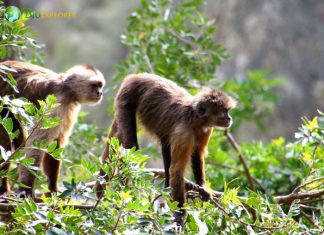
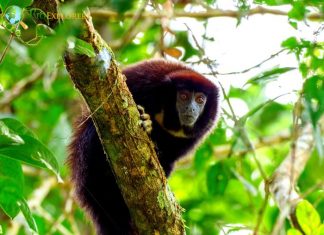
Mainly, Brazil is home to 131 species of Old-World and New-World monkeys, with 83 being endemic to the country. Some common examples of these species that only reside in Brazil include the red-handed howler monkey (Alouatta belzebul), the buffy-headed marmoset (Callithrix flaviceps), and the crested capuchin (Sapajus robustus).
Despite the efforts that have been taken to help protect the wildlife of Brazil, monkeys, as well as other species, are still being threatened with extinction due to habitat loss caused by deforestation, poaching, and other human-rooted issues[2].
Additionally, it should be noted that in light of the global monkeypox epidemic, some Brazilians have taken up attacking and poisoning monkeys in an attempt to limit the spread of the disease[3].
However, the World Health Organization (WHO) has strongly advised against doing this since monkeys (or any primate for that matter) have nothing to do with the current outbreak; on top of that, most of the transmissions of the virus have occurred because of close contact between humans themselves.
The Alta Floresta titi is a distinct but unnamed form of titi (Plecturocebus) rediscovered in 2019 in Chapada dos Parecis, a plateau in the far south of the Brazilian state of Rondônia. This species lives exclusively between the Teles-Pires and Juruena rivers in Mato Grosso.
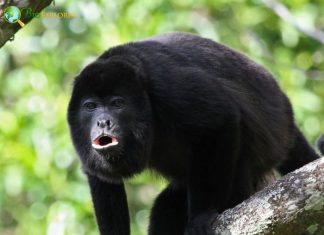
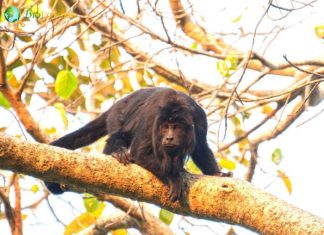
Amazon Black Howler is a New World tropical arboreal characterized by densely furry, prehensile tails, all-black faces, a stocky build, relatively large size, and loud howls. According to researchers, its howl sounds like a strong wind blowing through a tunnel can be heard more than two miles away.
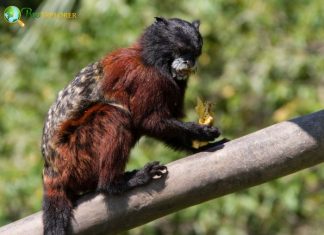
The Andean saddle tamarin, also known as the saddleback tamarin (formerly known as the brown-mantled tamarin), is a New World monkey species. Andean saddleback monkeys are considered “phyletic dwarfs,” meaning their small size is related to their evolutionary development.
The Aracá uakari, also called the Ayres black uakari, is a newly described monkey species endemic to the northwestern Brazilian Amazon. The species was found by Jean-Philippe Boubli of the University of Auckland after following local Yanomamo Indians on their hunts along the Aracá River, a northern tributary of the Negro River.
The Ashy black titi is a species initially described in 1823 as Callicebus cinerascens. Ashy black titi monkeys live in small families comprising a monogamous pair and their young. Adult males tend to carry their infants unless the mother is nursing.
The Atlantic titi, also known as the masked titi, inhabits the rainforests of the Atlantic coast of Brazil east of the Andes in the states of Bahia, Espírito Santo, northwest of Minas Gerais, north of Rio de Janeiro, and São Paulo. This species, found nowhere else in the world, inhabit the tropical forests of Brazil’s Atlantic coast east of the Andes.
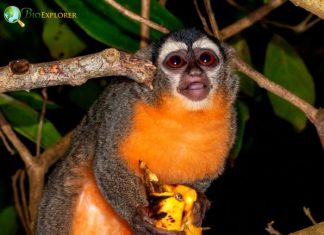
Azara’s night monkeys, also known as southern night monkeys and Azara’s owl monkeys, are native to the Gran Chaco region of South America, a vast area with many different ecosystems, from savannas to grasslands to dry spiny forests and gallery forests. Genetic testing has shown that the males of this species mated pairs are the fathers of the babies they care for.
The obscure Bald Uakari (Cacajao Calvus) is an acrobatic Amazonian monkey with a flaming red face uniquely adapted to periodically flooded forests. Surprising insights on its taxonomy, specialized seed-based diet, unusual social life, habitat flexibility, and urgent need to conserve diminishing flooded forest habitat across the Amazon Basin.
Barbara Brown’s titi also known as the northern Bahian blond titi or blond titi monkey, is a New World monkey species. Barbara Brown’s titi is named in honor of Barbara Elaine Russell Brown, a zoologist.
The bare-eared squirrel monkey also called the golden-backed squirrel monkey, is a subspecies of the Saimiri sciureus group native to the tropical forests and jungles of South and Central America. The bare-eared squirrel monkey differs from other species because it does not have ear tufts.
The bearded capuchin, also called the black-striped capuchin, is a New World monkey in the Cebidae family. They are found in central and northern Brazil. Until recently, the bearded capuchins were considered a subspecies of Tufted Capuchins.
The bearded sakis or cuxiús are five species of New World monkeys classified in the genus Chiropotes. Bearded saki shows slight sexual dimorphism: males are usually taller and have longer, more prominent beards than females.
The black-bearded saki is a species of bearded saki, a species of New World monkey, one of the five remaining monkeys of its kind. Another striking feature is its signature beards. This species prefers primary rainforest, where lush tree canopies provide a relatively safe area out of sight and out of reach of several predators.
The black capuchin, also called the black-horned capuchin, is a capuchin monkey native to the Atlantic rainforest of southeastern Brazil and extreme northeastern Argentina. The black capuchin was originally called Cebus nigritus or Cebus apella nigritus. Although this has changed, many sources still name the black capuchin as part of the Cebus genus.
Alouatta caraya is found in the tropical rain forests of central South America, extending through eastern Bolivia, Paraguay, southern Brazil, and northern Argentina. Alouatta Caraya monkeys are sexually dimorphic, with males weighing an average of 6.7 kg and females an average of 4.4 kg.
The black lion tamarin, also called the golden-rumped lion tamarin, is a lion tamarin native to the Brazilian state of Sao Paulo, almost exclusively in Morro do Diabo State Park. Its limited geographic range makes it the rarest of the New-World monkeys.
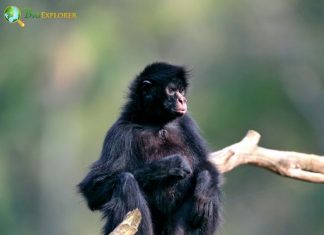
Ateles paniscus, the black spider monkey, is one of three sub-species of spider monkeys. Aside from the face, feet, and hands, they are covered in jet-black hair longer than a typical primate. Of all the Ateles species, Ateles paniscus is the largest.
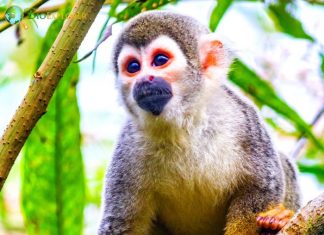
The black squirrel monkey, also called the black-headed squirrel monkey or the blackish squirrel monkey is a small New-World monkey native to the central Amazonian region of Brazil. The black squirrel monkey closely resembles the much more common Bolivian squirrel monkey. However, the latter lacks the central black back.
Also known as western black-handed tamarind, the black tamarind is a species of tamarin native to Brazil. Black tamarind uses primary and secondary forests during foraging, primarily attaching itself to the canopy and spending little time on the ground.
The Black Titi (Cheracebus lugens) is a species of Titi, a New World monkey endemic to South America. It is found in Venezuela, Colombia, and Brazil. It is also known as White-chested Titi.
Also called the golden-backed black uakari, golden-backed uakari, and Homboldt’s black-headed uakari, the black uakari, is a species native to southwestern Venezuela, southeastern Colombia, and northwestern Brazil. The face of Cacajao melanocephalus is black and bare, hence the common name “black uakari” or “black-faced uakari”. The hands and lower limbs are black too.
The black-capped squirrel monkey is a New-World primate species endemic to the upper Amazon basin in Bolivia, eastern Peru, and western Brazil. Primarily, black-capped squirrel monkeys are arboreal and found in native and plantation forests and some managed areas close to running water.
The black-faced lion tamarin, also known as superagüi lion tamarin, is a small New-World primate in the Callitrichidae family. Black-faced lion tamarins are diurnal and seek refuge in hollows or tree holes at night.
The black-fronted titi is a New-World monkey native to Brazil. Black-fronted titi monkeys have short faces, fluffy bodies, long legs, and long fluffy tails. The black-fronted titi monkey is listed as Near Threatened by the IUCN due to extensive habitat loss and fragmentation in the remnant Atlantic Forest in southeastern Brazil.
The black-headed marmoset is a species of marmoset native to Brazil. It inhabits tropical rainforests, mainly second growth and fringes. Black-headed marmoset lives in large family groups of 4 to 15 individuals. Typically, only one female per group breeds during any given breeding season.
The black-headed night monkey is a nocturnal monkey species native to South America. The monkeys are small primates about the size of a small squirrel. The black-headed night monkeys in Peru have mainly inhabited degraded areas.
The black-mantled tamarin is a saddleback tamarin native to northwestern Amazonia in far western Brazil, eastern Ecuador, southeastern Colombia, and northeastern Peru. Leontocebus nigricollis live in small multi-male and multi-female social groups of 4 to 12 and occupy 30 to 50 hectares.
The black-tailed marmoset is a New-World monkey species native to central South America. It is distributed from south-central Amazonia in Brazil to the Chaco far north of Paraguay. Black-tailed marmosets are arboreal and diurnal, using their claws for tree climbing.
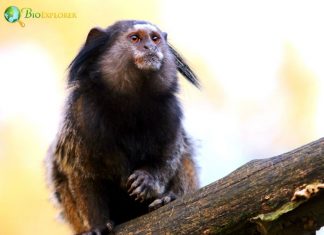
The black-tufted marmoset, also called the Black-pencilled marmosets or Mico-estrela in Portuguese is a type of New-World monkey. They live mainly in the neotropical gallery forests of the central Brazilian plateau.
The blond capuchin monkey is one of the capuchin monkeys native to northeastern Brazil. These Blonde monkeys get their name from the distinctive golden-blond fur on their bodies. Like other primate species, the blond capuchin is threatened by poaching and trapping for the illegal pet trade.
The Bolivian red howler monkey is a New-World monkey species native to neotropical South America. The Bolivian red howlers live in groups of 1 to 3 males and 2 to 7 females. Males in bachelor groups try to dominate the female group by wrestling the lead male.
The pied tamarin, also known as the pied bare-faced tamarin or Brazilian bare-faced tamarin, has one of the smallest home ranges of any primate in the world, located in and around the port city of Manaus.
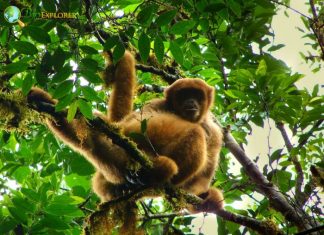
The brown howler monkey, also called the brown howler monkey, is a species of New World monkey that lives in the forests of southeastern Brazil and northeastern Argentina. Despite the common name “brown howler”, its color is remarkably variable, with some individuals mainly appearing black or reddish-orange.
The brown titi is another species of titi, a New World monkey native to South America. It was initially described in 1842 as Callicebus brunneus and transferred to the new genus Plecturocebus in 2016.
The brown-backed bearded Saki is one of 5 species of bearded Saki, a New World monkey species. Bearded sakis have a unique appearance. They are born with prehensile tails, which they retain for the first two months of their life. This allows them to cling to their mother’s body. After this time, the tail becomes non-prehensile.
The brown-mantled tamarin also called the Spix’s saddleback tamarin, is a species of saddleback tamarin native to South America. The species are considered “phyletic dwarfs,” meaning their small size is linked to their evolutionary development.
The buffy-headed marmoset is a rare species of marmoset native to the tropical rainforests of southeastern Brazil. These miniature and shy monkeys are mostly tree dwellers, crawling on 4 legs (quadrupeds) from tree to tree with jerky, squirrel-like movements.
The buffy-tufted marmoset, also called the white-eared marmoset or buffy-tufted-ear marmoset is a New World monkey living in the forests of the Atlantic coast of southeastern Brazil. Unlike most marmoset monkeys, buffy-tufted-ear marmosets are mainly insectivorous, although their diet is generally carnivorous.
The Burnished saki is a species of saki monkey, a species of New World monkey. It is located in central Peru and a small part of adjacent Brazil. The species was described by Johann Baptist von Spix in 1823 but was later merged with the monk saki (Pythecia monachus).
Cazuza’s Saki is native to northwestern Brazil. Populations of this species were previously classified as Rio Tapajós saki (Pithecia irrorata). Still, a 2014 study found that these populations had a pelage distinct from all other species in the genus and were therefore considered their own species, Pithecia cazuzai.
The Chacoan Titi Monkey is a species of titi (also called White-coated Titi), a type of New World monkey native to South America. These diurnal monkeys are stealthy and hard to spot as they navigate the canopy. They move between branches and trees by walking or jumping on four limbs.
The chestnut-bellied titi monkey is a New World primate species native to Brazil. The Chestnut-bellied Titi monkeys live in family groups consisting of father, mother, and baby monkeys ranging in size from three to seven with other affiliates.
The coastal black-handed titi is another species of titi, a New World primate native to the Atlantic Forest of northeastern Brazil. Coastal black-handed Titi monkeys vocalize synchronously early in the morning, possibly to announce their presence in their territory.
or Coimbra titi is a species of titi, a New World primate native to the forests of the Brazilian states of Sergipe and Bahia. It is named in honor of Adelmar F. Coimbra-Filho, founder and former director of the Rio de Janeiro Primate Center, for his Brazilian biology and primatology work.
The collared titi, also called the widow monkey, or yellow-handed monkey inhabits the lush rainforests of the Amazon and is typically found south of Río Negro and north of Río Solimões. Titi monkeys are often known to “duet” with each other, either between an adult female and an adult male, an adult female and her son, or an adult male and his daughter.
Collins’ Squirrel Monkey is a species of squirrel monkey endemic to Brazil. Until a genetic study by Jessica Lynch Alfaro et al. raised them to the species category, Collins’ squirrel monkey had been considered a subspecies of the squirrel monkey (Saimiri sciureus).
The common marmoset, also known as white-tufted-ear marmoset or white-tufted marmoset, is a type of New World monkey. As they have adapted to life at the forest edge of southeastern Brazil, common marmosets have also learned to take advantage of the region’s plantations.
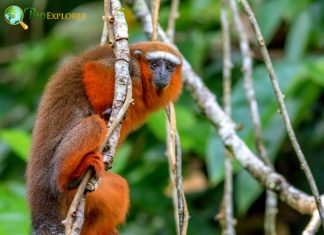
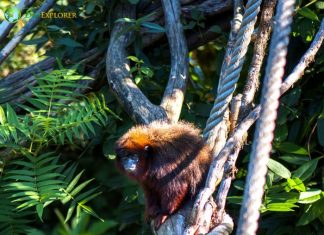
The coppery titi, or the red titi, is a species of titi, a type of New-World monkey native to South America. Coppery titi monkeys have dense fur that covers most of the body except for the face.
The Cruz Lima saddleback tamarin is a species of saddleback tamarin, a small monkey native to South America. The Cruz Lima saddleback tamarins were formerly thought to be a subspecies of the brown-mantled tamarin (Leontocebus fuscicollis).
The Eastern black-handed marmoset (Saguinus ursulus) is a species of marmoset native to Brazil. These tamarins are mainly covered in jet-black fur, with only a small area around the nose and eyes and most hairless ears.
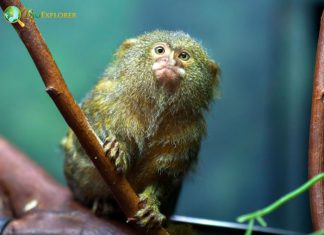
The eastern pygmy marmoset is a species of marmoset, a tiny New World monkey found in the southwestern Amazon rainforest. Notably, at just over 100 grams (3.5 ounces), the eastern pygmy marmoset is the smallest monkey and among the smallest primates in the world.
The Ecuadorian squirrel monkey is a species of the squirrel monkey. Although it occasionally ventures to the ground to play or feed, the Ecuadorian squirrel monkey is strictly an arboreal primate.
The Emilia’s marmoset also called the Snethlage’s marmoset, is a marmoset native to Brazil. The species is named after Emilie Snethlage, a German-born Brazilian ornithologist.
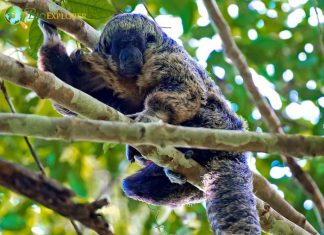
Geoffroy’s monk saki, also called monk saki, is a species of saki monkey, a New-World primate native to South America. A monk saki is one of seven species of New-World arboreal monkeys with a bushy, feathery tail.
Goeldi marmoset or Goeldi monkey is a small South American New-World monkey living in the upper Amazon basin region of Brazil, Bolivia, Ecuador, Colombia, and Peru. Goeldi marmosets generally stay less than 5 meters from the forest floor, moving to higher elevations for fruit.
The gold-and-white marmoset, also called the golden-white tassel-ear marmoset, is a species of marmoset, a tiny monkey native to the Amazon rainforest in the eastern Amazonas state of Brazil.
The golden lion tamarin (Leontopithecus rosalia), also called the golden tamarin, is a small New World primate in the Callitrichidae family. The golden lion tamarin derives its name from its vivid reddish-orange coat and extra-long hair around its face and ears, giving it a distinctive mane.
The golden-bellied capuchin (Sapajus xanthosternos), also called the buff-headed or yellow-breasted capuchin is a New World monkey species. They spend much time grooming one another for socialization, with the alpha species receiving the most attention.
The golden-faced saki (Pithecia chrysocephala) is a New World monkey found on the northern side of the Amazon on both sides of the Rio Negro in Brazil. This species was previously classified as a subspecies of white-faced saki (Pithecia pithecia) but was upgraded to full species status in 2014.
The golden-headed lion tamarin (Leontopithecus chrysomelas), also known as the golden-headed tamarin, is a lion tamarin native to Brazil. It is only found in fragments of lowland and premontane forests in the state of Bahia and is therefore considered an endangered species.
Gray’s Bald-faced Saki (Pithecia irrorata), also known as Rio Tapajós saki, is a New World monkey native to South America. These monkeys are renowned for being reclusive because they avoid humans and quiet nature.
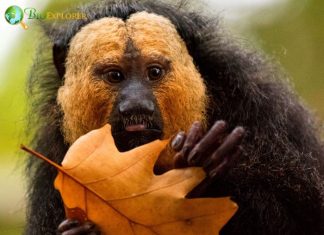
The white-faced saki (Pithecia pithecia), also known as the golden-faced saki, Guianan saki, and Guyana saki, is a New World saki monkey species. Typically, they have a lifespan of around 14 years in the wild and have lived up to 36 years in captivity.
The Guianan squirrel monkey, also called the South American squirrel monkey, is a squirrel monkey found in Guiana, Brazil, and Venezuela. Saimiri sciureus was once thought to belong to the Collins’ squirrel monkey and the Humboldt’s squirrel monkey. Still, genetic research in 2009 and 2015 showed they were different species.
The wedge-capped capuchin (Cebus olivaceus), also known as Guianan weeper capuchin, is a capuchin monkey native to South America. Wedge-capped capuchins get their name from a black triangle of dark fur centered on their forehead.
The Guyanan red howler monkey (Alouatta macconnelli) also known as Guianan Red Howler, is a New World monkey native to Guyana, Suriname, Trinidad, Venezuela, and Brazil. Each troop has a hierarchy consisting of a single dominant alpha male, sometimes with 1 or 2 subadult males. The rests are females and their young.
The hairy saki (Pithecia hirsuta) is a species of saki monkey, a New World primate species. The species was identified by Johann Baptist von Spix in 1823 but later merged with the Mönk saki (P. monachus). Then, a 2014 study revived it as a separate species due to differences in fur coloration.
The Hershkovitz marmoset (Mico intermedia), also called the Aripuanã marmoset, is endemic to the Amazon rainforest of south-central Brazil. The common name references Philip Hershkovitz, an American zoologist.
Hoffmann’s Titi (Plecturocebus hoffmannsi) is a New World primate native to Brazil. It was described as Callicebus hoffmannsi in 1908. These primates have small to medium-sized bodies. Hoffmann’s titis are known to live in small, pair-bonded, and territorial groups and are considered monogamous by most biologists.
The Azaras capuchin or hooded capuchin (Sapajus cay) is a robust capuchin species. It is found in northern Argentina, southeastern Bolivia, eastern Paraguay, and Brazil. Its habitat consists of humid, subtropical, semi-deciduous, gallery forests and forests in the Pantanales.
The three-striped night monkey (Aotus trivirgatus), also known as the northern owl monkey, Humboldt’s Night Monkey, or northern night monkey, is one of several currently recognized species of owl monkeys.
Humboldt’s squirrel monkey (Saimiri cassiquiarensis) is a species of squirrel monkey found in South America’s tropical rainforests, except for the coastal forests of southeastern Brazil.
Humboldt’s white capuchins, also known as white-fronted capuchins, are a species of New-World monkeys and one of the smallest capuchin groups. Humboldt's squirrel monkeys are usually led by a dominant male and female.
Humboldt’s woolly monkey, common woolly monkey, or brown woolly monkey (Lagothrix lagothricha) is a woolly monkey endemic to South America. Humboldt’s woolly monkeys can show subtle mood swings and intentions with various facial expressions.
The Kaapori capuchin (Cebus kaapori) also known as Ka’apor Capuchin, is a capuchin monkey native to Brazil. Previously considered a subspecies of the wedge-capped capuchin monkey (Cebus olivaceus), it was elevated to species status recently.
The Lake Baptista titi, Plecturocebus baptista, is a species of titi, a New World monkey native to Brazil. Lake Baptista Titi was initially described as Callicebus baptista in 1939.
Lucifer Titi (Cheracebus lucifer) is a species of Titi, a New World monkey endemic to South America. It is found in Peru, Ecuador, Colombia, and Brazil. This yellow-handed Titi was described as Callicebus lucifer in 1914.
The Maranhão red-handed howler (Alouatta ululata) is native to forests (e.g., Babaçu forests) in the northeastern Brazilian states of Piauí, Maranhão, and Ceará. Red-handed howler monkeys are among the least studied species of all howler monkeys.
The Marca marmoset (Mico marcai) is a native endemic to the Amazon in the Aripuanã-Manicoré interfluvium of Brazil. Marca marmosets that submit to a dominant individual show this by baring their teeth and laying their ears flat.
Martin’s tamarin (Saguinus martinsi) or Martin’s ochraceous bare-faced tamarin, is native to Brazil. These tamarins are distinguished from other New World monkeys by their small size and modified claws instead of nails on all digits except the big toe.
The Maués marmoset (Mico mauesi) is a marmoset native to Brazil. It is only found on the western bank of the Maués Açu River in the state of Amazonas. Maués marmosets are arboreal and diurnal, spending most of their lives in trees.
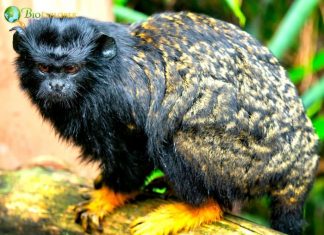
The Midas tamarin (Saguinus midas), also called the red-handed tamarin or golden-handed tamarin is a New-World monkey in the Callitrichidae family. Midas tamarin is also known as golden tamarin or red-handed tamarin. This attests to the remarkably vivid colors of the feet and hands.
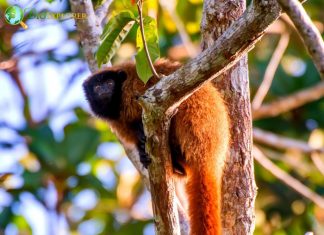
Milton’s titi (Plecturocebus miltoni) also called the fire-tailed titi monkey, is a species of titi, a type of New World monkey from the Amazon rainforest of southern Brazil.
Mittermeier’s Tapajós Saki (Pithecia mittermeieri) is a disputed species of saki monkey, a type of New World monkey. Populations of this species were previously classified as Tapajós River saki (Pithecia irrorata). Still, a 2014 study described these populations as a separate species, Pithecia mittermeieri, based on their distinctive fur.
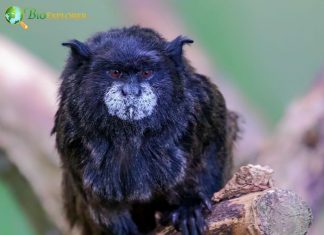
The Mottle-faced tamarin (Saguinus inustus) is endemic to South America. The Mottle-Faced tamarin monkey gets its name from its mottled face, which means their faces have spots.
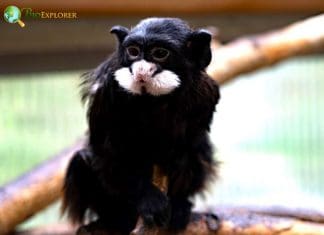
Moustached tamarins, also known as black-chested moustached tamarins and Spyx’s moustached tamarins, are native to Peru and Brazil. These monkeys are found in all strata of the lowland Amazon rainforest. The moustached tamarin gets its name from the lack of coloration in the facial hair around the mouth, which resembles a mustache.
The Munduruku marmoset (Mico munduruku) is a marmoset native to Brazil. It is only found in the southern Amazon over an area of about 120,000 km square, from the right bank of the Jamanxim River below the mouth of the Novo River to the mouth of the Tapajós River.
Nancy Ma’s Night Monkey (Aotus nancymaae) is a species of night monkey from South America. Nancy Ma’s night monkeys are social. They form small groups of 2 to 5 individuals, all directly related to each other.
The Neblina uakari (Cacajao hosomi), black-headed uakari, is a recently described monkey species from the extreme northwest of the Brazilian Amazon and adjacent southern Venezuela. Neblina uakari’s English name refers to the Pico da Neblina, which marks its known distribution approximate center.
The northern muriquí (Brachyteles hypoxanthus) is an endangered species of woolly spider monkey or muriquí endemic to Brazil. When searching for fruit and leaves in tall trees, these monkeys use their tails for support.
The Parecis titi (Plecturocebus parecis) is a species of titi, a New World monkey native to Brazil. The range of the new species is in the deforestation arc of the Amazon, where large tracts of forest are being destroyed for timber, settlements, and industrial agriculture.
Peruvian spider monkeys, like other Ateles species, have a prehensile tail that can be used to facilitate brachiation. Typically, Peruvian spider monkeys have completely black fur and complexions, unlike the lighter red-faced black spider monkey.
The Peruvian white-fronted capuchin or Marañón white-fronted capuchin (Cebus yuracus) is a species of gracile capuchin monkey native to the upper Amazon basin. Peruvian white-fronted capuchin monkeys live in multi-male, multi-female groups of 5 to 18 individuals, with approximately equal numbers of males and females.
Pissinatti’s Sakior or Pissinatti’s bald-faced saki (Pithecia pissinattii), is a controversial species of saki monkey, a New World monkey. This species is named after Alcides Pissinatti, a Brazilian veterinarian who pioneered the breeding of endangered Brazilian primates.
Prince Bernhard’s Titi (Plecturocebus bernhardi) is a species of titi in the subfamily Callicebinae. It is a species of New World monkey native to Brazil. The species is named after Prince Bernhard of the Netherlands, a naturalist who established the Order of the Golden Ark to honor conservationists worldwide.
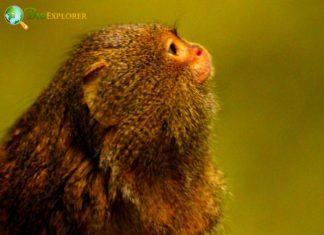
The pygmy marmoset (smallest monkey), genus Cebuella (also known as Finger Monkey), is a small genus of New-World monkeys endemic to the tropical rainforests of the western Amazon Basin in South America. Pygmy marmosets are also highly territorial, using scent glands to mark territories of up to 100 hectares.
The Colombian red howler or Venezuelan red howler is a South American species of howler monkey, a New World species of monkey found in the western Amazon basin. Colombian red howler monkeys live in relatively large social groups composed of around 10 individuals, with just one or possibly two of the individuals being male.
The red-backed bearded saki (Chiropotes chiropotes), also known as Guianan Bearded Saki, is a New World monkey native to South America. They live in groups of about 40 members of both sexes, sometimes separated into groups when traveling or foraging, their primary occupation.
The Red-bellied titi (Plecturocebus moloch) is a marmoset species of New World monkey native to Brazil. It lives in thickets and forests. Like other titis, red-bellied titi is territorial and emits vocal cries to mark its territory and scare other animals.
The Red-chested mustached tamarin (Saguinus labiatus), also known as Red-bellied Tamarin, is a tamarin that lives in the Amazon region of Brazil, Peru, and Bolivia. The red belly of these New World monkeys is their most striking external feature.
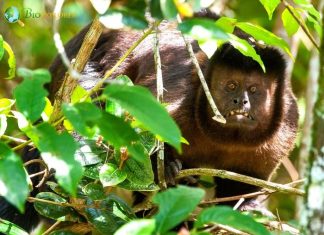
The red-handed howler monkey (Alouatta belzebul) is an endangered species of howler monkey, a New World species. Red-handed howler monkeys are diurnal, although they spend most of the day (up to 80%) sleeping on tree branches with members of their squad.
The red-headed titi (Cheracebus regulus) (also known as Juruá Collared Titi) is a marmoset species of New World monkey endemic to Brazil. Red-headed titi monkeys are diurnal and arboreal, waking up and sleeping with the sun.
The Rio Acari marmoset (Mico acariensis) is endemic to Brazil. It was first described in the year 2000. These Brazilian monkeys use their specialized claws to forcefully grip tree trunks and gnaw small holes in the bark with their lower incisors and canines.
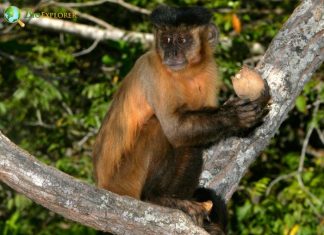
Robust capuchin monkeys, also called crested capuchin monkeys, are capuchin monkeys of the Sapajus genus. Some crested capuchin species are known to use stone tools in the wild. These are used to crack nuts and other seeds, dried fruits, and even oysters.
Rondon’s Marmoset (Mico rondoni), also called the Rondônia marmoset, is a small species of monkey in the Callitrichidae family found in the southwestern Amazon of Brazil. Rondon’s marmoset was only described in 2010, and its name refers to the famous Amazon explorer Cândido Rondon.
The Roosmalens dwarf marmoset, also called the black-crowned pygmy marmoset or black-crowned dwarf marmoset, is a New-World monkey endemic to the Amazon rainforest.
The Ryland’s Bald-Faced Saki (Pithecia rylandsi) is a controversial species of saki monkey, a New World monkey species. It is one of the largest sakis. This South American monkey was named after Brazilian primatologist Anthony Rylands, a former professor of vertebrate zoology at the Federal University of Minas Gerais and founding editor of the journal Neotropical Primates.
The Santarem marmoset (Mico humeralifer), also called the black-and-white tassel marmoset, is a marmoset native to the Amazon and Pará states of Brazil. Santarem marmosets make long cries with their rapidly vibrating tongue, designed to sound like a cricket, and shorter chirps.
The Satéré marmoset (Mico saterei) is native to Brazil and its genus is characterized by claw-like nails rather than the flat nails of other primates, long lower incisors, a specialized caecum, and squirrel-like movements in trees.
Schneider's marmoset (Mico schneideri) is a tiny Amazonian monkey discovered only in 2021. Endemic to Brazil's Mato Grosso forests, it lives in one of the most threatened rainforest regions. With a diet of fruits, insects, and flowers, it plays key ecological roles. Social and territorial, this marmoset breeds within tight-knit groups. Unfortunately, rampant deforestation threatens its survival. Urgent conservation is needed to protect this rare species and the rapidly vanishing habitat it calls home.
The Silvery marmoset (Mico argentatus) is a New-World monkey living in the eastern Amazon rainforest of Brazil. True to its name, the silvery marmoset’s body is a striking silver-grey color. Silvery marmosets are primarily arboreal species and can spend their entire lives in trees without descending to the ground.
The southern muriqui or woolly spider monkeys (Brachyteles arachnoides) are scattered across southeastern Brazil, from Bahia north to Sao Palo south. The southern muriqui is one of the largest primates in South America, with males weighing around 15 kg and females around 12 kg.
The Spix’s night monkey (Aotus vociferans), also called the Spix’s owl monkey, Colombian gray nocturnal monkey, and noisy night monkey is a species of night monkey native to South America.
Spix’s Red-Handed Howler (Alouatta discolor) is a species of howler monkey endemic to the southeastern Amazon in Brazil. Spix’s Red-headed Howler is currently on the International Union for Conservation of Nature’s Endangered Species List based on a population decline of more than 30% over the last 3 generations, mainly due to habitat loss.
Spix’s White-fronted Capuchin (Cebus unicolor) is a species of a gracile capuchin monkey. The species is widespread in the upper Amazon basin in Peru and Brazil. It is also present in northern Bolivia. According to the genetic studies by Boubli et al., Ryland and Mittermeier elevated it to a distinct species.
Stephen Nash’s Titi (Plecturocebus stephennashi), also known as Stephen Nash’s monkey or Nash’s Titi, is a species of Titi in the family Pitheciidae. This Brazilian monkey was discovered by Marc van Roosmalen in 2001 when local fishermen brought specimens to his breeding center. It was officially described in 2002.
Toppin’s Titi (Plecturocebus toppini) is a species of Titi, a species of New World monkey endemic to Bolivia, Peru, and Brazil. It got its name from Captain Toppin, who collected the type specimen of this species near the Tahuamanu River in Peru.
Uta Hick’s Bearded Saki (Chiropotes utahicki) is an endangered species of bearded saki, a New World monkey species. It was named after Uta Hick, a German primatologist who cared for bearded sakis at Cologne Zoo.
Vanzolini’s Bald-Faced Saki (Pithecia vanzolinii) is a species of saki monkey, a species of New World monkey. Vanzolini’s bald-faced saki monkey was first cataloged by naturalist Alfonso Ollala in 1936. His account describes a monkey with a long, fluffy tail and golden fur on its limbs.
The Vieira’s titi monkey (Plecturocebus vieirai) is a species of Titi, a New World monkey species native to north-central Brazil. They have bright reddish-brown faces with yellowish cheek hairs.
The Weddell’s saddle-back tamarin (Leontocebus weddelli) is a species of saddle-back tamarin, a species of small South American monkey. Weddell’s saddle-back tamarins are tree dwellers. As such, they are phenomenal climbers with sharp claws that allow them to cling to the sides of trees.
The Weeping capuchin, also known as the chestnut capuchin and chestnut weeper capuchin (Cebus castaneus), is a capuchin monkey endemic to northeastern Brazil, southern Guyana, French Guiana, and Suriname. This primate is also known as Wedge-capped capuchin.
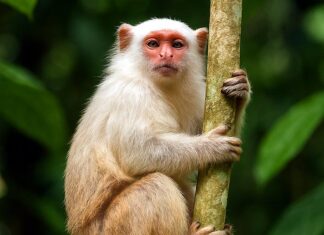
The white marmoset (Mico leucippe), also called the golden-white bare-eared marmoset, is an endangered marmoset native to the Amazon rainforest of Pará, Brazil.
The white-bellied spider monkey (Ateles belzebuth), also called the long-haired or white-fronted spider monkey, is an endangered species of spider monkey, a species of New-World monkey. These arboreal monkeys spend most of their time in the canopy. They rarely go down. When they do, they drink water, eat dirt, traverse a treeless area, or run away from an aggressive opponent.
The white-cheeked spider monkey (Ateles marginatus), also known as the white-whiskered spider monkey, is a New World monkey native to the Amazon Basin of central Brazil.
The white-eared Titi, Plecturocebus donacophilus, also known as the Bolivian gray Titi or Bolivian Titi, is a marmoset species, a New World monkey endemic to eastern Bolivia and a region of western Brazil.
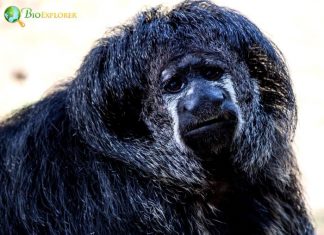
The white-footed Saki, also called the white Saki or buff saki, is a species of saki monkey, a New World species native to western Brazil. They hang from branches and hold on with their hind legs while eating seeds and fruits.
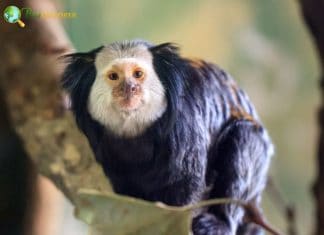
The Geoffroy’s marmoset, also called Geoffrey’s marmoset, white-headed marmoset, or tufted-ear marmoset is a marmoset native to the forests of eastern Brazil, where it is native to Minas Gerais, Espírito Santo, and Bahia. Geoffroy’s marmosets are said to follow swarms of army ants to catch insects expelled by the ants.
The white-nosed saki (Chiropotes albinasus) is bearded, a New World monkey species native to the Amazon rainforest of south-central Brazil. White-nosed sakis are sometimes found in large social groups of 18-30 individuals. Their main reason for traveling is the food search.
The Wied’s marmoset (Callithrix kuhlii), also called the Wied’s black-tufted-ear marmoset, is a New World monkey that lives in the tropical and subtropical forests of eastern Brazil. Unlike other common marmosets, Wied’s marmosets live in groups consisting of 4 or 5 females and 2 or 3 males (plus juveniles).