
Chestnut-bellied Titi
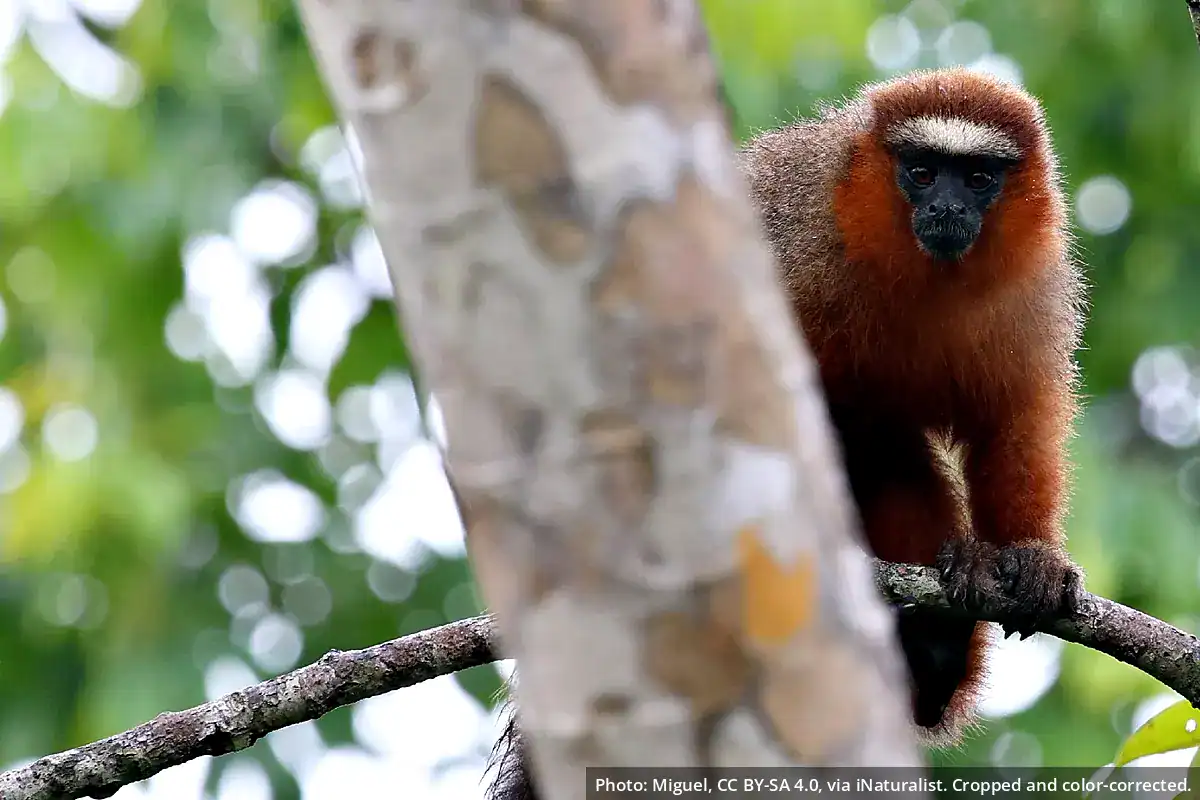
The chestnut-bellied titi is a small, red-bellied monkey of the Brazilian Amazon. Its scientific name is Plecturocebus caligatus. It lives between the Purus and Madeira rivers, south of the Solimões. It is one of the New World monkeys. The IUCN lists it as Least Concern.[1]
This Least Concern titi lives between the Purus and Madeira rivers.
- Common NamesChestnut-bellied titi, booted titi, Hershkovitz's titi, doubtful titi, zogue-zogue
- Taxonomy Classification Year1842
- Monkey SizeClassic-form males 31 to 41 cm (12.2 to 16.1 in), head and body
- Skin Color(s)Reddish-brown agouti, with chestnut underparts and a black or whitish forehead
- HabitatLowland Amazon rainforest, 100 to 400 m
- DietNo species data; titis in general eat fruit, leaves, insects and seeds
- Native CountriesBrazil
- Its chestnut-red belly gives the species its name.
- Some animals have a black forehead, others a white blaze.
- Scientists now count two former species as part of it.
- The 2013 handbook reports no species-specific diet information.
- Small family groups of two to four have been counted.
Chestnut-bellied Titi Distribution
 )
Chestnut-bellied Titi Guide:
Name and Classification
Johann Andreas Wagner described it in 1842.[2] He named it Callithrix caligata. A specimen kept in Vienna anchors the name. Its type locality is Borba, on the Rio Madeira.
Borba sits on the east bank of the Madeira. Yet the species lives only west of the river. So van Roosmalen's team argued the skins came from the opposite bank.[3]
Philip Hershkovitz described P. dubius in 1988. In 2016, Byrne and colleagues moved most Amazonian titis to Plecturocebus.[4] They placed this titi in the moloch group. They also tested a close look-alike, Hershkovitz's titi, P. dubius. Its DNA barely differed from the chestnut-bellied titi's. The two split only about 0.5 million years ago. So the team made dubius a junior synonym of caligatus.
Hershkovitz had already noticed a single difference. Only the forehead color told them apart. He suspected forehead color might vary within one species.
Not everyone agreed with the merger. A 2017 study kept the two forms apart as subspecies.[5] It called them well-marked, geographically separate varieties. The same study judged Stephen Nash's titi a hybrid form between them.
The Mammal Diversity Database now includes both names in this species. The IUCN still assesses them separately. This page follows the current checklist.
Physical Description
Males and females look alike in size and color.[6] The body is reddish-brown agouti. Each hair carries pale and dark bands. The underparts, throat, sideburns and lower arms are reddish. That chestnut belly gives the species its common name. It counts among the red monkeys and the brown monkeys.
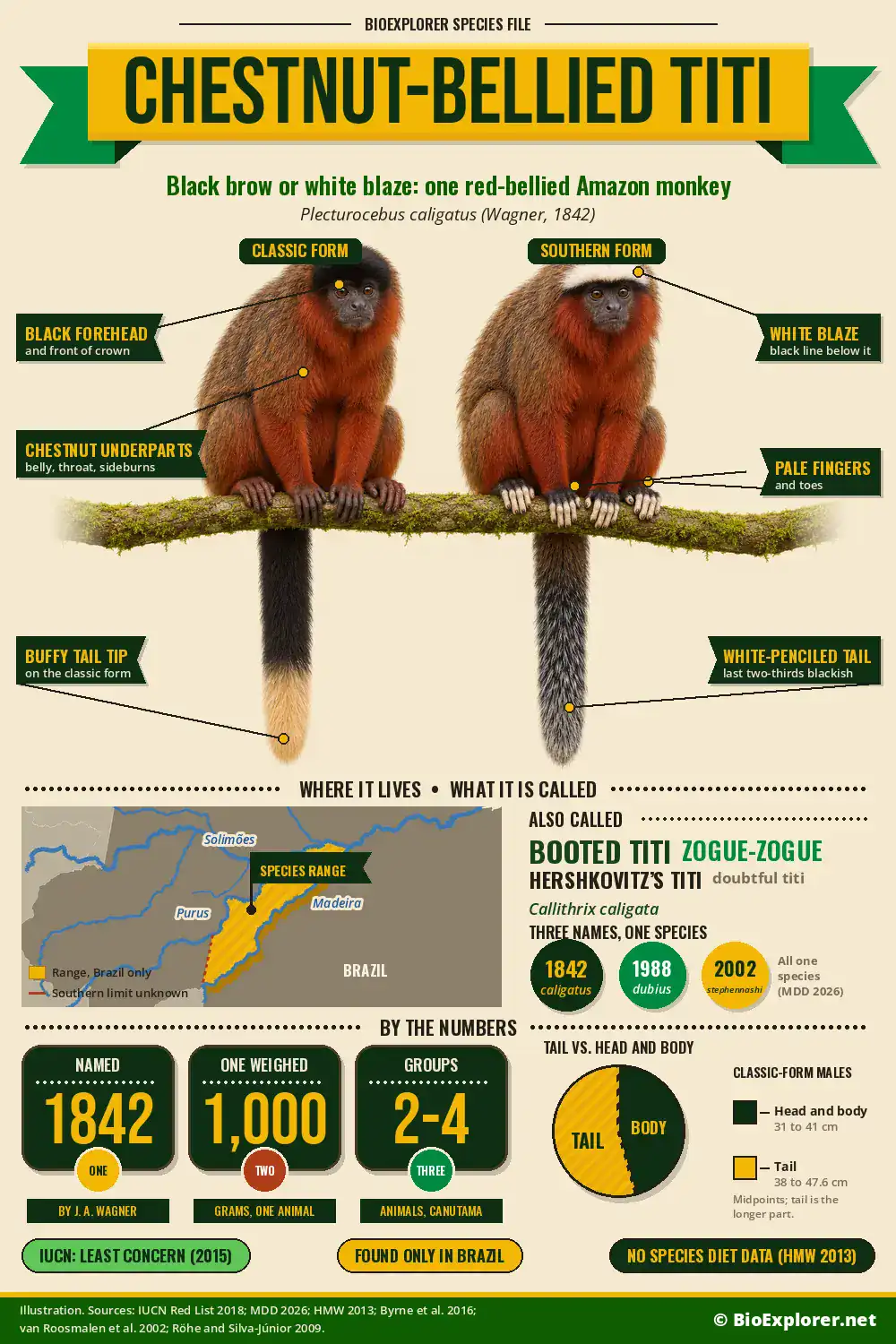
The classic form has a black forehead and front crown. Its hands and feet are blackish to reddish brown. Its tail ends in a pale buffy tip.
The southern form, once P. dubius, looks a little different.[7] A buffy or whitish blaze crosses its forehead. A thin black line runs below it, from ear to ear. Its sideburns and beard are deep reddish. Its fingers and toes are pale buffy or white. The last two-thirds of its tail are blackish, penciled with white.
Stephen Nash's titi, now also part of this species, looks different again.[8] Its back is silvery buffy. Its underparts are bright red. Its hands and feet are silvery white. It was described in 2002 from five captive animals. Its wild range is unknown. Its describers presumed the right bank of the Purus.
Size and Weight
Classic-form males measure 31 to 41 cm in head and body. That is 12.2 to 16.1 in. Females measure 30 to 39 cm, or 11.8 to 15.4 in.
Its tail is longer than its head and body. Male tails run 38 to 47.6 cm. That is 15 to 18.7 in. Female tails reach 46 cm.
The handbook estimates about 800 g. That is about 1.8 lb. It matches other titis of its old species group.
One measured animal weighed 1,000 g, or 2.2 lb. It was 29 cm long, with a 51 cm tail. Van Roosmalen's team recorded it. Southern-form males measure about 37 cm, with 47 cm tails.
Similar Species Compared
Big rivers separate most of these titis.
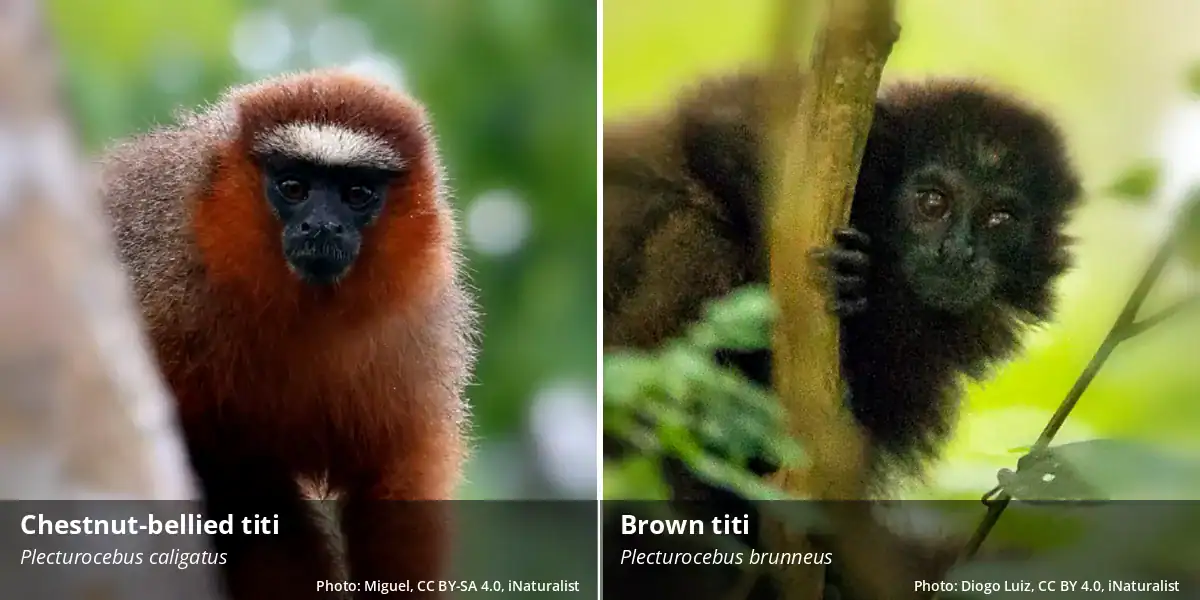
The brown titi lives across the Madeira, in northern Rondônia.[9] Its DNA places it close to the chestnut-bellied titi. It is dark brown, with blackish hands and feet. Its underparts are brownish, not set off from the sides. The IUCN lists it as Vulnerable, mainly from deforestation.[10]
The Prince Bernhard's titi lives east of the Madeira.[11] It was described in 2002, with Stephen Nash's titi. It is grayish black, with dark orange underparts. Its black tail ends in a white tip. A Rondônia survey counted 129 animals in 55 groups.[12] The IUCN lists it as Least Concern.[13]
| Trait | Chestnut-bellied titi | Brown titi | Prince Bernhard's titi |
|---|---|---|---|
| Scientific name | Plecturocebus caligatus | Plecturocebus brunneus | Plecturocebus bernhardi |
| Range | Brazil, between the Purus and Madeira, south of the Solimões | Brazil, northern Rondônia, between the Mamoré, Madeira and Ji-Paraná | Brazil, east of the Madeira, west to the Aripuanã |
| Habitat | Lowland rainforest, 100 to 400 m | Lowland rainforest, 100 to 400 m | Lowland terra firme rainforest, often disturbed forest |
| Coat and key marks | Reddish-brown agouti; chestnut underparts; black forehead or whitish blaze | Dark brown; blackish forehead, hands and feet; buffy tail tip | Grayish black; dark orange underparts; black tail with a white tip |
| Head and body | Classic form: males 31 to 41 cm; females 30 to 39 cm | Males 30 to 34.5 cm; females 30 to 32.5 cm | 36 to 38 cm |
| Tail | Classic form: males 38 to 47.6 cm; females up to 46 cm | Males 37.1 to 42 cm; females 38 to 44 cm | About 55 cm |
| Weight | Estimate about 800 g; one animal 1,000 g | 850 g; sample not stated | Two animals, 700 and 1,200 g |
| Diet | Not known | Not known | Not known |
| Group size | 2 to 4 | Not known | Not known |
| IUCN status | Least Concern (assessed 2015) | Vulnerable (assessed 2015) | Least Concern (assessed 2015) |
Range and Distribution
The chestnut-bellied titi lives only in Brazil.[14] The Solimões bounds its range to the north. The Purus bounds it to the west, the Madeira to the east. Most of the range lies in Amazonas State.
The classic form reaches south to the Rio Ipixuna. The white-browed form lives farther south. It reaches the Rio Mucuim and Rio Ituxí, tributaries of the Purus. It also reaches the Madeira near Porto Velho, in Rondônia. Its southern limit is unknown.
In 2007, surveyors walked trails in Canutama for 15 days.[15] They found nine groups of the white-browed form. One group lived across the Rio Mucuim. Titis there had crossed the river on a bridge.
West of the Ituxí mouth lives Toppin's titi.[16] That area was once mapped for the white-browed form. Across the Purus live the coppery titi and the collared titi.
Its whole range lies in Brazil. So it counts among the Brazilian monkeys.
Habitat Needs
It lives in lowland Amazon rainforest. The classic form lives at 100 to 200 m. The white-browed form reaches 400 m.
Like other titis, it prefers the lower levels of the canopy. At Canutama, groups used campinarana and open terra firme forest. That forest held many palms. That makes it one of the types of rainforest monkeys.
The IUCN has no ecological data for this species. Its relatives seem to tolerate disturbed and seasonally flooded forest.
Diet and Feeding
The 2013 handbook reports no species-specific diet information.
Titis in general eat fruit pulp, leaves, insects and seeds. That broad menu places titis among the omnivorous monkeys.
Behavior and Family Life
Groups of up to four have been seen in Rondônia. At Canutama, groups held two to four animals. That fits a breeding pair with its young.
No species-specific activity or social data are available. Across titis, adults form monogamous pairs. The father carries the single infant.
Titi pairs also sing loud duets.[17] By 2018, scientists had studied the duets of only seven titi taxa. This species was not among them.
Population and Status
The IUCN lists the chestnut-bellied titi as Least Concern. Boubli, de Azevedo and Röhe assessed it in January 2015. The assessment was published in 2018. The IUCN notes that it needs updating.
The IUCN reports no population information. It calls the trend unknown. It cites a fairly large range in a pristine region.
The IUCN still assesses the former forms separately. Hershkovitz's titi was assessed as Least Concern in 2016. Stephen Nash's titi is listed as Data Deficient.[18]
Threats and Conservation
The IUCN knows of no major threats at present. Its range lies in a remote part of the Amazon.
Roads may still change things. Bridges over the Mucuim and Água Branca span river barriers. They could let titi forms meet and mix. That effect remains to be studied.
It is listed on CITES Appendix II. The IUCN calls for research on its ecology and population trends.
The white-browed form has been recorded in several reserves. These include Abufari Biological Reserve and Mapinguari National Park. Biologist M. R. Messias also reported it from Cuniã Ecological Station.
Explore more monkeys starting with C. Or browse all various other monkeys.
Common Questions
The chestnut-bellied titi lives only in Brazil. It ranges between the Purus and Madeira rivers, south of the Solimões.
No. The IUCN lists the chestnut-bellied titi as Least Concern. It faces no known major threats.
The chestnut-bellied titi has reddish underparts. Its throat, sideburns and lower arms are reddish too.
The 2013 handbook reports no species-specific diet information for the chestnut-bellied titi. Titis in general eat fruit, leaves, insects and seeds.
Classic-form male chestnut-bellied titis measure 31 to 41 cm, head and body. Their tails reach 47.6 cm.
The Mammal Diversity Database treats Hershkovitz's titi as a chestnut-bellied titi. A 2016 DNA study found the two barely differ.
The Mammal Diversity Database now places Stephen Nash's titi in this species. The IUCN still lists it separately.
The chestnut-bellied titi is Plecturocebus caligatus. Wagner first named it Callithrix caligata in 1842.
Cite this page
BioExplorer. (2026, November 20). Chestnut-bellied Titi. https://www.bioexplorer.net/animals/mammals/monkeys/chestnut-bellied-titi/
About the author

Wildlife Writer and Photographer, BioExplorer.net
Arjun is a science writer and wildlife photographer at BioExplorer.net. He turns new research on animals into clear, accurate reads for curious readers. His work covers animal behavior, ecology, and newly described species. He holds a Cornell Lab of Ornithology certificate in bird biology. He is pursuing an HBSc at the University of Toronto Mississauga.