
Kaapori Capuchin
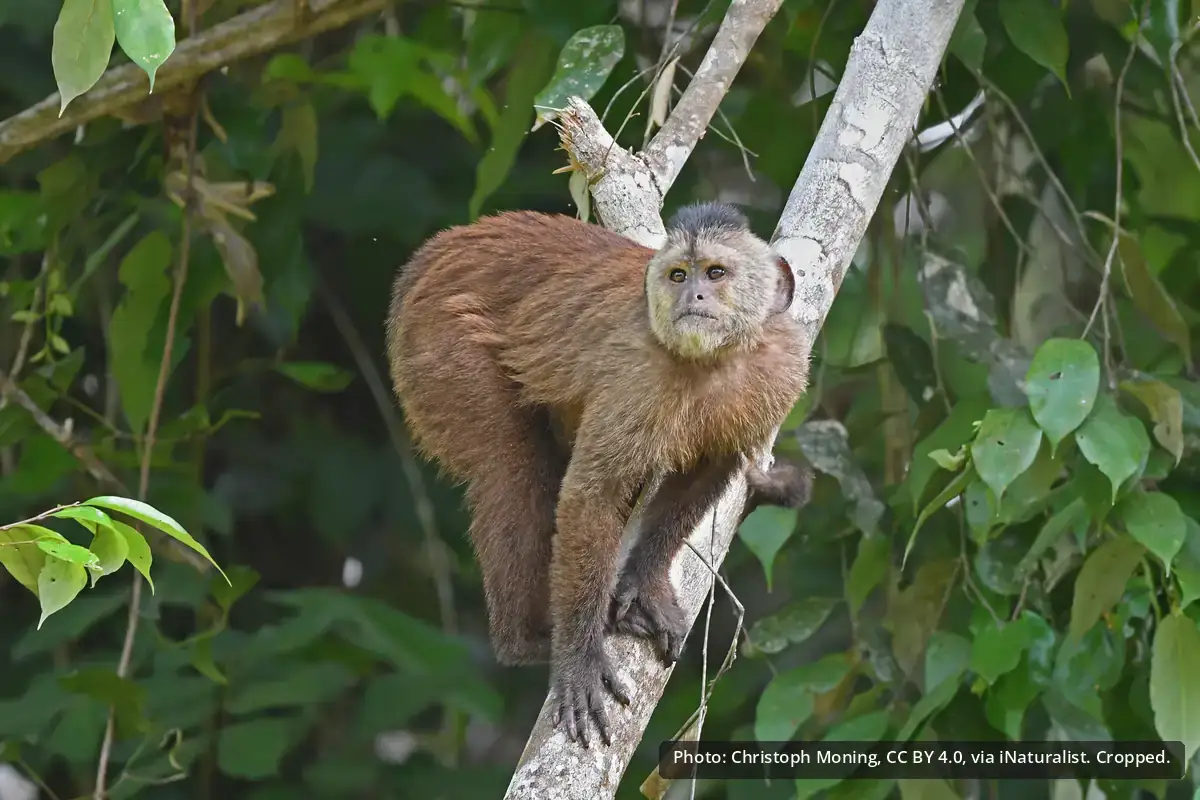
The Kaapori capuchin is a rare monkey of Brazil's eastern Amazon.[1] Its scientific name is Cebus kaapori. It also goes by the Ka'apor capuchin. Local Portuguese names include caiarara and macaco-cara-branca.[2]
The IUCN lists it as Critically Endangered.[3] Its forest home is shrinking fast.
The Kaapori capuchin is a rare monkey of Brazil's eastern Amazon. Its forest home is shrinking fast.
- Common NamesKaapori Capuchin, Ka'apor Capuchin, Caiarara
- Taxonomy Classification Year1992
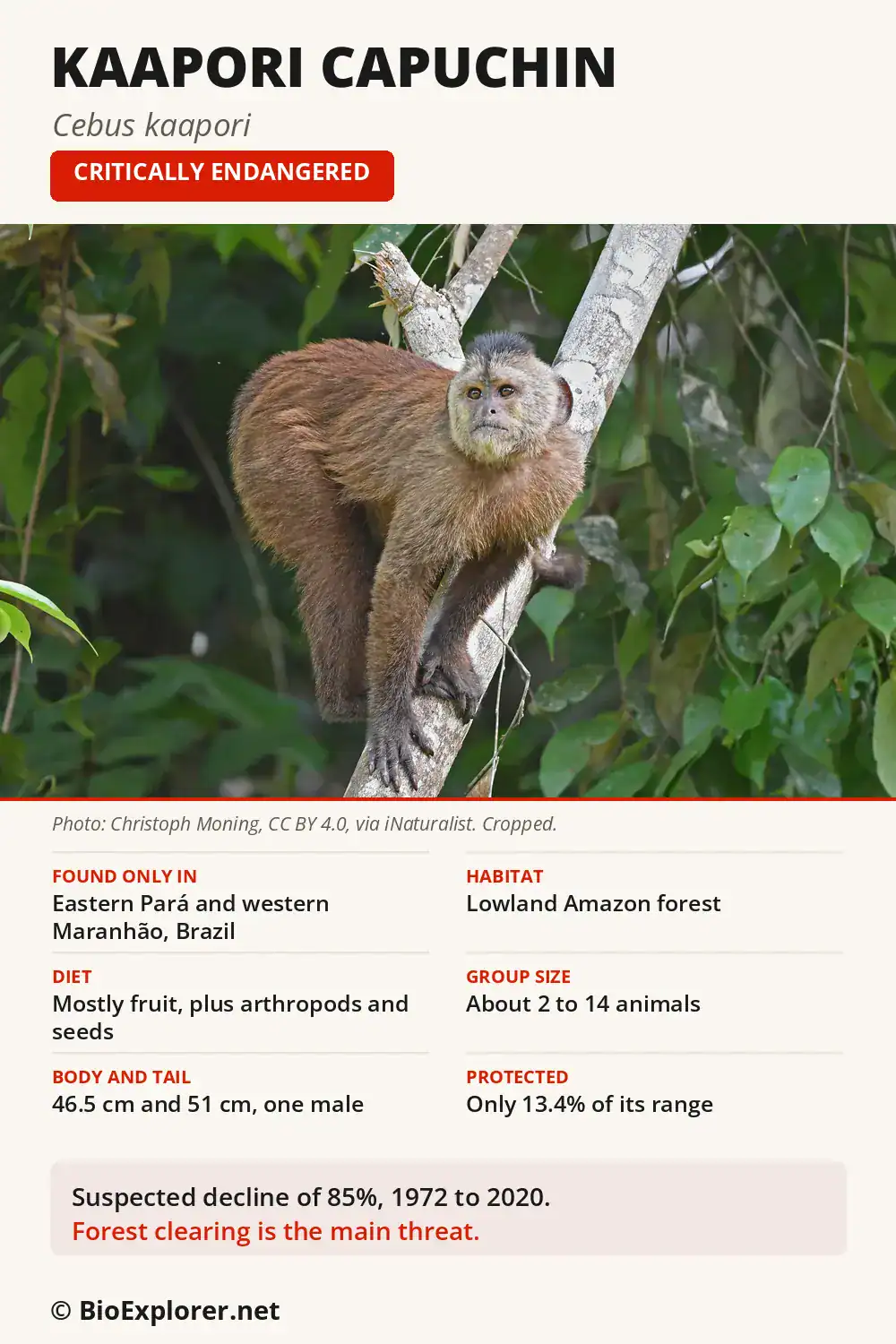
- Monkey SizeHead and body 46.5 cm (18.3 in), tail 51 cm (20.1 in), one adult male
- Skin Color(s)Brown, cream, black
- HabitatLowland Amazon forest
- DietOmnivorous, mostly fruit
- Native CountriesBrazil
- Scientific name: Cebus kaapori de Queiroz, 1992
- Family: Cebidae
- Status: Critically Endangered (IUCN and Brazil)
- Range: Maranhão and Pará, Brazil
- Head and body: 46.5 cm (18.3 in), one adult male
- Tail: 51 cm (20.1 in), one adult male
- Weight: 3.05 kg (6.7 lb), one adult male
- Diet: mostly fruit, plus arthropods and seeds
- Group size: roughly 2 to 14 animals
Kaapori Capuchin Distribution
 )
Kaapori Capuchin Guide:
Name and Classification
Helder de Queiroz described the species in 1992. The type specimen came from near the Rio Gurupi. That site lies near Carutapera, in Maranhão. Some authors later treated it as a subspecies of Cebus olivaceus. That relative is the Guianan weeper capuchin. Like all capuchins, it is one of the New World monkeys.
Today it is treated as a full species. The Mammal Diversity Database and ICMBio both recognize it. One 1998 review called it a valid taxon at either rank.[4]
Genetic work has not settled its exact place in the family tree.[5] A 2018 study found it close to C. olivaceus. That grouping lacked statistical support, though. The authors advised keeping it as a separate species. You can find it among other monkeys starting with K.
Physical Description
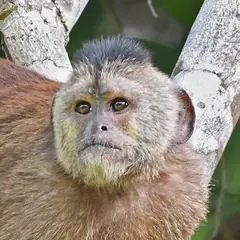
The Kaapori capuchin belongs to Cebus, the untufted capuchins. Other members include the weeping capuchin and Spix's white-fronted capuchin. Its coat blends light brown, dark brown and cream.[6] That coloring places it among the brown monkeys. The belly, limbs and tail range from light to dark brown. The shoulders and cheeks are cream. A dark brown to black cap sits on the crown.
The skull is rounder than in other capuchins. Males have heavier heads and slightly jutting foreheads. The tail is semi-prehensile.
Size and Weight
Measured data are scarce. Only one adult male has published measurements. Its head and body measured 46.5 cm (18.3 in). Its tail measured 51 cm (20.1 in). So the tail was longer than the body. This male paratype weighed 3.05 kg (6.7 lb).
Published female measurements are unavailable. In many capuchins, males outweigh females. That pattern has not been measured in this species.
Range and Distribution
This monkey lives only in Brazil. It occurs in eastern Pará and western Maranhão. It is one of many monkey species native to Brazil.
The range lies south of the Amazon River. The Tocantins River marks its western boundary. The northeast limit is the Rio Turiaçu. In the south, it reaches about 5°20′S. That line marks the edge of the Amazon biome.
Early work placed it between the Rio Gurupi and Rio Pindaré. It may extend along forest remnants between the Pindaré and Grajaú. East of the Rio Grajaú, it is essentially absent.
Some groups survive in coastal mangrove and estuarine forest fragments in Pará. Reports suggest it may also occur in the Marajó archipelago. Whether a wild population lives there remains under investigation.
ICMBio's mapped distribution covers about 204,600 km² (79,000 sq mi). Only 13.4% of that area lies in protected areas or Indigenous lands. By 2004, the Belém Area of Endemism had lost 76% of forest. That region overlaps most of the range.
Habitat Needs
The species lives in lowland Amazon forest. It persists in continuous forest, such as Gurupi Biological Reserve. Small groups also cling to remnant and managed forests. ICMBio describes it as extremely rare and sensitive to disturbance. It is one of many rainforest monkeys in the Amazon.
The tufted brown capuchin, Sapajus apella, shares almost all of its range. Those relatives are far easier to spot. They persist even in degraded habitat.
Diet and Feeding
Fruit dominates the diet.[7] One group of nine was tracked in Pará. The study ran four months in the dry season. About 74% of feeding records were arils and fruit pulp. Arthropods made up 13%, and seeds about 10%. The monkeys fed from 41 plant species.
With arthropods on the menu, it counts among the omnivorous monkeys. Selective logging removes fruit trees this monkey relies on.
Behavior and Groups
The Kaapori capuchin is arboreal. It travels mostly on all fours along large branches. It keeps to the lower and middle canopy. It sometimes drops to the ground to forage.
The Pará study group used 62.4 ha (154 acres). It covered its whole home range every month. Daily travel averaged about 2.2 km (1.35 mi).
Published records describe groups of two to ten animals. Unpublished work in Gurupi found 15 groups of 5 to 14. Those groups averaged 9.1 members. Social organization remains poorly studied. In Maranhão, groups were seen traveling with bearded sakis.
Life History
Breeding has not been studied in the wild. ICMBio fills the gap with data from related capuchins. Gestation probably lasts about five and a half months. Births may come about 26 months apart. Generation time is estimated at 16 years.
Population Status
Nobody knows how many remain. Densities are low, even in protected forest. Gurupi Biological Reserve holds roughly one animal per km².
Brazil's 2024 ICMBio account rates the species Critically Endangered. That category was assigned in 2022. It suspects an 85% reduction from 1972 to 2020. It projects a loss of at least 80% over 2002 to 2050. These figures are inferred from habitat loss and hunting. They are not head counts.
A 2009 population-viability model suggested only three viable populations. One is the Gurupi complex of reserve and Indigenous lands. Another is Araribóia Indigenous Land. The third lies in the Rio Capim region of Pará.
A 1998 review called it the rarest primate of eastern Amazonia. The IUCN assessment dates from 2020, amended in 2021.
Major Threats
Deforestation is the main threat across its range. Highways BR-316, BR-222 and BR-010 opened the forest to settlers. A local steel hub drives demand for charcoal. Oil palm, eucalyptus and sugarcane plantations keep expanding.
Fire is a growing danger. A 2015 blaze burned about half of Gurupi Biological Reserve. Selective logging degrades much of the remaining forest.
Hunting for food adds pressure. People also capture the monkeys as pets. Climate change may shrink suitable habitat further. Hybridization with tufted capuchins is a possible risk.
Conservation Efforts
Like other primates, it falls under CITES Appendix II. Primates have been on that appendix since 1977. Gurupi Biological Reserve is its only full-protection reserve. It also occurs in the Lago de Tucuruí protected area.
Several Indigenous lands hold populations too. These include Alto Turiaçu, Awá, Caru and Alto Rio Guamá. Araribóia records come only from interviews. Many other reserves in its range have never been surveyed.
ICMBio calls for stronger management of Gurupi and the Indigenous lands. It also urges new protected areas in priority zones. Surveys of Marajó and coastal reserves are a priority. Brazil's National Action Plan for Amazonian Primates covers the species.
The species joined the World's 25 Most Endangered Primates list in 2012.[8] It returned in the 2022 to 2023 edition.[9] That marked its fourth appearance.
Kaapori Capuchin FAQs
It lives only in Brazil, in eastern Pará and western Maranhão. It favors lowland forest in the eastern Amazon.
Yes. The IUCN lists it as Critically Endangered. Brazil suspects an 85% decline since 1972.
It eats mostly fruit and arils. It also takes arthropods and seeds.
One measured male had a 46.5 cm (18.3 in) body. His tail was 51 cm (20.1 in) long. He weighed 3.05 kg (6.7 lb).
Yes. Most authorities treat it as a full species. Some authors once called it a subspecies of Cebus olivaceus.
Forest clearing is the main cause. Fire, hunting and the pet trade add to the losses.
Cite this page
BioExplorer. (2026, October 17). Kaapori Capuchin. https://www.bioexplorer.net/animals/mammals/monkeys/kaapori-capuchin/
About the author