
Coastal Black-handed Titi
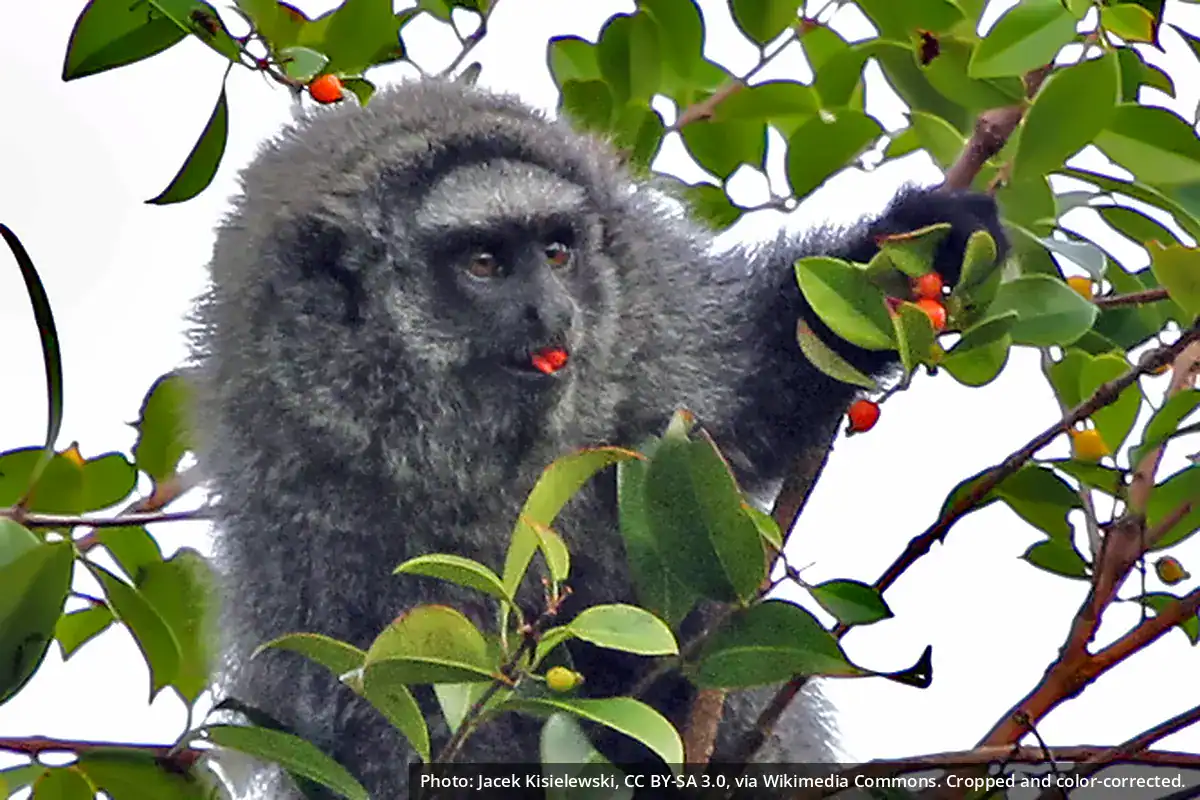
The coastal black-handed titi is a small monkey of eastern Brazil.[1] Its scientific name is Callicebus melanochir. It lives in the coastal Atlantic Forest of Bahia and Espírito Santo. Its hands and feet are blackish, as its name says. The IUCN lists it as Vulnerable.[2]
This Vulnerable titi lives only in eastern Brazil's coastal Atlantic Forest.
- Common NamesCoastal black-handed titi, black-handed titi, Southern Bahian titi, Southern Bahian masked titi, guigó, sauá
- Taxonomy Classification Year1820
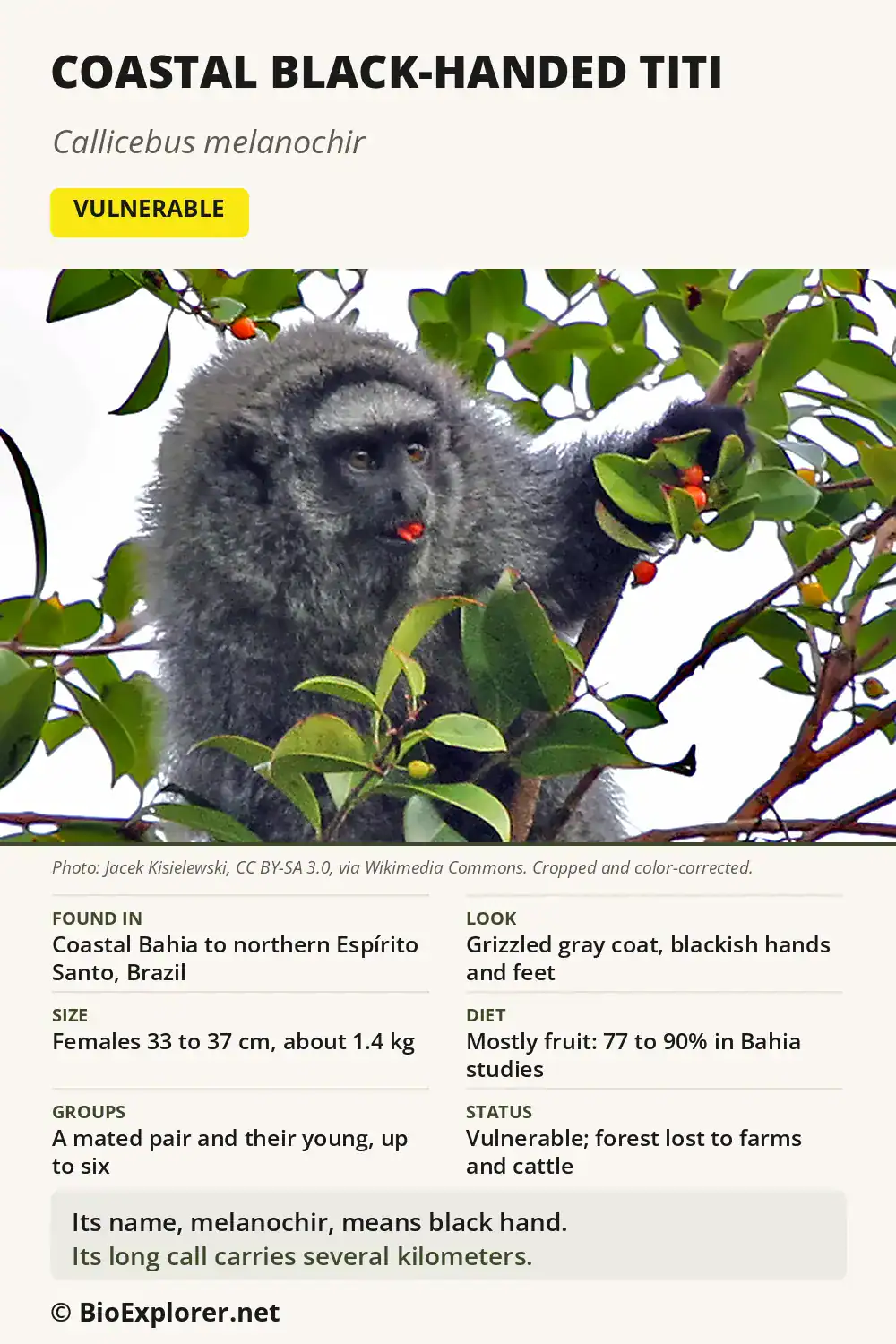
- Monkey SizeFemales 33 to 37 cm (13 to 14.6 in) in head and body; tail 39.5 to 51 cm (15.6 to 20.1 in)
- Skin Color(s)Grayish or buffy brownish agouti body and tail; blackish hands, feet, ears and face fringe
- HabitatCoastal Atlantic Forest, from near sea level to about 300 m
- DietMainly fruit and seeds, plus young leaves, flowers and some insects
- Native CountriesBrazil
- Its hands, feet, ears and face fringe are blackish.
- Its forehead and crown are grizzled, not black like its neighbors'.
- Fruit made up 77% to 90% of its diet in Bahia studies.
- Family groups hold a mated pair and up to four young.
- The father does most of the infant carrying.
Coastal Black-handed Titi Distribution
 )
Coastal Black-handed Titi Guide:
Name and Classification
Prince Maximilian of Wied-Neuwied described this titi in 1820.[3] He named it Callithrix melanochir. The name means "black hand" in Greek.[4] His specimens came from Morro d'Arara, a farm in Bahia.
A lectotype now sits in the Naturalis museum in Leiden.[5] It is a mounted skin with its skull. Philip Hershkovitz chose it in 1990.
Hershkovitz treated this titi as a subspecies of the masked titi. He called it Callicebus personatus melanochir. Kobayashi raised it to a full species in 1995. It belongs to the personatus group of Atlantic Brazil.
A 2016 genetic study kept the genus Callicebus for this group alone.[6] The group split from Plecturocebus titis about 8.3 million years ago. That study did not sample C. melanochir, though. A 2018 study did, using one sample.[7] It placed it closest to the Coimbra Filho's and Barbara Brown's titis. Its lineage split from their common ancestor about 1.9 million years ago.
Its group also holds the Atlantic titi and black-fronted titi. The Coimbra Filho's titi belongs to it too. So does the Barbara Brown's titi.
Like all titis, it ranks among the New World monkeys. It also appears among monkeys starting with C. Meet its relatives in our guide to all types of monkeys.
Other Common Names
The IUCN calls it the black-handed titi. The Mammal Diversity Database prefers Southern Bahian titi. Some sources say Southern Bahian masked titi. In Brazil, people call it guigó or sauá.
Physical Description
The body and tail are grizzled, or agouti. Each hair carries bands of color. The overall tone runs grayish to buffy brown.[8] The back and tail base often carry a reddish brown wash.
That grizzled coat places it among the gray monkeys. Browner animals fit with the brown monkeys.
The hands, feet and ears are blackish. So is the fringe of hair around the face. Those dark hands and feet count it among the black monkeys.
The forehead and crown are agouti too. That sets it apart from its southern relatives. The black-fronted titi has a black forehead. The Atlantic titi has a wholly black crown.
Hershkovitz saw this grizzled head as the oldest pattern in the group. The coat is coarse and shaggy, with hidden brownish wool.
Size and Weight
Published body measurements cover females only. Head and body run 33 to 37 cm (13 to 14.6 in). The tail runs 39.5 to 51 cm (15.6 to 20.1 in). Females weigh about 1.4 kg (3.1 lb).
Hershkovitz listed one female at 1,370 g (3 lb). No male body measurements have been published. The handbook expects the sexes to look alike.
Similar Species Compared
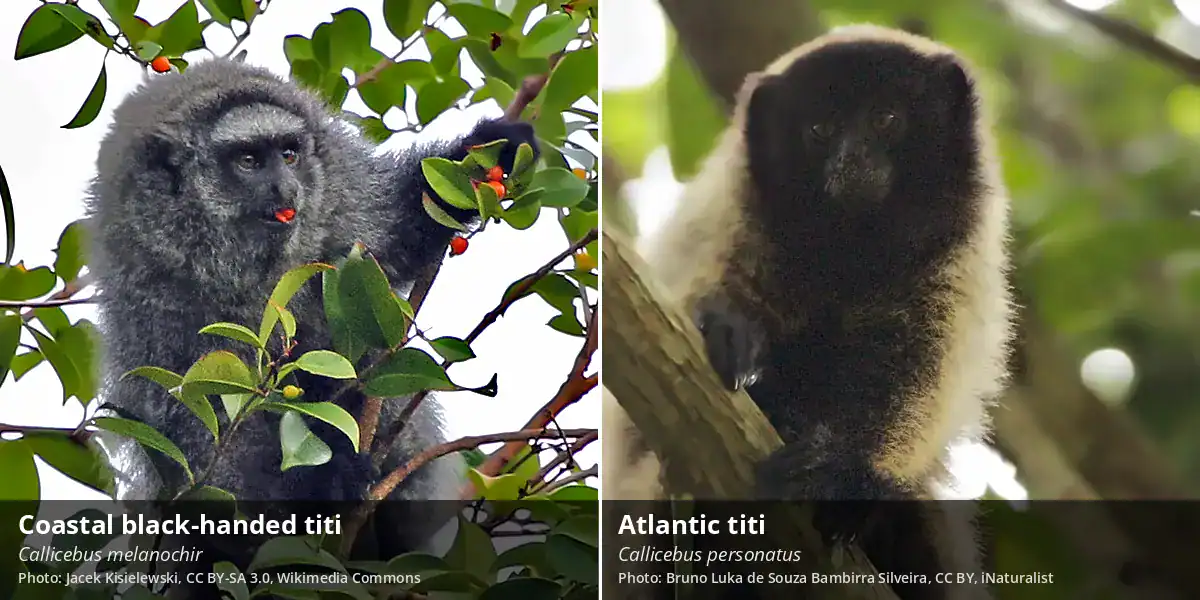
Two close relatives share its stretch of coast. The Atlantic titi lives to the south, in Espírito Santo.[9] Its forehead, crown and face are wholly black. Its body runs buffy to orange. The IUCN also lists it as Vulnerable.[10]
The Coimbra Filho's titi lives to the north, beyond the Paraguaçu River.[11] Its upper back carries crosswise stripes. Its forehead and crown are black, and its tail is orange. The IUCN lists it as Endangered.[12]
The coastal black-handed titi has neither black crown nor stripes. Its grizzled head is the quickest field mark.
| Trait | Coastal black-handed titi | Atlantic titi | Coimbra Filho's titi |
|---|---|---|---|
| Scientific name | Callicebus melanochir | Callicebus personatus | Callicebus coimbrai |
| Range | Eastern Bahia to northern Espírito Santo, Brazil | Espírito Santo, eastern Minas Gerais and northern Rio de Janeiro, Brazil | Coastal Sergipe and northeastern Bahia, Brazil |
| Habitat | Coastal Atlantic Forest, up to about 300 m | Rainforest, near sea level to about 1,000 m | Evergreen and semi-deciduous forest, up to about 300 m |
| Coat and key marks | Grizzled gray to buffy brown, blackish hands and feet, agouti crown | Buffy to orange body, wholly black crown and face | Buffy body, striped upper back, black crown, orange tail |
| Head and body | 33 to 37 cm (females) | 31 to 40 cm (females) | 34.7 to 36 cm (females) |
| Tail | 39.5 to 51 cm (females) | 41.8 to 56 cm (females) | 45.3 to 48.4 cm (females) |
| Weight | 1.4 kg (females) | 1 to 1.6 kg (females) | 1.03 to 1.3 kg (females) |
| Diet | 77 to 90% fruit at three sites, plus leaves, flowers, insects | 55 to 81% fruit in three groups, plus leaves and flowers | 61% fruit in one group, plus leaves, seeds, flowers, insects |
| Group size | Up to 6 | Up to 6 | Up to 6 |
| IUCN status | Vulnerable (assessed 2015) | Vulnerable (assessed 2015) | Endangered (assessed 2015) |
Range and Distribution
This titi lives only in Brazil. It counts among the Brazilian monkeys found nowhere else. Its range follows the Atlantic coast of eastern Bahia. It reaches northern Espírito Santo.
The IUCN reads Hershkovitz as setting two river limits. The Paraguaçu River marks the north. The Mucuri River marks the south. His own text names the Itapicuru or the Contas instead.
Drier forest and cerrado savanna limit it to the west. The IUCN suggests it once lived between the Pardo and Jequitinhonha. Most of those forests are now cattle pasture. Surveys cited by the IUCN found no titis there. But a 2013 to 2014 survey found them in that region.[13]
To the south, it may meet the Atlantic titi. The two may overlap in the Itaúnas and Mucuri valleys. Some authors suspect they intergrade there.
The IUCN puts its extent of occurrence at 124,798 km².
Habitat Needs
It lives in primary and disturbed coastal Atlantic Forest. That makes it one of the types of rainforest monkeys of Brazil. It ranges from near sea level to about 300 m (980 ft).
It copes with some disturbance. It even uses cabruca, cacao groves shaded by native trees. The IUCN notes records near Ilhéus and Itabuna.
One group of four used 22 ha (54 acres) for a year.[14] Undisturbed forest made up 58% of that range. Logged forest made up 31%, and regrowth 11%. The group used undisturbed forest more than expected. Its use tracked where food was most plentiful.
Forest size matters most. The 2013 to 2014 survey checked 38 forest fragments in southern Bahia. Playback and interviews found titis in 15 of them. Patch area was the best predictor of their presence.
Diet and Feeding
This titi eats mostly fruit. Fruit made up 90% of the diet at one Bahia site. At two other sites, fruit made up 77% to 85%. Seeds made up 26% to 34% of that share.
Leaves added 14% to 17%. Flowers and insects were eaten now and then. That mostly fruit diet places it among the frugivorous monkeys. The insects also count it among the omnivorous monkeys.
These titis also eat soil. A 1997 study recorded this geophagy in the species.[15]
Behavior and Groups
The coastal black-handed titi is active by day. It lives mostly in the trees. It occasionally moves on the ground, though. It can cross short stretches of open land.
One group spent 40% of its day resting. It spent 32% traveling and 27% feeding. Only 1% went to social behavior.
Groups hold a breeding pair and their young. Groups of up to six have been seen. Adults form stable, monogamous pairs. The male carries the infant.
Two groups in southern Bahia held ranges of 22 and 24 ha. At one site, groups traveled 532 to 1,539 m daily.
Its long call is distinctive. No other primate there sounds like it. People can hear it several kilometers away.
Reproduction and Young
Females give birth to one infant at a time. Gestation lasts about five months. Fathers do most of the carrying. The handbook gives no birth season.
Population and Status
No census covers the whole species. The IUCN has no information on its population status. A 2023 study cites Brazil's 2018 Red Book on numbers.[16] It put mature adults at probably not much above 10,000.
The IUCN lists it as Vulnerable under criterion A4c. It suspects a decline of more than 30% over 24 years. That window runs from 2010 to 2034. The population is severely fragmented.
That assessment dates from January 2015. The IUCN marks it as needing an update. Brazil's national list also ranks it Vulnerable. It is on CITES Appendix II.
Major Threats
Habitat loss is the main threat. Its region is among Brazil's most developed and crowded. Only 5% to 10% of its forest cover remains.
Cattle ranching and farming drive most forest loss. Its remaining forest is increasingly fragmented. The IUCN calls hunting probably negligible to moderate in most places. Titis are too small to draw much hunting.
Predators take some titis too. Its remains turned up at Harpy Eagle nests in Bahia. That was the first record of the eagle eating this species.
Climate alone may not shrink its range. A 2023 model projected a small net gain in suitable climate.[17] The model projected a 22% gain and 5% loss by 2100. That was under high emissions.
Conservation Efforts
Brazilian law fully protects this titi. It lives in several protected areas.
The IUCN lists Una Biological Reserve and Pau Brasil National Park. Monte Pascoal National Park holds it too. In Espírito Santo, it occurs in Córrego Grande Biological Reserve. Córrego do Veado reserve and Rio Preto National Forest do too.
Private reserves help too. The Serra Bonita reserve in southern Bahia holds it.
Cacao farms may matter. A 2015 study mapped its habitat use in a farm-forest mosaic.[18] That study also covered the golden-bellied capuchin.
The IUCN calls for better data on its numbers and ecology. The survey team's 2021 paper urges action in small fragments. Large forest tracts are now scarce there.
Common Questions
The coastal black-handed titi lives only in eastern Brazil. It inhabits coastal Atlantic Forest from Bahia to northern Espírito Santo.
The IUCN lists the coastal black-handed titi as Vulnerable, not Endangered. Its 2015 assessment suspects a decline of over 30%.
The coastal black-handed titi has blackish hands and feet. Its scientific name, melanochir, means black hand in Greek.
The coastal black-handed titi eats mostly fruit and seeds. It also eats young leaves, flowers and some insects.
Female coastal black-handed titis measure 33 to 37 cm in head-body length. They weigh about 1.4 kg.
The coastal black-handed titi has a grizzled crown. The Atlantic titi has a wholly black crown and face.
Cite this page
BioExplorer. (2026, November 11). Coastal Black-handed Titi. https://www.bioexplorer.net/animals/mammals/monkeys/coastal-black-handed-titi/
About the author

Wildlife Writer and Photographer, BioExplorer.net
Arjun is a science writer and wildlife photographer at BioExplorer.net. He turns new research on animals into clear, accurate reads for curious readers. His work covers animal behavior, ecology, and newly described species. He holds a Cornell Lab of Ornithology certificate in bird biology. He is pursuing an HBSc at the University of Toronto Mississauga.