
Maranhão Red-Handed Howler
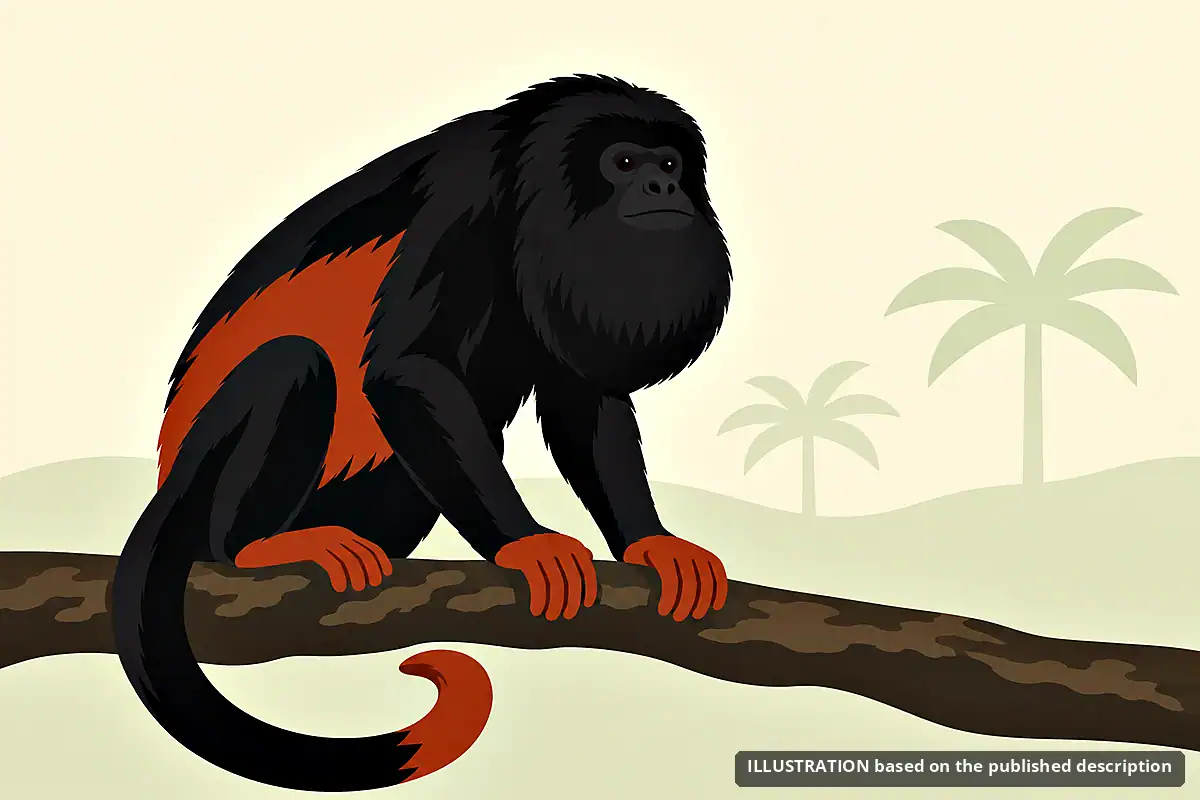
The Maranhão red-handed howler is a howler monkey from northeastern Brazil.[1] Its scientific name is Alouatta ululata. It lives in the states of Maranhão, Piauí and Ceará. It is one of the Brazilian monkeys. It also belongs to the New World monkeys. The IUCN lists it as Endangered.[2]
This Endangered howler lives in northeastern Brazil's dry forests and mangroves.

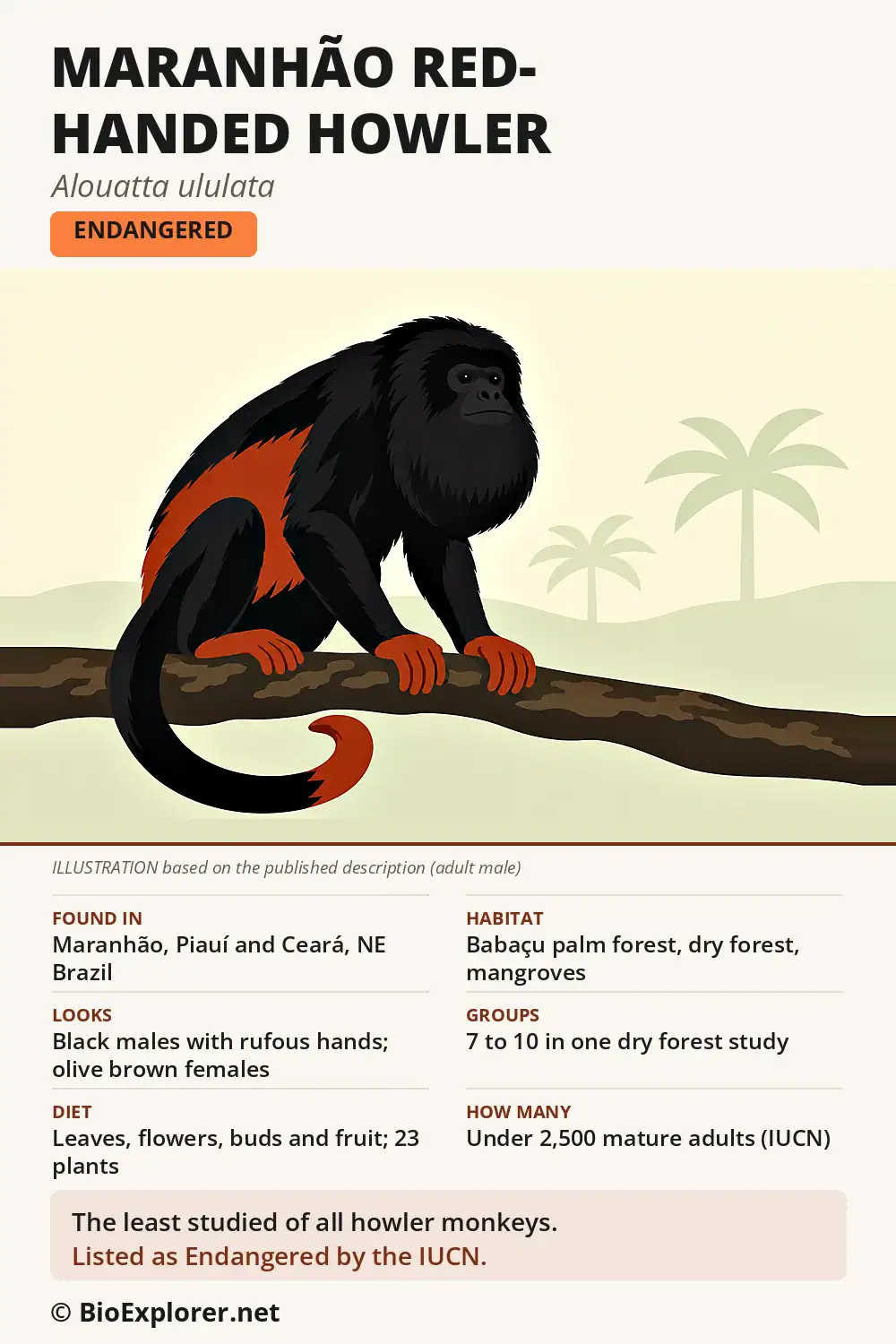
- Common NamesMaranhão red-handed howler, Caatinga howler monkey, guariba-da-caatinga
- Taxonomy Classification Year1912
- Monkey SizeHead and body 56.5 cm (22.2 in) and tail 56 cm (22 in) in the type male
- Skin Color(s)Males black with rufous hands, feet, tail tip and flanks; females olive yellowish brown
- HabitatBabaçu palm forest, dry and semi-deciduous forest and coastal mangroves, 0 to 800 m
- DietMostly leaves, flowers, buds and fruit; 23 plant species recorded in Piauí
- Native CountriesBrazil
- Adult males are black, with rufous hands, feet and tail tip.
- Females are yellowish brown, with an olive tinge.
- It lives only in Maranhão, Piauí and Ceará, in Brazil.
- The IUCN infers that fewer than 2,500 mature individuals remain.
- Hunting and forest loss drive its decline.
Maranhão Red-handed Howler Distribution
 )
Maranhão Red-handed Howler Guide:
Name and Classification
Daniel Giraud Elliot named it in 1912.[3] Its Portuguese name, guariba-da-caatinga, means caatinga howler. The type male came from Miritiba, now Humberto de Campos, in Maranhão. For decades it was treated as part of the red-handed howler. W. C. O. Hill's 1962 review listed it among five subspecies.[4] Another of the five was the Amazon black howler. Colin Groves still kept it within the red-handed howler in 2005.
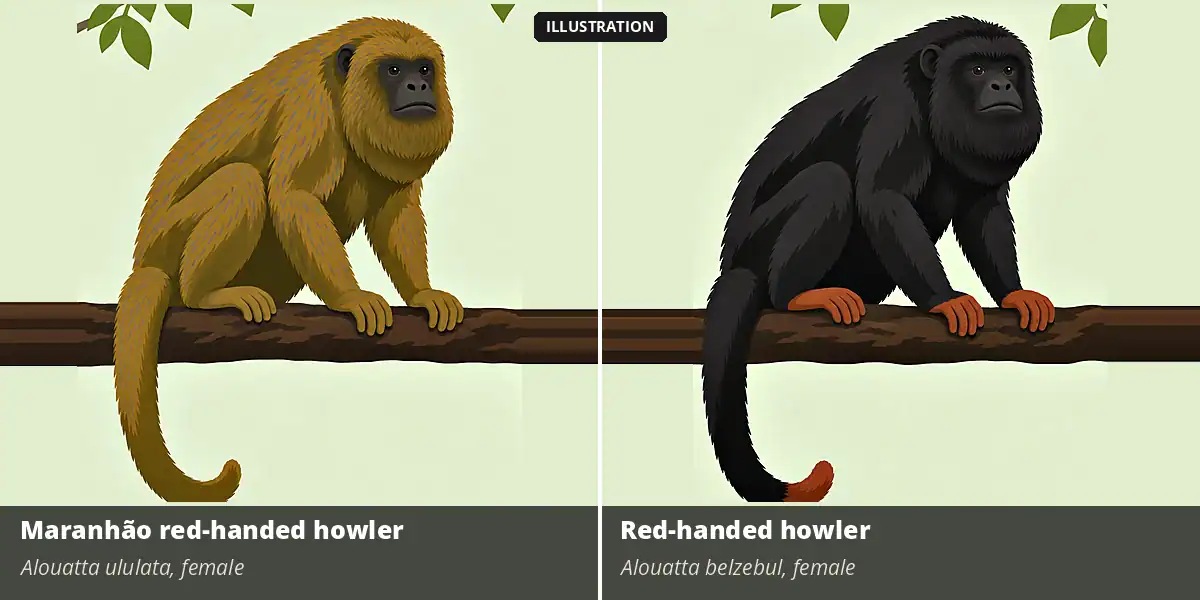
In 2006, Ricardo Gregorin raised it to a full species. He did the same for the Spix's red-handed howler. Gregorin noted that its males and females differ in color. That difference had not been described in its close relatives.
Genetic work has not settled the question. One male had 49 chromosomes, the same count as the red-handed howler.[5] Its one sampled mitochondrial sequence fell inside the red-handed howler clade. A 2022 study also found no clear genetic structure for it.[6] The IUCN treats it as a species. It still calls the question open.
Physical Description
Males and females look very different. Adult males are black. Their hands, feet, tail tip and flanks are rufous to reddish brown. Females are yellowish brown, with sparse grayish hairs. Those hairs give females an olive look.
Black males place it among the black monkeys. Their rufous hands also fit the red monkeys. The yellowish-brown females link it to the yellow monkeys. They also fit the brown monkeys.
Size and Weight
Published measurements come from one adult, the type male. Its head and body measured 56.5 cm (22.2 in). Its tail added 56 cm (22 in). A 2013 handbook found no body weight data for it.
Similar Species Compared
The red-handed howler is a close relative and western neighbor. It lives in eastern Amazonia and a few Atlantic Forest fragments. It is mainly black, with reddish-brown to yellow hands and feet. In some areas, one or both sexes are all black or red. The IUCN lists it as Vulnerable.[7]
The black howler monkey lives to the south.[8] Its range reaches southern Maranhão and Piauí. Its adult males are also black. Its females are pale grayish yellow or golden brown. It is far more widespread. The IUCN lists it as Near Threatened.[9]
| Trait | Maranhão red-handed howler | Red-handed howler | Black howler monkey |
|---|---|---|---|
| Scientific name | Alouatta ululata | Alouatta belzebul | Alouatta caraya |
| Range | Northern Maranhão, Piauí and Ceará, Brazil | Eastern Amazonia and northeastern Atlantic Forest, Brazil | Central and southern Brazil, Paraguay, northern Argentina and eastern Bolivia |
| Habitat | Babaçu forest, dry and semi-deciduous forest, mangroves | Terra firme, evergreen and flooded forest | Gallery and dry forest in cerrado, caatinga, Chaco and Pantanal |
| Coat and key marks | Males black with rufous hands and feet; females olive yellowish brown | Mainly black, with reddish-brown to yellow hands, feet and tail tip | Males mostly black; females pale grayish yellow or golden brown |
| Head and body | 56.5 cm in the type male | Males 58 to 65 cm, females 37 to 50 cm | Males 60 to 65 cm, females about 50 cm |
| Tail | 56 cm in the type male | Males 56 to 70 cm, females 45 to 57 cm | Males 60 to 65 cm, females 54.5 to 60 cm |
| Weight | No data in 2013 handbook | Males 6.5 to 8 kg, females 4.8 to 6.2 kg | Males 5.3 to 9.6 kg, females 3.6 to 6.5 kg |
| Diet | Leaves, flowers, buds and fruit; 23 plant species recorded | Fruit, leaves and flowers | Mainly leaves, plus fruit and flowers |
| Group size | 7 to 10 in dry forest, 2 to 14 in mangroves | 5 to 14 in northeastern Brazil | 3 to 22 |
| IUCN status | Endangered (assessed 2020) | Vulnerable (assessed 2019) | Near Threatened (assessed 2015) |
Range and Distribution
It is found only in northeastern Brazil. Its range covers northern Maranhão, Piauí and Ceará. In the west, the Itapecuru River seems to mark its limit. In the east, it reaches Coreaú in Ceará. Unpublished surveys place it south at least to Floriano, on the Parnaíba.
Piauí holds its highest densities. An isolated population lives near Acopiara, in Ceará. That area lies far from any other known population. It ranges from sea level to 800 m (2,625 ft).
Records from Ceará have grown since 2000. That year, two new sites turned up at Ibiapina.[10] Ibiapina lies in the Serra da Ibiapaba. Interviews with local residents later revealed more areas in Ceará.[11]
Habitat Needs
It lives in remnant forest within the Caatinga and Cerrado regions. Its habitats include tall coastal forest and babaçu palm forest. It also uses semi-deciduous forest in the caatinga and coastal mangroves. The Red List also lists moist savanna and moist montane forest.
It does not need untouched forest. Even so, it tolerates human disturbance poorly. The main reason is its high sensitivity to hunting.
Diet and Feeding
A 2013 handbook account found no feeding data at all. It called the species the least studied of all howlers.
A field project in Piauí studied its diet from 2009 to 2011.[12] It eats mostly leaves, flowers, buds and fruit. The team recorded 23 plant species from 19 families. They used feeding observations and fecal samples. Angico trees, a mistletoe and a Pisonia tree were key foods. The team reported more leaf eating in the dry season. Flowers and fruit were commoner in the wet season. Leaves and fruit make it one of the herbivorous monkeys.
Behavior and Groups
Groups defend small home ranges. The same project followed six groups in Caxingó's dry forest. They held 7 to 10 howlers, averaging about 8. Two methods gave one group a range of 7 or 14 ha. For a second group, they gave 19 or 36 ha. The Red List cites the team's mangrove counts at Ilha Grande too. Groups there held 2 to 14 howlers. Home ranges there averaged about 8 ha (20 acres).
Local residents know the hours and seasons when howlers call. That knowledge may help researchers find groups.
In 2018, researchers saw possible twins at São Miguel do Tapuio, Piauí.[13] It was the first such record for the species. The group's alpha male stayed close to the infants. In February 2019, he was seen carrying one of them. The authors saw this as possible cooperative care.
Population and Status
The IUCN assessed it as Endangered in July 2020. The listing rests on its small population and continuing decline. The IUCN infers fewer than 2,500 mature individuals. No subpopulation is thought to exceed 250 mature individuals. Its numbers are decreasing.
It was listed as Critically Endangered in 1996, 2000 and 2003. Back then it ranked as a subspecies of the red-handed howler. It has been listed as Endangered since 2008.
Surveys in 2004 to 2006 mapped 19 localities with surviving howlers. Numbers at each were very small. Unpublished data put one Piauí subpopulation at 100 to 150 mature individuals. The Parnaíba River delta holds another of the largest known subpopulations.
Major Threats
Hunting is the most serious threat. People hunt it for bushmeat. In northeastern Brazil, it has also been used as medicine.[14] In Ceará, it survives only on hilltops and steep slopes. Hunters struggle to reach those places.
Forest loss adds to the pressure. Sugarcane spreads along the middle and lower Parnaíba River. Rural settlements and charcoal making also clear its forest.
A 2020 model mapped its most important remaining areas.[15] Only about 21% of them lie in protected areas. The study found full protection in only two national parks. They were Ubajara and Sete Cidades. About 3.8% of that priority area was cleared from 2000 to 2014. Forecasts say the region may grow hotter and drier by 2100. The Red List says climate change may become the dominant long-term threat.
Conservation Efforts
It is listed on CITES Appendix II. It lives in several protected areas. They include Lençóis Maranhenses National Park and the Parnaíba Delta marine reserve. The Serra da Ibiapaba protected area also holds populations. The population in Ubajara National Park may already be gone.
Very few live in captivity. There is no coordinated breeding program. Experts call for more surveys and less hunting and clearing.
Explore more monkeys starting with M. Or browse all types of monkeys.
Common Questions
It lives only in northeastern Brazil. Its range covers northern Maranhão, Piauí and Ceará.
Adult males are black, with rufous hands, feet and tail tip. Females are yellowish brown, with an olive tinge.
It eats mostly leaves, flowers, buds and fruit. One study recorded 23 plant species.
Yes. The IUCN lists it as Endangered. Hunting and forest loss drive its decline.
The IUCN infers fewer than 2,500 mature individuals. No full census exists.
Its sexes differ in color, so females are olive yellowish brown. The red-handed howler is mainly black in both sexes.
Cite this page
BioExplorer. (2026, November 3). Maranhão Red-Handed Howler. https://www.bioexplorer.net/animals/mammals/monkeys/maranhao-red-handed-howler/
About the author

Wildlife Writer and Photographer, BioExplorer.net
Arjun is a science writer and wildlife photographer at BioExplorer.net. He turns new research on animals into clear, accurate reads for curious readers. His work covers animal behavior, ecology, and newly described species. He holds a Cornell Lab of Ornithology certificate in bird biology. He is pursuing an HBSc at the University of Toronto Mississauga.