
Hershkovitz’s Marmoset
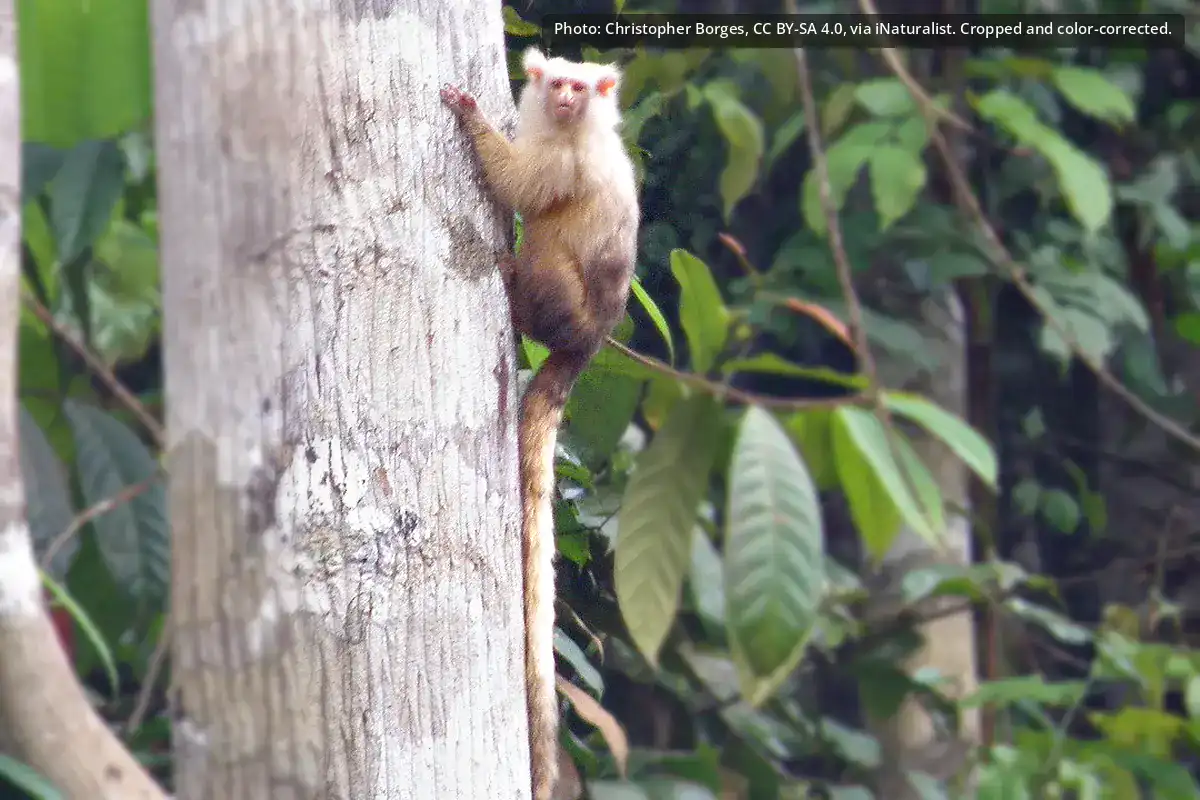
The Hershkovitz's marmoset is a small monkey of the southern Amazon.[1] Its scientific name is Mico intermedius. It lives only in Brazil, between the Roosevelt and Aripuanã rivers. It is one of the New World monkeys. The IUCN lists it as Least Concern.
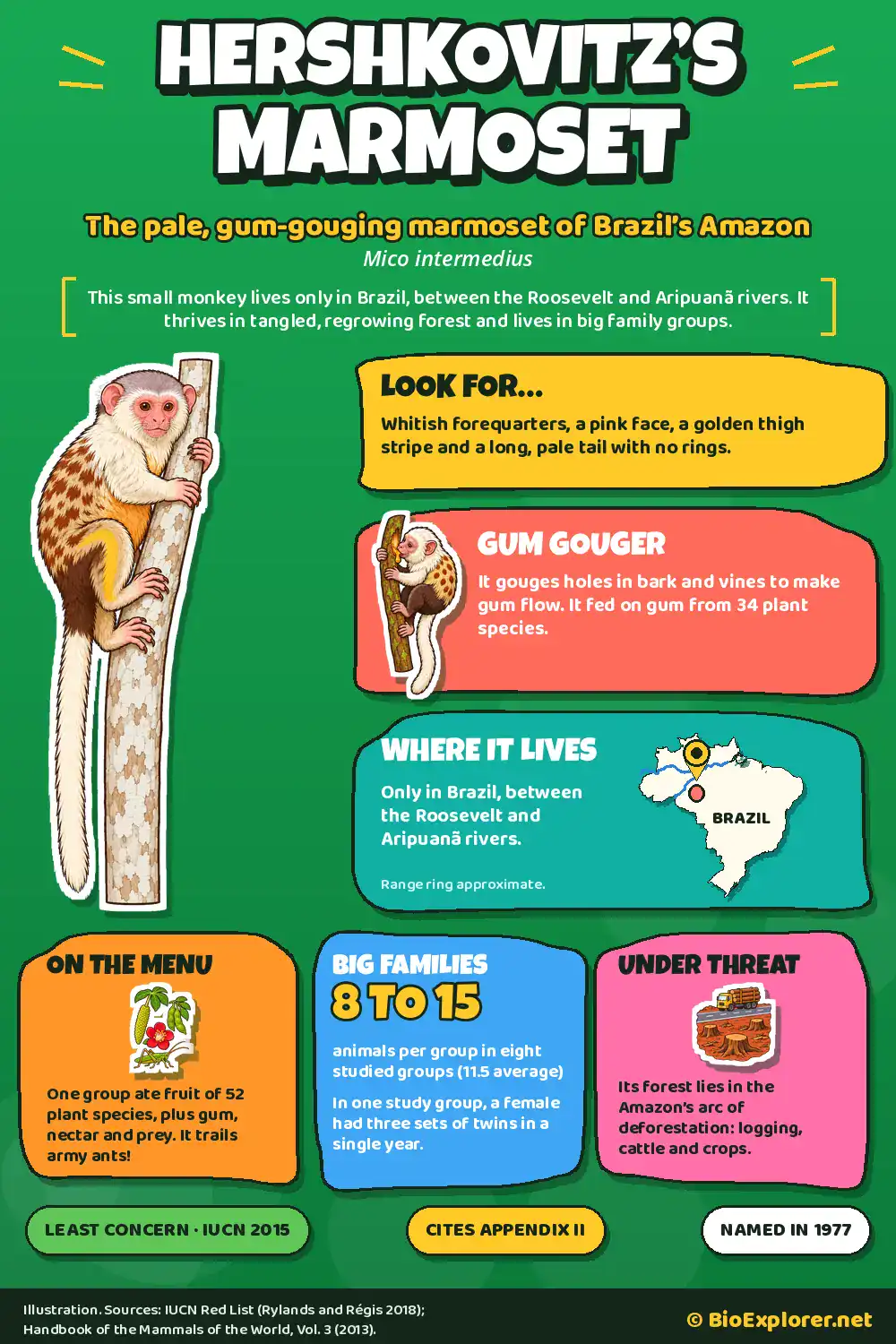
Its head and shoulders are whitish, and its face is pink. A golden stripe runs down each thigh. Its long tail is pale and has no rings.
This pale marmoset lives between the Roosevelt and Aripuanã rivers.
- Common NamesHershkovitz's marmoset, Aripuanã marmoset, Rio Aripuanã marmoset
- Taxonomy Classification Year1977
- Monkey SizeHead and body 20 to 24 cm; tail 32 to 40 cm (handbook)
- Skin Color(s)Whitish forequarters, golden thigh stripe, dark brown rump, pale tail, pink face
- HabitatDense primary and secondary rainforest, especially tangled regrowth
- DietFruit, gum, nectar, flowers and small animal prey
- Native CountriesBrazil
- Philip Hershkovitz described it in 1977 as a subspecies.
- Eight studied groups held 8 to 15 animals, averaging 11.5.
- One female bore three sets of twins in one year.
- It gouges bark on trunks and vines to feed on gum.
- The IUCN assessed it as Least Concern in 2015.
Hershkovitz's Marmoset Distribution
 )
Hershkovitz's Marmoset Guide:
Name and Classification
Philip Hershkovitz described it in 1977.[2] He called it Callithrix humeralifer intermedius. He treated it as a subspecies of the Santarem marmoset. Its type locality lies near the mouth of the Rio Guariba. That spot is on the left bank of the Aripuanã, in Amazonas.
The holotype is specimen MPEG 8.156 at the Goeldi Museum in Belém.[3] The Mammal Diversity Database calls it the Rio Aripuanã marmoset. Another reference calls it Hershkovitz's marmoset.[4] The name likely honors Philip Hershkovitz, who described it. That name places it among the monkeys starting with H. The Latin word intermedius means intermediate.
Mário de Vivo raised it to a full species in 1991. In 2000, Rylands and colleagues moved it to the genus Mico. That genus holds the Amazonian marmoset monkeys.
A Name Mix-Up
For years, this marmoset hid under another name. Anthony Rylands studied it in the wild from 1978. He published his findings under Callithrix humeralifer.[5] At that time, this marmoset counted as part of that species.
So his ranging and feeding studies describe this species. They do not describe the Santarem marmoset. The Santarem marmoset lives far to the northeast, near the Tapajós.
Gene studies show the old grouping was wrong. A 2019 study compared 1,780 DNA loci.[6] It placed this marmoset beside a group holding Rondon's marmoset. That group also holds the silvery marmoset and the Emilia's marmoset. The Munduruku marmoset belongs to that lineage too.
The Santarem and Maués marmoset form a separate lineage. A 2021 study confirmed this split.[7]
Physical Description
Its forequarters are whitish, silvery or yellowish white. The back half of the body is spotted with chestnut. That pale front places it among the white monkeys.
The upper chest is creamy white. The underparts are pale orange. A golden-yellow stripe runs down the outer thigh. The rump and the base of the tail are dark brown. That dark rump also links it with brown monkeys.
The tail is pale off-white and has no rings. Nine museum specimens showed scattered black hairs in the tail. These were densest at the base and the tip.
The face and ears are pink, or partly gray. The crown is grayish. Its white ear tufts are tiny. They grow only from the outer surface of the ear. The Santarem marmoset has full tufts on both ear surfaces.
The IUCN notes another look-alike, the black-tailed marmoset. Both share a pale thigh stripe and similar hindquarters. Hershkovitz's marmoset has paler forequarters and a pale tail.
Size and Weight
The IUCN gives adult weights of 400 to 450 g. That is about 14 to 16 oz. The figure comes from Rylands's 1982 field study. It covers both males and females.
The handbook gives a head and body of 20 to 24 cm. It lists a tail of 32 to 40 cm. The tail is far longer than the body. It gives males about 280 g. It gives females about 310 g. Those handbook figures match its gold-and-white marmoset entry exactly. So treat them with care.
Similar Species Compared
Marca's marmoset lives just west, across the Rio Roosevelt.[8] Its crown is black, and its head is light gray. Its tail is black. It has no pale thigh stripe.[9] The IUCN lists it as Vulnerable.[10]
The black-tailed marmoset replaces Hershkovitz's marmoset across the Aripuanã. Its tail is black, and its hip patch is yellowish or orange.[11] The IUCN lists it as Near Threatened.[12]
The gold-and-white marmoset lives east of the lower Aripuanã. It is almost completely white, with long white ear tufts.[13] Its limbs and tail are golden to orange. The IUCN lists it as Least Concern.[14]
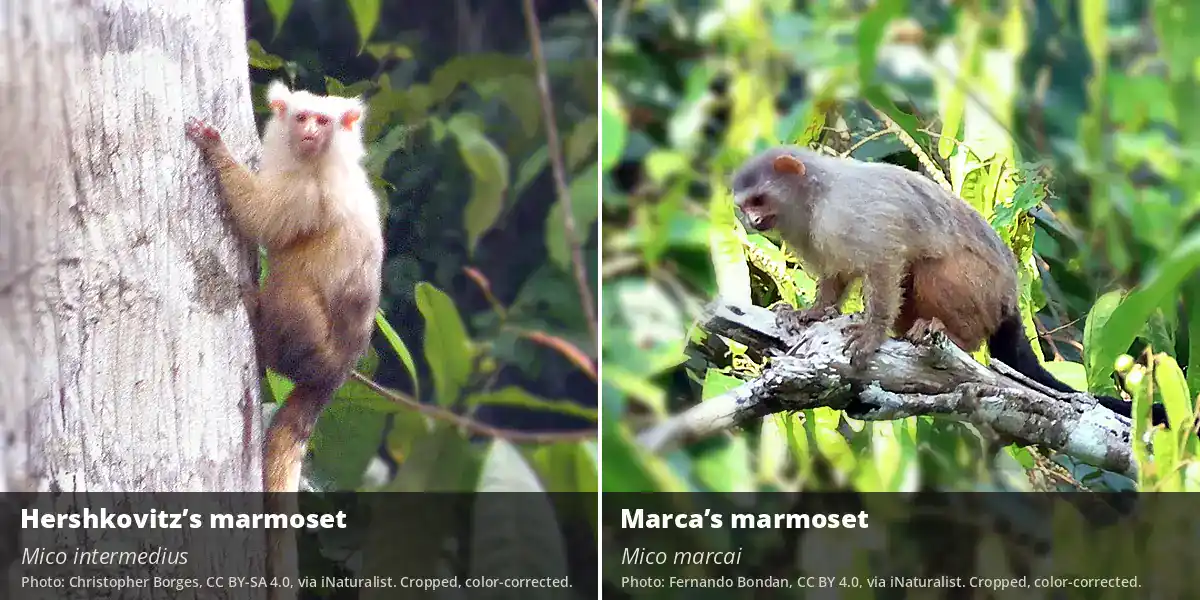
| Trait | Hershkovitz's marmoset | Marca's marmoset | Black-tailed marmoset | Gold-and-white marmoset |
|---|---|---|---|---|
| Scientific name | Mico intermedius | Mico marcai | Mico melanurus | Mico chrysoleucos |
| Range | Brazil, between the Roosevelt and Aripuanã rivers | Brazil, between the Aripuanã and Marmelos rivers | Brazil, Bolivia and Paraguay | Brazil, between the Madeira, lower Aripuanã and Canumã rivers |
| Habitat | Dense primary and secondary rainforest | Dense lowland rainforest | Rainforest, dry forest and Chaco scrub | Lowland rainforest |
| Coat and key marks | Whitish forequarters, golden thigh stripe, pale tail | Black crown, light gray head, black tail | Brown back, yellowish hip patch, black tail | Almost all white, long white ear tufts, golden limbs |
| Head and body | 20 to 24 cm (handbook) | About 22 cm (handbook) | 22 to 24 cm | 19.5 to 23.6 cm, 28 animals |
| Tail | 32 to 40 cm (handbook) | About 36 cm (handbook) | About 30 to 34 cm | 29.8 to 35.5 cm, 28 animals |
| Weight | 400 to 450 g, adults | 280 to 310 g, sex and sample not given (handbook) | About 330 g | About 280 g males; about 310 g females (handbook) |
| Diet | Fruit, gum, nectar and small prey | Not studied | Fruit, nectar, gum and small prey | Fruit, nectar, gum and small prey |
| Group size | 8 to 15, mean 11.5, eight groups | Estimated mean 4.09; observed 1 to 11 | 5 to 14 in the Chaco | Not known |
| IUCN status | Least Concern (assessed 2015) | Vulnerable (assessed 2021) | Near Threatened (assessed 2015) | Least Concern (assessed 2015) |
Range and Distribution
It lives only in Brazil, in Amazonas and Mato Grosso. Its range lies between the Rio Roosevelt and the Rio Aripuanã. It includes the whole basin of the Rio Guariba. It is one of many Brazilian monkeys.
The two rivers act as walls. The black-tailed marmoset lives across the Aripuanã. The two species do not share a bank there. Hershkovitz once suggested they overlapped, but later work disagreed.
Its southern limit is not known. It probably reaches the headwaters of the two rivers.
Habitat Needs
It lives in dense primary and secondary rainforest. This forest has a wet season from December to March. The dry season runs from May to October. Such forest makes it one of the types of rainforest monkeys.
It likes messy forest best. Groups were most common in patches with dense undergrowth and vine tangles. These came from tree falls or human clearing. It was scarce in flooded riverside forest and in tall, open forest.
Rylands estimated 0.44 to 4.69 groups per km². The lowest densities were in tall old-growth forest. The highest were in dense second growth. One group also used white-sand forest.
Diet and Feeding
It eats small sweet fruits, nectar, gum and small animal prey. That mix puts it among the omnivorous monkeys.
Fruit made up 32 to 94% of its monthly plant diet. Gum made up 6 to 59%. Over one year, a group ate fruit from 52 plant species. Pourouma, Inga and Cecropia fruited for months and fed it all year.
It gouges holes in trunks, branches and lianas to start gum flowing. It fed on gum from 34 plant species. Gum mattered most late in the wet season, when fruit was scarce.
It spent 25 to 34% of each day hunting prey. It ate grasshoppers, crickets, mantises, beetles, spiders, small lizards and frogs. It also followed army ant swarms. It stayed at the swarm's front and grabbed fleeing insects.
Family Life
Eight studied groups held 8 to 15 animals, averaging 11.5. Each group has one to four adult males. It has one to five adult females.
One group used a home range of 28.25 ha. Each day it traveled 772 to 2,115 m. It slept in vine tangles, low bushes or dense tree crowns.
Usually only one female breeds in a group. In one study group, she bore twins three times in a year. Births came about 150 days apart. Three males mated with her. Several adults carried the infants, starting on the day of birth.
Population and Status
The IUCN assessed it on 26 January 2015. It is listed as Least Concern. Its population trend is decreasing. The assessment is flagged as needing an update.
The listing rests on its fairly wide range. It also seems to tolerate some human disturbance.
Its rating has shifted over time. In 1994, the IUCN listed it as Vulnerable. It has been rated Least Concern since 2003.
Major Threats
Its range sits inside the Amazon's arc of deforestation. There, the farming frontier pushes north through Mato Grosso. Much of its range is logged or cleared for cattle and crops.
The IUCN says the Cuiabá to Porto Velho highway crosses its range. Logging, settlement and forest loss follow that road. It is generally not hunted. Some are taken as local pets.
Conservation Efforts
The IUCN has not recorded it in any protected area. It is listed on CITES Appendix II. That listing controls international trade in it. Explore more kinds of monkeys.
Common Questions
The Hershkovitz's marmoset lives only in Brazil. Its range lies between the Roosevelt and Aripuanã rivers.
The IUCN lists the Hershkovitz's marmoset as Least Concern. Its population is decreasing as forest is cleared.
The Hershkovitz's marmoset eats fruit, gum, nectar and small animal prey. It gouges bark to make gum flow.
Adult Hershkovitz's marmosets weigh about 400 to 450 g. Their tails are longer than their bodies.
One study found Hershkovitz's marmoset groups of 8 to 15 animals. The eight groups averaged 11.5.
Philip Hershkovitz described the Hershkovitz's marmoset in 1977. He named it as a subspecies.
Cite this page
BioExplorer. (2026, November 18). Hershkovitz’s Marmoset. https://www.bioexplorer.net/animals/mammals/monkeys/hershkovitzs-marmoset/
About the author

Wildlife Writer and Photographer, BioExplorer.net
Arjun is a science writer and wildlife photographer at BioExplorer.net. He turns new research on animals into clear, accurate reads for curious readers. His work covers animal behavior, ecology, and newly described species. He holds a Cornell Lab of Ornithology certificate in bird biology. He is pursuing an HBSc at the University of Toronto Mississauga.