
Toppin’s Titi
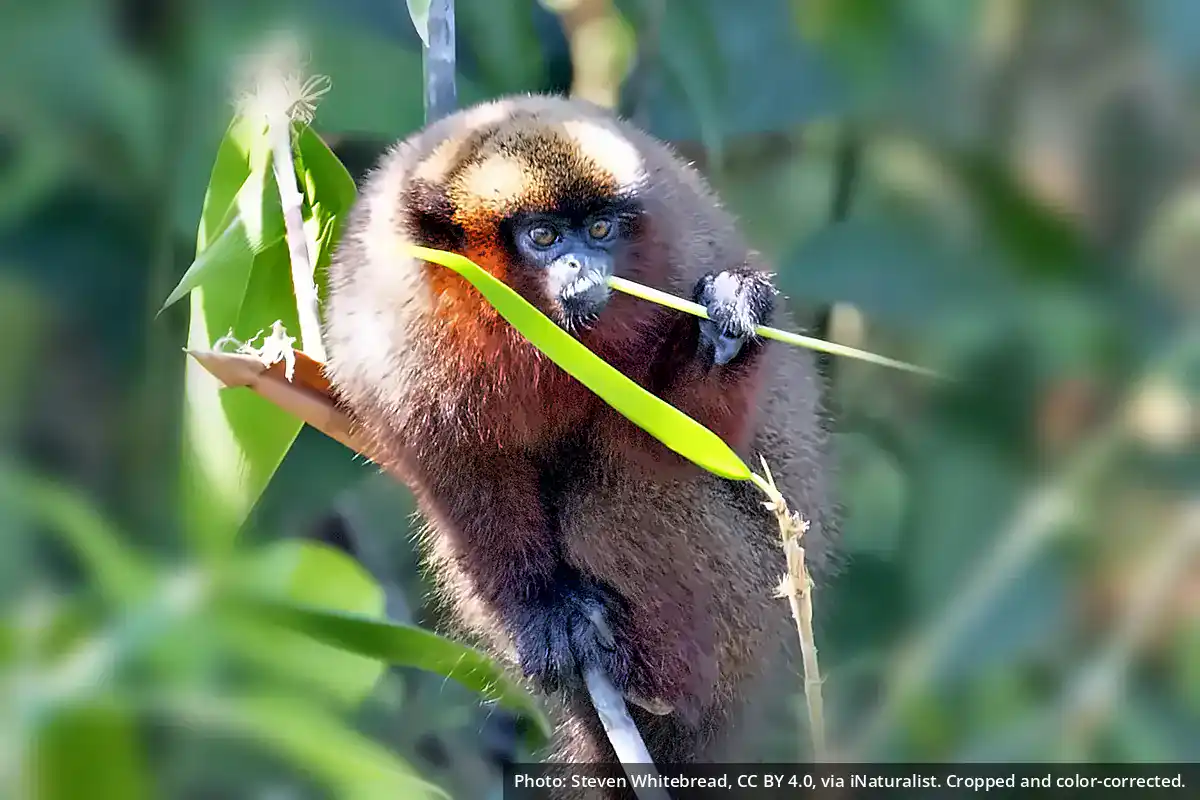
Toppin's titi is a small, pair-living monkey of the southwestern Amazon. Its scientific name is Plecturocebus toppini. It lives in southeastern Peru, western Brazil and northern Bolivia. It is one of the New World monkeys. The IUCN lists it as Least Concern.[1]
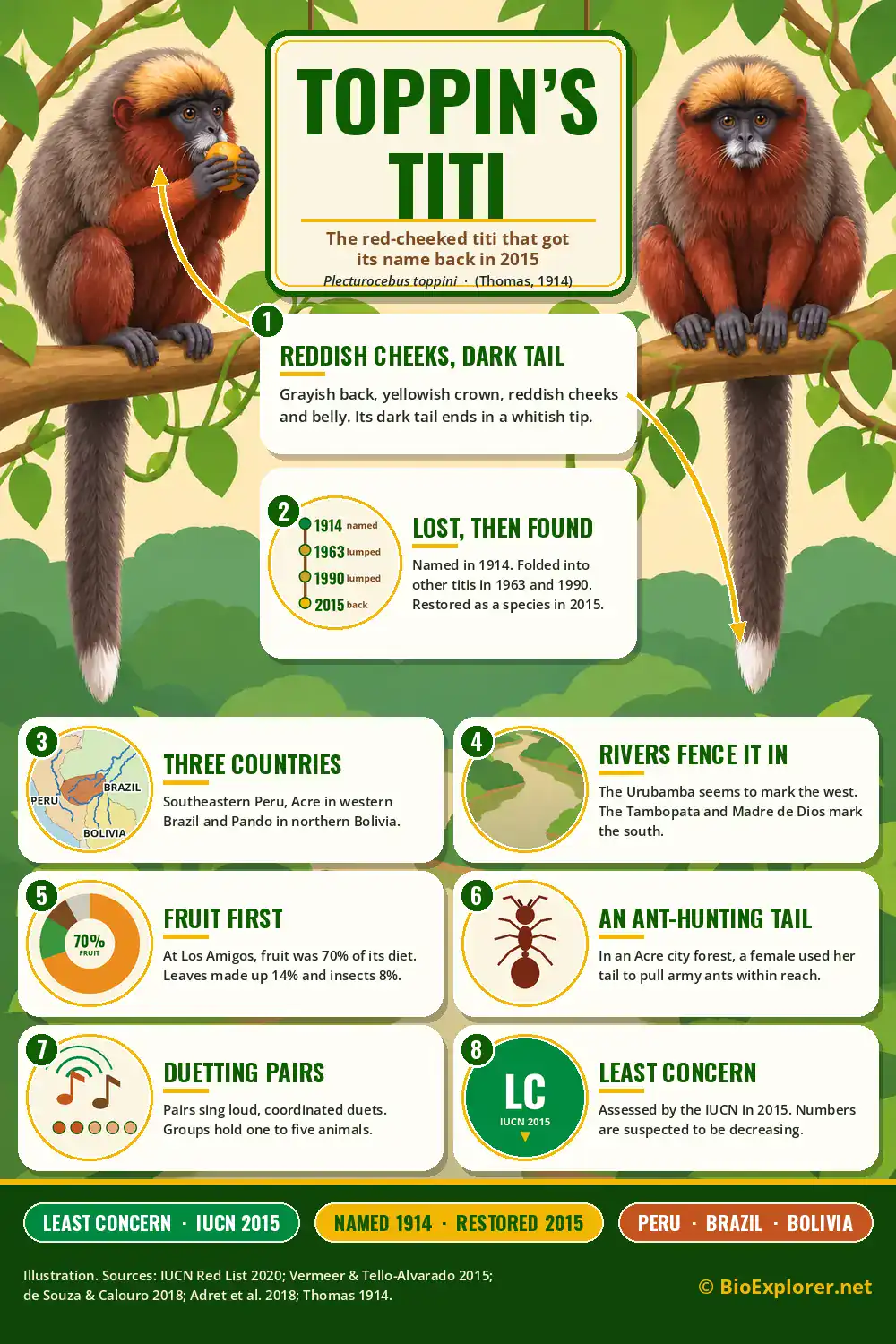
It has a grayish back, reddish cheeks and a reddish belly. Its dark tail ends in a whitish tip. For about 50 years, scientists filed it under other species. It was only reinstated as a species in 2015.
This reddish-cheeked titi lives in southwestern Amazon lowland forest.
- Common NamesToppin's titi, Toppin's titi monkey, mono tocón, lucachi
- Taxonomy Classification Year1914
- Monkey SizeHead and body 29.3 cm (11.5 in), tail 52.4 cm (20.6 in), about 1 kg (2.2 lb), from the former Madidi titi type male
- Skin Color(s)Grayish to brownish back, yellowish crown, reddish cheeks, belly and lower limbs, dark tail with a whitish tip
- HabitatLowland Amazon forest, including bamboo thickets and river-edge forest
- DietMostly fruit, plus leaves and insects
- Native CountriesBolivia, Brazil and Peru
- Oldfield Thomas named it in 1914, from a Tahuamanu River female.
- Its whitish-tipped dark tail sets it apart from the coppery titi.
- Pairs sing loud, coordinated duets in the morning.
- Fruit makes up about half or more of its diet.
- It was reinstated as a full species in 2015.
Toppin's Titi Distribution
 )
 )
 )
Toppin's Titi Guide:
Name and Classification
The British zoologist Oldfield Thomas described Callicebus toppini in 1914.[2] He named it for Captain H. S. Toppin. Toppin collected the type specimen on the Tahuamanu River. That river lies in southeastern Peru, near the Bolivian border. The type is an adult female in the Natural History Museum, London.
Thomas wrote "N.E. Peru" by mistake. Later authors corrected it to southeastern Peru.[3]
Thomas saw a grizzled brown titi like the coppery titi. He noted red on the hind legs reaching up over the knee. He also noted dark-tipped hairs on most of the tail.
The name soon disappeared. In 1963, Philip Hershkovitz folded it into the brown titi. In 1990, after seeing the type, he moved it again. This time it went to the coppery titi. For decades, titis there were called brown titis.
In 2015, Jan Vermeer and Julio Tello-Alvarado restored it as a species. They showed it looks different from the coppery titi. The same paper named the Urubamba brown titi as new.
In 2016, a DNA study split the genus Callicebus in three.[4] Toppin's titi moved into Plecturocebus. That study did not sample it, though. The Mammal Diversity Database accepts it as a species.[5] It lists Callicebus cupreus acreanus, named in 1952, as a synonym.
In 2015, Vermeer and Tello-Alvarado also questioned the Madidi titi. One of their Toppin's titis looked much like its type. They asked whether it was only a color variant. In January 2026, the Mammal Diversity Database merged it into Toppin's titi. It now lists Plecturocebus aureipalatii as a synonym. That change follows a 2025 review by Vermeer and colleagues. The IUCN still assesses the Madidi titi separately, as Least Concern.[6]
It belongs among the monkeys starting with T.
Physical Description
Surveyors observed 29 animals along the Río Inuya. They had reddish undersides and cheeks. Their backs were grayish, and their crowns were yellowish. Each had a dark tail with a whitish tip. Color varied little in that sample.
A museum male from the Río Urubamba shows more detail. It has reddish hairs on the ears. A thin black line crosses the forehead. Infants are an even reddish agouti on the back.
Across the range, the back runs from grayish to brownish. The belly varies most. So does the black on the forehead, ears and hands. A personal report covered seven Los Amigos pairs. All males looked dark, while females appeared redder. The reddish fur places it among the red monkeys. Thomas called its coat grizzled brown. That fits the brown monkeys.
Size and Weight
No body measurements were published under the name Plecturocebus toppini. Thomas measured only the type skull. Its greatest length was 65.6 mm (2.6 in).
Titis in general are small primates of about 1 kg (2.2 lb).[7] The former Madidi titi now falls within Toppin's titi. Its type male weighed 1,000 g (2.2 lb). His head and body measured 29.3 cm (11.5 in). His tail measured 52.4 cm (20.6 in). A female weighed 900 g (2 lb). Her tail measured 48 cm (18.9 in).
Similar Species Compared
The Urubamba brown titi is its western neighbor. It was named in the same 2015 paper. It lives in Peru, mostly west of the Río Urubamba. The two meet on the upper Madre de Dios. There they live side by side. The Urubamba brown titi is dark, with brownish underparts. A jet-black band crosses its forehead. The IUCN lists it as Least Concern.[8]
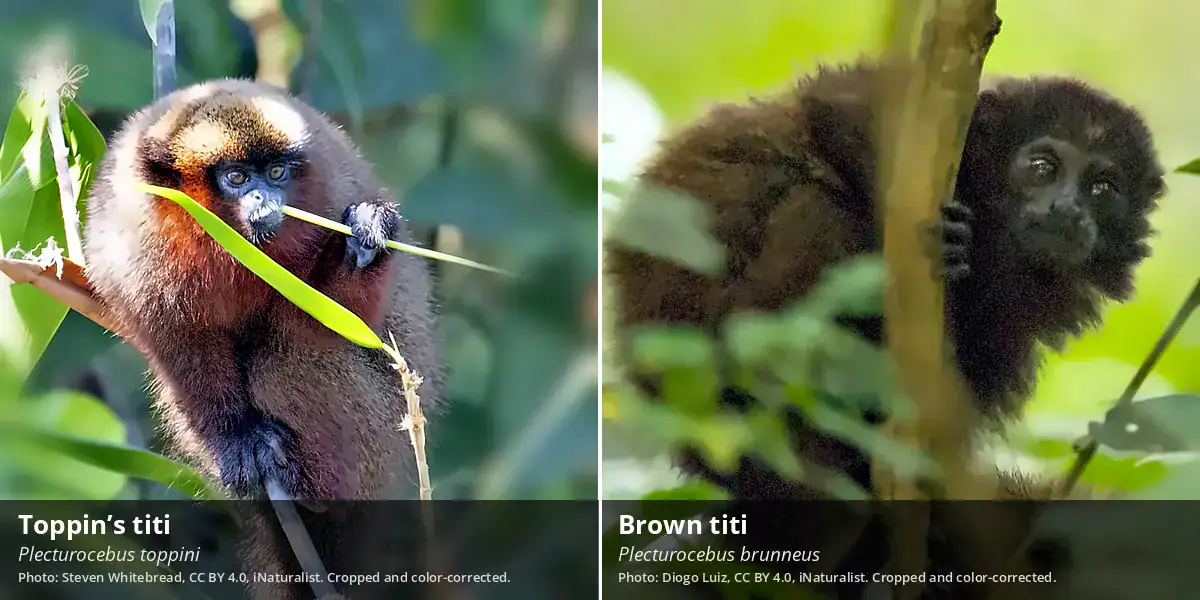
The brown titi is the name most often mixed up with it. Researchers in southern Peru long used that name for Toppin's titi. The true brown titi lives in Brazil's Rondônia. It is dark brown, with a black forehead band. The IUCN lists it as Vulnerable, mainly from deforestation.[9]
Toppin's titi sat inside the coppery titi from 1990 to 2015. Its tail is fluffier and grayish white along its length.[10] Some coppery titis are as orange as Toppin's titi. Their whitish tails still give them away. The IUCN lists the coppery titi as Least Concern.[11]
| Trait | Toppin's titi | Urubamba brown titi | Brown titi | Coppery titi |
|---|---|---|---|---|
| Scientific name | Plecturocebus toppini | Plecturocebus urubambensis | Plecturocebus brunneus | Plecturocebus cupreus |
| Range | SE Peru, SW Brazil, NW Bolivia | Peru, between the Tambo, Urubamba and upper Madre de Dios | Rondonia, Brazil | E Peru east of the Ucayali; W Brazil west of the Purus |
| Habitat | Lowland forest, bamboo and river-edge forest | Lowland forest, including regrowth near villages | Lowland rainforest | Lowland rainforest, 100 to 300 m |
| Coat and key marks | Grayish back, reddish cheeks and belly, yellowish crown, dark tail with whitish tip | Dark brownish agouti, jet-black forehead band, brownish underparts | Dark brown body, black forehead, buffy tail tip | Buff-brown body, reddish underparts, grayish-white tail |
| Head and body | 29.3 cm, former Madidi titi type male | 30 cm, type male | Not known | 29 to 34 cm male |
| Tail | 52.4 cm male, 48 cm female, former Madidi titi | 40 cm, type male | Not known | 39.5 to 48 cm male |
| Weight | 1 kg male, 0.9 kg female, former Madidi titi | Not known | Not known | 1 to 1.2 kg male |
| Diet | Mostly fruit, plus leaves and insects | Not known | Not known | Mostly fruit, plus leaves and arthropods |
| Group size | 1 to 5 | 1 to 5 per sighting | Not known | 2 to 6, once 7 |
| IUCN status | Least Concern (assessed 2015) | Least Concern (assessed 2015) | Vulnerable (assessed 2015) | Least Concern (assessed 2015) |
Range and Distribution
Toppin's titi has a wide range across three countries. It lives in southern Peru, western Brazil and northern Bolivia. In Brazil it is known from Acre, around Rio Branco. In Bolivia it is known from Pando. It counts among the Peruvian monkeys, Brazilian monkeys and Bolivian monkeys.
Big rivers seem to fence it in. The Río Urubamba appears to be its western barrier. The Río Ituxi is probably the eastern one. The Tambopata and Madre de Dios rivers mark the south. Along the Río Ucayali, the IUCN says the white-tailed titi replaces it. Its exact northern limits are still unknown.
Vermeer and Tello-Alvarado conditionally treated the Madidi titi as Toppin's titi. Under that treatment, the Hondo Valley is its southernmost locality. The Río Beni is its eastern boundary there.
The IUCN asks for more fieldwork to fix the range limits. Museum titis labeled coppery or brown titis need a second look. Some may prove to be Toppin's titis.
Habitat and Forest Layers
It lives in lowland moist forest. Survey sightings ran from 188 to 331 m (617 to 1,086 ft). On the Río Inuya, it used open forest with spiny bamboo stands. Along the Ucayali, it lived in disturbed, flood-prone forest near villages. Forests like these make it one of the types of rainforest monkeys.
In Pando, Bolivia, titis turned up often in regrowing forest. They used forest edges, river-edge forest and bamboo. Their mean height was 11.3 m (37 ft). They kept to small and medium branches and rarely climbed straight up.
The IUCN notes a liking for dense plant cover. Bamboo thickets and leafy vine tangles suit it. It moves mostly through the dense middle layer of the forest. It favors supports thinner than 5 cm (2 in). No vertical clinging or leaping was seen in a 1988 study.
Diet and Feeding
Fruit leads its diet. The IUCN cites a 1988 study in southern Peru. There, fruit made up 50% of the diet. Leaves made up 39%, and prey 11%. The fruits came from only six plant families. All the prey were invertebrates, including spiders, moths and butterflies.
A later study at Los Amigos found 70% fruit. Leaves made up 14%, and insects 8%. Insect feeding rose in the dry season. That fruit-heavy mix places it among the frugivorous monkeys. Its taste for prey also makes it one of the omnivorous monkeys.
In Acre, one group lived in a city forest fragment.[12] It fed on army ants of the species Eciton rapax. In the dry season, fruit was scarcest. Then it took ants on the ground. At other times it picked them off branches and leaves. The adult female used her tail to pull ants within reach. The study calls this behavior new for the genus.
Behavior and Groups
Toppin's titis live in small, pair-bonded, territorial groups. They are considered monogamous. In the 2013 Ucayali survey, groups held one to five animals. In Pando, groups held one to five, with a mean of three.
At Los Amigos, groups were a pair with up to three young. One group may have held a second adult male. He gave a loud call, and the pair answered. One group used a territory of 1.4 ha (3.5 acres).
Pairs sing loud, coordinated duets.[13] Their duets follow the same pattern as several close relatives. Titis call loudly in the morning, likely to mark territory edges.
In Pando, titis often joined tamarin groups south of the Río Tahuamanu. They were seen with Weddell's saddle-back tamarin in 25% of encounters. They were seen with the emperor tamarin in 43.2%. North of that river, they rarely mixed with tamarins.
Predators are a risk too. At Los Amigos, a capuchin attacked and killed a female titi.
Life Cycle and Breeding
No breeding studies exist for Toppin's titi itself. In titis generally, pairs raise one infant at a time.[14] The father does much of the carrying. On the Río Urubamba, a hunter killed an adult male. An infant was with him.
Population and Status
The IUCN assessed Toppin's titi on 26 January 2015. It listed the species as Least Concern. It was published in 2020 and is marked as needing an update.
It earns that status from its large range and protected areas. Habitat loss threatens parts of its range. No evidence shows a decline warranting threatened status.
No range-wide population estimate exists. The IUCN suspects numbers are decreasing. A 1988 study found 2.52 groups per square kilometer. Groups there averaged 2.56 animals. A 1982 survey found 14.7 animals per square kilometer. It is listed on CITES Appendix II.
Threats and Protection
Hunting seems to be the main threat in Bolivia. In Peru, the assessor reported seeing hunting himself. Deforestation is another threat. People hunt it for food, for local use only. On the upper Río Inuya, hunting and logging threaten the primates.
It lives in several protected areas. In Peru, these include Manu National Park and Megantoni National Sanctuary. Tambopata National Reserve and the Los Amigos Conservation Area hold it too. In Bolivia, it lives in Manuripi National Reserve.
Browse all types of monkeys to meet its relatives.
Common Questions
Toppin's titi lives in southeastern Peru, western Brazil and northern Bolivia. It keeps to lowland Amazon forest.
No. The IUCN lists Toppin's titi as Least Concern. It suspects the population is decreasing, though.
Toppin's titi has a grayish back and reddish cheeks and belly. Its dark tail ends in a whitish tip.
Toppin's titi eats mostly fruit. It also eats leaves, insects, spiders and even army ants.
Toppin's titi has a dark tail with a whitish tip. The coppery titi's tail is whitish along its length.
In 2026, the Mammal Diversity Database merged the two. The IUCN still lists them separately.
Toppin's titi is named for Captain H. S. Toppin. He collected the type specimen in southeastern Peru.
Cite this page
BioExplorer. (2026, November 17). Toppin’s Titi. https://www.bioexplorer.net/animals/mammals/monkeys/toppins-titi/
About the author

Wildlife Writer and Photographer, BioExplorer.net
Arjun is a science writer and wildlife photographer at BioExplorer.net. He turns new research on animals into clear, accurate reads for curious readers. His work covers animal behavior, ecology, and newly described species. He holds a Cornell Lab of Ornithology certificate in bird biology. He is pursuing an HBSc at the University of Toronto Mississauga.