
Marca’s Marmoset
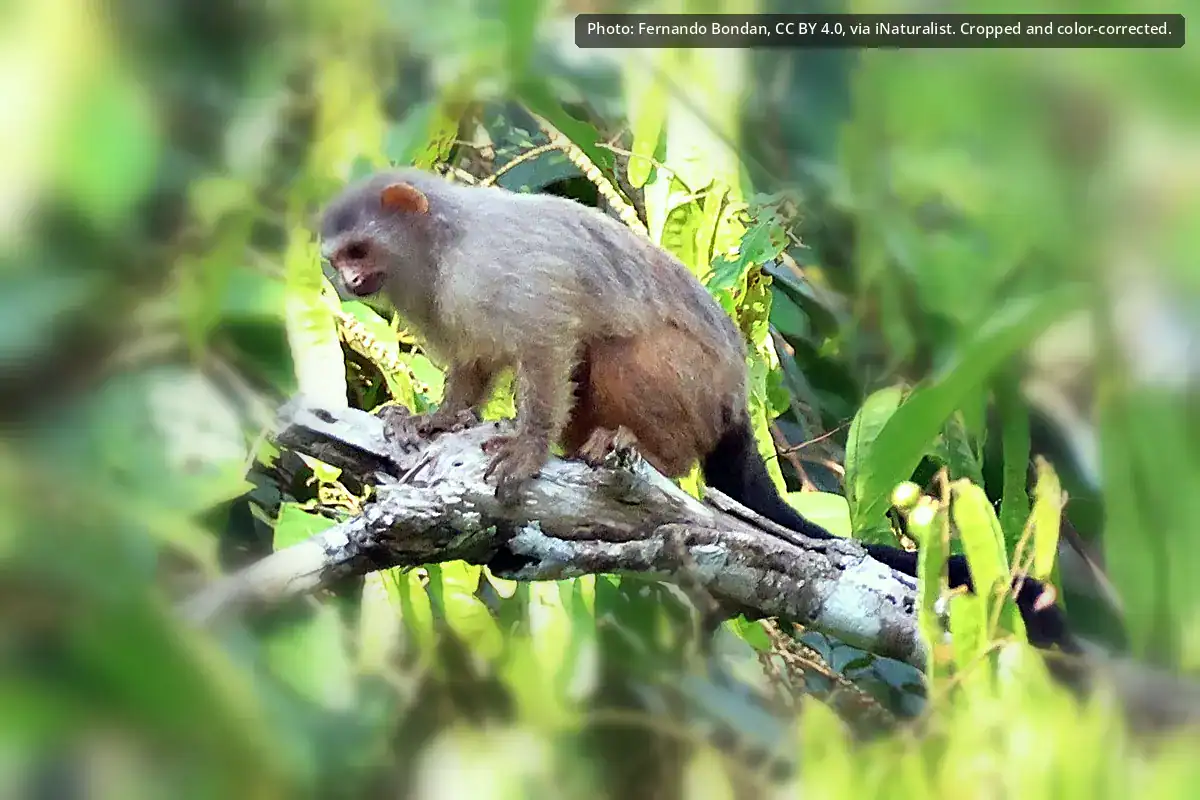
The Marca's marmoset is a small monkey of the southern Amazon. Its scientific name is Mico marcai. It lives only in Amazonas State, Brazil. That makes it one of the Brazilian monkeys. It is also one of the New World monkeys. The IUCN lists it as Vulnerable.[1]
This Vulnerable marmoset lives only in Brazil's southern Amazon.
- Common NamesMarca's marmoset, Roosevelt-Rondon expedition marmoset, sagüi de Marca
- Taxonomy Classification Year1993
- Monkey SizeAbout 22 cm (9 in) head and body, with a 36 cm (14 in) tail
- Skin Color(s)Light gray head with a black crown, blackish gray mantle, black tail
- HabitatDense lowland rainforest of the southern Amazon
- DietNot studied; marmosets eat fruit, gums, nectar and small prey
- Native CountriesBrazil
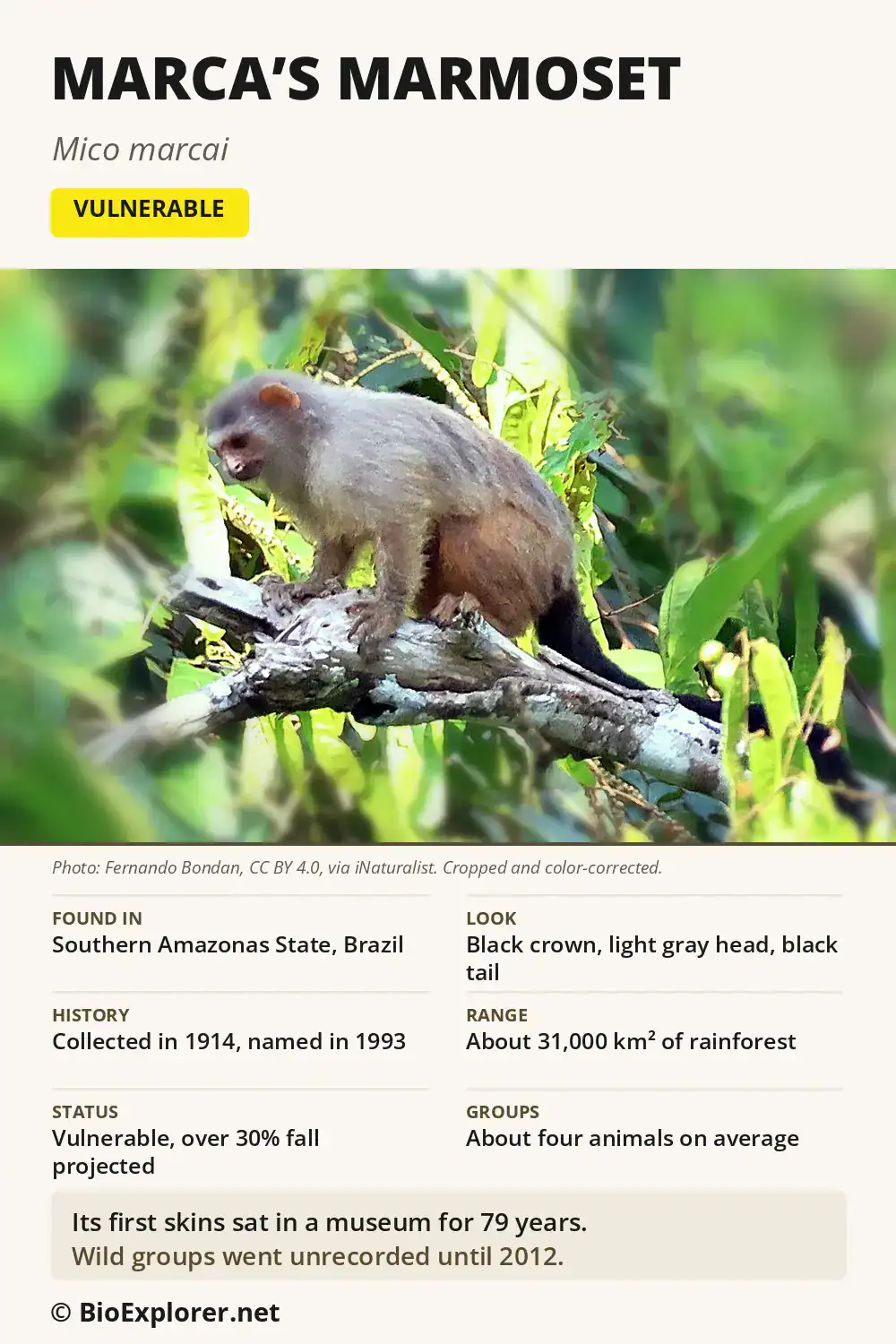
- It was first collected in 1914, on the Roosevelt-Rondon expedition.
- The specimens sat unnamed in a museum for 79 years.
- Field teams first recorded it in the wild in 2012.
- Field surveys found groups of about four animals on average.
- Its range covers an estimated 31,073 km² of Amazon forest.
Marca's Marmoset Distribution
 )
Marca's Marmoset Guide:
Name and Classification
Alperin named it in 1993. He first called it a subspecies of the silvery marmoset. Its original name was Callithrix argentata marcai.[2] In 2000, scientists raised it to a full species. They also moved it to the genus Mico.
The holotype is specimen MN 2856.[3] The Roosevelt-Rondon expedition collected it in 1914.[4] The skins then sat in the museum for 79 years.
Its type locality is the mouth of the Rio Castanho. Alperin treated that name as an old name for the Rio Roosevelt.[5] Other authors read the Castanho as a tributary of the Roosevelt. Both readings place the locality near the Roosevelt-Aripuanã confluence.
A second marmoset, Mico manicorensis, was named in 2000. In 2014, Gustavo Garbino found no clear difference between the two.[6] He treated manicorensis as the same species. The Mammal Diversity Database follows him. A 2021 study called the question unsettled.[7] It said marcai, manicorensis and the black-headed marmoset look alike.
The same study placed it in one lineage with two relatives. Its closest relative is Schneider's marmoset, named in 2021. Next comes the black-tailed marmoset. A 2019 study sampled one Marca's marmoset.[8] That study named the Munduruku marmoset.
It belongs to the family Callitrichidae. It ranks among the marmoset monkeys.
Physical Description
The 2021 study scored its coat from skins and field material. The crown is black. The rest of the head is light gray. The mantle on the shoulders is blackish gray. The forearms are blackish light orange. The back and rump are a dark, speckled agouti. The underparts and feet are blackish ochre. The tail is black.
An older handbook described the three 1914 skins. It called the back brindled brownish. It said the legs, tail and head were chestnut. It noted no white thigh stripe and no white crown mark. The facial skin is dark, but paler around the muzzle.
That mix of tones fits two color groups. It counts among the gray monkeys. Its brownish back also places it among the brown monkeys.
Like other marmosets, it has claw-like nails on most digits. Only the big toe carries a flat nail.
Size and Weight
No measured series of wild animals has been published. The handbook gives a head-body length of about 22 cm. That is about 9 in. It gives a tail of about 36 cm, or 14 in. The tail is much longer than the body.
The handbook lists a weight of 280 to 310 g. That is about 10 to 11 oz. It gives no sample size or sex for these figures. When it was written, only the three old skins were known.
Similar Species Compared
Three other marmosets occur around its known range.
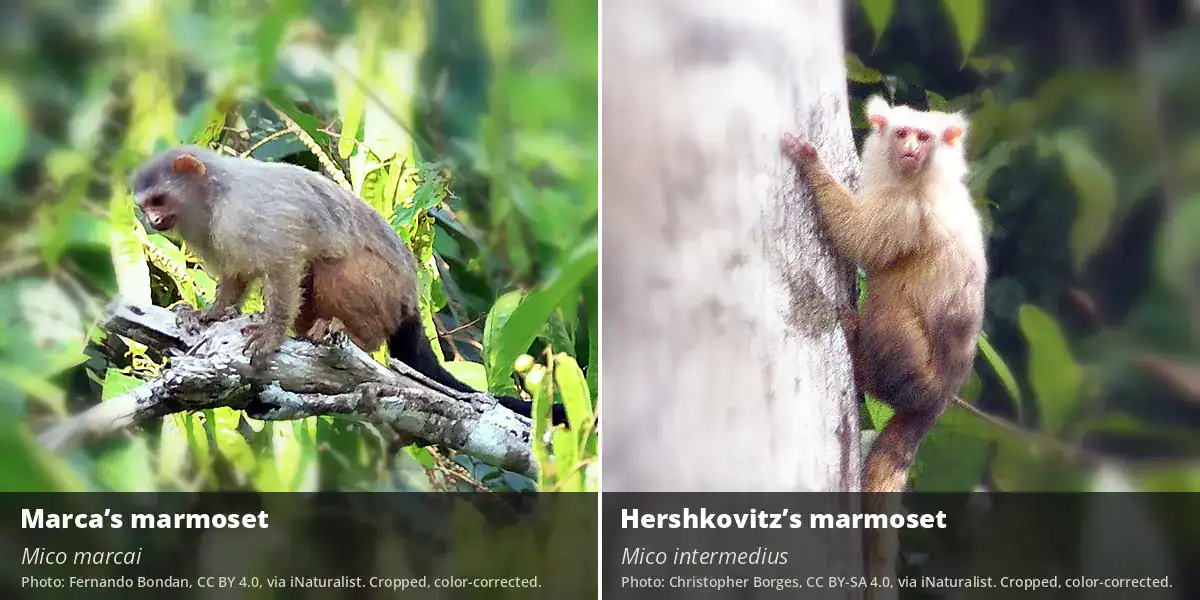
The black-headed marmoset lives west of the Rio Marmelos.[9] It also has a black crown and a black tail. Its back is brownish gray, and its hind legs are orange-red. It also has a thigh stripe. The IUCN lists it as Near Threatened.[10]
Hershkovitz's marmoset lives across the Rio Roosevelt.[11] It looks quite different. Its forequarters are whitish, and its tail is pale off-white. It has a golden-yellow thigh stripe. Genetic work puts it in another lineage. The IUCN lists it as Least Concern.[12]
Across the lower Aripuanã lives the gold-and-white marmoset. Its head is white, with white, fan-like ear tufts.[13]
| Trait | Marca's marmoset | Black-headed marmoset | Hershkovitz's marmoset |
|---|---|---|---|
| Scientific name | Mico marcai | Mico nigriceps | Mico intermedius |
| Range | Between the Aripuanã and Marmelos rivers, Amazonas | Between the Marmelos, Madeira and Ji-Paraná rivers | Between the Roosevelt and Aripuanã rivers |
| Habitat | Dense lowland rainforest | Lowland rainforest and forest edge | Primary and secondary rainforest |
| Coat and key marks | Black crown, light gray head, black tail, no white thigh stripe | Black crown and tail, orange-red hind legs, thigh stripe | Whitish forequarters, golden thigh stripe, pale tail |
| Head and body | About 22 cm (handbook) | 21.1 cm, average of six | 20 to 24 cm |
| Tail | About 36 cm (handbook) | 33.2 cm, average of six | 32 to 40 cm |
| Weight | 280 to 310 g (handbook) | 380 g, three males | 400 to 450 g, adults |
| Diet | Not studied | Fruit, nectar, gums and small prey | Fruit, gums, nectar and small prey |
| Group size | 4.09 on average, range 1 to 11 | 4 to 15 (IUCN) | 8 to 15, average 11.5 |
| IUCN status | Vulnerable (assessed 2021) | Near Threatened (assessed 2015) | Least Concern (assessed 2015) |
Range and Distribution
It lives in the south of Brazil's Amazonas State. Its range lies between the Rio Aripuanã and the Rio Marmelos. The Rio Madeira bounds it to the north. The southern boundary near Campos Amazônicos National Park remains unclear.
Silva and colleagues gave the first field data on its range. From 2012, observers found groups at 13 localities. They found them on the left banks of the Aripuanã and Roosevelt. They also found them on both banks of the Rio Manicoré. So the Manicoré is not a barrier for this marmoset. Groups also lived on both banks of the Rio Branco. It feeds the Marmelos.
The study estimated its extent of occurrence at 31,073 km². That is about 12,000 square miles. The IUCN calls the southern limit unclear. The marmosets south of the park have uncertain taxonomy.
It shares this forest with Roosmalens' dwarf marmoset. The IUCN says it went unrecorded in the wild until 2012.
Habitat Needs
It lives in dense lowland rainforest. That places it among the types of rainforest monkeys. The survey area mixes upland terra firme forest and seasonally flooded forest. Patches of pioneer and savanna-like plants also occur there.
The climate is hot and wet. Mean annual temperature is about 28 °C, or 82 °F. Rain totals 2,500 to 3,000 mm a year. The dry season runs from July to September.
Diet and Behavior
The IUCN says no behavioral or ecological field studies exist for it. So its diet, breeding and home range are unknown.
Other marmosets give some clues. They eat fruit, flowers, nectar, gums and small animals. Prey includes insects, spiders, frogs and lizards. Marmosets gouge bark to start gum flowing. That mixed diet fits the omnivorous monkeys. Marmosets usually live in family groups, with one breeding female. These are genus-level patterns, not data for this species.
The only field data cover group size and density. Surveyors counted groups of 4.09 animals on average. Groups ranged from one to 11 animals. They estimated 8.31 marmosets per km².
Field teams have played back its long calls. The calls draw marmosets closer.
Threats and Conservation
The IUCN listed it as Data Deficient until 2020. In 2021, it moved the species to Vulnerable. The assessment dates from 14 August 2021. It rests on a projected fall of over 30% within 18 years.
Silva and colleagues modeled about 258,218 marmosets. The confidence interval ran from 150,705 to 441,860. Forest loss had already removed 1,266.23 km² by 2017. That was 4% of its range.
The study modeled two futures to 2035. With better governance, 5,800 km² of forest would go. That is 19% of the range. Under business as usual, 10,396 km² would go. That is 33% of the range. The IUCN judged business as usual the more likely path.
The Trans-Amazonian Highway, BR-230, crosses its range. Near Apuí, Novo Aripuanã and Manicoré, logging and cattle ranching dominate. The 2020 study cited four planned dams. It projected 1,118.42 km² of flooding. The 2021 IUCN assessment cited seven approved schemes. Their reservoirs would flood 900 km². Assessor F. E. Silva has seen it kept as a pet. The IUCN also says it is occasionally hunted.
Part of its range lies in protected areas and Indigenous lands. The survey worked in the Juma Sustainable Development Reserve. It is listed on CITES Appendix II.
Explore more monkeys starting with M. Or browse all types of monkeys.
Common Questions
The Marca's marmoset lives in Amazonas State, Brazil. Its range lies between the Aripuanã and Marmelos rivers.
The IUCN lists the Marca's marmoset as Vulnerable. Its 2021 assessment projects a fall of over 30%.
The Marca's marmoset has a black crown and a light gray head. Its mantle is blackish gray, and its tail is black.
A handbook gives the Marca's marmoset a head-body length near 22 cm. Its tail is about 36 cm.
The diet of the Marca's marmoset has not been studied. Related marmosets eat fruit, gums, nectar and small prey.
Distance sampling in 2015 estimated about 258,218 Marca's marmosets. This was an estimate, not a census. The confidence interval was 150,705 to 441,860.
Cite this page
BioExplorer. (2026, November 8). Marca’s Marmoset. https://www.bioexplorer.net/animals/mammals/monkeys/marcas-marmoset/
About the author

Wildlife Writer and Photographer, BioExplorer.net
Arjun is a science writer and wildlife photographer at BioExplorer.net. He turns new research on animals into clear, accurate reads for curious readers. His work covers animal behavior, ecology, and newly described species. He holds a Cornell Lab of Ornithology certificate in bird biology. He is pursuing an HBSc at the University of Toronto Mississauga.