
Black Titi
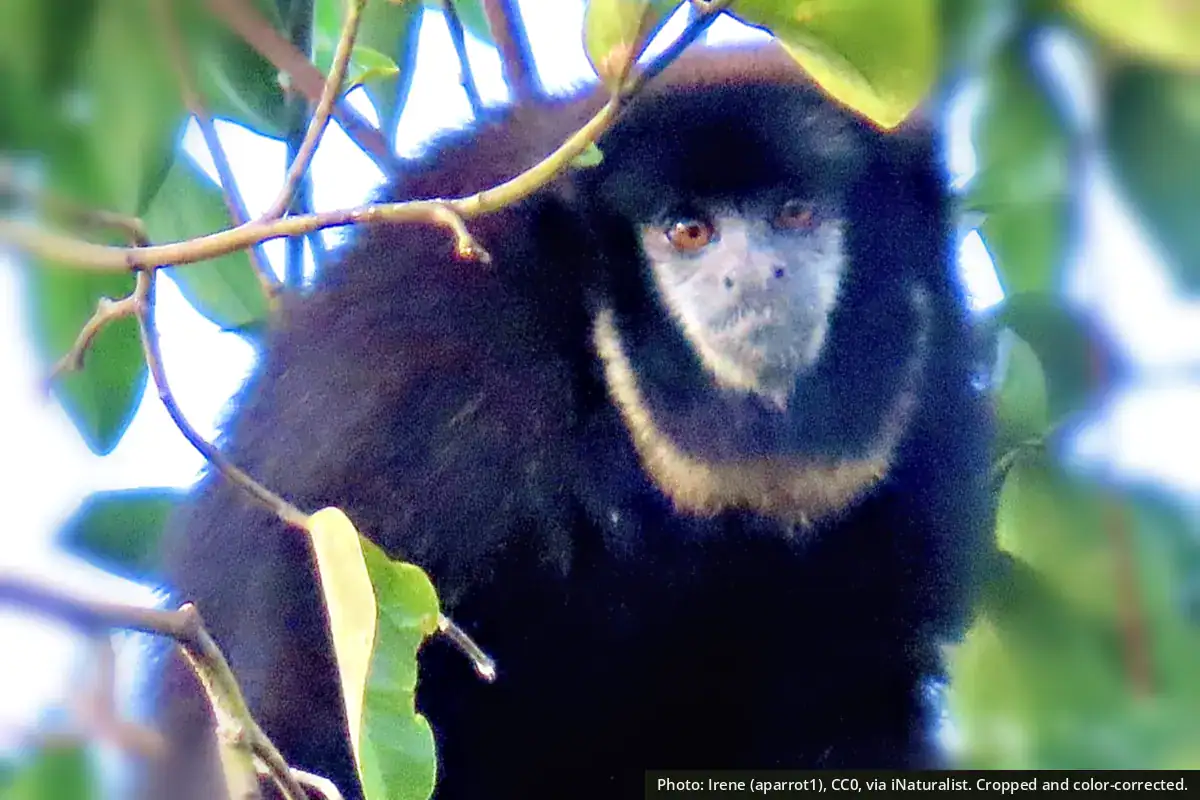
The black titi is a small, dark monkey of the northern Amazon. Its scientific name is Cheracebus lugens. It lives in Colombia, Venezuela and northwestern Brazil. It is one of the New World monkeys. The IUCN lists it as Least Concern.[1]
This Least Concern titi lives in remote northern Amazon forests.
- Common NamesBlack titi, white-chested titi, widow monkey, white-handed titi
- Taxonomy Classification Year1812
- Monkey SizeMales 31.2 to 35.5 cm (12.3 to 14 in), head and body
- Skin Color(s)Blackish, with pale hands and a whitish throat and chest
- HabitatLowland and hill rainforest, 100 to 1,000 m
- DietMostly fruit and immature seeds, plus leaves and flowers
- Native CountriesColombia, Venezuela, Brazil
- Alexander von Humboldt described it from a captive animal.
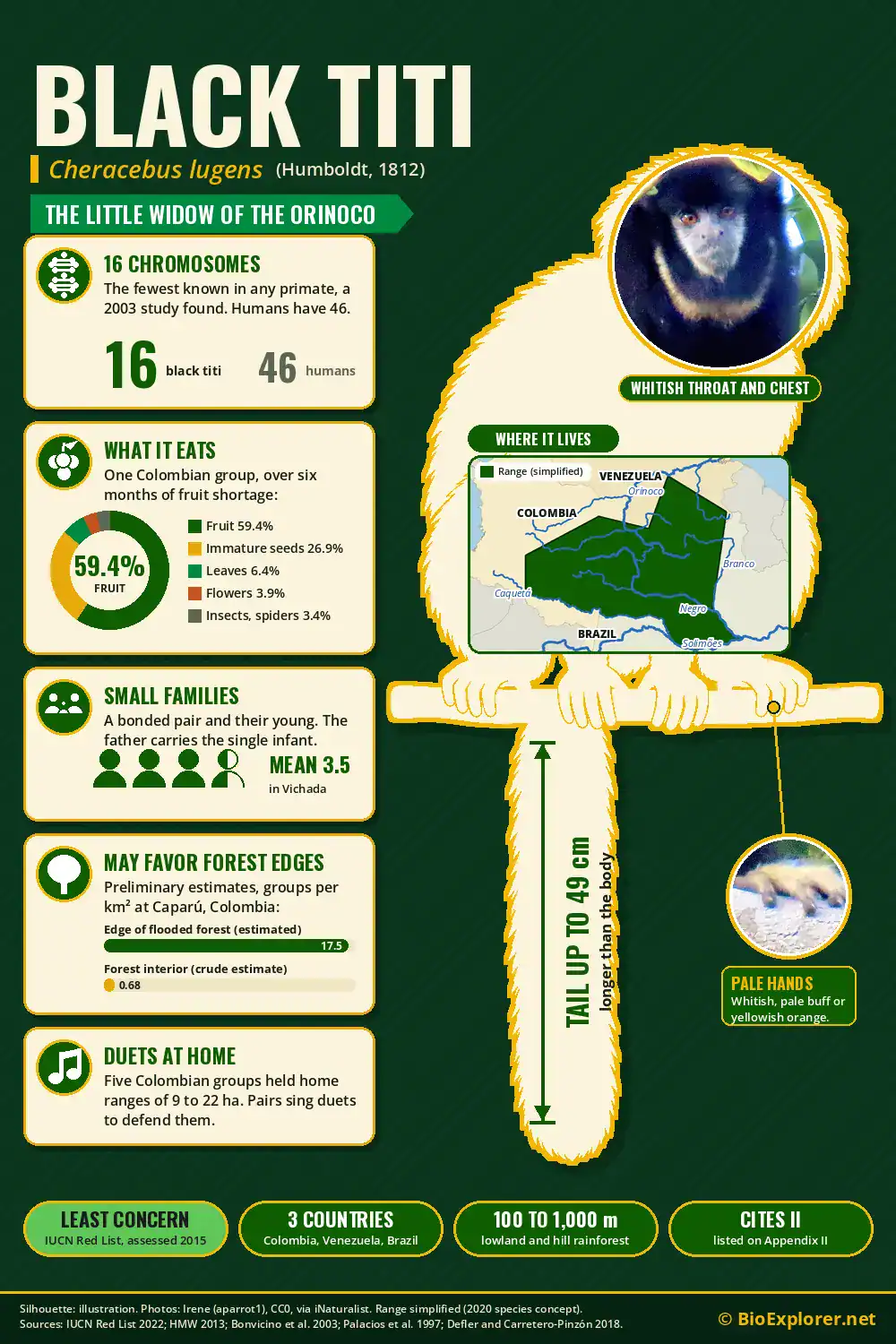
- Its 16 chromosomes are the fewest known in any primate.
- It has the largest range of any widow monkey.
- Pairs live in small family groups of about three or four.
- The father carries the single infant.
Black Titi Distribution
 )
 )
 )
Black Titi Guide:
Name and Classification
Alexander von Humboldt described it as Simia lugens.[2] He described it from a captive animal on the upper Orinoco. No type specimen survives. The type locality is near San Fernando de Atabapo, in Venezuela. There, the Orinoco meets the Guaviare.
The Mammal Diversity Database dates the name to 1812. Many authors, and the IUCN, give 1811. Humboldt's work appeared in two printings, so both dates circulate.
The Latin word lugens means "mourning". Missionaries on the Orinoco called the monkey "viudita", the little widow.[3] Its pale face recalled a widow's veil. Its collar and hands recalled a neckerchief and gloves.
For decades, it was a subspecies of the collared titi. Its name then was Callicebus torquatus lugens.[4] Van Roosmalen and colleagues raised it to a full species in 2002.[5]
In 2016, Byrne and colleagues split the old titi genus into three. They named a new genus, Cheracebus, for these widow monkeys. They chose this species as its type species. Cheracebus means "widow monkey". The team dated the genus to about 11 million years ago.
A 2020 study then redrew the species lines.[6] It placed every Cheracebus north of three rivers in this species. Those rivers are the Solimões, Japurá and Caquetá. That included animals long called collared titis. The name C. torquatus now belongs to a titi south of the Solimões.
Physical Description
Males and females look alike in size and color. The coat is mostly blackish. The back and sides can show some dark chestnut. That mix places it among the black monkeys and the brown monkeys.
The throat and upper chest are whitish. A white band runs up to the chin. That pale bib explains another name, the white-chested titi. It also counts among the white monkeys on this site.
The hands are pale. The handbook calls them whitish or pale buff. Hershkovitz described them as golden or yellowish orange. Humboldt saw white hands with black palms.
Coat color varies a lot across the range. The 2020 study found backs from blackish to dark reddish brown. Some animals have only a weak, diffuse collar.
Size and Weight
The handbook gives males 31.2 to 35.5 cm in head and body. That is 12.3 to 14 in. Females measure 30 to 40 cm, or 11.8 to 15.7 in.
The tail is longer than the body. It runs 42 to 48.5 cm in males. That is 16.5 to 19.1 in. Females have tails of 41 to 49 cm.
The handbook estimates 1,000 to 1,500 g. That is about 2.2 to 3.3 lb.
Chromosomes and Genes
This titi holds a primate record. It has just 16 chromosomes in each body cell.[7] That is the lowest number known in any primate. A 2003 study reported it.
Humans have 46 chromosomes. Lucifer titis have 20 chromosomes, Byrne's team noted. Chromosome painting showed that fusions shaped its karyotype.[8]
Animals from both banks of the Rio Negro share 16 chromosomes.[9] Their DNA still differs. A 2020 study found a 1.47% genetic distance between them.[10] It called a new species there possible, but premature.
Similar Species Compared
Four widow monkeys can confuse readers. Rivers separate them better than coat colors.
The collared titi now lives only south of the Solimões, in Brazil.[11] It has a bright red crown and a distinct collar. Its hands are yellow-whitish.[12]
The Lucifer titi lives south of the Caquetá and Japurá.[13] Its hands are often yellowish orange. Yet some have blackish hands, the 2020 study found. Its white collar reaches the ears. The IUCN lists it in Colombia, Ecuador, Peru and Brazil.[14]
The Colombian black-handed titi lives just across the Río Caquetá.[15] Its hands are usually blackish. The 2020 study calls its validity uncertain. The river keeps the two apart.[16]
The newest widow monkey is Aquino's titi, described from Peru in 2022.
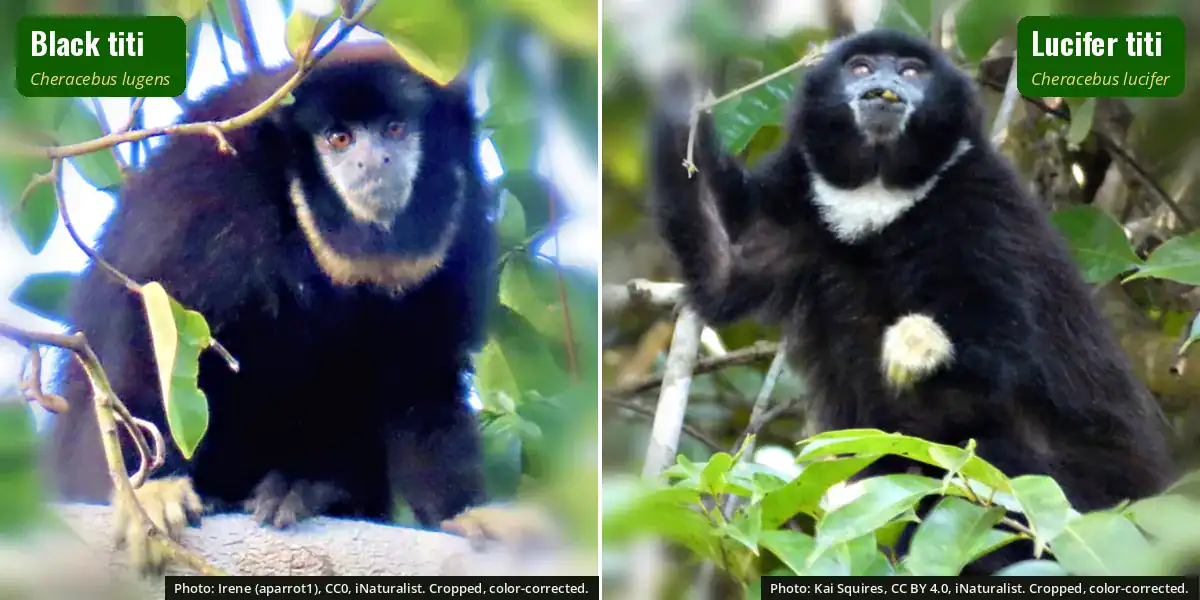
| Trait | Black titi | Collared titi | Lucifer titi | Colombian black-handed titi |
|---|---|---|---|---|
| Scientific name | Cheracebus lugens | Cheracebus torquatus | Cheracebus lucifer | Cheracebus medemi |
| Range | Colombia, Venezuela and Brazil, north of the Solimões, Japurá and Caquetá | Brazil only, south of the Solimões, between the Juruá and Purus | Colombia, Ecuador, Peru and Brazil, south of the Caquetá and Japurá | Colombia only, between the Caquetá and Putumayo |
| Habitat | Lowland and hill forest, 100 to 1,000 m; terra firme, white sand, várzea | Igapó and terra firme, 100 to 200 m | Tall terra firme and white-sand forest, 100 to 300 m | Lowland rainforest, 100 to 450 m |
| Coat and key marks | Blackish, some chestnut; pale hands; whitish throat and chest | Dark reddish brown; red crown; yellow-whitish hands; collar to the ears | Blackish; hands often yellowish orange, sometimes blackish; white collar to the ears | Blackish, including the hands; white throat |
| Head and body | Males 31.2 to 35.5 cm; females 30 to 40 cm | Males 40 to 46 cm; females 36.8 to 42 cm | Males 36 to 39 cm; females 34.9 to 41 cm | Females 23.2 to 36 cm |
| Tail | Males 42 to 48.5 cm; females 41 to 49 cm | Males 39 to 47 cm; females 37 to 50 cm | Males 46.5 to 48 cm; females 45 to 45.6 cm | Females 42.5 to 49.3 cm |
| Weight | Estimated 1,000 to 1,500 g | Not known | Male 1,500 g | Females 1,151 to 1,462 g |
| Diet | One group: 59.4% fruit, 26.9% immature seeds | Not known | 67 to 74% fruit; 14 to 16% arthropods | Not known |
| Group size | Mean 3.5 in Vichada | Mean 3.3 at Lago Uauaçú | Up to 5 | Not known |
| IUCN status | Least Concern (assessed 2015) | Least Concern (assessed 2022) | Least Concern (assessed 2015) | Vulnerable (assessed 2015) |
Range and Distribution
It has the largest range of any Cheracebus species. It spans three countries: Colombia, Venezuela and Brazil.
In Colombia, it lives east of the Andes. It ranges from the Río Tomo south to the Caguán and Caquetá. It covers Vichada, Guainía, Guaviare and Vaupés. It also reaches eastern Meta and eastern Caquetá.
In Venezuela, it lives in southern Amazonas State. It also lives in Bolívar State, between the Caura and Caroní rivers.
In Brazil, it lives in Amazonas and Roraima states. Van Roosmalen observed it west of the Branco, near Mount Roraima. Most records there lie north of the Rio Negro. Casado and colleagues first reported it south of the Negro, at Barcelos.
Colombia holds most of its records. Of 183 GBIF records in November 2026, 112 came from Colombia.[17] Another 42 came from Brazil.
At its northwest edge, it meets the ornate titi. Hershkovitz found the two together on the Río Guayabero, in Meta. He called the overlap slight.
Habitat Needs
It lives in lowland and hill rainforest, from 100 to 1,000 m. That makes it one of the types of rainforest monkeys. It uses terra firme forest, white-sand forest and flooded várzea.
Preliminary Colombian data suggest it favors forest edges. At Caparú, in Vaupés, groups lived along blackwater flooded forest.[18] Yet they very rarely entered that flooded forest itself.
Estimated edge density reached 17.5 groups per km² at Caparú. Interior crude density was 0.68 groups per km². Gallery forest at El Tuparro held 8 groups per km².
Thomas Defler found Colombian widow monkeys did not depend on white sand.[19] They used tall, layered upland and flooded forests on many soils.
Diet and Feeding
Eduardo Palacios and colleagues followed one group in eastern Colombia.[20] They watched it for six months, during the yearly fruit shortage. Fruit made up 59.4% of its diet. Immature seeds added 26.9%. Leaves made up 6.4%, and flowers 3.9%. Insects and spiders made up just 3.4%.
The group ate 62 plant species. Nutmeg-family trees led its menu, at 25% of feeding time. The authors called it a frugivore-granivore, like sakis and uakaris.
The handbook sums up two Colombian studies at 82 to 86% fruit. In one study, seeds reached 48% of the diet. That is the highest share recorded for any titi.
Such a menu places it among the frugivorous monkeys. Its insects and spiders also earn it a place with omnivorous monkeys.
A 2012 study watched how it handles fruit.[21] It ate 69 plant species, mostly the fleshy parts. It dropped or spat out most seeds near the parent tree. Fruit ripeness was linked to which parts it ate.
Behavior and Family Life
The black titi is active by day and lives in the trees. One Colombian group spent 54% of its time resting. It spent 23% moving and 18% feeding.
Groups are a bonded pair and their young. The mean group size in Vichada was 3.5. The largest groups reach five.
Five Colombian groups held home ranges of 9 to 22 ha. Pairs sing duets to defend their ground. Even so, neighbors' ranges can overlap by up to 40%.
Pairs are monogamous. The father carries the single infant. In Colombia, births peak in January. Females are usually pregnant during the yearly fruit shortage.
Population and Status
The IUCN lists the black titi as Least Concern. The assessment dates from 26 January 2015 and was republished in 2022. The IUCN flags it as needing an update.
The 2015 IUCN assessment gives no population estimate. It calls the trend unknown. It points to protected areas and no evidence of decline.
Brazil's national assessment, dated 2019, also rates it Least Concern.[22] It found no threats likely to endanger it soon.
Threats and Conservation
Its range covers some of the most remote forest in Amazonia. The IUCN knows of no major threats to it.
Local people do not target it, given its small size. Yanomami hunters take widow monkeys for meat. They do so only when preferred species are not found.
It lives in many protected areas. In Colombia, they include El Tuparro, Chiribiquete, Puinawai and Nukak. In Brazil, they include Pico da Neblina and the Yanomami Indigenous Territory. In Venezuela, they include Serranía de la Neblina.
It is listed on CITES Appendix II. The IUCN calls for research on its numbers and ecology.
Other primates share its forests. At Caparú, Defler counted eight species in one community.[23] They include the Humboldt's woolly monkey and the black uakari. The red howler monkey lives there too. So does Humboldt's white capuchin.
Its range includes Brazil, so it counts among the Brazilian monkeys. Explore more monkeys starting with B. Or browse all types of monkeys.
Common Questions
The black titi lives in Colombia, Venezuela and northwestern Brazil. It ranges north of the Solimões, Japurá and Caquetá rivers.
No. The IUCN lists the black titi as Least Concern. Its remote range faces no known major threats.
The black titi is mostly blackish, with some chestnut on the back. It has pale hands and a whitish throat and chest.
The black titi eats mostly fruit and immature seeds. It also eats leaves, flowers, insects and spiders.
The black titi has 16 chromosomes. That is the lowest number known in any primate.
Male black titis measure 31.2 to 35.5 cm, head and body. Their tails reach 48.5 cm.
Missionaries called the black titi the little widow. Its pale face recalled a widow's veil. Its collar and hands recalled a neckerchief and gloves.
The black titi is Cheracebus lugens. Humboldt first named it Simia lugens.
Cite this page
BioExplorer. (2026, November 18). Black Titi. https://www.bioexplorer.net/animals/mammals/monkeys/black-titi/
About the author

Wildlife Writer and Photographer, BioExplorer.net
Arjun is a science writer and wildlife photographer at BioExplorer.net. He turns new research on animals into clear, accurate reads for curious readers. His work covers animal behavior, ecology, and newly described species. He holds a Cornell Lab of Ornithology certificate in bird biology. He is pursuing an HBSc at the University of Toronto Mississauga.