
Barbara Brown’s Titi
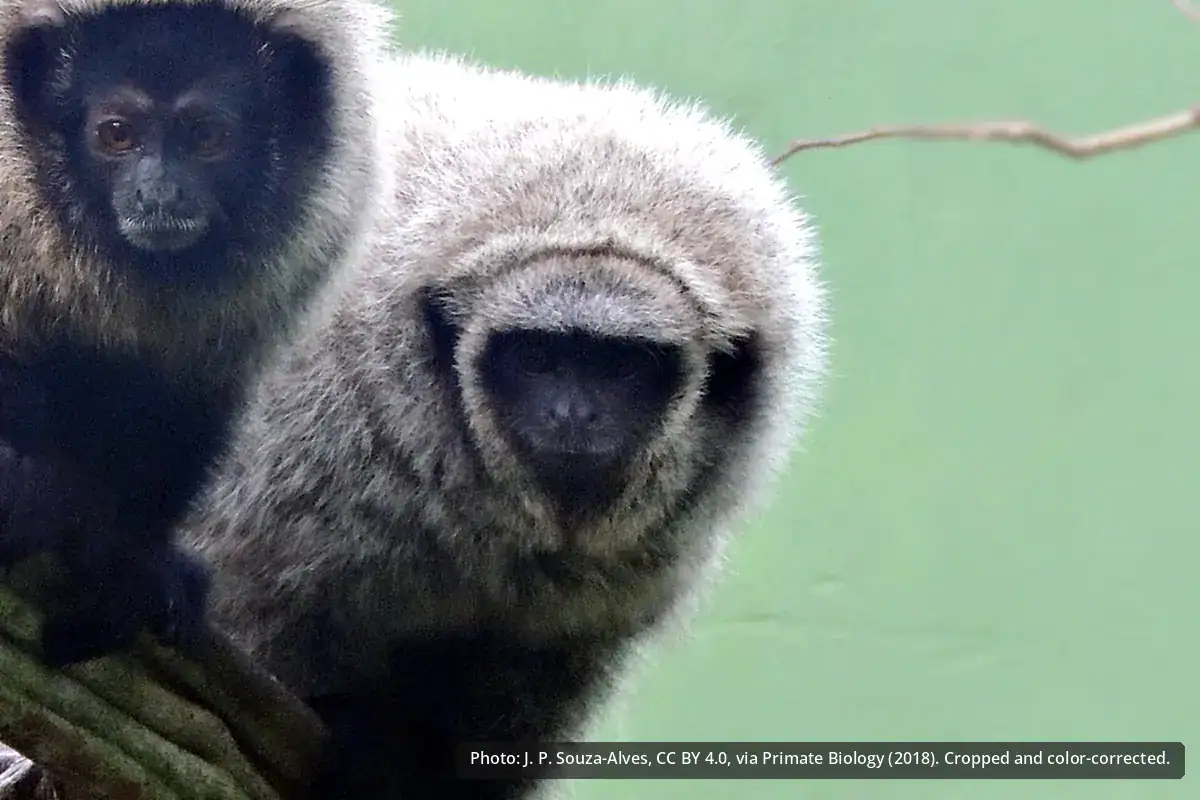
The Barbara Brown's titi is a small, pale monkey of northeastern Brazil.[1] Its scientific name is Callicebus barbarabrownae. It is also known as the blond titi. It lives in the Caatinga region of Bahia and Sergipe. The IUCN lists it as Critically Endangered.[2]
This Critically Endangered titi lives only in northeastern Brazil's Caatinga region.
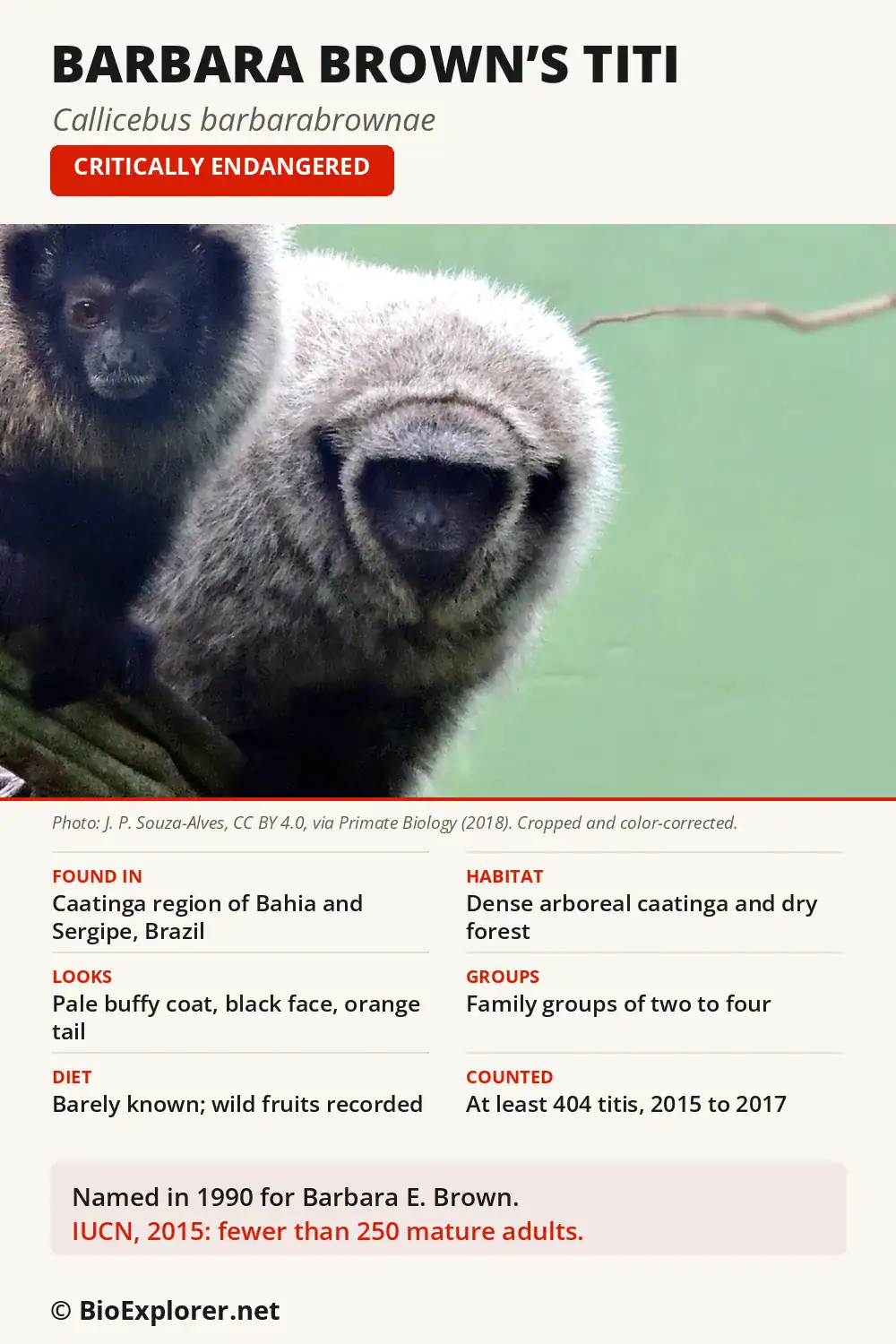
- Common NamesBarbara Brown's titi, blond titi, northern Bahian blond titi, guigó-da-caatinga
- Taxonomy Classification Year1990
- Monkey SizeFemales 33 to 36 cm (13 to 14 in) in head and body; tail about 39.5 to 43 cm (15.6 to 16.9 in)
- Skin Color(s)Pale buffy to silvery body, black face, hands and feet, orange tail
- HabitatDense arboreal caatinga and dry forest, about 240 to 900 m
- DietPoorly known; fruits of Capparis and Manilkara recorded
- Native CountriesBrazil
- It is the palest member of the masked titi group.
- Its face, hands and feet are black, and its tail is orange.
- It lives in dense, tree-filled caatinga and dry forest patches.
- Family groups usually hold two to four titis.
- The IUCN's 2015 assessment inferred fewer than 250 mature adults.
Barbara Brown's Titi Distribution
 )
Barbara Brown's Titi Guide:
Name and Classification
Philip Hershkovitz described this titi in 1990.[3] He named it Callicebus personatus barbarabrownae, a subspecies of the masked titi. His type specimen came from Lamarão, Bahia. It sat about 300 m (980 ft) above sea level. A collector named A. Robert took it in June 1903.
The name honors Barbara E. Brown. She was an Associate of the Field Museum in Chicago. Hershkovitz thanked her for years of support to its Division of Mammals.
Later work raised it to a full species.[4] It belongs to the personatus group of Atlantic Brazil. A 2016 genetic study kept the genus Callicebus for this group alone.[5]
Its group also includes the Atlantic titi and black-fronted titi. The coastal black-handed titi belongs to the group too. So does the Coimbra Filho's titi.
The name may not last. In 1823, Johann Baptist von Spix published a plate of Callithrix gigot. Hershkovitz judged that the plate shows this species. The IUCN notes barbarabrownae may prove a junior synonym of gigot.
Like all titis, it is one of the New World monkeys. It also appears among monkeys starting with B. Meet its relatives in our guide to all types of monkeys.
Other Common Names
The IUCN and Mammal Diversity Database call it blond titi monkey. The database also lists northern Bahian blond titi. In Brazil, it is the guigó-da-caatinga.
Physical Description
Hershkovitz called it the palest member of its species group. Its coat runs buffy to silvery. Pale fur covers the forehead, crown and throat. The hairs carry only fine blackish tips.
Its pale, buffy coat earns the name blond titi. That places it among the yellow monkeys.
The back and sides look pale buff. Blackish hair bases show through the fur. The chest and belly are almost all buffy. The face, hands and feet are black. The ear tufts are blackish too.
The tail stands out. It ranges from dark orange to rich chestnut. That bright tail counts it among the orange monkeys.
Field teams have seen at least three color forms. They range from mostly grayish to mostly brownish. Grayer animals fit among the gray monkeys. Browner ones join the brown monkeys.
Size and Weight
Published measurements cover females only. Head and body measure 33 to 36 cm (13 to 14 in). The tail runs about 39.5 to 43 cm (15.6 to 16.9 in). No male measurements are available.
No adult has been weighed in a published study. One handbook guesses about 1 to 1.3 kg (2.2 to 2.9 lb). The sexes look alike.
Range and Distribution
This titi lives only in Brazil. It is endemic to the Caatinga, the dry biome of the northeast. It counts among the Brazilian monkeys found nowhere else.
Until 2004, science knew it from just four places. All lay in Bahia: Lamarão, Formosa, Bandeira de Mello and Mirorós. A 2004 and 2005 survey spent 130 days in the field.[6] It found the titi at 37 new localities.
That survey set its range limits. Serra do Minuim marked the north. Coronel João Sá, on the Sergipe border, marked the east. Gentio do Ouro marked the west. The titis lived between 241 and 908 m (790 to 2,980 ft).
Its area of occupancy was just 2,636 km² (1,018 sq mi). The species occupies under 30% of the Caatinga.
Sergipe joined the range later. A 2013 study added seven records in northern Sergipe.[7] They extended its Sergipe range by over 50 km (31 mi).
Habitat Needs
The blond titi needs trees. It lives mainly in dense arboreal caatinga, a closed dry forest. It also uses highland coastal forest in eastern Bahia. The 2004 and 2005 survey found none in shrubby caatinga. The IUCN still lists dry shrubland as suitable habitat.
Its habitat is naturally patchy. Tall dry forest forms islands within open, thorny scrub. In Chapada Diamantina, it lives in semi-deciduous forest.[8] Groups favored taller forest. Every titi seen there was more than 10 m (33 ft) up.
The survey's authors say ranching favors forest patches more than crops. Ranching was the main activity on 28% of occupied farms. On farms without titis, the figure was 15%.
Diet and Feeding
Its diet is barely known. A 2013 handbook said no information was available. Field teams have since found a few clues.
In Banzaê, Bahia, researchers found fresh bite marks on wild fruits.[9] The fruits came from Capparis and Manilkara trees. Local people also say the titis eat Manilkara fruit.
Behavior and Groups
The blond titi lives in small family groups. Each holds an adult pair and their young. Groups usually number two to four titis.
Pairs are monogamous. The male helps raise the young, mainly by carrying the infant.
Titis are hard to see but easy to hear. Pairs give loud calls, mostly in the morning. Detection probability was four times higher before midmorning.[10]
Home ranges may be large for a titi. Two pairs shared one isolated 115 ha (284 acres) fragment in Sergipe. That suggests each pair uses more than 50 ha (124 acres).
A captive female showed another habit.[11] She rubbed squeezed Bauhinia plant material on her chest and belly. Rescued from the illegal pet trade, she lived in Salvador's zoo park.
Population and Status
Counting this titi is hard. Older surveys combined interviews, sightings and some playback. Newer surveys play recorded calls at set points.
The 2004 and 2005 survey logged 65 groups, by sight or call. Assuming four titis per group gave at least 260 animals. The authors called it a minimum and likely an underestimate.
Later work found more. Models estimated 91 groups in one 221 km² (85 sq mi) area. Assuming three adults per group gave 273 adults. A 2015 to 2017 reassessment found 194 groups.[12] It counted at least 404 individuals.
The IUCN lists it as Critically Endangered under criterion C2a(i). It infers fewer than 250 mature adults. No subpopulation holds more than 50 mature adults. That assessment dates from January 2015. The IUCN marks it as needing an update.
It was listed as Endangered in 1994. It has been Critically Endangered since 1996. Brazil also lists it as Critically Endangered.[13] It is on CITES Appendix II.
Major Threats
From 2005 to 2016, forest cover in its range fell 11%. Urban area grew 67% over the same years.
Cattle ranching, farming and growing towns drive most losses. A dense road network speeds development. Titis have vanished near Feira de Santana and Serrinha.
Dogs, power lines and roads also pose dangers. Hunters take titis too. In Chapada Diamantina, researchers met armed hunters eight times. One hunter carried a dead titi near Lençóis.
Climate change adds pressure. Models project a third of suitable area lost within 50 years.[14] Only about a quarter of known populations may be viable.
People also keep titis as pets. Surveys found a few animals in homes.
Conservation Efforts
For years, no protected area was known to hold the species. The 2004 and 2005 survey found none.
That has changed. In 2014, researchers reported it in the Marimbus-Iraquara Environmental Protection Area. The 2015 to 2017 reassessment recorded it in three protected areas.
Chapada Diamantina National Park now looks vital. A 2021 to 2023 project surveyed 212 playback sites there.[15] Its grant report estimates 873 titis in the park.
The report calls the park its only strictly protected home.
Common Questions
The Barbara Brown's titi lives only in northeastern Brazil. It inhabits the Caatinga region of Bahia and Sergipe.
Yes. The IUCN lists the Barbara Brown's titi as Critically Endangered. Its 2015 assessment inferred fewer than 250 mature adults.
Hershkovitz named Barbara Brown's titi after Barbara E. Brown in 1990. She was an Associate of Chicago's Field Museum.
The Barbara Brown's titi has a pale buffy to silvery coat. Its face, hands and feet are black, and its tail is orange.
The diet of Barbara Brown's titi is barely studied. Researchers found Capparis and Manilkara fruits bearing fresh bite marks.
A 2015 to 2017 survey counted at least 404 Barbara Brown's titis. The IUCN's 2015 assessment inferred fewer than 250 mature adults.
Cite this page
BioExplorer. (2026, November 2). Barbara Brown’s Titi. https://www.bioexplorer.net/animals/mammals/monkeys/barbara-browns-titi/
About the author

Wildlife Writer and Photographer, BioExplorer.net
Arjun is a science writer and wildlife photographer at BioExplorer.net. He turns new research on animals into clear, accurate reads for curious readers. His work covers animal behavior, ecology, and newly described species. He holds a Cornell Lab of Ornithology certificate in bird biology. He is pursuing an HBSc at the University of Toronto Mississauga.