
Cell Biology
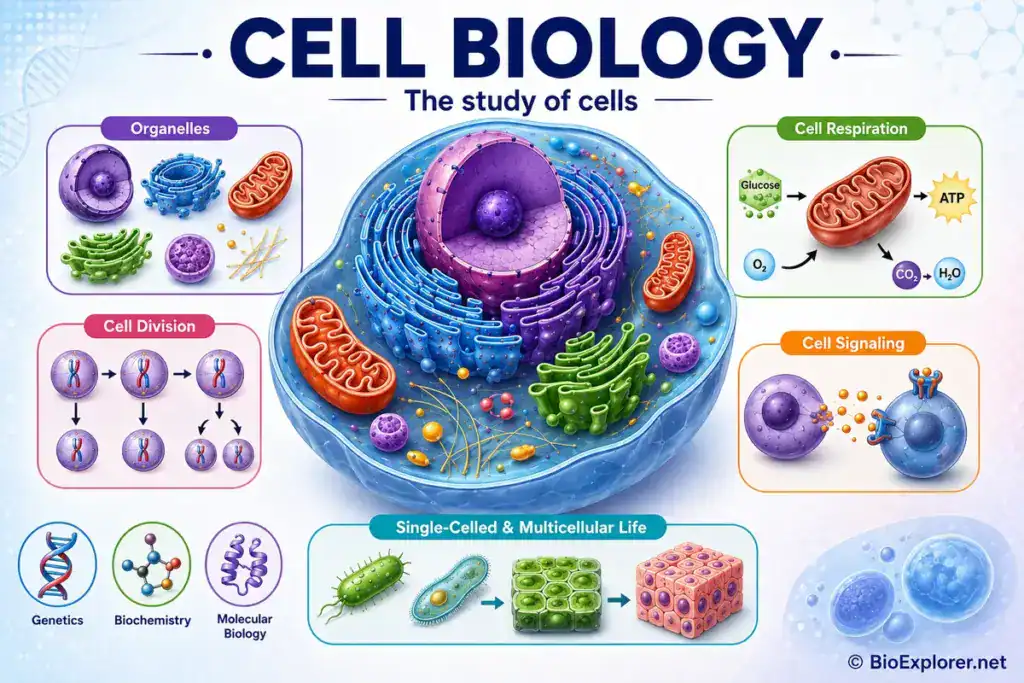
Cells are often described as the ‘basic unit of life‘. Cell biology is a sub-discipline of biological studies that deals with the study of cells in all aspects. From cell anatomy, cell death, cell respiration to the processes of cell divisions like mitosis and meiosis, cell biology covers all topics.
The Cell Biology Glossary explains key terms used in cell structure, organelles, membranes, cell division, transport, respiration, and cellular organization.
Cell Biology Guide:
- What Cell Biology Studies
- Why Cell Biology Matters
- Main Areas of Cell Biology
- Cell Biology vs Molecular Biology
- Cell Biology Articles on BioExplorer
- Cell Structure and Organization
- Organelles and Cell Components
- Cell Division and Chromosomes
- Cell Transport and Cellular Processes
- Specialized Cells and Tissues
- Stem Cells and Cell Specialization
- Cell Biology Learning Resources
- Related Biology Fields
- FAQs
- Recommended Cell Biology Resources
- Cell Biology Learning Resources
- Cell Images, Microscopy, and Visual Resources
- Advanced Cell Biology and Research Databases
Originally derived from the Greek word 'kytos' meaning contain, this area of biology strictly deals with the physiological properties of the cell, the organelles that present in these, cell structure, the pattern of interaction between cells and cell pathways.
The study of cells focuses on both single-celled organisms like bacteria and protozoa to complex, multi-cellular organisms like plants, animals and human bodies. Tracking down the nature of these cells, their functions and similarities and dissimilarities of cells in living organisms are all a part of the course.
What Cell Biology Studies
Cell biology studies cells, the basic structural and functional units of life. Every living organism is made of one or more cells, and cell biology explains how these cells are built, how they work, how they divide, and how they interact with their surroundings.
At the structural level, cell biology examines the cell membrane, cytoplasm, nucleus, mitochondria, ribosomes, endoplasmic reticulum, Golgi apparatus, lysosomes, vesicles, vacuoles, chromosomes, and other cellular components. These structures work together to keep the cell alive, organized, and responsive to change.
At the functional level, cell biology studies processes such as cellular respiration, protein synthesis, cell signaling, membrane transport, diffusion, osmosis, cell growth, cell specialization, mitosis, meiosis, and programmed cell death. These processes help explain how cells produce energy, pass genetic information, build proteins, repair damage, and form tissues.
Cell biology also compares different cell types. It explores how prokaryotic cells differ from eukaryotic cells, how plant cells differ from animal cells, and how specialized cells such as nerve cells, bone cells, skin cells, immune cells, and stem cells perform unique roles in the body.
Why Cell Biology Matters
Cell biology matters because nearly every major biological process begins at the cellular level. Growth, reproduction, healing, immunity, inheritance, development, aging, and disease all depend on how cells function.
In medicine, cell biology helps scientists understand cancer, infections, genetic disorders, immune responses, neurodegenerative diseases, infertility, and tissue damage. Many diseases begin when cells divide incorrectly, fail to communicate, lose control of gene expression, or stop performing their normal functions.
Cell biology also supports drug discovery and vaccine development. Researchers study how cells respond to chemicals, pathogens, antibodies, and genetic changes so they can design better treatments. Stem cell research, regenerative medicine, cancer biology, immunotherapy, and tissue engineering all depend heavily on cell biology.
In agriculture and biotechnology, cell biology helps scientists improve crops, study plant cells, understand microbial behavior, and develop useful biological products. In forensic science, cell biology supports DNA analysis, tissue identification, and other evidence-based investigations.
Without cell biology, it would be difficult to understand how organisms grow, how tissues form, how diseases develop, or how life operates at its most basic level.
Main Areas of Cell Biology
Cell biology covers many connected areas of study. Some focus on cell structure, while others focus on function, division, genetics, energy, communication, or disease.
| Area of Cell Biology | What It Studies | Examples |
|---|---|---|
| Cell structure | The parts of the cell and how they are organized | Cell membrane, cytoplasm, nucleus, organelles |
| Cell physiology | How cells carry out life processes | Energy production, transport, signaling, growth |
| Cell division | How cells reproduce and pass genetic material | Mitosis, meiosis, cell cycle |
| Cell genetics | How DNA and chromosomes influence cell behavior | Gene expression, mutations, inheritance |
| Membrane biology | How substances move across cell boundaries | Diffusion, osmosis, active transport, facilitated diffusion |
| Organelle biology | How internal cell structures perform specialized roles | Mitochondria, ribosomes, Golgi apparatus, vesicles |
| Stem cell biology | How unspecialized cells develop into specialized cells | Embryonic stem cells, adult stem cells, tissue repair |
| Cellular communication | How cells send, receive, and respond to signals | Hormones, receptors, immune signals |
| Cell death | How cells die naturally or through damage | Apoptosis, necrosis, disease-related cell death |
| Cellular pathology | How abnormal cell behavior causes disease | Cancer, infection, degenerative disease |
Together, these areas explain how cells stay alive, maintain order, respond to stress, divide accurately, and contribute to the structure and function of tissues and organs.
Cell Biology vs Molecular Biology
Cell biology and molecular biology are closely related, but they do not focus on exactly the same thing.
- Cell biology studies the cell as a living unit. It looks at cell structure, organelles, membranes, cell division, cell communication, transport, energy production, and how cells behave inside organisms.
- Molecular biology focuses more deeply on the molecules that control life, especially DNA, RNA, proteins, genes, and gene expression. It explains how genetic information is copied, read, translated, regulated, and used to build cellular components.
For example, cell biology studies how a cell divides during mitosis. Molecular biology studies how DNA is replicated, how genes are expressed, and how proteins help control that division.
The two fields overlap strongly. To understand cells, scientists need molecular biology. To understand molecular processes in real organisms, scientists need cell biology. Together, they explain how life works from molecules to cells to tissues.
Cell Biology Articles on BioExplorer
BioExplorer includes a wide range of cell biology articles covering cell structure, organelles, cell division, membranes, stem cells, genetics, and cellular processes.
Cell Structure and Organization
- Cellular Organization: Exploring The Cell: Learn how cell components are arranged and how organelles work together inside the cell.
- Explore Cytoplasm Functions, Types, Processes & Features: Understand the cytoplasm, cytosol, and the role of the cell's internal fluid environment.
- Cell Wall: Types, Structure, and Functions: Explore the structure and function of cell walls in different organisms.
- Plasma Membrane Functions, Composition, & Structures: Learn how the plasma membrane protects the cell and controls movement in and out.
- The Fluid Mosaic Model: Phospholipid Bilayer: Explore the phospholipid bilayer and the structure of biological membranes.
Organelles and Cell Components
- Explore Mitochondria Functions & Their Importance: Learn why mitochondria are important for energy production.
- Explore The Top 8 Functions of Golgi Apparatus: Understand how the Golgi apparatus modifies, sorts, and packages cellular materials.
- Ribosomes Function: The Cell’s Protein Machinery: Explore how ribosomes help build proteins.
- Explore Vesicles, Types & Their 9 Major Functions: Learn how vesicles transport and store substances inside and outside cells.
- The Biology Of The Plant Central Vacuole: Structures And Functions: Understand the role of the central vacuole in plant cells.
Cell Division and Chromosomes
- Cell Cycle: Learn the stages of the cell cycle and how cells prepare for division.
- What is Mitosis?: Explore how mitosis produces two genetically identical daughter cells.
- What is Meiosis?: Learn how meiosis produces reproductive cells with half the chromosome number.
- Differences Between Mitosis and Meiosis: Compare the two major types of cell division.
- Errors In Meiosis: The Science Behind Nondisjunction: Understand how chromosome separation errors can affect offspring.
- What is the Difference Between Chromosome and Chromatid?: Learn how chromosomes and chromatids differ.
- What Is A Homologous Chromosome?: Explore homologous chromosomes and their role in cell division.
Cell Transport and Cellular Processes
- Difference Between Diffusion and Osmosis: Compare two important transport processes in cells.
- What Is Facilitated Diffusion & Their Importance, Experiments, and Examples?: Learn how channel and carrier proteins help molecules cross membranes.
- Pinocytosis: The Science of Cell Drinking: Explore how cells take in extracellular fluid and dissolved substances.
- Overview Of Cellular Respiration Equation, Types, Stages & Products: Learn how cells produce usable energy.
Specialized Cells and Tissues
- Explore Different Types of Nerve Cells: Learn about neurons, glial cells, and nervous system cell functions.
- Explore The Cells of The Epidermis: Explore skin cell types and the structure of the epidermis.
- Types of Bone Cells: Learn about osteoblasts, osteocytes, and osteoclasts.
- Goblet Cells: Definition, Functions, Mucus Secretion & Associated Diseases: Understand mucus-producing cells and where they are found.
- Kupffer Cells In Liver: Definition, Development, Anatomy, and Functions: Explore specialized macrophages found in the liver.
- What Are Parenchyma Cells?: Learn about plant parenchyma cells and their role in ground tissue.
Stem Cells and Cell Specialization
- Cell Specialization: Mechanisms, Examples, & Significance: Learn how cells become specialized for different roles.
- Where Do Stem Cells Come From?: Explore stem cell origins, types, and functions.
- Hematopoietic Stem Cells (HSCs): Learn how blood cells are continuously replaced.
- Mesenchymal Stem Cells (MSCs): Overview, Properties, Functions & Therapies: Explore multipotent stem cells and their possible applications.
- Top 17 Stem Cell Research Pros and Cons: Review the benefits, limitations, and ethical questions around stem cell research.
- Top 20 Cord Blood Banking Pros and Cons: Learn about cord blood as a source of stem cells.
Cell Biology Learning Resources
- Explore What Is Cell Theory & Parts of Cell Theory: Understand the major ideas behind cell theory.
- History of Cell Biology: Learn how the study of cells developed over time.
- Top 11 Cell Biology Textbooks of All Times: Explore useful textbooks for students and researchers.
- Top Cell Biology News of 2020: A Round Up: Review notable cell biology discoveries and research updates.
- Top 10 Cell Biology Discoveries in 2019: Explore important cell biology research from 2019.
- Top 15 Discoveries in Cell Biology for 2018: Review selected cell biology discoveries from 2018.
Related Biology Fields
Cell biology connects with several major branches of biology.
- Molecular Biology: Studies DNA, RNA, proteins, gene expression, and molecular mechanisms inside cells.
- Genetics: Studies heredity, genes, chromosomes, mutations, and how traits pass from one generation to another.
- Biochemistry: Studies the chemical reactions and molecules that support cellular life, including enzymes, proteins, lipids, carbohydrates, and ATP.
- Developmental Biology: Studies how cells divide, specialize, and organize into tissues, organs, and body plans during growth.
- Immunology: Studies immune cells, antibodies, immune signaling, and how the body defends itself against disease.
- Anatomy: Studies body structure at larger scales, including tissues, organs, and organ systems built from cells.
- Microbiology: Studies bacteria, archaea, protists, fungi, viruses, and other microscopic life forms.
- Biotechnology: Applies cellular and molecular processes to medicine, agriculture, industry, and research.
These fields overlap because cells are the foundation of living organisms. Understanding cell biology makes it easier to understand tissues, organs, inheritance, disease, development, and evolution.
FAQs
Cell biology is the branch of biology that studies cells. It examines cell structure, organelles, membranes, cell division, cell communication, energy production, transport, specialization, and cell death.
Cells are called the basic unit of life because all living organisms are made of cells, and cells carry out the essential processes needed for life, including metabolism, growth, response, repair, and reproduction.
Cytology traditionally refers to the study of cells, especially their structure and appearance. Cell biology is broader and includes cell structure, function, molecular processes, signaling, division, transport, and interactions.
Common cell parts include the cell membrane, cytoplasm, nucleus, mitochondria, ribosomes, endoplasmic reticulum, Golgi apparatus, lysosomes, vesicles, vacuoles, and chromosomes. Not all cells contain the same structures.
Prokaryotic cells lack a membrane-bound nucleus and membrane-bound organelles. Bacteria and archaea are prokaryotes. Eukaryotic cells have a nucleus and organelles, and they occur in animals, plants, fungi, and protists.
Cell biology helps medicine by explaining how diseases begin, how cells respond to drugs, how immune cells work, how cancer cells divide, how tissues repair damage, and how stem cells may support regenerative therapies.
Yes. Cell biology and genetics are closely linked because DNA, chromosomes, gene expression, mutation, mitosis, meiosis, and inheritance all involve cellular processes.
You can browse the Cell Biology Glossary for clear definitions of important cell biology terms.
Recommended Cell Biology Resources
These trusted external resources can help readers explore cell structure, organelles, cell division, membranes, microscopy, cell imaging, molecular cell biology, and cell biology research in more detail.
Cell Biology Learning Resources
- OpenStax Biology 2e: Cell Structure
A free textbook chapter covering cell structure, prokaryotic cells, eukaryotic cells, the endomembrane system, cytoskeleton, and cell connections. - Khan Academy: Structure of a Cell
A beginner-friendly learning unit on cells, organelles, cell size, membranes, extracellular structures, and differences between plant and animal cells. - HHMI BioInteractive: Cell Biology
Classroom-ready videos, interactives, activities, and teaching resources related to cell biology, cell division, cell signaling, and cellular processes. - NCBI Bookshelf: The Cell
A detailed textbook-style resource on molecular cell biology, including membranes, genome structure, gene expression, signaling, and the cell cycle. - NCBI Bookshelf: Molecular Biology of the Cell
A classic advanced reference for cell biology and molecular biology, useful for deeper study beyond the basics.
Cell Images, Microscopy, and Visual Resources
- The Cell Image Library
A searchable database of cell images, videos, and animations showing cell structures, cell types, organisms, and cellular processes. - Allen Cell Explorer
An open-access visual resource for exploring human cells, cell organization, 3D cell images, datasets, and cell structure models. - Allen Cell Explorer: Educational Resources
Short online activities and teaching materials that help students learn core principles of cell biology. - iBiology: Microscopy Course Overview
A useful introduction to light microscopy and cell imaging from expert scientists.
Advanced Cell Biology and Research Databases
- The Human Protein Atlas
A major research resource showing protein expression and localization in human cells, tissues, organs, blood, brain, and disease contexts. - iBiology: Cell Biology Flipped Course
A free advanced cell biology course using expert video lectures on cellular structure, macromolecules, cell movement, and cell division. - American Society for Cell Biology
A professional society for cell biologists with resources related to cell biology research, education, careers, meetings, and publications.
Cite this page
Bio Explorer. (2026, June 21). Cell Biology. https://www.bioexplorer.net/divisions_of_biology/cell_biology/