
Molecular Biology: Life at the Molecular Level
Molecular biology is the division of biology that studies life at the level of DNA, RNA, proteins, genes, and other molecules inside cells. It explains how genetic information is stored, copied, expressed, regulated, repaired, and translated into the molecules that help cells function.
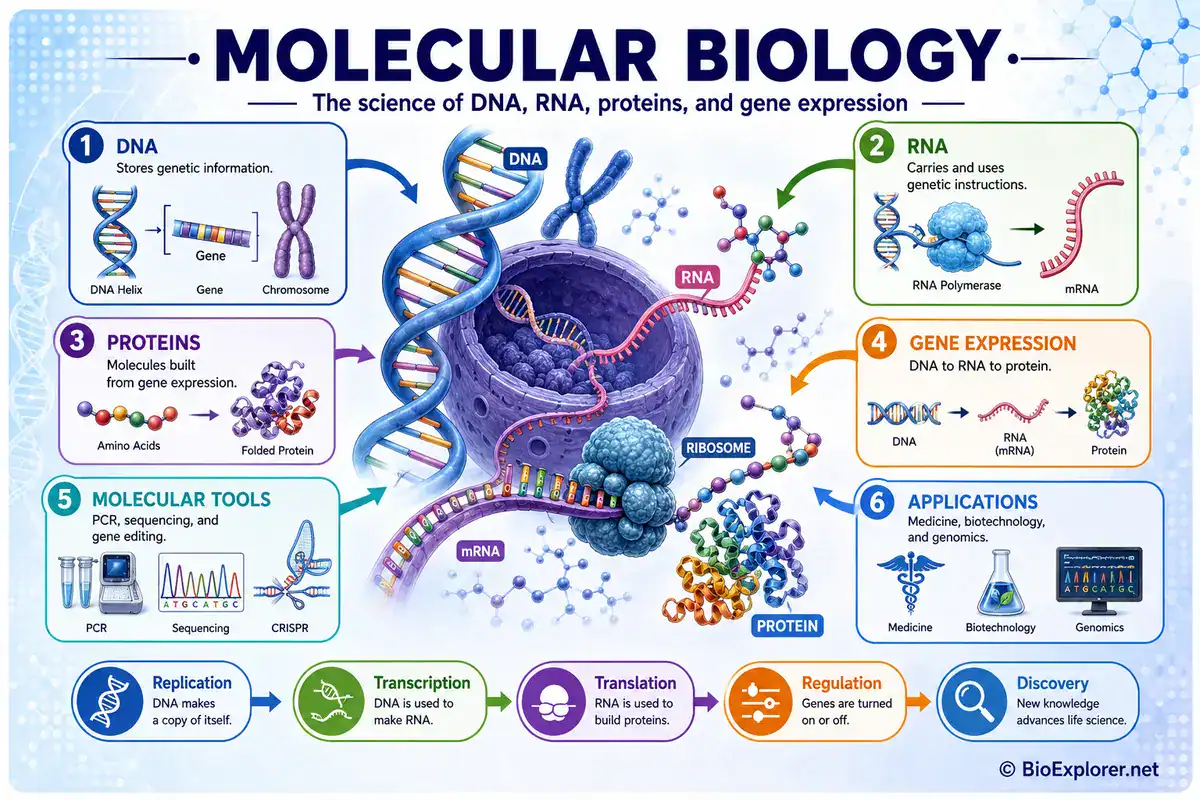
Molecular biology connects closely with genetics, biochemistry, cell biology, biotechnology, microbiology, medicine, genomics, and bioinformatics. It helps scientists understand DNA replication, transcription, translation, mutations, gene expression, molecular disease, protein synthesis, genome editing, and many modern laboratory techniques.
Explore the Molecular Biology Glossary for clear definitions of DNA, RNA, genes, codons, transcription, translation, polymerase, ribosomes, plasmids, promoters, restriction enzymes, PCR, cloning, and other key molecular biology terms. You can also browse the full Biology Glossary for related terms across genetics, biochemistry, cell biology, biotechnology, and microbiology.
Molecular Biology Guide:
- Molecular Biology Definition and Meaning
- History of Molecular Biology
- What Does Molecular Biology Study?
- DNA and Genetic Information
- RNA and Gene Expression
- Proteins and Molecular Function
- Genes and Gene Regulation
- Molecular Interactions
- The Central Dogma of Molecular Biology
- Major Molecules in Molecular Biology
- Major Branches and Topics in Molecular Biology
- Molecular Biology Techniques
- Why Is Molecular Biology Important?
- Examples of Molecular Biology in Real Life
- Molecular Biology Careers
- Molecular Biology vs Genetics, Biochemistry, and Cell Biology
- Related Biology Fields
- BioExplorer Molecular Biology Articles and Resources
- Core Molecular Biology Resources
- Related BioExplorer Hubs
- Recommended Molecular Biology Resources
- Molecular Biology Learning Resources
- Textbook and Reference Resources
- Genomics, Gene Expression, and Protein Databases
- Molecular Biology Tools and Protocols
- FAQs
Molecular Biology Definition and Meaning
Molecular biology is the scientific study of biological molecules and the processes that control life inside cells. It focuses mainly on DNA, RNA, proteins, genes, chromosomes, enzymes, molecular machines, and the flow of genetic information.
A molecular biologist studies how cells copy DNA, make RNA, build proteins, regulate genes, repair damage, respond to signals, and pass genetic information from one generation of cells to the next. These processes explain many features of growth, development, inheritance, disease, and evolution.
Molecular biology is not the same as simply studying small molecules. It asks how molecules inside living systems work together to produce life. A single gene, RNA molecule, enzyme, or protein complex can affect the behavior of an entire cell or organism.
History of Molecular Biology
The history of molecular biology grew out of genetics, biochemistry, microbiology, and cell biology. Early scientists knew that traits were inherited, but they did not yet understand the molecular structure of genetic material or how genes controlled cellular activity.
The field changed dramatically in the twentieth century as scientists identified DNA as genetic material, described the double-helix structure of DNA, worked out the genetic code, and learned how RNA and ribosomes help build proteins. These discoveries helped connect genes, molecules, and cellular function.
Modern molecular biology expanded further with DNA sequencing, recombinant DNA technology, PCR, genome editing, genomics, proteomics, structural biology, and bioinformatics. Today, molecular biology is central to medicine, biotechnology, diagnostics, agriculture, forensics, and basic biological research.
What Does Molecular Biology Study?
Molecular biology studies how molecules inside cells store information, transmit signals, build structures, perform chemical reactions, and control biological processes. It explains how cells turn genetic instructions into working molecules.
DNA and Genetic Information
DNA stores genetic information in the sequence of its nucleotide bases. Genes are sections of DNA that contain instructions for making RNA molecules or proteins. Molecular biologists study how DNA is organized, copied, damaged, repaired, and passed to new cells.
RNA and Gene Expression
RNA helps cells use genetic information. Messenger RNA carries instructions from DNA to ribosomes. Other RNA molecules help build proteins, control gene activity, process RNA, or regulate cellular responses. RNA is especially important in transcription, translation, gene regulation, viruses, and modern biotechnology.
Proteins and Molecular Function
Proteins carry out many of the cell’s jobs. They act as enzymes, receptors, transporters, structural supports, motors, antibodies, hormones, and regulators. Molecular biology studies how proteins are made, folded, modified, transported, and controlled.
Genes and Gene Regulation
Gene regulation explains how cells control which genes are active, when they are active, and how strongly they are expressed. This allows different cell types to perform different jobs even when they contain the same DNA.
Molecular Interactions
Cells depend on interactions between DNA, RNA, proteins, lipids, carbohydrates, ions, and small molecules. Molecular biologists study these interactions to understand cell signaling, metabolism, cell division, immunity, development, and disease.
The Central Dogma of Molecular Biology
One of the most important ideas in molecular biology is the central dogma. It describes the usual flow of genetic information in cells: DNA is copied into RNA, and RNA is used to make proteins.
| Process | What Happens | Why It Matters |
|---|---|---|
| DNA Replication | A cell copies its DNA before cell division. | Each new cell receives genetic instructions. |
| Transcription | A gene’s DNA sequence is copied into RNA. | The cell creates a working message from genetic information. |
| RNA Processing | Some RNA molecules are edited, capped, spliced, or modified before use. | The cell prepares RNA for translation, regulation, or other functions. |
| Translation | Ribosomes read mRNA codons to build a protein. | Genetic information becomes a functional molecule. |
| Protein Folding and Modification | New proteins fold and may be chemically modified. | Proteins become active, stable, and ready for cellular work. |
| Gene Regulation | Cells control when and how strongly genes are used. | Different cells can perform different jobs using the same genome. |
Major Molecules in Molecular Biology
Molecular biology focuses on several major classes of biological molecules. Each has a different role in storing information, carrying messages, building structures, or performing work inside cells.
| Molecule | Main Role | Example Topics |
|---|---|---|
| DNA | Stores hereditary information. | Genes, chromosomes, replication, mutation, DNA repair, sequencing. |
| RNA | Carries, processes, or regulates genetic information. | mRNA, tRNA, rRNA, microRNA, splicing, RNA viruses, RNA interference. |
| Proteins | Perform many structural, chemical, and regulatory jobs. | Enzymes, receptors, transcription factors, ribosomes, antibodies, transporters. |
| Nucleotides | Build DNA and RNA and help transfer energy or signals. | ATP, GTP, bases, codons, nucleic acid structure. |
| Enzymes | Speed up biochemical reactions. | Polymerases, ligases, restriction enzymes, helicases, proteases. |
| Plasmids | Small circular DNA molecules often used in bacteria and biotechnology. | Cloning, recombinant DNA, gene expression, bacterial transformation. |
| Molecular Complexes | Groups of molecules that work together. | Ribosomes, spliceosomes, replisomes, transcription complexes, protein machines. |
Major Branches and Topics in Molecular Biology
Molecular biology has many subfields because DNA, RNA, proteins, and genes can be studied from several angles. Some branches focus on information flow, while others focus on structure, regulation, disease, or technology.
| Area | What It Studies | Example Topics |
|---|---|---|
| Molecular Genetics | Genes, inheritance, mutation, and genetic information at the molecular level. | Gene structure, alleles, mutations, recombination, gene regulation. |
| Gene Expression | How genes are turned into RNA and proteins. | Transcription, translation, promoters, enhancers, transcription factors. |
| Genomics | Whole genomes and large-scale DNA analysis. | Genome sequencing, comparative genomics, genome annotation, variants. |
| Transcriptomics | RNA molecules produced by cells or tissues. | RNA sequencing, gene expression profiles, splicing, noncoding RNA. |
| Proteomics | Proteins produced by cells or organisms. | Protein abundance, protein modification, protein interactions, mass spectrometry. |
| Structural Biology | The three-dimensional shapes of biological molecules. | Protein structures, DNA-protein binding, ribosomes, enzymes, molecular machines. |
| Epigenetics | Chemical changes that affect gene activity without changing DNA sequence. | DNA methylation, histone modification, chromatin remodeling, gene silencing. |
| Molecular Medicine | Molecular causes, diagnosis, and treatment of disease. | Cancer mutations, genetic disorders, biomarkers, gene therapy, precision medicine. |
| Molecular Biotechnology | Using molecular tools to study or modify living systems. | PCR, cloning, recombinant DNA, CRISPR, plasmids, synthetic biology. |
Molecular Biology Techniques
Molecular biology depends on laboratory methods that allow scientists to copy, detect, cut, edit, sequence, and analyze DNA, RNA, and proteins. These techniques are used in research, medicine, biotechnology, agriculture, and diagnostics.
| Technique | What It Does | Common Use |
|---|---|---|
| PCR | Amplifies a selected DNA sequence. | Genetic testing, pathogen detection, cloning, forensics. |
| Gel Electrophoresis | Separates DNA, RNA, or proteins by size. | Checking PCR products, DNA fragments, and protein samples. |
| DNA Sequencing | Determines the order of bases in DNA. | Genome analysis, mutation detection, species identification. |
| Reverse Transcription | Copies RNA into complementary DNA. | Studying gene expression and RNA viruses. |
| Cloning | Inserts DNA into vectors such as plasmids. | Gene study, protein production, recombinant DNA research. |
| Restriction Digestion | Cuts DNA at specific sequences. | Cloning, mapping, and DNA fragment analysis. |
| Blotting Methods | Detect specific DNA, RNA, or protein molecules. | Southern blot, Northern blot, Western blot. |
| CRISPR-Cas Systems | Target and edit selected DNA sequences. | Genome editing, gene function studies, biotechnology. |
| RNA Sequencing | Measures RNA molecules in a sample. | Gene expression, transcriptomics, cell-state analysis. |
| Protein Structure Methods | Reveal molecular shape and interactions. | X-ray crystallography, cryo-EM, NMR, structural biology. |
For practical laboratory methods, visit BioExplorer’s Molecular Biology Methods and Protocols.
Why Is Molecular Biology Important?
Molecular biology is important because it explains how life works at the level of genes and molecules. It connects the information stored in DNA with the traits, functions, and diseases seen in cells and organisms.
In medicine, molecular biology helps scientists understand cancer, inherited disease, viral infection, immune responses, drug resistance, and genetic disorders. It also supports diagnostic testing, vaccine development, gene therapy, targeted drugs, and precision medicine.
In biotechnology, molecular biology makes it possible to clone genes, engineer microbes, design proteins, develop genetic tests, edit genomes, produce medicines, and build new tools for research and industry.
In ecology and evolution, molecular biology helps scientists compare DNA sequences, identify species, track populations, study evolutionary relationships, and understand how organisms adapt to changing environments.
Examples of Molecular Biology in Real Life
Molecular biology is not limited to research laboratories. It affects medicine, agriculture, food safety, conservation, ancestry testing, biotechnology, and public health.
- Medical diagnosis: Molecular tests can detect pathogens, mutations, cancer markers, and inherited disease risks.
- Vaccines: Molecular biology helps scientists design and produce vaccines, including RNA-based vaccine platforms.
- Genetic testing: DNA analysis can identify variants linked to disease, ancestry, or biological relationships.
- Forensics: DNA profiling helps identify individuals from biological samples.
- Agriculture: Molecular tools help improve crops, track plant diseases, and study stress tolerance.
- Biotechnology: Recombinant DNA methods help produce insulin, enzymes, antibodies, and other useful products.
- Conservation: DNA analysis helps track endangered species, genetic diversity, and illegal wildlife trade.
- Basic research: Molecular biology reveals how cells divide, respond, specialize, and communicate.
Molecular Biology Careers
Molecular biology can lead to careers in research, medicine, biotechnology, pharmaceuticals, diagnostics, genomics, agriculture, forensics, public health, education, and bioinformatics.
- Molecular biologist: Studies DNA, RNA, proteins, genes, and molecular processes inside cells.
- Genomics scientist: Studies genomes, DNA sequencing data, variants, and gene function.
- Bioinformatics analyst: Uses computational tools to analyze DNA, RNA, protein, or biological data.
- Research scientist: Designs experiments to study genes, proteins, pathways, or molecular disease.
- Clinical laboratory scientist: Uses molecular tests to support diagnosis and patient care.
- Biotechnology scientist: Applies molecular tools to develop products, assays, therapies, or engineered systems.
- Forensic DNA analyst: Uses DNA methods to identify individuals or biological evidence.
- Pharmaceutical scientist: Studies drug targets, biomarkers, protein interactions, and disease pathways.
- Genetic testing specialist: Works with DNA tests, variants, reports, and molecular diagnostics.
Molecular Biology vs Genetics, Biochemistry, and Cell Biology
Molecular biology overlaps with several fields, but each one has a different main focus.
| Field | Main Focus | How It Connects to Molecular Biology |
|---|---|---|
| Genetics | Inheritance, genes, traits, and genetic variation. | Molecular biology explains how genes work at the DNA, RNA, and protein level. |
| Biochemistry | Chemical reactions and molecules in living systems. | Molecular biology uses biochemistry to understand enzymes, nucleic acids, and proteins. |
| Cell Biology | Cell structure, organelles, cell division, and cell function. | Molecular biology explains the molecular processes that control cellular activity. |
| Biotechnology | Using living systems and molecular tools for practical applications. | Molecular biology provides techniques such as PCR, cloning, sequencing, and genome editing. |
| Microbiology | Microbes such as bacteria, archaea, fungi, protozoa, and viruses. | Molecular biology explains microbial genes, plasmids, resistance genes, and viral replication. |
Related Biology Fields
Molecular biology is closely related to genetics, because both study genes and inherited information. It connects with biochemistry, because DNA, RNA, and proteins are chemical molecules that take part in reactions inside cells.
It also overlaps with cell biology, because molecular processes happen inside cells. Biotechnology uses molecular biology tools to make useful products, edit genes, and develop new treatments. Microbiology uses molecular methods to study microbes, viruses, antibiotic resistance, and microbial evolution.
BioExplorer Molecular Biology Articles and Resources
Use these BioExplorer resources to go deeper into molecular biology concepts, laboratory methods, RNA, protein synthesis, and related biology fields.
Core Molecular Biology Resources
- Molecular Biology Methods and Protocols
- Ribosomes Function
- Overview of Translation Biology
- RNA Databases
- Top Biology Discoveries
- History of Biology
Related BioExplorer Hubs
Recommended Molecular Biology Resources
These trusted external resources can help readers explore molecular biology, gene expression, DNA, RNA, proteins, central dogma, molecular techniques, genomics, protein structure, and research databases in more detail.
Molecular Biology Learning Resources
- OpenStax Biology 2e: The Genetic Code
A free textbook section explaining transcription, translation, codons, and the relationship between mRNA and protein synthesis. - Khan Academy: Central Dogma and Gene Expression
Beginner-friendly videos and articles on DNA, RNA, transcription, translation, gene regulation, and protein synthesis. - HHMI BioInteractive: Central Dogma and Genetic Medicine
An interactive module showing how the central dogma connects with modern genetic medicine. - HHMI BioInteractive: Molecular Biology
Classroom-ready molecular biology resources on gene expression, DNA, RNA, epigenetics, and genomics. - Cold Spring Harbor Laboratory DNA Learning Center
A strong education resource for molecular biology, genetics, DNA structure, gene function, and hands-on biology learning. - DNA from the Beginning
An animated primer explaining major concepts and experiments in genetics and molecular biology.
Textbook and Reference Resources
- NCBI Bookshelf: Molecular Biology of the Cell
A classic in-depth reference for understanding cells from a molecular perspective. - NCBI Bookshelf: The Cell, A Molecular Approach
A textbook-style reference focused on cell and molecular biology, including genome structure, gene expression, signaling, and the cell cycle.
Genomics, Gene Expression, and Protein Databases
- National Center for Biotechnology Information
A major NIH resource providing access to biomedical, genomic, sequence, literature, and molecular biology information. - NCBI Gene
A gene-centered database with gene names, RefSeqs, maps, pathways, variations, phenotypes, and links to related resources. - NCBI GenBank
The NIH genetic sequence database for publicly available DNA sequences. - NCBI Gene Expression Omnibus
A public functional genomics repository for gene expression profiles, sequence-based data, and related datasets. - RCSB Protein Data Bank
A major resource for exploring, visualizing, and analyzing three-dimensional structures of biological macromolecules. - UniProt
A comprehensive resource for protein sequence and functional information.
Molecular Biology Tools and Protocols
- Addgene
A nonprofit repository for plasmids, viral vectors, and antibodies developed by the global research community. - Addgene Educational Resources
Helpful written and video resources for molecular biology, plasmid cloning, CRISPR, gel electrophoresis, bacterial transformation, and viral vectors. - Addgene Protocols
Practical protocols for basic molecular biology, plasmid cloning, viral work, antibodies, and related laboratory methods. - Addgene CRISPR Guide
A practical introduction to CRISPR biology, genome editing applications, and CRISPR tools.
FAQs
Molecular biology is the branch of biology that studies life at the level of DNA, RNA, proteins, genes, and other molecules inside cells.
A molecular biologist studies DNA replication, transcription, translation, gene regulation, mutations, proteins, molecular interactions, and laboratory methods used to analyze biological molecules.
The central dogma describes the usual flow of genetic information in cells: DNA is copied into RNA, and RNA is used to make proteins.
No. Genetics focuses on genes, inheritance, and variation. Molecular biology explains how genes work at the DNA, RNA, and protein level.
Biochemistry studies chemical processes and molecules in living systems. Molecular biology focuses more on DNA, RNA, proteins, genes, and the flow of genetic information.
Common molecular biology techniques include PCR, gel electrophoresis, DNA sequencing, cloning, restriction digestion, reverse transcription, blotting methods, RNA sequencing, and CRISPR genome editing.
Molecular biology is important because it explains how genes and molecules control life, disease, inheritance, cell function, biotechnology, diagnostics, and modern medicine.
Molecular biology careers include molecular biologist, genomics scientist, bioinformatics analyst, research scientist, clinical laboratory scientist, biotechnology scientist, forensic DNA analyst, and pharmaceutical scientist.
Cite this page
Bio Explorer. (2026, June 27). Molecular Biology: Life at the Molecular Level. https://www.bioexplorer.net/divisions_of_biology/molecular_biology/