
Biochemistry: The Chemistry of Life
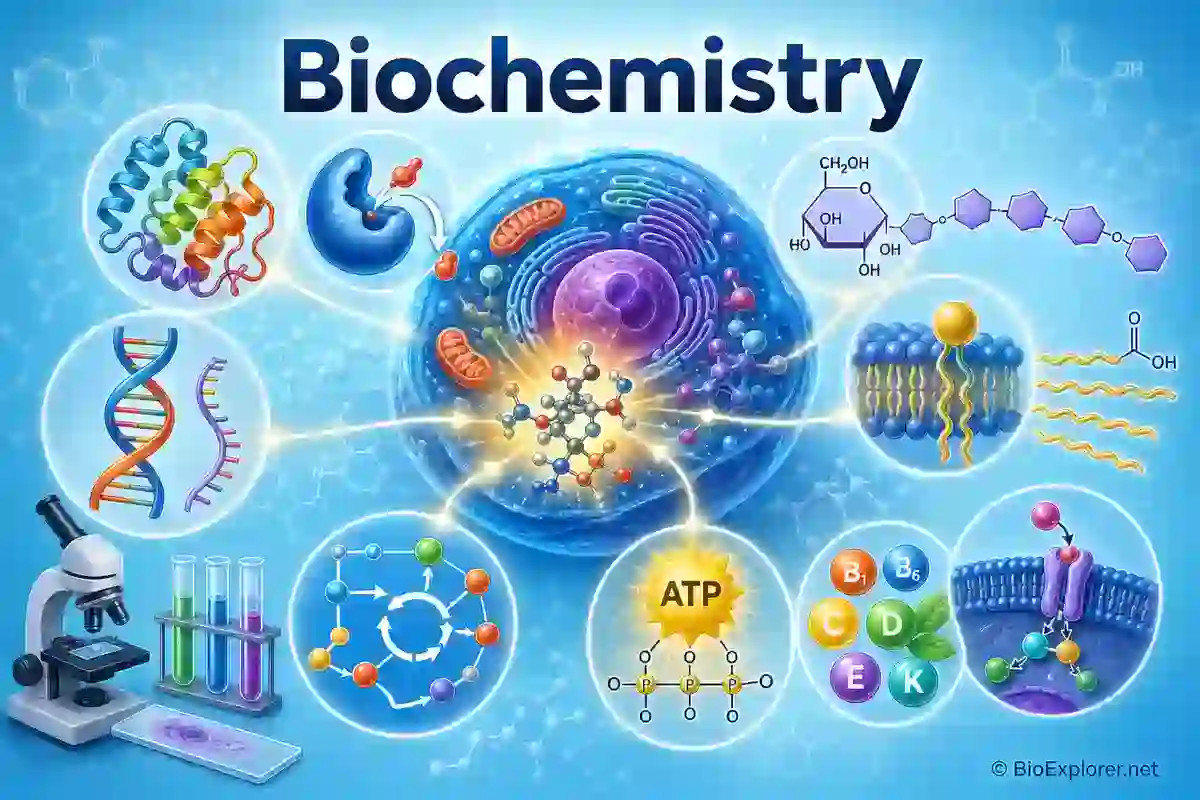
Biochemistry is the branch of biology that studies the chemical substances and reactions that make life possible. It explains how molecules such as proteins, carbohydrates, lipids, nucleic acids, enzymes, vitamins, hormones, and ATP help cells grow, use energy, communicate, repair damage, and stay alive.
Biochemistry connects biology with chemistry. It helps scientists understand metabolism, enzyme activity, protein structure, DNA and RNA chemistry, cell signaling, nutrition, disease, drug action, biotechnology, and many processes that happen inside living organisms.
Explore the Biochemistry Glossary for clear definitions of enzymes, proteins, amino acids, carbohydrates, lipids, nucleotides, ATP, metabolism, hydrolysis, fermentation, buffers, and other key biochemistry terms. You can also browse the full Biology Glossary for related terms across molecular biology, cell biology, genetics, biotechnology, and physiology.
Biochemistry Guide:
- Biochemistry Definition and Meaning
- History of Biochemistry
- What Does Biochemistry Study?
- Biomolecules
- Enzymes
- Metabolism
- Energy Transfer
- Cell Signaling
- Major Biomolecules in Biochemistry
- Branches of Biochemistry
- A) Structural Biology: The Architecture of Life
- B) Enzymology: The Machinery of Life
- C) Metabolism: The Energy of Life
- Key Biochemical Processes
- Biochemistry Techniques
- Why Is Biochemistry Important?
- Examples of Biochemistry in Real Life
- Biochemistry Careers
- Biochemistry vs Molecular Biology, Genetics, and Cell Biology
- Related Biology Fields
- BioExplorer Biochemistry Articles and Resources
- Core Biochemistry Articles
- Related BioExplorer Hubs
- Recommended Biochemistry Resources
- Learning Resources
- Pathway, Enzyme, and Protein Databases
- Biochemistry FAQs
Biochemistry Definition and Meaning
Biochemistry, also called biological chemistry, is the study of the chemistry of living organisms and the chemical processes that support life. It focuses on the molecules inside cells and the reactions that allow organisms to obtain energy, build new structures, remove waste, respond to signals, and reproduce.
A simple biochemistry definition is this:
Biochemistry studies life at the molecular and chemical level. Instead of looking only at organs, tissues, or whole organisms, biochemistry asks how molecules behave inside living systems.
For example, a biochemist may study how an enzyme speeds up a reaction, how glucose is broken down during metabolism, how proteins fold into specific shapes, how DNA stores information, or how a drug changes a biochemical pathway.
History of Biochemistry
The history of biochemistry grew from chemistry, physiology, medicine, and early studies of fermentation, digestion, and metabolism. Scientists gradually learned that living organisms follow chemical laws, even though the reactions inside cells are highly organized and tightly controlled.
In the nineteenth and twentieth centuries, biochemistry became a distinct scientific field as researchers studied enzymes, proteins, carbohydrates, lipids, vitamins, hormones, metabolic pathways, and nucleic acids. Discoveries about fermentation, enzyme activity, cellular respiration, protein structure, DNA, RNA, and molecular genetics helped explain how living systems work at the chemical level.
Modern biochemistry now overlaps strongly with molecular biology, cell biology, genetics, biotechnology, medicine, nutrition, pharmacology, bioinformatics, and structural biology.
What Does Biochemistry Study?
Biochemistry studies the molecules and chemical reactions that allow cells and organisms to function. It explains how life depends on energy flow, molecular structure, chemical bonds, enzyme activity, and controlled reaction pathways.
Biomolecules
Biomolecules are molecules made by living organisms or used by living systems. The major biological macromolecules are carbohydrates, lipids, proteins, and nucleic acids. These molecules support energy storage, cell structure, chemical reactions, inheritance, signaling, and growth.
Enzymes
Enzymes are biological catalysts, usually proteins, that speed up chemical reactions without being consumed by the reaction. Biochemistry studies enzyme structure, active sites, substrates, cofactors, inhibitors, reaction rates, and enzyme regulation.
Metabolism
Metabolism is the sum of chemical reactions that happen in cells. It includes catabolism, where molecules are broken down to release energy, and anabolism, where smaller molecules are used to build larger molecules.
Energy Transfer
Cells use molecules such as ATP, NADH, FADH2, and ion gradients to transfer energy. Biochemistry explains how energy from food, sunlight, or chemical compounds is captured and converted into forms cells can use.
Cell Signaling
Cells respond to hormones, nutrients, toxins, immune signals, and environmental changes through biochemical pathways. These pathways help cells communicate, adapt, divide, specialize, or defend themselves.
Major Biomolecules in Biochemistry
Biochemistry depends on understanding the structure and function of biological molecules. Small changes in molecular shape, charge, bonding, or sequence can change how a molecule behaves inside a cell.
| Biomolecule | Main Role | Examples |
|---|---|---|
| Carbohydrates | Provide energy, store energy, and support cell structure. | Glucose, starch, glycogen, cellulose, ribose. |
| Lipids | Store energy, form membranes, and act in signaling. | Fats, phospholipids, steroids, cholesterol, triglycerides. |
| Proteins | Perform structural, catalytic, transport, signaling, and regulatory roles. | Enzymes, antibodies, receptors, hemoglobin, collagen. |
| Nucleic Acids | Store, transmit, and express genetic information. | DNA, RNA, mRNA, tRNA, rRNA. |
| Nucleotides | Build nucleic acids and help transfer energy or signals. | ATP, GTP, DNA nucleotides, RNA nucleotides. |
| Vitamins and Cofactors | Help enzymes and metabolic pathways function properly. | NAD+, FAD, coenzyme A, biotin, vitamin B12. |
Branches of Biochemistry
Biochemistry is a broad field, but many introductory courses and textbooks organize it around three major branches: structural biology, enzymology, and metabolism. These branches explain how molecular shape, catalytic activity, and energy flow support life.
A) Structural Biology: The Architecture of Life
Structural biology studies the three-dimensional shapes of biological molecules such as proteins, DNA, RNA, enzymes, receptors, and molecular complexes. In biochemistry, structure and function are closely linked. When a molecule’s shape changes, its function may also change.
- What it studies: How atoms are arranged inside biological molecules.
- Why it matters: Molecular shape helps explain enzyme activity, protein folding, drug binding, receptor signaling, and many diseases.
- Example: A drug may work by fitting into a protein’s active site and blocking a biochemical reaction.
B) Enzymology: The Machinery of Life
Enzymology is the study of enzymes. Enzymes make life possible by speeding up reactions that would otherwise happen too slowly to support living cells. They help digest food, copy DNA, build molecules, break down toxins, release energy, and control metabolism.
- What it studies: Enzyme structure, substrates, active sites, cofactors, inhibitors, reaction rates, and regulation.
- Why it matters: Many diseases, medicines, toxins, and metabolic disorders involve enzyme activity.
- Example: Digestive enzymes break large food molecules into smaller molecules that cells can absorb.
C) Metabolism: The Energy of Life
Metabolism includes all the chemical reactions that happen inside cells. Some metabolic pathways break molecules down to release energy, while others build molecules needed for growth, repair, storage, and reproduction.
- What it studies: Catabolism, anabolism, ATP production, cellular respiration, fermentation, and metabolic regulation.
- Why it matters: Metabolism helps explain diabetes, exercise physiology, nutrition, obesity, starvation, inherited metabolic disorders, and drug effects.
- Example: During cellular respiration, cells break down glucose and capture energy in ATP.
Key Biochemical Processes
Biochemical processes are organized into pathways. Each pathway contains a series of chemical reactions controlled by enzymes, energy carriers, substrates, products, and feedback signals.
| Process | What Happens | Why It Matters |
|---|---|---|
| Cellular Respiration | Cells break down glucose and capture usable energy as ATP. | Provides energy for growth, movement, repair, and cellular work. |
| Fermentation | Cells produce energy without oxygen through pathways such as lactic acid or alcoholic fermentation. | Supports microbes, muscle cells under low oxygen, food production, and biotechnology. |
| Protein Synthesis | Cells use genetic information to build proteins from amino acids. | Creates enzymes, receptors, antibodies, transporters, and structural proteins. |
| DNA Replication | Cells copy DNA before cell division. | Passes genetic information to new cells. |
| Hydrolysis | Water is used to break chemical bonds in larger molecules. | Helps digest and recycle carbohydrates, proteins, lipids, and nucleic acids. |
| Dehydration Synthesis | Small molecules join together while releasing water. | Builds larger molecules such as proteins, polysaccharides, and nucleic acids. |
| Cell Signaling | Molecules transmit information within or between cells. | Controls growth, metabolism, immunity, hormones, and development. |
Biochemistry Techniques
Biochemistry techniques allow scientists to isolate, measure, visualize, and analyze biological molecules. These methods are used in research labs, hospitals, pharmaceutical companies, biotechnology firms, food testing, agriculture, and forensic science.
| Technique | What It Does | Common Use |
|---|---|---|
| Chromatography | Separates molecules based on chemical properties. | Protein purification, metabolite analysis, drug testing. |
| Electrophoresis | Separates proteins, DNA, or RNA by size and charge. | Protein analysis, nucleic acid analysis, lab diagnostics. |
| Spectrophotometry | Measures how molecules absorb light. | Enzyme assays, concentration measurements, reaction tracking. |
| Mass Spectrometry | Identifies molecules by mass and charge. | Proteomics, metabolomics, biomarker discovery, drug analysis. |
| Enzyme Assays | Measure enzyme activity under different conditions. | Drug testing, metabolic research, clinical diagnosis. |
| Western Blotting | Detects specific proteins in a sample. | Protein expression studies and disease research. |
| X-ray Crystallography | Determines molecular structure from crystal diffraction patterns. | Protein structure, enzyme mechanisms, drug design. |
| Cryo-EM | Visualizes biological molecules and complexes at very high resolution. | Structural biology, protein complexes, viruses, molecular machines. |
For practical laboratory resources, visit BioExplorer’s Biochemistry Methods and Protocols.
Why Is Biochemistry Important?
Biochemistry is important because it explains how life works at the chemical level. Every organism depends on biochemical reactions to use energy, build cells, repair damage, respond to the environment, and pass information to the next generation.
In medicine, biochemistry helps scientists understand disease mechanisms, blood chemistry, hormones, enzymes, genetic disorders, nutrition, cancer biology, immune responses, and drug action. Many diagnostic tests measure biochemical markers in blood, urine, tissues, or cells.
In biotechnology, biochemistry supports protein engineering, enzyme design, fermentation, vaccine development, recombinant protein production, genetic testing, drug discovery, and synthetic biology.
In ecology and evolution, biochemistry helps researchers compare metabolic pathways, study adaptation, understand photosynthesis and respiration, and examine how organisms process nutrients and environmental chemicals.
Examples of Biochemistry in Real Life
Biochemistry affects ordinary life in ways most people do not notice. It is involved whenever the body digests food, muscles use energy, medicines act on cells, microbes ferment food, or a lab test measures a disease marker.
- Digestion: Enzymes break carbohydrates, proteins, and lipids into smaller molecules that the body can absorb.
- Exercise: Muscles use ATP, glucose, glycogen, fatty acids, and metabolic pathways to produce energy.
- Medicine: Many drugs work by blocking enzymes, receptors, transporters, or signaling pathways.
- Nutrition: Vitamins, minerals, amino acids, fatty acids, and carbohydrates affect metabolism and health.
- Fermentation: Microbes use biochemical pathways to make foods such as yogurt, bread, cheese, vinegar, and fermented drinks.
- Genetic testing: DNA, RNA, and protein analysis can help detect variants, infections, or disease markers.
- Biotechnology: Recombinant DNA and protein production rely on biochemical tools and pathways.
- Environmental science: Biochemistry helps explain biodegradation, toxin metabolism, nutrient cycling, and microbial activity.
Biochemistry Careers
Biochemistry can lead to careers in research, medicine, biotechnology, pharmaceuticals, diagnostics, nutrition, agriculture, food science, forensic science, public health, education, and environmental science.
- Biochemist: Studies biomolecules, enzymes, metabolism, and chemical reactions in living systems.
- Clinical biochemist: Analyzes biochemical markers to support diagnosis and patient care.
- Pharmaceutical scientist: Studies drug targets, drug metabolism, toxicology, and disease pathways.
- Biotechnology scientist: Uses biochemical and molecular tools to develop products, tests, enzymes, or therapies.
- Protein scientist: Studies protein structure, folding, purification, engineering, and function.
- Enzymologist: Studies enzyme mechanisms, kinetics, inhibition, cofactors, and regulation.
- Metabolic researcher: Studies energy use, metabolic pathways, nutrition, diabetes, obesity, or inherited metabolic disorders.
- Forensic scientist: Uses biochemical and molecular evidence in legal investigations.
- Food scientist: Studies food chemistry, fermentation, nutrition, spoilage, and quality control.
- Bioinformatics analyst: Uses computational tools to analyze proteins, pathways, genomes, and large biological datasets.
Biochemistry vs Molecular Biology, Genetics, and Cell Biology
Biochemistry overlaps with several fields, but each field has a different center of gravity.
| Field | Main Focus | How It Connects to Biochemistry |
|---|---|---|
| Biochemistry | Chemical substances and reactions in living organisms. | Explains enzymes, biomolecules, metabolism, energy transfer, and molecular interactions. |
| Molecular Biology | DNA, RNA, proteins, genes, and gene expression. | Uses biochemical principles to explain how genetic information becomes functional molecules. |
| Genetics | Genes, inheritance, variation, and traits. | Connects inherited information with biochemical pathways and molecular function. |
| Cell Biology | Cell structure, organelles, division, signaling, and cell behavior. | Shows where biochemical reactions happen inside cells. |
| Biotechnology | Using living systems and biological tools for practical applications. | Applies enzymes, proteins, DNA, fermentation, and metabolic pathways to solve problems. |
Related Biology Fields
Biochemistry is closely linked with molecular biology, because both fields study DNA, RNA, proteins, enzymes, and gene expression. It also connects with cell biology, because biochemical reactions happen inside cells and organelles.
Biochemistry supports genetics by explaining how genes affect proteins and biochemical pathways. It supports immunology by explaining antibodies, cytokines, receptors, inflammation, and immune signaling. It also supports microbiology and biotechnology through fermentation, antibiotics, enzyme production, microbial metabolism, and recombinant proteins.
BioExplorer Biochemistry Articles and Resources
Use these BioExplorer resources to go deeper into biomolecules, metabolism, enzymes, protein structure, nucleic acids, and biochemical reactions.
Core Biochemistry Articles
- Building Blocks of Carbohydrates
- Building Blocks of Lipids
- Building Blocks of Proteins
- Building Blocks of Nucleic Acids
- Cellular Respiration Equation, Types, Stages, and Products
- Introduction to Fermentation Biology
- Dehydration Synthesis and Hydrolysis
- Recombinant Proteins
Related BioExplorer Hubs
Recommended Biochemistry Resources
These external resources are useful for learning biochemistry, checking biochemical pathways, exploring enzymes, studying proteins, and understanding molecular structure.
Learning Resources
- American Society for Biochemistry and Molecular Biology: About BMB
A strong overview of biochemistry and molecular biology as foundational molecular life sciences. - OpenStax Biology 2e: Synthesis of Biological Macromolecules
A clear textbook section on carbohydrates, lipids, proteins, nucleic acids, dehydration synthesis, and hydrolysis. - OpenStax Biology 2e: Energy and Metabolism
A useful introduction to metabolism, cellular energy, and chemical reactions in cells. - Khan Academy: Biomolecules
Beginner-friendly lessons on proteins, carbohydrates, lipids, nucleic acids, ATP, and metabolism. - NCBI Bookshelf: Biochemistry
A concise reference entry defining biochemistry as the chemistry of living organisms and vital processes.
Pathway, Enzyme, and Protein Databases
- KEGG PATHWAY Database
A major pathway resource for metabolic, genetic, environmental, and cellular process maps. - BRENDA Enzyme Database
A detailed enzyme information system for enzyme function, classification, kinetics, substrates, and inhibitors. - UniProt
A major resource for protein sequence and functional information. - RCSB Protein Data Bank
A leading resource for exploring three-dimensional structures of proteins, nucleic acids, and other biological macromolecules. - PDB-101
Educational materials from RCSB PDB for learning about proteins, molecular structure, and structural biology.
Biochemistry FAQs
Biochemistry is the branch of biology that studies the chemical substances and reactions that make life possible, including biomolecules, enzymes, metabolism, and energy transfer.
A biochemist studies molecules such as proteins, carbohydrates, lipids, nucleic acids, enzymes, vitamins, hormones, and ATP, along with the reactions and pathways that control life.
The main branches of biochemistry are often described as structural biology, enzymology, and metabolism. These areas study molecular shape, enzyme activity, and energy flow in living systems.
The major biomolecules in biochemistry include carbohydrates, lipids, proteins, nucleic acids, nucleotides, vitamins, cofactors, and other molecules used by living systems.
Enzymes are important because they speed up biochemical reactions, control metabolic pathways, and allow cells to perform essential processes at useful rates.
Biochemistry focuses on chemical substances and reactions in living systems. Molecular biology focuses more on DNA, RNA, proteins, genes, and gene expression.
Biochemistry is important because it explains metabolism, enzyme activity, nutrition, disease, drug action, genetic function, biotechnology, and how cells use energy.
Biochemistry careers include biochemist, clinical biochemist, pharmaceutical scientist, biotechnology scientist, protein scientist, enzymologist, metabolic researcher, forensic scientist, and food scientist.
Cite this page
BioExplorer. (2026, September 30). Biochemistry: The Chemistry of Life. https://www.bioexplorer.net/divisions_of_biology/biochemistry/