
Branches of Genetics
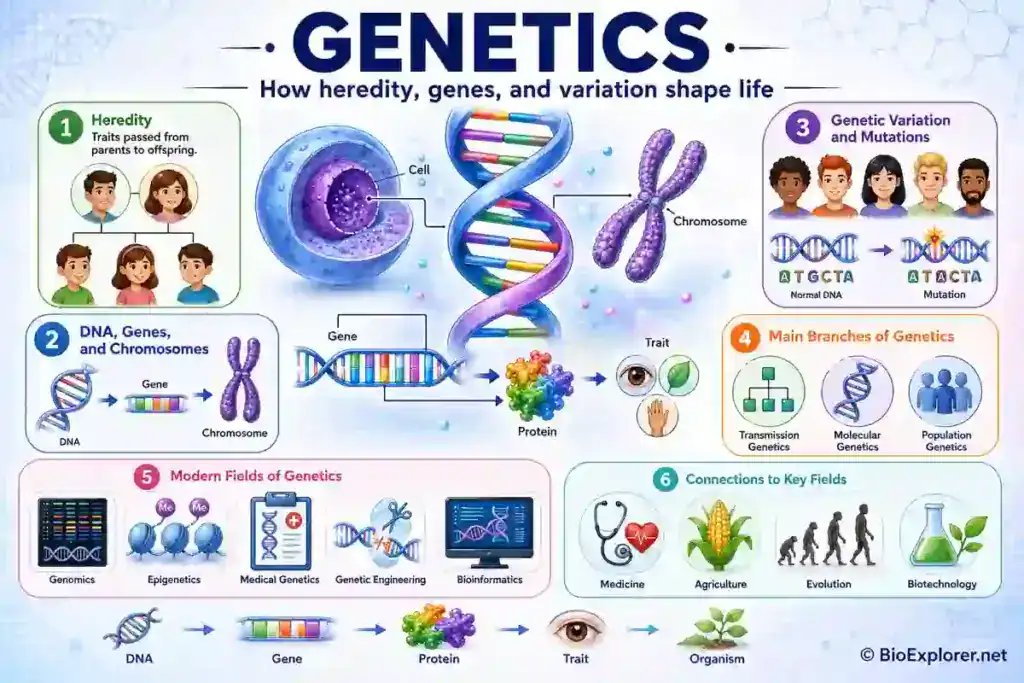
Genetics is the division of biology that studies heredity, genes, DNA, chromosomes, genetic variation, and how traits are passed from one generation to the next. It explains why organisms inherit similarities from their parents, why individuals differ, and how genetic information affects cells, bodies, populations, and evolution.
Genetics connects closely with molecular biology, cell biology, evolutionary biology, biotechnology, medicine, agriculture, ecology, and bioinformatics. It helps scientists understand inherited disorders, gene expression, DNA mutations, chromosome behavior, genetic testing, population variation, and the molecular basis of life.
The major branches of genetics include transmission genetics, molecular genetics, and population genetics. Modern genetics also includes genomics, epigenetics, cytogenetics, quantitative genetics, developmental genetics, conservation genetics, medical genetics, genetic engineering, and bioinformatics.
Browse the Genetics Glossary for clear definitions of terms such as gene, allele, DNA, chromosome, genotype, phenotype, mutation, heredity, dominant trait, recessive trait, gene expression, and genetic variation.
Genetics Guide:
- What Is Genetics?
- Genetics Definition
- Why Genetics Matters
- Genes, DNA, and Chromosomes
- Genotype and Phenotype
- 3 Primary Branches of Genetics
- A) Transmission Genetics
- B) Molecular Genetics
- C) Population Genetics
- Modern Branches and Applications of Genetics
- Genomics
- Epigenetics
- Cytogenetics
- Medical Genetics
- Genetic Engineering
- Conservation Genetics
- Genetics Curriculum Overview
- Genetics Articles and Related Guides
- Inheritance and Chromosomes
- DNA, Genes, and Molecular Genetics
- Genetic Engineering, Biotechnology, and Bioethics
- Genetic Variation in Animals
- Population Genetics and Evolution
- Genomics, Databases, and Research Resources
- Genetics News and Learning Resources
- Common Misunderstandings About Genetics
- FAQs
- Recommended Genetics Resources
- Genetics Learning Resources
- Genetics Databases and Advanced Resources
What Is Genetics?
Genetics is the study of genes, heredity, and variation in living organisms. Genes are segments of DNA that contain instructions for making functional molecules, often proteins. These instructions influence traits, but traits can also be affected by environment, development, gene regulation, and interactions among many genes.
Heredity is the passing of genetic information from parents to offspring. Variation is the genetic difference among individuals, families, populations, and species. Together, heredity and variation explain why living organisms show both resemblance and difference.
Genetics helps explain inheritance, family resemblance, genetic disorders, chromosome behavior, DNA mutations, gene expression, and genetic differences among populations. It also supports applied fields such as genetic testing, gene therapy, crop improvement, conservation biology, and personalized medicine.
For background on how the field developed from Mendel's pea plant experiments to DNA sequencing and modern genomics, see the History of Genetics.
Genetics Definition
A simple genetics definition is this: genetics is the biological study of genes, heredity, and variation.
A more complete definition is that genetics studies how genetic information is stored, copied, expressed, inherited, changed, and distributed in organisms and populations. This includes DNA structure, gene function, chromosome behavior, inheritance patterns, mutations, genetic variation, gene regulation, and evolutionary change.
Genes do not act alone. A trait may be shaped by one gene, many genes, the environment, developmental processes, or interactions among these factors. That is why modern genetics often moves beyond simple "one gene equals one trait" explanations.
Curious whether a condition runs in families through carriers? The Pedigree Analyzer walks you through three generations and tells you the pattern.
Why Genetics Matters
Genetics matters because it explains how biological information moves through life. It helps scientists understand how cells function, how organisms develop, how diseases can be inherited, how populations evolve, and how traits vary across species.
Genetics is important in many areas:
- Medicine: Genetics helps explain inherited disorders, cancer risk, genetic testing, pharmacogenomics, and gene therapy.
- Agriculture: Genetics supports crop improvement, plant breeding, livestock selection, disease resistance, and genetically modified organisms.
- Evolutionary biology: Genetics explains variation, mutation, natural selection, genetic drift, gene flow, and speciation.
- Conservation biology: Genetics helps identify population bottlenecks, inbreeding risk, and genetic diversity in threatened species.
- Forensics: DNA evidence can help identify individuals and biological relationships.
- Biotechnology: Genetics supports cloning, genetic engineering, recombinant DNA technology, and genome editing.
- Bioinformatics: Genetic data can be analyzed using databases, computational tools, and genome-scale comparisons.
Genetics is also important for students because it links many major biology topics, including DNA, proteins, cell division, reproduction, inheritance, evolution, and disease.
Genes, DNA, and Chromosomes
Genes, DNA, and chromosomes are central concepts in genetics.
DNA is the molecule that stores genetic information in most living organisms. It is made of nucleotides arranged in a sequence. These sequences contain instructions that cells can use to make RNA and proteins.
Genes are functional sections of DNA. Many genes contain instructions for making proteins, while other genes help produce functional RNA molecules or regulate biological processes.
Chromosomes are organized structures made of DNA and associated proteins. In eukaryotic cells, chromosomes are found in the nucleus. They help package DNA and allow genetic information to be copied and passed to new cells.
The difference between a chromosome and a chromatid often causes confusion. A chromosome is a DNA-containing structure, while a chromatid is one of the duplicated copies of a chromosome during cell division.
Genotype and Phenotype
Genotype and phenotype are two important terms in genetics.
- A genotype is the genetic makeup of an organism for a trait or set of traits. It refers to the alleles or gene variants an organism carries.
- A phenotype is the observable trait or characteristic. This may include physical features, biochemical traits, behavior, disease risk, or other measurable characteristics.
The genotype helps influence the phenotype, but the relationship is not always simple. Environment, development, nutrition, gene regulation, and interactions among genes can all affect how traits appear.
For example, two organisms may have similar genotypes for a trait but show different phenotypes if they grow in different environments. Likewise, some traits are controlled by many genes rather than one gene.
🧬 Punnett Square Calculators
Want to see how genotypes can turn into possible offspring traits? Try our Punnett Square Calculator to predict genotype and phenotype probabilities for monohybrid, dihybrid, and advanced Mendelian crosses. It is a simple way to visualize how alleles from two parents can combine.
Need to work out the odds for a sex-linked trait like hemophilia, color blindness, or Duchenne? The X-Linked Punnett Square Calculator tracks the X and Y chromosomes separately and flags carriers automatically.
3 Primary Branches of Genetics
The three primary branches of genetics are transmission genetics, molecular genetics, and population genetics. Each branch studies genetic information at a different level.
| Branch of Genetics | Main Focus | Example Topics |
|---|---|---|
| Transmission genetics | How traits pass from parents to offspring | Mendelian inheritance, dominant and recessive traits, pedigrees |
| Molecular genetics | How genes work at the DNA, RNA, and protein level | DNA replication, transcription, translation, mutations |
| Population genetics | How genetic variation changes in populations | Gene pools, natural selection, genetic drift, founder effect |
These branches overlap. For example, an inherited disorder may involve transmission genetics because it runs in families, molecular genetics because it involves a DNA change, and population genetics because its frequency may vary among populations.
A) Transmission Genetics
Transmission genetics, also called classical genetics or Mendelian genetics, studies how traits are passed from parents to offspring. It focuses on inheritance patterns, alleles, dominant and recessive traits, family pedigrees, chromosome behavior, and the probability of traits appearing in offspring.
This branch is strongly associated with Gregor Mendel, whose pea plant experiments helped explain how traits can be inherited in predictable patterns. Mendel's work helped establish basic principles such as segregation and independent assortment.
Transmission genetics helps answer questions such as:
- Why do children resemble their parents?
- How can a trait skip a generation?
- What does dominant inheritance mean?
- What does recessive inheritance mean?
- How can two unaffected carrier parents have an affected child?
- How do chromosomes separate during meiosis?
- How are family pedigrees used to study inherited conditions?
Transmission genetics is especially important in the study of inherited disorders. For example, autosomal recessive inheritance explains how a child may inherit a condition when both parents carry one changed copy of a gene.
Dominant and Recessive Inheritance
Dominant and recessive inheritance describe how some alleles affect traits when paired with other alleles.
A dominant allele can influence a trait when only one copy is present. A recessive allele usually affects a trait only when two copies are present, one inherited from each parent.
These terms do not mean that one allele is stronger or better than another. They describe how alleles affect phenotype in a specific inheritance pattern.
Many real traits are more complex than simple dominant and recessive inheritance. Some traits involve incomplete dominance, codominance, multiple alleles, sex-linked inheritance, many genes, or environmental effects.
Meiosis and Inheritance
Meiosis is essential for sexual reproduction and inheritance. It produces gametes, such as sperm and egg cells, with half the usual number of chromosomes. When two gametes combine during fertilization, the offspring receives one set of chromosomes from each parent.
Meiosis helps explain why offspring are genetically different from their parents and siblings. During meiosis, homologous chromosomes separate, and genetic recombination can create new combinations of alleles.
This is why meiosis is central to transmission genetics, genetic variation, and evolution.
B) Molecular Genetics
Molecular genetics studies genes at the molecular level. It focuses on DNA, RNA, proteins, gene expression, mutations, replication, transcription, translation, and gene regulation.
This branch asks how genetic information is stored, copied, read, repaired, and used inside cells. It connects closely with molecular biology, biochemistry, cell biology, and biotechnology.
Molecular genetics helps answer questions such as:
- What is DNA made of?
- How is DNA copied?
- How does a gene produce a functional molecule?
- How does mRNA help make proteins?
- How do mutations change gene function?
- How are genes turned on or off?
- How can gene expression differ among cells?
- How can genetic engineering change DNA?
DNA, RNA, and Protein Synthesis
Molecular genetics often focuses on how genetic information flows from DNA to RNA to protein. This idea is commonly called the central dogma of molecular biology.
DNA stores genetic instructions. RNA helps carry or use those instructions. Proteins perform many important cellular functions, including structural support, chemical reactions, signaling, transport, and regulation.
Protein synthesis includes two major steps:
- Transcription: A gene's DNA sequence is copied into RNA.
- Translation: The mRNA sequence is read to build a chain of amino acids.
Translation connects genetic information to protein structure and function. For a deeper explanation, see From mRNA to Protein.
Gene Expression
Gene expression is the process by which information in a gene is used to make a functional product, such as RNA or protein.
Gene expression is not the same thing as microarray technology. Microarrays are one tool scientists can use to measure the activity of many genes at once. Gene expression itself is the broader biological process of using genetic information.
Different cells in the same organism can have the same DNA but express different genes. This helps explain why nerve cells, muscle cells, skin cells, and blood cells can have different structures and functions.
Gene expression can be affected by cell type, development, environment, hormones, chemical signals, and regulatory DNA sequences.
Mutations
A mutation is a change in genetic material. Mutations can occur in DNA sequences or in larger chromosome structures.
Mutations may be harmful, neutral, or beneficial depending on where they occur and how they affect gene function. Some mutations change a protein. Others affect gene regulation. Some have no noticeable effect.
Mutations are important because they create genetic variation. They can also contribute to inherited disorders, cancer, antibiotic resistance, and evolutionary change.
C) Population Genetics
Population genetics studies genetic variation within and among populations. A population is a group of individuals of the same species that live in the same area and can reproduce with one another.
Instead of focusing on one family or one gene inside a cell, population genetics looks at gene frequencies in groups over time. It connects genetics with evolution, ecology, statistics, and conservation biology.
Population genetics helps answer questions such as:
- How common is a gene variant in a population?
- Why do allele frequencies change over time?
- How does natural selection affect genetic variation?
- What happens when a population becomes small or isolated?
- How does migration move genes between populations?
- How does genetic drift affect small populations?
- How do populations become genetically different?
Population genetics is central to evolutionary biology because evolution can be measured as changes in genetic variation across generations.
Gene Pool and Allele Frequency
A gene pool is the total collection of genetic variation in a population. It includes all the alleles present among individuals in that population.
An allele frequency is how common a specific allele is in a population. If allele frequencies change over generations, the population has evolved genetically.
Allele frequencies can change through mutation, natural selection, genetic drift, gene flow, and nonrandom mating.
Genetic Drift and Founder Effect
Genetic drift is random change in allele frequencies. It is especially important in small populations, where chance events can strongly affect which alleles become common or disappear.
The founder effect is a type of genetic drift. It happens when a small group starts a new population and carries only part of the original population's genetic variation. The new population may have allele frequencies that differ from the source population.
Natural Selection and Genetic Variation
Natural selection can change allele frequencies when heritable traits affect survival or reproduction. If a genetic variant improves reproductive success in a particular environment, it may become more common over generations.
Natural selection does not act directly on genes in isolation. It acts on traits expressed by organisms. Genes influence many traits, but environment and development also matter.
Genetics and evolution are deeply connected. For a broader overview, see Evolutionary Biology.
Modern Branches and Applications of Genetics
Modern genetics includes many specialized branches. These areas build on transmission genetics, molecular genetics, and population genetics.
| Branch or Application | What It Studies |
|---|---|
| Genomics | Entire genomes, including all DNA in an organism |
| Epigenetics | Changes in gene activity that do not change the DNA sequence |
| Cytogenetics | Chromosomes, chromosome number, and chromosome structure |
| Quantitative genetics | Traits influenced by many genes and environmental factors |
| Developmental genetics | How genes guide growth, development, and body formation |
| Conservation genetics | Genetic diversity in endangered or fragmented populations |
| Medical genetics | Genetic causes, risks, diagnosis, and treatment of disease |
| Genetic engineering | Direct modification of genetic material |
| Bioinformatics | Computational analysis of DNA, RNA, protein, and genome data |
These fields are important in medicine, agriculture, biotechnology, ecology, conservation, and evolutionary research.
Genomics
Genomics is the study of entire genomes. A genome is the complete set of genetic material in an organism.
Genomics looks beyond single genes. It studies gene locations, genome organization, regulatory regions, sequence variation, gene families, and genome-wide patterns.
Genomics became especially important after the Human Genome Project and the growth of high-throughput DNA sequencing. Modern genomics supports medical research, ancestry analysis, evolutionary studies, crop science, and microbial research.
Epigenetics
Epigenetics studies changes in gene activity that do not involve changes in the DNA sequence itself.
Epigenetic mechanisms can influence whether genes are more active or less active. These mechanisms include DNA methylation, histone modification, and changes in chromatin structure.
Epigenetics helps explain how cells with the same DNA can behave differently. It is important in development, cell specialization, disease research, aging, and environmental biology.
A key caution: epigenetics does not mean that every lifestyle change is inherited across many generations. Some epigenetic changes are temporary, some affect only one individual, and some may be reset during reproduction.
Cytogenetics
Cytogenetics studies chromosomes. It focuses on chromosome number, chromosome structure, chromosome abnormalities, and how chromosomes behave during cell division.
Cytogenetics is important for detecting large-scale chromosome changes, such as missing chromosomes, extra chromosomes, deletions, duplications, inversions, and translocations.
This branch connects genetics with cell biology because chromosomes must be copied and separated correctly during mitosis and meiosis.
Medical Genetics
Medical genetics studies how genetic variation affects human health and disease. It includes inherited disorders, chromosome abnormalities, genetic testing, genetic counseling, gene therapy, and genetic risk assessment.
Medical genetics does not mean that genes determine everything about health. Most diseases involve interactions among genes, environment, lifestyle, age, and chance.
Genetic testing can be useful, but it also raises questions about privacy, accuracy, interpretation, family implications, and emotional impact.
Genetic Engineering
Genetic engineering is the direct modification of genetic material. It may involve inserting, deleting, editing, or changing DNA sequences.
Genetic engineering is used in medicine, agriculture, research, and biotechnology. It can help produce medicines, study gene function, create genetically modified crops, and develop experimental therapies.
However, genetic engineering also raises ethical, ecological, medical, and social questions.
Conservation Genetics
Conservation genetics studies genetic diversity in wild populations. It helps scientists understand inbreeding, population bottlenecks, founder effects, hybridization, and the loss of genetic variation.
This branch is important for endangered species and fragmented habitats. A population with low genetic diversity may have fewer options for adapting to disease, climate change, or environmental stress.
Conservation genetics connects genetics with ecology, evolutionary biology, zoology, botany, and environmental science.
Genetics Curriculum Overview
A strong genetics curriculum usually begins with basic heredity and then moves into molecular and population-level genetics.
Students learning genetics should understand:
- What genes, alleles, DNA, RNA, and chromosomes are.
- How traits can be inherited from parents.
- How dominant and recessive inheritance patterns work.
- How meiosis produces genetic variation.
- How DNA is copied, transcribed, and translated.
- How mutations can affect genes and chromosomes.
- How genotype and phenotype are related.
- How gene expression is regulated.
- How genetic variation changes in populations.
- How natural selection, genetic drift, and gene flow affect evolution.
- How genetic testing, genetic engineering, cloning, and gene therapy are used.
- How modern genetics connects with ethics, medicine, agriculture, and conservation.
Genetics is easier to learn when students connect vocabulary with real examples. Family pedigrees, chromosome diagrams, protein synthesis models, DNA sequence comparisons, and population examples all help make genetics more understandable.
Genetics Articles and Related Guides
The following BioExplorer articles connect naturally with genetics, inheritance, DNA, chromosomes, gene expression, genetic technology, and evolution.
Inheritance and Chromosomes
- Autosomal Recessive Inheritance: Learn how recessive traits and disorders can be inherited when both parents carry a changed gene copy.
- Homologous Chromosomes: Understand paired chromosomes and their role in meiosis and inheritance.
- Chromosome vs Chromatid: Compare two commonly confused chromosome terms.
- Chromosomal Mutations: Review chromosome-level genetic changes.
- Chromosome Theory of Inheritance: Learn how chromosomes carry genes across generations.
DNA, Genes, and Molecular Genetics
- Nucleotides: Building Blocks of Nucleic Acids: Explore the molecules that make up DNA and RNA.
- From mRNA to Protein: Learn how genetic instructions are translated into proteins.
- Genetic Determinism: Understand why genes matter, but do not act alone in shaping traits.
- Genetic Testing: Review benefits, limits, and concerns related to genetic testing.
- DNA Testing Service: Learn how consumer DNA testing is used for ancestry and genetic exploration.
Genetic Engineering, Biotechnology, and Bioethics
- Genetic Engineering Pros and Cons: Explore uses, benefits, and concerns related to genetic engineering.
- Gene Therapy Pros and Cons: Review how gene therapy works and why it matters.
- Cloning Pros and Cons: Learn about cloning technology and its scientific and ethical issues.
- Designer Babies Pros and Cons: Explore ethical questions around embryo selection and genetic intervention.
- Genetically Modified Foods: Review a BioExplorer guide on genetically modified food concerns.
- Bioethical Issues : Explore broader ethical questions in biotechnology and genetics.
Genetic Variation in Animals
- Albino Bats: Learn how pigmentation changes can affect rare animals.
- Albino Crows: Explore albinism and survival challenges in birds.
- Albino Deer: Review a rare genetic condition in deer.
- Albino Ferrets: Learn about albinism in ferrets.
- Albino Monkeys: Explore albinism in primates.
- Can Animals Have Down Syndrome?: Review how chromosome disorders are discussed in animals.
Population Genetics and Evolution
- Founder Effect: Learn how small founding populations can shape genetic variation.
- Evolutionary Biology: Understand how genetic variation supports evolutionary change.
- Biological Species Concept: Explore one way scientists define species.
- Levels of Biological Organization: Place genetics within the larger organization of life.
Genomics, Databases, and Research Resources
- Major Sequence Databases: Explore resources used to compare DNA and RNA sequences.
- Protein Databases: Review protein sequence and function resources.
- Protein Domains: Learn how protein domains help researchers study structure, function, and evolution.
- RNA Databases: Explore RNA-focused biological databases.
- Genetics Methods and Protocols: Browse genetics research methods and protocols.
- Molecular Biology Methods and Protocols: Explore methods used to study DNA, RNA, and proteins.
- Genetics Journals: Browse journals related to genetics research.
Genetics News and Learning Resources
- Genetics Discoveries of 2018: Review major genetics-related discoveries from 2018.
- Genetics Discoveries of 2019: Explore notable genetics research highlights from 2019.
- Genetics News of 2020: Review genetics news and research from 2020.
- Genetics Textbooks: Explore recommended textbooks for learning genetics.
Common Misunderstandings About Genetics
Genes are not destiny.
Genes influence many traits, but they do not determine everything. Environment, development, lifestyle, chance, and gene interactions can all affect traits.
One gene does not always control one trait.
Some traits are influenced by one major gene, but many traits are polygenic. That means they are affected by many genes and often by environmental factors.
Dominant does not mean common.
A dominant allele can affect a trait when one copy is present, but that does not mean it is always common in a population.
Recessive does not mean weak.
A recessive allele is not necessarily weak or harmful. Recessive describes how an allele behaves in a particular inheritance pattern.
Mutations are not always bad.
Some mutations are harmful, some are neutral, and some can be beneficial in a particular environment.
Gene expression is not the same as genetic testing.
Gene expression is the use of genetic information to make RNA or protein. Genetic testing is a method used to examine DNA, chromosomes, or gene products.
Genetics and genomics are related, but not identical.
Genetics often studies genes, inheritance, and variation. Genomics studies entire genomes and large-scale DNA patterns.
FAQs
Genetics is the branch of biology that studies genes, heredity, DNA, chromosomes, genetic variation, and how traits are passed from parents to offspring.
Genetics is the biological study of genes, heredity, and variation in living organisms. It examines how genetic information is stored, expressed, inherited, and changed.
The three primary branches of genetics are transmission genetics, molecular genetics, and population genetics. Modern genetics also includes genomics, epigenetics, cytogenetics, medical genetics, conservation genetics, and bioinformatics.
Transmission genetics studies how traits pass from parents to offspring. It includes Mendelian inheritance, dominant and recessive traits, pedigrees, chromosomes, and meiosis.
Molecular genetics studies genes at the DNA, RNA, and protein level. It examines replication, transcription, translation, mutation, gene expression, and gene regulation.
Population genetics studies genetic variation in populations. It examines allele frequencies, gene pools, natural selection, genetic drift, gene flow, and evolutionary change.
Genetics often focuses on genes, inheritance, and variation. Genomics studies entire genomes, including all DNA in an organism and genome-wide patterns.
Genetics is important because it explains inheritance, variation, gene function, disease risk, evolution, genetic testing, gene therapy, crop improvement, and many areas of biotechnology.
You can browse the Genetics Glossary for clear definitions of important genetics terms.
Recommended Genetics Resources
These trusted external resources can help readers explore genetics, heredity, DNA, genes, chromosomes, human genetic conditions, genome databases, and model organism genetics in more detail.
Compare embryonic stages across human, mouse, rat, chick, zebrafish, and Xenopus with the Model Organism Development Stage Converter.
Genetics Learning Resources
- NHGRI Talking Glossary of Genomic and Genetic Terms
Clear definitions of genetics and genomics terms from the National Human Genome Research Institute. - MedlinePlus Genetics: Help Me Understand Genetics
Beginner-friendly explanations of genes, chromosomes, inheritance, genetic variation, and human genetic conditions. - Learn.Genetics by the University of Utah
Interactive genetics lessons, animations, and educational materials for students and teachers. - Cold Spring Harbor Laboratory DNA Learning Center
Genetics and DNA education resources, including classroom activities, virtual learning, and student-friendly explanations. - NHGRI: The Human Genome Project
A strong replacement for the old Human Genome Project links, with a current overview of the project and its scientific importance.
Genetics Databases and Advanced Resources
- NCBI Gene
A major gene database that integrates gene information, maps, pathways, variation, phenotypes, and links to related biological resources. - NCBI GenBank
The NIH genetic sequence database for publicly available DNA sequences. - KEGG: Kyoto Encyclopedia of Genes and Genomes
An advanced bioinformatics resource for genes, genomes, molecular pathways, and biological systems. - FlyBase
A database for Drosophila genes, genomes, and model organism genetics. - MaizeGDB Stock Catalog
A useful plant genetics resource for maize genetic stocks, mutants, traits, and research materials.
Cite this page
BioExplorer. (2026, October 25). Branches of Genetics. https://www.bioexplorer.net/divisions_of_biology/genetics/