
Ecology Glossary
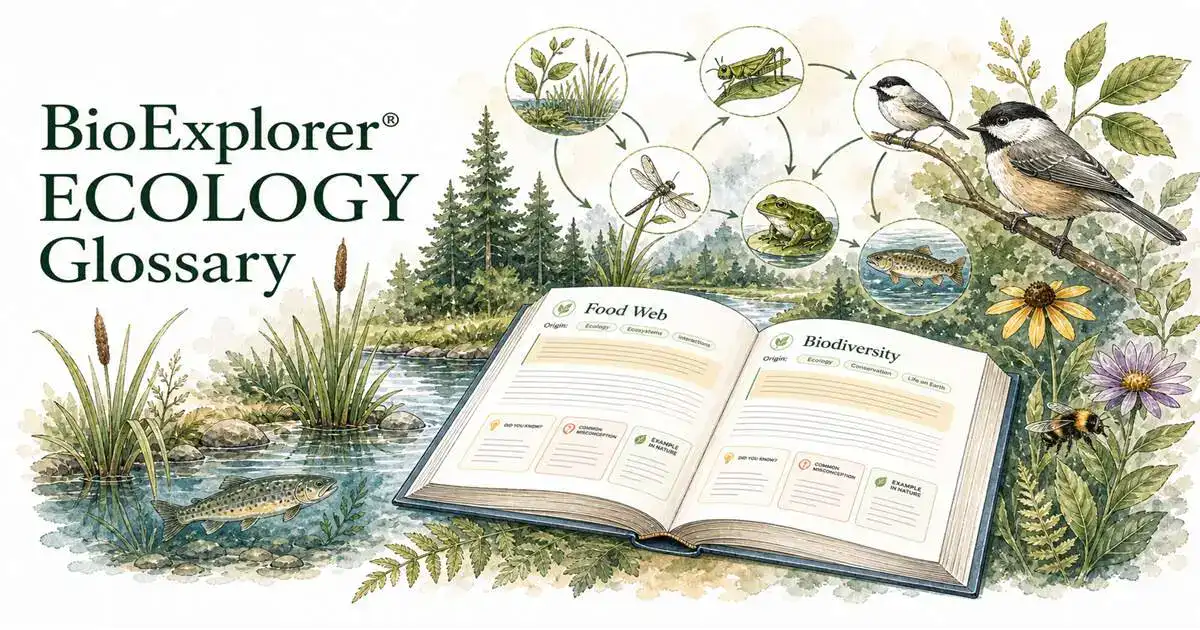
This ecology glossary brings together clear definitions for ecosystems, populations, habitats, environmental change, and interactions among living things.
The entries range from foundational terms such as ecological pyramid to more specialized concepts such as biogeochemical cycling and ecological stoichiometry. Each definition includes a nature example from a real ecosystem, helping turn abstract ecological relationships into specific, memorable cases.
On This Page:
- Ecology A–Z: Explore by Letter
- About Ecology: Ecosystems, Populations, and Environmental Relationships
- Populations and Communities
- Ecosystems and Biogeochemical Cycles
- Landscape, Global, and Behavioral Ecology
- Conservation Biology and Applied Ecology
- Ecology Glossary FAQs
- Explore Other Domain Glossaries
Ecology A–Z: Explore by Letter
About Ecology: Ecosystems, Populations, and Environmental Relationships
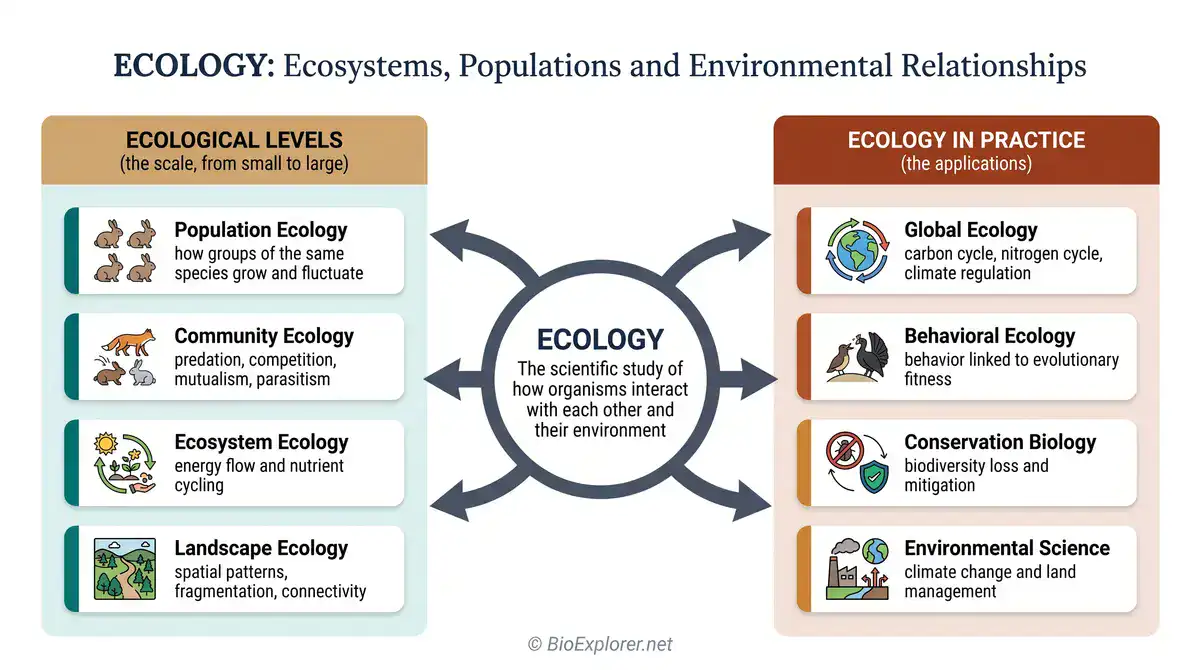
Ecology is the scientific study of how organisms interact with each other and with their physical environment, from the behavior of individual organisms to the functioning of the entire biosphere. The history of ecology shows how biology moved beyond studying organisms alone and began studying them as parts of connected systems.
What makes ecology distinctive among the biological sciences is that the subject is not the organism in isolation, but the organism in context. Each organism is shaped by competitors, predators, prey, symbionts, and the chemical and physical conditions of its surroundings.
Populations and Communities
Population ecology studies how groups of the same species grow, shrink, and respond to limiting factors such as food, space, disease, and predation.
A classic example is the rise and fall of snowshoe hare and lynx populations in boreal Canada. This pattern helps show how predator and prey populations can affect each other over time, although food supply and environmental conditions also play important roles.
Community ecology looks at how different species live together in the same habitat. It studies relationships such as predation, mutualism, parasitism, and commensalism. These interactions help determine which species thrive, which struggle, and how the whole community is organized.
Ecosystems and Biogeochemical Cycles
Ecosystem ecology tracks how energy flows and how nutrients cycle through the living and non-living parts of a habitat.
Energy enters most ecosystems through photosynthesis, moves up trophic levels, and is lost as heat at each step. This energy loss helps limit how many levels a food chain can realistically support.
Nutrients such as carbon, nitrogen, and phosphorus move through organisms, soil, water, and the atmosphere. Their balance helps determine how productive an ecosystem can be.
The carbon cycle has become especially important today. Human disruption of carbon flows through fossil fuel combustion is the main driver of modern climate change. Fossil fuels formed from ancient organic matter over millions of years, while dinosaur fossils are preserved remains or traces that help scientists understand past ecosystems.
Landscape, Global, and Behavioral Ecology
Landscape ecology studies how the arrangement of habitats affects the movement and survival of species across large areas. For example, forest patches, wildlife corridors, and fragmented edges can shape how animals move, find food, and reproduce.
Global ecology looks at ecological processes at the scale of the whole planet. Vegetation can affect sunlight reflection and water movement through transpiration. Ocean phytoplankton help move carbon from surface waters into the deep ocean. Soil microbes help control nutrient availability across large regions, partly through biological weathering, where living organisms help break down rocks and minerals.
Behavioral ecology connects animal behavior to survival and reproduction. It studies decisions such as where to forage, how to choose a mate, and how to defend a territory in a specific environmental context.
Conservation Biology and Applied Ecology
Conservation biology applies ecological principles to understand and slow the loss of biodiversity. It studies major threats to biodiversity, including habitat destruction, invasive species, pollution, and climate change.
The field also draws on population genetics to understand why small, fragmented populations can become less healthy over time. Community ecology helps scientists design reserves that protect working ecosystems, not just isolated species.
The U.S. Environmental Protection Agency publishes data and educational resources on ecological systems, ecosystem health, and environmental monitoring across the United States.
Ecology Glossary FAQs
A food chain is a linear sequence showing how energy passes from one organism to the next, such as grass to grasshopper to frog to hawk. A food web shows all the feeding relationships within an ecosystem at once, connecting multiple food chains into a network.
Food webs are more accurate representations of real ecosystems because most organisms eat more than one type of food and are in turn eaten by more than one predator.
A habitat is the physical environment where an organism lives, such as a coral reef, a forest floor, or a freshwater lake. A niche is the role an organism plays in its ecosystem, including what it eats, what eats it, when it is active, how it reproduces, and how it interacts with other species.
Two species can share a habitat but occupy different niches, which reduces direct competition between them.
Primary succession occurs when organisms colonize a substrate that has never supported life before, such as bare rock left after a glacier retreats. Secondary succession occurs when a community recovers after a disturbance that removes organisms but leaves the soil intact, such as after a fire or flood.
Secondary succession is typically faster than primary succession because the soil already contains seeds, nutrients, and organic matter.
Biodiversity means the variety of life in a given area. It includes diversity within genes, among species, and across ecosystems.
High biodiversity often makes ecosystems more stable and resilient. When many species fill different roles, the ecosystem is less likely to collapse if one species declines.
Biodiversity also supports practical human needs. Many medicines come from wild species, crops depend on diverse pollinators, and healthy fisheries rely on diverse marine food webs.
An ecosystem is a specific community of organisms and the physical environment they interact with, such as a particular lake, a patch of forest, or a stretch of coral reef. A biome is a large-scale category defined by climate and the type of vegetation it supports, such as tropical rainforest, temperate grassland, or tundra. Many individual ecosystems can exist within a single biome, and the same biome type can occur on different continents where climate conditions are similar.