
Immunology Glossary
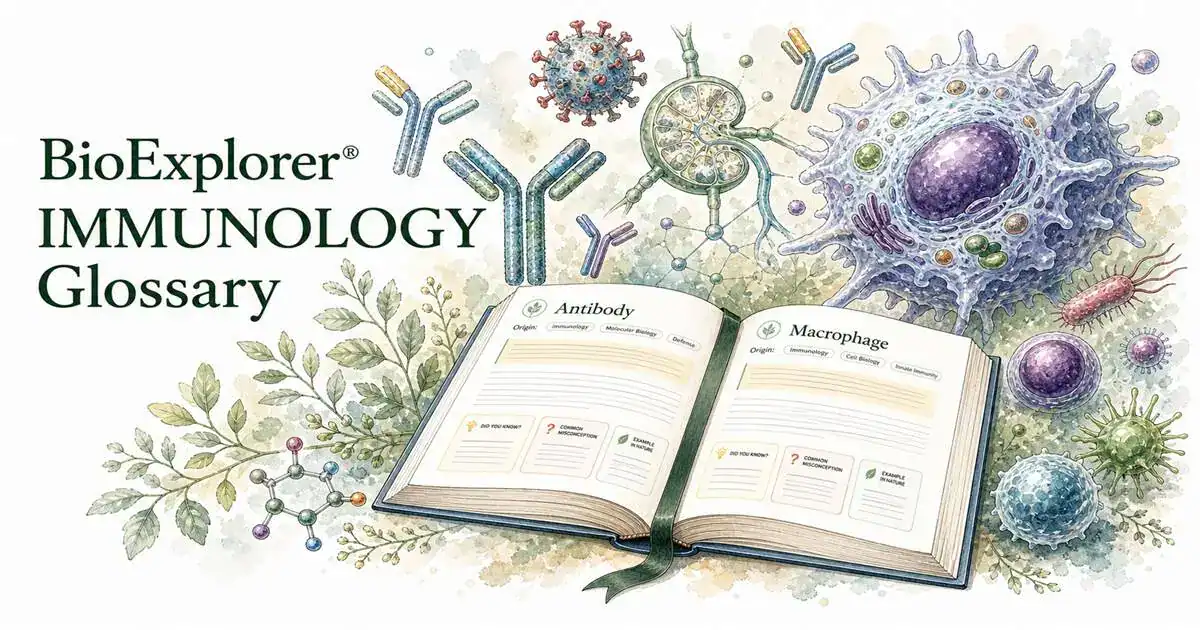
Explore this immunology glossary to find clear definitions for immune cells, antibodies, pathogens, inflammation, and the body’s defenses. With 85+ entries covering terms such as Antibody, Monocyte, Plasma Cell, Hypersensitivity, and Major Histocompatibility Complex, each definition places the term in the context of how the immune system functions as a whole.
On This Page:
- Immunology A–Z: Explore by Letter
- About Immunology: How Living Organisms Defend Against Disease
- Innate and Adaptive Immunity
- Immunopathology: When the System Misfires
- Cancer Immunology and Immunotherapy
- Connections to Clinical Medicine and Research
- Immunology Glossary FAQs
- Explore Other Domain Glossaries
Immunology A–Z: Explore by Letter
About Immunology: How Living Organisms Defend Against Disease
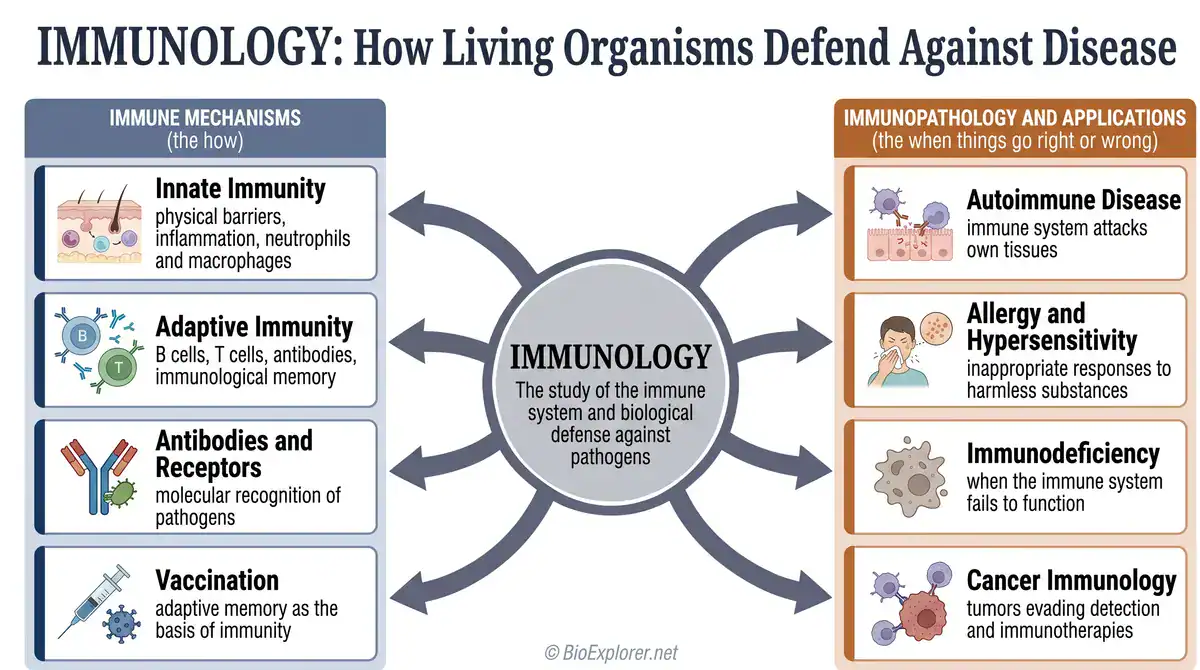
Immunology is the study of the immune system, the biological machinery that allows organisms to detect and respond to pathogens, damaged cells, and foreign substances while leaving healthy tissue alone. The history of immunology shows how scientists moved from early observations about disease resistance to a detailed understanding of cells, antibodies, vaccines, and immune memory.
The immune system operates through two connected arms that work at different speeds and with different levels of precision.
Nature examples in this glossary are drawn from real disease, infection, and tolerance scenarios. Misconception entries address the confusion that often surrounds immunity in general science communication.
Innate and Adaptive Immunity
Innate immunity provides the first line of defense. It responds quickly to many kinds of threats through physical barriers, inflammation, and immune cells such as neutrophils, macrophages, and natural killer cells.
Adaptive immunity is slower at first, but more precise. It depends on lymphocytes, including B cells and T cells. B cells produce antibodies that target specific pathogens, and the different types of antibodies help the immune system respond in different ways. T cells either coordinate the immune response or directly kill infected cells.
Adaptive immunity also creates immunological memory, which is the biological basis of vaccination.
Immunopathology: When the System Misfires
Not every immune response protects the body. Autoimmune diseases happen when the immune system attacks the body's own tissues. Rheumatoid arthritis, type 1 diabetes, and multiple sclerosis are examples of diseases linked to failures of self-tolerance.
Allergies are a different kind of immune mistake. They happen when the immune system reacts too strongly to harmless substances, such as pollen or certain foods.
Immunodeficiency diseases sit at the opposite end. In these conditions, the immune system cannot mount a strong enough defense, leaving the body more vulnerable to infections.
Cancer Immunology and Immunotherapy
Cancer immunology studies how tumors avoid immune detection and how scientists can help the immune system recognize them again.
The immune system can detect and destroy some abnormal cells before they grow into tumors. However, cancers that survive may develop ways to weaken or escape immune responses around them. This process is part of immune editing.
Immunotherapy uses this knowledge to restore or redirect immune attacks against cancer cells. Checkpoint inhibitors, CAR-T cell therapy, and some cancer vaccines are examples of this approach. These treatments have improved outcomes for several cancers that were once difficult to treat.
Connections to Clinical Medicine and Research
Immunology sits near the center of modern medicine. Transplant rejection, sepsis care, vaccine development, and the treatment of inflammatory bowel disease all require a strong understanding of the immune system.
Cell biology and genetics help explain how immune responses work at the molecular level. In recent decades, immunology has also become one of the most important areas for new treatments, especially through vaccines, biologic drugs, and cancer immunotherapy.
The National Institute of Allergy and Infectious Diseases at NIH conducts and publishes research on immune system function, infectious disease, and immunological disorders.
Immunology Glossary FAQs
Innate immunity is the body’s immediate, non-specific defense system, which responds to pathogens using physical barriers, inflammation, and cells like neutrophils and macrophages that attack any foreign material. Adaptive immunity is the slower, highly specific system built around T cells and B cells, which recognize particular pathogens and produce targeted antibodies.
Adaptive immunity also creates immunological memory, which is why a second exposure to the same pathogen typically produces a faster and stronger response.
Vaccines work by introducing the immune system to a harmless version of a pathogen, or to a component of it such as a protein from its surface, triggering an adaptive immune response without causing disease. The immune system produces antibodies and generates memory cells that persist after the response.
If the same pathogen is encountered later, the memory cells mount a rapid immune response that clears the infection before symptoms develop.
An autoimmune disease occurs when the immune system mistakenly attacks the body’s own tissues, treating them as foreign. Normally the immune system distinguishes self from non-self through a selection process that eliminates immune cells that react against the body’s own molecules.
When this process fails, self-reactive immune cells survive and cause chronic inflammation and tissue damage. Examples include rheumatoid arthritis, type 1 diabetes, multiple sclerosis, and lupus.
Inflammation is the immune system’s response to tissue damage or infection, characterized by redness, heat, swelling, and pain. When cells detect injury or pathogens, they release signaling molecules called cytokines that recruit immune cells to the site and increase blood flow to the affected area.
Acute inflammation is short-lived and resolves once the threat is cleared. Chronic inflammation, which persists when the immune system cannot clear the trigger, underlies conditions including atherosclerosis, type 2 diabetes, and many autoimmune diseases.
An antigen is any molecule that the immune system can recognize as foreign and mount a response against, typically a protein on the surface of a pathogen. An antibody is a protein produced by B cells specifically designed to bind to a particular antigen.
When an antibody binds its target antigen, it can neutralize the pathogen directly, mark it for destruction by other immune cells, or trigger the complement system. The relationship is highly specific: each antibody binds only to the antigen that triggered its production.