
Molecular Biology Glossary
Explore this molecular biology glossary to find clear definitions for DNA, RNA, proteins, gene expression, and the molecular machinery inside cells. With over 120 entries covering terms such as UTR, Argonaute, Gene Silencing, Insertion Sequence, and Post-Translational Modification, each definition is precise enough for a research context while remaining accessible to advanced graduates.
On This Page:
- Molecular Biology A–Z: Explore by Letter
- About Molecular Biology: Genes, Proteins, and the Machinery of Cells
- DNA Replication and Transcription
- Translation and Gene Regulation
- Protein Biochemistry and Research Techniques
- Connections to Genetics, Medicine, and Evolution
- Molecular Biology Glossary FAQs
- Explore Other Domain Glossaries
Molecular Biology A–Z: Explore by Letter
About Molecular Biology: Genes, Proteins, and the Machinery of Cells
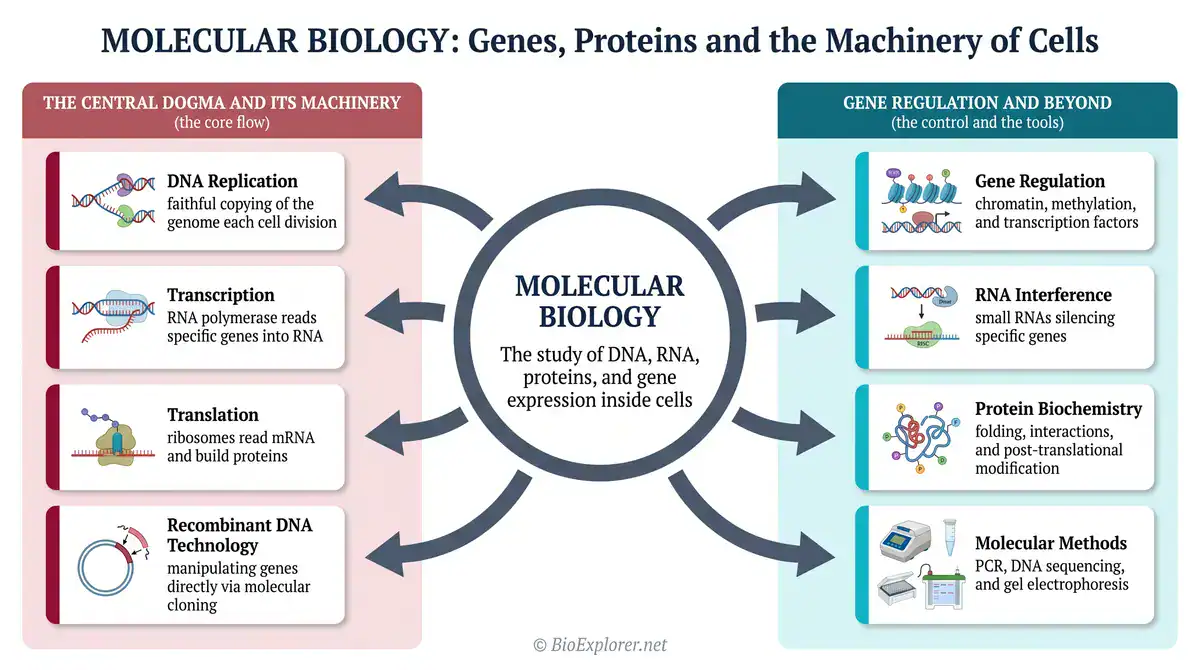
Molecular biology examines life at the level of molecules, focusing on how genetic information is stored, copied, expressed, and regulated inside living cells. Its foundational concept is the central dogma: DNA is transcribed into messenger RNA, which is then translated into protein. Etymology is particularly valuable in this domain, where many terms derive from the names of experimental systems or organisms that first revealed the underlying mechanism.
DNA Replication and Transcription
During cell division, DNA is faithfully copied through replication so each daughter cell receives a complete genome. Transcription research examines how specific genes are read by RNA polymerase to produce RNA molecules, and how transcription factors and regulatory elements control which genes are active in which cells and at which times.
Translation and Gene Regulation
Translation covers how ribosomes read messenger RNA and assemble amino acids into proteins according to the genetic code. Gene regulation encompasses the full range of mechanisms that control gene expression, from chromatin structure and DNA methylation to RNA interference and non-coding RNA.
Protein Biochemistry and Research Techniques
Protein biochemistry examines how proteins fold, interact, and are modified after translation. Recombinant DNA technology and molecular cloning made it possible to manipulate genes directly, and techniques such as PCR, DNA sequencing, and gel electrophoresis are fundamental to molecular biology research.
Connections to Genetics, Medicine, and Evolution
Molecular biology intersects with genetics, cell biology, and evolutionary biology, and its insights have transformed medicine, agriculture, and our understanding of inherited disease.
The National Human Genome Research Institute maintains fact sheets on DNA, RNA, and the molecular mechanisms of genetic information in living cells.
Molecular Biology Glossary FAQs
The central dogma describes the flow of genetic information in cells: DNA is copied into messenger RNA through transcription, and messenger RNA is then used as a template to build proteins through translation.
This framework, proposed by Francis Crick in 1958, established that information flows from nucleic acid to protein and not in reverse. Later discoveries, including reverse transcription in retroviruses, added complexity to the model but did not overturn its core logic.
DNA replication copies the entire DNA molecule so that each daughter cell receives a complete genome when the cell divides. Transcription copies specific genes into messenger RNA molecules, which carry instructions from the nucleus to the ribosomes where proteins are assembled. Replication produces DNA from DNA, while transcription produces RNA from DNA, and the two processes use different enzymes and occur for different purposes.
RNA interference is a biological process in which small RNA molecules silence specific genes by targeting and destroying messenger RNA before it can be translated into protein. It was discovered in the late 1990s and is now understood to be a widespread gene regulation mechanism in eukaryotic cells, involved in defending against viruses and controlling which genes are active at different times.
RNA interference has also become a powerful research tool and is being developed as a medical treatment for conditions where turning off a specific gene would be beneficial.
Genetics studies the inheritance, variation, and expression of genes across generations and populations, asking which traits are passed on and how.
Molecular biology examines the physical molecules and mechanisms that carry out genetic information storage and expression inside individual cells.
The two fields overlap substantially, particularly in gene regulation, but genetics operates at the level of traits and inheritance patterns while molecular biology operates at the level of DNA sequences, RNA molecules, and protein interactions.
Polymerase chain reaction amplifies specific DNA sequences from small samples, making them detectable and workable. DNA sequencing determines the precise order of nucleotides in a DNA molecule.
Gel electrophoresis separates DNA, RNA, or protein fragments by size. Recombinant DNA techniques allow specific genes to be cut, spliced, and inserted into new contexts.
CRISPR-Cas9 enables precise editing of DNA sequences in living cells and has become one of the most widely used tools in modern molecular biology research.