
Neuroscience Glossary
Explore this neuroscience glossary to find clear definitions for brain structures, neural signaling, nervous system organization, and behavior. With 90+ entries covering terms such as Neuron, Glial Cell, Temporal Lobe, Hyperpolarization, and Parasympathetic Nervous System, each definition describes what a component does and includes an example from a real organism.
On This Page:
- Neuroscience A–Z: Explore by Letter
- About Neuroscience: The Nervous System, Brain Function, and Behavior
- Neuroanatomy and Neurophysiology
- Molecular and Developmental Neuroscience
- Cognitive and Behavioral Neuroscience
- Clinical Neuroscience and Interdisciplinary Connections
- Neuroscience Glossary FAQs
- Explore Other Domain Glossaries
Neuroscience A–Z: Explore by Letter
About Neuroscience: The Nervous System, Brain Function, and Behavior
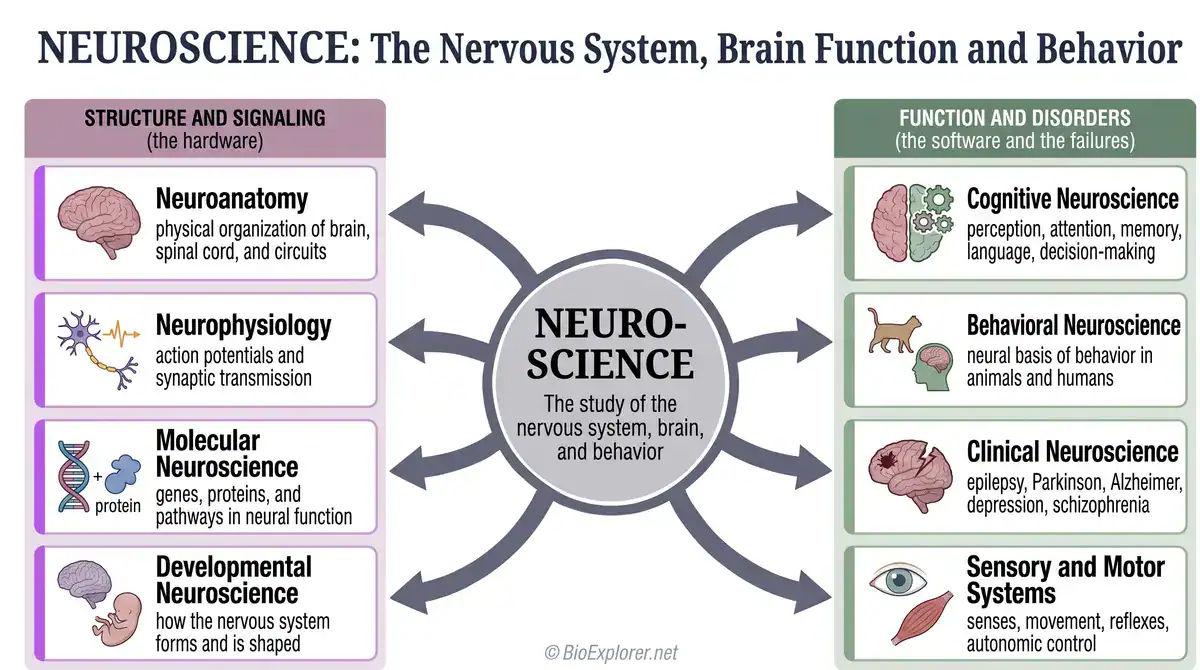
Neuroscience is the scientific study of the nervous system, including its structure, function, development, genetics, biochemistry, physiology, and the disorders that affect it. The nervous system coordinates responses to internal and external stimuli, processes sensory information, regulates organ function, generates movement, and produces cognition, emotion, and behavior.
Neuroanatomy and Neurophysiology
Neuroanatomy describes the physical organization of the nervous system, from the gross structures of the brain and spinal cord to the microscopic architecture of neural circuits.
Neurophysiology examines how neurons generate and transmit electrical signals through action potentials and how neurotransmitters carry chemical signals across synapses.
Molecular and Developmental Neuroscience
Molecular neuroscience investigates the genes, proteins, and biochemical pathways that underlie neural function.
Developmental neuroscience studies how the nervous system forms during embryogenesis and how experience shapes its organization through neuroplasticity.
Cognitive and Behavioral Neuroscience
Cognitive neuroscience connects neural activity to perception, attention, memory, language, and decision-making.
Behavioral neuroscience links brain function to observable behavior in animals and humans, drawing on experimental methods from both biology and psychology.
Clinical Neuroscience and Interdisciplinary Connections
Clinical neuroscience addresses disorders of the nervous system including epilepsy, Parkinson’s disease, depression, and schizophrenia. The field intersects with physiology, genetics, pharmacology, and psychology, making it one of the most interdisciplinary areas in modern biology.
The National Institute of Neurological Disorders and Stroke publishes Brain Basics, a foundational resource on nervous system structure and neurological function.
Neuroscience Glossary FAQs
Neurons communicate at junctions called synapses. When an electrical signal called an action potential reaches the end of a neuron, it triggers the release of chemical messengers called neurotransmitters into the synaptic cleft.
These neurotransmitters bind to receptors on the next neuron, which either excites or inhibits the generation of a new action potential. The strength of connections between neurons can change with experience, a property called synaptic plasticity, which is the cellular basis of learning and memory.
The central nervous system consists of the brain and spinal cord, which process information and coordinate responses. The peripheral nervous system consists of all the nerves outside the brain and spinal cord, which carry signals between the central nervous system and the rest of the body.
The peripheral nervous system divides further into the somatic nervous system, which controls voluntary movements, and the autonomic nervous system, which regulates involuntary functions like heart rate, digestion, and breathing.
Neuroplasticity is the ability of the nervous system to change its structure and function in response to experience, learning, injury, or disease. It includes the formation of new synaptic connections, the strengthening or weakening of existing connections, and in some regions the generation of new neurons.
Neuroplasticity is highest during early development but continues throughout life, and it is the biological mechanism underlying skill acquisition, memory formation, and recovery of function after brain injury.
Neuroscience divides into sub-disciplines defined by scale and method. Molecular and cellular neuroscience examines genes, proteins, and individual neurons. Neurophysiology studies electrical signaling.
Neuroanatomy maps the structure of the nervous system. Cognitive neuroscience connects neural activity to perception, memory, and decision-making. Behavioral neuroscience links brain function to observable behavior. Clinical neuroscience addresses disorders including epilepsy, Parkinson’s disease, and depression.
Neurons are the electrically excitable cells that transmit information through action potentials and synaptic signaling.
Glial cells are non-neuronal support cells that outnumber neurons and perform functions including insulating axons with myelin, regulating the chemical environment around neurons, supplying nutrients, and clearing cellular debris.
Astrocytes, oligodendrocytes, and microglia are the main glial types in the central nervous system, each with distinct roles in maintaining neural function.