
Evolutionary Biology Glossary
Use this evolutionary biology glossary to find clear definitions for evolution, natural selection, ancestry, adaptation, and the diversity of life.
The entries range from foundational terms such as common ancestor and transitional fossil to more specialized concepts such as clade, hybrid zone, and last universal common ancestor. Each definition explains the mechanism or pattern with examples from real organisms, fossils, or genomic evidence.
On This Page:
- Evolutionary Biology A–Z: Explore by Letter
- About Evolutionary Biology: The Origins and Diversification of Life
- Natural Selection and Other Evolutionary Mechanisms
- Speciation and Phylogenetics
- The Fossil Record and Deep Time
- Evolutionary Biology as a Unifying Science
- Evolutionary Biology Glossary FAQs
- Explore Other Domain Glossaries
Evolutionary Biology A–Z: Explore by Letter
About Evolutionary Biology: The Origins and Diversification of Life
Evolutionary biology asks how life changes across generations and how the great diversity of organisms on Earth, from bacteria to blue whales, came to exist. The history of evolution shows how scientists built this explanation through evidence from fossils, anatomy, genetics, and living ecosystems.
The answers draw on genetics, paleontology, comparative anatomy, biogeography, and ecology. These are not separate stories, but connected lines of evidence that point to the same underlying processes.
The misconception entries in this glossary are especially useful here. Evolutionary biology carries more public misunderstanding than almost any other area of biology, and clear definitions help correct those errors.
Natural Selection and Other Evolutionary Mechanisms
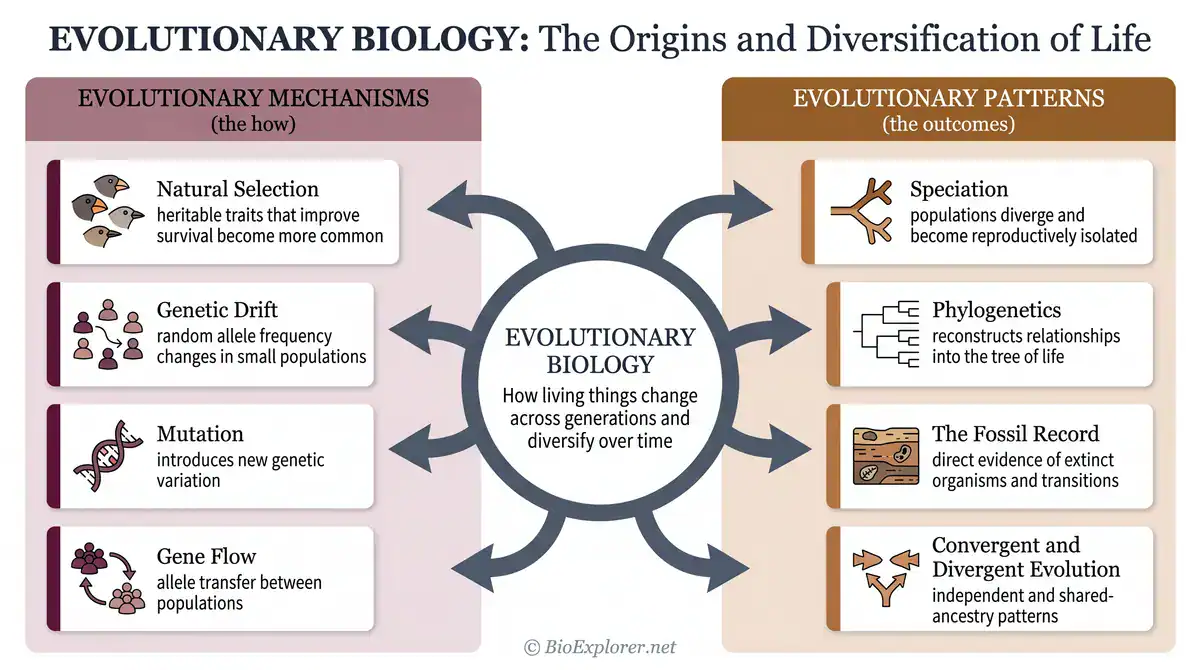
Natural selection is one of the most important mechanisms of evolutionary change. It happens when heritable traits that improve survival or reproduction become more common in a population over generations. Individuals with those traits tend to leave more offspring, so the traits spread.
Natural selection is not the only force that shapes evolution. Genetic drift causes random changes in allele frequencies, especially in small populations. The founder effect and population bottlenecks are two examples of genetic drift.
Mutation introduces new genetic variation. Gene flow moves alleles between populations when individuals migrate or reproduce across population boundaries. Together, natural selection, genetic drift, mutation, and gene flow help explain how populations change over time.
Speciation and Phylogenetics
When populations become reproductively isolated for a long time, they can build up genetic differences. Eventually, they may no longer be able to interbreed successfully. At that point, a new species may have formed.
Speciation can happen in several ways. Populations may become separated by geography, adapt to different environments, or develop chromosomal differences that make hybrids weak, inviable, or sterile.
Phylogenetics studies these branching relationships. Scientists compare DNA sequences, body structures, and developmental patterns to build evolutionary trees. These trees help show the shared ancestry of living organisms.
The founder effect shows how a small founding population can become genetically different from its parent population. This can contribute to speciation, especially on islands such as the Galapagos and Hawaii.
The Fossil Record and Deep Time
The fossil record gives scientists direct evidence of organisms that no longer exist. It documents major transitions in the history of life, including the origin of multicellular life, the movement of vertebrates onto land, the evolution of flowering plants, and the mass extinction events that changed life on Earth.
Transitional fossils, such as Tiktaalik and Archaeopteryx, show mixtures of features from different groups. These fossils provide strong physical evidence that body plans changed over long periods of geological time.
Evolutionary Biology as a Unifying Science
Theodosius Dobzhansky’s observation that nothing in biology makes sense except in the light of evolution still holds. Antibiotic resistance, cancer progression, conservation genetics, and the origins of human cognition are all evolutionary problems at their core.
The Smithsonian National Museum of Natural History offers teaching resources and educational materials on evolution, the fossil record, and the history of life on Earth.
Evolutionary Biology Glossary FAQs
Natural selection is the process by which individuals with heritable traits that improve survival or reproduction in their environment leave more offspring than individuals without those traits.
Over generations, this causes those traits to become more common in the population. Natural selection acts on existing variation and does not produce traits on demand; it simply changes the frequency of traits that already exist.
Convergent evolution occurs when unrelated species independently evolve similar traits in response to similar environmental pressures, such as the streamlined body shape shared by sharks, dolphins, and extinct ichthyosaurs.
Divergent evolution occurs when populations of the same ancestral species accumulate different traits over time, eventually producing distinct species, as seen in the diversity of beak shapes among Darwin’s finches in the Galapagos Islands.
Homologous structures are anatomical features in different species that share a common evolutionary origin, even if they now perform different functions, such as the forelimbs of humans, bats, and whales.
Analogous structures perform similar functions but evolved independently in different lineages, such as the wings of birds and the wings of insects. Homology is evidence of shared ancestry while analogy is evidence of convergent evolution.
Evolution is the change in inherited traits within a population over generations.
Natural selection is one mechanism that can cause evolution. It happens when traits that improve survival or reproduction become more common because individuals with those traits leave more offspring.
Other mechanisms also drive evolution, including genetic drift, mutation, and gene flow. Natural selection often pushes populations in a clear direction, but evolution can also happen without it, especially through random genetic drift in small populations.
Multiple independent lines of evidence support the theory of evolution. The fossil record documents organisms that no longer exist and preserves transitional forms showing gradual anatomical change over time. Comparative anatomy reveals homologous structures across distantly related species that share a common ancestor. Molecular biology shows that all living organisms use the same genetic code and that DNA sequence similarity closely mirrors evolutionary relationships. Directly observed examples include antibiotic resistance in bacteria, the evolution of beak shapes in Galapagos finches, and the emergence of new virus strains.