
Developmental Biology Glossary
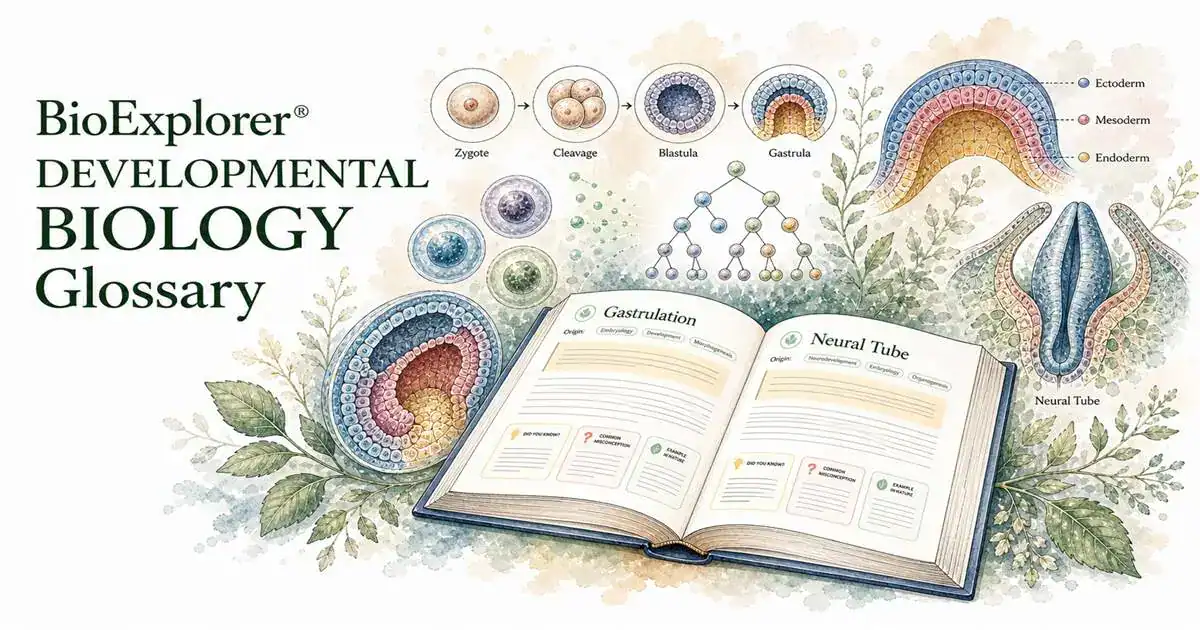
This developmental biology glossary explains how organisms grow from a single fertilized cell into organized tissues, organs, and body plans. The entries cover terms such as embryo, oogenesis, segmentation, gastrulation, and zone of polarizing activity.
Each definition uses sequence-aware language, because developmental biology terms often make the most sense when you understand what happens before and after them.
On This Page:
- Developmental Biology A–Z: Explore by Letter
- About Developmental Biology: How Organisms Grow and Take Shape
- Embryology, Organogenesis, and Post-Embryonic Development
- Core Concepts: Fate, Induction, and Pattern Formation
- Model Organisms and Research Tools
- Connections to Stem Cell Biology and Medicine
- Developmental Biology Glossary FAQs
- Explore Other Domain Glossaries
Developmental Biology A–Z: Explore by Letter
About Developmental Biology: How Organisms Grow and Take Shape
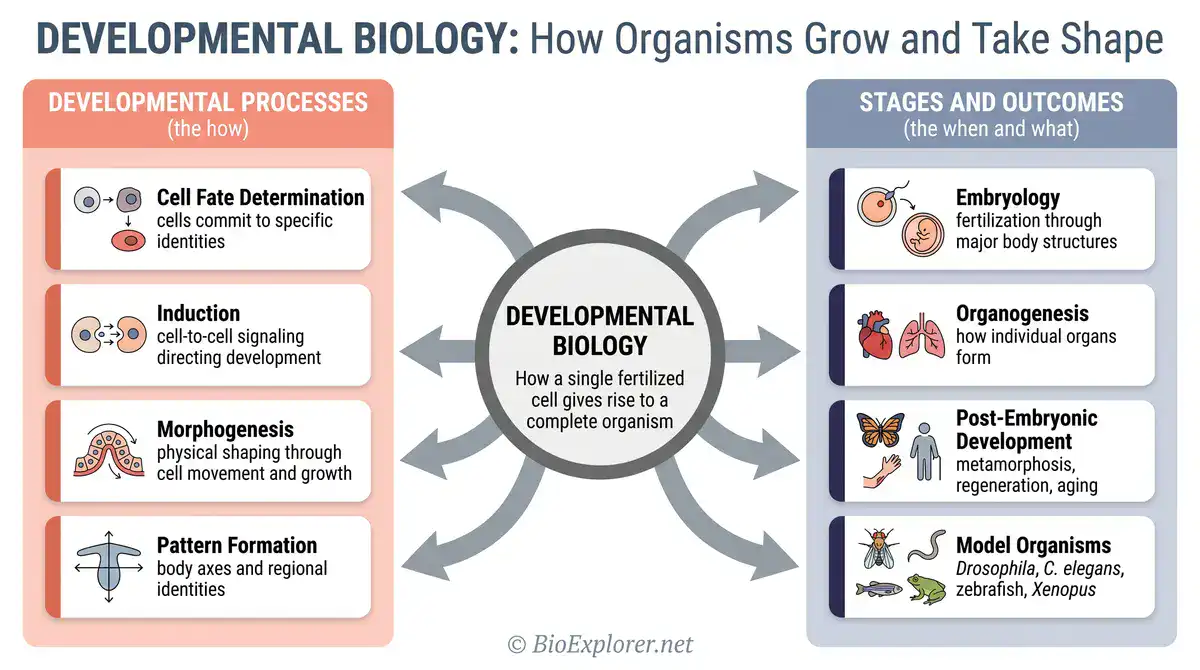
Developmental biology studies how one fertilized cell grows into a complete organism with specialized cells, tissues, and organ systems.
It asks how cells know what to become, where to move, and when to divide or die as the body forms.
Examples from nature, such as sea urchin embryos and human fetal development, help explain abstract developmental ideas in a concrete way.
Embryology, Organogenesis, and Post-Embryonic Development
The field includes embryology, which studies the embryo as the major body structures begin to form. It also includes organogenesis, which studies how individual organs develop from early groups of specialized cells.
Development does not stop at the embryo stage. Post-embryonic development includes processes such as metamorphosis in insects and amphibians, regeneration in animals like the axolotl, and the cellular changes linked to aging.
Each stage has its own vocabulary. Many developmental biology terms become easier to understand once you know where they fit in the sequence from fertilized cell to mature organism.
Core Concepts: Fate, Induction, and Pattern Formation
Cell fate determination is the process by which cells commit to becoming specific cell types. In most tissues, this decision becomes difficult or impossible to reverse once it is made.
Induction is one way cells receive these instructions. In this process, one group of cells sends signals that guide nearby cells to develop in a certain direction. A famous example came from Hans Spemann's frog embryo experiments, where one region of the embryo could influence nearby tissue and help form a second body axis.
Morphogenesis is the physical shaping of tissues and organs. It happens through coordinated cell movement, cell attachment, and programmed cell death. Pattern formation is the process that helps set up the body's axes and regional identities, such as head-to-tail and back-to-belly organization.
Model Organisms and Research Tools
Several model organisms have been central to developmental biology. These include the fruit fly, Drosophila melanogaster; the roundworm, Caenorhabditis elegans; the zebrafish, Danio rerio; and the African clawed frog, Xenopus laevis.
Scientists use these organisms because they develop quickly, are easier to study in the lab, and allow researchers to observe important developmental processes in living tissue.
In the 1980s, genetic screens in Drosophila helped identify the genes that control body segmentation. This work, led by Christiane Nüsslein-Volhard and Eric Wieschaus, later earned a Nobel Prize and shaped how scientists understand body patterning in many animals.
Curious how developmental stages line up across species? Try the Model Organism Development Stage Converter.
Connections to Stem Cell Biology and Medicine
Stem cell biology and regenerative medicine both draw directly on developmental biology. When scientists reprogram specialized cells into induced pluripotent stem cells, they partly reverse the cell commitment process that developmental biology studies.
Understanding how organs form can also help researchers study congenital defects and explore possible treatments. Developmental gene networks are important in cancer biology as well, because cancer cells can reuse or disrupt normal developmental pathways when they lose their usual identity.
The National Institute of Child Health and Human Development at NIH provides resources on fetal development and the biological processes underlying human developmental stages.
Developmental Biology Glossary FAQs
Embryology is the study of the embryo, covering the period from fertilization through the formation of the major body structures. Developmental biology is the broader field that encompasses embryology but also includes post-embryonic development, metamorphosis, regeneration, aging, and the molecular and genetic mechanisms that control how organisms grow and change throughout their entire life cycle.
Cell differentiation is the process by which a single fertilized egg cell gives rise to the hundreds of specialized cell types found in a mature organism, such as muscle cells, neurons, and red blood cells. Each differentiated cell type expresses a different subset of genes even though all cells in an organism share the same DNA.
Understanding differentiation is central to stem cell biology, regenerative medicine, and cancer research, since cancer involves cells that lose normal differentiation controls.
A model organism is a species used in research because it has features that make it especially useful for studying a biological question. In developmental biology, common model organisms include the fruit fly Drosophila melanogaster, the nematode Caenorhabditis elegans, the zebrafish Danio rerio, and the African clawed frog Xenopus laevis.
These organisms are used because they develop quickly, produce large numbers of offspring, are easy to manipulate genetically, and share fundamental developmental mechanisms with more complex animals including humans.
Gastrulation is the process in which an early embryo reorganizes into three main cell layers, called germ layers. These layers are the ectoderm, mesoderm, and endoderm.
Each germ layer develops into different body tissues. The ectoderm forms the skin and nervous system. The mesoderm forms muscles, bones, blood, and the circulatory system. The endoderm forms the lining of the gut and helps produce internal organs such as the lungs and liver.
Gastrulation is one of the most important stages of animal development, although its timing and exact process vary across species.
Mitosis is cell division that produces two genetically identical daughter cells, used for growth, tissue repair, and asexual reproduction. Meiosis is a specialized division that produces four genetically unique cells with half the chromosome number of the parent cell, used to generate eggs and sperm. In development, mitosis drives the rapid cell proliferation of the early embryo; meiosis occurs in the gonads to produce the gametes that will form the next generation. The reduction in chromosome number during meiosis ensures that when egg and sperm fuse, the resulting embryo has the correct total chromosome count.