
Anatomy Glossary
Explore this anatomy glossary to find clear definitions for structures, organs, tissues, and body processes found in living organisms. The entries cover terms such as lung, humerus, glomerulus, axial skeleton, and hypothalamic-pituitary axis.
Each definition includes a nature example drawn from a real organism, along with a pronunciation guide, etymology, and a common misconception to help clarify where anatomy is often misunderstood.
On This Page:
Anatomy A–Z: Explore by Letter
About Anatomy: Structures, Systems, and Biological Form
Anatomy is the study of body structure: how the parts of living things are built, where they are located, and how they connect. It is one of the oldest medical sciences. People began carefully studying the human body through dissection in Alexandria around 300 BCE, and the work of Vesalius in the 1500s still influences how anatomy is taught today. To learn how the field developed over time, explore the history of anatomy.
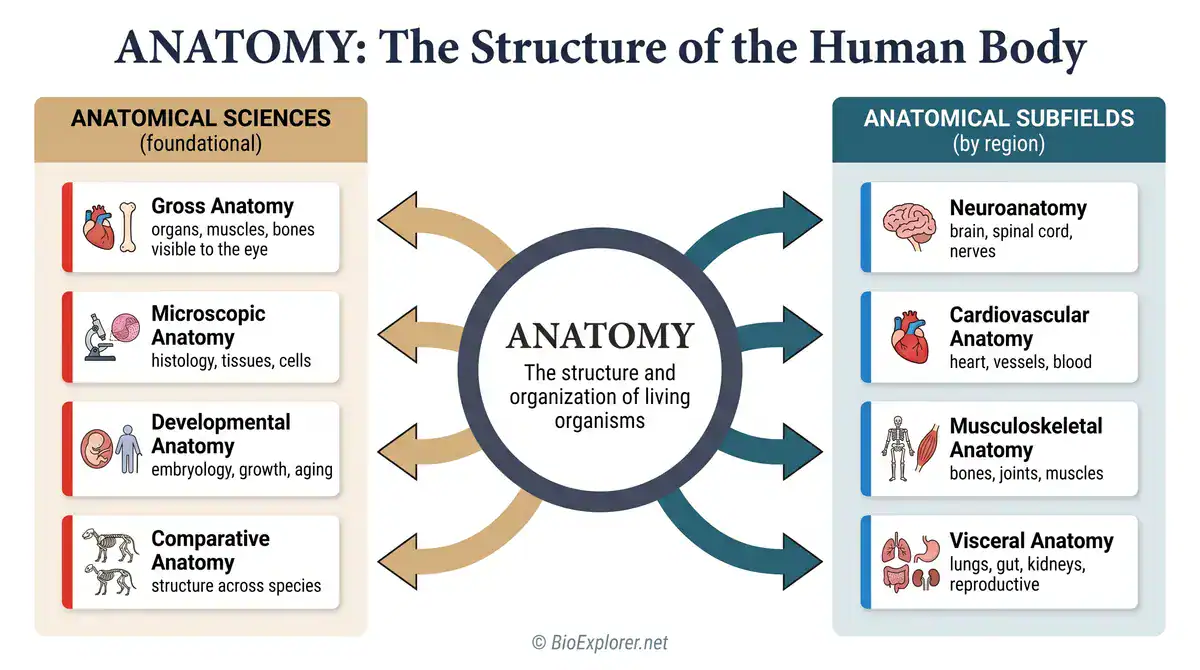
Two main approaches define the field: gross anatomy studies body parts that can be seen with the naked eye, while microscopic anatomy uses histology and cytology to study tissues and cells that are too small to see without a microscope.
Comparative and Developmental Anatomy
Comparative anatomy compares body structures across different species. It shows how similar or different those structures are and helps reveal evolutionary relationships. For example, a human arm, a bat wing, a whale flipper, and a horse foreleg all share the same basic bone pattern. This similarity is evidence of common descent, which anatomy helped scientists understand long before genetics existed.
Developmental anatomy studies how body structures form from fertilization through adulthood. It follows the changes that turn a ball of cells into a fully developed organism with working organ systems.
Human Organ Systems
Human anatomy organizes the body into several major systems.
- Cardiovascular system: Pumps blood through about 100,000 kilometers of blood vessels.
- Respiratory system: Brings oxygen into the body and removes carbon dioxide.
- Digestive system: Breaks down food, absorbs nutrients, and removes solid waste.
- Nervous system: Sends fast signals throughout the body and helps control body functions.
- Skeletal system: Supports the body, protects organs, produces blood cells in red marrow, and stores calcium.
- Muscular system: Moves the body, helps maintain posture, and produces heat.
- Integumentary system: Includes the skin, hair, and nails. It protects the body and helps control temperature.
- Endocrine system: Uses hormones to control growth, metabolism, reproduction, and other long-term body functions.
- Urinary system: Filters blood, removes liquid waste, and helps balance water and salts.
- Reproductive system: Produces sex cells and supports reproduction.
- Immune and lymphatic systems: Help defend the body against disease and return fluid to the bloodstream.
Each body system has its own job, but no system works alone. To understand one system well, you need to understand how it works with the others.
Zootomy, Etymology, and Clinical Connections
Animal anatomy, also called zootomy, studies body structures across many kinds of animals.
- Wide range of animals: It includes both vertebrates and invertebrates, from sharks and insects to octopuses and mammals.
- Anatomical examples: Cephalopod arms, insect spiracles, and shark ampullae of Lorenzini are all structures that anatomists study.
- Shared methods: Scientists describe animal structures using many of the same tools and terms used in human anatomy.
- Word origins: Much of anatomical vocabulary comes from Latin and Greek. That is why this glossary includes etymology for each term.
- Helpful example: The word glomerulus means little ball of yarn, which helps explain the rounded, tangled shape of this kidney filtration structure.
- Related fields: Anatomy connects closely with cell biology and developmental biology at the microscopic level, and with clinical medicine in real-world medical use.
For clinical context on anatomical structures and body systems, MedlinePlus from the National Library of Medicine provides authoritative health and anatomy references.
Anatomy Glossary FAQs
Anatomy is the study of biological structure, describing what body parts are and where they are located. Physiology is the study of function, explaining how those structures work. The two fields are closely linked because the shape and arrangement of a structure directly determines what it can do, a principle sometimes described as form following function.
Anatomy divides into gross anatomy, which studies structures visible to the naked eye, and microscopic anatomy, which includes histology (tissues) and cytology (cells). Comparative anatomy examines structural similarities and differences across species, while developmental anatomy traces how body structures form from fertilization through adulthood.
Most anatomical terms derive from Latin and Greek because these were the languages of science in the period when systematic anatomy was developed, primarily in Europe between the 16th and 19th centuries. Using classical roots creates terms that are consistent across modern languages, so a structure has the same name whether studied in English, Spanish, German, or Japanese.
The human body is organized into several major organ systems. The skeletal system supports the body and protects internal organs. The muscular system enables movement.
The cardiovascular system circulates blood, oxygen, and nutrients. The nervous system controls signals and responses. The respiratory system exchanges oxygen and carbon dioxide. The digestive system breaks down food and absorbs nutrients.
The endocrine system regulates body functions through hormones. The urinary system removes waste from the blood. The reproductive system supports reproduction.
The integumentary system, which includes the skin, hair, and nails, protects the body and helps regulate temperature. The lymphatic and immune systems help defend the body against disease and return extra fluid to the bloodstream.
Gross anatomy, also called macroscopic anatomy, studies body structures that are visible to the naked eye without magnification: organs, muscles, bones, blood vessels, and nerves. Microscopic anatomy requires a microscope to examine structures at the tissue and cellular level. Histology is the branch of microscopic anatomy that studies tissue organization and cell types, while cytology focuses specifically on individual cells. Both branches complement each other: understanding an organ requires knowing both its gross organization and the cellular architecture of its tissues.