
Genetics Glossary
Explore this genetics glossary to find clear definitions for DNA, genes, chromosomes, inheritance, variation, and genetic technologies.
The entries range from foundational terms such as allele, mutation, and chromosome to more specialized concepts such as epigenomics and electrophoresis. Each definition includes a nature example showing where the concept appears in a real organism.
On This Page:
- Genetics A–Z: Explore by Letter
- About Genetics: Heredity, DNA, and Biological Variation
- Classical and Molecular Genetics
- Epigenetics and Population Genetics
- Developmental Genetics and Genetic Technologies
- Genetics Across Medicine, Agriculture, and Evolution
- Genetics Glossary FAQs
- Explore Other Domain Glossaries
Genetics A–Z: Explore by Letter
Learning about alleles, genotypes, phenotypes, and inheritance patterns? Try the Punnett Square Calculator to predict genotype and phenotype probabilities for monohybrid, dihybrid, and advanced Mendelian crosses. For sex-linked traits like hemophilia, color blindness, and Rett syndrome, the X-Linked Punnett Square Calculator handles the X and Y chromosome math in one click.
Working through a genetics problem set? Try the Pedigree Analyzer to test your answers against autosomal dominant, recessive, and X-linked patterns.
About Genetics: Heredity, DNA, and Biological Variation
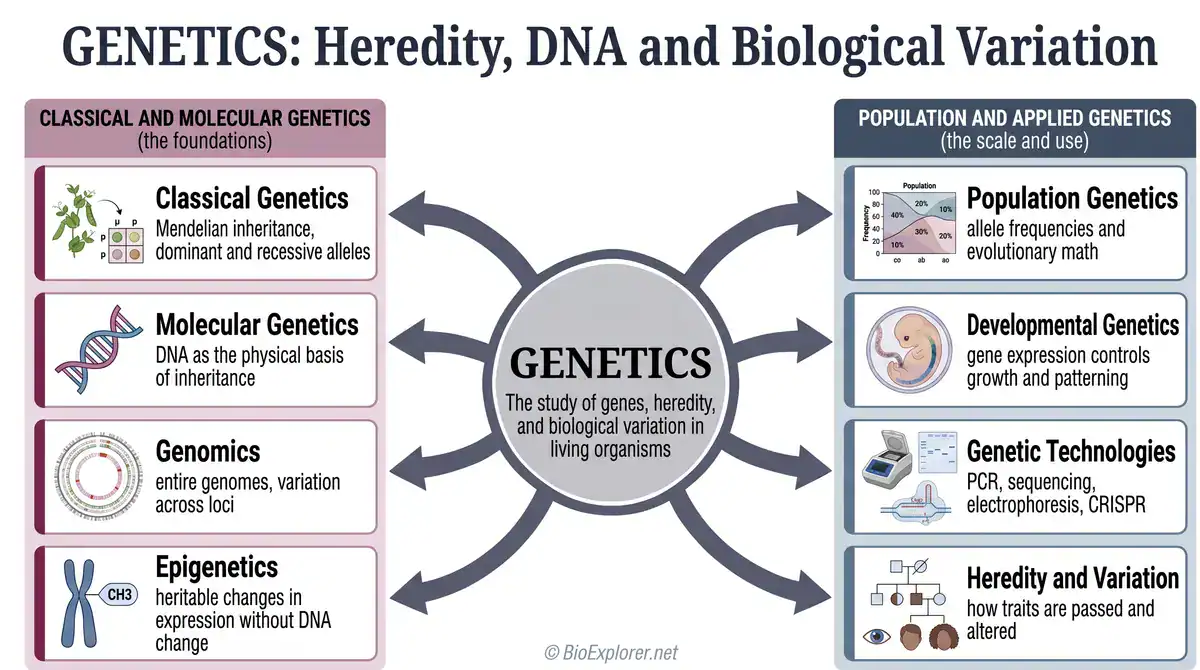
Genetics is the scientific study of genes, heredity, and biological variation. At its core, it asks a simple but powerful question: why do offspring resemble their parents, and why are they not exactly the same?
The history of genetics stretches from Gregor Mendel's 19th-century work on dominant and recessive traits to modern discoveries about DNA replication and gene expression.
The entries in this glossary cover that full range, from basic inheritance concepts to modern genetic technologies. They are written to be scientifically accurate while still being clear for readers who are new to genetics.
Classical and Molecular Genetics
Classical genetics studied how traits pass from parents to offspring through dominant and recessive alleles. Scientists understood these inheritance patterns before they knew what genes were physically made of.
Molecular genetics later explained the mechanism. Genes are sections of DNA that carry instructions, often for building proteins. Cells read those instructions through processes such as transcription and translation.
Genomics expanded the field even further. It studies the full set of DNA in an organism and helps explain how variation across many genes can influence complex traits, health, and disease risk.
Epigenetics and Population Genetics
Epigenetics studies heritable changes in gene activity that do not change the DNA sequence itself. DNA methylation, histone modification, and chromatin remodeling can help switch genes on or off. Some of these changes can pass to daughter cells, and in certain cases, across generations.
Population genetics tracks allele frequencies within and between populations. It provides the mathematical framework that connects mutation, selection, genetic drift, and gene flow to evolutionary change. This also helps explain why biological species concepts often focus on whether populations can interbreed and exchange genes.
Developmental Genetics and Genetic Technologies
Developmental genetics studies how genes turn on and off at the right times and in the right places as an organism develops. This helps explain how one fertilized cell can produce many different cell types in precise locations, even though most cells contain the same genome.
On the applied side, CRISPR-Cas9 and related gene-editing tools allow scientists to make targeted changes to DNA. These tools have important uses in studying inherited diseases, developing disease-resistant crops, and exploring the genetics of extinct species.
Genetics Across Medicine, Agriculture, and Evolution
Genetics is one of the largest and most cross-referenced domains in this glossary. That reflects how deeply genetic concepts run through every other area of biology.
Forensic identification, carrier screening, crop improvement, and phylogenetic reconstruction all depend on tools and vocabulary that originated in genetics research.
The National Human Genome Research Institute at NIH publishes fact sheets covering the distinction between genetics and genomics, a question that comes up often enough that it warranted its own page.
Genetics Glossary FAQs
Genotype refers to the specific genetic makeup of an organism, the actual alleles it carries for a given trait or set of traits. Phenotype refers to the observable characteristics that result from the interaction of the genotype with the environment.
Two organisms with the same genotype can have different phenotypes if they develop under different environmental conditions, and organisms with different genotypes can sometimes share the same phenotype.
A dominant allele produces its associated trait when only one copy is present, meaning it masks the effect of the other allele. A recessive allele only produces its associated trait when two copies are present, one inherited from each parent.
The terms dominant and recessive describe the relationship between alleles at the same gene, not any property of the alleles themselves, and many traits are influenced by more than one gene.
DNA, or deoxyribonucleic acid, is the molecule that stores hereditary information in living cells. It is made of two strands twisted into a double helix, with the sequence of four chemical bases along each strand encoding instructions for building and operating an organism.
Those instructions are read and used by the cell to produce RNA and ultimately proteins, which carry out most of the work inside cells and determine the traits of an organism.
Genetics focuses on individual genes. It studies how genes are structured, how they work, and how they pass from parents to offspring.
Genomics studies the entire set of DNA in an organism, called the genome. It looks at how many genes work together and how variation across the genome can affect traits, health, and disease risk.
In simple terms, genetics often studies one gene or trait at a time, while genomics studies DNA at the scale of the whole genome.
A mutation is any change in the DNA sequence of an organism. Mutations can be as small as a single base substitution or as large as a deletion, duplication, or rearrangement of entire chromosomal regions. Some mutations alter the protein a gene encodes and affect the organism’s traits; others occur in non-coding regions and have little or no effect. Mutations are the ultimate source of all genetic variation in populations, and natural selection acts on that variation to drive evolutionary change.