
Marine Biology Glossary
Explore this marine biology glossary to find clear definitions for ocean habitats, marine organisms, coastal environments, and deep-sea life. The entries cover terms such as atoll, seamount, zooplankton, deep-sea trench, and countercurrent exchange. Each definition is grounded in a real species or environment, from kelp forests and hydrothermal vents to open ocean gyres and intertidal zones.
On This Page:
- Marine Biology A–Z: Explore by Letter
- About Marine Biology: Life in Oceans, Seas, and Coastal Waters
- From Microbes to Marine Mammals
- Invertebrates, Fish, and Coastal Habitats
- Benthic and Pelagic Ecology
- Conservation and Physical Oceanography
- Marine Biology Glossary FAQs
- Explore Other Domain Glossaries
Marine Biology A–Z: Explore by Letter
About Marine Biology: Life in Oceans, Seas, and Coastal Waters
Marine biology is the scientific study of organisms that live in saltwater environments, including oceans, seas, estuaries, coral reefs, mangroves, and deep-sea habitats. The ocean covers roughly 71 percent of Earth’s surface and contains the majority of its habitable volume, supporting life from sun-lit surface waters to hydrothermal vents at the bottom of ocean trenches.
From Microbes to Marine Mammals
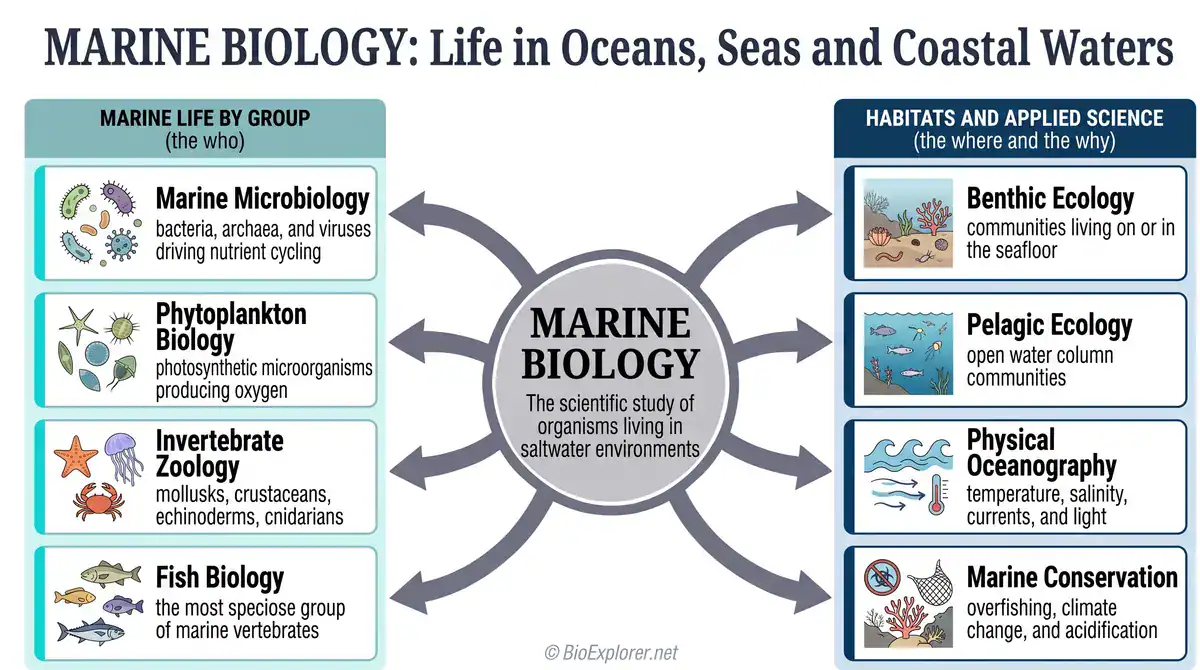
The field spans an enormous range of organisms and scales. At the microscopic end, marine microbiology covers the bacteria, archaea, and viruses that drive much of the ocean's nutrient cycling. It also includes phytoplankton, which produce a large share of Earth's oxygen.
At the larger end, marine mammal biology studies whales, dolphins, and seals. These animals had ancestors that lived on land but later returned to the sea. Their warm blood, air-breathing lungs, streamlined bodies, blubber, and diving abilities are powerful examples of ocean animal adaptations.
Invertebrates, Fish, and Coastal Habitats
Marine invertebrates make up much of ocean diversity. Molluscs, crustaceans, echinoderms, and cnidarians together include a large share of described marine species.
Fish biology is another major area of marine biology. It studies the anatomy, physiology, behavior, and ecology of fish, the most diverse group of vertebrates.
Coastal habitats such as coral reefs, mangroves, and seagrass beds are highly productive for their size. They serve as nurseries for many marine species and help protect coastal communities from storm damage.
Benthic and Pelagic Ecology
Benthic ecology studies communities that live on or in the seafloor. These habitats range from shallow sandy flats to abyssal plains about 6,000 meters deep, where pressure is extremely high.
Pelagic ecology studies the open water column above the seafloor. In this zone, organisms have no solid surface to anchor to, so they must swim, float, or drift.
The two systems are linked by the biological pump. Organic material made in surface waters sinks as particles and dead organisms, carrying energy to deep-sea communities that never receive sunlight.
Conservation and Physical Oceanography
Marine conservation biology studies the threats facing ocean ecosystems. Climate change, ocean acidification, overfishing, and plastic pollution are changing habitats faster than many species can adapt.
The work of famous marine biologists has helped bring attention to these problems and has shaped how scientists study and protect ocean life.
Physical oceanography is technically a separate discipline, but it gives marine biologists important environmental context. Temperature, salinity, current patterns, and light levels all help determine where marine life can survive and how populations stay connected across ocean basins.
The NOAA Ocean Service provides authoritative resources on ocean ecosystems, marine habitats, and coastal science.
Marine Biology Glossary FAQs
The ocean is divided into depth zones with distinct conditions. The sunlit photic zone from the surface down to about 200 meters supports photosynthetic phytoplankton and most ocean biodiversity, including coral reefs, fish, and marine mammals.
The twilight mesopelagic zone from 200 to 1000 meters receives too little light for photosynthesis but supports many fish and invertebrates that migrate up at night. Below 1000 meters the bathypelagic and abyssal zones are permanently dark, cold, and under extreme pressure, yet support diverse communities including bioluminescent fish and filter feeders that depend on organic material sinking from above.
Coral bleaching occurs when corals expel the symbiotic algae, called zooxanthellae, that live in their tissues and provide up to 90 percent of their energy through photosynthesis.
The expulsion is triggered by stress, most commonly elevated water temperatures, which cause the algae to produce harmful compounds. Without the algae, the coral turns white and is weakened. If temperatures return to normal quickly enough the algae can recolonize, but prolonged bleaching leads to coral death.
Oceans are the large, continuous bodies of salt water that cover most of Earth’s surface, divided into five named oceans: the Pacific, Atlantic, Indian, Southern, and Arctic. Seas are smaller bodies of salt water that are partially enclosed by land and typically connected to an ocean, such as the Mediterranean Sea, the Red Sea, and the Caribbean Sea.
The distinction is geographical rather than biological, but it matters in marine biology because enclosed seas often develop distinct species assemblages due to restricted water exchange.
Marine biologists study the organisms that live in saltwater environments and the physical and chemical conditions that shape their lives. Depending on their specialization, they may examine phytoplankton ecology, fish behavior, whale migration, coral reef dynamics, deep-sea biodiversity, or the microbial communities that drive ocean nutrient cycles.
Marine biologists work in the field collecting specimens and recording observations, in laboratories analyzing samples and running experiments, and increasingly using remote sensing and underwater vehicles to access environments that are difficult to reach.
An ocean food web is the network of feeding relationships among marine organisms. Phytoplankton form the base, converting sunlight and dissolved nutrients into organic matter through photosynthesis. Zooplankton graze on phytoplankton and are in turn eaten by small fish, which are eaten by larger fish, marine mammals, and seabirds.
Decomposers and bacteria break down dead organic matter and return nutrients to the water. Unlike a simple food chain, a food web captures the reality that most organisms eat multiple prey types and are eaten by multiple predators.