
Botany Glossary
Explore this botany glossary to find clear definitions for plant structures, growth, reproduction, transport, and adaptation. The entries cover terms such as axil, stomata, angiosperm, gamopetalous, and alternation of generations.
Each definition explains the structure, process, or adaptation in plain language and includes an example from a real plant species you might encounter in a garden, field, or forest.
On This Page:
Botany A–Z: Explore by Letter
About Botany: Plant Biology from Cell to Ecosystem
Botany is one of the oldest biological sciences. In the history of botany, systematic plant study dates back to ancient Greece, and for much of human history it was closely tied to medicine, agriculture, and exploration. Today, the field covers the structure, function, growth, reproduction, evolution, and ecology of plants, algae, and other photosynthetic organisms. The 200+ terms in this glossary reflect the enormous structural and ecological diversity of plant life, from tropical rainforests to arctic tundra.
Plant Morphology, Anatomy, and Physiology
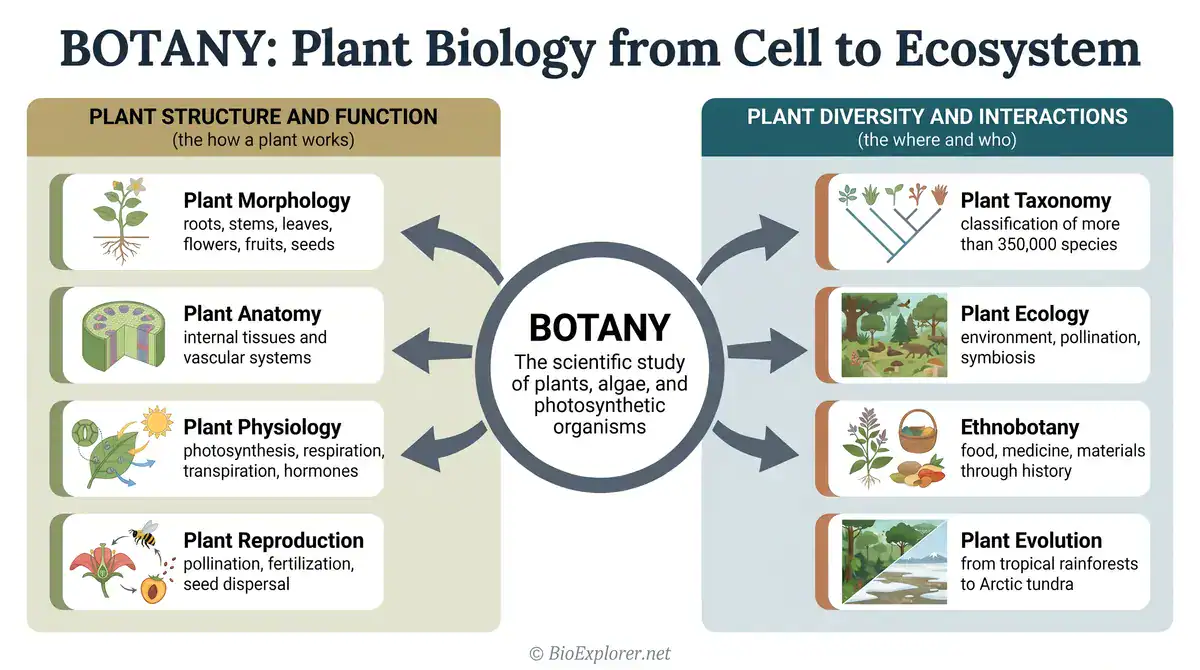
Plant morphology describes the outside structure of plants, including roots, stems, leaves, flowers, fruits, and seeds. These are the parts botanists name, compare, and measure in the field.
Plant anatomy goes deeper by studying the internal structure of plant tissues. For example, xylem carries water upward, phloem moves sugars through the plant, and specialized cells help with photosynthesis, gas exchange, and support.
Plant physiology studies the life processes that keep plants alive. These include photosynthesis, respiration, transpiration, and hormone-controlled growth. Physiology helps explain why a plant wilts, flowers at the right time, or bends toward light.
Plant Ecology and Interactions
Plants rarely operate in isolation. Plant ecology studies how plants interact with their physical environment and with other organisms. For example, the mutualism between a fig tree and its dedicated fig wasp pollinator is just as much a botanical subject as the anatomy of the fig itself.
Pollination, seed dispersal, competition for light and nutrients, and chemical defenses against herbivores all belong to plant ecology. One vivid example is the layered structure of tropical rainforests. The different layers of rainforest create vertical niches, where different plant species grow at different heights and help shape the structure of the entire ecosystem.
Taxonomy, Systematics, and Ethnobotany
Plant taxonomy and systematics organize the roughly 400,000 known plant species into an evolutionary framework. They use both visible features and molecular evidence to understand relationships between plants and assign scientific names.
- Taxonomy: Names, describes, and classifies plant species.
- Systematics: Studies how plants are related through evolution.
- Modern classification: Scientists now use DNA evidence along with plant structure, which has changed many older groupings.
- Ethnobotany: Studies how human cultures have used plants for food, medicine, fiber, dye, and ceremony.
- Human value: This record still helps scientists find useful compounds, guide conservation work, and understand the long relationship between people and plants.
Plant Evolution and Conservation
Plants began colonizing land roughly 470 million years ago. This changed Earth's atmosphere, helped create soil, and made life on land possible for animals.
Since then, major plant innovations have opened new ecological opportunities. Vascular tissue helped plants grow taller and move water more efficiently. Seeds helped plants reproduce and spread in drier places. Flowers helped many plants attract pollinators and diversify into new forms.
Conservation botany now tracks thousands of plant species threatened by habitat loss and climate change. Many of these species are poorly studied, and some have no common name because scientists have only examined them as herbarium specimens.
The U.S. Forest Service maintains plant biology and wildflower resources that document native plant species and botanical ecology across North American habitats.
Botany Glossary FAQs
Monocots and dicots are the two main groups of flowering plants, distinguished primarily by the number of seed leaves, or cotyledons, in the embryo.
Monocots have one cotyledon and typically show parallel leaf venation, flower parts in multiples of three, and scattered vascular bundles in the stem. Dicots have two cotyledons, branched leaf venation, flower parts in multiples of four or five, and vascular bundles arranged in a ring.
Plants move water upward through xylem vessels using a combination of root pressure, capillary action, and transpiration pull. As water evaporates from leaf surfaces through stomata, it creates tension that pulls the water column upward through the continuous network of xylem tissue.
This process, called the cohesion-tension mechanism, works because water molecules stick to each other and to the walls of the xylem vessels.
Photosynthesis converts light energy into chemical energy, using carbon dioxide and water to produce glucose and oxygen. Cellular respiration breaks down that glucose to release the stored energy, consuming oxygen and producing carbon dioxide and water.
Plants carry out both processes: photosynthesis predominantly in leaves during daylight, and cellular respiration continuously in all living cells.
Angiosperms are flowering plants that produce seeds enclosed within a fruit, which develops from the ovary after fertilization. They are the most diverse plant group, with over 300,000 described species, and include grasses, oaks, roses, and most crop plants. Gymnosperms produce seeds that are not enclosed in a fruit but are instead exposed on the scales of a cone or similar structure.
Conifers, cycads, ginkgo, and gnetophytes are all gymnosperms. The distinction matters ecologically because the enclosing fruit of angiosperms often plays a role in seed dispersal by animals.
Pollination is the transfer of pollen from the male reproductive structures of a flower to the female reproductive structures, enabling fertilization and seed production. In animal-pollinated plants, pollen is carried by insects, birds, or bats that visit flowers for nectar or pollen rewards.
In wind-pollinated plants, large quantities of lightweight pollen are released into the air, relying on chance contact with receptive flowers. Self-pollination occurs when pollen from the same plant fertilizes its own flowers, while cross-pollination between different plants promotes genetic diversity.