
Zoology Glossary
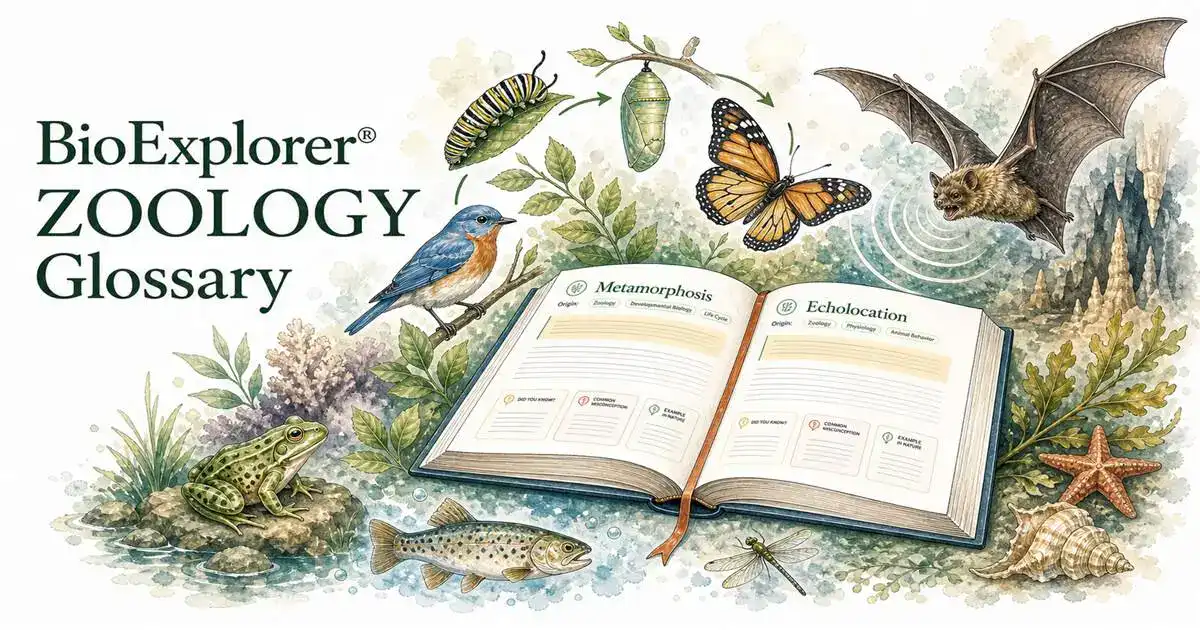
Explore this zoology glossary to find clear definitions for animal anatomy, behavior, classification, reproduction, and adaptation. With 150+ entries, it covers representative terms such as Fin, Chordate, Proboscis, Poikilotherm, and Counter Current Exchange; each definition anchored to a named species so readers connect the term to a real organism they can observe or look up.
On This Page:
- Zoology A–Z: Explore by Letter
- About Zoology: Animal Life, Diversity, and Biological Adaptation
- Invertebrate and Vertebrate Zoology
- Comparative Anatomy and Animal Physiology
- Ethology and Animal Behavior
- Evolutionary Biology, Genetics, and Conservation
- Zoology Glossary FAQs
- Explore Other Domain Glossaries
Zoology A–Z: Explore by Letter
About Zoology: Animal Life, Diversity, and Biological Adaptation
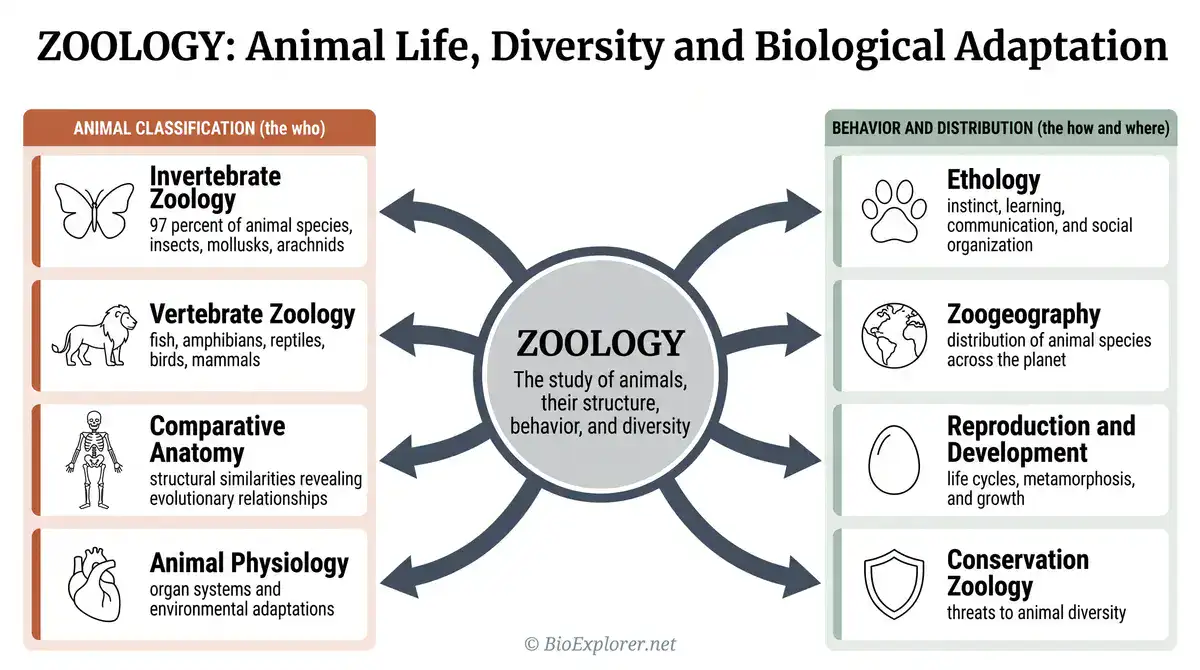
Zoology is the branch of biology devoted to the study of animals, encompassing their structure, physiology, behavior, classification, evolution, distribution, and ecology.
Animals are the most behaviorally and morphologically diverse group of multicellular organisms, with an estimated one million described species and many more yet to be identified.
Invertebrate and Vertebrate Zoology
Invertebrate zoology studies animals without backbones, including insects, arachnids, molluscs, annelids, crustaceans, echinoderms, and cnidarians. These animals make up the vast majority of animal species.
Vertebrate zoology studies animals with backbones, including fish, amphibians, reptiles, birds, and mammals. Its major branches include ichthyology for fish, herpetology for amphibians and reptiles, ornithology for birds, and mammalogy for mammals.
Comparative Anatomy and Animal Physiology
Comparative anatomy traces structural similarities and differences across animal groups to reveal evolutionary relationships and adaptive solutions to common biological problems.
Animal physiology studies how organ systems function across species, including adaptations to extreme environments such as deep-sea pressure, arctic cold, and desert heat.
Ethology and Animal Behavior
Ethology examines animal behavior in natural settings, studying instinct, learning, communication, and social organization. The field was formalized by Nikolaas Tinbergen and Konrad Lorenz, who established a framework of four questions for any behavior: its immediate cause, its development, its function, and its evolutionary history.
Zoogeography maps the distribution of animal species across the planet and explains how geography, climate, and history shaped those patterns.
Evolutionary Biology, Genetics, and Conservation
Modern zoology intersects with evolutionary biology, genetics, and conservation biology. Its vocabulary spans everyday animal names and the precise technical terms of comparative biology.
The Smithsonian’s National Zoo and Conservation Biology Institute conducts and publishes research on animal biology, behavior, and conservation across a wide range of species.
Zoology Glossary FAQs
Vertebrates are animals with a backbone, or vertebral column, which forms part of an internal skeleton. They include fish, amphibians, reptiles, birds, and mammals.
Invertebrates are all animals without a backbone and represent the vast majority of animal species, including insects, worms, molluscs, crustaceans, and echinoderms.
The distinction is anatomical and reflects a fundamental difference in body plan, though both groups span an enormous range of complexity, size, and ecology.
Cold-blooded animals, or ectotherms, regulate their body temperature primarily through behavior, such as basking in sunlight or moving into shade, and their internal temperature varies with the environment.
Warm-blooded animals, or endotherms, generate heat internally through metabolism and maintain a relatively constant body temperature regardless of external conditions.
Birds and mammals are endotherms. Most fish, amphibians, and reptiles are ectotherms, though some large fish like the bluefin tuna maintain elevated muscle temperatures through specialized circulation.
Zoology divides into sub-disciplines organized around animal groups and methods. Entomology covers insects; ichthyology covers fish; herpetology covers reptiles and amphibians; ornithology covers birds; and mammalogy covers mammals.
Ethology studies animal behavior; comparative anatomy examines structural relationships across groups; and zoogeography maps species distributions. Conservation biology and wildlife ecology apply zoological knowledge to threatened species and habitat management.
Animal behavior includes everything an animal does in response to its internal state and its environment, from feeding and mating to navigation and social interaction.
Zoologists study behavior through field observation, controlled experiments, and by tracing the genetic and neurological mechanisms that produce it. The field of ethology, pioneered by Nikolaas Tinbergen and Konrad Lorenz, established the framework of asking four questions about any behavior: what causes it, how does it develop, what is its function, and how did it evolve.
Zoology focuses specifically on animals, which are multicellular, heterotrophic organisms that obtain energy by consuming other organisms.
Botany covers plants and photosynthetic organisms, which produce their own energy from sunlight. Microbiology examines microorganisms including bacteria, archaea, fungi, and viruses, most of which are unicellular.
The three fields share methods in genetics and ecology but differ in their subject organisms and the structural and physiological systems they prioritize.