
Cell Biology Glossary
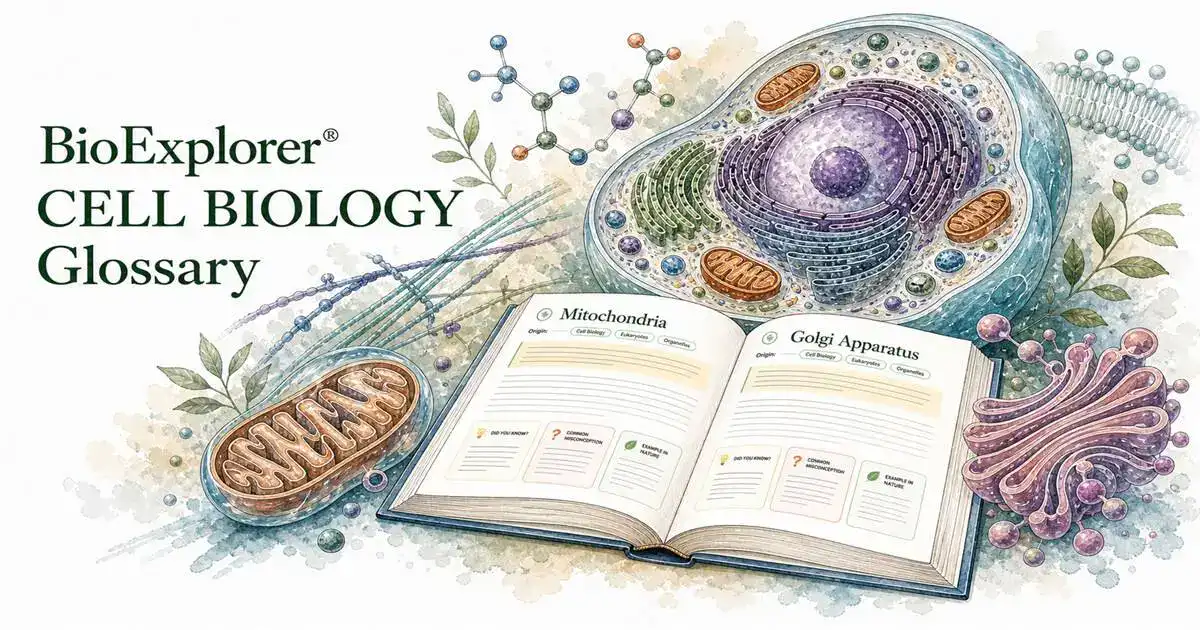
This cell biology glossary explains the structures, transport systems, signaling pathways, and processes that keep cells alive. The entries cover terms such as mitochondria, aquaporin, chloroplast, zona pellucida, and unfolded protein response.
Each definition explains organelles, membranes, cell division, and related processes in clear language, with enough detail to support study while staying readable for non-specialists.
On This Page:
- Cell Biology A–Z: Explore by Letter
- About Cell Biology: The Structure and Function of Living Cells
- Prokaryotic and Eukaryotic Cells
- Organelles, Membranes, and Transport
- Cell Division, Signaling, and Death
- Cell Biology in Medicine and Research
- Cell Biology Glossary FAQs
- Explore Other Domain Glossaries
Cell Biology A–Z: Explore by Letter
About Cell Biology: The Structure and Function of Living Cells
Cell biology is the scientific study of how that machinery is built, how it works, and how it fails. The history of cell biology shows how discoveries such as the microscope, cell theory, and modern imaging changed our understanding of life at its smallest functional level.
Calcium Imaging Delta F/F0 Calculator
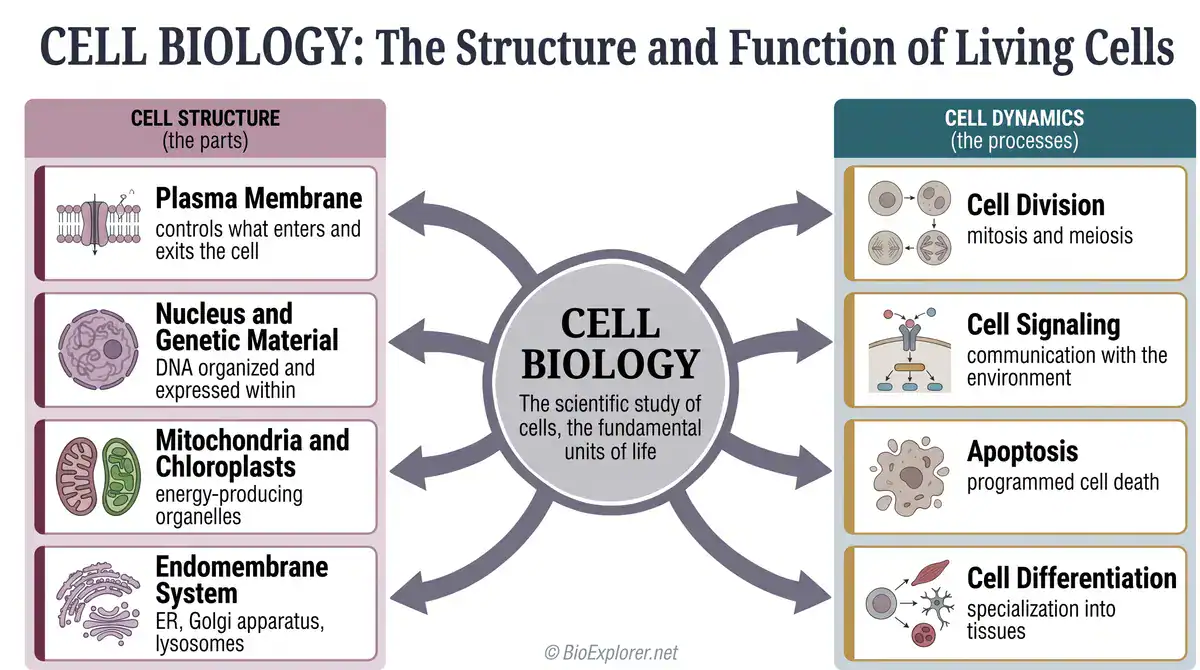
Because cells are the basic unit of life, discoveries in cell biology also shape medicine, genetics, and evolutionary biology. Each term in this glossary includes a misconception entry, since imprecise language in cell biology can lead to repeated errors in understanding.
Prokaryotic and Eukaryotic Cells
One of the most important divisions in cell biology is between prokaryotic cells and eukaryotic cells. Prokaryotic cells, which include bacteria and archaea, do not have a membrane-bound nucleus. Eukaryotic cells have a nucleus and many specialized organelles.
This structural difference reflects roughly 2 billion years of evolutionary separation. It also helps explain why some antibiotics can target bacterial ribosomes without harming human cells in the same way.
Plants, animals, fungi, and protists are all eukaryotes, but their cells are not identical. For example, plant cells have chloroplasts and a rigid cell wall, while animal cells do not. To compare these features in more detail, see our guide on the difference between plant and animal cells.
Organelles, Membranes, and Transport
Inside a eukaryotic cell, the plasma membrane controls what enters and exits. It does this through channels, pumps, and receptors, not by acting as a simple barrier.
Mitochondria generate ATP through cellular respiration and carry their own DNA, which reflects their ancient bacterial origin. The endoplasmic reticulum helps make proteins and lipids, while the Golgi apparatus sorts and sends them to the right places. Lysosomes break down cellular waste.
The cytoskeleton is a network of protein filaments that gives the cell its shape, moves organelles, and helps pull chromosomes apart during cell division. Aquaporins are a useful example of membrane transport. These channel proteins allow water to cross the membrane much faster than simple diffusion, without using cellular energy.
Cell Division, Signaling, and Death
Cells divide through mitosis, a carefully controlled process that helps one cell produce two genetically identical cells. Before division continues, checkpoints help make sure the DNA is copied correctly and is not badly damaged.
When these checkpoints fail, cells may divide too often or at the wrong time. This uncontrolled cell division is one of the main cellular causes of cancer.
Cells also communicate through signaling pathways. These pathways help cells receive and respond to information from hormones, growth factors, stress signals, and nearby cells.
Programmed cell death, also called apoptosis, provides the balance. It is a controlled process that removes cells that are damaged, unnecessary, or no longer needed. Apoptosis is essential for normal development, tissue repair, and keeping cell growth under control.
Cell Biology in Medicine and Research
Much of modern medicine depends on cell biology. Many drugs work by targeting receptors on cell membranes. Chemotherapy can disrupt cell division. Gene therapies aim to change or correct the machinery inside cells.
Cancer biology, stem cell research, and cell-based therapies all use the same core vocabulary covered in this glossary.
The National Institute of General Medical Sciences at NIH publishes educational resources on cell biology and the fundamental discoveries shaping our understanding of living cells.
Cell Biology Glossary FAQs
Prokaryotic cells, found in bacteria and archaea, lack a membrane-bound nucleus and most other organelles, with their genetic material floating freely in the cytoplasm.
Eukaryotic cells, found in animals, plants, fungi, and protists, have a defined nucleus enclosed by a membrane along with a range of specialized organelles including mitochondria, endoplasmic reticulum, and Golgi apparatus. Eukaryotic cells are generally larger and structurally more complex.
Mitochondria generate most of a cell’s supply of ATP through a process called cellular respiration, which breaks down glucose and other fuel molecules using oxygen.
Beyond energy production, mitochondria also regulate calcium levels, produce heat, and play a central role in initiating programmed cell death. They contain their own small genome, which is evidence that mitochondria originated as independent bacteria that were incorporated into ancestral eukaryotic cells.
The cell cycle is the series of events a cell undergoes from its formation to its division into two daughter cells. It consists of interphase, during which the cell grows and copies its DNA, and the mitotic phase, during which the copied chromosomes are separated and the cell divides.
Cell cycle checkpoints monitor whether each stage has been completed correctly, and defects in this control system are a primary cause of cancer.
Plant cells have three structures not found in animal cells: a rigid cell wall made of cellulose outside the plasma membrane, chloroplasts that carry out photosynthesis, and a large central vacuole that maintains turgor pressure and stores water and nutrients.
Animal cells lack all three, but have centrioles that help organize cell division; structures plant cells do not require in the same way. Both cell types contain a nucleus, mitochondria, endoplasmic reticulum, Golgi apparatus, and ribosomes, and both are eukaryotic.
Osmosis is the movement of water across a semipermeable membrane from a region of lower solute concentration to a region of higher solute concentration. In cells, the plasma membrane acts as this barrier, and the balance of solutes inside and outside the cell determines the direction of water flow.
If a cell is placed in a solution more concentrated than its contents, water moves out and the cell shrinks. If the solution is more dilute, water moves in and the cell swells. Aquaporins are channel proteins that dramatically accelerate the rate of water movement across the membrane without changing its direction.