
History of Ecology
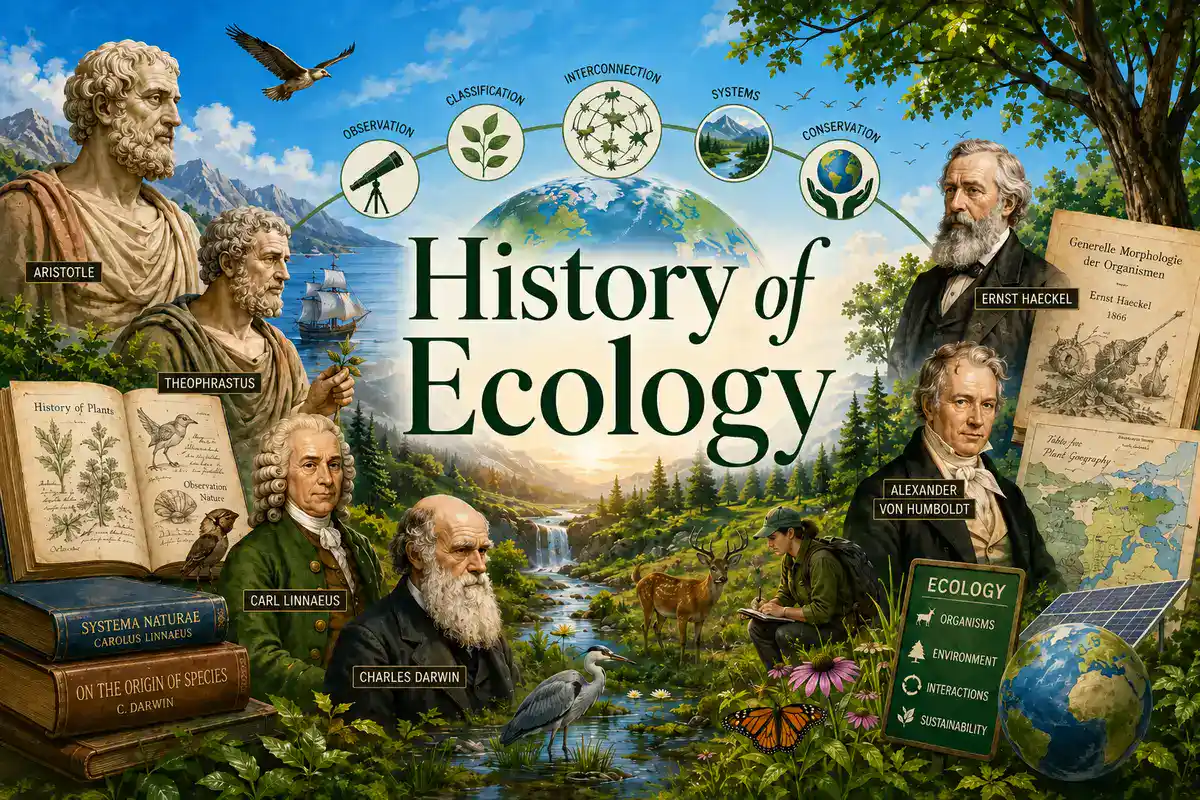
Ecology is the scientific study of the interactions that determine the distribution and abundance of organisms in their environment. The history of ecology spans more than two thousand years, from Aristotle and Theophrastus’s early observations of plant and animal life in the 4th century BCE, to Ernst Haeckel formally naming the discipline in 1866, through its rapid growth into a modern science in the 20th century.
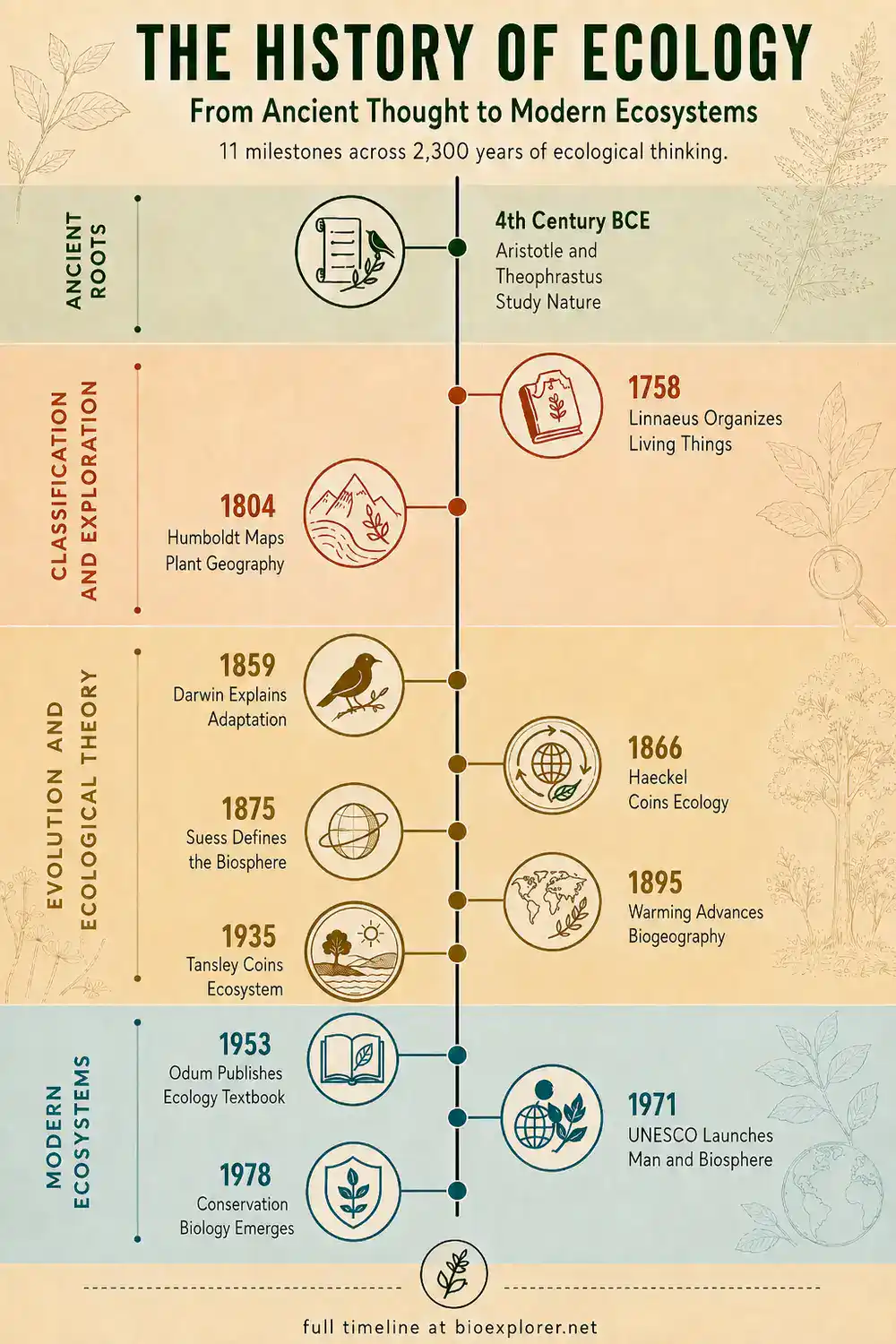
Below is a complete history of ecology timeline covering the key events and the ecologists who shaped the subject of ecology as it’s studied today.
Ecology Timeline Guide:
Ecology didn’t emerge on its own. Explore the full History of Biology to trace how ideas about ecosystems and species interactions grew out of centuries of earlier discovery.
Origin of Ecology

In 1866, Ernst Haeckel coined the term "ecology". It comes from the Greek word Oikos meaning "household" and logos meaning "study of", therefore the "study of nature's household". Relating this definition to science, ecology becomes the study of the management of the natural environment, which includes the relations of organisms with one another and their surroundings.
Ecology as a scientific discipline is said to be multidisciplinary. It often encompasses several fields like biology, geography, and Earth science.
However, ecology is not always focused on the environment but on man. Practical applications in ecology include conservation biology, restoration ecology, resource management, and wetland management.
Pre-18th Century (Before 1700)
-
4th Century B.C.E:
Ecological thought is said to derive its roots from the early teachings of philosophy, ethics, and politics.
Aristotle and Theophrastus were considered the first ecologists who had an interest in studying plants and animals. Theophrastus described several interrelationships that exist between living organisms and their environment.
18th Century (1700 to 1799)
-
Early 1700s:
Two schools of thought dominated the growing scientific study of ecology.
The first school of thought is the "Arcadian Ecology" which advocates for a “simple, humble life for man” and a harmonious relationship with man and nature. On the other hand, the second school of thought, known as the "Imperial Ecology" believes in the establishment of man's dominance over nature through the exercise of reason and hard work.
Both views rivaled through the early years of the 18th century until Carolus Linnaeus came in the picture. -
1758:
 Carolus Linnaeus (Carl von Linné.) pioneered the field of taxonomy, the science of naming and classifying organisms. Linnaeus discovered a vast number of plants and animals and recorded them in his book entitled Systema Naturae (PDF).
Linnaeus became a huge supporter of Imperialism, and because of his immense popularity, the view of Imperial Ecology became the dominant view within the discipline. -
1798:
Thomas Malthus published An Essay on the Principle of Population, arguing that population growth would inevitably outpace food supply, resulting in checks such as famine and disease. His theory directly influenced Charles Darwin and Alfred Russel Wallace as they independently developed the concept of natural selection. It remains a foundational text bridging population biology and ecological thought.
19th Century (1800 to 1899)
-
Early 1800s:
Countries such as Great Britain, Portugal, and Spain have set several expeditions to discover new natural resources and to make records about them.
-
1804:
Alexander von Humboldt reported an impressive number of species, particularly plants, for which he sought to explain their geographic distribution concerning geological data. One year after, he published his work entitled Idea for Plant Geography (PDF). Alexander von Humboldt was considered the father of ecology by many scholars.
-
1859:
In this year, Charles Darwin proposed his theory of evolution and adaptation. According to this theory, organisms change over time because of their inherited traits and characters. Such evolutionary changes allow them to adapt better to their environment. These changes also ensure survival by increasing the likelihood of producing more offspring.
Charles Darwin's fame can be greatly attributed to his idea of natural selection or more commonly referred to as "survival of the fittest". Along with Alfred Russel Wallace, who defined the role of natural selection in the formation of various organisms, Charles Darwin published all his observations, proposed mechanisms, and discoveries in his book entitled On the Origin of Species by Means of Natural Selection. -
1866:
Ernst Haeckel coined the term "ecology". Since then, ecology has become the study of the relationships of organisms with their environment.
-
1875:
Eduard Suess first defined the term biosphere (from Greek bios = life, sphaira, sphere) as the system composed of living organisms and their environment.
-
1879:
Not long after, symbiosis or the living together in more or less intimate association or close union of two dissimilar organisms, was first described.
-
1895:
Eugen Warming introduced the discipline of biogeography, the study of how living things are geographically distributed, in his 1895 textbook. Biogeography also considers how abiotic factors such as wind, fire, and temperature shape where organisms live. This ecological understanding built on earlier chemistry breakthroughs, including Antoine Lavoisier’s identification of nitrogen in the 1770s and Theodore de Saussure’s 1804 studies on how plants absorb nitrogen, work that laid the foundation for understanding the nitrogen cycle. Here is an interesting research article on the nitrogen cycle.
20th Century (1900 to 1999)
-
1920:
The study of human ecology emerged. This discipline aimed to increase ecological science’s role in managing cities and residential places.
-
1926:
Vladimir I. Vernadsky, in his book, The Biosphere, redefined the biosphere as the global ecological system integrating all living beings and their relationships, including their interaction with the elements of the lithosphere, geosphere, hydrosphere, and atmosphere. Here is an excerpt from his work.
-
1927:
Charles Elton published Animal Ecology, introducing the concepts of the food chain and the ecological niche. His work gave ecologists a framework for understanding how energy and resources move between species within a community. These ideas became central building blocks of modern ecosystem ecology.
-
1935:
Arthur Tansley coined the term ecosystem as the biological community of interacting organisms and their physical environment. Because of this, ecology became the science of ecosystems.
-
1942:
Raymond Lindeman published his trophic-dynamic concept of ecology, describing how energy flows and is transformed as it moves through different feeding levels (trophic levels) within an ecosystem. This quantitative approach shifted ecology toward a more systems-based, energy-focused science. His framework remains a core teaching model in ecology today.
-
1948–1949:
Patrick studied interdependence of organisms, particularly freshwater ecosystems. She developed methods to measure the health of a stream.
-
1950:
The harmful effects of pollution to ecosystems became known to people.
-
1953:
Eugene Odum and Howard Odum wrote the first ecology textbook and ecology became a university course.
-
1960:
The discipline of Ecology gained much public prominence because of the widespread concern for the state of the environment.
-
1962:
Rachel Carson published Silent Spring, exposing the harmful ecological effects of pesticides like DDT on wildlife and ecosystems. The book is widely credited with launching the modern environmental movement and prompting stricter regulation of pesticide use. It remains one of the most influential ecological works of the 20th century.
-
1971:
UNESCO launched the research program Man and Biosphere in the goal of increasing the awareness of humans about their relationship with nature. More info can be found here.
-
1972:
James Lovelock introduced the term Gaia, or the idea that the whole earth is one living entity and will ensure its survival even if humans destroy themselves.
-
1978:
Conservation Biology established as a discipline focusing on environmental management.
21st Century (2000 to Current)
-
2005:
The Millennium Ecosystem Assessment, a four-year UN-commissioned study involving over 1,300 scientists worldwide, was published. It introduced the now-standard framework of “ecosystem services,” categorizing the benefits nature provides to humans, and became the most comprehensive global stocktake of ecosystem health ever conducted.
-
2009:
Johan Rockström and colleagues introduced the planetary boundaries framework in Nature, defining nine Earth-system processes (climate change, biodiversity loss, the nitrogen cycle, and others) within which humanity must stay to avoid catastrophic environmental change. It reframed ecology at a planetary scale and remains one of the most cited frameworks in environmental science.
-
2012:
The Intergovernmental Science-Policy Platform on Biodiversity and Ecosystem Services (IPBES) was established by 94 governments in Panama City. Often described as the “IPCC for biodiversity”, it became the leading international body for assessing the state of the world’s ecosystems and species.
-
2019:
IPBES released its first Global Assessment Report on Biodiversity and Ecosystem Services, warning that around 1 million species face extinction. It was the most significant biodiversity assessment since the 2005 Millennium Ecosystem Assessment, and it found conditions had worsened considerably in the intervening years.
-
2022:
Nearly 200 countries adopted the Kunming-Montreal Global Biodiversity Framework at COP15, setting the “30×30” target to protect 30% of the planet’s land and ocean by 2030. It’s the biodiversity equivalent of the Paris Climate Agreement and now anchors most national conservation policy.
Top 10 Ecology News in 2017
15 Leading Ecology News of 2018
Top 10 Discoveries in Ecology 2019
Top 10 Ecology News of 2020
Top 15 Ecology News of 2021
Top 15 Ecology News of 2022
About the author

Cite this page
BioExplorer. (2026, July 30). History of Ecology. https://www.bioexplorer.net/history_of_biology/ecology/