
Biochemistry Glossary
Explore this biochemistry glossary to find clear definitions for the molecules and chemical reactions that support life. The entries cover enzymes, metabolic pathways, macromolecules, redox chemistry, and thermodynamics, with examples such as adenosine triphosphate, citric acid cycle, protein folding, Michaelis-Menten kinetics, redox reaction, and zymogen.
Every entry includes a real biological example, pronunciation guide, and etymology.
On This Page:
Biochemistry A–Z: Explore by Letter
About Biochemistry: Molecules, Reactions, and the Chemistry of Life
Every visible property of a living organism, from its color and movement to its ability to grow and reproduce, is the product of chemistry happening at a scale too small to see.
Biochemistry is the scientific study of those chemical processes: the molecules cells are built from, the reactions that transform them, and the regulatory systems that keep everything in balance. It sits where biology and chemistry meet, but the questions it asks are distinctly biological; not just what a molecule is, but what it does inside a living system and what goes wrong when it stops working.
Pronunciation and etymology are included for every term in this glossary, making it useful for readers approaching biochemistry vocabulary for the first time.
The 4 Classes of Biological Macromolecules
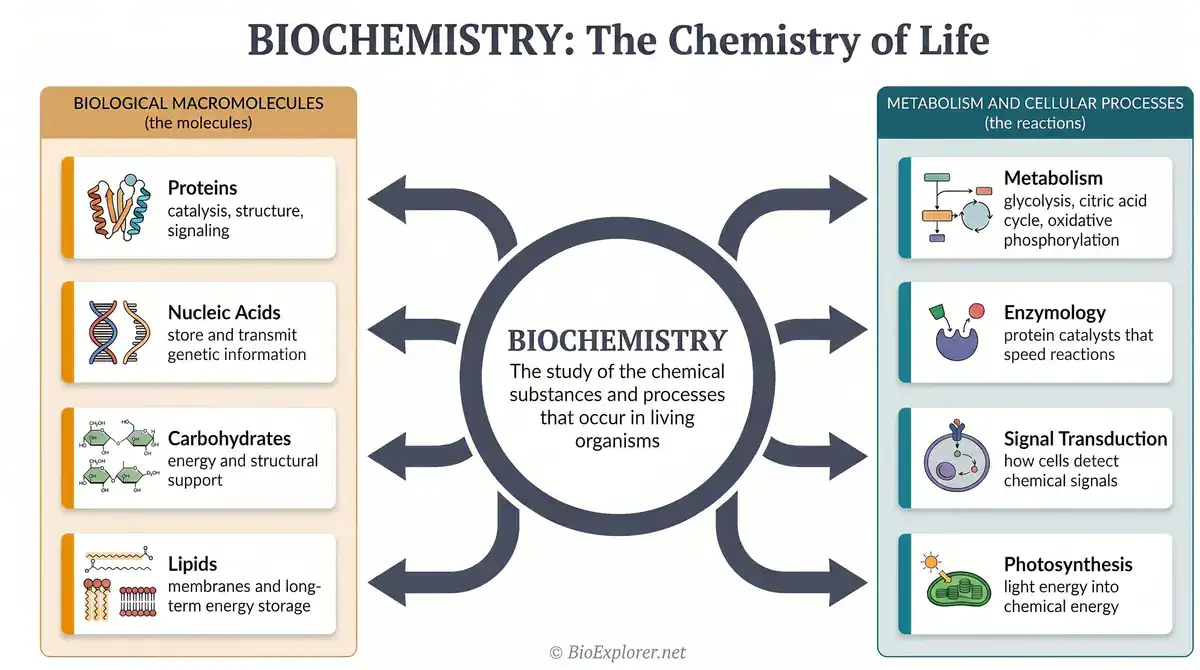
Four classes of molecules do most of the structural and functional work in living cells.
- Proteins are the most versatile; enzymes, antibodies, structural fibers, and molecular motors are all proteins, each folded into a shape that determines what it can do. The building blocks of protein are amino acids.
- Nucleic acids, including DNA and RNA store and transmit the instructions for building those proteins. The building blocks of nucleic acid are nucleotides.
- Carbohydrates provide the immediate energy currency of the cell and the structural rigidity of plant cell walls. The building blocks of carbohydrates are simple sugars called monosaccharides.
- Lipids build the membranes that define cells and their compartments. They also store long-term energy in a compact form. The building blocks of lipids are mainly fatty acids and glycerol, although lipids are more chemically varied than proteins, carbohydrates, and nucleic acids.
Metabolism and Key Pathways
Metabolism is the network of chemical reactions that extract energy from nutrients and build the molecules a cell needs.
Core metabolic pathways, including glycolysis, the citric acid cycle, and oxidative phosphorylation, form the sequence that breaks glucose down to carbon dioxide and water, capturing the released energy as ATP.
Photosynthesis runs the reverse logic in plants and algae: using light energy to fix carbon dioxide into glucose. The details of these pathways, including which enzymes catalyze which steps, which intermediates accumulate, and which points are regulated, constitute a large portion of what biochemistry textbooks cover.
Enzymes, Signal Transduction, and Medicine
Enzyme biochemistry examines how proteins catalyze reactions with extraordinary speed and specificity; a single enzyme molecule can process thousands of substrate molecules per second, and the shape of its active site ensures it acts on almost nothing else.
Signal transduction biochemistry covers how cells detect chemical signals from their environment and relay those signals internally through cascades of molecular interactions. Most drugs work by interfering with one of these processes: statins inhibit an enzyme in the cholesterol synthesis pathway; beta-blockers block a receptor in the cardiac signaling cascade; many antibiotics target enzymes specific to bacterial cell wall synthesis.
The genetic basis of inherited metabolic disorders, including phenylketonuria, galactosaemia, and maple syrup urine disease, is ultimately a biochemical one: a missing or dysfunctional enzyme breaks a pathway the body depends on.
The National Institute of General Medical Sciences (NIGMS) supports foundational biochemistry research and publishes science education resources on molecules, cells, and chemical processes.
Biochemistry Glossary FAQs
Biochemistry focuses on the chemical compounds and reactions that occur in living organisms, including molecules like lipids, carbohydrates, proteins, and the metabolic pathways connecting them. Molecular biology focuses more specifically on how genetic information is stored, copied, and expressed. The two fields overlap considerably, particularly in the study of nucleic acids and protein synthesis.
The four main classes of biological macromolecules are carbohydrates, lipids, proteins, and nucleic acids. Carbohydrates store and release energy and provide structural support. Proteins carry out most of the work inside cells, from catalysis to structural support to signaling. Nucleic acids store and transmit genetic information. Lipids form membranes and store long-term energy.
An enzyme is a protein that acts as a biological catalyst, speeding up a chemical reaction without being consumed in the process. Enzymes work by lowering the activation energy needed for a reaction to proceed, and each enzyme is highly specific, typically catalyzing only one reaction or a small group of closely related reactions. Without enzymes, most biochemical reactions in cells would occur too slowly to sustain life.
Metabolism is the complete set of chemical reactions that occur in a living organism to sustain life. It has two broad directions: catabolism breaks down larger molecules into smaller ones, releasing energy in the process, and anabolism uses that energy to build the molecules an organism needs. Cellular respiration is a catabolic pathway that extracts energy from glucose; protein synthesis is an anabolic pathway that assembles amino acids into proteins. Every cell in every organism is running both directions simultaneously, continuously.
An acid is a substance that donates protons (hydrogen ions) in solution, lowering the pH. A base accepts protons, raising the pH. The pH scale runs from 0 to 14, with 7 being neutral; values below 7 are acidic and above 7 are basic. In biochemistry, pH is critical because most enzymes have a narrow optimal pH range outside of which they lose their shape and function. Lactate, for example, is the conjugate base of lactic acid and accumulates in muscle tissue during intense exercise, contributing to the local drop in pH that impairs continued contraction.