
Microbiology Glossary
Explore this microbiology glossary to find clear definitions for bacteria, viruses, microbial growth, laboratory methods, and infectious diseases. The entries cover terms such as HIV, protozoa, conjugation, transformation, and extracellular polymeric substance. Each definition places the term in a real biological or environmental context, such as soil health, human disease, or food production.
On This Page:
- Microbiology A–Z: Explore by Letter
- About Microbiology: The Study of Microscopic Life and Its Processes
- Bacteriology and Virology
- Mycology and Medical Microbiology
- Environmental Microbiology and Antimicrobial Resistance
- Methods and Broader Connections
- Microbiology Glossary FAQs
- Explore Other Domain Glossaries
Microbiology A–Z: Explore by Letter
About Microbiology: The Study of Microscopic Life and Its Processes
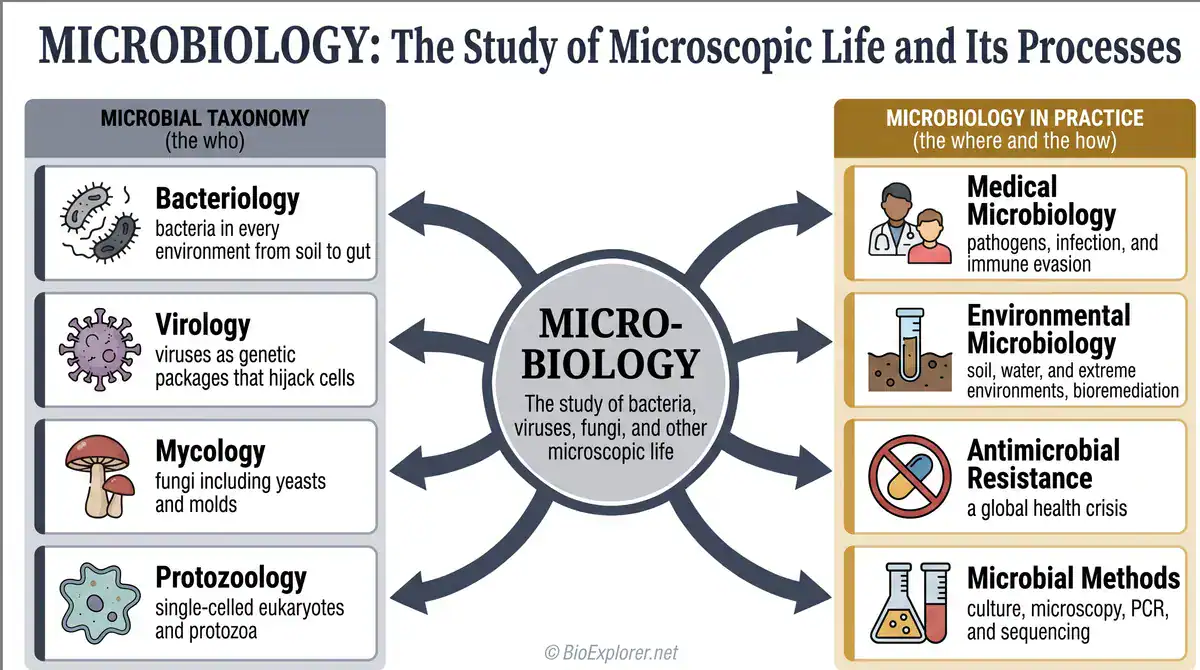
Microbiology is the scientific study of organisms and biological agents too small to see clearly without magnification. This includes bacteria, archaea, fungi, protozoa, algae, and viruses.
The history of microbiology reveals how scientists came to understand microbes as some of the oldest and most abundant forms of life on Earth. Their metabolic activity drives major biogeochemical cycles, which help make the planet habitable for other forms of life.
Bacteriology and Virology
Bacteriology is a major subfield of microbiology. It studies the structure, physiology, genetics, and ecology of bacteria, which live in nearly every environment, from deep ocean sediments to the human gut.
Viruses are different because they are not cells. They are packets of genetic material surrounded by a protein coat, and they can reproduce only by using the machinery of a host cell.
Virology studies how viruses enter cells, replicate, spread, and cause disease. Examples range from the common cold to Ebola.
A glossary can tell you that PFU stands for plaque-forming unit. It cannot tell you why PFU, TCID₅₀ and genome copies are not interchangeable, or which of them answers the question you are actually asking.
Mycology and Medical Microbiology
Fungi are an important part of microbiology. Yeasts help drive fermentation in food production and biotechnology. Molds break down organic matter, and some fungal species can cause disease.
Pathogenic fungi such as Candida and Aspergillus can cause serious infections, especially in people with weakened immune systems.
Medical microbiology studies how pathogens cause infection, evade immune defenses, and respond to treatment. These pathogens can include bacteria, viruses, fungi, and other microbes.
Environmental Microbiology and Antimicrobial Resistance
Soil and aquatic microbial communities help fix nitrogen, cycle carbon, and break down pollutants through bioremediation.
Antimicrobial resistance is one of the most serious problems in global health. It happens when microorganisms acquire mutations or resistance genes that help them survive drugs designed to kill or control them. As a result, infections that were once easy to treat can become dangerous again.
Horizontal gene transfer can make this problem worse. It allows resistance genes to move between bacteria, including unrelated species, and can help resistance spread quickly.
Methods and Broader Connections
Culture, microscopy, PCR, and DNA sequencing are core methods in microbiology. These tools also support many areas of modern biological research beyond microbiology itself.
Microbiology connects closely with immunology, genetics, ecology, and clinical medicine. The human microbiome has changed how researchers think about digestion, immunity, and disease risk.
The National Institute of Allergy and Infectious Diseases funds and publishes research on microbial biology, infectious disease, and microbiome science.
Microbiology Glossary FAQs
Bacteria are single-celled living organisms with their own cellular machinery for metabolism and reproduction, and they can be killed by antibiotics that disrupt bacterial-specific processes.
Viruses are not cells and are not considered fully alive in the biological sense; they are packages of genetic material in a protein coat that can only reproduce by hijacking the machinery of a host cell. Because viruses lack the cellular targets that antibiotics act on, bacterial antibiotics have no effect on viral infections.
Antibiotic resistance occurs when bacteria evolve mechanisms that allow them to survive exposure to antibiotics that would normally kill them.
Resistance develops through natural selection: if a population of bacteria is exposed to an antibiotic, any individual cells with mutations that confer resistance survive and reproduce, passing the resistance on to their offspring. Resistance can also spread rapidly between bacteria through horizontal gene transfer, where bacteria share genetic material directly.
Microorganisms perform functions that make most other life on Earth possible. Bacteria and fungi decompose dead organic matter, recycling nutrients back into the soil and water. Nitrogen-fixing bacteria convert atmospheric nitrogen into forms that plants can use, underpinning the nitrogen cycle.
Phytoplankton and cyanobacteria produce roughly half of the oxygen in Earth’s atmosphere and form the base of most aquatic food webs. Microorganisms also live symbiotically inside animals, including the human gut microbiome, which plays a central role in digestion and immune function.
Prokaryotes are organisms whose cells lack a membrane-bound nucleus; their genetic material floats freely in the cytoplasm. Bacteria and archaea are prokaryotes. Eukaryotes have a nucleus that encloses their DNA, along with other membrane-bound organelles such as mitochondria.
All fungi, protists, plants, and animals are eukaryotes. The distinction matters in microbiology because many antibiotics target structures found only in prokaryotic cells, which is why they can kill bacteria without harming the eukaryotic cells of the patient.
The human microbiome is the community of microorganisms that live on and inside the human body, most densely in the gut. A healthy adult carries trillions of microbial cells, primarily bacteria, along with fungi, viruses, and archaea.
These microorganisms help digest food, synthesize vitamins, train the immune system, and compete against pathogens. Disruptions to the microbiome have been linked to conditions including inflammatory bowel disease, obesity, and susceptibility to infection.