
What is Virology?
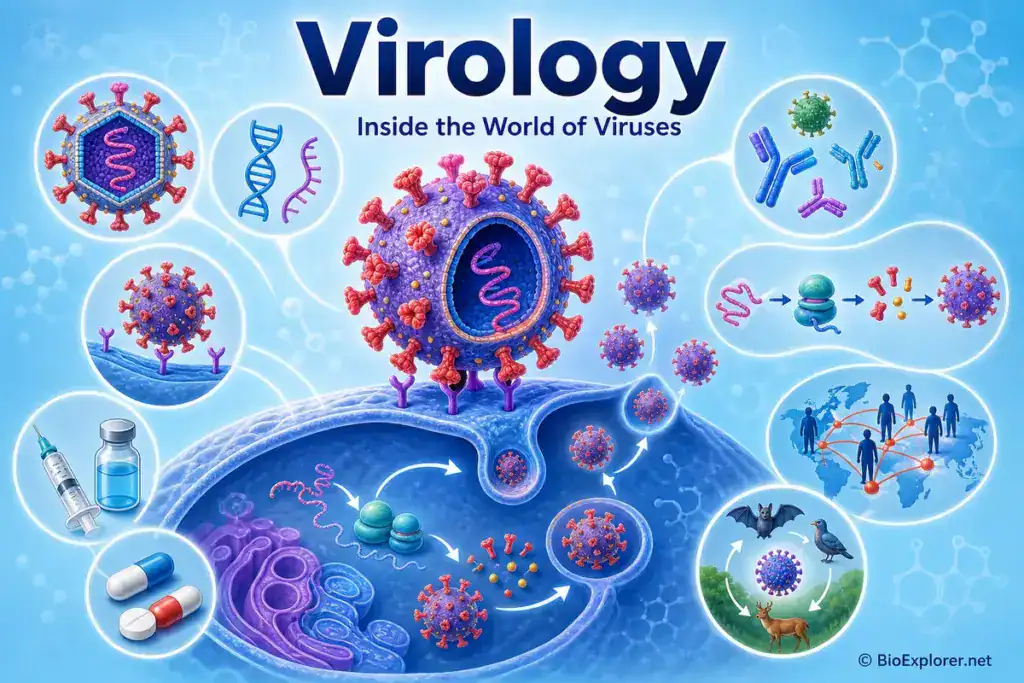
Virology is the branch of biology that studies viruses, virus-like agents, viral infections, and the ways viruses interact with host cells. It explains how viruses are structured, how they replicate, how they spread, how they cause disease, and how scientists detect, prevent, and treat viral infections.
Virology connects closely with microbiology, immunology, molecular biology, genetics, medicine, public health, epidemiology, ecology, biotechnology, and evolutionary biology. It helps scientists understand viral diseases, vaccines, antiviral drugs, immune responses, virus evolution, outbreaks, and the role of viruses in nature.
Virology Guide:
- Virology Definition and Meaning
- History of Virology
- What Do Virologists Study?
- What Are Viruses?
- Virus Structure
- The Viral Replication Cycle
- Virus Classification
- Major Branches of Virology
- Types of Viruses
- Viruses by Host
- Viruses by Genome
- Viral Diseases
- Vaccines, Immunity, and Antiviral Drugs
- Why Is Virology Important?
- Virology Techniques
- Virology Careers
- Virology vs Microbiology, Immunology, Molecular Biology, and Epidemiology
- Related Biology Fields
- BioExplorer Virology Articles
- Recommended Virology Resources
- Virus Taxonomy and Classification
- Virus Sequence and Molecular Resources
- Virus Structure Resources
- Public Health and Outbreak Resources
- Virology FAQs
Virology Definition and Meaning
Virology is the scientific study of viruses and viral diseases. It includes the study of virus structure, viral genomes, viral replication, virus classification, viral evolution, host range, transmission, immune responses, vaccines, antiviral therapies, and laboratory methods used to detect and analyze viruses.
A virus is an acellular infectious agent that contains genetic material, either DNA or RNA, enclosed in a protein coat called a capsid. Some viruses also have a lipid envelope derived from host cell membranes. Viruses do not have cells, ribosomes, or independent metabolism, so they must use host cells to make new virus particles.
Virology is not limited to human disease. Virologists study viruses that infect animals, plants, fungi, bacteria, archaea, protists, and other organisms. They also study bacteriophages, which are viruses that infect bacteria, and viruses that influence ecosystems, evolution, biotechnology, and global health.
History of Virology
The history of virology began before scientists could see viruses directly. In the late nineteenth century, researchers studying tobacco mosaic disease found that an infectious agent could pass through filters that trapped bacteria. This helped reveal that some infectious agents were smaller than bacteria.
As microscopes, cell culture, immunology, molecular biology, and genome sequencing improved, virology grew into a major scientific field. Scientists learned that viruses contain DNA or RNA, replicate inside host cells, evolve rapidly, and can infect every major group of living organisms.
Modern virology now supports medicine, vaccine development, antiviral drug discovery, cancer research, agriculture, food security, conservation, biotechnology, public health surveillance, and outbreak response.
What Do Virologists Study?
Virologists study viruses at several levels, from molecular structure to global spread. Some focus on how viruses enter cells and copy their genomes. Others study viral disease, immune defense, vaccines, animal reservoirs, plant viruses, viral evolution, or public health surveillance.
- Virus structure: The capsid, genome, envelope, surface proteins, and other viral components.
- Viral replication: How viruses enter cells, copy genetic material, make proteins, assemble particles, and exit host cells.
- Virus classification: How viruses are grouped by genome type, structure, host, replication strategy, and evolutionary relationships.
- Viral diseases: How viruses damage tissues, trigger immune responses, and spread between hosts.
- Vaccines and immunity: How the immune system recognizes viruses and how vaccines train immune memory.
- Antiviral drugs: How medicines block viral entry, replication, protein processing, or release.
- Virus evolution: How mutation, recombination, reassortment, and selection shape viral populations.
- Viral ecology: How viruses affect bacteria, animals, plants, oceans, soils, and ecosystems.
What Are Viruses?
Viruses are infectious agents that replicate only inside host cells. A complete infectious virus particle outside a host cell is called a virion. A virion carries the viral genome and the structural proteins needed to protect that genome and help the virus enter a suitable host cell.
Viruses differ from cellular organisms. They do not grow by cell division, do not produce their own ATP through metabolism, and do not contain ribosomes for making proteins. Instead, viruses depend on host cells for many steps of replication.
Viruses can infect all forms of cellular life. Some infect humans and other animals. Others infect plants, fungi, protists, bacteria, or archaea. This wide host range makes virology important in medicine, agriculture, ecology, biotechnology, and environmental science.
Virus Structure
Virus structure varies widely, but many viruses share a few basic parts. Understanding structure helps explain how viruses attach to host cells, protect their genomes, evade immunity, and spread.
| Part | What It Is | Why It Matters |
|---|---|---|
| Genome | DNA or RNA that carries viral genetic instructions. | Controls replication, protein production, and viral traits. |
| Capsid | A protein coat that surrounds and protects the genome. | Helps package the genome and gives many viruses their shape. |
| Envelope | A lipid membrane found around some viruses. | Helps some viruses enter host cells and exit by budding. |
| Surface Proteins | Viral proteins exposed on the capsid or envelope. | Help viruses bind host receptors and are often immune targets. |
| Viral Enzymes | Proteins carried or encoded by some viruses. | Support genome replication, transcription, integration, or protein processing. |
Viruses can have helical, icosahedral, prolate, complex, or enveloped structures.
Explore Virus Structure, Viral Structure Types, and Functions
The Viral Replication Cycle
Viral replication is the process by which a virus makes new virus particles inside a host cell. The details differ between DNA viruses, RNA viruses, retroviruses, enveloped viruses, non-enveloped viruses, and bacteriophages, but many viruses follow a general pattern.
| Stage | What Happens | Why It Matters |
|---|---|---|
| Attachment | The virus binds to specific receptors on a host cell. | Helps determine which species and cell types the virus can infect. |
| Entry | The virus or viral genome enters the host cell. | Allows the virus to reach the cellular environment needed for replication. |
| Uncoating | The viral genome is released from the capsid. | Makes the genome available for copying or gene expression. |
| Genome Replication | The viral DNA or RNA is copied. | Produces genomes for new virus particles. |
| Protein Synthesis | Host ribosomes make viral proteins from viral instructions. | Creates capsid proteins, enzymes, and surface proteins. |
| Assembly | New viral genomes and proteins are assembled into particles. | Builds new virions inside the host cell. |
| Release | New virions leave the host cell by lysis, budding, or other pathways. | Allows infection of additional cells or hosts. |
How Do Viruses Reproduce?
Virus Classification
Virus classification helps scientists organize the enormous diversity of viruses. Viruses can be classified by genome type, capsid shape, envelope presence, replication strategy, host range, and evolutionary relationship.
One widely used molecular approach is the Baltimore classification system, which groups viruses by genome type and how they produce messenger RNA. This matters because a DNA virus, positive-sense RNA virus, negative-sense RNA virus, double-stranded RNA virus, and retrovirus may replicate in very different ways.
| Classification Feature | Examples of What Scientists Compare |
|---|---|
| Genome Type | DNA or RNA; single-stranded or double-stranded; positive-sense or negative-sense RNA. |
| Capsid Shape | Helical, icosahedral, prolate, complex, or other forms. |
| Envelope | Enveloped or non-enveloped viruses. |
| Host Range | Viruses of animals, plants, bacteria, archaea, fungi, or protists. |
| Replication Strategy | How the virus copies its genome and produces viral proteins. |
| Taxonomy | Formal groups such as realm, kingdom, phylum, class, order, family, genus, and species. |
The International Committee on Taxonomy of Viruses, or ICTV, maintains official virus taxonomy resources used by researchers worldwide.
Major Branches of Virology
Virology has several branches because viruses infect many hosts and can be studied from medical, molecular, ecological, agricultural, and evolutionary perspectives.
| Branch | What It Studies | Example Topics |
|---|---|---|
| Medical Virology | Viruses that infect humans and cause disease. | Diagnosis, treatment, vaccines, viral hepatitis, influenza, HIV, herpesviruses. |
| Veterinary Virology | Viruses that infect animals. | Animal vaccines, zoonotic viruses, livestock diseases, wildlife reservoirs. |
| Plant Virology | Viruses that infect crops, trees, and wild plants. | Plant disease, crop losses, virus-vector relationships, resistant varieties. |
| Molecular Virology | Viral genes, proteins, replication, and host-cell interactions. | Viral entry, polymerases, reverse transcription, genome packaging, protein processing. |
| Structural Virology | The three-dimensional shapes of viruses and viral proteins. | Capsids, envelopes, spikes, receptors, antibody binding, drug targets. |
| Environmental Virology | Viruses in water, soil, air, oceans, wastewater, and ecosystems. | Viral ecology, wastewater surveillance, marine viruses, microbial population control. |
| Viral Immunology | How the immune system detects and responds to viruses. | Antibodies, T cells, interferons, immune escape, vaccine responses. |
| Viral Epidemiology | How viruses spread through populations. | Outbreaks, transmission, surveillance, risk factors, public health control. |
| Phage Biology | Bacteriophages, the viruses that infect bacteria. | Phage therapy, bacterial evolution, microbiomes, gene transfer. |
Types of Viruses
There are many ways to describe types of viruses. A useful approach is to group viruses by the kind of host they infect or by the type of genetic material they carry.
Viruses by Host
- Animal viruses: Infect animals, including humans, mammals, birds, reptiles, amphibians, fish, and invertebrates.
- Plant viruses: Infect crops, garden plants, forest plants, and wild plant species.
- Bacteriophages: Infect bacteria and can influence bacterial populations and gene transfer.
- Archaeal viruses: Infect archaea, including species that live in extreme environments.
- Fungal viruses: Infect fungi and can affect fungal growth or virulence.
Viruses by Genome
- DNA viruses: Carry DNA as their genetic material.
- RNA viruses: Carry RNA as their genetic material.
- Retroviruses: Carry RNA but use reverse transcription to make DNA during replication.
- Single-stranded viruses: Carry one strand of DNA or RNA.
- Double-stranded viruses: Carry two complementary strands of DNA or RNA.
Viral Diseases
Viral diseases happen when viruses infect host cells and disrupt normal biological function. Disease can result from direct cell damage, tissue injury, immune responses, inflammation, or long-term effects of infection.
Not every viral infection causes severe disease. Some infections are mild or asymptomatic. Others can be serious, especially when they affect the nervous system, lungs, liver, immune system, developing fetus, or people with weakened immunity.
| Virus or Virus Group | Examples of Associated Disease | Important Note |
|---|---|---|
| Influenza viruses | Seasonal flu and occasional pandemics. | Change over time through mutation and reassortment. |
| Coronaviruses | Common colds, SARS, MERS, COVID-19. | Some infect animals and can cross into humans. |
| Herpesviruses | Cold sores, chickenpox, shingles, mononucleosis. | Some can establish long-term latent infections. |
| Hepatitis viruses | Inflammation of the liver. | Different hepatitis viruses spread in different ways. |
| Human papillomaviruses | Warts and some cancers. | Vaccines can prevent infection with high-risk types. |
| HIV | Human immunodeficiency virus infection and AIDS if untreated. | Antiretroviral therapy can control infection. |
| Rabies virus | Rabies. | Nearly always fatal after symptoms begin, but preventable after exposure with prompt medical care. |
This page is educational and should not be used for diagnosis or treatment. For symptoms, exposure concerns, vaccination decisions, or treatment questions, readers should consult a qualified medical professional or public health authority.
Vaccines, Immunity, and Antiviral Drugs
Virology is central to vaccine science. Vaccines train the immune system to recognize viral antigens before a dangerous infection occurs. Depending on the vaccine type, they may use inactivated viruses, weakened viruses, protein subunits, viral vectors, or nucleic acid instructions.
The immune system uses several defenses against viruses. Innate immune responses can detect viral patterns and trigger interferons. Adaptive immune responses use antibodies, B cells, helper T cells, cytotoxic T cells, and immune memory to recognize and respond to infection.
Antiviral drugs work differently from antibiotics. Antibiotics target bacteria, not viruses. Antiviral medicines may block viral entry, genome replication, protein processing, integration, or release, depending on the virus and drug.
Why Is Virology Important?
Virology is important because viruses affect human health, animal health, crops, ecosystems, biotechnology, and global public health. Viral outbreaks can move across borders, affect economies, disrupt healthcare systems, and reveal gaps in surveillance and preparedness.
In medicine, virology helps scientists diagnose infections, design vaccines, develop antiviral drugs, study cancer-causing viruses, understand immune responses, and track viral evolution. In agriculture, virology helps protect crops and livestock from viral diseases.
In ecology, viruses influence microbial populations, nutrient cycles, marine ecosystems, and host evolution. In biotechnology, viruses and viral tools are used in gene delivery, vaccine platforms, phage research, molecular biology, and some forms of gene therapy.
Virology Techniques
Virologists use laboratory and computational techniques to detect viruses, grow them, sequence their genomes, study their proteins, and measure immune responses.
| Technique | What It Does | Common Use |
|---|---|---|
| PCR and RT-PCR | Detects viral DNA or RNA. | Diagnosis, surveillance, research, outbreak testing. |
| Genome Sequencing | Determines viral genetic sequences. | Variant tracking, evolution, transmission studies, classification. |
| Cell Culture | Grows some viruses in living cells. | Virus isolation, vaccine research, antiviral testing. |
| Serology | Detects antibodies or antigens in blood or other samples. | Immune response studies, exposure history, diagnostic support. |
| Electron Microscopy | Visualizes virus particles and structures. | Structural studies and virus identification in specialized settings. |
| Neutralization Assays | Measures whether antibodies block viral infection. | Vaccine evaluation, immunity studies, antibody research. |
| Phylogenetic Analysis | Compares viral sequences to infer relationships. | Evolution, outbreak tracing, variant analysis. |
| Structural Biology | Reveals shapes of viral proteins and particles. | Drug design, vaccine design, receptor binding, antibody studies. |
Virology Careers
Virology can lead to careers in research, medicine, diagnostics, biotechnology, public health, agriculture, veterinary science, pharmaceuticals, environmental science, and science communication.
- Virologist: Studies viruses, viral replication, host interactions, and viral disease.
- Medical virologist: Works with human viral infections, diagnosis, treatment, and clinical research.
- Public health scientist: Tracks viral outbreaks, transmission, surveillance data, and prevention strategies.
- Vaccine researcher: Studies viral antigens, immune responses, vaccine platforms, and protection.
- Antiviral drug researcher: Tests compounds that block viral replication or viral proteins.
- Molecular virologist: Studies viral genomes, proteins, replication cycles, and host-cell machinery.
- Veterinary virologist: Studies viruses that infect domestic animals, wildlife, or livestock.
- Plant virologist: Studies viruses that affect crops, forests, and plant health.
- Bioinformatics analyst: Uses computational tools to analyze viral genomes, variants, and evolution.
- Structural virologist: Studies the shapes of viral proteins, capsids, and molecular complexes.
Virology vs Microbiology, Immunology, Molecular Biology, and Epidemiology
Virology overlaps with several fields, but each has a different focus.
| Field | Main Focus | How It Connects to Virology |
|---|---|---|
| Virology | Viruses and virus-like agents. | Studies virus structure, replication, classification, infection, immunity, and disease. |
| Microbiology | Microorganisms and microscopic agents. | Includes virology, bacteriology, mycology, parasitology, and microbial ecology. |
| Immunology | The immune system. | Explains how the body detects viruses and builds protection through immune memory. |
| Molecular Biology | DNA, RNA, proteins, genes, and gene expression. | Explains viral genomes, replication enzymes, transcription, translation, and viral protein function. |
| Epidemiology | Disease patterns in populations. | Tracks viral transmission, outbreaks, risk factors, and public health interventions. |
Related Biology Fields
Virology is closely related to microbiology, because viruses are studied alongside bacteria, fungi, protozoa, archaea, and other microscopic life forms or infectious agents. It also connects with immunology, because viral infections trigger antibodies, T cells, inflammation, interferons, and immune memory.
Virology depends heavily on molecular biology and genetics, because viruses carry genetic material and depend on molecular processes inside host cells. It also supports biotechnology through viral vectors, vaccine platforms, phage research, gene delivery tools, and recombinant protein systems.
Plant viruses connect virology with botany, animal viruses connect it with zoology, and environmental viruses connect it with ecology.
BioExplorer Virology Articles
Use these BioExplorer articles to explore virus structure, viral reproduction, and the difference between viruses and bacteria.
- Explore Virus Structure, Viral Structure Types, and Functions
- How Do Viruses Reproduce?
- How Are Viruses Different From Bacteria?
Recommended Virology Resources
These external resources are useful for learning virology, checking virus taxonomy, exploring viral sequence data, studying virus families, and following reliable public health information.
Virus Taxonomy and Classification
- International Committee on Taxonomy of Viruses
The official body responsible for virus taxonomy and virus naming. - ICTV Taxonomy Browser
A current taxonomy browser for approved virus taxa and classification updates.
Virus Sequence and Molecular Resources
- NCBI Virus
A community portal for viral sequence data from RefSeq, GenBank, and other NCBI repositories. - ViralZone
A SIB Swiss Institute of Bioinformatics resource for virus families, genera, molecular information, and virion figures. - UniProt
A major resource for protein sequence and functional information, including viral proteins.
Virus Structure Resources
- RCSB Protein Data Bank
A leading resource for three-dimensional structures of proteins, nucleic acids, and biological macromolecules, including viral structures. - PDB-101
Educational materials from RCSB PDB for learning about molecular structure, viral proteins, and structural biology.
Public Health and Outbreak Resources
- Centers for Disease Control and Prevention
Public health information on infectious diseases, vaccination, outbreaks, and prevention. - WHO Disease Outbreak News
Global reports on confirmed and potential public health events of concern. - National Institute of Allergy and Infectious Diseases
Research information on infectious, immune-mediated, and allergic diseases.
Virology FAQs
Virology is the branch of biology that studies viruses, viral infections, virus structure, viral replication, classification, vaccines, antiviral drugs, and virus-host interactions.
A virologist studies how viruses are structured, how they replicate, how they infect hosts, how they spread, how they evolve, and how infections can be detected, prevented, or treated.
Viruses are usually described as acellular infectious agents. They contain genetic material, but they lack cells, independent metabolism, and the ability to reproduce without a host cell.
A virus usually contains DNA or RNA inside a protein capsid. Some viruses also have a lipid envelope and surface proteins that help them enter host cells.
Viruses reproduce by entering host cells, releasing their genomes, copying viral genetic material, making viral proteins, assembling new virus particles, and exiting the cell.
Viruses are classified by features such as genome type, capsid shape, envelope presence, replication strategy, host range, and evolutionary relationship.
No. Antibiotics target bacteria, not viruses. Viral infections may require prevention through vaccination, supportive care, or antiviral medicines when appropriate.
Virology careers include virologist, medical virologist, vaccine researcher, antiviral drug researcher, public health scientist, molecular virologist, veterinary virologist, plant virologist, and bioinformatics analyst.
Cite this page
Bio Explorer. (2026, June 22). What is Virology?. https://www.bioexplorer.net/divisions_of_biology/virology/