
Evolutionary Biology: How Life Changes Over Time
Evolutionary biology is the branch of biology that studies how life changes over time. It explains how populations change across generations, how new species arise, why organisms share common ancestry, and how the diversity of life on Earth developed.
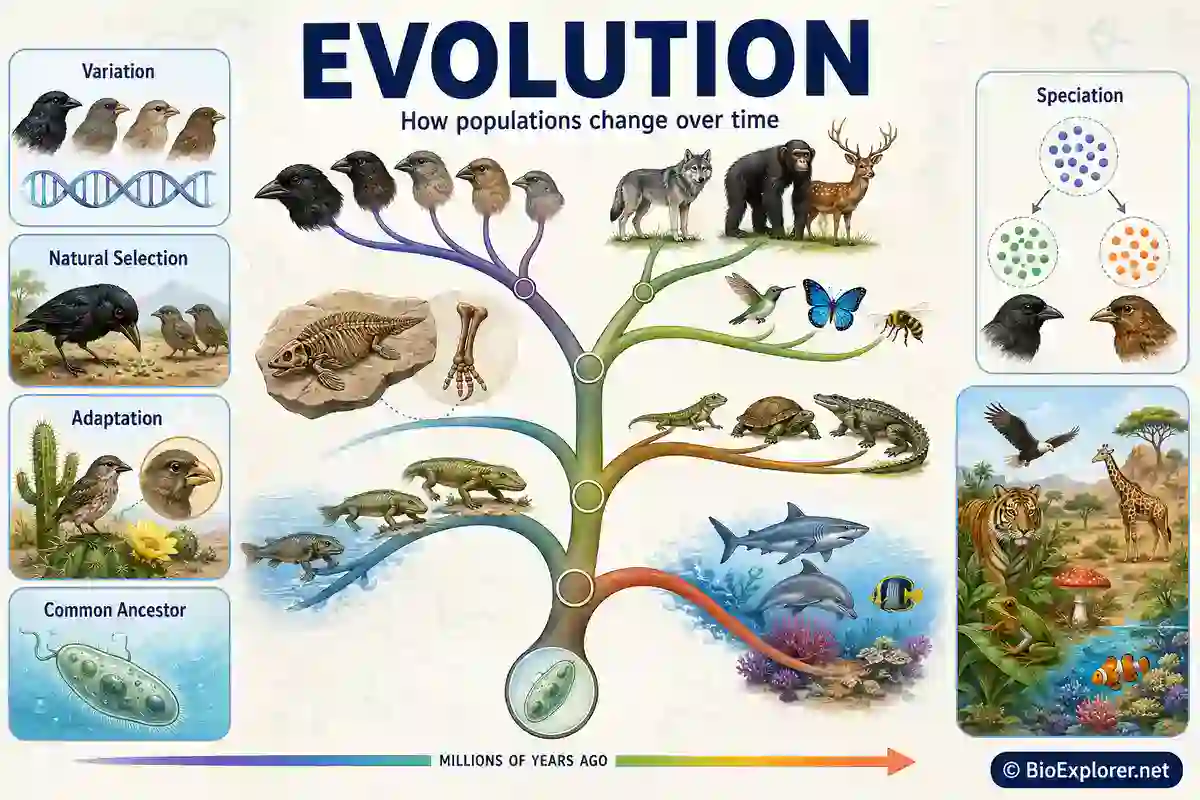
Evolution is the change in heritable traits of biological populations across generations. These traits can include physical features, behaviors, DNA sequences, biochemical pathways, and other inherited characteristics. Evolution does not happen to one individual during its lifetime. It happens when inherited variation becomes more or less common in a population over generations.
The Evolutionary Biology Glossary explains key terms such as adaptation, natural selection, genetic drift, mutation, gene flow, common ancestor, speciation, population, heredity, fossil, selection pressure, and descent with modification.
Evolutionary Biology Guide:
- What Is Evolution?
- What Evolutionary Biology Studies
- Evolution and Natural Selection
- Mechanisms of Evolution
- Mutation
- Natural Selection
- Genetic Drift
- Gene Flow
- Sexual Selection
- Evidence for Evolution
- Fossil Evidence
- DNA and Molecular Evidence
- Comparative Anatomy
- Embryology and Development
- Biogeography
- Direct Observation
- Common Ancestry and Descent With Modification
- Speciation
- Microevolution and Macroevolution
- Branches of Evolutionary Biology
- Evolutionary Biology and Other Fields
- Evolutionary Biology Articles and Related Guides
- Evolution, Genetics, and Speciation
- Fossils, Extinction, and Ancient Life
- Animal Evolution, Behavior, and Adaptation
- Classification and Biological Diversity
- Molecular Evolution and Research Resources
- Evolution News and Research Updates
- Evolution Resources
- Common Misunderstandings About Evolution
- FAQs
- Recommended Evolutionary Biology Resources
- Evolution Learning Resources
- Evidence, Fossils, and Human Evolution
- Phylogeny and Tree of Life Resources
- Darwin and Historical Evolution Resources
Evolutionary biology connects closely with genetics, ecology, molecular biology, biochemistry, microbiology, zoology, botany, paleontology, anthropology, and environmental science. It uses evidence from fossil records, DNA, anatomy, development, species distribution, and direct observation to explain how organisms are related and how they adapt to changing environments.
What Is Evolution?
Evolution is the change in inherited traits within biological populations over generations. A population is a group of organisms of the same species living in the same area and capable of reproducing. When the inherited traits in a population change over time, evolution has occurred.
These changes may be small, such as a shift in the frequency of a gene variant. They may also be large over long periods, leading to new adaptations, new species, and major changes in body structure, behavior, or ecology.
Evolution depends on heritable variation. Individuals in a population are not exactly alike. Some differences come from genes, mutations, recombination, and chromosome-level changes. If certain inherited traits help organisms survive or reproduce more successfully, those traits may become more common in future generations. Related topics include chromosomal mutations and the chromosome theory of inheritance.
Evolution explains why living things show both unity and diversity. Organisms share deep similarities because they descend from common ancestor. They also differ because populations have changed in different environments over long spans of time.
What Evolutionary Biology Studies
Evolutionary biology studies the patterns, processes, and causes of biological change. It asks how organisms are related, how species form, how adaptations arise, and how life has changed from its earliest origins to the present.
Major questions in evolutionary biology include:
- How do populations change over time?
- How does natural selection shape adaptation?
- How do mutation, genetic drift, and gene flow affect genetic variation?
- How do new species form?
- What does the fossil record reveal about the history of life?
- How do DNA sequences show common ancestry?
- Why do organisms share similar structures?
- How do extinction and environmental change influence evolution?
- How do behavior, ecology, and reproduction affect evolutionary change?
Evolutionary biology does not only study the distant past. It also studies changes happening today, including antibiotic resistance in bacteria, pesticide resistance in insects, changes in animal populations, viral evolution, and the genetic effects of habitat fragmentation.
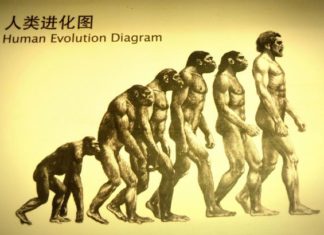
History of Evolution
Evolution and Natural Selection
Charles Darwin and Alfred Russel Wallace helped explain evolution through natural selection. Natural selection is one of the major mechanisms of evolution.
Natural selection happens when individuals with certain heritable traits survive or reproduce more successfully than others in a particular environment. If those traits are passed to offspring, they can become more common in the population over generations.
Darwin's reasoning depended on several key observations:
- Individuals in a population vary in their traits.
- Some trait differences are heritable.
- More offspring are often produced than can survive.
- Survival and reproduction are not random when certain traits improve fitness in a given environment.
- Over generations, favorable heritable traits may become more common.
Natural selection can produce adaptations. An adaptation is an inherited trait that improves survival or reproduction in a specific environment. Examples include camouflage, drought tolerance in plants, beak shape in birds, antibiotic resistance in bacteria, and defensive chemicals in some organisms.
Natural selection is powerful, but it is not the only mechanism of evolution. Evolution can also occur through mutation, genetic drift, gene flow, and sexual selection.
Mechanisms of Evolution
The mechanisms of evolution are the processes that change heritable traits in populations over time. The most important mechanisms include mutation, natural selection, genetic drift, gene flow, and sexual selection.
| Mechanism | What It Means | Example |
|---|---|---|
| Mutation | A change in DNA that can create new genetic variation | A new gene variant appears in a population |
| Natural selection | Heritable traits that improve survival or reproduction become more common | Insects resistant to a pesticide survive and reproduce |
| Genetic drift | Random changes in gene frequencies, especially in small populations | A rare trait becomes common by chance after a population bottleneck |
| Gene flow | Movement of genes between populations | Animals migrate and breed with a nearby population |
| Sexual selection | Traits become common because they improve mating success | Bright coloration or courtship behavior attracts mates |
| Recombination | Genetic material is reshuffled during sexual reproduction | Offspring inherit new combinations of traits |
These mechanisms can act together. For example, mutation may create a new genetic variant, natural selection may increase it if it improves fitness, and gene flow may spread it to another population.
Mutation
Mutation is a change in DNA. Mutations are important because they create new genetic variation. Without mutation, evolution would have little raw material to work with.
Mutations can be harmful, neutral, or beneficial depending on the organism and environment. A mutation that harms survival in one setting may have little effect in another. A mutation that helps an organism survive under one condition may become more common if it is inherited and improves reproductive success.
Mutations do not happen because an organism needs them. They arise through errors in DNA replication, environmental damage to DNA, or other molecular processes. Natural selection then acts on the variation that exists.
Natural Selection
Natural selection favors heritable traits that improve survival or reproduction in a particular environment. It does not create perfect organisms. It works on existing variation and is limited by genetic history, tradeoffs, environmental change, and chance.
A trait that is useful in one environment may not be useful in another. Thick fur may help an animal survive cold climates, but it may become a disadvantage in hot climates. A large bright display may help attract mates, but it may also attract predators.
Natural selection is often described as nonrandom survival and reproduction. The variation arises through genetic processes, but which traits become more common depends partly on how those traits affect fitness in real environments.
Genetic Drift
Genetic drift is evolutionary change caused by random shifts in gene frequencies. It is especially important in small populations, where chance events can strongly affect which individuals survive and reproduce.
A forest fire, storm, disease outbreak, or random breeding pattern may remove some individuals and leave others. The surviving population may not represent the full genetic variation of the original group.
Two important forms of genetic drift are the bottleneck effect and the founder effect. A bottleneck occurs when a population is sharply reduced in size. A founder effect occurs when a small group starts a new population and carries only part of the original population's genetic variation.
Genetic drift can reduce genetic diversity and make populations more vulnerable to environmental change, disease, and inbreeding.
Gene Flow
Gene flow is the movement of genes between populations. It happens when individuals migrate and reproduce, or when reproductive cells such as pollen move between populations.
Gene flow can introduce new genetic variation into a population. It can also make neighboring populations more similar to one another. For example, if animals from one population regularly mate with animals from another, their gene pools may become more mixed over time.
Gene flow can slow divergence between populations, but it can also help populations adapt by bringing in useful genetic variation.
Sexual Selection
Sexual selection is a form of selection related to mating success. A trait may become common if it helps an individual attract mates, compete for mates, or reproduce successfully.
The peacock's tail is a classic example. A large, colorful tail may make movement harder or increase visibility to predators, but it can also help males attract mates. If females prefer that trait and it is heritable, it may become more common over generations.
40 Most Colorful Birds in the World (Stunning Photos)
Sexual selection can shape appearance, behavior, sound production, body size, weapon-like structures, courtship displays, and mating systems. It connects strongly with animal behavior and ethological theory.
Evidence for Evolution
Evidence for evolution comes from many independent lines of scientific study. These lines of evidence support the idea that living organisms share common ancestry and have changed over time.
Fossil Evidence
Fossils preserve traces of past life. They show that many organisms that once lived on Earth are now extinct. They also reveal changes in body forms over time.
Transitional fossils show combinations of traits that help scientists understand evolutionary relationships. For example, Archaeopteryx has often been discussed because it shows a mix of traits associated with nonavian dinosaurs and birds. Fossil evidence also supports the study of extinct groups, including dinosaur fossils and flying dinosaurs.
Fossils do not preserve every organism, but the fossil record gives strong evidence that life has changed across geological time.
DNA and Molecular Evidence
DNA provides some of the strongest evidence for evolution. Closely related species tend to share more similar DNA sequences than distantly related species. This pattern makes sense if related organisms inherited DNA from common ancestors.
Molecular comparisons can help scientists study relationships among species, trace population history, and understand how genes change over time. Biological databases, including major sequence databases, protein databases, and RNA databases, help researchers compare DNA, RNA, and protein sequences across organisms.
Shared genetic features, conserved genes, similar proteins, and related biochemical pathways all support common ancestry. These molecular patterns also explain why evolutionary biology overlaps with molecular biology and biochemistry.
Comparative Anatomy
Comparative anatomy studies similarities and differences in body structures among organisms. Some species have homologous structures, meaning the structures share a common evolutionary origin even if they now serve different functions.
For example, the forelimbs of humans, bats, whales, and cats have different uses, but they share a similar underlying bone pattern. This suggests descent from a common ancestor.
Comparative anatomy also helps scientists study adaptation, body plans, and evolutionary relationships among groups of organisms.
Embryology and Development
Developmental biology can also support evolutionary relationships. Related organisms may show similarities during early development because they inherited developmental pathways from common ancestors.
Modern evolutionary developmental biology, sometimes called evo-devo, studies how changes in developmental genes and processes can produce differences in body form.
Biogeography
Biogeography studies where organisms live and how they are distributed across Earth. Island species, continental patterns, and isolated populations often provide strong evidence for evolution.
Species found on islands often resemble species from nearby mainland areas, but they may evolve unique traits after isolation. This pattern helps explain adaptive radiation, founder effects, and speciation.
Direct Observation
Evolution can be observed in real time. Bacteria can evolve antibiotic resistance. Insects can evolve pesticide resistance. Viruses can change rapidly as mutations accumulate and spread. Populations of animals and plants can shift in measurable ways when environments change.
These examples show that evolution is not only a historical explanation. It is an ongoing biological process.
Common Ancestry and Descent With Modification
Evolution is often described as descent with modification. This means that organisms inherit traits from ancestors, but those traits can change across generations.
Common ancestry means that different groups of organisms can trace their lineage back to shared ancestors. All known life shares deep biochemical similarities, including DNA or RNA as genetic material, related genetic code patterns, and common cellular machinery.
Scientists often use the phrase last universal common ancestor, or LUCA, to describe the ancient population or lineage from which all known living organisms ultimately descend. LUCA was not the first living thing, and scientists continue to study what early life may have been like.
The major domains of life, including Archaea and Eukarya, help scientists organize living organisms and study deep evolutionary relationships. Understanding the difference between prokaryotic and eukaryotic cells also helps explain major differences in cell structure across life.
Common ancestry does not mean that one modern species came from another modern species. Humans did not evolve from modern chimpanzees. Instead, humans and chimpanzees share a common ancestor that lived in the past.
Speciation
Speciation is the formation of new species. It occurs when populations become genetically different enough that they no longer interbreed successfully, or when they remain distinct evolutionary lineages.
One common route is geographic isolation. If a population is split by a mountain range, river, island formation, glacier, or habitat change, the separated groups may evolve independently. Over time, mutation, natural selection, genetic drift, and different environmental pressures can make the groups increasingly different.
Speciation can also occur without complete geographic isolation, especially when ecological differences, reproductive behavior, chromosome changes, or mating preferences reduce gene flow.
The biological species concept defines species partly by reproductive isolation, but not all organisms fit neatly into one species concept. Bacteria, fossils, hybridizing species, and asexual organisms can require different approaches.
Microevolution and Macroevolution
Microevolution refers to evolutionary change within populations or species. It includes changes in gene frequencies, small adaptations, local variation, and population-level shifts.
Macroevolution refers to larger patterns of evolution at or above the species level. It includes speciation, extinction, adaptive radiation, major evolutionary transitions, and long-term changes in biodiversity.
Microevolution and macroevolution are connected. Large evolutionary patterns build from population-level processes over long periods of time.
Branches of Evolutionary Biology
Evolutionary biology includes several branches and related areas of study. These branches help scientists study evolution from different angles.
| Branch | What It Studies |
|---|---|
| Population genetics | How gene frequencies change in populations |
| Molecular evolution | How DNA, RNA, and proteins change over time |
| Phylogenetics | Evolutionary relationships among organisms |
| Paleobiology | Evolutionary history using fossils |
| Evolutionary ecology | How ecological interactions shape evolution |
| Evolutionary developmental biology | How changes in development influence body form |
| Behavioral evolution | How behavior evolves and affects fitness |
| Human evolution | The evolutionary history of humans and close relatives |
| Conservation genetics | How genetic variation affects conservation and survival |
| Evolutionary medicine | How evolution helps explain disease, resistance, and human biology |
These branches often overlap. For example, evolutionary ecology may use genetics, field observations, animal behavior, and climate data to understand how populations adapt to changing environments.
Evolutionary Biology and Other Fields
Evolutionary biology connects many branches of biology.
- Genetics: Explains heredity, mutation, variation, chromosomes, and gene frequencies.
- Ecology: Explains environmental pressures, species interactions, adaptation, and survival.
- Molecular Biology: Studies DNA, RNA, gene expression, protein synthesis, and molecular change.
- Biochemistry: Explains proteins, enzymes, metabolic pathways, and molecular similarities among organisms.
- Zoology: Studies animal diversity, behavior, anatomy, and evolutionary relationships.
- Botany: Studies plant evolution, adaptation, reproduction, and classification.
- Microbiology: Studies microbial evolution, antibiotic resistance, symbiosis, and rapid genetic change.
- Paleontology: Uses fossils to study extinct organisms and ancient ecosystems.
- Anthropology: Studies human evolution, primates, behavior, fossils, and culture.
Evolutionary biology gives these fields a historical framework. It helps explain why organisms are built the way they are, why traits vary, and how life has changed through time.
Evolutionary Biology Articles and Related Guides
The following guides connect naturally with the study of evolution, adaptation, classification, ecology, genetics, fossils, and biological diversity.
Evolution, Genetics, and Speciation
- Founder Effect: Learn how small founding populations can shape genetic variation.
- Biological Species Concept: Understand one major way scientists define species.
- Genetic Determinism: Explore why genes matter, but do not act alone in shaping traits.
- Chromosomal Mutations: Learn how chromosome-level changes can affect organisms.
- Autosomal Recessive Inheritance: Review a genetic inheritance pattern that can influence traits in populations.
- What Is the Chromosome Theory of Inheritance?: Understand how chromosomes carry genes across generations.
Fossils, Extinction, and Ancient Life
- Dinosaur Fossils: Explore how fossils help scientists study extinct organisms.
- Flying Dinosaurs: Learn about prehistoric flying reptiles and the fossil evidence used to study them.
- Herbivore Dinosaurs: Explore plant-eating dinosaurs and their ecological roles.
- Extinct Birds: Learn about bird species that disappeared and what extinction can reveal about environmental change.
- Woolly Mammoth Clone: Review modern discussions around extinct species, genetics, and de-extinction.
Animal Evolution, Behavior, and Adaptation
- Ethological Theory: Explore how animal behavior develops and connects with survival and reproduction.
- Ocean Animal Adaptations: See how marine animals survive pressure, cold, salinity, darkness, currents, and limited food.
- Tundra Animal Adaptations: Learn how animals survive cold, seasonal ecosystems.
- Tropical Rainforest Animal Adaptations: Explore adaptations shaped by competition, rainfall, canopy structure, and predation.
- Desert Birds: See how birds survive dry environments.
- Old World Monkeys Vs. New World Monkeys: Compare two major monkey groups and their evolutionary differences.
- Types of Monkeys: Explore monkey diversity across habitats and lineages.
- Types of Apes: Explore apes, including gibbons, orangutans, gorillas, chimpanzees, and bonobos.
- Elephant Evolution: Review how elephant lineages changed through evolutionary history.
Classification and Biological Diversity
- Levels of Biological Organization: Review how life is organized from molecules to the biosphere.
- Types of Animals: Explore animal diversity across major groups.
- Types of Plants: Explore plant diversity and major plant groups.
- Domain Archaea: Learn about one of the major domains of life.
- Domain Eukarya: Explore the domain that includes animals, plants, fungi, and protists.
- Difference Between Prokaryotic and Eukaryotic Cells: Understand one of the major cellular distinctions in life's diversity.
Molecular Evolution and Research Resources
- Major Sequence Databases: See how biological sequence data supports research in genetics, molecular biology, and evolution.
- Protein Databases: Explore resources used to study protein sequences and functions.
- Protein Domains: Learn how protein domains support studies of protein structure, function, and evolutionary relationships.
- RNA Databases: Explore resources for RNA sequence and function research.
- Genetics Methods and Protocols: Browse research methods connected with heredity and genetic variation.
- Molecular Biology Methods and Protocols: Explore methods used to study DNA, RNA, proteins, and molecular mechanisms.
- Evolutionary Biology Journals: Browse journals related to evolution and evolutionary research.
Evolution News and Research Updates
- Evolutionary Biology News of 2017: Review evolution-related discoveries and research updates from 2017.
- Evolutionary Biology News of 2018: Explore notable evolutionary biology news from 2018.
- Evolutionary Biology News of 2021: Review evolution research highlights from 2021.
- Evolutionary Biology News of 2022: Explore major evolutionary biology news and discoveries from 2022.
Evolution Resources
The study of evolution uses many kinds of resources, including books, fossil databases, DNA sequence databases, museum collections, field studies, research papers, journals, and educational guides.
Useful evolution resources often cover:
- Darwin's writings and the history of evolutionary thought
- Evidence for evolution from fossils, DNA, anatomy, and biogeography
- Natural selection and adaptation
- Genetic drift, mutation, and gene flow
- Human evolution and fossil hominins
- Evolutionary relationships among organisms
- Misunderstandings about evolution
- Molecular evolution and sequence comparisons
- Macroevolution and speciation
- Evolutionary theory and modern synthesis
When using evolution resources, check whether they explain both evidence and mechanisms. Strong resources should separate the fact that evolution occurs from the scientific explanations for how evolutionary change happens.
Common Misunderstandings About Evolution
Evolution is often misunderstood. These points help clarify the most common errors.
Evolution is not "just change."
In biology, evolution specifically means change in heritable traits of populations across generations. A person changing during life is development, not evolution.
Individuals do not evolve during their lifetime.
Individuals grow, develop, learn, and respond to the environment. Populations evolve when inherited traits become more or less common over generations.
Natural selection is not the same as evolution.
Natural selection is one mechanism of evolution. Other mechanisms include mutation, genetic drift, gene flow, and sexual selection.
Evolution does not have a goal.
Evolution does not move toward perfection. It depends on variation, inheritance, environment, chance, and reproductive success.
Modern species do not evolve from other modern species.
Humans did not evolve from modern chimpanzees. Humans and chimpanzees share a common ancestor.
Evolution does not deny that organisms are complex.
Evolution explains how complexity can arise through cumulative change, selection, genetic variation, developmental processes, and long spans of time.
FAQs
Evolutionary biology is the branch of biology that studies how life changes over time. It examines evolution, natural selection, genetic drift, mutation, gene flow, speciation, common ancestry, adaptation, fossils, and the history of life.
Evolution is the change in heritable traits of biological populations across generations. These changes may involve genes, physical traits, behaviors, or other inherited characteristics.
The main mechanisms of evolution include mutation, natural selection, genetic drift, gene flow, and sexual selection. These processes can change genetic variation and trait frequencies in populations over time.
Natural selection is a mechanism of evolution in which heritable traits that improve survival or reproduction become more common in a population over generations.
Genetic drift is random change in gene frequencies, especially in small populations. It can reduce genetic diversity and strongly affect isolated populations.
Gene flow is the movement of genes between populations. It can happen when individuals migrate and reproduce, or when pollen, spores, or other reproductive cells move between populations.
Speciation is the formation of new species. It often happens when populations become isolated and evolve differences that reduce or prevent successful interbreeding.
Common ancestry means that different organisms descend from shared ancestors. The more recently two species share an ancestor, the more closely related they usually are.
Evidence for evolution comes from fossils, DNA sequences, comparative anatomy, embryology, biogeography, direct observation, and the shared biochemical features of living organisms.
Yes. Evolution is still happening. Examples include antibiotic resistance in bacteria, pesticide resistance in insects, viral evolution, and genetic changes in wild populations.
You can browse the Evolutionary Biology Glossary for clear definitions of important evolution terms.
Recommended Evolutionary Biology Resources
These trusted external resources can help readers explore evolution, natural selection, common ancestry, fossils, human evolution, phylogenetic trees, Darwin’s writings, and the evidence for evolutionary change.
Evolution Learning Resources
- Understanding Evolution by UC Berkeley
A clear, student-friendly resource explaining evolution, natural selection, common ancestry, speciation, evidence for evolution, and common misunderstandings. - UC Berkeley: Evolution 101
A focused introduction to the patterns and mechanisms of evolution, including descent with modification, natural selection, mutation, migration, genetic drift, and speciation. - HHMI BioInteractive: Evolution and Biodiversity
Classroom-ready activities, videos, data explorations, and teaching resources on evolution, biodiversity, natural selection, genetic drift, and adaptation. - National Academies: Evolution Resources
Reliable science education resources about evolution, the nature of science, evidence for evolution, and how evolution is taught.
Evidence, Fossils, and Human Evolution
- Smithsonian Human Origins Program
A trusted introduction to human evolution, early humans, fossils, behavior, climate, and the scientific evidence behind human origins. - Smithsonian: Human Evolution Evidence
A useful resource for exploring fossil evidence, stone tools, genetics, behavior, and other lines of evidence for human evolution. - The Paleobiology Database
A public fossil database useful for exploring paleontology, extinct organisms, biodiversity patterns, fossil records, and deep-time evolutionary history.
Phylogeny and Tree of Life Resources
- Open Tree of Life
An interactive resource for exploring evolutionary relationships among organisms using published phylogenetic and taxonomic data. - OneZoom Tree of Life Explorer
A visual tree of life that helps readers explore how species are related and how life has diversified over evolutionary time. - Interactive Tree Of Life
An advanced tool for displaying, annotating, and managing phylogenetic trees.
Darwin and Historical Evolution Resources
- Darwin Online: On the Origin of Species
A reliable source for Charles Darwin’s most famous work and related historical material on evolutionary theory. - The Complete Work of Charles Darwin Online
A major digital archive of Darwin’s writings, publications, manuscripts, and historical materials.
Cite this page
BioExplorer. (2026, August 6). Evolutionary Biology: How Life Changes Over Time. https://www.bioexplorer.net/divisions_of_biology/evolution/