
Paleontology: The Study of Ancient Life
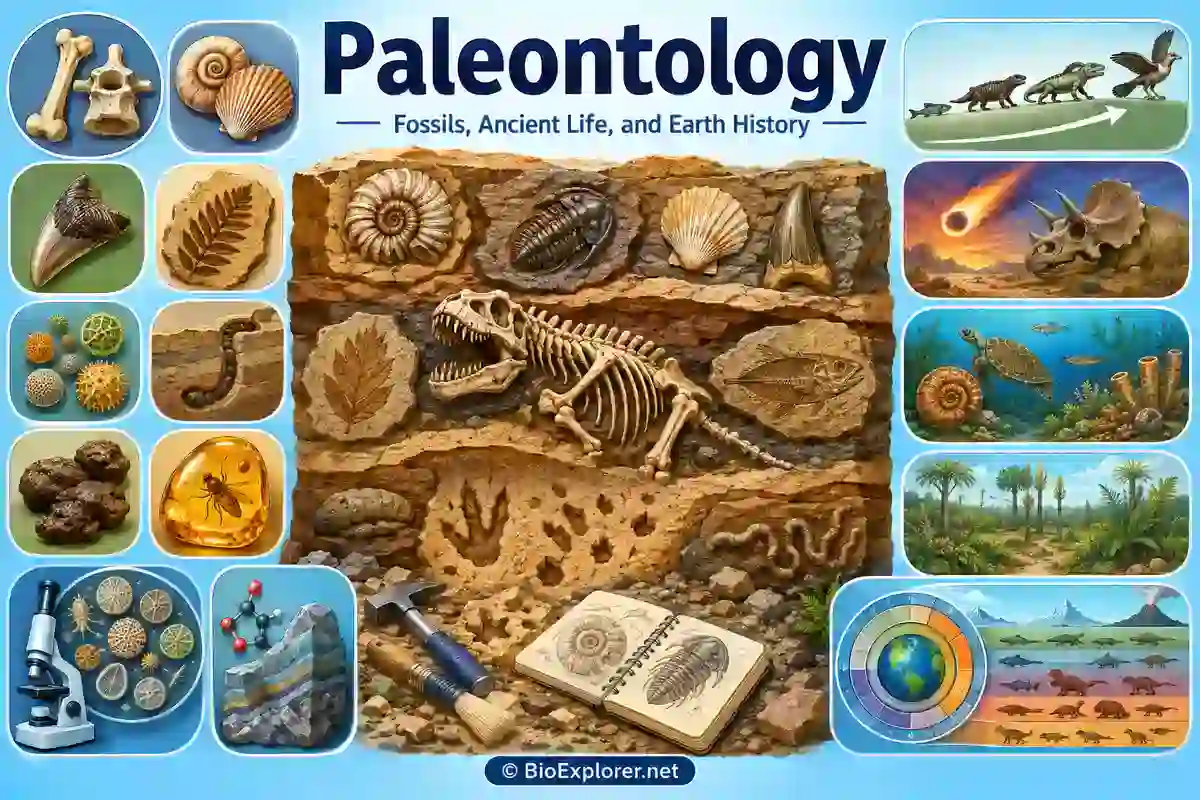
Paleontology is the scientific study of ancient life through fossils and the rocks that preserve them. It uses bones, shells, teeth, leaves, pollen, spores, footprints, burrows, coprolites, amber, microfossils, and chemical traces to understand organisms that lived in the past.
A paleontologist does not only ask, "What fossil is this?" The better question is: what living thing left this evidence, when did it live, how did it die, what environment preserved it, and what does it reveal about evolution, extinction, ecology, and Earth history?
Paleontology Guide:
- The Fossil Record Is Evidence, Not a Perfect Archive
- Fossils Are More Than Bones
- How Fossils Become Scientific Evidence
- Time Is the Other Half of Paleontology
- Dinosaurs Are Only One Doorway Into Paleontology
- What Paleontologists Study
- Paleontology vs Archaeology, Geology, and Paleobiology
- History of Paleontology: A Few Turning Points
- Tools Paleontologists Use
- Why Paleontology Matters
- Paleontology Careers
- Related BioExplorer Resources
- Recommended Paleontology Resources
- Paleontology FAQs
The Fossil Record Is Evidence, Not a Perfect Archive
The fossil record is one of biology’s strongest windows into deep time, but it is not a complete record of every organism that ever lived. Fossilization is rare. Most living things decay, are eaten, dissolve, or are destroyed before they can be preserved.
Hard parts such as bones, shells, teeth, wood, and mineralized tissues usually fossilize more easily than soft bodies. Organisms that lived near sedimentary environments also had better chances of preservation. This means the fossil record is powerful, but biased. Paleontologists must study both the fossil and the conditions that allowed it to survive.
That is what makes paleontology different from simply collecting fossils. A fossil without context is interesting. A fossil with rock layer, location, age, anatomy, preservation, and comparison becomes scientific evidence.
Fossils Are More Than Bones
Popular culture often treats fossils as dinosaur bones, but paleontology works with many kinds of evidence. Some fossils preserve parts of organisms. Others preserve behavior, chemistry, or environmental conditions.
| Fossil Type | What It Preserves | Why It Matters |
|---|---|---|
| Body Fossil | Actual body parts such as bones, teeth, shells, leaves, wood, or exoskeletons. | Helps identify organisms, anatomy, growth, relationships, and evolution. |
| Trace Fossil | Evidence of activity such as footprints, burrows, nests, bite marks, or trails. | Shows behavior, movement, feeding, nesting, and interactions. |
| Microfossil | Tiny fossils such as pollen, spores, foraminifera, diatoms, or small skeletal parts. | Useful for dating rocks, reconstructing climates, and studying past oceans and plants. |
| Mold and Cast | An impression and its filled copy after an organism or part dissolves. | Preserves shape even when original material is gone. |
| Amber Inclusion | Small organisms or body parts trapped in fossilized tree resin. | Can preserve insects, plant fragments, feathers, and fine surface details. |
| Coprolite | Fossilized feces. | Reveals diet, digestion, parasites, and food webs. |
| Chemical Fossil | Molecular or isotopic evidence left by past life. | Can reveal ancient biological activity when body fossils are absent. |
| Subfossil | Remains that are not fully fossilized and are often relatively recent geologically. | Useful for studying recent extinctions, climate change, and human impacts. |
| Lagerstätte Fossil | Exceptionally preserved fossils from special deposits. | Can preserve soft tissues, rare organisms, or entire ancient communities. |
How Fossils Become Scientific Evidence
A fossil becomes more informative when paleontologists connect it to its setting. The surrounding rock can reveal whether the organism lived in a river, floodplain, reef, lake, desert, swamp, forest, or deep ocean. Sediment grain size, mineral content, nearby fossils, and rock layering all matter.
Paleontologists also study taphonomy, which is what happens to organisms after death and before discovery. Taphonomy asks whether a body was buried quickly, transported by water, scavenged, broken, compressed, mineralized, dissolved, or distorted. This helps separate biology from preservation effects.
The same fossil bone can mean different things depending on whether it was found in place, washed into a deposit, associated with other bones, or preserved with footprints, eggs, shells, pollen, ash beds, or sedimentary structures.
Time Is the Other Half of Paleontology
Paleontology depends on geologic time. Fossils are interpreted through rock layers, relative age, radiometric dating, index fossils, stratigraphy, and comparison across regions. Without time, a fossil is only a specimen. With time, it becomes part of a story about evolution and environmental change.
- Stratigraphy: Studies rock layers and their order.
- Relative dating: Places rocks or fossils in older-younger order.
- Radiometric dating: Uses radioactive decay in minerals to estimate numerical ages, often from volcanic layers near fossils.
- Biostratigraphy: Uses fossils, especially widespread and time-limited species, to correlate rock layers.
- Geologic time scale: Organizes Earth history into eons, eras, periods, epochs, and ages.
This is why paleontology sits between biology and geology. The fossils are biological, but the clock and context often come from rocks.
Dinosaurs Are Only One Doorway Into Paleontology
Dinosaurs are important, but paleontology is much larger than dinosaurs. Paleontologists study ancient bacteria, algae, fungi, plants, invertebrates, fishes, amphibians, reptiles, birds, mammals, ecosystems, climates, extinctions, and evolutionary transitions.
Some of the most useful fossils are not dramatic skeletons. Pollen grains can reveal ancient vegetation. Marine microfossils can help date rocks and reconstruct past oceans. Trace fossils can show behavior. Teeth can reveal diet. Shell chemistry can record environmental conditions. Fossil leaves can help reconstruct past climates.
For dinosaur-related BioExplorer content, see Dinosaurs, Dinosaur Fossils, Herbivore Dinosaurs, and Flying Dinosaurs.
What Paleontologists Study
Paleontology has many specialties because ancient life left many kinds of evidence. Some paleontologists work mostly with bones. Others work with shells, plants, pollen, footprints, microscopic fossils, isotopes, ancient ecosystems, or mass extinctions.
| Area of Paleontology | What It Studies | Example Question |
|---|---|---|
| Vertebrate Paleontology | Fossil animals with backbones, including fishes, amphibians, reptiles, birds, and mammals. | How did early tetrapods move from water onto land? |
| Invertebrate Paleontology | Fossil animals without backbones, such as trilobites, mollusks, corals, and brachiopods. | How did marine ecosystems change after a mass extinction? |
| Paleobotany | Fossil plants, algae, pollen, spores, seeds, wood, and leaves. | How did flowering plants spread through ancient ecosystems? |
| Micropaleontology | Microscopic fossils such as foraminifera, radiolarians, diatoms, pollen, and spores. | What do microfossils reveal about ancient oceans or climates? |
| Ichnology | Trace fossils such as footprints, burrows, trails, nests, and feeding marks. | What behavior did an organism leave behind? |
| Paleoecology | Ancient ecosystems and interactions among organisms and environments. | What did a fossil community eat, compete with, or live beside? |
| Paleoclimatology | Past climates using fossils, rocks, isotopes, and sediments. | How did climate change during a warming or cooling interval? |
| Taphonomy | How organisms decay, are buried, and become fossils. | Was this fossil preserved where the organism lived or moved after death? |
| Paleoanthropology | Human evolution and fossil relatives of humans. | What do fossils reveal about bipedalism, diet, brain size, or migration? |
Paleontology vs Archaeology, Geology, and Paleobiology
Several fields study the past, but they do not ask the same questions. Paleontology focuses on ancient life, especially through fossils. Archaeology focuses on human cultures and material remains. Geology studies Earth materials, structures, and processes. Paleobiology is a closely related term that emphasizes biological patterns and processes in the fossil record.
| Field | Main Focus | Key Difference |
|---|---|---|
| Paleontology | Ancient life preserved in fossils and geologic context. | Studies organisms, evolution, extinction, and past ecosystems. |
| Archaeology | Human cultures, artifacts, settlements, and human-made materials. | Focuses on human history and culture, not dinosaurs or most fossil life. |
| Geology | Rocks, minerals, Earth processes, tectonics, sediments, and time. | Provides the rock record and dating framework paleontology uses. |
| Paleobiology | Biological questions about fossil organisms and ancient ecosystems. | Often emphasizes evolution, ecology, function, and macroevolutionary patterns. |
| Paleoanthropology | Human evolution and fossil relatives of humans. | Sits at the overlap of paleontology, anthropology, anatomy, and evolution. |
History of Paleontology: A Few Turning Points
The history of paleontology is not just a list of famous fossils. The major turning points changed how scientists understood rock layers, extinction, evolution, ancient ecosystems, and the connection between fossils and living organisms.
| Year | Discovery or Contribution | Why It Matters |
|---|---|---|
| 1669 | Nicolas Steno published ideas that helped establish principles of stratigraphy. | Gave scientists a way to interpret rock layers and relative age. |
| 1796 | Georges Cuvier argued from fossil elephant relatives that extinction was real. | Helped establish extinction as a scientific reality, not just a missing living species. |
| 1811 to 1812 | Mary Anning and her family recovered an important ichthyosaur skeleton from Lyme Regis. | Helped bring marine reptile fossils into scientific attention during the early growth of paleontology. |
| 1859 | Charles Darwin published On the Origin of Species. | Placed fossils into a broader evolutionary framework of common ancestry and change over time. |
| 1861 | Archaeopteryx was discovered in Solnhofen limestone. | Became a famous fossil linking bird-like and reptile-like traits. |
| 1909 | Charles Doolittle Walcott discovered the Burgess Shale fossils in Canada. | Revealed exceptional preservation of Cambrian soft-bodied organisms. |
| 1980 | Luis and Walter Alvarez and colleagues proposed an asteroid-impact explanation for the end-Cretaceous mass extinction. | Changed scientific understanding of the extinction that ended non-avian dinosaurs and many other groups. |
| 2004 to 2006 | Tiktaalik was discovered and described as a key fossil near the fish-tetrapod transition. | Helped illuminate anatomical steps in the movement of vertebrates toward land. |
Tools Paleontologists Use
Modern paleontology is both field-based and technology-driven. A paleontologist may spend weeks searching rock exposures, then months preparing, scanning, measuring, comparing, and analyzing specimens.
- Field mapping: Records exactly where fossils occur in rock layers.
- Preparation tools: Remove rock from fossils using needles, air scribes, microscopes, and stabilizers.
- Comparative anatomy: Compares fossil structures with living and extinct organisms.
- CT scanning: Reveals internal anatomy without destroying specimens.
- Microscopy: Studies bone histology, pollen, spores, microfossils, and fine structures.
- Geochemistry: Uses isotopes and elemental chemistry to study diet, temperature, migration, or environments.
- Phylogenetic analysis: Tests evolutionary relationships using anatomical or molecular data where available.
- Digital modeling: Reconstructs movement, bite force, body mass, growth, or biomechanical function.
- Databases: Compare fossils across time, geography, taxonomy, and environmental settings.
Why Paleontology Matters
Paleontology matters because life today is only the latest page of a much longer story. Fossils show how organisms changed, diversified, migrated, adapted, and disappeared through deep time. They reveal evolutionary transitions that cannot be seen by studying living species alone.
Paleontology also helps scientists understand extinction. The fossil record contains examples of background extinction, mass extinction, ecological recovery, invasive expansions, climate stress, sea-level change, reef collapse, and major reorganizations of ecosystems. These records do not provide simple predictions, but they give biology a long-term perspective on change.
In practical terms, fossils help date rocks, reconstruct ancient environments, understand past climates, locate sedimentary resources, study biodiversity through time, and test evolutionary hypotheses. Paleontology is useful because the past is not separate from biology. It is the evidence trail behind living diversity.
Paleontology Careers
Paleontology careers can be found in universities, museums, geological surveys, natural history collections, government agencies, science education, environmental consulting, research institutes, fossil preparation labs, and public outreach. Many professional roles require advanced training in paleontology, geology, evolutionary biology, anatomy, or a related field.
- Paleontologist: Studies fossils and ancient life in geological context.
- Vertebrate paleontologist: Studies fossil animals with backbones.
- Invertebrate paleontologist: Studies fossil animals without backbones.
- Paleobotanist: Studies fossil plants, pollen, spores, wood, leaves, and seeds.
- Micropaleontologist: Studies microscopic fossils used in dating, climate, and environmental reconstruction.
- Paleoecologist: Reconstructs ancient ecosystems and species interactions.
- Taphonomist: Studies how organisms become preserved as fossils.
- Fossil preparator: Cleans, stabilizes, repairs, and prepares fossils for research or display.
- Museum curator: Manages fossil collections, research access, exhibits, and scientific documentation.
- Science communicator: Explains fossils, evolution, deep time, and paleontology to public audiences.
Related BioExplorer Resources
Use these BioExplorer pages to connect paleontology with evolution, animals, plants, fossils, and ancient life:
- Evolutionary Biology
- Zoology
- Botany
- Ecology
- Anatomy
- Developmental Biology
- Genetics
- Marine Biology
- Dinosaurs
- Dinosaur Fossils
- Famous Paleontologists
- Herbivore Dinosaurs
- Flying Dinosaurs
- Types of Animals
- Types of Plants
Recommended Paleontology Resources
These external resources are useful for learning about paleontology, fossils, geologic time, fossil databases, extinction, dinosaur research, and ancient ecosystems.
- Britannica: Paleontology A concise reference definition and overview of paleontology.
- UC Museum of Paleontology A major educational resource on fossils, evolution, geologic time, and the history of life.
- Natural History Museum: What Is a Fossil? A clear explanation of fossils and fossilization.
- USGS: Fossils, Rocks, and Time A reliable guide to fossils, rock layers, and geologic time.
- Smithsonian Department of Paleobiology A research resource for fossils, ancient life, and paleobiology collections.
- Paleobiology Database A major scientific database for fossil occurrences, taxonomy, ages, and paleobiological research.
- Royal Ontario Museum: Burgess Shale A strong resource on the Burgess Shale and exceptional Cambrian fossil preservation.
- National Park Service: Fossils and Paleontology A public resource on fossils in national parks and paleontological heritage.
- Society of Vertebrate Paleontology A professional society focused on vertebrate paleontology research, ethics, education, and conservation.
- The Palaeontological Association A professional organization supporting paleontology research and education.
- Tiktaalik roseae Project A university resource explaining the discovery and significance of Tiktaalik.
- American Museum of Natural History: Paleontology A research and collections resource for fossil life and evolutionary history.
Paleontology FAQs
Paleontology is the scientific study of ancient life through fossils and the rocks that preserve them. It studies organisms, evolution, extinction, environments, and the history of life on Earth.
Paleontologists study fossils, fossilization, ancient organisms, rock layers, geologic time, evolution, extinction, ancient ecosystems, trace fossils, microfossils, and past climates.
No. Dinosaurs are one part of paleontology, but the field also studies fossil plants, mammals, fishes, invertebrates, microbes, trace fossils, microfossils, ancient ecosystems, and mass extinctions.
The fossil record is the preserved evidence of past life found in rocks and sediments. It includes body fossils, trace fossils, microfossils, chemical traces, and other preserved remains.
Paleontology studies ancient life through fossils, including organisms that lived long before humans. Archaeology studies human cultures, artifacts, settlements, and human-made materials.
Trace fossils are preserved evidence of activity rather than body parts. Examples include footprints, burrows, nests, bite marks, trails, and feeding traces.
Paleontology is important because it reveals the history of life, shows evolutionary change, documents extinction, reconstructs ancient ecosystems, and gives long-term context for biodiversity and environmental change.
Paleontology careers include paleontologist, vertebrate paleontologist, invertebrate paleontologist, paleobotanist, micropaleontologist, paleoecologist, taphonomist, fossil preparator, museum curator, and science communicator.
Cite this page
BioExplorer. (2026, September 30). Paleontology: The Study of Ancient Life. https://www.bioexplorer.net/divisions_of_biology/paleontology/