
Pharmacology: How Drugs Affect Living Systems
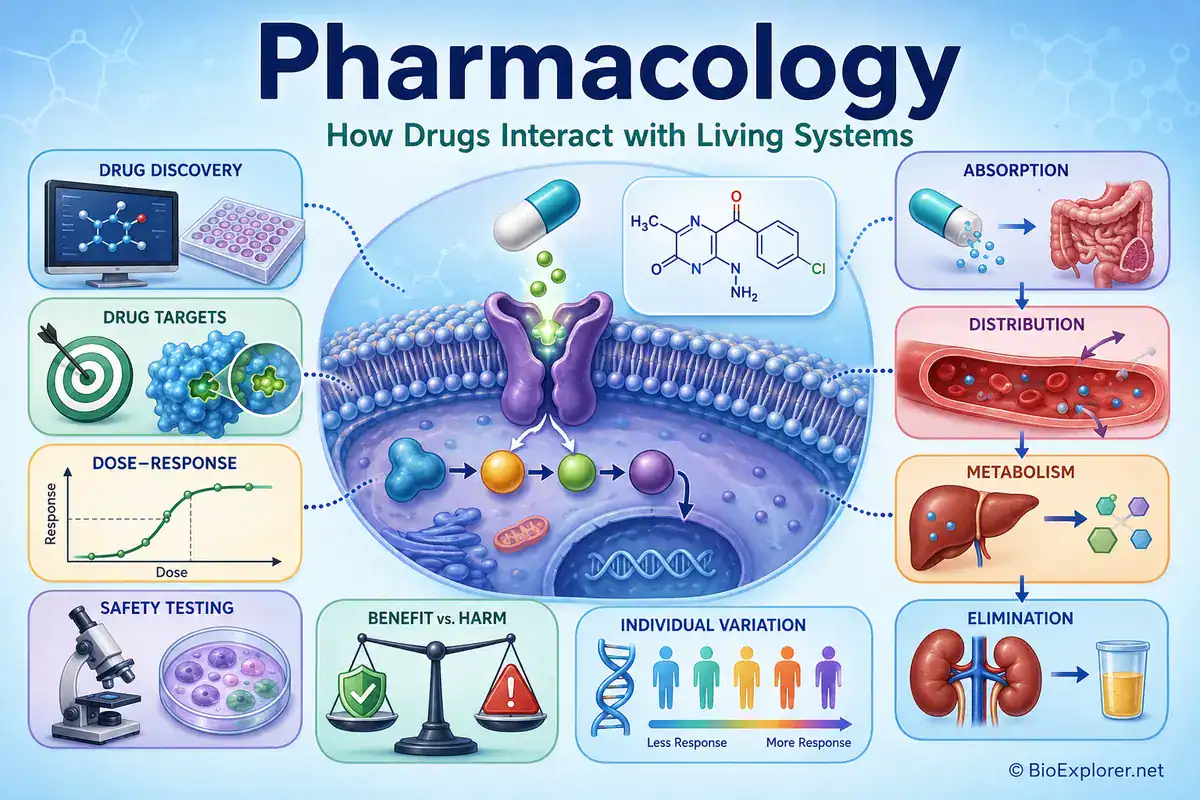
Pharmacology is the branch of biology and biomedical science that studies how drugs interact with living systems. It explains how medicines and other biologically active chemicals are discovered, absorbed, distributed, metabolized, eliminated, targeted, tested, dosed, and used to change biological function.
A pharmacologist does not simply ask whether a drug works. The deeper question is: what does the drug do, where does it act, how much is needed, how long does it last, who responds differently, and when does benefit become harm?
Pharmacology connects closely with biochemistry, molecular biology, cell biology, physiology, neuroscience, microbiology, immunology, genetics, and biotechnology.
Pharmacology Guide:
- A Drug Has Two Stories
- Pharmacology Definition and Scope
- Pharmacology Is Not the Same as Pharmacy
- How Drugs Produce Effects
- Dose Makes Pharmacology Practical
- What Pharmacologists Study
- Pharmacokinetics: Absorption, Distribution, Metabolism, and Excretion
- Pharmacodynamics: Targets, Effects, and Response
- Drug Discovery and Development
- History of Pharmacology: Discoveries That Changed Medicine
- Where Pharmacology Meets Biology
- Pharmacology Careers
- Related BioExplorer Resources
- Recommended Pharmacology Resources
- Pharmacology FAQs
A Drug Has Two Stories
Pharmacology is often built around two linked ideas: pharmacodynamics and pharmacokinetics. Pharmacodynamics asks what a drug does to the body. Pharmacokinetics asks what the body does to the drug.
That split matters. A drug can bind the right target but fail because it is poorly absorbed. Another drug can reach the bloodstream but cause toxicity because it stays too long, reaches the wrong tissue, or interacts with another medicine. Good pharmacology studies both sides at the same time.
| Core Idea | Main Question | Why It Matters |
|---|---|---|
| Pharmacodynamics | What does the drug do to the body? | Explains drug targets, receptor binding, dose-response, potency, efficacy, and biological effect. |
| Pharmacokinetics | What does the body do to the drug? | Explains absorption, distribution, metabolism, and excretion. |
| Drug Target | Where does the drug act? | Many drugs act on receptors, enzymes, ion channels, transporters, nucleic acids, or microbes. |
| Dose-Response | How does effect change with dose? | Helps determine useful doses, maximum effects, and toxic ranges. |
| Selectivity | How specific is the drug for its intended target? | More selective drugs may reduce unwanted effects, though no drug is risk-free. |
| Therapeutic Window | What dose range gives benefit without unacceptable harm? | A narrow window requires more careful dosing and monitoring. |
| Drug Interactions | How do other drugs, foods, or conditions change response? | Interactions can increase toxicity, reduce benefit, or change drug levels. |
| Patient Variability | Why do people respond differently? | Genetics, age, organ function, disease, pregnancy, diet, and other factors can change response. |
Pharmacology Definition and Scope
A practical pharmacology definition is:
The scientific study of drugs and their effects on biological systems. In this context, a drug can mean a medicine used to prevent or treat disease, but it can also mean any chemical substance that changes biological activity.
Pharmacology includes natural compounds, synthetic drugs, biologic medicines, vaccines, antibiotics, antivirals, hormones, anesthetics, cancer therapies, psychiatric drugs, immune therapies, pain medicines, cardiovascular drugs, and many experimental molecules that never become approved treatments.
The field is biological because drugs act through living systems. A drug may block an enzymes, activate a receptor, inhibit a transporter, disrupt a microbial pathway, alter neurotransmission, change immune signaling, affect gene expression, or interfere with cell division.
Pharmacology Is Not the Same as Pharmacy
Pharmacology is the science of drug action. Pharmacy is the health profession focused on preparing, dispensing, managing, and advising on medicines. The two fields overlap, but they are not the same.
A pharmacologist may study receptors, dose-response curves, drug metabolism, animal models, cell assays, or clinical trial data. A pharmacist works directly with medicines and patients, helping ensure that drugs are used safely and effectively in real-world care.
How Drugs Produce Effects
Many drugs work by binding to molecular targets. These targets may be proteins, enzymes, receptors, ion channels, transporters, nucleic acids, or microbial structures. Binding alone is not enough. The important question is whether that binding changes function in a useful way.
Some drugs activate receptors and mimic natural signals. Others block receptors so natural signals cannot act. Some inhibit enzymes. Some kill bacteria by interfering with cell wall synthesis, protein synthesis, nucleic acid synthesis, or metabolism. Some cancer drugs target abnormal signaling pathways or rapidly dividing cells.
This is where pharmacology depends heavily on molecular biology, cell biology, and biochemistry. A drug effect often begins at the molecular level but shows up as a change in cells, organs, symptoms, or survival.
Dose Makes Pharmacology Practical
Dose is one of the reasons pharmacology is different from simply knowing that a chemical has an effect. A low dose may do nothing. A moderate dose may help. A high dose may cause harm. The same drug can be therapeutic, ineffective, or toxic depending on dose, route, timing, patient biology, and context.
Pharmacologists study potency, efficacy, dose-response relationships, side effects, toxicity, and the therapeutic window. This is not just academic. It is how researchers and clinicians determine whether a drug can be used safely enough to justify its benefits.
What Pharmacologists Study
Pharmacology covers the full path from molecule to biological response. Some pharmacologists work before a drug reaches human testing. Others work in clinical research, drug safety, regulatory science, precision medicine, or post-approval monitoring.
| Area | What It Studies | Example |
|---|---|---|
| Molecular Pharmacology | Drug interactions with receptors, enzymes, ion channels, transporters, and signaling pathways. | Studying how a beta blocker binds a receptor. |
| Cellular Pharmacology | How drugs change cell behavior, survival, signaling, or metabolism. | Testing whether a cancer drug slows cell division. |
| Systems Pharmacology | Drug effects across organs and networks. | Studying how a blood pressure drug affects vessels, kidneys, and hormones. |
| Clinical Pharmacology | Drug effects, dosing, safety, and variability in humans. | Comparing dose schedules in a clinical trial. |
| Neuropharmacology | Drug effects on the nervous system. | Studying antidepressants, anesthetics, pain medicines, or seizure drugs. |
| Cardiovascular Pharmacology | Drug effects on the heart, blood vessels, and circulation. | Studying antihypertensive or antiarrhythmic medicines. |
| Antimicrobial Pharmacology | Drugs that act against bacteria, viruses, fungi, or parasites. | Studying antibiotic dosing and resistance. |
| Immunopharmacology | Drugs that affect immune function. | Studying biologics, immunosuppressants, vaccines, and inflammation pathways. |
| Pharmacogenomics | How genetic variation changes drug response. | Studying why one patient metabolizes a drug faster than another. |
Pharmacokinetics: Absorption, Distribution, Metabolism, and Excretion
Pharmacokinetics is often summarized as ADME: absorption, distribution, metabolism, and excretion. It describes how a drug moves through the body over time.
- Absorption: How a drug enters the bloodstream after oral, injected, inhaled, topical, or other routes.
- Distribution: How a drug moves through blood and tissues, including whether it reaches the target site.
- Metabolism: How enzymes, often in the liver, chemically change the drug into active or inactive forms.
- Excretion: How the body removes the drug or its metabolites, often through urine or bile.
Pharmacokinetics helps explain why some drugs are taken once a day, others several times a day, and some require blood-level monitoring. It also explains why kidney function, liver function, age, pregnancy, genetics, and drug interactions can change dosing decisions.
Pharmacodynamics: Targets, Effects, and Response
Pharmacodynamics studies the relationship between drug concentration and biological effect. It includes receptor binding, signaling, enzyme inhibition, ion channel effects, antimicrobial action, immune modulation, and dose-response curves.
Two drugs can have similar uses but behave differently. One may be more potent, meaning a lower dose produces an effect. Another may have greater efficacy, meaning it can produce a stronger maximum effect. Another may be safer because its useful dose is farther away from its toxic dose.
These details matter because drug action is rarely a simple on-off switch. Biological systems compensate, adapt, metabolize, repair, resist, and vary from person to person.
Drug Discovery and Development
Drug development usually begins with a biological problem, a target, a pathway, a screening strategy, or a compound with promising activity. Researchers then test whether the compound is active, selective, stable, deliverable, and safe enough to keep studying.
Before human testing, drug candidates are studied in laboratory systems and animal models when appropriate. If early evidence supports further testing, clinical trials may evaluate safety, dosing, effectiveness, side effects, interactions, and comparisons with existing options. Regulatory agencies review evidence before approving a medicine for specific uses.
Many drug candidates fail. That is part of pharmacology. A compound can fail because it is not effective enough, not selective enough, too toxic, poorly absorbed, unstable, difficult to manufacture, or less useful than existing treatments.
History of Pharmacology: Discoveries That Changed Medicine
The history of pharmacology is not just a list of famous drugs. It is the story of moving from crude remedies to purified compounds, controlled dosing, receptor theory, antibiotics, hormone replacement, rational drug design, targeted therapy, and precision medicine.
| Year | What Was Discovered or Introduced | Significance |
|---|---|---|
| 1804 to 1806 | Friedrich Sertürner isolated morphine from opium. | Helped establish the idea that a plant remedy could contain a purified active chemical with measurable effects. |
| 1846 | A public demonstration of ether anesthesia took place at Massachusetts General Hospital. | Showed that a chemical could reversibly suppress pain and consciousness enough to transform surgery. |
| 1909 to 1910 | Paul Ehrlich and Sahachiro Hata developed arsphenamine, also known as Salvarsan, for syphilis. | Became an early example of targeted chemotherapy and the idea of selective toxicity. |
| 1921 to 1922 | Insulin was discovered and first used clinically for diabetes. | Turned type 1 diabetes from a rapidly fatal disease into a treatable condition through hormone replacement. |
| 1928; 1940s | Alexander Fleming discovered penicillin, and later work by Howard Florey, Ernst Chain, and colleagues enabled clinical use. | Launched the antibiotic era and changed treatment of bacterial infections. |
| 1932 to 1935 | Gerhard Domagk showed the antibacterial effects of Prontosil, leading to sulfonamide drugs. | Opened the era of synthetic antibacterial chemotherapy before penicillin became widely available. |
| 1952 | Chlorpromazine entered psychiatric medicine. | Helped transform treatment of psychosis and launched modern psychopharmacology. |
| 1960s | James Black and colleagues developed beta blockers such as propranolol. | Advanced receptor-based drug design and changed treatment of angina, hypertension, and other cardiovascular conditions. |
| 1981 | Captopril became the first ACE inhibitor approved in the United States. | Marked an important success for mechanism-based cardiovascular drug development. |
| 1987 | Zidovudine, also called AZT, was approved as the first antiretroviral drug for HIV/AIDS. | Started the first approved drug treatment era for HIV infection. |
| 2001 | Imatinib was approved for chronic myeloid leukemia. | Became a landmark targeted cancer therapy aimed at a specific abnormal tyrosine kinase. |
Where Pharmacology Meets Biology
Pharmacology is a bridge between chemistry and biology, but the biological side is what gives it meaning. A drug may be designed as a molecule, but its value depends on how it behaves inside cells, tissues, organs, patients, microbes, tumors, or immune systems.
- In neuroscience: pharmacology explains anesthetics, antidepressants, seizure medicines, pain drugs, and neurotransmitter signaling.
- In microbiology: pharmacology explains antibiotics, antivirals, antifungals, antiparasitic drugs, and antimicrobial resistance.
- In immunology: pharmacology explains vaccines, immunosuppressants, anti-inflammatory drugs, monoclonal antibodies, and immune checkpoint therapies.
- In physiology: pharmacology explains how drugs change blood pressure, breathing, kidney function, hormones, digestion, and heart rhythm.
- In genetics: pharmacology explains why genetic variation can change drug metabolism, toxicity, and treatment response.
- In biotechnology: pharmacology helps evaluate biologics, gene-based therapies, engineered proteins, and cell-based treatments.
Pharmacology Careers
Pharmacology careers can be found in universities, pharmaceutical companies, biotechnology firms, hospitals, government agencies, clinical research organizations, toxicology labs, regulatory science, medical writing, and public health.
- Pharmacologist: Studies drug action, targets, effects, safety, and biological responses.
- Clinical pharmacologist: Studies drug dosing, safety, effectiveness, and variability in humans.
- Pharmacokinetic scientist: Studies absorption, distribution, metabolism, excretion, and drug exposure over time.
- Neuropharmacologist: Studies drugs that affect the brain, nerves, behavior, pain, mood, or consciousness.
- Cardiovascular pharmacologist: Studies drugs that affect the heart, blood vessels, circulation, and blood pressure.
- Immunopharmacologist: Studies drugs that affect immune pathways, inflammation, antibodies, and immune cells.
- Toxicologist: Studies harmful effects of chemicals, drugs, doses, exposures, and environmental agents.
- Regulatory scientist: Evaluates evidence related to drug quality, safety, effectiveness, labeling, and approval.
- Pharmacogenomics specialist: Studies how genetic variation changes drug response and dosing.
Related BioExplorer Resources
Use these BioExplorer pages to connect pharmacology with related areas of biology:
- Biochemistry
- Molecular Biology
- Cell Biology
- Physiology
- Neuroscience
- Microbiology
- Immunology
- Genetics
- Biotechnology
- Building Blocks of Proteins
- Cellular Organization
- Cellular Respiration
Recommended Pharmacology Resources
These external resources are useful for learning pharmacology, drug action, drug development, pharmacokinetics, pharmacodynamics, receptors, drug safety, and clinical research.
- British Pharmacological Society: What Is Pharmacology? A clear introduction to pharmacology, drug action, and careers.
- ASPET: About Pharmacology A professional society resource explaining pharmacology and what pharmacologists do.
- NCBI Bookshelf: Pharmacokinetics A useful reference for absorption, distribution, metabolism, and excretion.
- NCBI Bookshelf: Pharmacology Basics A starting point for core drug action and pharmacology concepts.
- FDA: Drug Development Process A reliable overview of how drugs are studied, reviewed, and approved.
- ClinicalTrials.gov A database of clinical studies involving drugs, biologics, devices, and other interventions.
- DrugBank A detailed resource on drug targets, mechanisms, interactions, and chemical information.
- IUPHAR/BPS Guide to Pharmacology A curated database of drug targets, ligands, receptors, enzymes, ion channels, and transporters.
- PubChem A major NIH chemical database for compounds, substances, bioassays, and molecular information.
- ChEMBL A manually curated database of bioactive molecules and drug-like compounds.
- NIGMS: Medicines by Design An accessible NIH resource on how scientists design and develop medicines.
- Nobel Prize: Physiology or Medicine A useful source for major discoveries related to drugs, hormones, antibiotics, receptors, and biological mechanisms.
Pharmacology FAQs
Pharmacology is the scientific study of drugs and how they interact with living systems. It includes drug action, targets, dosing, safety, metabolism, toxicity, and therapeutic use.
Pharmacologists study how drugs work, where they act, how the body processes them, how dose affects response, why side effects happen, and why people respond differently.
Pharmacodynamics is the study of what a drug does to the body, including receptor binding, biological effects, dose-response relationships, potency, efficacy, and toxicity.
Pharmacokinetics is the study of what the body does to a drug. It includes absorption, distribution, metabolism, and excretion, often summarized as ADME.
No. Pharmacology is the science of drug action, while pharmacy is the health profession focused on preparing, dispensing, managing, and advising on medicines.
Dose is important because the same drug can be ineffective, beneficial, or harmful depending on amount, route, timing, patient biology, interactions, and therapeutic window.
Pharmacology helps researchers identify drug targets, test biological effects, study safety, compare doses, understand metabolism, evaluate toxicity, and support clinical trials.
Pharmacology careers include pharmacologist, clinical pharmacologist, pharmacokinetic scientist, neuropharmacologist, cardiovascular pharmacologist, immunopharmacologist, toxicologist, regulatory scientist, and pharmacogenomics specialist.
Cite this page
BioExplorer. (2026, September 24). Pharmacology: How Drugs Affect Living Systems. https://www.bioexplorer.net/divisions_of_biology/pharmacology/