
Branches of Physiology
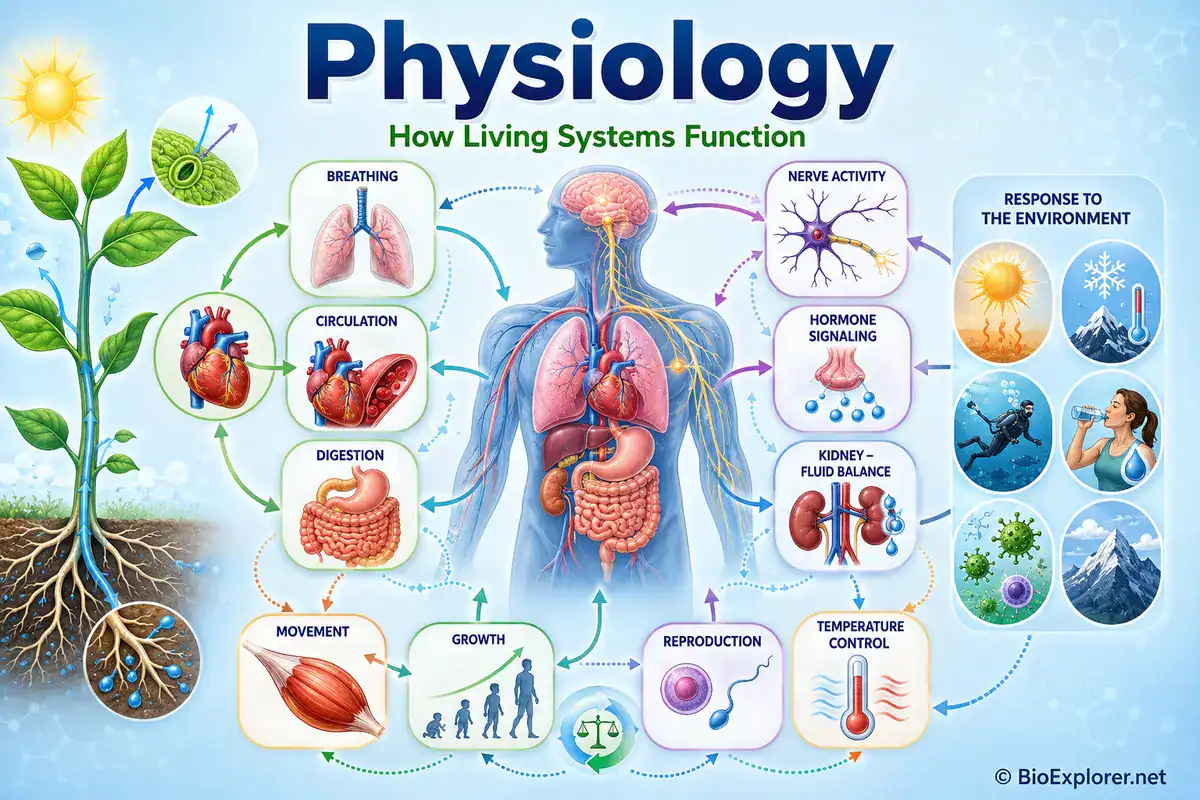
Physiology is the branch of biology that studies how living organisms work. It explains how cells, tissues, organs, and organ systems carry out body functions such as breathing, circulation, digestion, movement, temperature control, hormone signaling, nerve activity, growth, reproduction, and response to the environment.
In simple terms, physiology asks: How does life function? A physiologist may study how a muscle contracts, how the heart adjusts during exercise, how plants move water from roots to leaves, how kidneys regulate salt and water, or how animals survive heat, cold, altitude, diving, dehydration, or disease.
Physiology connects closely with anatomy, cell biology, biochemistry, neuroscience, botany, and zoology. Anatomy shows what structures are present. Physiology explains what those structures do and how they are controlled.
Physiology Guide:
- Physiology Definition and Meaning
- The Questions Physiologists Ask
- Homeostasis: The Core Idea in Physiology
- From Cells to Organ Systems
- How Organ Systems Work Together
- Main Branches of Physiology
- Human Physiology
- Animal Physiology
- Plant Physiology
- Cell Physiology
- Comparative and Environmental Physiology
- What Do Physiologists Measure?
- Physiology in Everyday Life
- Why Is Physiology Important?
- Physiology vs Anatomy, Biochemistry, and Medicine
- Physiology Careers
- Related BioExplorer Resources
- Recommended Physiology Resources
- Physiology FAQs
Physiology Definition and Meaning
A useful physiology definition is: physiology is the scientific study of biological function in living organisms and their parts. It can focus on a whole organism, an organ system, a single organ, a tissue, a cell, or even the molecular events that allow a cell to work.
Physiology is not limited to human health. Human physiology studies how the human body works. Animal physiology studies how animals function, adapt, and survive. Plant physiology studies processes such as photosynthesis, water transport, mineral nutrition, plant hormones, growth, and responses to light. Cell physiology studies how cells move materials, generate energy, communicate, divide, and maintain internal balance.
The Questions Physiologists Ask
Physiology is practical because it begins with observable functions. The question may be simple, but the answer often involves many levels of biology working together.
- How does the heart change its rate and force during exercise?
- How do nerves send signals so quickly?
- How do lungs exchange oxygen and carbon dioxide?
- How do kidneys control water, salts, and blood pressure?
- How do hormones coordinate growth, metabolism, stress, and reproduction?
- How do muscles turn chemical energy into movement?
- How do plants regulate water loss through stomata?
- How do animals maintain body temperature in extreme environments?
- How does disease disrupt normal body functions?
This is why physiology is central to medicine, veterinary science, exercise science, agriculture, ecology, neuroscience, pharmacology, and biotechnology. It gives researchers a way to connect biological structure with biological performance.
Homeostasis: The Core Idea in Physiology
Homeostasis is the ability of a living system to keep internal conditions within a working range. It does not mean the body is perfectly still or unchanging. It means the body constantly monitors and adjusts variables such as temperature, blood pressure, blood glucose, oxygen, carbon dioxide, pH, water, and electrolytes.
Most homeostatic control depends on negative feedback. A sensor detects a change, a control center compares that change with a normal range, and effectors produce a response that reduces the disturbance. Positive feedback also occurs, but it is usually limited to processes with a clear endpoint, such as blood clotting or childbirth.
| Physiological Variable | What Is Regulated | Why It Matters |
|---|---|---|
| Body Temperature | Heat production and heat loss. | Enzymes, cells, and organs work best within a limited temperature range. |
| Blood Glucose | The amount of glucose circulating in the blood. | Cells need fuel, but excess or insufficient glucose can disrupt normal function. |
| Blood Pressure | The force of blood against vessel walls. | Proper pressure helps deliver oxygen and nutrients to tissues. |
| Blood pH | The acidity or alkalinity of body fluids. | Proteins and enzymes are sensitive to changes in pH. |
| Water Balance | Water intake, loss, and distribution. | Cells need stable fluid balance to maintain volume and chemical conditions. |
| Oxygen and Carbon Dioxide | Gas exchange and transport. | Cells need oxygen for energy production and must remove carbon dioxide. |
From Cells to Organ Systems
Physiology works across levels of biological organization. A change at one level can affect the next. For example, a change in ion movement across a nerve cell membrane can alter nerve signaling, muscle contraction, heart rhythm, breathing, or behavior.
| Level | What Physiologists Study | Example |
|---|---|---|
| Molecules | Chemical signals, enzymes, ions, receptors, and energy transfer. | How calcium ions trigger muscle contraction. |
| Cells | Membranes, transport, metabolism, signaling, and electrical activity. | How nerve cells generate action potentials. |
| Tissues | Groups of similar cells working together. | How smooth muscle controls blood vessel diameter. |
| Organs | Structures made of multiple tissues performing a function. | How the kidney filters blood and adjusts water balance. |
| Organ Systems | Groups of organs that coordinate major body functions. | How the respiratory and cardiovascular systems deliver oxygen. |
| Whole Organisms | Integrated function, adaptation, performance, and survival. | How an animal responds to heat, exercise, altitude, or dehydration. |
For background on how cells are arranged and organized, see Cellular Organization. For cellular energy, see Cellular Respiration.
How Organ Systems Work Together
One reason physiology is different from memorizing body parts is that it studies coordination. The nervous system can adjust heart rate within seconds. The endocrine system can change metabolism over minutes, hours, or days. The kidneys help regulate blood volume and pH. The lungs exchange gases. The digestive system supplies nutrients. The immune system detects and responds to threats.
| Organ System | Main Function | Physiology Example |
|---|---|---|
| Nervous System | Detects information and coordinates fast responses. | Reflexes, sensory processing, movement, and autonomic control. |
| Endocrine System | Uses hormones to regulate slower and longer-lasting processes. | Growth, metabolism, stress responses, reproduction, and glucose control. |
| Cardiovascular System | Moves blood through the body. | Heart rate, blood pressure, circulation, and tissue oxygen delivery. |
| Respiratory System | Exchanges oxygen and carbon dioxide. | Ventilation, gas exchange, blood pH regulation, and exercise response. |
| Digestive System | Breaks down food and absorbs nutrients. | Enzyme secretion, gut motility, nutrient absorption, and microbiome interactions. |
| Urinary System | Regulates water, electrolytes, waste removal, and acid-base balance. | Kidney filtration, urine concentration, sodium balance, and pH control. |
| Muscular System | Produces movement and force. | Muscle contraction, posture, heat production, and exercise performance. |
| Immune System | Defends against infection and abnormal cells. | Inflammation, fever, immune signaling, and pathogen clearance. |
| Reproductive System | Produces gametes and supports reproduction. | Hormonal cycles, gamete production, pregnancy, and lactation. |
| Integumentary System | Protects the body and helps regulate temperature. | Sweating, blood flow to skin, barrier function, and wound repair. |
Main Branches of Physiology
Physiology can be organized in several ways. Some areas focus on humans and medicine. Others focus on animals, plants, cells, evolution, or environmental adaptation.
Human Physiology
Human physiology studies how the human body functions in health, stress, development, aging, exercise, and disease. It includes cardiovascular physiology, respiratory physiology, renal physiology, neurophysiology, endocrine physiology, digestive physiology, reproductive physiology, and exercise physiology.
Animal Physiology
Animal physiology studies how animals function and adapt. It compares body functions across species, including how animals breathe, circulate fluids, regulate temperature, digest food, conserve water, reproduce, migrate, hibernate, dive, fly, or survive in unusual environments.
Plant Physiology
Plant physiology studies how plants live and grow. It includes photosynthesis, respiration, water movement, mineral uptake, transpiration, plant hormones, seed germination, flowering, tropisms, stress responses, and the opening and closing of stomata.
Cell Physiology
Cell physiology studies how cells maintain their internal environment, move substances across membranes, produce energy, communicate, divide, respond to signals, and specialize into different cell types. It connects directly with cell biology and biochemistry.
Comparative and Environmental Physiology
Comparative physiology compares function across organisms. Environmental physiology studies how organisms respond to conditions such as heat, cold, drought, salinity, pressure, oxygen availability, toxins, and altitude. These areas are important in ecology, evolution, conservation, and climate-related biology.
What Do Physiologists Measure?
Physiologists often measure signals that reveal how a living system is functioning. Some measurements come from whole organisms, while others come from organs, cells, tissues, blood samples, imaging, sensors, or experimental models.
| Measurement | What It Shows | Common Use |
|---|---|---|
| Heart Rate | How often the heart beats. | Exercise physiology, stress response, cardiovascular health, and autonomic regulation. |
| Blood Pressure | The pressure generated by circulating blood. | Cardiovascular function, kidney regulation, and vascular resistance. |
| Electrocardiogram | Electrical activity of the heart. | Heart rhythm, conduction, and cardiac physiology. |
| Lung Volume | How much air the lungs move or hold. | Respiratory physiology, exercise testing, and lung function assessment. |
| Blood Glucose | Glucose concentration in the blood. | Metabolism, endocrine physiology, and diabetes research. |
| Oxygen Saturation | How much hemoglobin is carrying oxygen. | Respiratory function, circulation, altitude response, and clinical monitoring. |
| Hormone Levels | Chemical messages in blood or tissues. | Endocrine function, stress, reproduction, growth, and metabolism. |
| Nerve Activity | Electrical signaling in neurons or nerves. | Neurophysiology, reflexes, sensation, movement, and autonomic function. |
Physiology in Everyday Life
Physiology is visible in ordinary experiences. When you run up stairs, your breathing rate rises, your heart pumps faster, blood vessel redirect flow, muscles use more energy, and sweat glands help release heat. That is not one system working alone. It is integrated physiology.
- Breathing: The respiratory system moves air, while blood transports oxygen and carbon dioxide.
- Exercise: Muscles, heart, lungs, nerves, hormones, and metabolism adjust together.
- Digestion: Enzymes, stomach acid, bile, gut movement, absorption, and hormones coordinate nutrient handling.
- Temperature control: Sweating, shivering, skin blood flow, behavior, and metabolism help regulate heat.
- Sleep: Brain activity, hormones, temperature, and circadian rhythms shift through the night.
- Stress: The nervous and endocrine systems help mobilize energy and adjust circulation.
- Dehydration: Thirst, kidney function, hormones, and electrolyte balance respond to water loss.
Why Is Physiology Important?
Physiology is important because it explains normal function and what happens when function changes. A disease may begin with a gene, a cell, a tissue, an organ, or an environmental stress, but its effects are often seen as altered physiology.
In medicine, physiology helps explain symptoms, diagnosis, treatment, drug action, recovery, and prevention. In sports science, it helps explain endurance, strength, fatigue, oxygen use, hydration, and training adaptation. In agriculture, plant and animal physiology help improve crop growth, livestock health, stress tolerance, and productivity. In conservation biology, physiology helps researchers understand how organisms respond to heat, drought, pollution, salinity, oxygen limitation, and habitat change.
Physiology also supports research in pharmacology, toxicology, neuroscience, developmental biology, nutrition, public health, veterinary medicine, and environmental biology. For related fields, see developmental biology, ecology, and zoology.
Physiology vs Anatomy, Biochemistry, and Medicine
Physiology overlaps with several fields, but its central focus is function. It explains how living systems operate, regulate themselves, and respond to change.
| Field | Main Focus | How It Connects to Physiology |
|---|---|---|
| Anatomy | Body structures and their organization. | Physiology explains what those structures do. |
| Cell Biology | Cell structure, cell behavior, and cell processes. | Physiology connects cell activity to tissue, organ, and organism function. |
| Biochemistry | Chemical reactions and molecules in living systems. | Physiology uses biochemical processes to explain function and regulation. |
| Medicine | Diagnosis, treatment, and prevention of disease. | Physiology explains normal function and how disease disrupts it. |
| Pharmacology | How drugs affect living systems. | Physiology helps explain drug effects on cells, organs, and body systems. |
Difference Between Anatomy and Physiology
Physiology Careers
Physiology careers can be found in research, medicine, healthcare, biotechnology, sports science, veterinary science, education, environmental science, and pharmaceutical development. Many physiology roles require advanced training, especially in research or clinical settings.
- Physiologist: Studies how living systems function in health, stress, adaptation, or disease.
- Clinical physiologist: Measures and interprets body functions in healthcare settings.
- Exercise physiologist: Studies how the body responds and adapts to physical activity.
- Neurophysiologist: Studies nerve activity, brain function, sensation, movement, and neural control.
- Cardiovascular physiologist: Studies the heart, blood vessels, circulation, and blood pressure regulation.
- Respiratory physiologist: Studies breathing, lung function, gas exchange, and oxygen transport.
- Plant physiologist: Studies photosynthesis, growth, water transport, hormones, and environmental responses in plants.
- Comparative physiologist: Studies how different organisms solve functional problems in different environments.
- Pharmaceutical or biotechnology scientist: Uses physiology to evaluate drug effects, biological responses, and disease models.
Related BioExplorer Resources
These BioExplorer pages can help readers connect physiology with related biology concepts:
- Anatomy
- Cell Biology
- Biochemistry
- Neuroscience
- Botany
- Zoology
- Developmental Biology
- Ecology
- Cellular Organization
- Cellular Respiration
- Building Blocks of Proteins
- Building Blocks of Carbohydrates
- Building Blocks of Lipids
- Building Blocks of Nucleic Acids
Recommended Physiology Resources
These external resources provide reliable physiology definitions, learning materials, research databases, journals, and educational references.
- American Physiological Society: What Is Physiology? A student-friendly overview of physiology and the body systems physiologists study.
- The Physiological Society: What Is Physiology? A clear explanation of physiology as the science of life and living mechanisms.
- OpenStax Anatomy and Physiology 2e: Homeostasis A free textbook section explaining homeostasis, negative feedback, positive feedback, and physiological regulation.
- OpenStax Anatomy and Physiology 2e A full open textbook covering human anatomy, physiology, organ systems, and homeostatic control.
- Khan Academy: Principles of Physiology Beginner-friendly lessons on body structure, homeostasis, and physiological systems.
- Britannica: Physiology A concise reference definition of physiology as the study of function in living organisms and their parts.
- PhysioNet A research resource with open physiological signal data and software, useful for advanced study and biomedical data analysis.
- American Physiological Society Journals Peer-reviewed journals covering physiological research from cells and molecules to organ systems.
- Physiological Reviews A leading review journal for advanced physiology topics.
- Plant Physiology A major journal for plant physiology, plant function, plant development, and plant responses to the environment.
Physiology FAQs
Physiology is the branch of biology that studies how living organisms and their parts function. It explains body functions, homeostasis, organ systems, cells, tissues, plants, animals, and responses to the environment.
Physiologists study how cells, tissues, organs, and organ systems work. They may study breathing, circulation, digestion, nerve signals, hormones, muscles, kidneys, plant growth, animal adaptation, or disease-related changes in function.
Homeostasis is important because living systems must keep internal conditions within working ranges. Temperature, blood pressure, blood glucose, pH, oxygen, water, and electrolytes are examples of regulated variables.
No. Anatomy studies biological structures, while physiology studies how those structures function. The two fields are closely connected because structure often supports function.
Human physiology is the study of how the human body works. It includes organ systems such as the nervous, endocrine, cardiovascular, respiratory, digestive, urinary, muscular, immune, and reproductive systems.
Plant physiology is the study of how plants function. It includes photosynthesis, respiration, water transport, mineral uptake, transpiration, plant hormones, germination, flowering, and responses to light or stress.
Physiology is important because it explains normal function and how function changes during exercise, stress, disease, development, aging, environmental change, and treatment.
Physiology careers include physiologist, clinical physiologist, exercise physiologist, neurophysiologist, cardiovascular physiologist, respiratory physiologist, plant physiologist, comparative physiologist, and biotechnology or pharmaceutical scientist.
Cite this page
BioExplorer. (2026, September 24). Branches of Physiology. https://www.bioexplorer.net/divisions_of_biology/physiology/