
Developmental Biology: How Organisms Grow and Form
An animal, plant, or fungus does not begin life as a finished miniature. It begins with cells that divide, move, receive signals, switch genes on and off, change shape, specialize, and assemble tissues in the right places. Developmental Biology is the branch of biology that studies how that transformation happens.
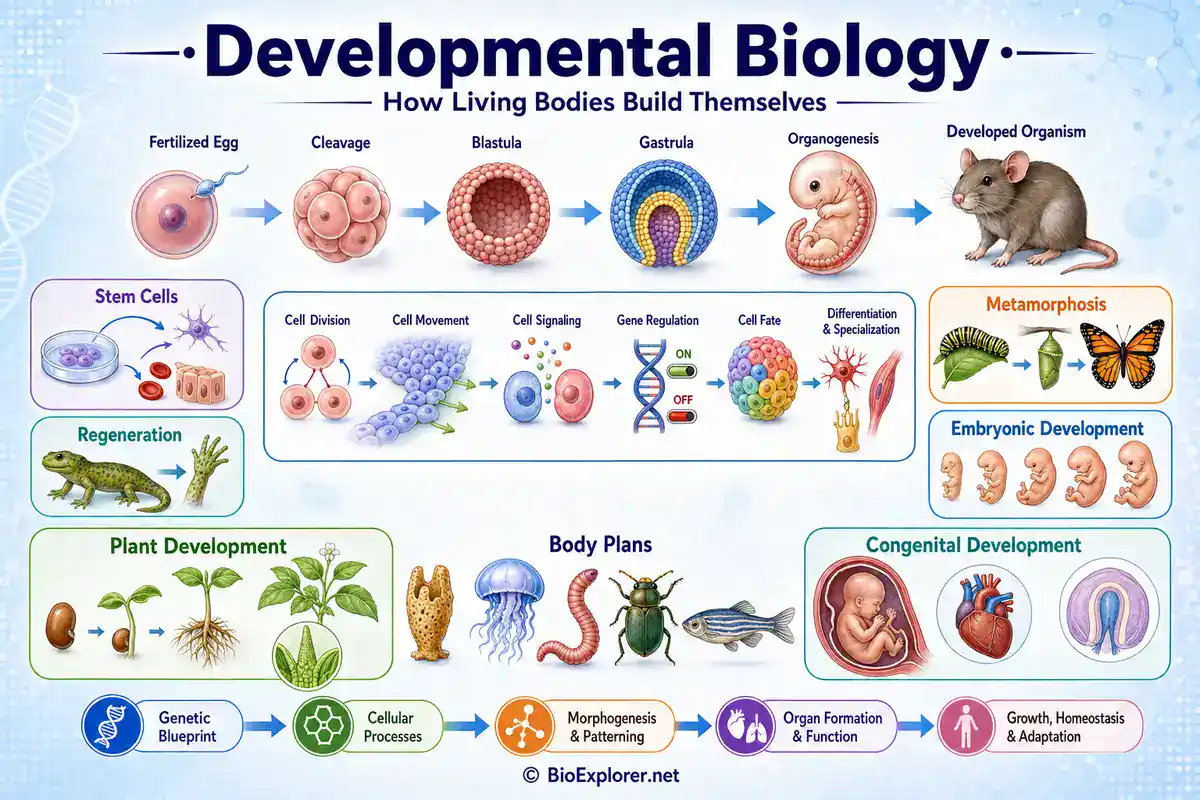
The field follows one of biology’s hardest problems: how a living body builds order from a starting cell, egg, embryo, meristem, larva, seed, stem cell, or regenerating tissue. It studies embryos, growth, cell fate, body plans, organ formation, regeneration, metamorphosis, congenital disorders, stem cells, and evolutionary changes in development.
Use the Developmental Biology Glossary to clarify terms such as cell fate, differentiation, gastrulation, morphogenesis, organogenesis, germ layers, induction, patterning, homeotic genes, stem cells, regeneration, and model organisms. You can also browse the full Biology Glossary for related terms across cell biology, genetics, molecular biology, anatomy, and evolution.
Developmental Biology Guide:
- The Real Puzzle: Same Genome, Different Destinies
- Cell Biology vs Developmental Biology
- Development Is a Sequence, Not a Single Event
- Gastrulation: When the Body Plan Starts to Take Shape
- Cell Fate: How a Cell Becomes Committed
- Signals Do Not Work Unless Cells Are Ready to Hear Them
- Morphogenesis: Cells Build Shape by Moving and Pulling
- Embryology vs Developmental Biology
- Model Organisms Make Development Visible
- Development Does Not Stop at Birth, Hatching, or Germination
- When Development Goes Wrong
- Developmental Biology and Evolution
- Stem Cells, Organoids, and Regenerative Medicine
- History of Developmental Biology: Turning Points That Changed the Field
- Tools Developmental Biologists Use
- Developmental Biology Careers
- Related BioExplorer Resources
- Recommended Developmental Biology Resources
- Developmental Biology FAQs
The Real Puzzle: Same Genome, Different Destinies
Most cells in a multicellular organism carry the same genome, but they do not become the same thing. A skin cell, neuron, muscle cell, blood cell, root hair, and leaf cell behave differently because they use different sets of genes at different times and in different places.
This is the central logic of developmental biology. Development is not only about cell division. It is about controlled difference. Cells must learn where they are, what neighbors they have, what signals they receive, what genes to activate, what shape to take, and when to stop changing.
That makes developmental biology deeply connected to cell biology, genetics, and molecular biology, but its focus is different. It asks how cells become organized into a living form.
Cell Biology vs Developmental Biology
Cell biology and developmental biology overlap because development depends on cells. The difference is focus. Cell biology studies how cells work. Developmental biology studies how cells work together across time to build tissues, organs, body patterns, and whole organisms.
A cell biologist may ask how a cell divides, moves, signals, changes shape, or controls gene expression. A developmental biologist asks how those same cell behaviors are coordinated so that an embryo forms germ layers, a limb bud grows in the right place, a neuron connects to a target, or a root and shoot develop in a plant.
| Point of Difference | Cell Biology | Developmental Biology |
|---|---|---|
| Main Focus | How individual cells are structured, organized, and controlled. | How cells produce organized growth, body plans, tissues, organs, and life-stage changes. |
| Core Question | How does a cell function? | How do many cells become a structured organism? |
| Typical Scale | Cell membrane, nucleus, cytoplasm, organelles, cytoskeleton, signaling pathways. | Embryo, tissue layer, organ field, body axis, limb bud, meristem, regenerating structure. |
| Time Dimension | Often studies cell processes at a moment or over short cellular events. | Studies coordinated change over developmental time, from early stages to mature form. |
| Example Topic | How actin helps a cell move. | How groups of moving cells shape an embryo during gastrulation. |
| Typical Methods | Microscopy, cell culture, protein localization, live-cell imaging, molecular assays. | Fate mapping, lineage tracing, embryo manipulation, model organisms, organoids, developmental genetics. |
| Best Way to Remember | Cell biology explains the parts and behaviors of cells. | Developmental biology explains how cell behaviors are organized into form. |
Development Is a Sequence, Not a Single Event
Development is often taught as a list of stages, but the more useful view is a sequence of decisions. Early cells divide. Some become different from others. Cell groups move. Axes form. Layers appear. Tissues interact. Organs emerge. Growth changes proportions. The body plan becomes more precise over time.
| Developmental Step | What Happens | Why It Matters |
|---|---|---|
| Fertilization | Gametes fuse and create a zygote in sexually reproducing organisms. | Begins a new organism and activates early developmental programs. |
| Cleavage | Rapid cell divisions increase cell number without much overall growth. | Creates many cells that can later take different positions and fates. |
| Blastula or Blastocyst Stage | Cells form an early organized structure, often with a cavity or distinct cell groups. | Sets up later cell movements and lineage decisions. |
| Gastrulation | Cells move and reorganize into germ layers. | Establishes the basic body plan and positions tissues for future organ formation. |
| Neurulation | In chordates, tissue folds and forms the early neural tube. | Begins formation of the central nervous system. |
| Organogenesis | Germ layers and tissue interactions produce organs and body structures. | Builds functional systems such as heart, kidney, gut, skin, and nervous tissue. |
| Growth and Maturation | Cells divide, enlarge, specialize, and coordinate function. | Turns early structures into working tissues and body systems. |
| Regeneration or Repair | Some organisms replace lost or damaged parts after injury. | Shows that developmental programs can be reactivated beyond early embryonic life. |
Gastrulation: When the Body Plan Starts to Take Shape
Gastrulation is one of the most important events in animal development. During gastrulation, cells move into new positions and form the early germ layers: ectoderm, mesoderm, and endoderm. These layers are not finished tissues yet. They are organized starting zones for future tissues and organs.
The ectoderm can contribute to structures such as the nervous system and outer body covering. The mesoderm can contribute to muscles, blood, connective tissues, kidneys, and heart-related tissues. The endoderm can contribute to the lining of the digestive and respiratory systems and organs such as the liver and pancreas in vertebrates.
Gastrulation matters because position becomes information. Once cells move, they meet new neighbors, receive new signals, and become part of new tissue territories. A body plan is not drawn on top of an embryo. It is built by cell movement, signaling, and gene regulation working together.
Cell Fate: How a Cell Becomes Committed
Cell fate means what a cell or group of cells is expected to become. Some cells remain flexible for a time. Others become determined, meaning their future direction is harder to change. Later, cells differentiate and begin performing specialized functions.
Cell fate is controlled by several kinds of information. Some information is inherited from the egg. Some comes from nearby cells. Some comes from chemical gradients. Some comes from mechanical force, cell contact, or timing. Developmental biologists study how these signals are interpreted by gene networks.
A useful way to think about cell fate is this: development gives cells both an address and a job. The address tells the cell where it is. The job tells the cell what to become.
Signals Do Not Work Unless Cells Are Ready to Hear Them
Embryos use signaling molecules such as BMP, Wnt, Hedgehog, Notch, FGF, and retinoic acid to coordinate development. These signals can influence cell fate, growth, movement, polarity, survival, and tissue patterning. The same signal can produce different outcomes depending on timing, concentration, tissue type, and cell competence.
Competence is the ability of a cell or tissue to respond to a signal. A signal may be present, but if the receiving cell lacks the right receptors, transcription factors, chromatin state, or developmental context, the response may be weak or absent.
This is why developmental biology is not a simple list of "signal A causes structure B." The same pathway can help build limbs, nerves, gut, skin, or organs in different contexts. Development depends on timing, position, history, and response.
Morphogenesis: Cells Build Shape by Moving and Pulling
Morphogenesis is the formation of biological shape. It includes folding, bending, thickening, branching, spreading, migration, tube formation, and tissue rearrangement. Morphogenesis turns cell populations into physical structures.
A neural tube folds. A heart tube loops. A lung branches. A limb bud grows. A root tip extends. A leaf forms veins. These are not only genetic events. They also involve force, adhesion, cell polarity, cytoskeleton activity, extracellular matrix, and mechanical feedback.
This is where developmental biology overlaps with biophysics, anatomy, and physiology. Genes help set the instructions, but tissues still have to move, fold, and hold together in real space.
For a practical breakdown of 12 core biophysics techniques, from X-ray crystallography to molecular dynamics, with protocol checklists, common mistakes, and free calculators, see BioExplorer’s Biophysics Methods and Protocols guide.
Embryology vs Developmental Biology
Embryology and developmental biology overlap, but they are not identical. Embryology is the older and narrower term, focused mainly on embryo formation and prenatal development. Developmental biology is broader. It includes embryos, postnatal growth, regeneration, stem cells, metamorphosis, plant development, organoids, and developmental genetics.
| Point of Difference | Embryology | Developmental Biology |
|---|---|---|
| Main Focus | Embryos and prenatal development. | The full biological process of building and changing organisms across life stages. |
| Typical Question | How does an embryo form tissues and organs? | How do cells, genes, signals, tissues, and environments produce organized living form? |
| Scope | Mostly early development, especially in animals. | Embryos, growth, regeneration, metamorphosis, stem cells, organ formation, and plant development. |
| Methods | Embryo observation, anatomy, microscopy, fate mapping, classical experiments. | Genetics, live imaging, molecular biology, single-cell data, gene editing, organoids, and modeling. |
| Best Use of Term | When discussing embryos and prenatal stages specifically. | When discussing the wider field of development across organisms and life stages. |
| BioExplorer Page Angle | Useful as a subtopic within development. | The main hub for body plans, cell fate, morphogenesis, regeneration, model organisms, and developmental disorders. |
Model Organisms Make Development Visible
Development is difficult to study directly in humans, so scientists use model organisms. A good model organism is not chosen because it is identical to humans. It is chosen because it makes a developmental question easier to see, test, image, mutate, or compare.
| Model Organism | Why It Is Useful | Developmental Questions It Helps Answer |
|---|---|---|
| Fruit Fly Drosophila melanogaster | Fast life cycle, powerful genetics, visible embryos, classic patterning mutants. | How genes pattern body axes, segments, organs, and cell fates. |
| Nematode Caenorhabditis elegans | Transparent body, known cell lineage, simple anatomy, strong genetics. | How individual cells divide, die, migrate, and form a complete organism. |
| Zebrafish Danio rerio | Transparent embryos, external development, live imaging, vertebrate body plan. | How vertebrate organs, blood vessels, nerves, and tissues form. |
| African Clawed Frog Xenopus laevis | Large eggs and embryos, classic embryology, transplantation experiments. | How early embryos pattern axes, germ layers, and induction events. |
| Mouse Mus musculus | Mammalian development, genetics, disease models, stem cell tools. | How mammalian embryos, organs, placenta, and developmental disorders form. |
| Chick Gallus gallus | Accessible embryo inside egg, useful for tissue grafts and limb studies. | How limbs, nerves, heart, and body patterning develop. |
| Thale Cress Arabidopsis thaliana | Small plant, short generation time, powerful genetics. | How roots, shoots, flowers, leaves, and plant body plans form. |
| Axolotl Ambystoma mexicanum | Strong regenerative ability in limbs, spinal cord, and other tissues. | How regeneration restores complex structures after injury. |
| Sea Urchin | External development, clear embryos, classic fertilization and cleavage studies. | How early cell divisions, fertilization, and embryo patterning are controlled. |
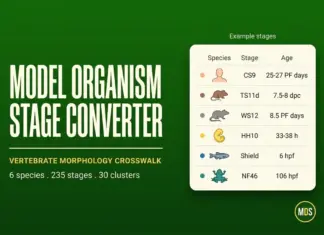
Model Organism Development Stage Converter
Development Does Not Stop at Birth, Hatching, or Germination
Development continues after early embryonic stages. Animals grow, mature, remodel tissues, pass through puberty, regenerate some structures, or undergo metamorphosis. Plants continue producing new organs from meristems, including roots, leaves, flowers, and branches.
Metamorphosis is a dramatic example. A caterpillar and a butterfly have the same genome, but developmental programs reorganize body structure, feeding behavior, movement, and reproduction. Amphibian metamorphosis also shows how hormones can coordinate major changes in organs, limbs, skin, gut, and behavior.
Regeneration is another important window into development. Planarians, axolotls, hydra, and some other organisms can replace lost structures. Studying them helps scientists ask why some tissues can rebuild while others scar, fail, or only partly repair.
When Development Goes Wrong
Developmental errors can occur when cell division, migration, signaling, gene regulation, tissue folding, organ formation, or environmental exposure disrupts normal development. These disruptions can lead to congenital disorders, growth problems, infertility, pregnancy loss, birth defects, cancer risk, or later disease susceptibility.
Developmental biology does not treat these conditions as random defects. It asks which step was disturbed. Was an organ field specified incorrectly? Did cells fail to migrate? Did a signaling pathway overactivate? Did tissue fail to close? Did a mutation affect a transcription factor? Did a toxin, drug, infection, nutrition problem, or environmental exposure affect a sensitive developmental window?
This makes the field important to pathology, pharmacology, environmental biology, toxicology, reproductive biology, and medicine. It also helps explain why timing matters: the same exposure may have different effects depending on the developmental stage.
Developmental Biology and Evolution
Evolution changes organisms partly by changing development. A small shift in when, where, or how strongly a developmental gene acts can alter body size, limb shape, flower structure, segmentation, coloration, or organ form.
Evolutionary developmental biology, often called evo-devo, studies how developmental processes evolve and how changes in development help produce biological diversity. It explains why distantly related animals can share deep developmental toolkits while still producing very different body forms.
Developmental biology also helps compare ontogeny and phylogeny. Ontogeny is the development of an individual organism. Phylogeny is the evolutionary history of a lineage. The old phrase "ontogeny recapitulates phylogeny" is too simplistic, but comparing embryos can still reveal important clues about shared ancestry and developmental change.
Stem Cells, Organoids, and Regenerative Medicine
Stem cells are important because they can divide and produce specialized cell types. Embryonic stem cells, adult stem cells, and induced pluripotent stem cells are studied for different reasons. They help researchers understand cell fate, tissue formation, repair, disease, and possible therapies.
Organoids are small three-dimensional tissue-like systems grown from stem cells or progenitor cells. They can mimic some features of organs such as brain, intestine, kidney, lung, or liver tissue. They are not complete organs, but they give scientists a way to study development, disease, infection, drug response, and tissue organization in controlled conditions.
These areas connect developmental biology with biotechnology, regenerative medicine, disease modeling, and ethical questions about human development.
History of Developmental Biology: Turning Points That Changed the Field
The history of developmental biology moved from observation to experiment, then to genes, molecules, imaging, and cell reprogramming. The milestones below are selected because each changed how scientists understood development, not because they form a complete timeline.
| Year | Milestone | Why It Matters |
|---|---|---|
| 1828 | Karl Ernst von Baer described important principles of comparative embryology. | Helped show that embryos develop from general features toward more specialized forms. |
| 1888 | Wilhelm Roux used experimental manipulation of frog embryos to test developmental causation. | Helped move embryology from description toward experimental embryology. |
| 1890s | Hans Driesch separated early sea urchin blastomeres and showed that each could form a complete larva under some conditions. | Supported the idea that early embryonic cells can regulate development after disturbance. |
| 1924 | Hans Spemann and Hilde Mangold published the organizer experiment in amphibian embryos. | Showed that one embryonic region could induce neighboring tissue to form organized structures. |
| 1935 | Hans Spemann received the Nobel Prize for the organizer effect in embryonic development. | Recognized embryonic induction as a central developmental principle. |
| 1952 | Alan Turing published The Chemical Basis of Morphogenesis. | Provided a mathematical model for how reaction-diffusion systems can generate biological patterns. |
| 1978 | Edward B. Lewis published influential work on homeotic genes in Drosophila. | Helped connect genes with body segment identity and developmental patterning. |
| 1995 | Edward B. Lewis, Christiane Nüsslein-Volhard, and Eric Wieschaus received the Nobel Prize for discoveries on genetic control of early embryonic development. | Recognized the genetic logic of embryonic patterning. |
| 2012 | John Gurdon and Shinya Yamanaka received the Nobel Prize for showing that mature cells can be reprogrammed to pluripotency. | Changed how scientists think about cell identity, developmental potential, and regenerative medicine. |
Tools Developmental Biologists Use
Developmental biology depends on watching change. A single image can be useful, but development is a process across time. Scientists need tools that reveal where cells came from, where they go, what genes they express, and how tissues behave.
- Fate mapping: Tracks where cells or tissues go during development.
- Lineage tracing: Follows descendants of a cell across time.
- Live imaging: Records cell movement, division, tissue folding, and organ formation.
- Gene knockouts and knockdowns: Test what happens when a gene is removed or reduced.
- CRISPR gene editing: Changes specific DNA sequences to study gene function.
- Single-cell sequencing: Measures gene activity in individual cells during development.
- In situ hybridization: Shows where specific RNA molecules are located in tissues.
- Immunostaining: Uses antibodies to detect proteins in cells or tissues.
- Transplantation experiments: Move cells or tissues to test induction, competence, and fate.
- Organoid culture: Studies tissue-like development in controlled laboratory systems.
Developmental Biology Careers
Careers in developmental biology often follow a question rather than a single workplace. Some scientists study embryos. Others study stem cells, organoids, regeneration, plant growth, congenital disorders, reproductive biology, cancer, or evolutionary changes in body form.
- Developmental biologist: Studies how organisms grow, pattern, and form tissues and organs.
- Embryologist: Studies embryos, fertilization, early development, and reproductive processes.
- Stem cell biologist: Studies cell potency, differentiation, tissue repair, and reprogramming.
- Regeneration researcher: Studies how organisms repair or replace damaged structures.
- Developmental geneticist: Studies genes that control body patterning, cell fate, and organ formation.
- Plant developmental biologist: Studies roots, shoots, flowers, leaves, seeds, meristems, and plant growth patterns.
- Evolutionary developmental biologist: Studies how changes in development contribute to evolution.
- Reproductive biologist: Studies gametes, fertilization, implantation, pregnancy, and early development.
- Organoid researcher: Uses 3D tissue models to study development, disease, and drug response.
- Developmental toxicologist: Studies how chemicals, drugs, infections, or environmental exposures affect development.
Related BioExplorer Resources
Use these BioExplorer pages to connect developmental biology with cells, genes, body systems, plants, animals, evolution, and molecular building blocks:

Recommended Developmental Biology Resources
These external resources are useful for learning about embryos, development, model organisms, stem cells, regeneration, developmental genetics, and classic discoveries in the field.
- Society for Developmental Biology A major professional society for developmental biology research, education, meetings, and community resources.
- The Node A community site from The Company of Biologists for developmental biology and stem cell biology news, discussions, and resources.
- Development Journal A leading peer-reviewed journal focused on developmental biology and stem cell research.
- Developmental Biology Journal A long-running journal covering mechanisms of development across organisms.
- Embryo Project Encyclopedia A valuable historical and educational resource on embryos, reproduction, development, and developmental biology.
- Xenbase A model organism database for Xenopus research, including embryology and developmental genetics.
- ZFIN: Zebrafish Information Network A major database for zebrafish genetics, development, anatomy, and research tools.
- FlyBase A key database for Drosophila genetics, development, genes, phenotypes, and literature.
- WormBase A major database for C. elegans genetics, cell biology, development, and lineage research.
- The Arabidopsis Information Resource A central resource for plant developmental genetics and Arabidopsis research.
- Nobel Prize: Hans Spemann Official Nobel background on the organizer effect in embryonic development.
- Nobel Prize: Genetic Control of Early Embryonic Development Official Nobel background on Lewis, Nüsslein-Volhard, and Wieschaus.
- Nobel Prize: Cell Reprogramming Official Nobel background on Gurdon, Yamanaka, and cellular pluripotency.
Developmental Biology FAQs
Developmental biology is the branch of biology that studies how organisms grow and develop, including embryos, cell fate, morphogenesis, organ formation, regeneration, stem cells, and body patterning.
Developmental biologists study fertilization, embryos, cell division, cell fate, gene regulation, signaling, gastrulation, morphogenesis, organogenesis, growth, regeneration, stem cells, and developmental disorders.
Embryology focuses mainly on embryos and prenatal development. Developmental biology is broader and includes embryos, growth, regeneration, stem cells, organoids, metamorphosis, plant development, and developmental genetics.
Cell fate is the future identity or role a cell is expected to take during development. It is influenced by gene regulation, signals, position, timing, and interactions with other cells.
Gastrulation is an early developmental process in animals where cells move and reorganize to form germ layers, helping establish the basic body plan.
Morphogenesis is the process by which cells and tissues form biological shape. It includes folding, migration, branching, tube formation, growth, and tissue rearrangement.
Model organisms help scientists study development in systems that are easier to observe, manipulate, image, and compare. Examples include fruit flies, zebrafish, mice, frogs, worms, sea urchins, Arabidopsis, and axolotls.
Developmental biology is important because it explains how bodies form, how organs develop, how cells specialize, how birth defects arise, how regeneration works, and how changes in development influence evolution.
Cite this page
BioExplorer. (2026, September 24). Developmental Biology: How Organisms Grow and Form. https://www.bioexplorer.net/divisions_of_biology/developmental_biology/