
Model Organism Development Stage Converter
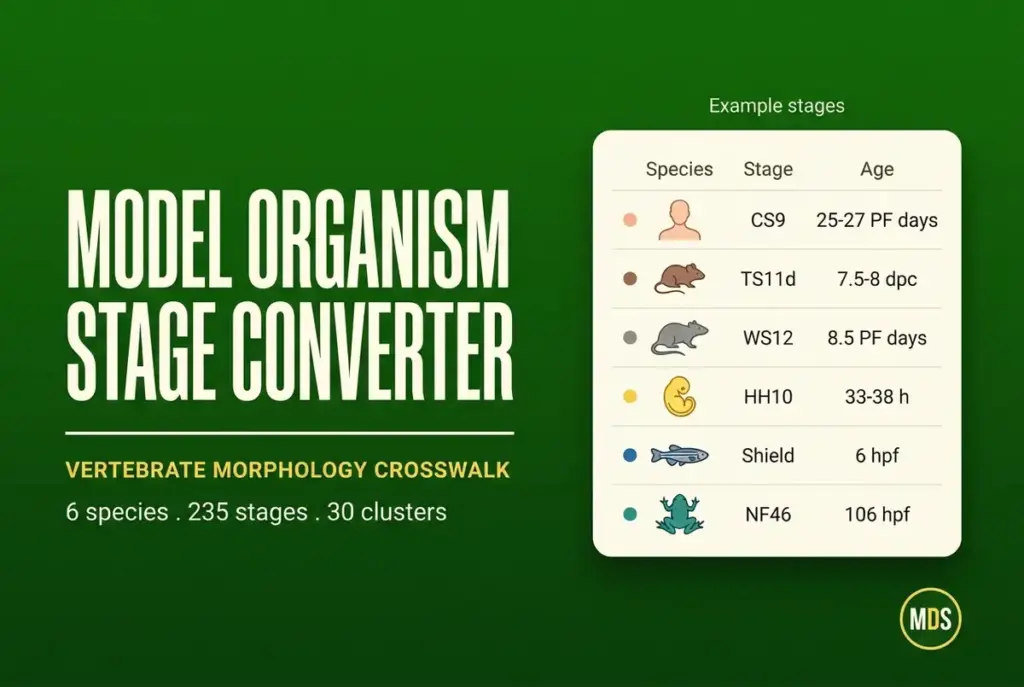
A model organism development stage converter compares embryonic stages across vertebrate model organisms using canonical staging systems and shared morphological landmarks. The BioExplorer tool covers human (Carnegie), mouse (Theiler), rat (Witschi), chick (Hamburger-Hamilton), zebrafish (Kimmel/ZFIN), and Xenopus (Nieuwkoop-Faber).
The tool supports three input modes: a stage-first mode that returns the closest stage in every other species, an age-first mode that handles boundary ages without arbitrary tie-breaking, and a landmark-first mode that returns the first stage in each species where a selected morphological event is observed.
The match is morphology-first, not age-scaled, and the tool returns the closest documented or curated stage in one or all other species with a confidence label and a citation to the underlying source.
Model Organism Development Stage Converter
Compare embryonic stages across human, mouse, rat, chick, zebrafish, and Xenopus using curated morphological landmarks and standard staging systems. No proportional scaling.
Input mode
Stage-first is the canonical mode. Age-first is supported with species-appropriate units and a boundary warning when the age falls between two stage ranges. Landmark-first (Mode C) returns the first stage in each species where the selected morphological event is observed.
Source
1 Source stage record
2 Cluster used & caveat
3 Six-species comparison
4 Caveat & temperature
5 Landmark comparison
Source citations (21 sources)
How to Use the Model Organism Development Stage Converter
- Pick a source species from the dropdown. The default is mouse (Theiler stages) because it is the most common research model.
- Choose an input mode. The Stage → Stages mode is the canonical morphology-first mode. The Age → Stage mode lets you enter a chronological age in the species-appropriate unit and shows a candidate list when the age falls at a boundary (no arbitrary tie-breaking). The Landmark → Stages mode returns the first stage in each species where a controlled vocabulary event is observed.
- Select a source stage from the species-specific dropdown, enter a chronological age in the Age mode (e.g. mouse 8.0 dpc, human 6 weeks GA, zebrafish 24 hpf), or pick a landmark in the Landmark mode (e.g. “Neural plate“, “First heartbeat”, “Hindlimb bud”).
- Optionally narrow the result with the focus-track filter (whole-embryo, neural, somite, cardiac, sensory, or limb) and the target-species checklist (uncheck species to exclude them from the result table).
- For chick, zebrafish, and Xenopus, the reference temperature (37.5C, 28.5C, and 23C respectively) is shown next to the temperature field. Leave it at the reference, or enter a custom temperature to see the no-correction warning.
- Click Convert to see the source record, the alignment cluster used, the six-species comparison table, the caveat panel, and the landmark comparison panel. The landmark comparison panel shows the per-species state of the anchor landmarks that support the cross-species match.
- If the Age mode returns multiple candidate stages, the tool shows a candidate list instead of auto-picking a winner. Click “Select this candidate” to see the cross-species comparison for that specific stage, or expand “View all candidate comparisons” to see every candidate in turn.
- Click Reset to defaults to return to mouse TS1 in Stage mode with all target species checked and no focus-track filter.
Why this tool exists: morphology, not age, defines a stage
A developmental stage is defined by what the embryo looks like, not by how long it has been developing. Two mouse embryos of the same Theiler stage can differ in age by half a day or more, and two embryos of the same dpc can be at different Theiler stages. Somite number, head fold elevation, heart looping, and other morphological landmarks define the stage. Chronological age, when given, is a rough estimate that varies with strain, temperature, husbandry, and individual development.
A crosswalk from one species to another is therefore not a percentage of gestation. CS9 in human is not 9 divided by 23 times 100 percent of human development, and it is not the equivalent fraction of mouse development. The shared evidence is the morphology: head fold present, neural folds elevated, somites beginning.
This tool builds that shared evidence into alignment clusters, and it returns the closest documented or curated stage in the other species, with a confidence label and the underlying source.
The six canonical staging systems
- Human — Carnegie stages (CS1-CS23). Coverage from fertilization through the end of the eighth post-fertilization week. Source: HDBR Atlas and O’Rahilly and Mueller 2010. Approximate post-fertilization age is given in PF days. The clinical gestational age is a dating convention (last menstrual period) and equals PF days plus 14.
- Mouse — Theiler stages (TS1-TS26). Coverage from fertilization through birth. Source: eMouseAtlas, EMAP, and UNSW Embryology. dpc is the canonical age unit (E0.5 equals morning of vaginal plug). Sub-stages TS11a-d and TS12a-b are preserved as separate records.
- Rat — Witschi stages (WS1-WS35). Coverage of prenatal development. Source: Witschi 1962 Rat Development chapter (reproduced on UNSW Embryology). Post-fertilization days are the canonical age unit. WS34 and WS35 are wide heterogeneous late-fetal stages.
- Chick — Hamburger-Hamilton stages (HH1-HH46). Coverage from embryonic shield (pre-streak) through hatching. Source: Hamburger and Hamilton 1951, GEISHA, and UNSW Embryology. Incubation hours at 37.5C are the canonical age unit. The Eyal-Giladi-Kochav pre-laying stages are out of scope for v1.
- Zebrafish — Kimmel/ZFIN named stages. Coverage from 1-cell through Pec-fin (about 60 hpf) at 28.5C reference. Source: Kimmel et al. 1995 and the ZFIN stage series. Stages are named (1-cell, Shield, Prim-5, High-pec, Long-pec, Pec-fin), not numbered. v1 does not apply a universal Q10 or degree-hour correction.
- Xenopus laevis — Nieuwkoop-Faber stages (NF1-NF66). Coverage from fertilized egg through froglet (end of metamorphosis) at 23C reference. Source: Nieuwkoop and Faber 1994, Xenbase alldev, and Zahn et al. 2022. Half-stages (NF6.5, NF8.5, NF10.5, NF11.5, NF12.5) and combined labels (NF29/30, NF37/38) are preserved. X. laevis timing is not interchangeable with X. tropicalis.
How cross-species matches are determined
The tool uses 30 alignment clusters that group stages across species by shared morphological landmarks. A cluster has a track (whole-embryo, neural, somite, sensory, cardiac, or limb), a list of event identifiers (zygote, neuralPlate, headFold, somites5to9, heartTube, forelimbBud, and others), an evidence type (direct-crosswalk, curated-morphology, or no-equivalent), a set of member stages, and a caveat.
Given a source stage, the tool finds all clusters that contain the source and returns the matching target stages for each other species, picking the best confidence per species.
The optional focus-track filter narrows the cluster lookup to one morphological track (whole-embryo, neural, somite, cardiac, sensory, or limb). The optional target-species checklist filters which species appear in the comparison table without affecting the cluster lookup itself.
The third input mode, Landmark → Stages (Mode C), does not use alignment clusters. It scans each species’ stage list for the first stage where the selected landmark is present (or in any non-absent state) and returns that stage as the species’ landmark anchor.
This is useful when the user knows a morphological feature but not the corresponding stage code. The result is the first stage in each species where the landmark is observed, with the species-appropriate age range and the canonical stage code.
- Direct-crosswalk means a single published source explicitly maps one species to another. The only such cluster in v1 is the UNSW Embryology mouse stages page, which states that Theiler stage 11 is equivalent to Carnegie stage 9 in human and Witschi stages 12-13 in rat.
- Curated-morphology means the match was assembled by comparing the separate staging-system tables, with the shared evidence being the same morphological event captured in each system’s terminology.
- No-equivalent identifies a species-specific event without a defensible whole-embryo crosswalk. Confidence describes certainty in the stage–event association and may be high, moderate, or low; it does not imply cross-species equivalence. The cluster lists the relevant species so the tool can show a per-species “no equivalent” cell rather than silently skipping the species.
What the confidence label means
- High: Direct published cross-species correspondence, or several specific morphological landmarks agree within a narrow target range.
- Moderate: Two or more conserved landmarks agree, no direct published crosswalk, and the target range is small.
- Low: Only a broad developmental phase agrees, the architectures are substantially different, or the target range is wide.
- Unavailable: No homologous landmark, the source is outside the target coverage, or the result would depend only on proportional age or stage number. The tool returns “no equivalent” rather than fabricating a match.
Reference temperatures and age conventions
For zebrafish and Xenopus, hpf is only meaningful at the reference temperature (28.5C and 23C respectively). The tool does not perform a temperature correction in v1. If a custom temperature is entered, the tool shows a warning and uses the reference table only, because a universal Q10 or degree-hour conversion would be misleading.
The hpf value in the data is the published reference value, and the user can decide whether the experimental temperature is close enough to the reference for the match to be informative.
For human, the data uses post-fertilization days. Clinical gestational age is a dating convention (last menstrual period) and equals PF days plus 14. A 6-week gestational age is 28 PF days, which is at the boundary of CS10 and CS11 in the Carnegie system. The tool returns both candidates with a boundary warning, because the stage cannot be determined from age alone at a boundary.
For chick, the data uses hours of incubation at 37.5C. The user can also enter days, which the tool converts to hours. Cooler or warmer incubation shifts the rate; the tool does not correct for that.
Worked examples
Example 1: Mouse TS11d, the direct crosswalk
Setup: Select mouse as the source species, then pick TS11d from the stage dropdown. The source record shows approximately 7.5 to 8 dpc, phase neurulation, landmarks late head fold and foregut invagination. Click Convert.
Results: The tool returns the six-species comparison with human CS9, rat WS12-13 (range), chick HH6, and Xenopus NF16. Zebrafish has no v1 crosswalk for this stage and shows “no equivalent”. The cluster used is cl-direct-mammalian-ts11-cs9-ws12-13 (the only direct-crosswalk in v1) plus cl-head-fold for the chick and Xenopus matches.
Both clusters have high confidence for the mammalian and chick matches, with Xenopus at moderate confidence because the morphology is more loosely conserved.
Example 2: Chick HH10, somites and primary brain vesicles
Setup: Switch the source species to chick, then pick HH10 from the stage dropdown. The source record shows 33 to 38 hours of incubation at 37.5C, 10 somites, 3 primary brain vesicles, optic vesicle present, heart field present.
Results: The tool uses cl-10-13-somites (somite track) as the primary cluster. The six-species comparison shows human CS10 (4-12 somites) as the overlapping Carnegie match, mouse TS13, rat WS15, zebrafish 10-13 somites (14-16.5 hpf at 28.5C), and Xenopus NF33.
Confidence is high for all five non-source species because the somite count is the conserved landmark and each staging system captures it directly. The Xenopus match comes from cl-heartbeat (cardiac track) which co-occurs at the same morphology as 10-13 somites; the algorithm picks the highest-confidence per-species member across all matching clusters.
Explore Vesicles, Types & Their 9 Major Functions
Example 3: Zebrafish 5-9 somites, named-stage lookup
Setup: Switch the source species to zebrafish, then pick “5-9 somites” from the named-stage dropdown. The source record shows 11.66 to 14 hpf at 28.5C reference, 5-9 somites, segmentation period.
Results: The tool uses cl-5-9-somites (somite track) as the primary cluster, with cl-optic-vesicle (sensory track) as a secondary cluster. The six-species comparison shows mouse TS12b, rat WS15, chick HH9 (7 somites) as the closest somite match, human CS11 (13-20 somites, with optic vesicle present) as the human match from the optic-vesicle cluster, and Xenopus NF19. CS9 (1-3 somites) is too low to match the 5-9 somite range and is NOT returned.
CS10 (4-12 somites) is not the best match because the algorithm picks the highest-confidence member across the matching clusters, and cl-optic-vesicle places the human match at CS11 (where the optic vesicle state matches the zebrafish 5-9 somites state at “emerging”).
Confidence is high for the mammalian and chick matches, with Xenopus at moderate because the optic-vesicle crosswalk is a more indirect morphological anchor than the somite count.
Example 4: Xenopus NF14, early neurula
Setup: Switch the source species to Xenopus, then pick NF14. The source record shows approximately 15.75 to 16.75 hpf at 23C reference, neural plate present, neural folds early.
Results: The tool uses cl-neural-plate (neural track). The six-species comparison shows mouse TS11b, human CS8, rat WS13, chick HH5, and zebrafish Bud. Confidence is high for the mammalian and chick matches, with zebrafish at moderate because the zebrafish gastrulation is faster and the named-stage series does not split the early neurulation as finely as the other systems.
The best per-species pick is the single most specific match in the cluster (TS11b, CS8, WS13, HH5) rather than a range.
Example 5: Human CS23, end of Carnegie coverage
Setup: Switch the source species to human, then pick CS23. The source record shows 53 to 58 PF days, fetal-transition phase, separated digits present, CRL 23 to 32 mm. This is the final Carnegie embryonic stage.
Results: The tool prioritizes cl-separated-digits (curated-morphology, limb track) because the algorithm picks the highest-confidence per-species match across all clusters containing the source. The six-species comparison shows mouse TS22, rat WS35, chick HH30, and Xenopus NF55, all at high or moderate confidence from the separated-digits cluster.
The cluster list also includes cl-end-of-embryonic (no-equivalent evidence) which would map CS23 to mouse TS26, rat WS35, and chick HH46, but those are different biological events (mouse TS26 is birth, rat WS35 is a wide late-fetal stage, chick HH46 is hatching) so the algorithm correctly prefers the more specific morphological match from cl-separated-digits. Zebrafish is not in either cluster and shows “no equivalent”.
Example 6: Xenopus NF66, the froglet, has no Carnegie equivalent
Setup: Switch the source species to Xenopus, then pick NF66. The source record shows approximately 58 days, froglet, end of metamorphosis with fully resorbed tail. NF66 is the END of metamorphosis, not a post-froglet stage.
Results: The tool uses cl-metamorphosis (no-equivalent). Human has no v1 crosswalk within the Carnegie-stage range because CS23 is end-of-embryonic and NF66 is end-of-metamorphosis, a different biological event. The result correctly returns “no reliable equivalent within Carnegie-stage range” rather than fabricating a match. The other species are similarly species-specific in this window.
Example 7: Human 6 weeks GA, boundary age
Setup: Switch to Age mode, pick human, enter 6 in the age field, and the unit is set to gestational-weeks. Click Convert.
Results: The tool converts 6 weeks to 28 PF days (7 times 6 minus 14). The age falls at the boundary of CS10 (28-30 PF days) and CS11 (28-30 PF days). The tool returns CS10 and CS11 as candidates but does not build a cross-species comparison until the user explicitly selects one. This avoids arbitrary tie-breaking.
Example 8: Zebrafish 12 hpf at 25C, no temperature correction
Setup: Switch the source species to zebrafish, enter 12 in the age field, set unit to hpf, and change the temperature field from 28.5 to 25. Click Convert.
Results: The tool matches 12 hpf against the 28.5C reference table and returns the corresponding stage (approximately 5-9 somites at 11.66 hpf). The caveat panel shows a warning that zebrafish development at 25C is slower than at 28.5C and that v1 does not perform temperature correction. The user is informed that the match is approximate at 25C and that a temperature-corrected table is required for an accurate stage at 25C.
Developmental heterochrony and why this matters
Different organs develop at different rates within a single embryo, and the relative timing of organ development varies between species. This is called heterochrony. A mouse at Theiler stage 14 can be at a different human Carnegie stage for the limb buds than for the heart, and the same is true for any cross-species comparison.
The 30 alignment clusters in v1 capture the major heterochrony through the track field (whole-embryo, neural, somite, cardiac, sensory, limb). The cluster that best matches the source is the one whose track is closest to the user’s question. If the user asks about limb development, the limb-track clusters are the right ones to consult; the whole-embryo clusters are too coarse to answer limb-specific questions.
Appendicular mappings (limb, fin, wing) deserve extra caution. Fins, wings, and tetrapod limbs are not interchangeable whole-organism clocks. The forelimb bud appears at a different relative time in the Xenopus series (NF48, concealed under the operculum until NF54) than in the mouse (TS15) or chick (HH15).
The tool returns these matches with explicit confidence and a caveat rather than hiding the heterochrony.
Why the tool does not chain conversions or use proportional scaling
A conversion A to B to C would require that the A-B match and the B-C match are independently defensible and that the A-C match is consistent with both. In practice, the A-B match uses landmarks that the B-C match may not preserve, and the A-C result would be a compound estimate whose error is hard to bound. The tool instead looks up every target independently from the original source. Each result is anchored to the source’s morphology, not to another target’s result.
Proportional scaling (mouse TS14 is half of prenatal development, so it is the equivalent of CS14 in human) is rejected for the same reason: events are not uniformly distributed across development. The cluster structure in v1 is the explicit alternative, with each cluster named for the morphological anchor that supports the cross-species match.
Related Resources
- Biology tools directory for more interactive calculators across genetics, ecology, cell biology, and other branches.
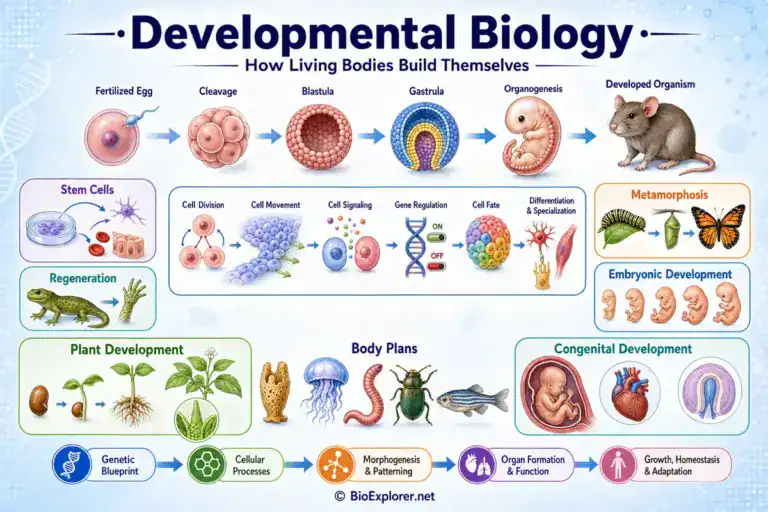
- Divisions of biology index for the branch of biology that studies how organisms grow from a single cell to a complex body plan (developmental biology).

References
- O’Rahilly R. and Mueller F. (2010). Developmental Stages in Human Embryos: Revised and New Measurements. Cells Tissues Organs 192:73-84. The 2010 Cells Tissues Organs paper that supplies the revised post-fertilization age ranges used for the human (CS1-CS23) records in this tool. (The 1987 Carnegie monograph and the 2001 third-edition textbook are separate publications and are not the source of the v0.5 age ranges.)
- Human Developmental Biology Resource. Carnegie staging criteria. The HDBR Atlas staging page used for the Carnegie stage definitions.
- UNSW Embryology. Carnegie stages. The secondary staging reference for human.
- eMouseAtlas. Theiler stage definition. The reference for the mouse (TS1-TS26) records in this tool.
- UNSW Embryology. Mouse stages. The page that states “Theiler Stage 11 … Equivalent Witschi Stage in rat = 12-13, Equivalent Carnegie Stage in humans = 9” and is the source of the only direct-crosswalk cluster in v1.
- EMAP Theiler. eMouseAtlas Theiler model summary. The reference for somite-counted mouse staging between TS12 and TS20.
- Witschi E. (1962). Development: Rat. In: Altman PL, Dittmer DS, eds. Growth Including Reproduction and Morphological Development. Federation of American Societies for Experimental Biology, pp. 304-314. Reproduced on UNSW Embryology Rat Timeline. The reference for the rat (WS1-WS35) records in this tool.
- Hamburger V. and Hamilton H. L. (1951). A series of normal stages in the development of the chick embryo. Journal of Morphology 88:49-92. The reference for the chick (HH1-HH46) records in this tool.
- GEISHA. GEISHA chick stage browser. The in-situ hybridization database for chick embryos with stage-based queries.
- UNSW Embryology. Hamburger-Hamilton stages. The secondary staging reference for chick.
- Kimmel C. B., Ballard W. W., Kimmel S. R., Ullmann B. and Schilling T. F. (1995). Stages of embryonic development of the zebrafish. Developmental Dynamics 203:253-310. The reference for the zebrafish named-stage records in this tool.
- ZFIN. Zebrafish stages. The ZFIN stage series with hpf-at-28.5C reference values.
- ZFIN. ZFIN staging publication record. The ZFIN publication record for the staging introduction.
- Nieuwkoop P. D. and Faber J. (1994). Normal Table of Xenopus laevis (Daudin). Garland Publishing. The reference for the Xenopus laevis (NF1-NF66) records in this tool.
- Xenbase. Xenbase alldev timepoint series. The Xenbase staging table with hpf-at-23C reference values.
- Xenbase. Xenbase N&F landmarks table. The Xenbase reference for the N&F landmark state mappings (hindlimb bud, forelimb bud, hand-foot plate, digit rays).
- Zahn N., James-Zorn C., Ponferrada V. G., et al. (2022). Normal Table of Xenopus development: a new graphical resource. Development 149:dev200356. The modern reference that places NF66 at the froglet (end of metamorphosis) and provides the 23C reference for Xenopus timing. PMCID PMC9445888.
- Werneburg I. (2009). A standard system to study vertebrate embryos. PLOS ONE 4:e5887. The Standard Event System for vertebrate embryos used as the cross-species morphological vocabulary.
- Bgee. Bgee data curation. The Bgee multi-species gene expression database with curated stage annotations across vertebrates.
- Theiler K. (1989). The House Mouse: Atlas of Embryonic Development. Springer-Verlag. The original Theiler staging reference.
- eMouseAtlas. Theiler staging table (current canonical PDF). The tabular reference for Theiler stages with dpc ranges and morphological criteria.
Frequently Asked Questions
Morphology-first stage conversion means a cross-species match is based on shared morphological landmarks (neural plate, somite count, heart looping, and others) rather than on the chronological age or stage number. Simple proportional scaling would map CS9 in human to approximately TS10 in mouse, but this would still be biologically misleading because developmental events are not uniformly distributed across either staging system.
The tool instead uses 30 alignment clusters that group stages by shared morphology, and the only direct-crosswalk in v1 is the UNSW Embryology-cited mouse TS11d, human CS9, rat WS12-13 mapping. The morphology-first approach is consistent with how the canonical staging systems were defined: by what the embryo looks like, not by how long it has been developing.
The tool covers six vertebrate model organisms: human (Carnegie stages CS1-CS23), mouse (Theiler stages TS1-TS26 plus the TS11a-d and TS12a-b substages), rat (Witschi stages WS1-WS35), chick (Hamburger-Hamilton stages HH1-HH46), zebrafish (Kimmel/ZFIN named stages from 1-cell through Pec-fin), and Xenopus laevis (Nieuwkoop-Faber stages NF1-NF66 plus the half-stages and combined labels).
Drosophila and C. elegans are excluded because they are invertebrates and the six selected systems describe vertebrate development. Direct whole-embryo equivalence between an insect and a vertebrate would not be defensible. Each invertebrate has its own staging system (BDGP for Drosophila, Sulston for C. elegans) and could be the basis for a separate invertebrate stage converter in a future version.
Select mouse as the source species, pick TS11d from the stage dropdown, and click Convert. The tool returns the six-species comparison with the cl-direct-mammalian-ts11-cs9-ws12-13 cluster for the mammalian matches (human CS9 high confidence, rat WS12-13 range high confidence) and the cl-head-fold cluster for the chick HH6 and Xenopus NF16 matches.
Zebrafish has no v1 crosswalk for TS11d in the matching clusters and shows no equivalent. The cluster used is labelled direct-crosswalk only for the mammalian matches because only those have a single published source that explicitly maps one species to another. The chick and Xenopus matches are curated-morphology, which means the match was assembled by comparing the separate staging-system tables rather than from a single source.
Evidence type and confidence are separate fields. Direct-crosswalk describes an explicit published mapping, while curated-morphology describes a comparison assembled from canonical staging tables. Curated matches may have high, moderate, or low confidence. A direct-crosswalk cluster has a single published source that explicitly maps one species to another.
The only such cluster in v1 is cl-direct-mammalian-ts11-cs9-ws12-13, anchored on the UNSW Embryology mouse stages page that states Theiler stage 11 is equivalent to Carnegie stage 9 in human and Witschi stages 12-13 in rat. A curated-morphology cluster was assembled by comparing the separate staging-system tables: the shared evidence is the same morphological event (neural plate, somite count, heart looping, and so on) captured in each system’s terminology, but no single publication maps all the species. Direct-crosswalk is the strongest possible evidence in v1 and is reserved for the clusters that actually have such a single source.
Zebrafish and Xenopus development rate depend on temperature, and the published stage tables are anchored on a reference temperature (28.5C for zebrafish, 23C for Xenopus). The tool uses the reference table only and does not perform a universal Q10 or degree-hour correction because the rate-temperature relationship is not a single constant across the embryonic period, and applying a generic correction would mislead more than inform.
If a custom temperature is entered, the tool shows a warning that the match is against the reference table and that the user should consult a temperature-corrected table for an accurate stage at the experimental temperature. A v2 with a per-stage temperature correction is a possible expansion, but the brief explicitly prohibits automatic correction in v1.
A boundary age is one that falls within the published age range of two or more stages because the ranges overlap. The tool returns all candidate stages with a boundary warning and does not apply an arbitrary tie-break. For mouse 8.0 dpc, the tool returns the seven overlapping ranges (TS11a, TS11b, TS11c, TS11d, TS12a, TS12b, and the start of TS13) with a boundary warning.
Mouse TS17 is at 10 to 11.25 dpc, so 8.0 dpc is well below the TS17 range; the candidate set is governed by the canonical stage age windows, not by a single arbitrary pick. Boundary handling is part of the age-first mode and is not used in the stage-first mode where the user picks a specific stage. The brief explicitly prohibits fractional stage interpolation; the tool never invents a stage between two canonical stages.
End of embryonic period is different for each species: human CS23 is the transition from embryo to fetus, mouse TS26 is birth (postnatal day 0), rat WS35 is a wide late-fetal stage, chick HH46 is hatching, Xenopus NF66 is the froglet (end of metamorphosis), and zebrafish has a separate hatching-to-larval transition. These are different biological events and the cl-end-of-embryonic cluster in v1 is labelled no-equivalent precisely to mark this asymmetry.
The cl-end-of-embryonic members are marked low confidence. Metamorphosis and hatching are also labelled no-equivalent, although their stage–event confidence may be high or moderate. No-equivalent refers to the absence of a defensible cross-species equivalence, not uncertainty that the event occurs. Returning a single end-of-embryonic match would be misleading; the tool is honest about the species-specific differences.
Each stage record lists the source IDs that support it, and the tool surfaces the citations panel below the comparison table. The 21 sources include the canonical references: O’Rahilly and Mueller 2010 for human Carnegie stages, the eMouseAtlas Theiler stage definition and UNSW Embryology mouse stages for mouse, the Witschi 1962 Rat Development chapter for rat, the Hamburger and Hamilton 1951 paper and the GEISHA stage browser for chick, the Kimmel 1995 paper and the ZFIN stage series for zebrafish, and the Nieuwkoop and Faber 1994 reference plus the Xenbase alldev and landmarks tables plus Zahn et al. 2022 for Xenopus.
Each URL points to the specific page, table, or paper, not to a homepage or aggregator. The Werneburg 2009 Standard Event System and the Bgee curation calls are included as the cross-species vocabulary and the multi-species gene expression reference.
The Landmark → Stages mode (Mode C) lets the user pick a developmental landmark from a controlled vocabulary (neural plate, first somite, optic vesicle, first heartbeat, forelimb bud, digit rays, and so on) and returns the first stage in each species where that landmark is observed.
This is useful when the user knows a morphological feature is happening but does not know the corresponding stage code in any given staging system. The result is a six-row table showing the canonical stage and age range where each species first reaches the landmark.
The vocabulary is grouped by category (early development, gastrulation, axis and nervous system, segmentation, sensory and craniofacial, cardiovascular, appendicular, late events) and the dropdown shows the category as a hint.
The target-species checklist below the input panel lets the user uncheck any species they do not want to see in the comparison table. By default all six species are checked. The unchecking is a display filter: it does not affect the cluster lookup, only which rows appear in the result table. The ‘All species’ button re-checks every species at once.
This is convenient when, for example, the user only wants to compare mammals and can uncheck chick, zebrafish, and Xenopus to see a three-row table.
The focus track dropdown filters the alignment cluster lookup to a single morphological track (whole-embryo, neural, somite, cardiac, sensory, or limb). The default ‘All tracks’ uses every cluster regardless of track. When a specific track is selected, the cross-species conversion only considers clusters whose track field matches.
This is useful for organ-specific questions. For example, setting the focus to ‘limb’ will use the limb-track clusters (cl-forelimb-bud, cl-hindlimb-bud, cl-hand-foot-plate, cl-digit-rays, cl-separated-digits) instead of the broader whole-embryo clusters. The result is a limb-specific crosswalk that may differ from the whole-embryo crosswalk because of heterochrony.
A boundary age is one that falls within the published age range of two or more stages because the ranges overlap. The tool returns all candidate stages with a boundary warning and does not apply an arbitrary tie-break.
For mouse 8.0 dpc, the tool returns the seven overlapping ranges (TS11a, TS11b, TS11c, TS11d, TS12a, TS12b, and the start of TS13) with a boundary warning. The user picks a candidate from the list, and the tool then builds the cross-species conversion for that specific stage. The user can also expand ‘view all candidate comparisons’ to see every candidate in turn. This is consistent with the brief’s prohibition on fractional stage interpolation and on silently picking a winner at a boundary.
The Model Organism Development Stage Converter is a free tool for developmental biology students, teachers, and researchers. The tool converts stages across six vertebrate model organisms (human, mouse, rat, chick, zebrafish, and Xenopus laevis) using 30 morphology-based alignment clusters. The tool supports three input modes: a Stage-first mode that is the canonical morphology-first mode, an Age-first mode that supports species-appropriate units with a candidate list when the age falls at a boundary (no arbitrary tie-breaking), and a Landmark-first mode that returns the first stage in each species where a controlled vocabulary event is observed. An optional focus-track filter narrows the cluster lookup to a single morphological track, and an optional target-species checklist filters the comparison table. The tool runs entirely in the browser, requires no signup, and ships with 21 source citations to the canonical staging references.
The underlying database contains 235 stage records across the six species. The cross-species equivalence is encoded in 30 alignment clusters rather than by proportional scaling or percentage-of-gestation conversion. The tool does not perform automatic temperature correction and does not chain conversions. The brief explicitly prohibits these in v1. v2 candidates include Drosophila and C. elegans staging, a per-stage temperature correction mode, and finer-grain tracking of cranial versus caudal neural tube closure.
Cite this page
BioExplorer. (2026, September 30). Model Organism Development Stage Converter. https://www.bioexplorer.net/model-organism-development-stage-converter/