
Environmental Biology and the Living World
Environmental Biology is the sub-division of biology that studies how living organisms respond to environmental conditions, environmental change, and human impact. It connects biology with pollution, climate stress, habitat loss, conservation, restoration, toxic chemicals, land use, water quality, soil health, air quality, invasive species, and ecosystem monitoring.
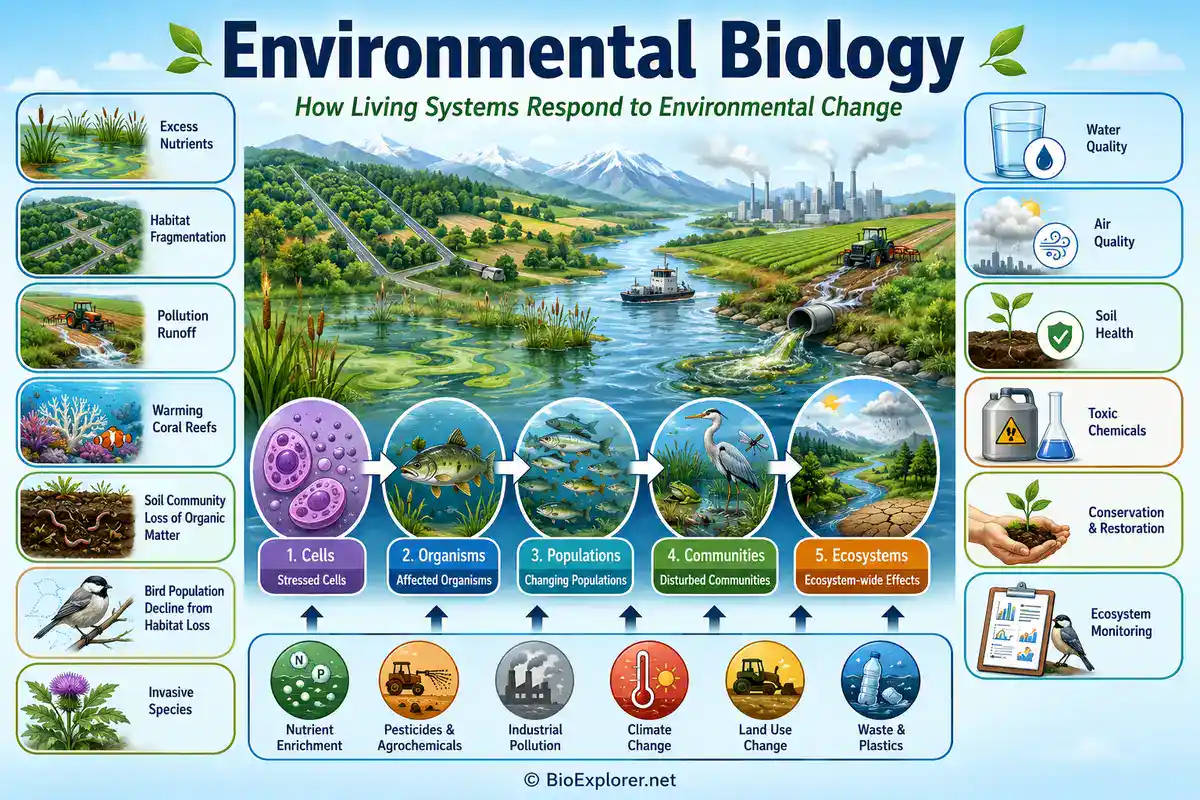
This field asks what happens after the environment changes. A wetland receives excess nutrients. A forest is divided by roads. A river carries pesticides. A coral reef warms. A soil community loses organic matter. A bird population declines after nesting habitat disappears. Environmental biology traces those changes through cells, organisms, populations, communities, and whole ecosystems.
Environmental Biology Guide:
- The Environment Becomes Biology When Something Responds
- Ecology vs Environmental Biology
- The Stressor-to-Response Chain
- Environmental Pressures and Biological Responses
- Bioindicators: Living Warning Signals
- Pollution Is a Biological Problem When It Moves Through Life
- Habitat Loss Changes the Rules of Survival
- Climate Change Acts Like a Biological Filter
- Environmental Biology Across Levels of Life
- Environmental Monitoring: Repeated Measurement Beats a One-Time Snapshot
- Restoration Is a Biological Test, Not Just a Planting Project
- History of Environmental Biology: Key Turning Points
- Environmental Biology Careers
- Related BioExplorer Resources
- Recommended Environmental Biology Resources
- Environmental Biology FAQs
The Environment Becomes Biology When Something Responds
Environmental biology begins when a living system reacts to its surroundings. The change may be obvious, such as fish dying after oxygen levels fall. It may be hidden, such as gene expression changing after chemical exposure. It may be slow, such as a forest losing species after decades of fragmentation.
The field is built around response. Does the organism tolerate the stress? Does it move, adapt, reproduce less, become sick, or die? Does the population shrink? Does the community change? Does the ecosystem lose a function such as pollination, water filtration, carbon storage, or nutrient cycling?
That response-based view keeps environmental biology distinct from a general environmental awareness page. The focus is not scenery. The focus is biological consequence.
Ecology vs Environmental Biology
Ecology and environmental biology overlap, but they are not the same page written with different labels. Ecology explains relationships among organisms and their surroundings. Environmental biology uses those relationships to understand how living systems respond when environmental conditions are altered, damaged, restored, or managed.
| Point of Difference | Ecology | Environmental Biology |
|---|---|---|
| Core Question | How do organisms interact with each other and with their environment? | How do organisms and ecosystems respond to environmental change, stress, and human impact? |
| Main Center of Gravity | Population, community, ecosystem, food web, niche, succession, biodiversity, energy flow. | Pollution, habitat loss, climate stress, conservation, restoration, toxic exposure, monitoring, and environmental risk. |
| Human Impact | Can be studied, but ecology also studies natural systems without human disturbance. | Usually central, especially land use, contamination, climate change, waste, agriculture, urbanization, and resource use. |
| Typical Example | How predators affect prey populations in a grassland. | How pesticide runoff affects aquatic insects, fish, amphibians, and water quality. |
| Scale of Study | Individuals, populations, communities, ecosystems, landscapes, biosphere. | Cells, organisms, populations, ecosystems, watersheds, cities, farms, forests, coasts, and polluted sites. |
| Common Tools | Field surveys, population models, food-web analysis, species interaction studies. | Bioindicators, toxicity tests, environmental monitoring, GIS, exposure assessment, restoration tracking, and risk assessment. |
| Applied Use | Conservation planning, wildlife management, habitat studies, ecosystem theory. | Pollution control, environmental health, conservation action, restoration, impact assessment, and sustainability decisions. |
| Best BioExplorer Angle | Explain natural relationships and ecosystem structure. | Explain biological effects of environmental pressure and how scientists measure, reduce, or repair damage. |
The Stressor-to-Response Chain
Environmental biology often follows a chain. Something changes in the environment, living systems are exposed, and a biological response appears. This chain helps scientists avoid vague statements such as "pollution is bad" and ask better biological questions.
- Source: Where does the pressure begin? Examples include farms, roads, factories, cities, mines, wastewater, wildfires, or land clearing.
- Stressor: What actually affects living systems? Examples include heat, sediment, nutrients, pesticides, metals, salt, noise, plastics, pathogens, or habitat removal.
- Exposure: Which organisms contact it, at what dose, for how long, and by which route?
- Response: What changes in cells, organisms, populations, communities, or ecosystem functions?
- Recovery or decline: Does the system adapt, move, recover, reorganize, or collapse into a less healthy state?
This chain is one reason environmental biology is highly practical. It links a cause to a measurable biological effect, then helps guide prevention, monitoring, restoration, or policy decisions.
Environmental Pressures and Biological Responses
Environmental pressures rarely affect only one species. A single pressure can alter body condition, reproduction, behavior, survival, food webs, microbial activity, and ecosystem processes at the same time.
| Environmental Pressure | Biological Response to Watch | Example |
|---|---|---|
| Nutrient Pollution | Algal growth, oxygen loss, fish stress, microbial shifts. | Excess nitrogen or phosphorus can fuel algal blooms and reduce dissolved oxygen. |
| Pesticides | Reduced survival, impaired reproduction, behavior change, non-target toxicity. | Aquatic insects, pollinators, amphibians, and fish may be affected depending on exposure. |
| Heavy Metals | Bioaccumulation, tissue damage, nervous system effects, reproductive problems. | Mercury can move through aquatic food webs and concentrate in predators. |
| Habitat Fragmentation | Smaller populations, reduced gene flow, edge effects, altered movement. | Roads and farms can divide forest habitat into isolated patches. |
| Climate Warming | Range shifts, heat stress, phenology mismatch, coral bleaching. | Species may shift poleward, uphill, or into deeper water when conditions change. |
| Invasive Species | Competition, predation, disease spread, community replacement. | Introduced species can displace native species or alter ecosystem function. |
| Plastic Pollution | Ingestion, entanglement, chemical transport, habitat contamination. | Marine birds, turtles, fish, and invertebrates can ingest plastic fragments. |
| Soil Degradation | Loss of microbes, lower fertility, erosion, reduced plant growth. | Compacted or eroded soil can support fewer roots, fungi, and invertebrates. |
| Noise and Light Pollution | Changed behavior, disrupted communication, altered navigation or timing. | Artificial night light can affect insects, birds, turtles, and plant-animal interactions. |
Bioindicators: Living Warning Signals
A bioindicator is an organism, community, or biological measurement that reveals environmental condition. Bioindicators are valuable because living systems integrate many stressors at once. A water sample may show one chemical value, but a stream insect community can reveal longer-term water quality, habitat quality, oxygen conditions, and disturbance.
Lichens can indicate air quality because they absorb substances directly from the atmosphere. Aquatic insects can indicate stream health. Amphibians can signal wetland stress because their skin, eggs, and life cycles expose them to water and land conditions. Microbial communities can reveal soil condition, decomposition, nutrient cycling, and contamination.
The strength of bioindicators is also their challenge. A change in a species or community may reflect more than one cause. Environmental biologists must combine biological observations with chemistry, habitat measurements, timing, location, and repeated sampling.
Pollution Is a Biological Problem When It Moves Through Life
Pollution becomes a biological issue when it reaches organisms. A chemical released into soil may bind to particles, dissolve into water, enter roots, move into insects, reach fish, or accumulate in predators. The same pollutant can behave differently depending on pH, temperature, oxygen, sunlight, sediment, microbes, and food webs.
Environmental biology studies exposure routes such as breathing, eating, drinking, skin contact, root uptake, gill uptake, egg exposure, and transfer through food chains. It also studies biological effects such as DNA damage, endocrine disruption, immune stress, developmental problems, reproductive failure, behavior change, and population decline.
This is where environmental biology overlaps with toxicology, pathology, physiology, microbiology, and food-web science.
Habitat Loss Changes the Rules of Survival
Habitat loss removes the places organisms need to feed, shelter, reproduce, migrate, or complete life cycles. Habitat fragmentation leaves habitat behind, but divides it into smaller and more isolated patches. That can make populations more vulnerable even when some habitat remains.
Fragmented habitats often have more edges. Edges can change light, temperature, wind, humidity, predation, invasive species pressure, and human disturbance. For some species, edges create opportunities. For others, edges reduce nesting success, movement, survival, or genetic exchange.
Climate Change Acts Like a Biological Filter
Climate change does not affect every organism in the same way. It filters species by heat tolerance, water needs, dispersal ability, food dependence, reproductive timing, disease exposure, and habitat availability. Species that can move, tolerate stress, or adjust timing may persist. Species with narrow ranges, specialized diets, limited movement, or sensitive life stages may face greater risk.
Environmental biologists study range shifts, heat stress, drought response, coral bleaching, flowering time, breeding time, migration timing, pest outbreaks, disease vectors, and food-web mismatch. A small timing shift can matter when one species depends on another. For example, a plant may flower earlier, but its pollinator may not emerge at the same time.
The biological question is not only whether the climate is warmer. The biological question is which organisms can keep functioning when temperature, water, seasons, disturbance, and species interactions change together.
Environmental Biology Across Levels of Life
Environmental biology is useful because it does not stop at one level. A pollutant may first change enzymes inside cells, then reduce growth in organisms, then alter survival in populations, then change food-web structure.
| Level of Life | What Environmental Biologists Measure | Example Question |
|---|---|---|
| Molecules and Genes | DNA damage, gene expression, stress proteins, biomarkers. | Does chemical exposure activate stress-response genes? |
| Cells and Tissues | Cell injury, inflammation, enzyme activity, tissue damage. | Does a pollutant harm gills, liver tissue, roots, or embryos? |
| Organisms | Growth, behavior, reproduction, survival, disease resistance. | Does exposure reduce feeding, movement, fertility, or survival? |
| Populations | Abundance, birth rate, death rate, age structure, genetic diversity. | Is a population declining after habitat change? |
| Communities | Species composition, richness, dominance, food-web relationships. | Are sensitive species disappearing while tolerant species increase? |
| Ecosystems | Nutrient cycling, productivity, decomposition, carbon storage, water filtration. | Is ecosystem function weakening after disturbance? |
| Landscapes | Connectivity, fragmentation, corridors, land-use patterns. | Can organisms move between suitable habitats? |
Environmental Monitoring: Repeated Measurement Beats a One-Time Snapshot
Environmental biology depends on repeated measurement because living systems change through seasons, life stages, storms, droughts, heat waves, land-use changes, and recovery periods. A single sample can miss the pattern.
- Water monitoring: Tracks dissolved oxygen, nutrients, pH, temperature, turbidity, salinity, microbes, algae, and aquatic life.
- Soil monitoring: Measures organic matter, nutrients, pH, compaction, contamination, erosion risk, microbes, fungi, and invertebrates.
- Air-related monitoring: Studies effects of smoke, ozone, particulates, nitrogen deposition, and airborne contaminants on organisms.
- Wildlife surveys: Track abundance, reproduction, movement, disease, survival, and habitat use.
- Vegetation surveys: Measure plant cover, native species, invasive species, regeneration, drought stress, and habitat structure.
- Remote sensing: Uses satellite or drone data to detect land cover, vegetation change, fire scars, algal blooms, and habitat loss.
- Environmental DNA: Detects genetic traces left by organisms in water, soil, or sediment.
- Long-term datasets: Reveal trends that short studies cannot detect.
Restoration Is a Biological Test, Not Just a Planting Project
Environmental restoration aims to improve damaged ecosystems, but planting trees or removing pollution is only part of the story. The real test is whether biological function returns.
In a restored wetland, scientists may ask whether native plants survive, amphibians breed, water quality improves, soil carbon increases, invasive species decline, pollinators return, and nutrient cycling stabilizes. In a restored stream, they may monitor flow, shade, temperature, dissolved oxygen, insects, fish, sediment, and riparian vegetation.
Successful restoration requires biology, not cosmetics. A green site is not automatically a functioning ecosystem.
History of Environmental Biology: Key Turning Points
Environmental biology grew from natural history, ecology, toxicology, public health, conservation, and environmental monitoring. The turning points below shaped the way scientists connect living systems with environmental stress and human action.
| Year | Milestone | Why It Matters |
|---|---|---|
| 1866 | Ernst Haeckel coined the term ecology. | Gave biology a formal language for studying relationships between organisms and their environment. |
| 1935 | Arthur Tansley introduced the ecosystem concept. | Helped scientists treat organisms and the physical environment as one interacting system. |
| 1962 | Rachel Carson published Silent Spring. | Helped bring pesticide effects, food webs, wildlife, and chemical exposure into public environmental awareness. |
| 1970 | The U.S. Environmental Protection Agency began operating after rising concern about air, water, pesticides, and environmental damage. | Marked a major institutional shift toward environmental monitoring, regulation, and applied environmental science. |
| 1972 | The Stockholm Conference placed environmental issues at the center of international discussion and led to the creation of UNEP. | Helped globalize environmental assessment, pollution control, and environmental governance. |
| 1987 | The Montreal Protocol was signed to phase out ozone-depleting substances. | Showed that environmental science, atmospheric chemistry, biology, and policy could reduce a global environmental threat. |
| 1992 | The Convention on Biological Diversity was signed at the Rio Earth Summit. | Made biodiversity conservation, sustainable use, and genetic resources central to international environmental action. |
| 2005 | The Millennium Ecosystem Assessment linked ecosystem change with human well-being and ecosystem services. | Strengthened the idea that biological systems support water, food, health, climate regulation, and livelihoods. |
Environmental Biology Careers
Environmental biology careers often begin with a place under pressure: a stream, farm, forest, wetland, city, coast, mine site, contaminated soil, restored prairie, protected area, or wildlife corridor. The work may involve field sampling, lab testing, data analysis, restoration planning, conservation, public health, or environmental risk assessment.
- Environmental biologist: Studies how organisms and ecosystems respond to environmental change.
- Conservation biologist: Works to protect species, habitats, biodiversity, and ecological processes.
- Ecotoxicologist: Studies how chemicals affect organisms, populations, and ecosystems.
- Restoration biologist: Helps repair degraded habitats and tracks biological recovery.
- Wildlife biologist: Studies animal populations, habitat needs, movement, reproduction, and survival.
- Water quality biologist: Monitors aquatic organisms, nutrients, oxygen, algae, microbes, and contaminants.
- Soil biologist: Studies soil organisms, decomposition, nutrient cycling, contamination, and soil health.
- Environmental microbiologist: Studies microbes in water, soil, waste, pollution, disease, and bioremediation.
- Environmental impact specialist: Assesses how projects may affect habitats, species, and ecosystem function.
- GIS and remote sensing analyst: Maps land cover, habitat change, fragmentation, fire, vegetation, and environmental risk.
Related BioExplorer Resources
Use these BioExplorer pages to connect environmental biology with organisms, ecosystems, biodiversity, environmental stress, and biological response:
- Ecology
- Botany
- Zoology
- Marine Biology
- Microbiology
- Physiology
- Genetics
- Evolutionary Biology
- Biotechnology
- Pathology
- Parasitology
- Biochemistry
- Cell Biology
- Threats to Biodiversity
- Biological Weathering
Recommended Environmental Biology Resources
These external resources are useful for learning about environmental biology, ecological risk, environmental health, biodiversity loss, pollution, ecosystem services, conservation, and environmental monitoring.
- EPA: Ecological Risk Assessment A strong resource on environmental stressors, exposure, effects, and ecological risk.
- NIEHS: Environmental Health Sciences Core Centers A useful resource on how environmental exposures interact with biology, genetics, and disease.
- UNEP: Global Environment Outlook 6 A major global report on environmental trends, planetary health, and sustainable development.
- IPBES Global Assessment A major assessment of biodiversity, ecosystem services, and drivers of biodiversity loss.
- Convention on Biological Diversity An official resource on biodiversity conservation, sustainable use, and genetic resources.
- UNEP Ozone Secretariat: Montreal Protocol A major example of global action on an environmental threat.
- EPA: The Origins of EPA Historical context for modern environmental protection and monitoring in the United States.
- Millennium Ecosystem Assessment A landmark assessment linking ecosystem change with human well-being.
- IUCN Red List A global resource for species conservation status and extinction risk.
- Global Biodiversity Information Facility A major biodiversity data platform for species occurrence records.
- WWF Conservation Science A public-facing resource on conservation, biodiversity, and environmental threats.
- Nature Education: Ecology A helpful resource for the ecological concepts that environmental biology applies.
Environmental Biology FAQs
Environmental biology is the branch of biology that studies how organisms and ecosystems respond to environmental conditions, environmental change, pollution, habitat loss, climate stress, and human impact.
No. Ecology studies relationships among organisms and their environment. Environmental biology is broader and more applied, focusing on biological responses to environmental change, pollution, conservation problems, and human impact.
Environmental biologists study pollution, habitat loss, climate change, invasive species, water quality, soil health, air pollution, bioindicators, conservation, restoration, biodiversity, and environmental risk.
A bioindicator is an organism, community, or biological measurement that helps reveal environmental condition. Examples include lichens for air quality and aquatic insects for stream health.
Pollution can affect organisms by causing toxicity, DNA damage, hormone disruption, immune stress, reduced growth, behavior changes, reproductive problems, disease vulnerability, and population decline.
Habitat fragmentation divides larger habitats into smaller isolated patches. It can reduce movement, gene flow, nesting success, survival, and population stability for sensitive species.
Environmental biology is important because it helps scientists understand, monitor, reduce, and repair biological damage caused by pollution, climate change, habitat loss, invasive species, and unsustainable land use.
Environmental biology careers include environmental biologist, conservation biologist, ecotoxicologist, restoration biologist, wildlife biologist, water quality biologist, soil biologist, environmental microbiologist, and environmental impact specialist.
Cite this page
BioExplorer. (2026, September 29). Environmental Biology and the Living World. https://www.bioexplorer.net/divisions_of_biology/environmental_biology/