
Parasitology: The Biology of Parasites
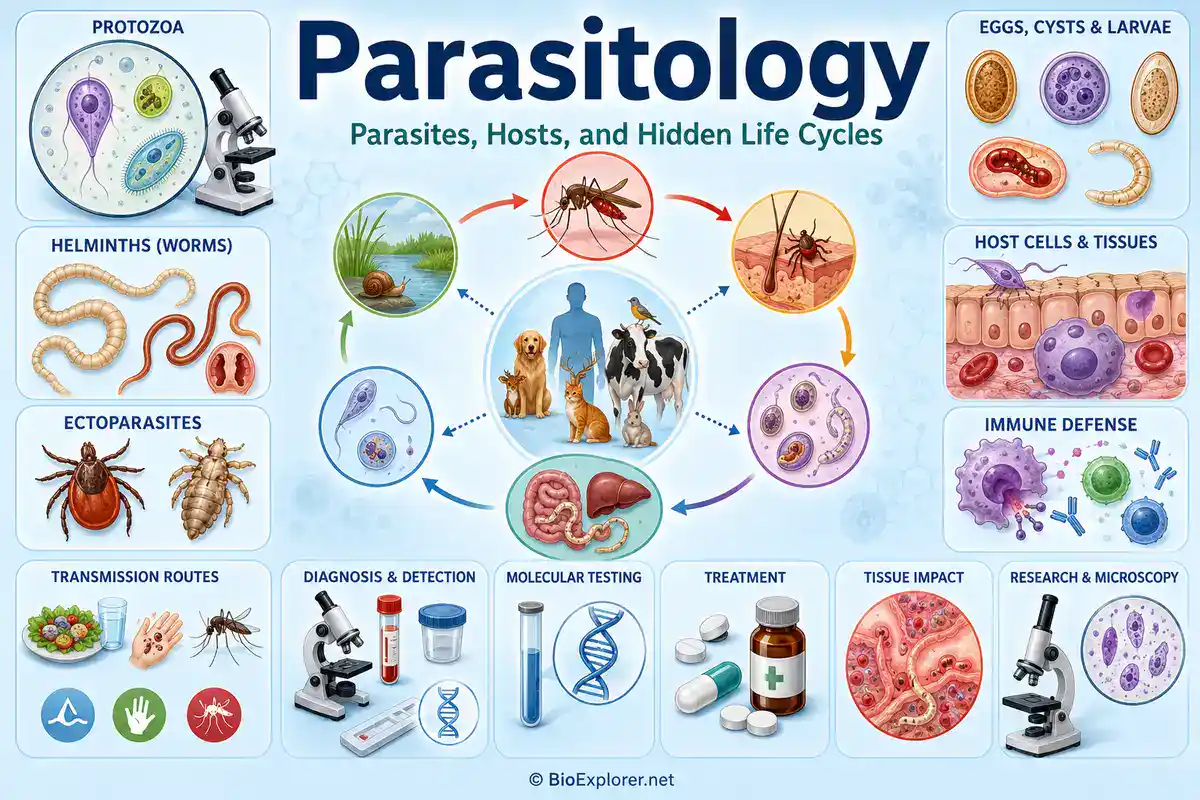
Parasitology is the scientific study of parasites, their hosts, and the relationships between them. It examines organisms that live on or inside another organism and depend on that host for food, shelter, development, reproduction, or transmission.
In parasitology, the organism and the route matter together. A malaria parasite, tapeworm, liver fluke, tick, louse, or Giardia cell cannot be fully understood by naming it alone. The key is to trace its life cycle: entry, feeding, development, reproduction, escape, and transmission to the next host.
Parasitology connects closely with microbiology, zoology, ecology, immunology, evolutionary biology, cell biology, molecular biology, genetics, and pharmacology.
Parasitology Guide:
- A Parasite Is Defined by Its Host
- Protozoa, Worms, and Ectoparasites Work Differently
- The Life Cycle Is the Map
- How Parasites Spread
- Parasites and the Immune System
- Parasites in Ecosystems
- Medical and Veterinary Parasitology
- How Parasitologists Identify Parasites
- History of Parasitology: A Few Turning Points
- What Do Parasitologists Study?
- Why Parasitology Matters
- Parasitology Careers
- Related BioExplorer Resources
- Recommended Parasitology Resources
- Parasitology FAQs
A Parasite Is Defined by Its Host
Parasites are defined by dependence. They live on or inside hosts and use those hosts as feeding sites, shelters, nurseries, transport systems, or reproductive stops. That relationship may be brief, as with a blood-feeding tick, or long-lasting, as with a tapeworm or chronic protozoan infection.
Some parasites live inside the body. These are called endoparasites. Others live on the surface, such as lice, ticks, mites, and fleas. These are called ectoparasites. Some parasites use one host. Others require two or more hosts before the life cycle is complete.
The host matters because it shapes the parasite’s food source, habitat, immune challenge, reproduction, and route to the next stage. In parasitology, a parasite’s biology is inseparable from the host it uses.
| Term | What It Means | Why It Matters |
|---|---|---|
| Parasite | An organism that lives on or inside a host and benefits at the host’s expense. | Defines the basic relationship studied in parasitology. |
| Host | An organism that supports the parasite. | Provides food, shelter, development, reproduction, or transmission opportunities. |
| Definitive Host | The host in which a parasite reaches sexual maturity or completes sexual reproduction. | Important for understanding the full life cycle. |
| Intermediate Host | A host that supports immature stages or asexual development. | Many parasites cannot complete their life cycle without this host. |
| Vector | An organism that carries and transmits a parasite between hosts. | Mosquitoes, ticks, flies, and other arthropods can spread parasitic diseases. |
| Reservoir Host | A host that maintains a parasite in nature and can be a source of infection. | Important in zoonotic disease and control programs. |
| Accidental Host | A host that is not part of the usual life cycle. | Can lead to unusual disease patterns or dead-end infections. |
Protozoa, Worms, and Ectoparasites Work Differently
The word parasite describes a lifestyle, not a single branch of life. A protozoan parasite is a single-celled eukaryote. A tapeworm is a multicellular flatworm. A tick is an arthropods. They are grouped together in parasitology because each depends on a host, not because they are close relatives.
Viruses are sometimes described broadly as obligate intracellular parasites, but they are usually studied under virology, not parasitology. Bacteria are studied mainly under microbiology. Parasitology has its own focus because many parasites have complex bodies, life stages, hosts, Vector, and transmission routes.
Top 12 Diseases Caused By Protozoa
| Parasite Group | What It Includes | Examples |
|---|---|---|
| Protozoa | Single-celled eukaryotic parasites. | Plasmodium, Giardia, Entamoeba, Trypanosoma, Leishmania, Toxoplasma. |
| Nematodes | Roundworms with elongated cylindrical bodies. | Ascaris, hookworms, pinworms, filarial worms, Trichinella. |
| Cestodes | Tapeworms with flattened segmented bodies. | Taenia species, Echinococcus species, Diphyllobothriid tapeworms. |
| Trematodes | Flukes with flattened leaf-like bodies. | Schistosoma, liver flukes, lung flukes, intestinal flukes. |
| Ectoparasitic Arthropods | External parasites or vectors such as insects and arachnids. | Ticks, lice, fleas, mites, and some biting flies. |
| Parasitic Plants | Plants that obtain water, nutrients, or sugars from other plants. | Mistletoe, dodder, broomrape. |
| Parasitic Fungi | Fungi that live on or inside hosts and may cause disease. | Plant rusts, smuts, dermatophytes, and some opportunistic fungi. |
The Life Cycle Is the Map
In parasitology, the life cycle is often more important than the parasite’s name. A parasite may look harmless in one stage and dangerous in another. It may live in a mosquito, snail, fish, mammal, bird, human, or soil before reaching its next host.
Malaria parasites are transmitted by infected Anopheles mosquitoes and then pass through liver and blood stages in humans. Schistosome flukes use freshwater snails as intermediate hosts before infecting humans through contact with contaminated water. Tapeworms may involve livestock, fish, dogs, wildlife, or humans depending on the species.
This is why control often depends on interrupting the life cycle. Treating the final host may not be enough if the parasite also depends on vectors, contaminated water, food animals, snails, soil, or Reservoir Host.
How Parasites Spread
Parasites move between hosts in different ways. Some are swallowed in contaminated food or water. Some penetrate skin. Some are transmitted by insect or tick vectors. Some pass from animals to people. Some move through blood, tissue, soil, or sexual contact. The route matters because prevention depends on the route.
- Fecal-oral transmission: Parasites or cysts are swallowed through contaminated hands, food, water, or surfaces.
- Foodborne transmission: Parasites are acquired from undercooked meat, fish, shellfish, or contaminated produce.
- Vector-borne transmission: Mosquitoes, ticks, flies, or other arthropods transmit parasites during feeding.
- Skin penetration: Some larvae enter through skin, often in contaminated soil or freshwater.
- Zoonotic transmission: Parasites move between animals and humans directly or through food, vectors, or environments.
- Congenital transmission: Some parasites can pass from a pregnant person to a fetus.
- Blood or tissue exposure: Some parasites can spread through blood transfusion, organ transplantation, or contaminated needles.
Parasites and the Immune System
Parasites are difficult opponents for the immune system because many are larger, more complex, or more changeable than bacteria and viruses. Some parasites hide inside cells. Some change surface molecules. Some form cysts. Some migrate through tissues. Some live for years inside a host.
The immune response depends on the parasite type and location. Protozoa, worms, and ectoparasites trigger different immune pathways. In many helminth infections, immune responses can involve eosinophils, IgE, mast cells, mucus production, tissue repair, and inflammation. These responses may help control parasites, but they can also contribute to symptoms and tissue damage.
This makes parasitology closely connected to immunology. A parasite’s success often depends on how well it survives the host’s defenses.
Parasites in Ecosystems
Parasitology is not only about human disease. Parasites are part of ecosystems. They influence food webs, host behavior, population size, predator-prey relationships, wildlife health, and evolution. Some parasites reduce host survival or reproduction. Others change where hosts feed, how they move, or how vulnerable they are to predators.
Parasites can also reveal ecological connections that are otherwise easy to miss. A parasite with several hosts may show links between snails, fish, birds, mammals, insects, water quality, and climate. When a parasite disappears, appears, or shifts range, it may signal a change in the ecosystem.
This is where parasitology overlaps with ecology, zoology, and evolutionary biology.
Medical and Veterinary Parasitology
Medical parasitology studies parasites that infect humans. Veterinary parasitology studies parasites of domestic animals, livestock, wildlife, and companion animals. These fields overlap because many parasites are zoonotic, meaning they can move between animals and people.
Important human parasitic diseases include malaria, giardiasis, amoebiasis, toxoplasmosis, leishmaniasis, Chagas disease, African trypanosomiasis, schistosomiasis, lymphatic filariasis, ascariasis, hookworm infection, strongyloidiasis, taeniasis, cysticercosis, scabies, and lice infestations.
Veterinary parasitology is essential for animal health, food safety, agriculture, wildlife conservation, and public health. Parasites can affect growth, reproduction, behavior, survival, milk production, meat production, and disease risk in animals.
How Parasitologists Identify Parasites
Parasite identification depends on the organism, life stage, sample type, and disease context. A blood parasite is not found the same way as an intestinal worm egg, skin mite, tissue cyst, or tick-borne protozoan.
- Microscopy: Used to examine blood smears, stool samples, tissue samples, eggs, larvae, cysts, and adult parasites.
- Morphology: Uses shape, size, structures, and life stage to identify parasites.
- Antigen tests: Detect parasite molecules in blood, stool, or other samples.
- Antibody tests: Detect immune responses to certain parasites, especially when direct detection is difficult.
- PCR and sequencing: Detect parasite DNA or RNA and help distinguish species or strains.
- Imaging: Used in some tissue infections where cysts, lesions, or organ involvement must be assessed.
- Vector surveillance: Tracks mosquitoes, ticks, flies, or snails involved in parasite transmission.
- Ecological sampling: Studies parasites in hosts, environments, reservoirs, and food webs.
History of Parasitology: A Few Turning Points
The history of parasitology became scientific when researchers learned to connect parasites with hosts, vectors, life cycles, and disease. The major advances were not just parasite discoveries. They changed how people understood transmission.
| Year | Discovery or Contribution | Why It Matters |
|---|---|---|
| 1681 | Antonie van Leeuwenhoek observed an intestinal protozoan later associated with Giardia in his own stool. | One of the earliest microscopic observations of a human intestinal parasite. |
| 1851 | Theodor Bilharz described Schistosoma haematobium in Egypt. | Helped establish the cause of urinary schistosomiasis. |
| 1877 to 1878 | Patrick Manson showed that mosquitoes are involved in the life cycle of filarial worms. | Provided key evidence that arthropods can transmit parasitic infections. |
| 1880 | Alphonse Laveran discovered malaria parasites in human blood. | Established that malaria is caused by a protozoan parasite. |
| 1897 | Ronald Ross demonstrated development of malaria parasites in mosquitoes. | Helped establish mosquito transmission of malaria. |
| 1909 | Carlos Chagas described Trypanosoma cruzi, its insect vector, and the disease later called Chagas disease. | A rare case where one scientist identified the parasite, vector, host disease, and major transmission cycle. |
| 1972 | Tu Youyou and colleagues identified artemisinin from sweet wormwood as an antimalarial compound. | Led to a major class of antimalarial drugs. |
| Late 1970s to 2015 | Avermectin discoveries by Satoshi Omura and William Campbell led to ivermectin; the 2015 Nobel Prize recognized ivermectin and artemisinin work. | Marked major advances against parasitic diseases such as river blindness, lymphatic filariasis, and malaria. |
What Do Parasitologists Study?
Parasitologists often work backwards from evidence: an egg in stool, a parasite in blood, a bite pattern, a sick animal, a contaminated water source, or a vector in the field. From there, they identify the organism and reconstruct the route that allowed it to reach the host.
| Area of Parasitology | What It Studies | Example Question |
|---|---|---|
| Medical Parasitology | Parasites that infect humans. | Which parasite is causing disease, and how is it transmitted? |
| Veterinary Parasitology | Parasites of livestock, pets, wildlife, and zoo animals. | How do parasites affect animal health, production, or conservation? |
| Ecological Parasitology | Parasites in ecosystems and food webs. | How do parasites influence host populations or predator-prey interactions? |
| Molecular Parasitology | Genes, proteins, metabolism, and cell biology of parasites. | Which parasite pathway can be targeted by a drug? |
| Immunoparasitology | Host immune responses to parasites. | How does a parasite evade or alter immune defenses? |
| Vector Biology | Arthropods and other organisms that transmit parasites. | Which mosquitoes, ticks, flies, or snails support parasite transmission? |
| Diagnostic Parasitology | Identification of parasites in clinical, veterinary, or environmental samples. | Which test can detect this parasite or life stage? |
| Evolutionary Parasitology | How parasites and hosts adapt to each other over time. | How do host defenses and parasite strategies coevolve? |
Why Parasitology Matters
Parasitology matters because parasites sit at the crossroads of health, ecology, food safety, poverty, wildlife, climate, and evolution. A parasite may be a medical problem in one setting, a livestock problem in another, and an ecological clue somewhere else.
Some parasites cause major tropical diseases. Some reduce livestock productivity. Some threaten endangered species. Some move through vectors whose ranges change with climate, land use, travel, and urbanization.
Parasitology also matters because parasites are part of biodiversity. They influence evolution, immunity, behavior, and ecological stability. A parasite can be a disease agent, a food-web connector, a selection pressure, a biological indicator, or a clue to hidden relationships among species.
In public health, parasitology supports diagnosis, surveillance, treatment research, sanitation, vector control, food safety, water quality, deworming programs, vaccine research, and drug development.
Parasitology Careers
Work in parasitology often follows the parasite’s route. Some careers focus on diagnosis in a lab. Others track vectors in the field, study wildlife reservoirs, test drugs, support public health programs, or investigate parasites in livestock, pets, and ecosystems.
- Parasitologist: Studies parasites, hosts, life cycles, transmission, and parasite biology.
- Medical parasitologist: Studies parasites that infect humans and supports diagnosis, surveillance, and research.
- Veterinary parasitologist: Studies parasites of livestock, pets, wildlife, and zoo animals.
- Diagnostic parasitologist: Identifies parasites in blood, stool, tissue, skin, or other samples.
- Vector biologist: Studies mosquitoes, ticks, flies, snails, and other organisms involved in transmission.
- Ecological parasitologist: Studies parasites in food webs, ecosystems, wildlife, and host populations.
- Molecular parasitologist: Studies parasite Genes, proteins, metabolism, drug targets, and cell biology.
- Public health scientist: Tracks parasitic diseases, outbreaks, control programs, and health risks.
- Drug or vaccine researcher: Studies treatments, prevention tools, and resistance in parasitic diseases.
How To Become A Parasitologist?
Related BioExplorer Resources
Use these BioExplorer pages to connect parasitology with related fields of biology:
- Microbiology
- Zoology
- Ecology
- Immunology
- Evolutionary Biology
- Cell Biology
- Molecular Biology
- Genetics
- Pharmacology
- Virology
- Types of Animals
- Types of Insects
- Domain Eukarya
Recommended Parasitology Resources
These external resources are useful for learning about parasites, parasite identification, life cycles, neglected tropical diseases, malaria, vectors, and public health parasitology.
- CDC: Parasites A reliable public-health resource on parasitic diseases, prevention, and parasite groups.
- CDC DPDx A major diagnostic parasitology reference with parasite images, life cycles, and laboratory information.
- WHO: Neglected Tropical Diseases A global resource on diseases that include many parasitic infections.
- WHO: Malaria A current overview of malaria, Plasmodium parasites, transmission, prevention, and control.
- NCBI Bookshelf: Medical Parasitology A textbook-style reference for parasite biology and medical parasitology.
- American Society of Parasitologists A professional society for parasitology research and education.
- British Society for Parasitology A professional organization supporting parasitology research, teaching, and communication.
- World Organisation for Animal Health: Animal Diseases A useful reference for animal diseases, including parasitic diseases relevant to veterinary and public health work.
- Nobel Prize: Alphonse Laveran Official Nobel background on the discovery of the malaria parasite.
- Nobel Prize: Ronald Ross Official Nobel background on malaria transmission research.
- Nobel Prize: Ivermectin and Artemisinin Official Nobel background on major treatments for parasitic diseases.
Parasitology FAQs
Parasitology is the scientific study of parasites, their hosts, and the relationships between them. It includes parasite biology, life cycles, transmission, diagnosis, ecology, immunity, and disease.
Parasitologists study parasites, hosts, vectors, life cycles, transmission routes, diagnosis, parasite evolution, immune responses, ecology, veterinary parasites, and human parasitic diseases.
The main parasite groups in medical parasitology are protozoa, helminths, and ectoparasites. Broader biology also includes parasitic plants, fungi, and other parasitic organisms.
An endoparasite lives inside a host, such as in the intestine, blood, or tissues. An ectoparasite lives on the outside of a host, such as lice, fleas, ticks, or mites.
A vector is an organism that carries and transmits a parasite between hosts. Mosquitoes, ticks, flies, and some other arthropods can act as vectors.
No. Parasitology includes human parasites, animal parasites, plant parasites, wildlife parasites, ecological interactions, parasite evolution, veterinary health, agriculture, and public health.
Parasitology is important because parasites affect human health, animal health, food security, wildlife, ecosystems, evolution, immunity, drug development, sanitation, vector control, and global public health.
Parasitology careers include parasitologist, medical parasitologist, veterinary parasitologist, diagnostic parasitologist, vector biologist, ecological parasitologist, molecular parasitologist, public health scientist, and drug or vaccine researcher.
Cite this page
BioExplorer. (2026, July 30). Parasitology: The Biology of Parasites. https://www.bioexplorer.net/divisions_of_biology/parasitology/