
Branches of Biotechnology
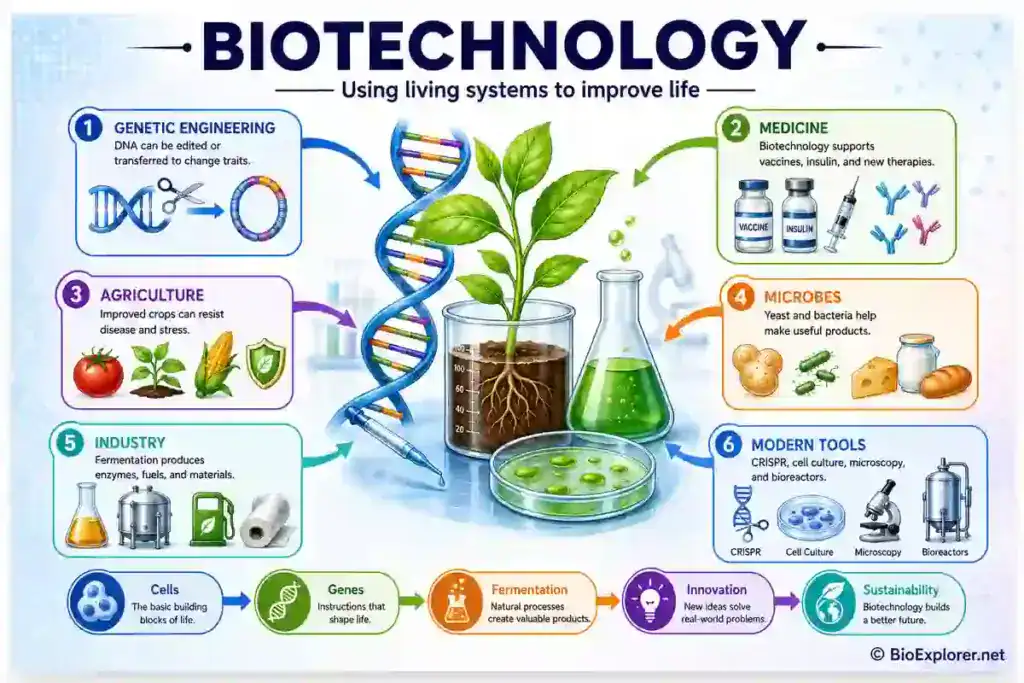
To define it in the simplest way possible, Biotechnology is the technology used on living systems and organisms to study and discover products that facilitate a better life.
The application of Biotechnology is nothing new. For thousands of years, human beings have applied and tested biotechnology in a variety of fields like food production, the discovery of drugs and medicines and of course agriculture.
The good examples of biotechnology are brewing and baking bread using “yeast” (a living organism) to make the final products.
Browse the Biotechnology Glossary for precise definitions of terms such as genetic engineering, fermentation, recombinant DNA, cloning, vaccine, biofuel, GMO, and gene therapy.
Jump to:
- Biotechnology Origin
- Branches of Biotechnology
- A) Red Biotechnology (Medical)
- B) Green Biotechnology (Agricultural)
- C) White Biotechnology (Industrial)
- D) Blue Biotechnology (Marine)
- Biotechnology Articles
- Recommended Biotechnology Resources
- Biotechnology Learning Resources
- Genetic Engineering and Genome Editing
- Biotechnology Databases and Research Tools
- Agricultural Biotechnology and Regulation
Biotechnology Origin
The term Biotechnology was first coined by a Hungarian engineer named Karoly Ereky in the year 1919. Continuous research and developments in the field have resulted in the expansion of Biotechnology to numerous other branches of science like applied immunology, genomics, pharmaceutical therapy, diagnostics, and gene technology.
History of Biotechnology
Branches of Biotechnology
Biotechnology is the application of biological systems and organisms to technical and industrial processes. Because this ranges from making medicine to cleaning the ocean, it is organized into distinct “colors” to help experts categorize their work.
A) Red Biotechnology (Medical)
Red biotechnology is the most well-known branch, focusing entirely on human health and medicine. It involves using living cells—like bacteria or yeast—to manufacture substances that can heal the body or prevent infectious diseases.
- What it develops: Vaccines, antibiotics, insulin, and gene therapies.
- Why it matters: It allows us to create “targeted” medicines that work with our own DNA to cure previously untreatable genetic disorders.
Top 34 Gene Therapy Pros and Cons
B) Green Biotechnology (Agricultural)
Green biotechnology focuses on farming and food production. Instead of using harsh chemical pesticides, this branch looks for biological solutions to make crops stronger, more nutritious, and more resistant to harsh weather.
- What it develops: Genetically modified (GM) crops, bio-pesticides, and plants that can grow in salty or dry soil.
- Why it matters: As the global population grows, green biotech helps ensure we can grow enough food using less water and fewer chemicals.

6 Major Disadvantages of Genetically Modified Foods
C) White Biotechnology (Industrial)
White biotechnology is often called “the branch of efficiency”. It focuses on industrial processes, using enzymes and microorganisms to make manufacturing cleaner and more sustainable. It aims to replace polluting chemical reactions with biological ones.
- What it develops: Bio-plastics (plastics made from plants), biofuels (fuel made from corn or algae), and biological detergents.
- Why it matters: It helps reduce the “carbon footprint” of factories by using renewable materials instead of oil and coal.

The Domain Archaea: Finding Life’s Extremists
D) Blue Biotechnology (Marine)
Blue biotechnology explores the resources of the ocean. Since the sea is home to some of the most unique organisms on Earth, scientists look here for rare molecules that cannot be found on land.
- What it develops: Medicines derived from coral or sponges, and methods to use algae for high-protein food supplements.
- Why it matters: The ocean is a massive, untapped “pharmacy” that could hold the key to new treatments for cancer and other complex diseases.

What Do Marine Biologists Do?
Biotechnology Articles
15 Wonderful Biotechnology Inventions In 2018

Introduction To Fermentation Biology

Top 10 Best Biotechnology Colleges in the USA
Top 10 Biotechnology News of 2020
Recommended Biotechnology Resources
These trusted external resources can help readers explore biotechnology, genetic engineering, recombinant DNA, CRISPR, genomics, agricultural biotechnology, biologics, regulation, and biotechnology research tools in more detail.
Biotechnology Learning Resources
- OpenStax Biology 2e: Biotechnology
A free textbook section explaining biotechnology, genetic engineering, DNA manipulation, and major applications in medicine and agriculture. - Khan Academy: Introduction to Biotechnology
A beginner-friendly explanation of biotechnology as the use of organisms, cells, or biological systems to make useful products or processes. - YourGenome
A free collection of genetics and genomics learning resources for students, teachers, and general readers. - HHMI BioInteractive: CRISPR-Cas9 Mechanism and Applications
An interactive learning resource showing how CRISPR-Cas9 works and how scientists use it in biotechnology research.
Genetic Engineering and Genome Editing
- NHGRI: Genetic Engineering
A clear definition of genetic engineering and how laboratory methods can alter the DNA of an organism. - NHGRI: Recombinant DNA Technology
A trusted explanation of recombinant DNA technology, gene manipulation, DNA splicing, and engineered DNA. - NHGRI: CRISPR
A concise explanation of CRISPR as a genome-editing technology adapted from bacterial defense systems. - MedlinePlus Genetics: Genome Editing and CRISPR-Cas9
A reader-friendly overview of genome editing, CRISPR-Cas9, and how scientists can add, remove, or alter DNA.
Biotechnology Databases and Research Tools
- National Center for Biotechnology Information
A major NIH resource providing access to biomedical, genomic, sequence, literature, and molecular biology information. - NCBI GenBank
A public genetic sequence database useful for DNA, RNA, genome, and biotechnology-related sequence research. - Addgene
A nonprofit repository for plasmids, viral vectors, and antibodies developed by the global research community. - Addgene Educational Resources
Helpful learning resources on plasmids, cloning, CRISPR, fluorescent proteins, viral vectors, and molecular biology techniques.
Agricultural Biotechnology and Regulation
- FAO: Biotechnologies in Food and Agriculture
A global resource on agricultural biotechnology in crops, livestock, forestry, fisheries, aquaculture, and food systems. - USDA: Biotechnology
A U.S. government resource explaining agricultural biotechnology and genetically engineered plant varieties. - USDA APHIS: Biotechnology Regulations
Information on permit, notification, movement, importation, and environmental release requirements for genetically engineered plants and plant pests. - FDA: Regulation of Plant and Animal Biotechnology Products
Explains how FDA works with USDA and EPA under the U.S. Coordinated Framework for biotechnology regulation. - FDA: GMO Crops, Animal Food, and Beyond
A consumer-facing resource about GMO crops, animal food, safety, and agricultural biotechnology. - EPA: Regulation of Genetically Engineered Microorganisms
A regulatory resource on genetically engineered microorganisms under EPA-related biotechnology rules.
Cite this page
Bio Explorer. (2026, June 21). Branches of Biotechnology. https://www.bioexplorer.net/divisions_of_biology/biotechnology/