
Neurobiology: The Biology of the Nervous System
Neurobiology is the branch of biology that studies the nervous system as living tissue. It explains how neurons, glial cells, synapses, circuits, neurotransmitters, genes, and electrical signals work together to produce sensation, movement, reflexes, learning, memory, emotion, behavior, and disease.
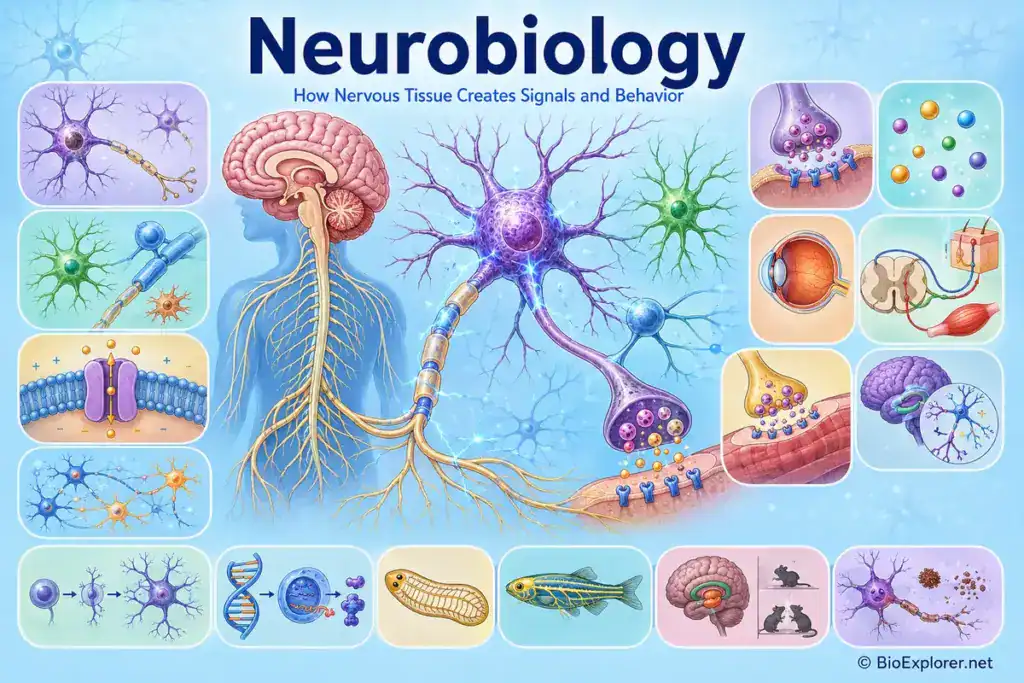
Neurobiology is not only the study of the brain. It includes the spinal cord, peripheral nerves, sensory organs, autonomic nerves, neuromuscular junctions, and nervous systems of animals ranging from simple invertebrates to humans. A neurobiologist may study a single ion channel, a synapse, a spinal reflex, a developing brain region, or a whole behavior controlled by neural circuits.
Neurobiology Guide:
- A Nervous System Is Not a Cable
- Neurons Signal With Ions and Chemistry
- Glial Cells Are Not Just Filler
- From Reflexes to Memory: Circuits Change With Use
- Neurobiology vs Neuroscience, Neurology, and Psychology
- What Do Neurobiologists Study?
- How Neurobiologists Study Living Nervous Systems
- History of Neurobiology: A Few Turning Points
- Why Neurobiology Matters
- Neurobiology Careers
- Related BioExplorer Resources
- Recommended Neurobiology Resources
- Neurobiology FAQs
A Nervous System Is Not a Cable
It is tempting to describe nerves as wires, but that picture is too simple. Neurons are living cells. They grow, change, repair, fail, communicate, strengthen connections, weaken connections, and respond to chemical signals. A nerve impulse is not electricity flowing through metal. It is a wave of ion movement across a cell membrane.
Neurobiology studies this living machinery. It asks how a cell becomes electrically excitable, how one neuron talks to another, how circuits process information, and how a pattern of activity becomes a movement, memory, perception, or behavior.
| Nervous System Part | What It Is | Why It Matters |
|---|---|---|
| Neuron | An excitable cell specialized for receiving, processing, and transmitting signals. | Neurons carry information through electrical impulses and chemical communication. |
| Dendrite | A branching part of a neuron that often receives signals. | Helps neurons collect input from other cells. |
| Axon | A long projection that carries signals away from the cell body. | Allows neurons to send information over short or long distances. |
| Synapse | A communication site between neurons or between a neuron and another cell. | Allows signals to pass through neurotransmitters or electrical connections. |
| Glial Cell | A support cell in the nervous system. | Glia help protect, nourish, insulate, repair, and regulate neural environments. |
| Myelin | A fatty insulating layer around many axons. | Speeds signal transmission and helps axons function efficiently. |
| Neurotransmitter | A chemical messenger released at many synapses. | Helps neurons communicate with other neurons, muscles, or glands. |
| Neural Circuit | A connected group of neurons that works together. | Circuits control reflexes, sensation, movement, memory, emotion, and behavior. |
Neurons Signal With Ions and Chemistry
Neurons communicate because their membranes can control ions such as sodium, potassium, calcium, and chloride. When ion channels open and close, the electrical charge across the membrane changes. If the change is strong enough, a neuron may fire an action potential, a rapid signal that travels along the Axon.
At many synapses, the arriving signal causes neurotransmitters to be released. These chemicals cross a tiny gap and bind to receptors on another cell. The receiving cell may become more likely to fire, less likely to fire, or change its internal activity in a slower way.
This is the cellular logic behind sensation, movement, reflexes, pain, attention, sleep, reward, and many drug effects. It is also why neurobiology depends heavily on membrane biology, protein function, metabolism, and molecular signaling.
Glial Cells Are Not Just Filler
Older descriptions often treated glial cells as simple support material. Modern neurobiology views them as active partners in nervous system function. Astrocytes help regulate the chemical environment around neurons and participate in synaptic function. Oligodendrocytes in the central nervous system and Schwann cells in the peripheral nervous system form myelin. Microglia are resident immune cells of the central nervous system and respond to injury, infection, and disease.
Glial biology matters in brain development, myelination, synapse regulation, repair, inflammation, neurodegenerative disease, pain, and nervous system injury. A nervous system is not only a network of neurons. It is a living tissue community.
From Reflexes to Memory: Circuits Change With Use
A neural circuit is a group of connected neurons that performs a function. Some circuits are fast and relatively automatic, such as spinal reflexes. Others support perception, decision-making, movement planning, emotion, language, learning, or memory.
Many synapses can change strength through experience, development, injury, sleep, stress, drugs, or disease. This ability is called neural plasticity. Plasticity helps explain learning and memory, but it also matters in chronic pain, addiction, rehabilitation, sensory adaptation, and recovery after injury.
Neurobiology vs Neuroscience, Neurology, and Psychology
Neurobiology overlaps with several fields, but its center is biological mechanism. It asks how nervous systems work at the level of cells, molecules, tissues, circuits, and organisms.
| Field | Main Focus | How It Relates to Neurobiology |
|---|---|---|
| Neurobiology | Biological mechanisms of nervous systems. | Focuses on neurons, glia, synapses, circuits, genes, molecules, and neural tissue. |
| Neuroscience | Broad scientific study of the nervous system. | Includes neurobiology, cognitive neuroscience, computational neuroscience, behavioral neuroscience, and clinical neuroscience. |
| Neurology | Medical diagnosis and treatment of nervous system disorders. | Uses neurobiology to understand diseases such as epilepsy, stroke, Parkinson disease, and multiple sclerosis. |
| Psychology | Mind, behavior, cognition, development, and mental processes. | Neurobiology helps explain the biological basis of behavior and mental function. |
| Neuroanatomy | Structure of the nervous system. | Provides the map of brain regions, nerves, pathways, and cells that neurobiology studies functionally. |
What Do Neurobiologists Study?
Neurobiologists study nervous systems at different scales. Some work on molecules inside one neuron. Others study developing circuits, sensory systems, animal behavior, brain disorders, or how genes and experience shape neural function.
| Study Area | What It Examines | Example Question |
|---|---|---|
| Cellular Neurobiology | Neurons, glia, membranes, ion channels, and synapses. | How does a neuron generate an action potential? |
| Molecular Neurobiology | Genes, proteins, receptors, neurotransmitters, and signaling pathways. | How does a receptor change synaptic strength? |
| Developmental Neurobiology | How nervous systems form, wire, and mature. | How do axons find their targets during development? |
| Systems Neurobiology | How neural circuits process information. | How does a sensory circuit turn touch into behavior? |
| Behavioral Neurobiology | How nervous systems produce actions and choices. | Which circuit controls feeding, sleep, fear, or courtship? |
| Sensory Neurobiology | How organisms detect light, sound, chemicals, pressure, pain, and body position. | How do photoreceptors or pain receptors convert stimuli into neural signals? |
| Motor Neurobiology | How nervous systems control movement. | How do motor neurons activate muscles in a coordinated way? |
| Neurobiology of Disease | How nervous system disorders alter cells and circuits. | What happens to neurons and glia in epilepsy, dementia, neuropathy, or injury? |
| Comparative Neurobiology | How nervous systems differ across animals. | How do simple nervous systems solve problems without a large brain? |
How Neurobiologists Study Living Nervous Systems
Neurobiology uses many methods because nervous systems operate across many scales. A single experiment may involve genetics, microscopy, electrophysiology, behavior, pharmacology, or imaging.
- Electrophysiology: Measures electrical activity in neurons, muscles, synapses, or circuits.
- Microscopy: Reveals neurons, Dendrite, axons, synapses, glial cells, and tissue structure.
- Calcium imaging: Tracks activity-related calcium changes in cells or circuits.
- Optogenetics: Uses light-sensitive proteins to control selected neurons in research settings.
- Molecular genetics: Studies genes and proteins that shape neural development, signaling, and disease.
- Behavioral assays: Connect neural activity with movement, learning, sleep, feeding, fear, social behavior, or sensation.
- Brain imaging: Studies structure, activity, and connectivity in living brains.
- Model organisms: Uses organisms such as fruit flies, zebrafish, mice, nematodes, squid, and sea slugs to study nervous system principles.
See how a single developmental stage compares across six species with the free Model Organism Development Stage Converter.
History of Neurobiology: A Few Turning Points
The history of neurobiology is not just a history of brain maps. The major breakthroughs came when scientists learned that the nervous system is made of cells, that neurons communicate across synapses, that nerve impulses have an ionic basis, and that experience can change synaptic function.
| Year | Discovery or Contribution | Why It Matters |
|---|---|---|
| 1873 | Camillo Golgi developed the black reaction staining method. | Made it possible to see individual neurons and their branching shapes in unusual detail. |
| 1888 to 1906 | Santiago Ramón y Cajal used Golgi staining to support the neuron doctrine. | Helped establish that neurons are separate cells rather than one continuous network. |
| 1897 | Charles Sherrington popularized the term synapse. | Gave biology a concept for the communication junction between neurons. |
| 1921 | Otto Loewi demonstrated chemical transmission using the frog heart experiment. | Helped show that nerves can communicate by releasing chemical messengers. |
| 1952 | Alan Hodgkin and Andrew Huxley described the ionic basis of the action potential in the squid giant axon. | Explained how nerve impulses arise from changes in membrane ion conductance. |
| 1973 | Terje Lømo and Timothy Bliss reported long-term potentiation in the hippocampus. | Provided an important experimental model for studying synaptic plasticity. |
| 2000 | Arvid Carlsson, Paul Greengard, and Eric Kandel received the Nobel Prize for discoveries on signal transduction in the nervous system. | Highlighted chemical signaling, synaptic regulation, and molecular mechanisms of memory. |
| 2013 | The NIH BRAIN Initiative began in the United States. | Accelerated tool development for mapping, measuring, and manipulating neural circuits. |
Why Neurobiology Matters
Neurobiology matters because the nervous system controls how organisms sense the world, move through it, learn from it, and respond to danger. It also explains why nervous system damage can affect movement, memory, mood, speech, sensation, sleep, balance, pain, and behavior.
In medicine, neurobiology helps researchers understand disorders such as epilepsy, stroke, Parkinson disease, Alzheimer disease, multiple sclerosis, neuropathy, spinal cord injury, migraine, depression, addiction, autism spectrum conditions, and traumatic brain injury. In biology, it helps explain animal behavior, development, sensory evolution, motor control, sleep, learning, and adaptation.
Neurobiology also supports new tools in biotechnology and medicine, including neural recording, brain stimulation, neural prosthetics, optogenetics, drug discovery, regenerative medicine, and computational models of nervous system function.
Neurobiology Careers
Neurobiology careers can be found in universities, medical schools, biotechnology companies, pharmaceutical research, hospitals, government laboratories, brain institutes, animal behavior research, imaging centers, and science education.
- Neurobiologist: Studies neurons, glia, synapses, circuits, and nervous system function.
- Cellular neuroscientist: Studies ion channels, membranes, synapses, and cellular signaling.
- Molecular neuroscientist: Studies genes, proteins, receptors, and molecular pathways in nervous systems.
- Developmental neurobiologist: Studies how nervous systems form, wire, mature, and change.
- Systems neuroscientist: Studies neural circuits that control sensation, movement, cognition, or behavior.
- Behavioral neurobiologist: Studies how nervous systems produce behavior in animals or humans.
- Neuropharmacologist: Studies how drugs affect neurons, synapses, neurotransmitters, and neural circuits.
- Clinical research scientist: Studies nervous system disease, biomarkers, therapies, and patient outcomes.
- Neurotechnology scientist: Works on neural recording, stimulation, imaging, prosthetics, or brain-computer interfaces.
How To Become A Neurosurgeon?
Related BioExplorer Resources
Use these BioExplorer pages to connect neurobiology with related biology topics:
- Neuroscience Glossary
- Cell Biology
- Molecular Biology
- Physiology
- Anatomy
- Genetics
- Biochemistry
- Pharmacology
- Photobiology
- Cellular Organization
- Building Blocks of Proteins
- Cell biology
- Molecular biology
- Developmental biology
Recommended Neurobiology Resources
These external resources are useful for learning about neurons, synapses, brain structure, nervous system function, neural circuits, neurobiology history, and neuroscience research tools.
- NINDS: Brain Basics, The Life and Death of a Neuron A reliable NIH introduction to neurons, synapses, neurotransmitters, and neural communication.
- BrainFacts.org A public neuroscience education resource supported by major neuroscience organizations.
- NCBI Bookshelf: Neuroscience A free textbook reference covering neurons, synapses, sensory systems, motor systems, development, and higher brain function.
- OpenStax Anatomy and Physiology 2e: Nervous Tissue A free textbook section on neurons, glia, nervous tissue, and neural signaling.
- Society for Neuroscience A major professional organization for neuroscience research, education, and public outreach.
- NIH BRAIN Initiative A major research initiative focused on developing tools to understand brain cells and circuits.
- Allen Brain Map A collection of brain atlases, cell-type resources, gene expression data, and neuroscience datasets.
- HHMI BioInteractive: Neuroscience Resources Classroom-ready resources related to nervous system biology and behavior.
- Nobel Prize: Golgi and Cajal Official Nobel Prize background on discoveries about the structure of the nervous system.
- Nobel Prize: Loewi and Dale Official Nobel Prize background on chemical transmission of nerve impulses.
- Nobel Prize: Eccles, Hodgkin, and Huxley Official Nobel Prize background on ionic mechanisms in nerve cell membranes.
- Nobel Prize: Signal Transduction in the Nervous System Official Nobel Prize background on neurotransmission, synaptic signaling, and memory mechanisms.
Neurobiology FAQs
Neurobiology is the branch of biology that studies nervous systems, including neurons, glial cells, synapses, neurotransmitters, circuits, genes, behavior, development, and nervous system disease.
Neurobiologists study how neurons and glial cells work, how synapses communicate, how circuits control behavior, how nervous systems develop, and how disease changes neural function.
Neurobiology is a biological part of neuroscience. Neuroscience is broader and may include cognitive, computational, behavioral, clinical, and social approaches to the nervous system.
Neurobiology is a research field that studies nervous system biology. Neurology is a medical specialty that diagnoses and treats diseases of the nervous system.
Neurons are excitable cells that send and receive signals. Glial cells support, protect, insulate, repair, and regulate the environment around neurons.
Synapses are communication sites between neurons or between neurons and other cells. They allow nervous systems to process information, control movement, form memories, and adapt.
Neurobiology is important because it explains how nervous systems control sensation, movement, learning, memory, behavior, sleep, pain, development, and many neurological and psychiatric disorders.
Neurobiology careers include neurobiologist, cellular neuroscientist, molecular neuroscientist, developmental neurobiologist, systems neuroscientist, behavioral neurobiologist, neuropharmacologist, and neurotechnology scientist.
Cite this page
BioExplorer. (2026, September 30). Neurobiology: The Biology of the Nervous System. https://www.bioexplorer.net/divisions_of_biology/neurobiology/