
Photobiology: How Light Affects Life
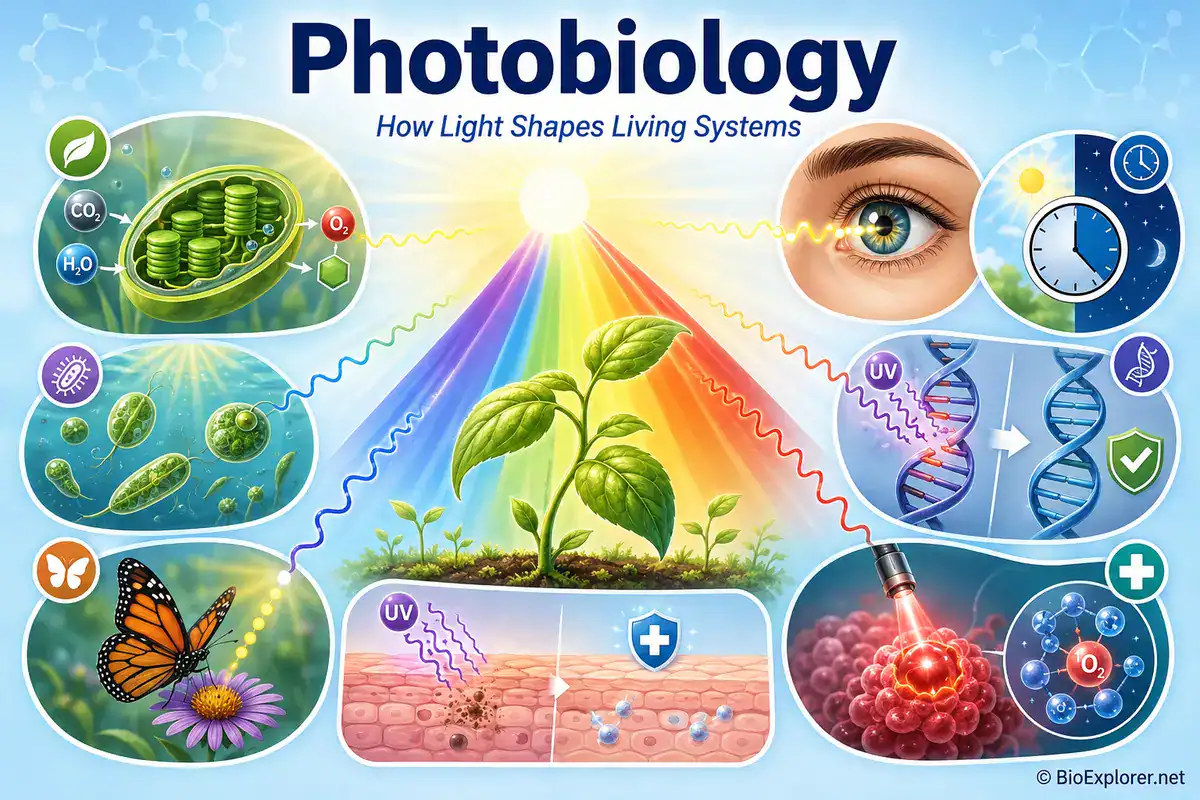
Photobiology is the branch of biology that studies how light interacts with living organisms. It explains how light powers photosynthesis, shapes plant growth, controls biological clocks, enables vision, damages DNA, drives repair responses, triggers behavior, and is used in medicine and biotechnology.
Light is not just illumination. In living systems, light can act as energy, information, stress, signal, clock, weapon, or treatment. A photobiologist may study how plants bend toward light, how eyes detect photons, how ultraviolet radiation affects skin cells, how algae harvest sunlight, or how light-activated drugs can target abnormal tissue.
Photobiology connects closely with botany, cell biology, biochemistry, molecular biology, neuroscience, physiology, ecology, phycology, and radiobiology.
Light Is Biology’s Most Versatile Signal
The same sunlight that powers a leaf can also set a human sleep cycle, guide a seedling, bleach coral, stimulate vitamin D production, damage DNA, attract a moth, trigger pigment changes, or activate a medical photosensitizer. Photobiology studies those different outcomes and asks why one wavelength, dose, timing pattern, or tissue response produces one effect rather than another.
That is why photobiology is broader than photosynthesis. Photosynthesis is one major part of the field, but photobiology also includes vision, circadian rhythms, ultraviolet biology, photoreceptors, bioluminescence, plant light responses, light-driven behavior, phototoxicity, photoprotection, and photomedicine.
Photobiology Guide:
- Light Is Biology's Most Versatile Signal
- The Light Spectrum in Living Systems
- Photosynthesis: When Light Becomes Chemical Energy
- Vision and Photoreception
- Circadian Rhythms: Light as a Biological Clock Setter
- Plant Photobiology: Growth, Shade, Direction, and Flowering
- UV Radiation, DNA Damage, and Repair
- Bioluminescence: When Living Things Make Light
- Photomedicine and Photodynamic Therapy
- What Do Photobiologists Study?
- Photobiology Careers
- Related BioExplorer Resources
- Recommended Photobiology Resources
- Photobiology FAQs
| Role of Light | Biological Example | Why It Matters |
|---|---|---|
| Energy Source | Plants, algae, and cyanobacteria use light in photosynthesis. | Light energy becomes chemical energy that supports food webs. |
| Sensory Information | Eyes and other photoreceptors detect light. | Organisms use light to see, orient, avoid danger, and find resources. |
| Biological Clock Cue | Light helps synchronize circadian rhythms. | Daily light-dark cycles influence sleep, hormones, metabolism, and behavior. |
| Growth Signal | Plants detect light direction, color, intensity, and day length. | Light helps regulate germination, stem growth, leaf expansion, shade response, and flowering. |
| Cellular Stressor | Ultraviolet radiation can damage DNA, proteins, membranes, and cells. | Organisms need protection and repair systems. |
| Ecological Signal | Light affects depth zones, seasonal cycles, migration, camouflage, and communication. | Light conditions shape habitats and species interactions. |
| Medical Tool | Light can activate photosensitizers or be used in controlled therapies. | Photomedicine uses light for diagnosis, treatment, and research. |
Types of Plants: The Four Major Classifications of Plants
The Light Spectrum in Living Systems
Photobiology focuses mainly on non-ionizing radiation, especially ultraviolet, visible, and infrared light. These forms of radiation do not remove electrons from atoms in the same way ionizing radiation can, but they can still produce powerful biological effects.
Different wavelengths interact with molecules in different ways. Visible light can be absorbed by pigments such as chlorophylls, carotenoids, rhodopsins, and phytochromes. Ultraviolet radiation can trigger DNA damage, sunburn, pigmentation, immune effects, and repair responses. Infrared radiation is strongly associated with heat and can affect temperature-sensitive biology.
| Light Range | Approximate Wavelength | Biological Relevance |
|---|---|---|
| Ultraviolet C | 100 to 280 nm | Strongly damaging to biological molecules; mostly blocked by Earth’s atmosphere before reaching the surface. |
| Ultraviolet B | 280 to 315 nm | Can damage DNA and skin cells, but also helps drive vitamin D production in humans. |
| Ultraviolet A | 315 to 400 nm | Penetrates deeper into skin than UVB and contributes to photoaging, pigment changes, and oxidative stress. |
| Visible Light | 400 to 700 nm | Used in vision, photosynthesis, plant signaling, and many light-sensitive biological responses. |
| Far-Red Light | About 700 to 750 nm | Important in plant shade sensing, phytochrome signaling, and photomorphogenesis. |
| Infrared | Longer than 700 nm | Associated with heat transfer and temperature-related biological effects. |
Photosynthesis: When Light Becomes Chemical Energy
Photosynthesis is one of the best-known examples of photobiology. Plants, algae, and cyanobacteria use light energy to help convert carbon dioxide and water into organic molecules. In oxygenic photosynthesis, oxygen is released as a byproduct.
The light-dependent reactions of photosynthesis occur in photosynthetic membranes. Pigments absorb photons, electrons move through transport chains, and cells produce energy-carrying molecules that support carbon fixation. This process supports terrestrial and aquatic food webs and is central to the biology of plants, algae, and cyanobacteria.
Photobiology asks more than whether photosynthesis happens. It asks how light intensity, wavelength, day length, shade, temperature, water, nutrients, and stress change photosynthetic performance. This is important in botany, phycology, agriculture, ecology, climate research, and biotechnology.
Explore The World of Thigmotropism
Vision and Photoreception
Photoreception is the ability to detect light. In animals, vision depends on light-sensitive molecules such as opsins, which change shape after absorbing photons. These molecular changes begin a signaling process that the nervous system can interpret as brightness, contrast, color, motion, or form.
Not all photoreception produces image-forming vision. Some organisms use light-sensitive cells or molecules to orient toward light, avoid damaging wavelengths, regulate daily rhythms, or control behavior. Photoreception appears in many forms across animals, plants, microbes, and algae.
This makes photobiology especially important for neuroscience and sensory biology. A visual response begins with light and molecules, but it can end as behavior.
Circadian Rhythms: Light as a Biological Clock Setter
Many organisms use light to keep time. Circadian rhythms are roughly 24-hour biological cycles that help coordinate sleep, activity, hormone release, body temperature, feeding, metabolism, and behavior. Light is one of the strongest environmental cues that synchronizes these internal clocks with the outside world.
In humans and many animals, light detected by the eyes helps adjust the brain’s timing system. In plants, algae, fungi, and microbes, light can also help coordinate daily cycles of metabolism, growth, movement, photosynthesis, and gene expression. This is why photobiology overlaps with chronobiology, physiology, neuroscience, and ecology.
Plant Photobiology: Growth, Shade, Direction, and Flowering
Plants do not have eyes, but they are highly sensitive to light. They detect brightness, color, direction, duration, and changes in the ratio of red to far-red light. These signals help plants decide how to grow.
Phototropism is growth toward or away from light. Photomorphogenesis is light-controlled development, such as seedling greening, leaf expansion, and stem growth. Photoperiodism is a response to day length and night length, often linked to flowering, dormancy, or seasonal timing.
Plant photobiology also studies shade avoidance, stomatal responses, chloroplast movement, pigment production, light stress, and the balance between capturing enough light and avoiding damage from too much light.
UV Radiation, DNA Damage, and Repair
Ultraviolet radiation is a major focus of photobiology because it can damage biological molecules. UVB can directly damage DNA by producing lesions such as pyrimidine dimers. UVA is less energetic than UVB but can contribute to oxidative stress and indirect molecular damage.
Cells are not passive under light stress. Many organisms have protective pigments, antioxidants, repair enzymes, avoidance behaviors, sunscreen-like compounds, or stress-response pathways. Some organisms can use light-dependent DNA repair systems, while many cells rely on other repair mechanisms to remove or correct damage.
This area overlaps with molecular biology, cell biology, dermatology, cancer biology, environmental health, and radiobiology.
Bioluminescence: When Living Things Make Light
Bioluminescence is light produced by living organisms through chemical reactions. It is common in many marine organisms and also occurs in some insects, fungi, bacteria, and other life forms. Fireflies, deep-sea animals, dinoflagellates, and some bacteria are well-known examples.
Bioluminescence can help organisms attract mates, lure prey, startle predators, camouflage themselves, communicate, or illuminate the surrounding water. In research, bioluminescent proteins and enzymes have also become useful tools for imaging, gene expression studies, and cell biology.
Photomedicine and Photodynamic Therapy
Photobiology also has medical applications. Photomedicine studies how light can be used to diagnose, monitor, or treat biological conditions. This includes controlled uses of ultraviolet light, visible light, lasers, fluorescence imaging, light-based diagnostics, and light-activated treatments.
Photodynamic therapy uses a photosensitizing drug and a specific wavelength of light. When the photosensitizer is activated by light in the presence of oxygen, it can produce reactive molecules that damage targeted cells. This approach is used for certain cancers and some non-cancer conditions, depending on the treatment site and medical context.
Photomedicine is powerful, but it depends on careful control of wavelength, dose, tissue penetration, photosensitizer behavior, oxygen availability, and treatment location.
What Do Photobiologists Study?
Photobiologists may work in laboratories, greenhouses, clinics, field sites, oceans, forests, crop systems, or imaging facilities. The methods vary, but the core question is the same: what does light do to living systems?
| Study Area | What It Examines | Example Question |
|---|---|---|
| Photosynthesis | How organisms capture and convert light energy. | How does blue or red light change photosynthetic rate? |
| Photoreceptors | Molecules and cells that detect light. | How do opsins, phytochromes, cryptochromes, or phototropins respond to wavelengths? |
| Circadian Biology | How light synchronizes biological timing. | How does evening light affect sleep timing or hormone release? |
| UV Biology | How ultraviolet radiation affects molecules and cells. | How do cells repair UV-induced DNA damage? |
| Plant Light Responses | How plants use light for growth and development. | How does shade change stem growth, leaf expansion, or flowering? |
| Bioluminescence | How organisms produce and use light. | How do marine organisms use light for signaling or defense? |
| Photomedicine | How light is used in diagnosis or treatment. | How can a photosensitizer be activated in a target tissue? |
| Environmental Photobiology | How light conditions shape ecosystems. | How do depth, turbidity, season, or ozone changes affect organisms? |
Photobiology Careers
Photobiology careers can appear in plant science, environmental science, medicine, vision research, dermatology, neuroscience, cancer research, biotechnology, imaging, agriculture, marine science, and pharmaceutical research.
- Photobiologist: Studies how light affects organisms, cells, tissues, molecules, and ecosystems.
- Plant photobiologist: Studies plant responses to light, including germination, phototropism, shade response, and flowering.
- Photosynthesis researcher: Studies light harvesting, electron transport, pigments, carbon fixation, and stress responses.
- Vision scientist: Studies photoreceptors, retinal function, visual pathways, and light detection.
- Circadian biology researcher: Studies how light and darkness regulate biological clocks.
- UV biology researcher: Studies DNA damage, repair, sunscreen biology, skin responses, and photoprotection.
- Photomedicine specialist: Works with medical uses of light, lasers, imaging, or photodynamic therapy.
- Environmental photobiologist: Studies how natural and artificial light affect organisms and ecosystems.
Related BioExplorer Resources
Use these BioExplorer pages to connect photobiology with related biology topics:
- Botany
- Phycology
- Marine Biology
- Cell Biology
- Biochemistry
- Molecular Biology
- Neuroscience
- Physiology
- Ecology
- Radiobiology
- Cellular Respiration
- Cellular Organization
Recommended Photobiology Resources
These external resources are useful for learning about photobiology, light responses, photosynthesis, UV effects, biological clocks, photomedicine, and light-sensitive organisms.
- American Society for Photobiology: What Is Photobiology? A clear introduction to photobiology and photochemistry.
- European Society for Photobiology A professional society focused on biological effects of ultraviolet, visible, and infrared radiation.
- OpenStax Biology 2e: Light-Dependent Reactions A free textbook section on photons, pigments, chlorophyll, and the light reactions of photosynthesis.
- NIH NIGMS: Circadian Rhythms A reliable overview of biological clocks and light-dark timing.
- National Cancer Institute: Photodynamic Therapy A precise medical reference on photosensitizers, light activation, and treatment use.
- EPA: UV Radiation A practical explanation of UVA, UVB, and UVC radiation and health effects.
- NOAA Ocean Service: Bioluminescence An accessible overview of light production in marine organisms.
- Plantae: Plant Photobiology A plant-science resource hub covering light signaling and plant responses.
- Photochemistry and Photobiology A peer-reviewed journal covering research on light-driven biological and chemical processes.
- Journal of Photochemistry and Photobiology B: Biology A research journal focused on biological effects of light and photochemical processes.
Photobiology FAQs
Photobiology is the branch of biology that studies how light interacts with living organisms, including photosynthesis, vision, circadian rhythms, UV damage, plant light responses, bioluminescence, and photomedicine.
Photobiologists study how light affects cells, molecules, tissues, organisms, and ecosystems. They may study photosynthesis, photoreceptors, UV damage, DNA repair, vision, plant growth, biological clocks, or light-based therapies.
No. Photosynthesis is a major part of photobiology, but the field also includes vision, circadian rhythms, UV radiation, plant photoreceptors, bioluminescence, phototoxicity, photoprotection, and photomedicine.
In photosynthesis, pigments such as chlorophyll absorb light energy. That energy helps drive reactions that support the production of chemical energy and organic molecules.
Ultraviolet light, especially UVB, can damage DNA by creating lesions such as pyrimidine dimers. Cells use repair systems to detect and correct many forms of UV-induced damage.
Plant photobiology studies how plants detect and respond to light. It includes phototropism, photomorphogenesis, photoperiodism, shade response, chloroplast movement, flowering, and light stress.
Photodynamic therapy is a medical treatment that uses a photosensitizing drug and a specific light wavelength to produce reactive molecules that damage targeted cells.
Photobiology careers include photobiologist, plant photobiologist, photosynthesis researcher, vision scientist, circadian biology researcher, UV biology researcher, photomedicine specialist, and environmental photobiologist.
Cite this page
BioExplorer. (2026, August 24). Photobiology: How Light Affects Life. https://www.bioexplorer.net/divisions_of_biology/photobiology/