
Structural Biology: The Shape of Life’s Molecules
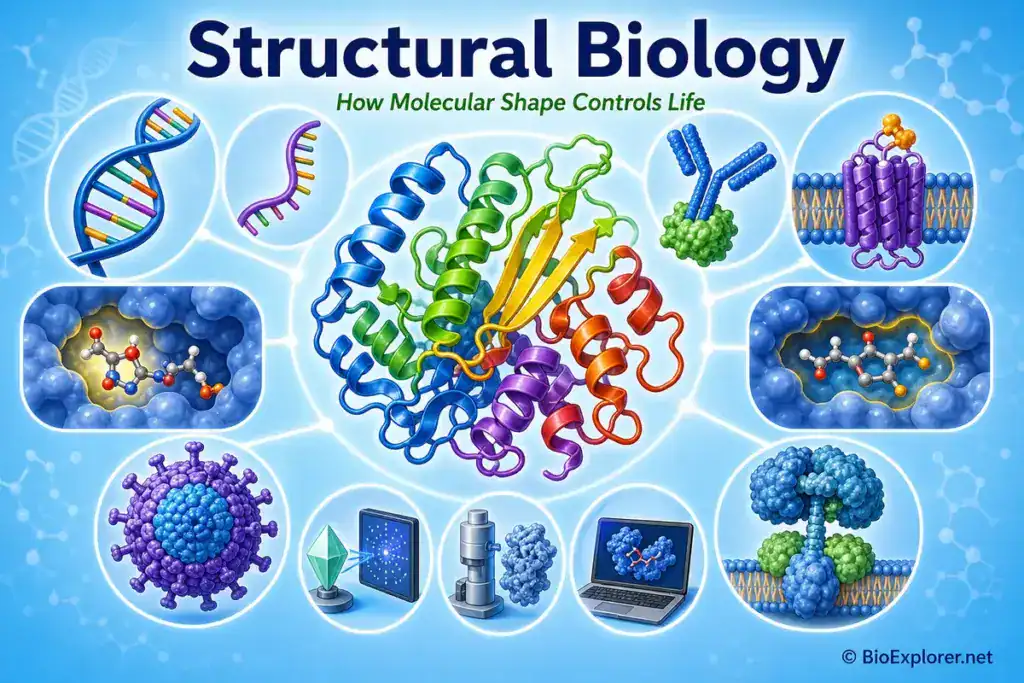
Structural biology is the branch of biology that studies the three-dimensional shapes of biological molecules and how those shapes control their function. It focuses on proteins, DNA, RNA, membranes, viruses, molecular machines, and large biological complexes inside cells.
Structural biology connects closely with biochemistry, molecular biology, cell biology, genetics, biotechnology, medicine, pharmacology, bioinformatics, and biophysics. It helps scientists understand protein folding, enzyme activity, DNA-protein binding, virus structure, cell signaling, drug targets, and disease mechanisms.
Structural Biology Guide:
- Structural Biology Definition and Meaning
- History of Structural Biology
- What Do Structural Biologists Study?
- Why Molecular Shape Matters
- Major Molecules Studied in Structural Biology
- Levels of Protein Structure
- Main Structural Biology Methods
- X-ray Crystallography
- Cryo-Electron Microscopy
- NMR Spectroscopy
- Computational Structure Prediction and Structural Bioinformatics
- Why Is Structural Biology Important?
- Examples of Structural Biology in Medicine and Biotechnology
- Structural Biology Careers
- Structural Biology vs Related Fields
- Related Biology Fields
- BioExplorer Structural Biology Articles
- Recommended Structural Biology Resources
- Structure Databases and Education
- Cryo-EM and Structural Data
- Protein Sequences and Structure Prediction
- Structural Biology FAQs
Structural Biology Definition and Meaning
Structural biology is the scientific study of biological macromolecules and molecular complexes in three dimensions. A structural biologist asks how the shape, movement, flexibility, and interactions of molecules explain what they do in living systems.
A simple structural biology definition is this: structural biology explains how molecular shape controls biological function.
This field matters because biological molecules are not flat diagrams. Proteins fold into precise shapes. DNA and RNA form complex structures. Enzymes have active sites. Receptors bind signals. Antibodies recognize antigens. Viruses use structural proteins to enter host cells. When structure changes, function often changes too.
History of Structural Biology
The history of structural biology grew from chemistry, physics, crystallography, biochemistry, and molecular biology. Early researchers used X-ray crystallography to reveal the structures of biological molecules, including proteins and nucleic acids.
One of the most famous structural discoveries was the double-helix model of DNA, which helped explain how genetic information could be stored and copied. Later advances revealed structures of enzymes, antibodies, ribosomes, membrane proteins, ion channels, viruses, and large molecular machines.
Modern structural biology now uses X-ray crystallography, cryo-electron microscopy, NMR spectroscopy, mass spectrometry, computational modeling, and AI-based structure prediction. These tools allow scientists to study molecules that were once too flexible, too large, too unstable, or too difficult to crystallize.
What Do Structural Biologists Study?
Structural biologists study the shape and organization of molecules that make life possible. Their work often begins with a biological question: How does this enzyme work? How does this virus enter a cell? Why does this mutation cause disease? How can a drug block this protein?
- Protein structure: How amino acid chains fold into functional shapes.
- Nucleic acid structure: How DNA and RNA store information, fold, and interact with proteins.
- Enzyme mechanisms: How active sites bind substrates and catalyze reactions.
- Membrane proteins: How receptors, transporters, and channels work inside membranes.
- Virus structure: How viral capsids, envelopes, and surface proteins support infection.
- Molecular machines: How ribosomes, motors, polymerases, and protein complexes perform cellular work.
- Drug targets: How small molecules bind proteins and change their activity.
- Protein folding: How proteins reach their functional shapes and what happens when folding fails.
Why Molecular Shape Matters
In structural biology, shape is not decoration. Shape is part of function. A protein’s folded structure determines which molecules it can bind, which reactions it can catalyze, where it can fit inside the cell, and how it responds to signals.
Small structural changes can have large biological effects. A mutation may change one amino acid, but that change can alter folding, stability, binding, enzyme activity, or interaction with other molecules. This is why structural biology is so important in medicine, genetics, and drug discovery.
For background on protein building blocks, read BioExplorer’s guide to building blocks of proteins. For DNA and RNA, see building blocks of nucleic acids.
Major Molecules Studied in Structural Biology
Structural biology studies many biological molecules, but proteins, nucleic acids, membranes, and molecular complexes are especially important.
| Molecule or Structure | What It Is | Why It Matters |
|---|---|---|
| Proteins | Chains of amino acids folded into functional shapes. | Control enzymes, receptors, transporters, antibodies, motors, and many cellular processes. |
| DNA | A nucleic acid that stores genetic information. | Its structure explains heredity, replication, mutation, and gene regulation. |
| RNA | A nucleic acid involved in coding, regulation, catalysis, and protein synthesis. | RNA structure affects translation, splicing, ribosomes, viruses, and gene control. |
| Membrane Proteins | Proteins embedded in or attached to cell membranes. | Important for signaling, transport, cell communication, immunity, and drug targeting. |
| Viruses | Infectious particles made of genomes and structural proteins. | Virus structure helps explain infection, host entry, immune recognition, and vaccine design. |
| Molecular Complexes | Groups of molecules that work together as machines. | Examples include ribosomes, polymerases, spliceosomes, channels, and protein assemblies. |
Levels of Protein Structure
Protein structure is one of the central topics in structural biology. A protein begins as a chain of amino acids, but it must fold into the right three-dimensional shape to work properly.
| Level | What It Describes | Example |
|---|---|---|
| Primary Structure | The linear sequence of amino acids in a protein. | The order of amino acids in hemoglobin or an enzyme. |
| Secondary Structure | Local folding patterns stabilized by hydrogen bonds. | Alpha helices and beta sheets. |
| Tertiary Structure | The full three-dimensional shape of one protein chain. | The folded shape of an enzyme active site. |
| Quaternary Structure | How multiple protein chains assemble together. | Hemoglobin made from four protein subunits. |
Protein folding is essential because a protein’s final shape affects its stability, binding sites, movement, and function. Misfolded proteins can lose function, form harmful aggregates, or contribute to disease.
Main Structural Biology Methods
Structural biology uses several methods because no single technique works for every molecule. Some proteins crystallize well. Others are flexible, membrane-bound, or part of large complexes. Scientists choose methods based on the size, stability, movement, and biological question involved.
| Method | What It Does | Common Use |
|---|---|---|
| X-ray Crystallography | Uses X-ray diffraction from crystals to determine atomic structure. | Proteins, enzymes, DNA complexes, drug-bound targets. |
| Cryo-Electron Microscopy | Uses frozen samples and electron microscopy to reconstruct 3D structures. | Large complexes, ribosomes, viruses, membrane proteins. |
| NMR Spectroscopy | Studies molecules in solution using nuclear magnetic resonance. | Small proteins, flexible regions, molecular dynamics, binding. |
| Mass Spectrometry | Measures molecular mass and can support structural analysis. | Protein complexes, interactions, modifications, cross-linking studies. |
| Structural Bioinformatics | Uses computational tools to analyze, compare, model, and interpret structures. | Protein families, binding sites, mutations, structure databases. |
| AI Structure Prediction | Predicts protein structures from sequence using computational models. | Hypothesis generation, protein annotation, model-guided research. |
X-ray Crystallography
X-ray crystallography is one of the classic methods of structural biology. Scientists crystallize a molecule, shine X-rays through the crystal, and use the diffraction pattern to calculate the molecule’s structure.
This method has revealed many important structures, including enzymes, protein complexes, DNA-protein interactions, and drug-bound targets. Its main limitation is that not all biological molecules form good crystals, and some flexible molecules are difficult to study this way.
Cryo-Electron Microscopy
Cryo-electron microscopy, often called cryo-EM, allows scientists to study biological molecules that are rapidly frozen in a thin layer of ice. Many images are collected and combined computationally to reconstruct a three-dimensional structure.
Cryo-EM is especially powerful for large complexes, viruses, ribosomes, membrane proteins, and molecular machines. It has become one of the most important tools in modern structural biology because it can study many molecules that are difficult to crystallize.
NMR Spectroscopy
NMR spectroscopy studies molecules in solution by measuring how atomic nuclei behave in a magnetic field. It can reveal structure, movement, flexibility, and interactions.
NMR is especially useful for smaller proteins, flexible regions, protein-ligand interactions, and molecular dynamics. Unlike crystallography, it can study molecules in solution, but it is usually less suitable for very large complexes.
Computational Structure Prediction and Structural Bioinformatics
Computational structure prediction uses algorithms to predict or model molecular structures. Structural bioinformatics uses databases, sequence comparisons, structure alignment, molecular visualization, and modeling tools to interpret structural data.
AI-based tools such as AlphaFold have made protein structure prediction much more accessible. However, predicted structures are not the same as experimentally confirmed structures. They are powerful research aids, but scientists still need biological interpretation, confidence assessment, and experimental validation for many questions.
Why Is Structural Biology Important?
Structural biology is important because molecular structure helps explain biological function. Once scientists can see the shape of a molecule, they can often understand how it works, why it fails, or how it might be targeted.
In medicine, structural biology helps identify drug targets, explain disease-causing mutations, design inhibitors, improve antibodies, and understand pathogens. In biotechnology, it helps researchers engineer enzymes, design proteins, improve vaccines, and build useful molecular tools.
Structural biology also supports basic research. It helps explain how ribosomes make proteins, how channels move ions, how receptors receive signals, how DNA is copied, how viruses assemble, and how enzymes catalyze reactions.
Examples of Structural Biology in Medicine and Biotechnology
Structural biology has practical value because many diseases begin at the molecular level. A receptor may misfire. An enzyme may become overactive. A protein may misfold. A virus may bind a host receptor. A mutation may weaken a protein complex.
- Drug discovery: Protein structures help scientists design molecules that fit into binding pockets or active sites.
- vaccine design: Viral protein structures help identify immune targets.
- Cancer research: Structures of mutated proteins can explain abnormal signaling and treatment resistance.
- Genetic disease: Structural models can show how mutations affect protein folding or stability.
- Enzyme engineering: Structural data helps scientists redesign enzymes for medicine, industry, and biotechnology.
- Antibody research: Structures show how antibodies recognize antigens.
- Virus research: Structures of viral capsids and surface proteins help explain host entry and immune recognition.
For related BioExplorer reading, see recombinant proteins and virus structure.
Structural Biology Careers
Structural biology can lead to careers in academic research, biotechnology, pharmaceuticals, medicine, bioinformatics, drug discovery, vaccine research, and scientific software development.
- Structural biologist: Studies the three-dimensional structures of biological molecules and complexes.
- Protein scientist: Studies protein folding, stability, purification, function, and engineering.
- Crystallographer: Uses crystallography to determine molecular structures.
- Cryo-EM scientist: Uses electron microscopy to study large biological molecules and complexes.
- NMR spectroscopist: Uses NMR to study molecular structure, motion, and interactions.
- Structural bioinformatician: Uses computational tools to analyze and compare molecular structures.
- Drug discovery scientist: Uses structure-guided methods to design or improve therapeutic molecules.
- Computational biologist: Builds or applies models to study protein structures and molecular interactions.
Structural Biology vs Related Fields
Structural biology overlaps with several fields, but its central question is different: what does the molecule look like in three dimensions, and how does that shape explain function?
| Field | Main Focus | How It Connects to Structural Biology |
|---|---|---|
| Structural Biology | Three-dimensional structures of biological molecules and complexes. | Explains how shape controls biological function. |
| Biochemistry | Chemical reactions and molecules in living systems. | Structural biology explains how molecular shape affects biochemical activity. |
| Molecular Biology | DNA, RNA, proteins, genes, and gene expression. | Structural biology shows how molecular machines carry out genetic processes. |
| Cell Biology | Cell structure, organelles, signaling, and cell behavior. | Structural biology explains the molecules that drive cellular processes. |
| Bioinformatics | Computational analysis of biological data. | Structural bioinformatics analyzes and predicts molecular structures. |
Related Biology Fields
Structural biology is deeply connected to biochemistry, because enzymes, proteins, lipids, carbohydrates, and nucleic acids all depend on chemical structure. It also overlaps with molecular biology, because DNA, RNA, ribosomes, polymerases, and regulatory proteins all have structural roles.
It supports cell biology by explaining how molecular machines work inside cells. It supports genetics by showing how mutations can change protein structure and function. It supports biotechnology by helping researchers engineer proteins, enzymes, antibodies, vaccines, and molecular tools.
BioExplorer Structural Biology Articles
Use these BioExplorer articles to explore proteins, nucleic acids, recombinant proteins, and virus structure in more detail.
- Building Blocks of Proteins
- Building Blocks of Nucleic Acids
- Recombinant Proteins
- Virus Structure, Viral Structure Types, and Functions
- Biochemistry
- Molecular Biology
Recommended Structural Biology Resources
These external resources are useful for learning structural biology, exploring protein structures, studying molecular complexes, and understanding modern structure databases.
Structure Databases and Education
- RCSB Protein Data Bank A major resource for experimentally determined 3D structures of biological macromolecules and computed structure models.
- PDB-101 An educational portal from RCSB PDB for learning about proteins, nucleic acids, molecular machines, and 3D biostructures.
- Worldwide Protein Data Bank The international organization that manages the global archive of experimentally determined biomolecular structures.
- Protein Data Bank in Europe A European resource for exploring and interpreting PDB structure data.
Cryo-EM and Structural Data
- Electron Microscopy Data Bank A public repository for cryo-EM volumes and tomograms of macromolecular complexes and subcellular structures.
- EMDataResource A resource for 3D electron microscopy structure data, validation, standards, and community information.
Protein Sequences and Structure Prediction
- UniProt A major resource for protein sequence and functional information.
- AlphaFold Protein Structure Database A database of predicted protein structures from EMBL-EBI and Google DeepMind. Use predictions thoughtfully and check confidence scores.
- InterPro A resource for protein families, domains, and functional sites.
Structural Biology FAQs
Structural biology is the branch of biology that studies the three-dimensional shapes of biological molecules and how those shapes control function.
A structural biologist studies proteins, DNA, RNA, viruses, membranes, enzymes, receptors, and molecular complexes to understand how structure affects function.
Protein structure is important because a protein’s shape controls how it binds molecules, catalyzes reactions, interacts with cells, and performs its biological role.
Major structural biology methods include X-ray crystallography, cryo-electron microscopy, NMR spectroscopy, mass spectrometry, structural bioinformatics, and computational structure prediction.
X-ray crystallography is used to determine atomic structures of molecules such as proteins, enzymes, nucleic acids, and drug-bound targets from crystal diffraction patterns.
Cryo-electron microscopy is a structural biology method that images frozen biological samples and reconstructs three-dimensional structures of molecules and complexes.
Structural biology helps drug discovery by showing the shapes of target proteins, binding pockets, active sites, and drug-protein interactions.
Structural biology careers include structural biologist, protein scientist, crystallographer, cryo-EM scientist, NMR spectroscopist, structural bioinformatician, and drug discovery scientist.
Cite this page
BioExplorer. (2026, September 30). Structural Biology: The Shape of Life’s Molecules. https://www.bioexplorer.net/divisions_of_biology/structural_biology/