
Chronobiology: How Living Things Keep Time
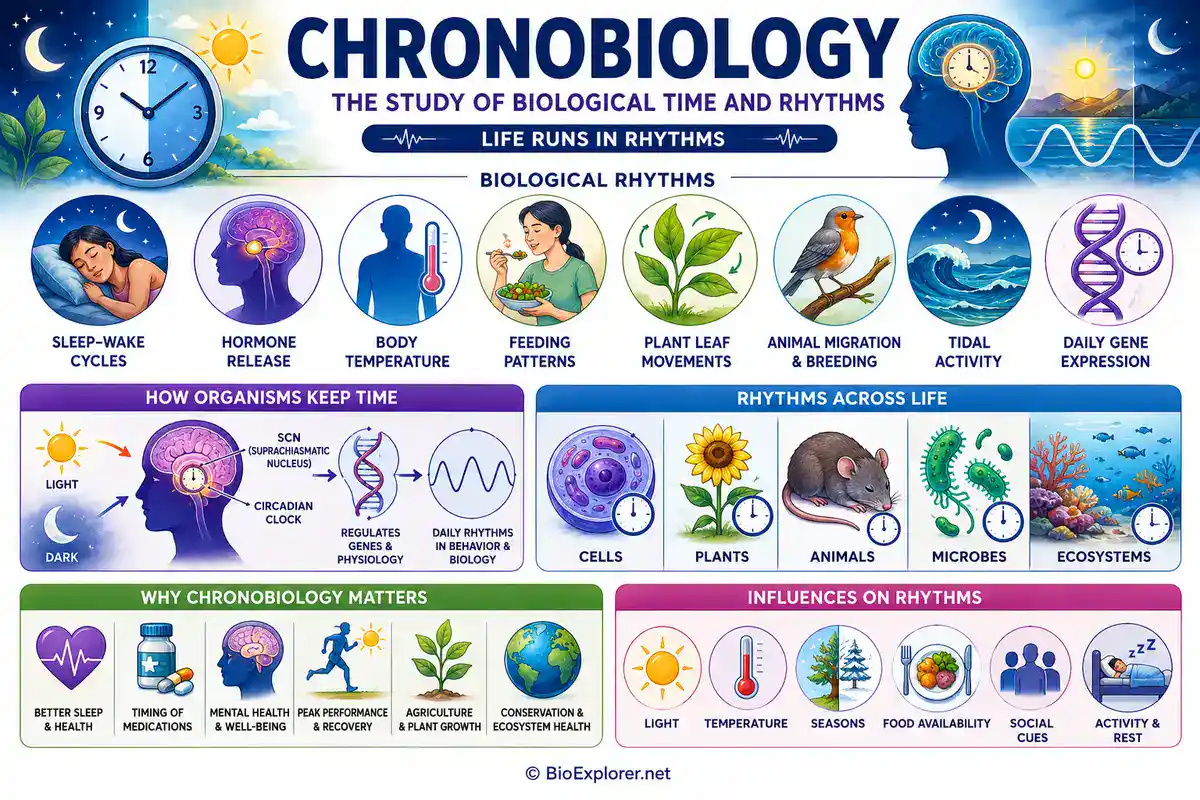
Chronobiology is the division of biology that studies how living things measure, organize, and respond to time. It explains biological rhythms such as sleep and wake cycles, hormone release, body temperature changes, feeding patterns, plant leaf movements, animal migration, breeding seasons, tidal activity, and daily gene expression.
Life does not run as a flat line. Cells, tissues, organs, animals, plants, microbes, and ecosystems often pulse in repeating patterns. Chronobiology studies those rhythms and asks how organisms keep time when the outside world changes between day and night, high tide and low tide, summer and winter, feeding and fasting, activity and rest.
Chronobiology connects closely with physiology, neuroscience, neurobiology, molecular biology, genetics, biochemistry, cell biology, photobiology, botany, zoology, ecology, and pharmacology.
Chronobiology Guide:
- Biological Time Is Not the Same as Clock Time
- The Vocabulary of Biological Rhythms
- A Clock Needs Three Jobs
- The Human Body Is a Clock Network
- Genes Make the Clock Tick
- Light Is the Strongest Daily Reset Button
- Timing Signals Across the Body
- Chronobiology Is Bigger Than Human Sleep
- When Biological Time Falls Out of Sync
- Chronopharmacology: When Dose Timing Matters
- How Scientists Measure Biological Time
- History of Chronobiology: Only the Turning Points That Matter Most
- Chronobiology Careers
- Related BioExplorer Resources
- Recommended Chronobiology Resources
- Chronobiology FAQs
Biological Time Is Not the Same as Clock Time
A wall clock measures hours. A biological clock prepares an organism for what usually happens next. Before sunrise, plants, animals, and microbes may already be changing gene activity, metabolism, hormone levels, temperature, alertness, feeding readiness, or photosynthetic machinery.
This preparation is the key idea in chronobiology. A rhythm is useful only if it helps the organism anticipate a repeating pattern. A nocturnal animal, a flowering plant, a coral, a human liver cell, and a cyanobacterium all face different timing problems, but each must coordinate internal biology with external cycles.
Chronobiology is therefore not just the study of sleep. Sleep is one famous example, but biological timing also affects digestion, immunity, reproduction, metabolism, behavior, photosynthesis, drug response, and ecological interactions.
The Vocabulary of Biological Rhythms
Chronobiology uses specific words because not all biological rhythms have the same period. Some repeat many times a day. Some repeat about once a day. Others follow tides, lunar cycles, seasons, or yearly patterns.
| Rhythm Type | Approximate Timing | Biological Example |
|---|---|---|
| Ultradian Rhythm | Shorter than 24 hours | Sleep stages, hormone pulses, feeding bouts, heart rate variability. |
| Circadian Rhythm | About 24 hours | Sleep-wake timing, body temperature, melatonin release, daily gene expression. |
| Diurnal Pattern | Active or expressed mainly during the day | Many birds, humans, and photosynthetic activity in plants. |
| Nocturnal Pattern | Active mainly during the night | Bats, owls, many rodents, and some insect behaviors. |
| Circatidal Rhythm | Linked to tidal cycles | Activity rhythms in some shore crabs, mollusks, and intertidal organisms. |
| Circalunar Rhythm | Linked to the lunar month | Some coral spawning, marine worm reproduction, and moon-related animal rhythms. |
| Circannual Rhythm | About one year | Migration, hibernation, seasonal breeding, flowering, and dormancy. |
A Clock Needs Three Jobs
A biological timing system usually has three jobs. It must generate a rhythm, adjust that rhythm to the environment, and send timing signals to the rest of the body or organism.
- Keep time: Internal molecular and cellular mechanisms generate a repeating rhythm.
- Reset time: External cues such as light, food, temperature, tide, or social timing adjust the clock.
- Distribute time: The clock coordinates tissues, organs, cells, behavior, and physiology.
The outside cues that reset biological clocks are called zeitgebers, a German word meaning time givers. Light is the most powerful zeitgeber for many circadian systems, but feeding time, temperature, activity, social cues, and seasonal day length can also matter.
The Human Body Is a Clock Network
In humans and other mammals, the master circadian clock is located in the brain’s suprachiasmatic nucleus, often shortened to SCN. The SCN receives light information from the eyes and helps synchronize rhythms across the body.
But the SCN is not the only clock. The liver, heart, lungs, muscles, fat tissue, immune cells, pancreas, gut, and many other tissues have their own circadian timing programs. These peripheral clocks help tissues perform different jobs at different times of day.
This is why chronobiology matters beyond sleep. Your brain, liver, immune system, gut, and muscles do not simply wait for bedtime. They run timed programs that affect alertness, metabolism, digestion, hormone release, temperature, repair, and response to medicine.
Genes Make the Clock Tick
At the cellular level, circadian clocks depend on feedback loops. Clock genes help produce clock proteins. Those proteins rise, fall, move into the nucleus, regulate gene activity, break down, and allow the cycle to begin again.
In fruit flies, the period gene and its PER protein became central to understanding molecular timekeeping. PER levels rise and fall over a daily cycle. Later discoveries, including timeless and doubletime, helped explain how clock proteins enter the nucleus and how timing is adjusted closer to a 24-hour rhythm.
The important lesson is that a biological clock is not a tiny gear. It is a self-regulating molecular circuit. That is why chronobiology overlaps deeply with molecular biology, genetics, and biochemistry.
Light Is the Strongest Daily Reset Button
Light is one of the most important timing signals in chronobiology. Morning light can help align the human circadian clock with daytime activity. Light at night can push the clock in the wrong direction, especially when it reaches the eyes during the biological night.
This is not only about brightness. Timing matters. Light exposure in the morning, evening, and middle of the night can affect the circadian system differently. Chronobiologists study this using phase response curves, melatonin timing, body temperature patterns, sleep timing, and controlled light exposure.
This is where chronobiology overlaps with photobiology, because light is both an environmental signal and a biological input.
Timing Signals Across the Body
Different tissues do not respond to the same timing signal equally. The brain is highly sensitive to light. The liver is strongly affected by feeding time. Muscles respond to activity. The immune system and hormone systems show daily patterns that influence inflammation, repair, and defense.
| Timing Signal | Where It Matters | Chronobiology Question |
|---|---|---|
| Light | Eyes, SCN, melatonin rhythm, sleep timing. | When does light reset the clock, and in which direction? |
| Food Timing | Liver, gut, pancreas, metabolism. | How does meal timing affect peripheral clocks? |
| Temperature | Plants, insects, microbes, cells, body rhythms. | How do organisms keep rhythms stable when temperature changes? |
| Activity | Muscle, brain, sleep-wake timing. | Can exercise shift or strengthen circadian rhythms? |
| Social Timing | Human sleep, work schedules, school schedules. | How do social clocks conflict with biological clocks? |
| Tides | Intertidal animals and coastal ecosystems. | How do organisms time behavior to high and low tides? |
| Day Length | Plants, birds, mammals, insects. | How does seasonal light duration control reproduction, dormancy, or migration? |
| Medication Timing | Drug metabolism, toxicity, response. | Does the time of dosing change benefit or side effects? |
Chronobiology Is Bigger Than Human Sleep
Sleep is one of the best-known circadian behaviors, but chronobiology reaches far beyond sleep medicine. Plants time leaf movement, flowering, photosynthesis, and seasonal responses. Animals time feeding, hunting, mating, migration, hibernation, and predator avoidance. Some birds even use their internal clock to steer. A sun compass only works if the animal knows the time of day, which is one clue to how birds navigate. Marine organisms may follow tidal or lunar rhythms. Microbes can also show daily timing programs.
In plants, biological timing helps coordinate light capture, carbon use, growth, and flowering. In animals, timing helps match behavior to temperature, food, predators, mates, and light conditions. In ecosystems, the timing of one species can affect pollination, feeding, reproduction, and predator-prey interactions.
This makes chronobiology important to botany, zoology, ecology, and marine biology.
When Biological Time Falls Out of Sync
Problems can appear when internal timing and external life do not match. Jet lag, night-shift work, rotating schedules, late-night light exposure, irregular meal timing, and some sleep-wake disorders can disturb circadian alignment.
Short-term circadian disruption can affect sleepiness, alertness, coordination, mood, learning, and focus. Long-term or repeated disruption is studied because it may affect metabolism, cardiovascular health, immune function, mood, and overall disease risk. Chronobiology does not reduce health to one clock, but it shows that timing is part of biology.
This is also why chronobiology has practical links to physiology, pathology, neuroscience, and pharmacology.
Chronopharmacology: When Dose Timing Matters
Chronopharmacology studies how the timing of a drug can affect its absorption, metabolism, effects, and side effects. This happens because liver enzymes, kidney function, gut activity, hormone levels, immune responses, blood pressure, and cell division can vary across the day.
The goal is not to claim that every medicine has one perfect time. The goal is to test whether timing changes drug response in a specific disease, tissue, drug class, or patient group. In some areas, such as cancer treatment, blood pressure treatment, asthma, pain, and sleep medicine, timing can be a serious research question.
Chronopharmacology sits at the intersection of chronobiology and pharmacology.
How Scientists Measure Biological Time
Chronobiologists often need to measure patterns over time rather than a single snapshot. A one-time blood sample, gene test, or behavior observation may miss the rhythm entirely. The timing of measurement can change the result.
- Actigraphy: Uses wearable movement data to estimate rest-activity patterns.
- Sleep diaries: Track sleep, wake time, naps, light exposure, and schedule patterns.
- Melatonin timing: Helps estimate circadian phase, especially under controlled light conditions.
- Core body temperature: Shows daily rhythms linked to circadian regulation.
- Gene expression sampling: Measures clock-controlled genes over time.
- Hormone profiles: Tracks timed signals such as melatonin and cortisol.
- Light exposure monitoring: Measures when and how much light reaches a person or organism.
- Behavioral assays: Track activity rhythms in animals, insects, and other research organisms.
- Mathematical modeling: Predicts rhythm phase, entrainment, misalignment, and recovery after disruption.
History of Chronobiology: Only the Turning Points That Matter Most
The history of chronobiology changed when scientists stopped treating biological rhythms as passive responses to the environment and began testing them as internal timing systems that can be reset, measured, mutated, and modeled.
| Year | Milestone | Why It Matters |
|---|---|---|
| 1729 | Jean-Jacques d’Ortous de Mairan observed that mimosa leaf movements continued in constant darkness. | Helped show that daily plant rhythms could persist without direct sunlight. |
| 1820s | Augustin Pyramus de Candolle measured plant leaf rhythms in constant conditions and found a period that was not exactly 24 hours. | Helped support the idea of an internal free-running rhythm. |
| 1960 | Cold Spring Harbor Symposium on Biological Clocks helped consolidate biological timing as a research field. | Brought together work on rhythms, entrainment, physiology, and experimental clock biology. |
| 1971 | Seymour Benzer and Ronald Konopka reported fruit fly mutants with altered circadian rhythms and identified the period gene. | Showed that genes could control biological clock timing. |
| Early 1970s | Research on the suprachiasmatic nucleus helped establish it as a central circadian pacemaker in mammals. | Connected a specific brain region with mammalian circadian organization. |
| 1984 | Jeffrey Hall, Michael Rosbash, and Michael Young isolated the period gene in fruit flies. | Opened the molecular era of circadian clock research. |
| 2017 | Jeffrey Hall, Michael Rosbash, and Michael Young received the Nobel Prize in Physiology or Medicine. | Recognized discoveries of molecular mechanisms controlling circadian rhythm. |
Chronobiology Careers
Chronobiology careers often follow the clock into different systems. Some researchers study genes and proteins. Others study sleep, shift work, plants, marine rhythms, animal behavior, drug timing, metabolism, or mathematical models of biological time.
- Chronobiologist: Studies biological rhythms and timing systems in living organisms.
- Circadian biologist: Studies about 24-hour rhythms, clock genes, entrainment, and clock-controlled physiology.
- Sleep researcher: Studies sleep timing, sleep-wake regulation, circadian disorders, and behavior.
- Molecular chronobiologist: Studies clock genes, clock proteins, feedback loops, and gene expression rhythms.
- Neurobiologist: Studies brain circuits such as the SCN and neural control of biological timing.
- Plant chronobiologist: Studies timing in photosynthesis, flowering, growth, and seasonal responses.
- Ecological chronobiologist: Studies rhythms in animals, plants, microbes, populations, and ecosystems.
- Chronopharmacology researcher: Studies how drug timing affects response, toxicity, and treatment outcomes.
- Occupational health scientist: Studies shift work, fatigue, light exposure, alertness, and schedule design.
- Computational chronobiologist: Uses models and data to study rhythm phase, entrainment, and clock networks.
How To Become A Sleep Doctor?
Related BioExplorer Resources
Use these BioExplorer pages to connect chronobiology with biological timing, light, nervous systems, physiology, genes, plants, animals, and ecology:
- Physiology
- Neuroscience
- Neurobiology
- Molecular Biology
- Genetics
- Biochemistry
- Cell Biology
- Photobiology
- Botany
- Zoology
- Ecology
- Marine Biology
- Pharmacology
- Theoretical Biology
- Cellular Organization
- Building Blocks of Proteins
Recommended Chronobiology Resources
These external resources are useful for learning about circadian rhythms, biological clocks, clock genes, sleep-wake timing, light exposure, shift work, chronobiology research, and biological rhythms.
- NIGMS: Circadian Rhythms A reliable NIH introduction to circadian rhythms, biological clocks, the SCN, and health effects.
- Nobel Prize: Circadian Rhythm Discoveries Official Nobel background on Hall, Rosbash, Young, and molecular clock mechanisms.
- Nobel Prize Press Release: 2017 Physiology or Medicine A clear explanation of the period gene, PER protein, timeless, and biological clock feedback loops.
- Society for Research on Biological Rhythms A professional society focused on biological rhythms and chronobiology research.
- Journal of Biological Rhythms A major peer-reviewed journal for circadian and biological rhythm research.
- Chronobiology International A journal focused on biological rhythms, chronobiology, and circadian science.
- CDC NIOSH: Shift Work and Long Work Hours Training A practical resource on sleep, circadian rhythms, fatigue, and shift work risk reduction.
- Sleep Foundation: Circadian Rhythm An accessible overview of circadian rhythm, sleep timing, light, and daily body patterns.
- BrainFacts.org: Sleep and the Brain A public neuroscience resource related to sleep, brain function, and biological timing.
- HHMI BioInteractive Educational biology resources, including materials useful for teaching biological clocks and genetics.
Chronobiology FAQs
Chronobiology is the branch of biology that studies biological rhythms and timing systems, including circadian rhythms, sleep-wake cycles, hormone timing, seasonal rhythms, tidal rhythms, and biological clocks.
Chronobiologists study biological clocks, clock genes, light exposure, sleep-wake timing, hormone rhythms, metabolism, plant rhythms, animal behavior, tidal rhythms, seasonal timing, and circadian disruption.
A circadian rhythm is an internal biological rhythm that repeats about every 24 hours. It helps organisms coordinate physiology and behavior with daily light-dark cycles.
A biological clock is an internal timing system that helps generate and coordinate rhythms in cells, tissues, organs, and behavior. In humans, the master circadian clock is in the suprachiasmatic nucleus.
Light can reset circadian rhythms because the eyes send timing information to the brain’s master clock. Morning light and nighttime light can affect the clock differently.
No. Chronobiology includes sleep, but it also studies metabolism, hormones, immunity, plant rhythms, animal behavior, seasonal timing, tidal rhythms, drug timing, and gene expression rhythms.
Chronopharmacology studies how the timing of a medicine can affect its absorption, metabolism, benefits, and side effects.
Chronobiology is important because timing affects sleep, alertness, metabolism, hormones, immunity, drug response, plant growth, animal behavior, ecological interactions, shift work, and jet lag.
Cite this page
BioExplorer. (2026, October 2). Chronobiology: How Living Things Keep Time. https://www.bioexplorer.net/divisions_of_biology/chronobiology/