Crow vs Raven: Every Difference Explained With Facts!
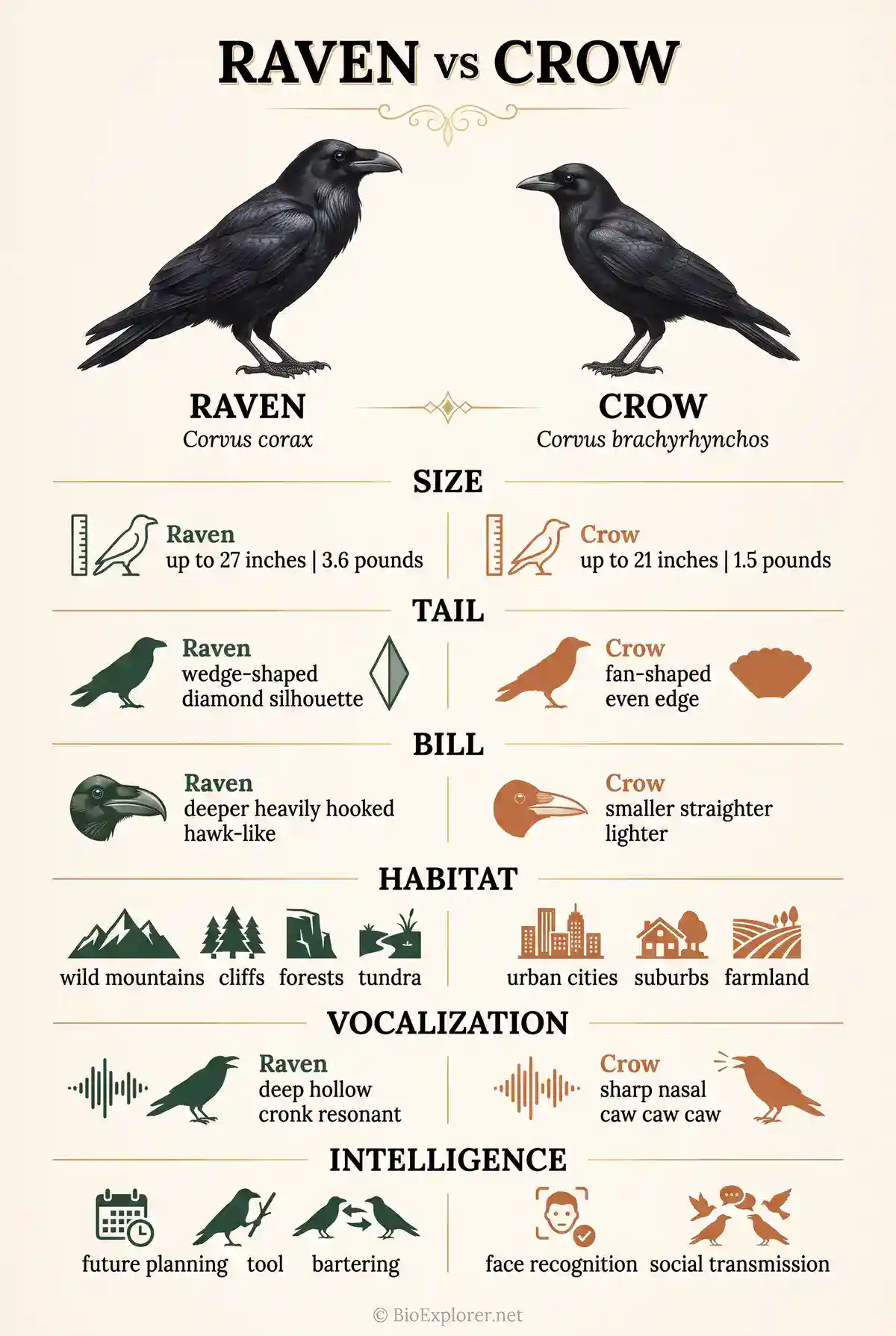
Crows and ravens belong to the same genus, Corvus, but ravens are larger, have a wedge-shaped tail, a deeply curved bill, and shaggy throat hackles that crows lack. In flight, ravens soar on flat wings while crows flap steadily. Their calls differ completely: crows produce a sharp nasal caw while ravens give a deep hollow cronk.
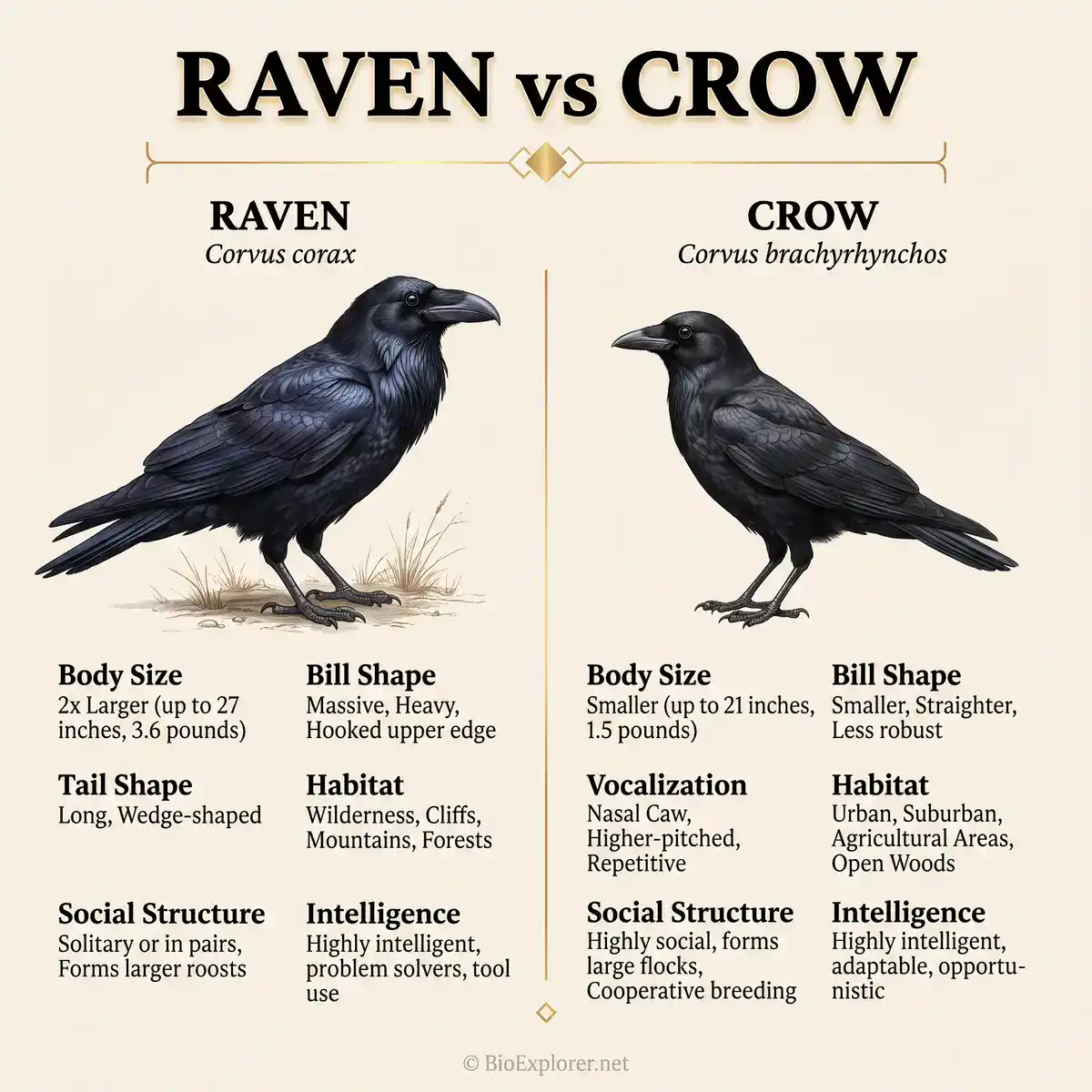
Stand at a trailhead in Alaska or a city park in Ohio and you may see a large black bird perched overhead. Whether it is a crow or a raven is a question that birders, hikers, and students debate regularly.
Both belong to the genus Corvus within the family Corvidae, yet they differ in body size, bill anatomy, tail shape, vocalizations, habitat preference, social structure, and cognitive profile. This page documents every measurable and behaviorally documented difference between the two, with sources for each claim.
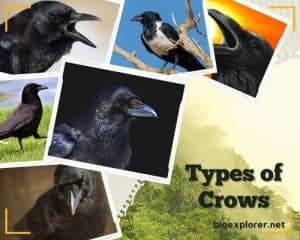
For a full list of all recognized Corvus species, see types of crows. For diet specifics, see what do crows eat.
Raven vs. Crow Differences Guide:
- Are Ravens a Type of Crow? The Taxonomy Answer
- Size and Weight: The Most Reliable Field Marker
- Tail Shape: The Single Fastest Field ID
- Bill Anatomy
- Throat Hackles
- Physical Field Marks: Full Comparison
- Flight Behavior
- Vocalizations
- Habitat and Geographic Range
- Social Structure and Group Behavior
- Diet and Foraging Strategy
- Intelligence and Cognition: Where Each Bird Excels
- Nesting and Breeding
- Lifespan
- Predators and Threats
- A Historical Note: Classification and Early Observation
- Quick Field Identification Summary
- Related Pages on BioExplorer
Are Ravens a Type of Crow? The Taxonomy Answer
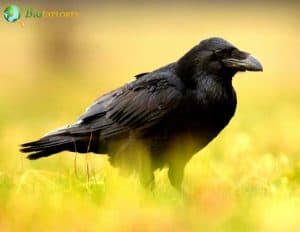
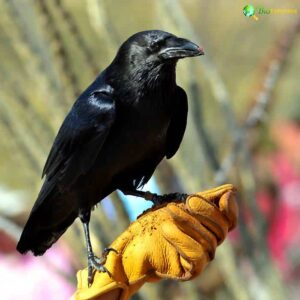
Yes. Ravens are crows in the strict scientific sense. The Common Raven (Corvus corax), the Thick-billed Raven (Corvus crassirostris), the Chihuahuan Raven (Corvus cryptoleucus), the Brown-necked Raven (Corvus ruficollis), and the White-necked Raven (Corvus albicollis) are all members of the same genus as the American Crow (Corvus brachyrhynchos), the Carrion Crow (Corvus corone), and the Hooded Crow (Corvus cornix). The distinction between “crows” and “ravens” is a matter of common name and body size, not a taxonomic division. Ravens are simply the larger members of Corvus.
Both crows and ravens belong to the order Passeriformes, making them passerine birds despite their large size. The Rook (Corvus frugilegus) and the Eurasian Jackdaw (now reclassified to genus Coloeus) are close corvid relatives. The study of these birds falls within Ornithology.
Size and Weight: The Most Reliable Field Marker
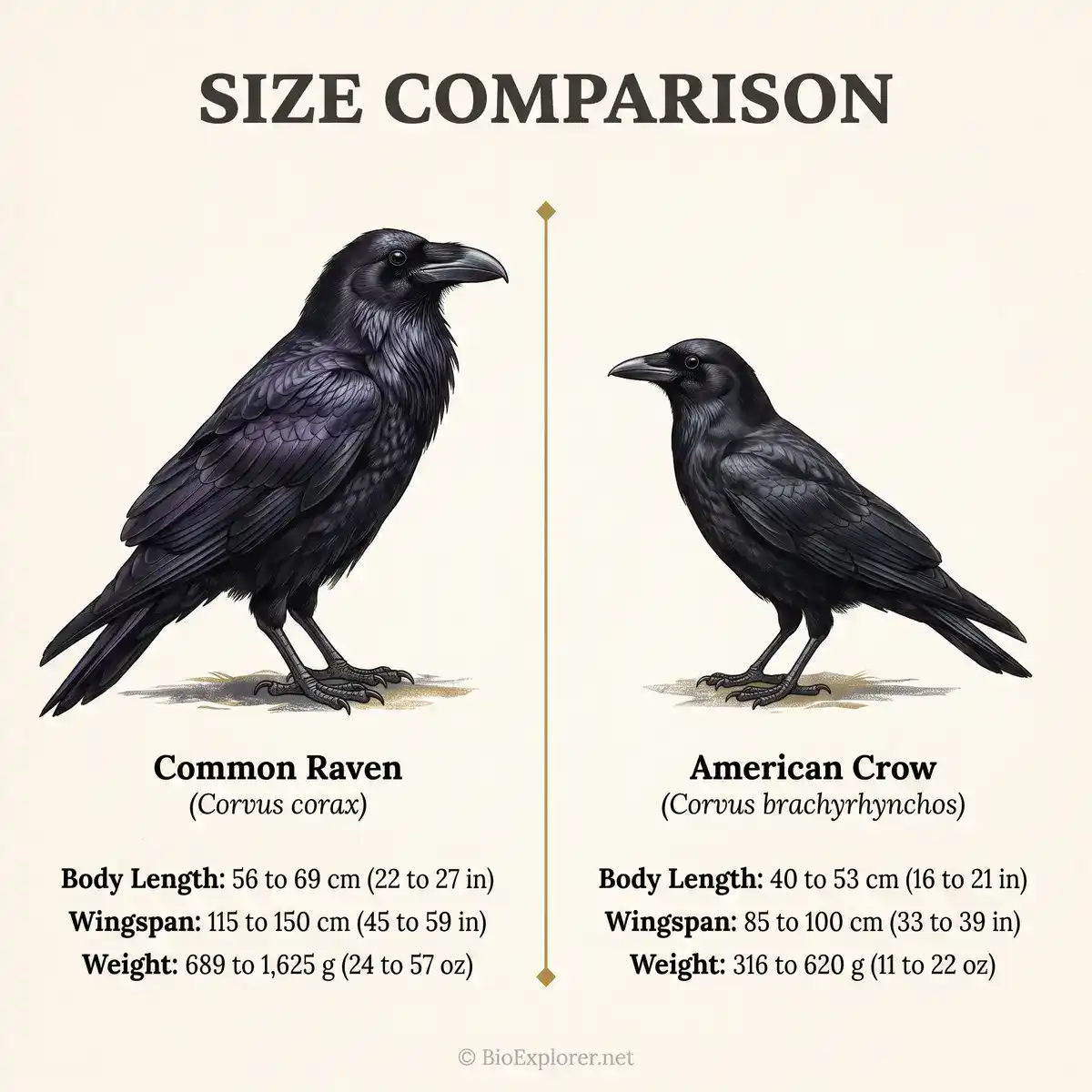
When a crow and a raven appear together, size settles the question immediately. The Common Raven is roughly the size of a Red-tailed Hawk. The American Crow is noticeably smaller, closer in size to a Rock Pigeon. The table below uses measurements from the Cornell Lab of Ornithology and Birds of the World.
| Measurement | American Crow (Corvus brachyrhynchos) | Common Raven (Corvus corax) |
|---|---|---|
| Body Length | 40 to 53 cm (16 to 21 in) | 56 to 69 cm (22 to 27 in) |
| Body Weight | 316 to 620 g (11 to 22 oz) | 689 to 1,625 g (24 to 57 oz) |
| Wingspan | 85 to 100 cm (33 to 39 in) | 115 to 150 cm (45 to 59 in) |
The Thick-billed Raven (Corvus crassirostris) of the Ethiopian highlands is the largest Corvus species of all, reaching up to 64 cm in length and exceeding 1 kg in weight, making it potentially the world’s heaviest passerine bird.
Tail Shape: The Single Fastest Field ID
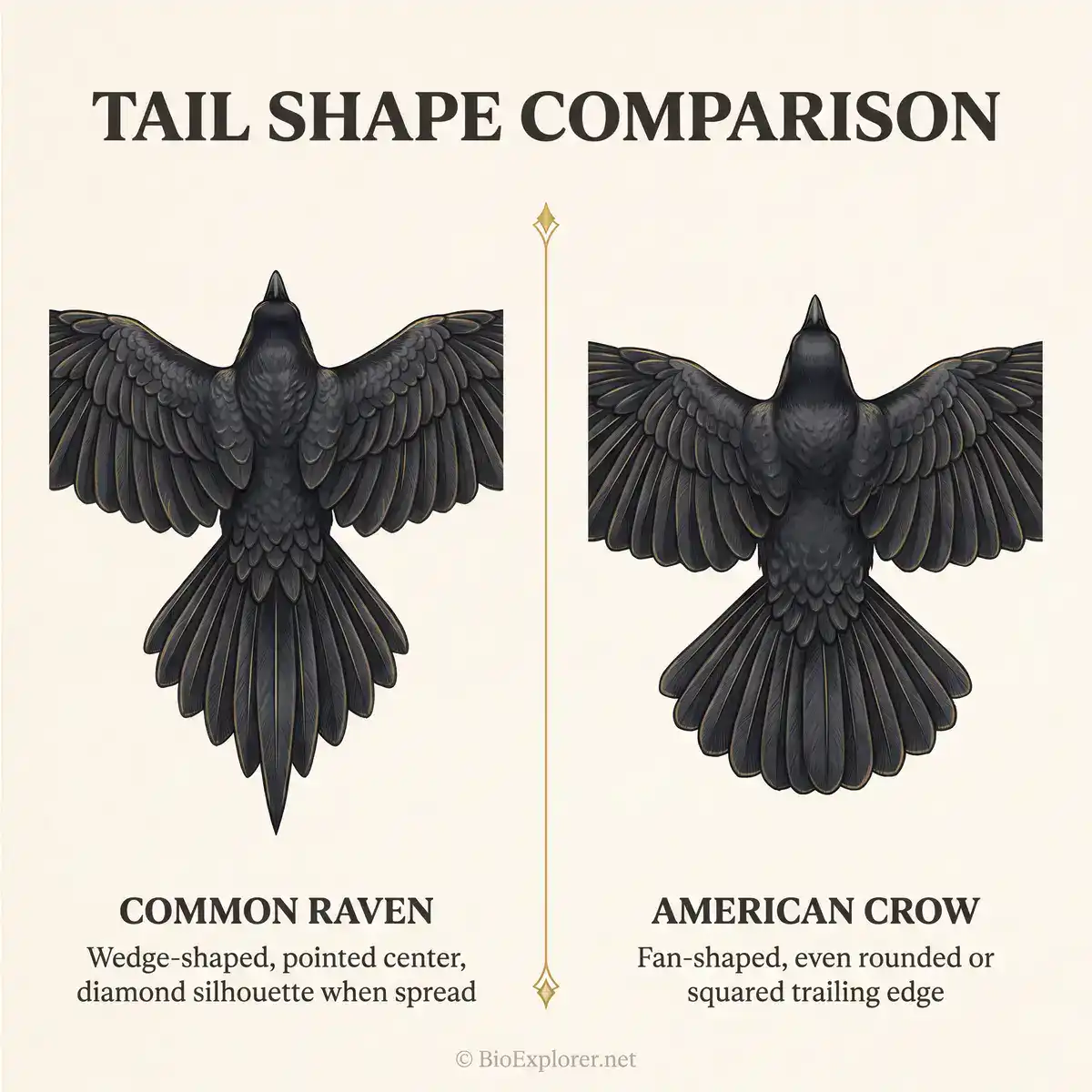
Tail shape is the fastest way to separate a crow from a raven in flight, and it works even at distance. Ravens have a wedge shaped tail, pointed in the center, forming a distinct diamond silhouette when spread. Crows have a fan shaped tail with an even, rounded or squared trailing edge.
This difference is visible whether the bird is perched or soaring. Look at the tail as the bird flies away from you. A pointed center tip means raven. A flat or gently rounded edge means crow. No other field mark resolves as quickly at a distance.
Bill Anatomy
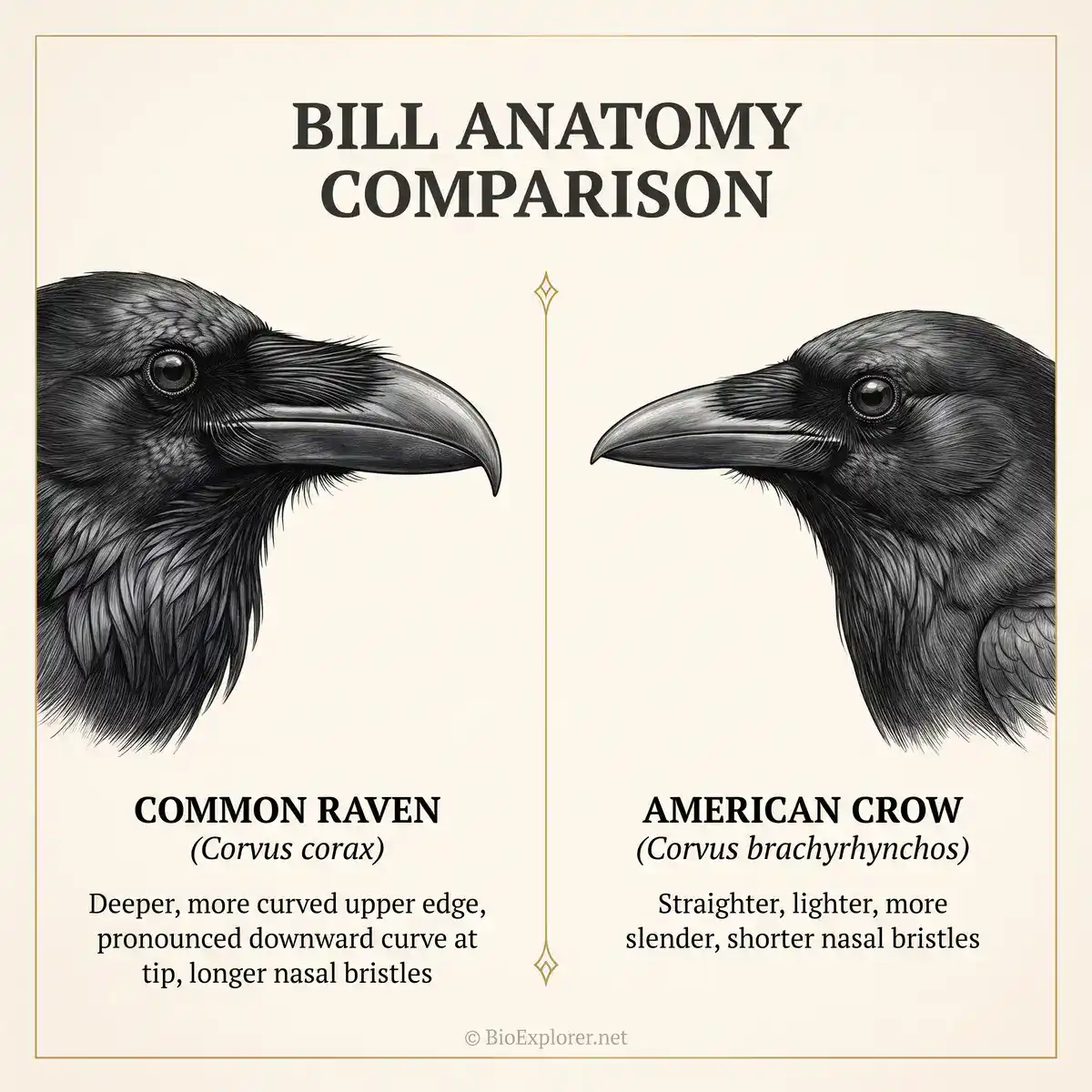
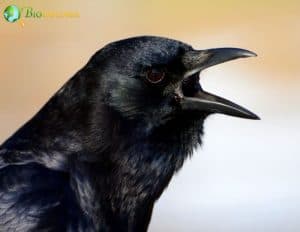
The raven bill is substantially deeper, more curved along the upper edge, and carries a pronounced downward curve at the tip. The nasal bristles (feathers covering the base of the upper mandible) extend further along the bill in ravens than in crows. The crow bill is straighter, lighter in proportion to the head, and appears more slender from the side.
In hand, the difference is unmistakable. In the field, the raven bill looks almost hawk like in its curvature, while the crow bill looks proportional and unremarkable.
Throat Hackles
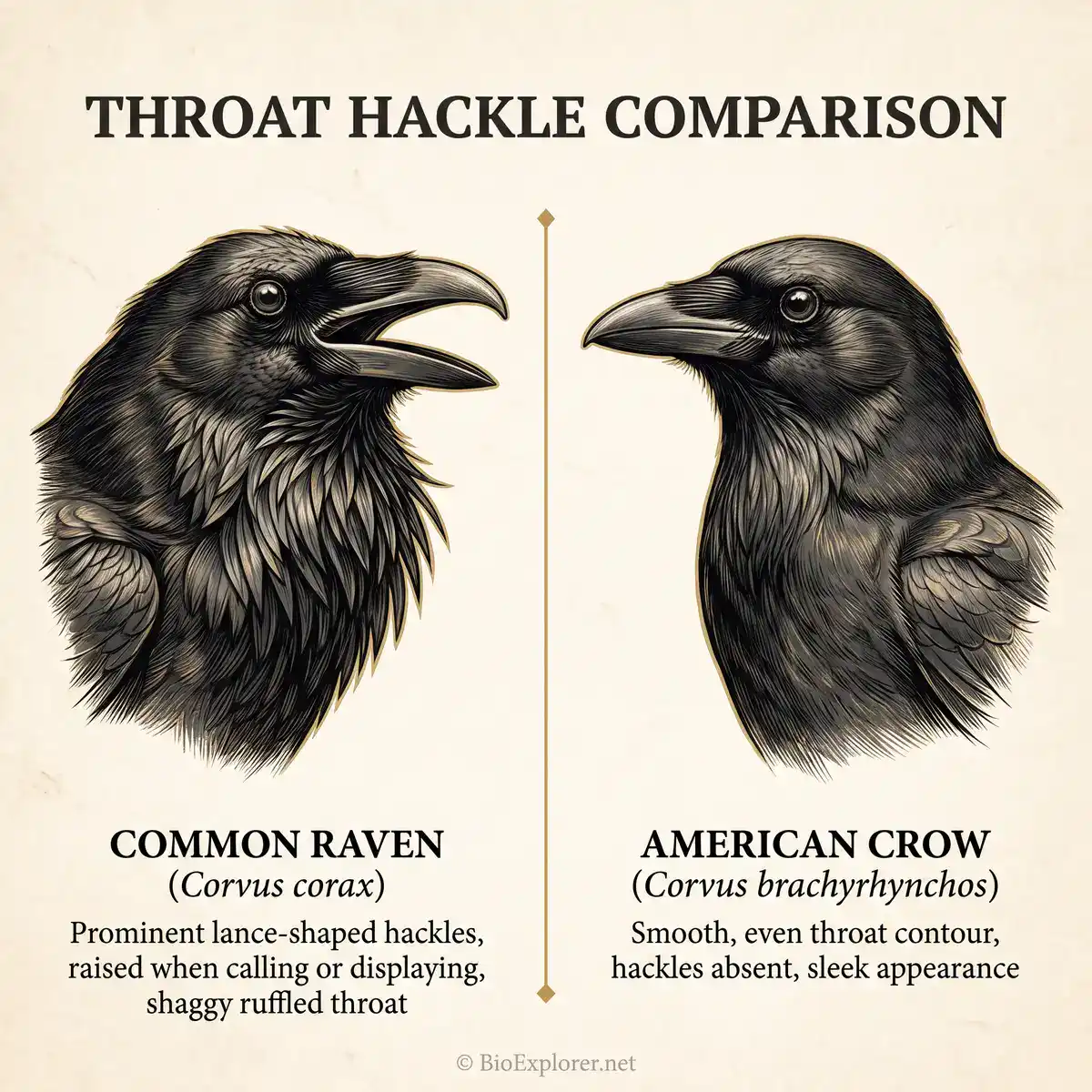
Ravens have prominent lance shaped feathers on the throat, called hackles, which they raise when vocalizing, displaying, or interacting socially. These hackles give the throat a shaggy, ruffled appearance that is entirely absent in crows. When a raven calls, the throat hackles visibly puff and move. A crow throat appears smooth and even by comparison. This is one of the clearest perched identification marks at close range.
Physical Field Marks: Full Comparison
| Feature | Crow (American Crow) | Raven (Common Raven) |
|---|---|---|
| Tail shape | Fan shaped, even trailing edge | Wedge shaped, pointed center |
| Bill profile | Straight, slender | Deeply curved, thick, hawk-like |
| Throat hackles | Absent; smooth throat feathers | Prominent lance-shaped hackles |
| Nasal bristles | Cover base of bill only | Extend 2/3 of bill length |
| Head shape | Rounded, smooth crown | Larger, slightly peaked crown |
| Wing tip | Rounded, compact | Longer primary feathers, splayed “fingers” |
| Plumage gloss | Black with blue or purple iridescence | Black with blue, green, and purple iridescence; stronger gloss |
| Eye color (adult) | Dark brown | Dark brown (slightly larger iris) |
Flight Behavior
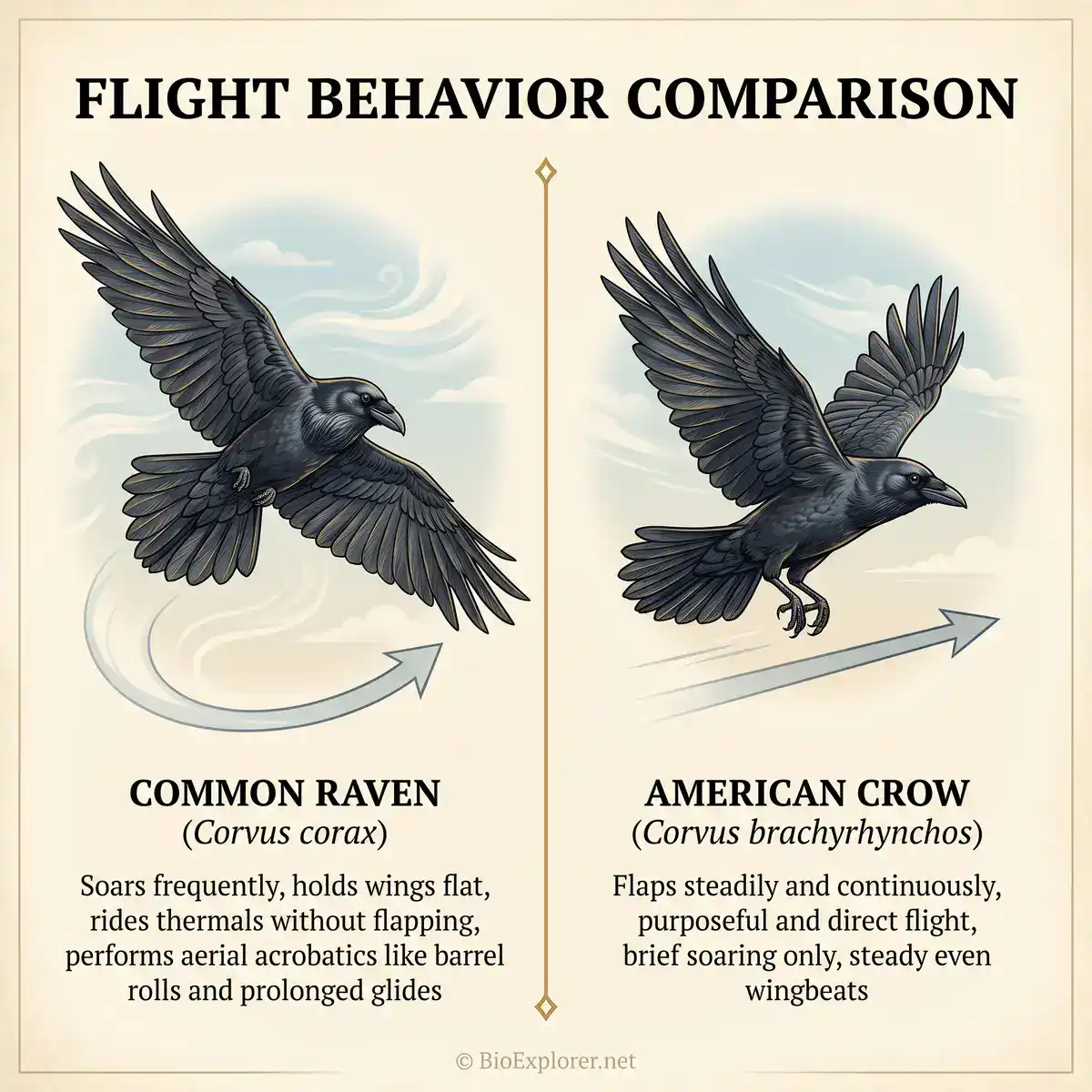
Flight style is one of the most underrated identification tools for separating these two birds, and it works at distances where physical features become hard to read.
Ravens soar frequently, holding their wings flat and riding thermals for extended periods without flapping. They also perform aerial acrobatics, including barrel rolls, tumbles, and prolonged glides, particularly during courtship and play. The wing loading of a raven relative to its surface area allows this sustained soaring in a way that crows cannot replicate.
Crows flap more steadily and continuously. Their flight is purposeful and direct. While crows can soar briefly, sustained thermal soaring is not characteristic of their flight. A bird circling effortlessly overhead without flapping is almost certainly a raven. A bird flying with steady, even wingbeats toward a destination is almost certainly a crow.
Vocalizations
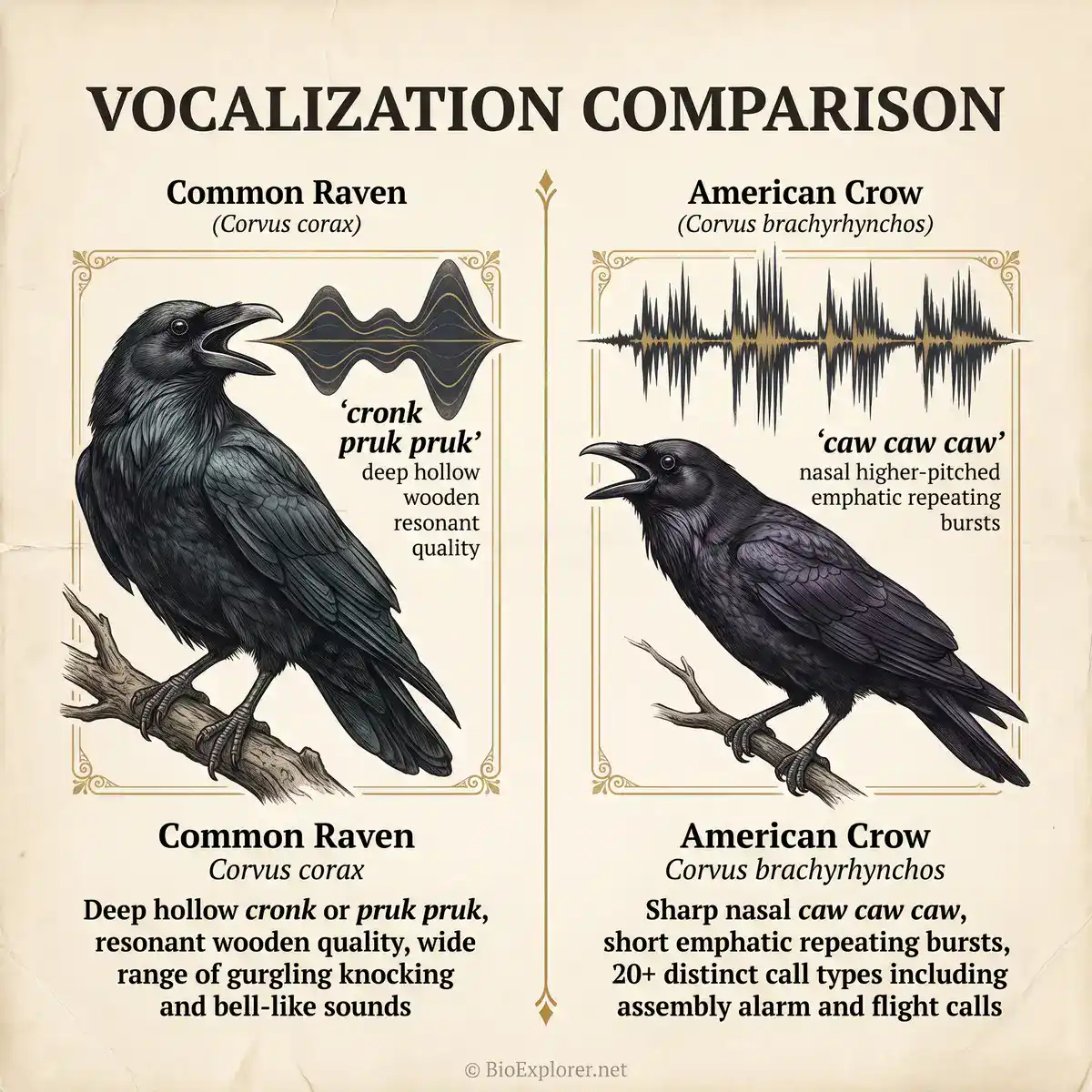
The calls of crows and ravens are distinctive enough to identify the bird by ear alone, even when it is out of sight. The American Crow produces a sharp, nasal “caw caw caw” that is familiar in suburbs, parks, and farmland across North America. The call carries well and repeats in short, emphatic bursts. American Crows use more than 20 distinct call types including assembly calls, alarm calls, and flight calls.
The Common Raven call is fundamentally different in character: a deep, hollow “cronk” or “pruk pruk” with a resonant, almost wooden quality. Ravens also produce a wide range of gurgling, knocking, and bell-like sounds. The depth and resonance of a raven call reflects the bird’s larger syrinx and body cavity. Hearing a “cronk” in a forest or mountain setting is a reliable indicator of raven presence.
| Call Type | American Crow | Common Raven |
|---|---|---|
| Primary call | Sharp, nasal “caw caw caw” | Deep, hollow “cronk” or “pruk pruk” |
| Tone quality | High and piercing | Low and resonant, wooden quality |
| Vocabulary range | 20+ distinct call types documented | Wide range: gurgling, knocking, bell-like notes |
| Alarm call | Rapid repeated cawing, highly social broadcast | Lower, shorter notes; less group-broadcast |
| Courtship call | Short soft notes between pair | Complex gurgling and bill-clicking sequences |
Habitat and Geographic Range
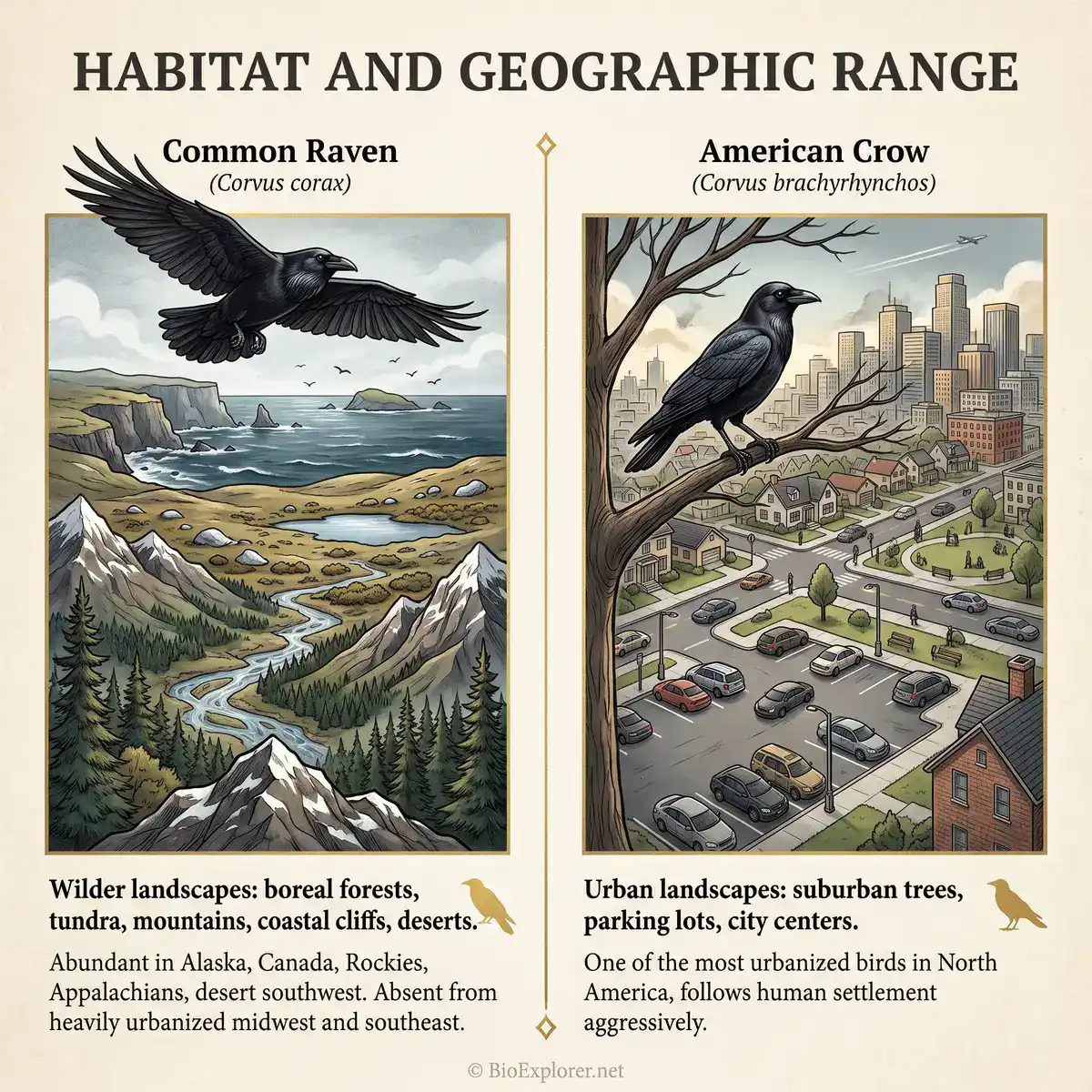
Habitat is where the ecological split between crows and ravens becomes most visible. Crows have followed human settlement aggressively. The American Crow is one of the most urbanized birds in North America, commonly nesting in suburban trees, foraging in parking lots, and roosting in city centers. The Carrion Crow occupies a similar urban niche across western Europe.
Ravens favor wilder landscapes: boreal forests, tundra, mountain ranges, coastal cliffs, and desert regions. In North America, the Common Raven is abundant across Alaska, Canada, the Rocky Mountains, Appalachians, and desert southwest, but largely absent from the heavily urbanized midwest and southeast. Where human settlements are sparse, ravens are often the dominant corvid. Where cities and suburbs dominate, crows take over.
| Characteristic | American Crow | Common Raven |
|---|---|---|
| Primary habitat | Urban, suburban, agricultural, woodland edge | Boreal forest, tundra, mountains, coastlines, desert |
| North American range | Year-round across most of continental USA and southern Canada | Alaska, Canada, western USA, Appalachians; circumpolar globally |
| Elevation | Low to moderate elevations | Sea level to above 6,000 m in mountain ranges |
| Urban tolerance | Very high; actively exploits human food sources | Low to moderate; avoids dense urban cores |
| Coexistence | Often displaces ravens from suburban areas | Dominates in remote, undeveloped landscapes |
The Common Raven has the widest range of any corvid, distributed across the entire Northern Hemisphere including Iceland, Greenland, North Africa, the Middle East, Central Asia, and the Pacific coast. It is the most widely distributed of all corvids. Source: IUCN Red List, Corvus corax assessment.
Social Structure and Group Behavior
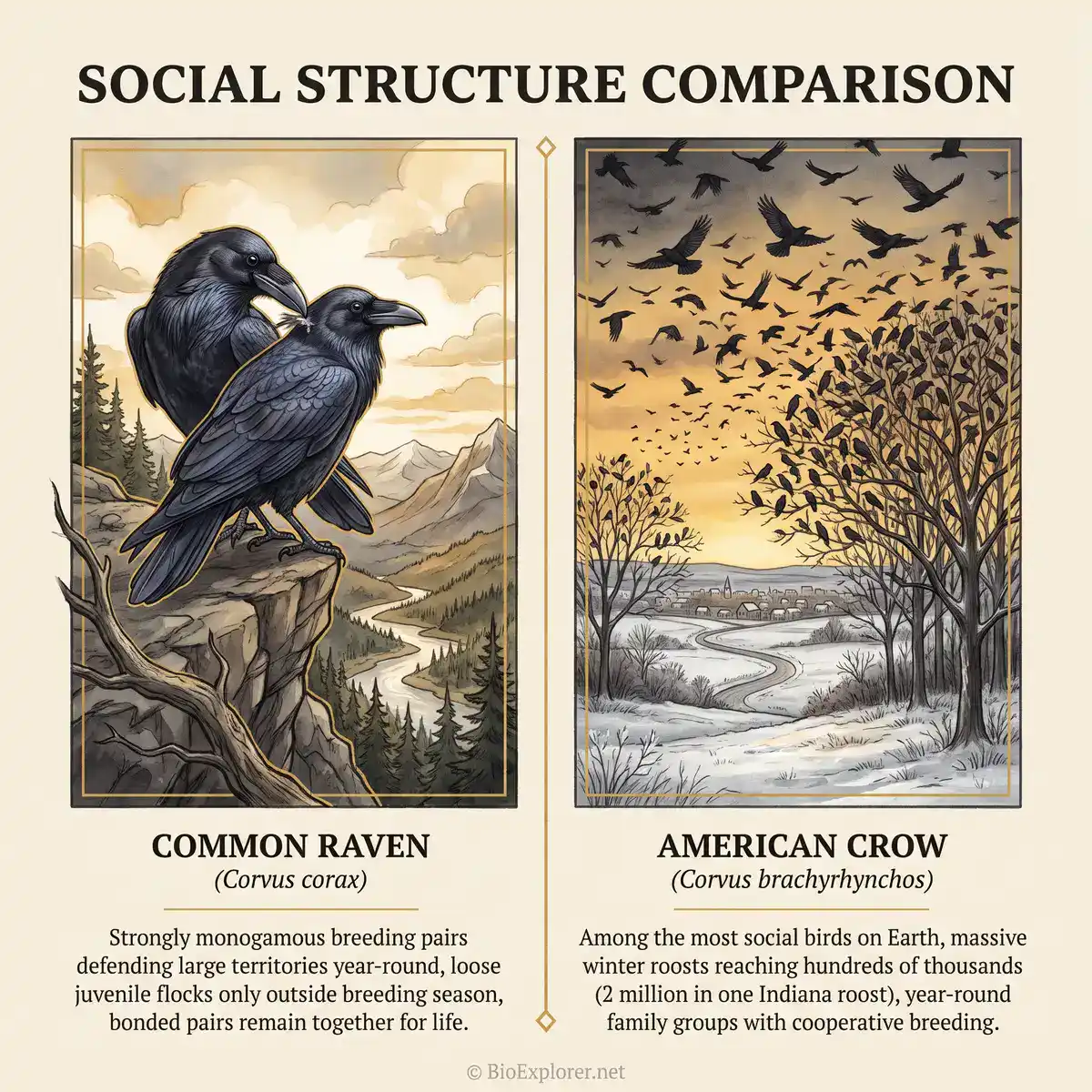
Crows are among the most social birds on Earth. American Crows form winter roosts that can number in the hundreds of thousands. A documented roost in Terre Haute, Indiana, reached an estimated 2 million individuals. Year-round, crows maintain complex family group structures in which offspring from previous years assist in raising the next clutch, a behavior called cooperative breeding.
Ravens operate very differently. Breeding pairs are strongly monogamous and defend large territories year-round. Outside the breeding season, non-breeding juveniles and subadults form loose flocks around food sources, but these flocks lack the cohesion and scale of crow roosts. A bonded raven pair typically remains together for life.
One behavioral overlap: both species mob predators including owls, hawks, and eagles. American Crows are particularly persistent mobbers and will recruit large groups to harass a roosting owl for extended periods.
Diet and Foraging Strategy
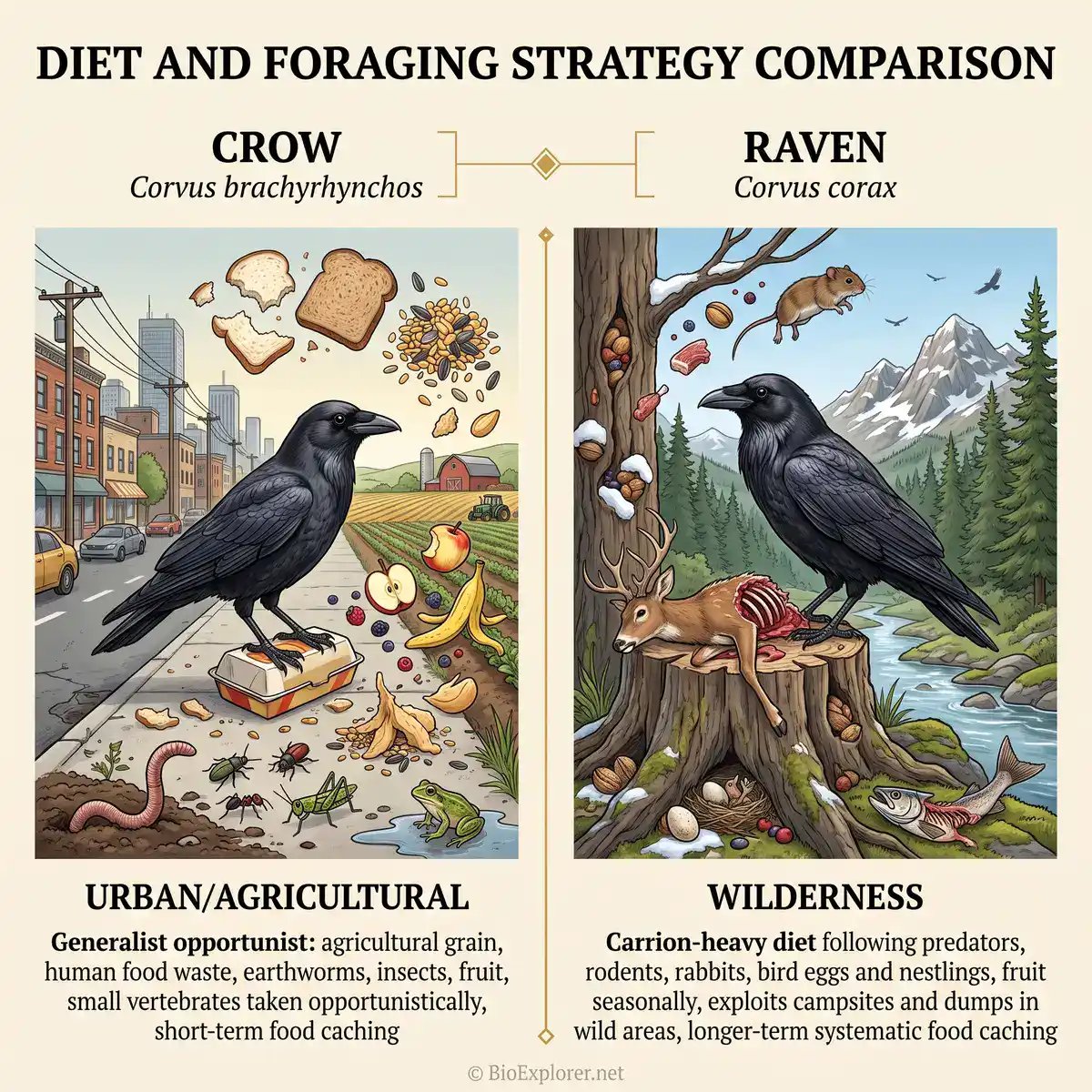
Both birds are omnivores, but their dietary profiles reflect their different ecological positions. Crows are generalist opportunists that exploit whatever food is locally abundant, from agricultural grain to fast food scraps to roadkill. Ravens lean more heavily toward carrion and large prey items, and their scavenging behavior is more systematic in remote habitats where carcasses from wolves, bears, or natural mortality are a reliable food source.
| Food Source | American Crow | Common Raven |
|---|---|---|
| Carrion | Taken opportunistically | Major dietary component; actively follows predators |
| Small vertebrates | Mice, frogs, nestlings | Rodents, rabbits, bird eggs, nestlings |
| Invertebrates | Earthworms, insects, beetles | Insects, beetles; less central than in crows |
| Grain and seeds | Major component in agricultural areas | Minor component |
| Human food waste | Primary urban food source | Exploited at campsites, dumps in wild areas |
| Fruit and berries | Regularly consumed | Consumed seasonally |
| Food caching | Practiced; short-term | Practiced; longer-term and more systematic |
Ravens have been documented following wolf packs in North America and Europe, feeding on carcasses that wolves open. This relationship is documented extensively in Yellowstone National Park.
Intelligence and Cognition: Where Each Bird Excels
Both crows and ravens are among the most cognitively studied birds in the world, and research has identified genuinely different cognitive specializations between them.
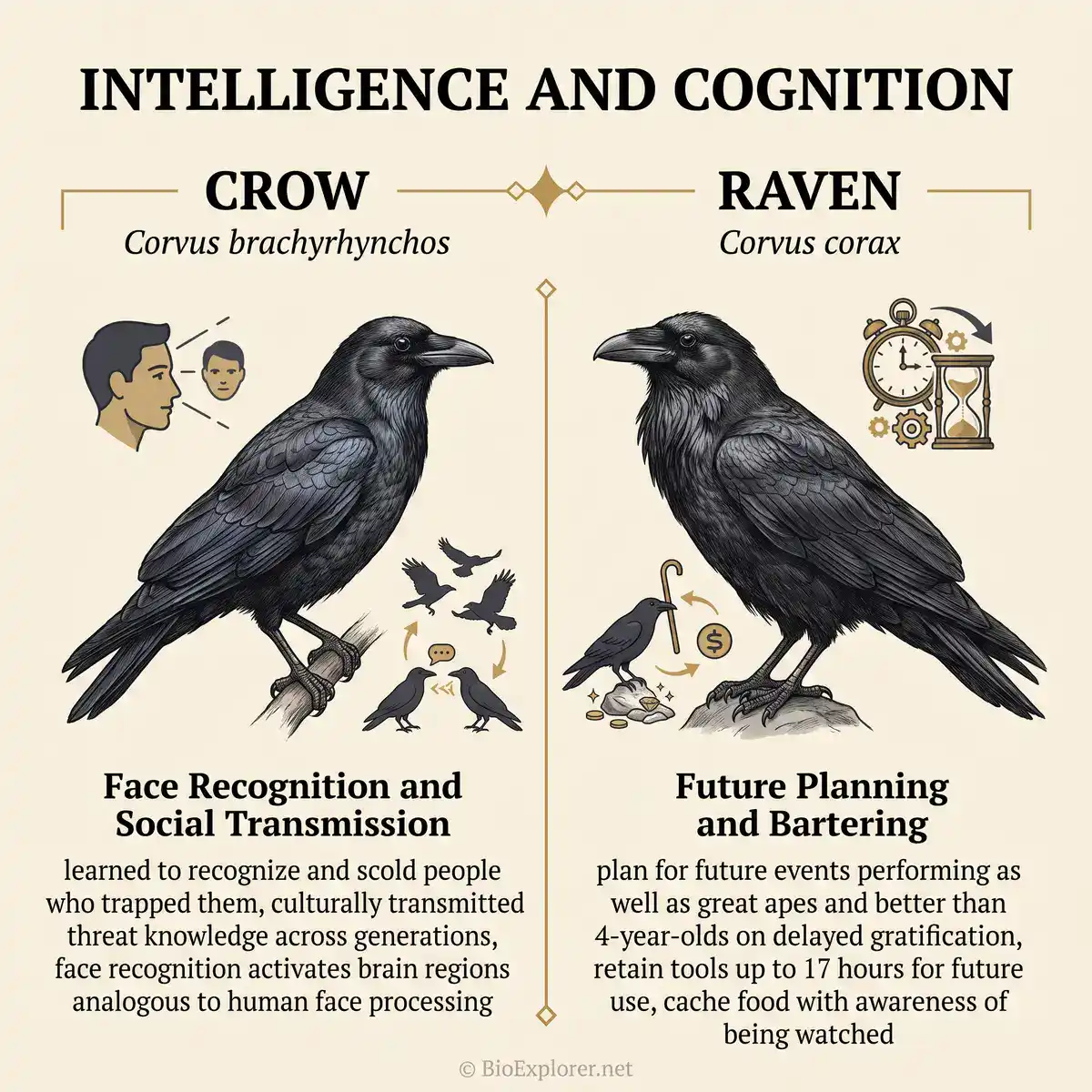
American Crows: Face recognition and social transmission. A 2010 study by Marzluff and colleagues published in Animal Behaviour demonstrated that wild American Crows near Seattle learned to recognize and scold people who had trapped and banded them, retaining that face memory for at least 2.7 years. Crows that had not been present during the original trapping subsequently learned the dangerous face through social observation, demonstrating culturally transmitted threat learning. A follow-up neuroimaging study confirmed that face recognition in crows activates brain regions analogous to those used in human face processing.
New Caledonian Crows: Tool manufacture. The New Caledonian Crow (Corvus moneduloides) is the most advanced non-human tool manufacturer documented. These birds craft hooked tools from plant stems, selecting specific materials and modifying them to extract invertebrates from tree cavities. The behavior is learned and varies regionally, meeting criteria for a tool culture.
Common Ravens: Future planning and bartering. A 2017 study by Kabadayi and Osvath published in Science demonstrated that ravens plan for future events involving tool use and bartering, performing at least as well as great apes and better than 4-year-old children on delayed gratification tasks. Ravens selected and retained a tool for up to 17 hours in anticipation of future use, a form of mental time travel not previously confirmed in non-human animals outside of great apes.
Food caching with deception. Ravens that have been observed caching food by other ravens will return later and move their caches to new locations, a behavior that implies awareness of being watched. This has been interpreted as evidence of theory of mind, though the interpretation remains debated among researchers.
Nesting and Breeding
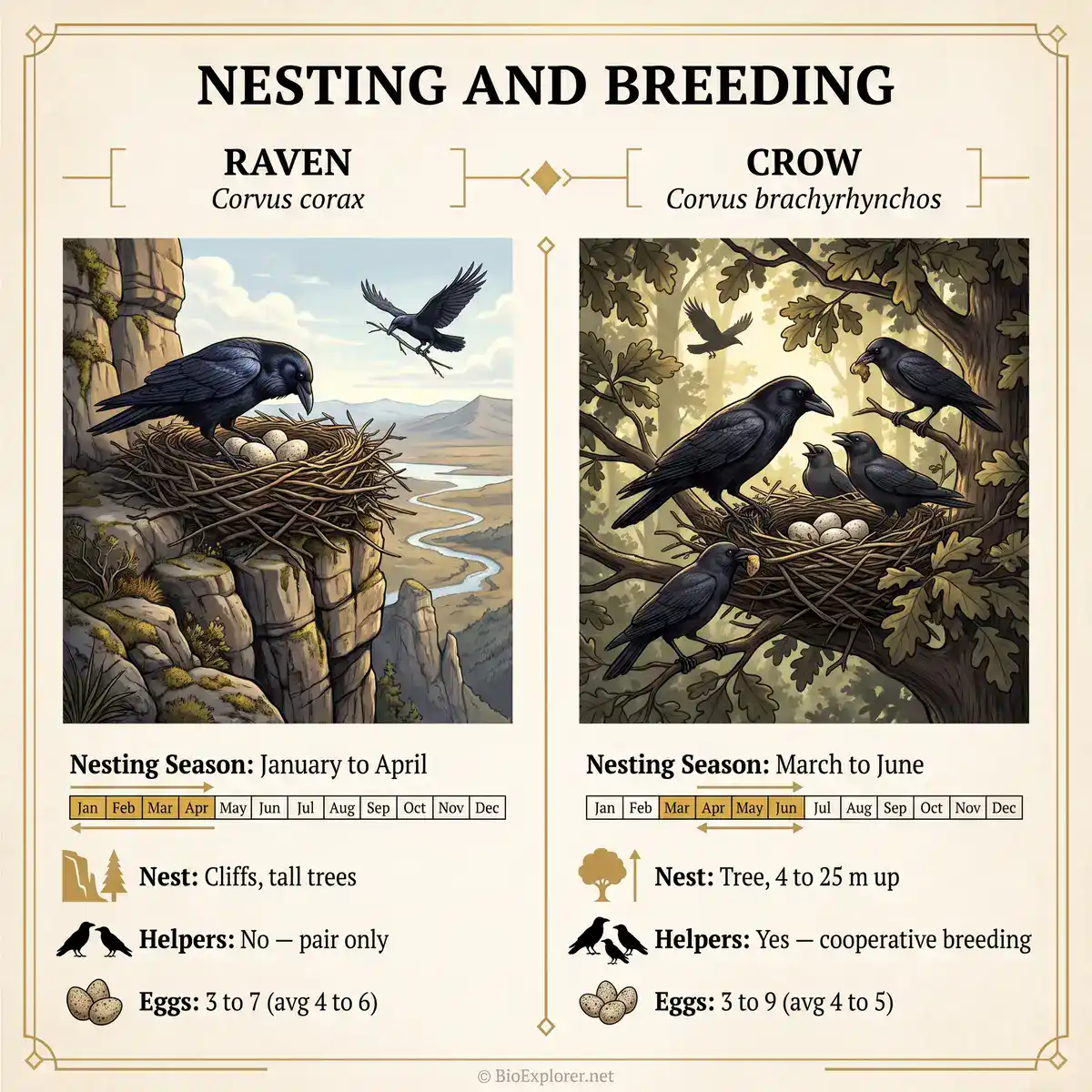
Ravens nest considerably earlier in the year than crows. This difference is consistent enough to be a seasonal identification clue: if you see a large black corvid on a nest in February, it is almost certainly a raven.
| Factor | American Crow | Common Raven |
|---|---|---|
| Nesting season | March to June | January to April; eggs often laid February to March |
| Nest location | Trees, 4 to 25 m above ground | Cliff ledges, large trees, man-made structures |
| Nest structure | Sticks lined with bark, grass, fur | Larger stick platform lined with wool, fur, bark |
| Clutch size | 3 to 9 eggs (average 4 to 5) | 3 to 7 eggs (average 4 to 6) |
| Incubation period | 18 to 19 days | 20 to 25 days |
| Fledging period | 30 to 45 days | 35 to 49 days (4 to 7 weeks) |
| Cooperative breeding | Yes; offspring from prior years act as helpers | No; breeding pair raises young without helpers |
| Sexual maturity | 2 to 4 years | 3 to 4 years |
Lifespan
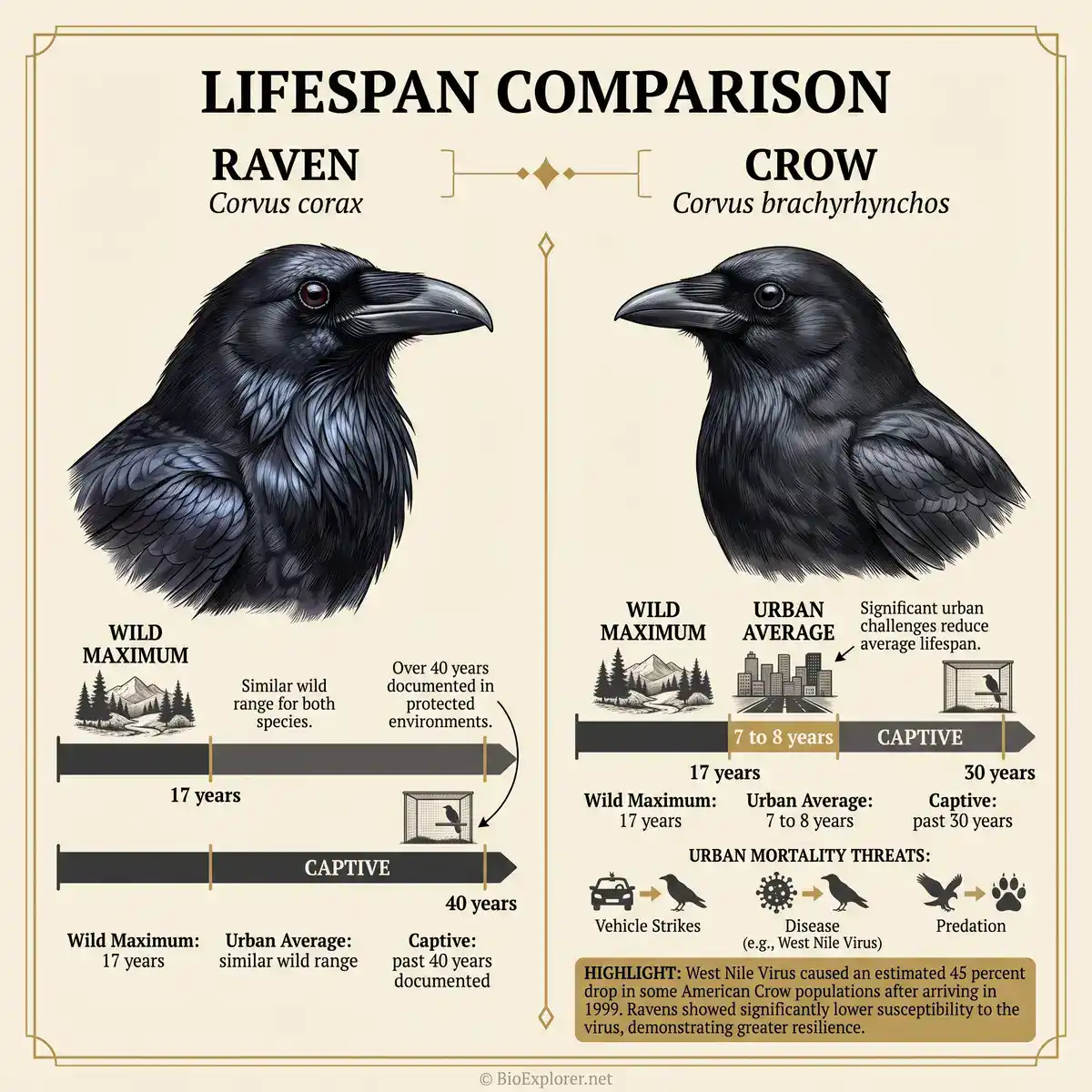
Wild American Crows have a recorded maximum lifespan of 17 years, though average survival in urban populations is considerably shorter at 7 to 8 years due to vehicle strikes, West Nile Virus, and predation. In captivity, crows have lived past 30 years. Wild Common Ravens have also been recorded at 17 years. In captivity, ravens are substantially longer-lived: documented cases exceed 40 years in managed care.
West Nile Virus is worth noting specifically for crows. When the virus entered North America in 1999, American Crow populations in affected regions dropped by an estimated 45 percent in some areas. Ravens showed far lower susceptibility to the same virus. The American Crow has since partially recovered in most regions.
Predators and Threats
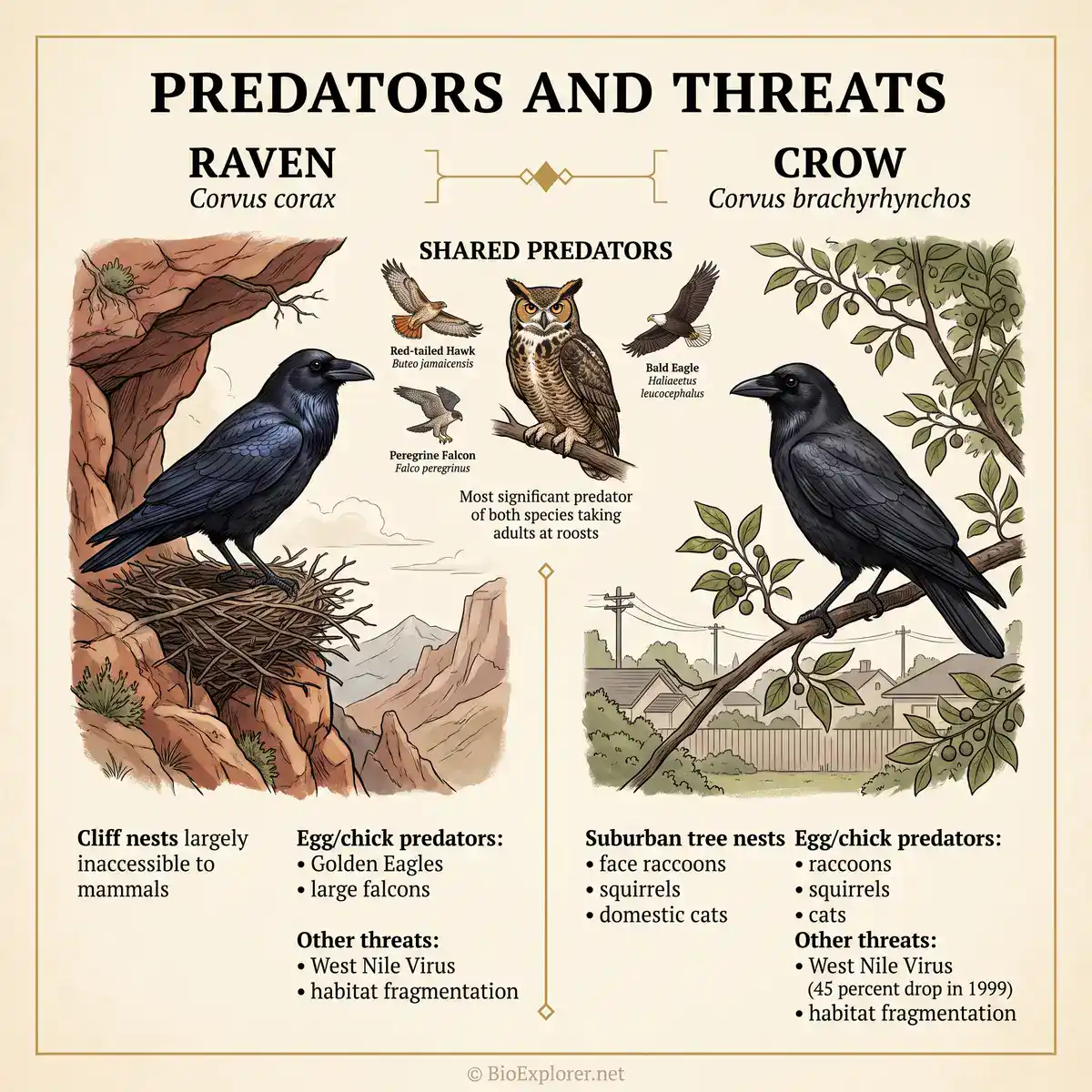
Adult crows and ravens share the same primary predators: Great Horned Owls, Red-tailed Hawks, Peregrine Falcons, and Bald Eagles. Great Horned Owls are the most significant predator of both, taking adults at roosts. Both species mob owls aggressively in response.
Nest predators differ by habitat. Crow nests in suburban trees face raccoons, squirrels, and domestic cats. Raven nests on cliff ledges are largely inaccessible to mammalian predators, though Golden Eagles and large falcons occasionally take eggs or chicks.
A Historical Note: Classification and Early Observation
Aristotle described ravens in Historia Animalium (circa 350 BC), noting their intelligence and the longevity attributed to them in Greek tradition. He also recorded that ravens were monogamous, an observation that has since been confirmed as broadly accurate for the Common Raven.
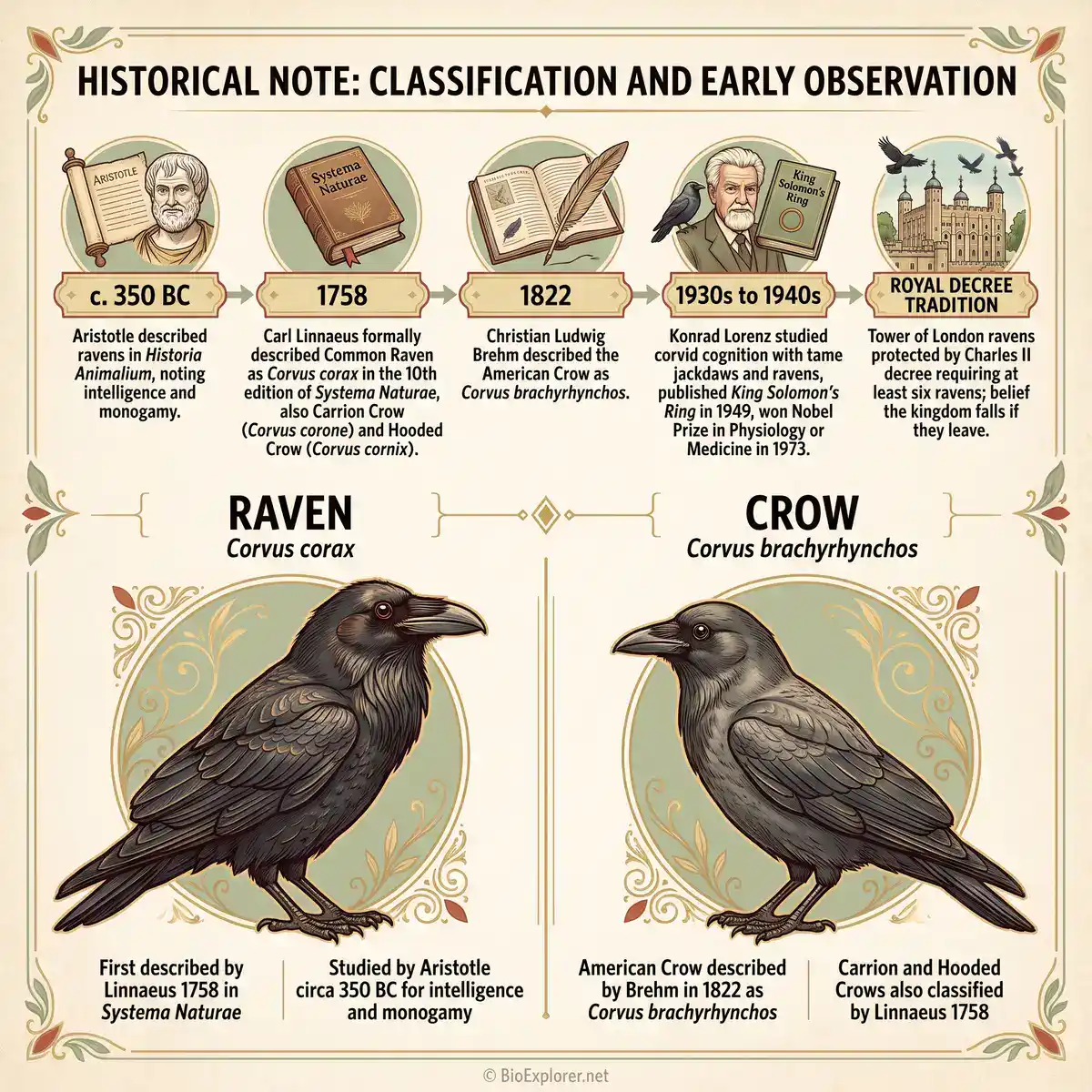
Carl Linnaeus formally described the Common Raven as Corvus corax in the 10th edition of Systema Naturae in 1758, the same landmark publication in which he described the Carrion Crow (Corvus corone), the Hooded Crow (Corvus cornix), and established the binomial nomenclature system still in use today. The American Crow was described later, by the German ornithologist Christian Ludwig Brehm in 1822, as Corvus brachyrhynchos.
The Austrian ethologist Konrad Lorenz conducted the first systematic behavioral studies of corvid cognition during the 1930s and 1940s, keeping tame jackdaws and ravens in his home and documenting their social and communicative behavior. His 1949 book King Solomon’s Ring brought corvid intelligence to a general audience for the first time. Lorenz won the Nobel Prize in Physiology or Medicine in 1973.
The Tower of London ravens occupy a specific place in English historical record. Charles II issued a royal decree, still in effect, requiring that at least six ravens be maintained at the Tower at all times. The belief that the kingdom would fall if the Tower ravens ever left predates the decree, though the exact origin of the tradition is disputed by historians.

History of Anatomy
Quick Field Identification Summary
Use this table when you are in the field with limited time to observe.
| What to Look At | If It Is a Crow | If It Is a Raven |
|---|---|---|
| Tail in flight | Even, fan shaped trailing edge | Pointed center: wedge or diamond shape |
| Body size | Pigeon to small hawk | Large hawk or larger |
| Bill from the side | Slender, relatively straight | Thick, deeply curved, heavy |
| Throat at close range | Smooth feathers | Shaggy, protruding hackles when calling |
| Flight behavior | Steady, continuous flapping | Soaring, gliding, barrel rolling |
| Call | Sharp, nasal “caw caw” | Deep, hollow “cronk” or resonant “pruk” |
| Setting | City, suburb, farm, woodland edge | Mountain, tundra, boreal forest, remote coast |
Related Pages on BioExplorer


Cite this page
Bio Explorer. (2026, June 29). Crow vs Raven: Every Difference Explained With Facts!. https://www.bioexplorer.net/raven-vs-crow.html/