Can Animals Have Down Syndrome?
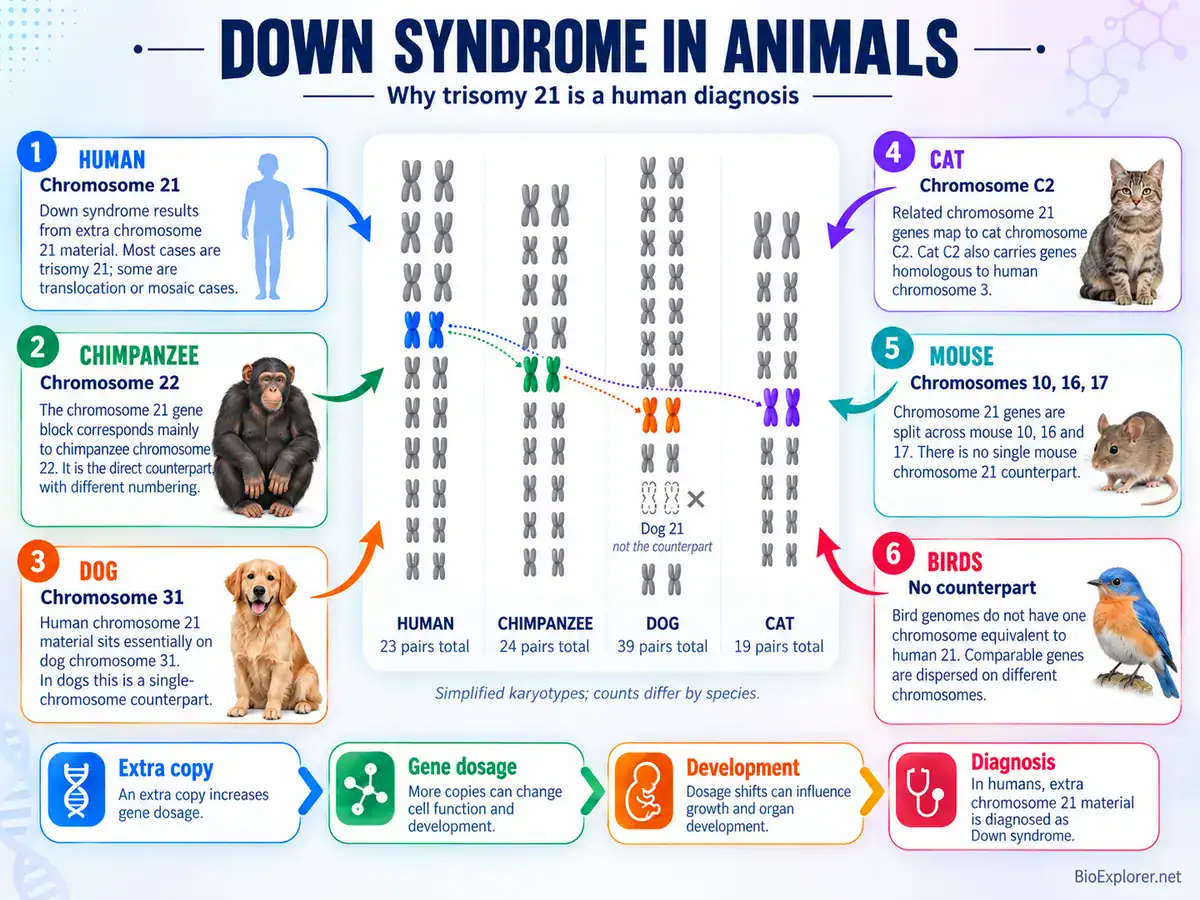
No animal other than a human can have Down syndrome in the strict sense. Down syndrome is a human diagnosis caused by extra genetic material from human chromosome 21. That is usually a complete third copy, and sometimes a partial or translocated copy.
No other species naturally carries that chromosome. Other animals do get extra chromosomes. In naturally occurring cases that chromosome is not human chromosome 21, so the resulting conditions are different disorders with different effects.
There is one close match. Chimpanzees carry a chromosome that holds the same genes as human chromosome 21. Two captive chimpanzees have been documented with a third copy of it. Researchers who published the second case titled their paper "Chimpanzee Down syndrome", and that remains the nearest thing to Down syndrome recorded outside humans.
Viral photos labeled as animals with Down syndrome generally show something else. Kenny the white tiger had inbreeding damage. Pale monkeys in circulated images may have albinism, though a photograph cannot establish that. Puppies with broad heads and slow development may have a treatable condition such as an untreated thyroid disorder. Each of those has a real cause, and none of them is trisomy 21.
Jump to:
- 📜 Summary of key facts
- 🧬 What Down syndrome actually is
- 🪢 Why extra chromosomes are common at conception and rare at birth
- ❷ Why the answer depends on how chromosomes are numbered
- 🦍 The chimpanzee cases: the closest match on record
- 🐒 Trisomy in monkeys
- 🐓 Trisomy in farm animals, pets, and other species
- ⚪ Animals that go viral as Down syndrome cases but are not
- 🧬 How the chromosome picture compares across species
- ❌ Common misconceptions
- ⁉️ Frequently asked questions
- 📑 References
📜 Summary of key facts
| Question | Short answer |
|---|---|
| Can animals have Down syndrome? | Not in the strict genetic sense. Down syndrome means extra material from human chromosome 21, and only humans naturally have that chromosome. |
| Which animal comes closest? | The chimpanzee. Two captive chimpanzees have been documented with trisomy of the chromosome that matches human chromosome 21. |
| Can animals have extra chromosomes at all? | Yes. Trisomy is documented in cattle, horses, monkeys, birds, and many other species. |
| Can dogs have Down syndrome? | No. The human chromosome 21 material sits on dog chromosome 31, not on dog chromosome 21, and no constitutional trisomy 31 has been documented. |
| Can cats have Down syndrome? | No. In cats the human chromosome 21 genes sit on chromosome C2 together with human chromosome 3 genes, so an extra C2 is a much larger imbalance. |
| Can birds, frogs, or reptiles have Down syndrome? | No. None has a chromosome equivalent to human chromosome 21, though some do tolerate other chromosome abnormalities. |
| What about the “Down syndrome tiger”? | Kenny the white tiger did not have Down syndrome. His appearance came from generations of deliberate inbreeding. |
| What about the “albino monkey with Down syndrome”? | Pale coloring suggests albinism, which comes from pigment gene mutations rather than an extra chromosome. A photo cannot confirm any diagnosis. |
| Which animal is used to study Down syndrome? | The mouse. Mice do not get Down syndrome naturally, so scientists engineer strains that carry extra copies of the relevant genes. |
| Why does the chromosome number matter so much? | Chromosome numbers are labels assigned roughly by size within one species. Matching numbers across species imply nothing about matching genes. |
🧬 What Down syndrome actually is
Down syndrome is a chromosome 21 dosage condition, not a look
Down syndrome is a chromosomal condition. It occurs when a person carries extra genetic material from chromosome 21. In most cases that means a whole extra copy in every cell, and the medical term for that form is trisomy 21, from the Greek prefix for three. In other cases the extra chromosome 21 material is attached to a different chromosome, so the total chromosome count can still be 46.
The extra genetic material changes how the body and brain develop. Common features include low muscle tone in infancy, a flattened facial profile, upward slanting eyes, small hands and feet, and intellectual disability that ranges from mild to moderate. Roughly half of babies with Down syndrome are born with a heart defect. The diagnosis is made by testing chromosomes, not by judging appearance.[1]
That distinction is the whole reason this question is hard to answer casually. A person can look a certain way without having trisomy 21. An animal can look a certain way without having any chromosome problem at all.
What sits on chromosome 21
Chromosome 21 is the smallest human chromosome. It spans about 48 million base pairs of DNA. That is roughly 1.5 to 2 percent of the DNA in a cell. It likely carries between 200 and 300 protein coding genes.[2]
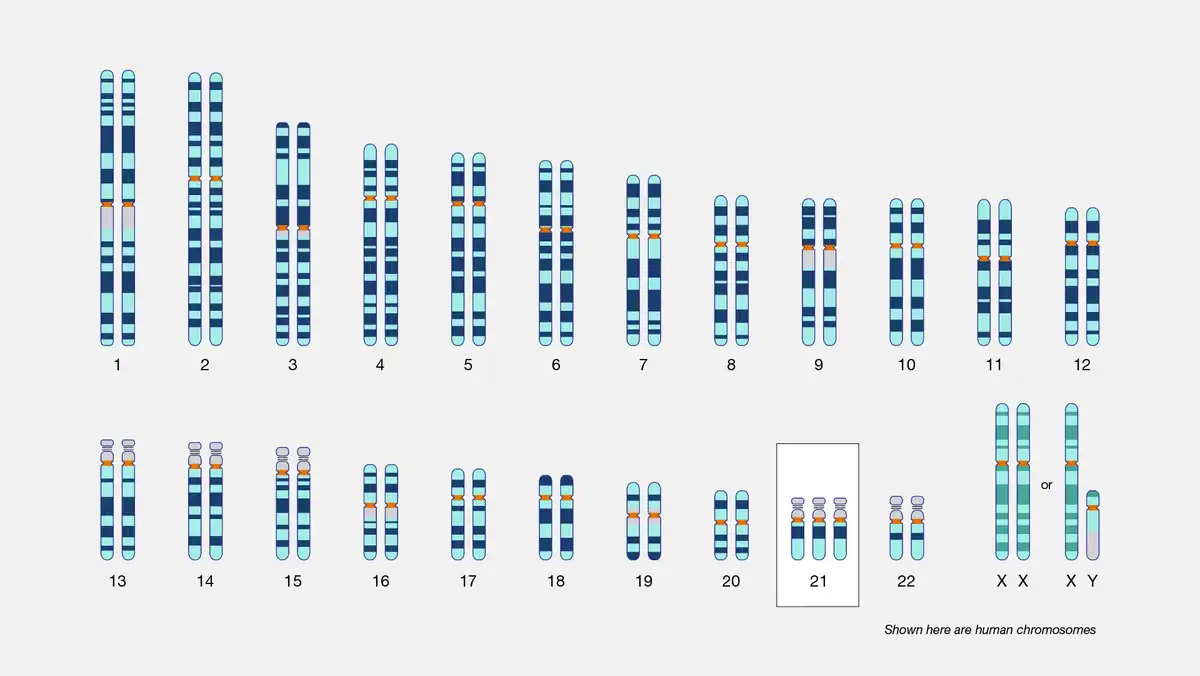
Small size matters here. An extra copy of a small chromosome adds fewer surplus genes than an extra copy of a large one. That is one reason trisomy 21 is survivable while trisomy of most other chromosomes is not.
The three forms of Down syndrome
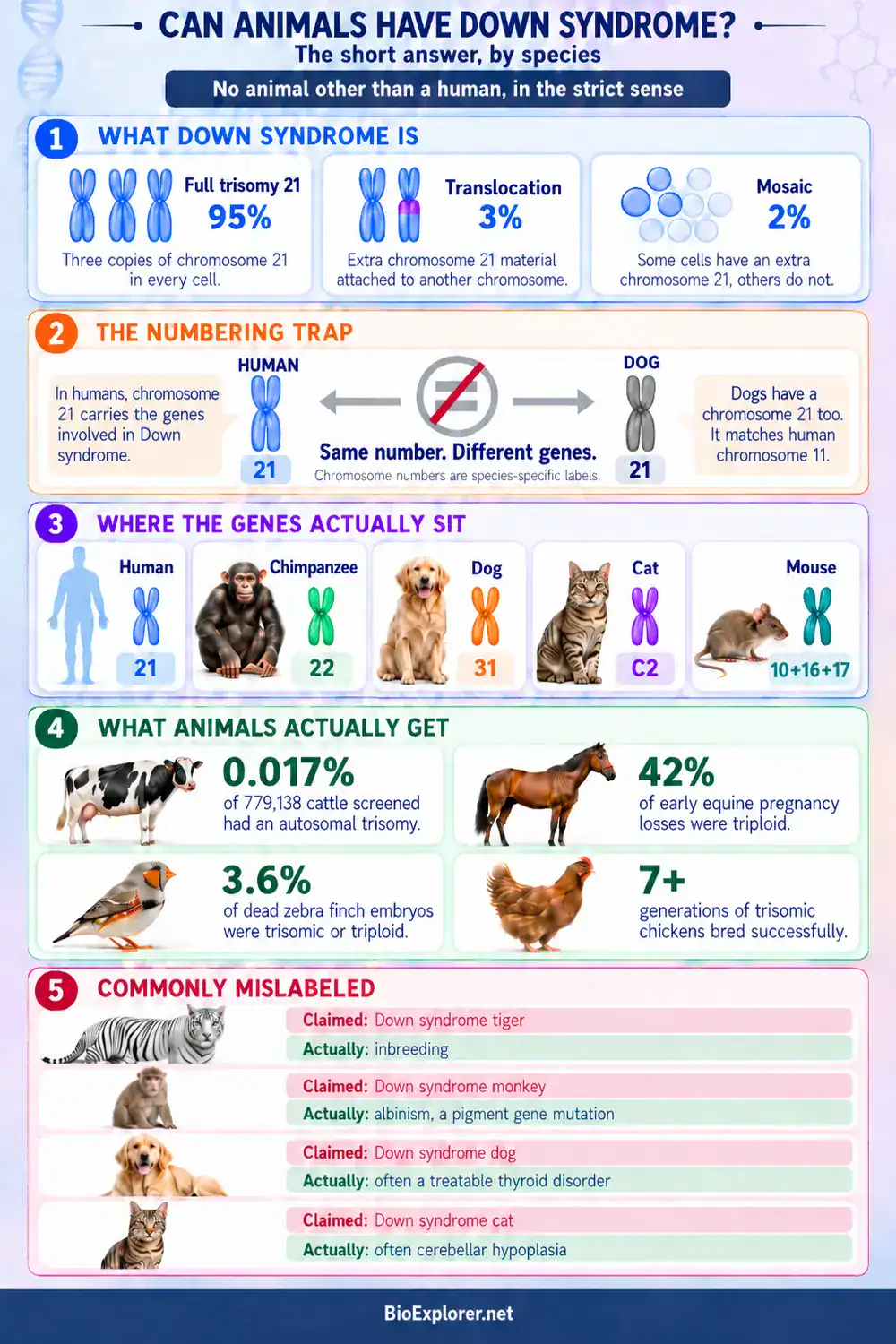
Not every case works the same way. About 95 percent of people with Down syndrome have full trisomy 21, meaning three separate copies of chromosome 21 in every cell. About 3 percent have translocation Down syndrome, in which extra chromosome 21 material is attached to another chromosome.
About 2 percent have mosaic Down syndrome, in which only some cells carry the extra copy. Around 5,775 babies are born with Down syndrome in the United States each year. The chance rises with the age of the mother, especially after 35, though most babies with Down syndrome are still born to mothers under 35.[3]
How the extra chromosome gets there
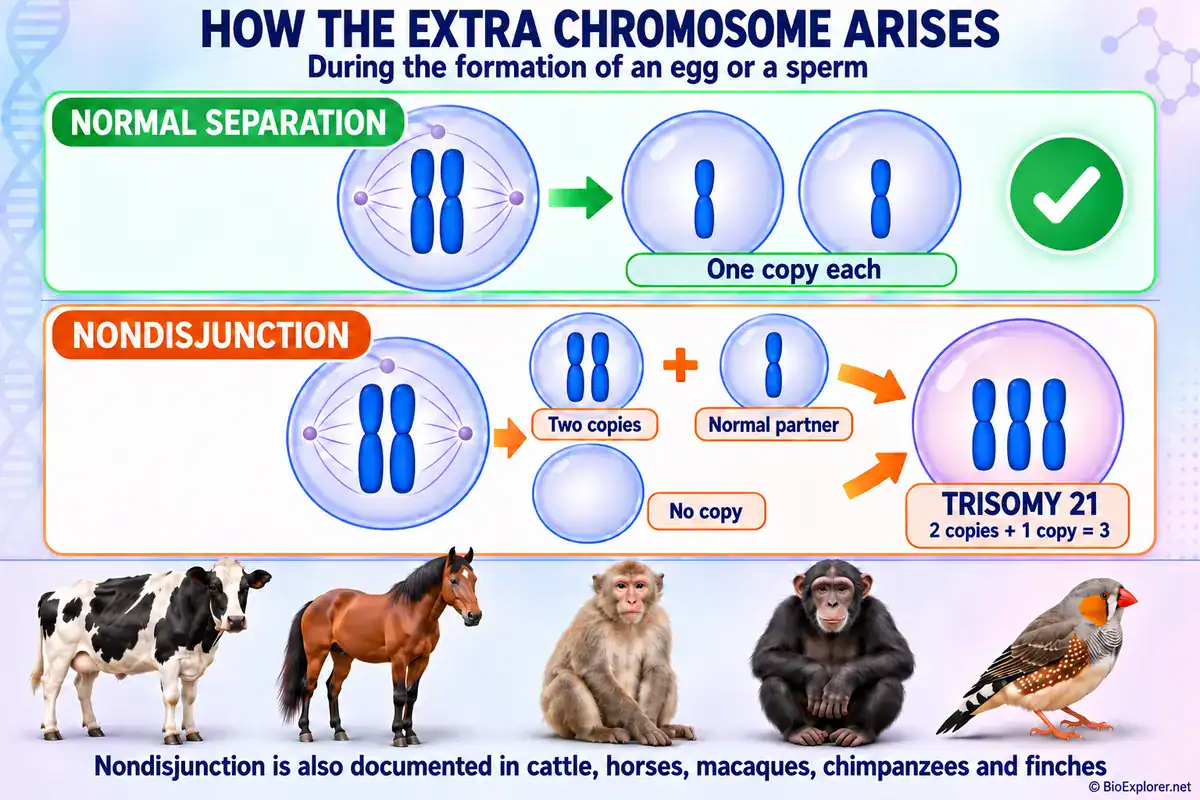
Most full trisomy 21 cases result from an error in cell division called nondisjunction. Eggs and sperm are made by meiosis rather than mitosis, and the differences between mitosis and meiosis matter here. Meiosis has to halve the chromosome number.
During the formation of an egg or a sperm, a pair of chromosomes fails to separate. One cell ends up with two copies of chromosome 21 instead of one. If that cell joins with a normal partner, the embryo starts with three copies. In most cases the extra chromosome comes from the egg. Fewer than 5 percent of cases trace to the sperm.
Translocation and mosaic Down syndrome arise by other routes, so nondisjunction in a parent's gametes does not explain every case. Nothing a parent does or fails to do causes any of them.[4]
What Down syndrome means for health and development
Down syndrome affects each person differently. Learning ability ranges from low normal to significant delay. Between 40 and 60 percent of babies are born with a heart defect.
Digestive problems, hearing loss, and thyroid disorders are more common than in the general population. Early intervention programs and therapy improve outcomes considerably. Many adults with Down syndrome hold jobs and live independently.[5]
The words researchers and advocacy groups use
Terminology has shifted, and the current standard is worth knowing. Down syndrome is described as a condition or a syndrome, not a disease. People have Down syndrome rather than suffering from it.
Person first phrasing is preferred, so "a child with Down syndrome" rather than "a Down syndrome child“. Life expectancy has changed dramatically. In 1910 a child with Down syndrome was expected to live to about age nine. Today roughly 80 percent of adults with Down syndrome reach age 60.[6]
🪢 Why extra chromosomes are common at conception and rare at birth
Most embryos with the wrong chromosome count never reach birth
Aneuploidy is the general term for having an abnormal number of chromosomes. It belongs to the wider family of chromosomal mutations. Trisomy is one type. Aneuploidy is far more common at conception than most people realize. Trisomic and monosomic embryos account for at least 10 percent of human pregnancies.
For women near the end of their reproductive years, that figure can exceed 50 percent. About 35 percent of miscarried pregnancies show a chromosome abnormality. Only about 0.3 percent of newborns do. The gap between those two numbers is the point. Nearly all aneuploid embryos are lost before birth. The errors almost always occur in the egg.[7]
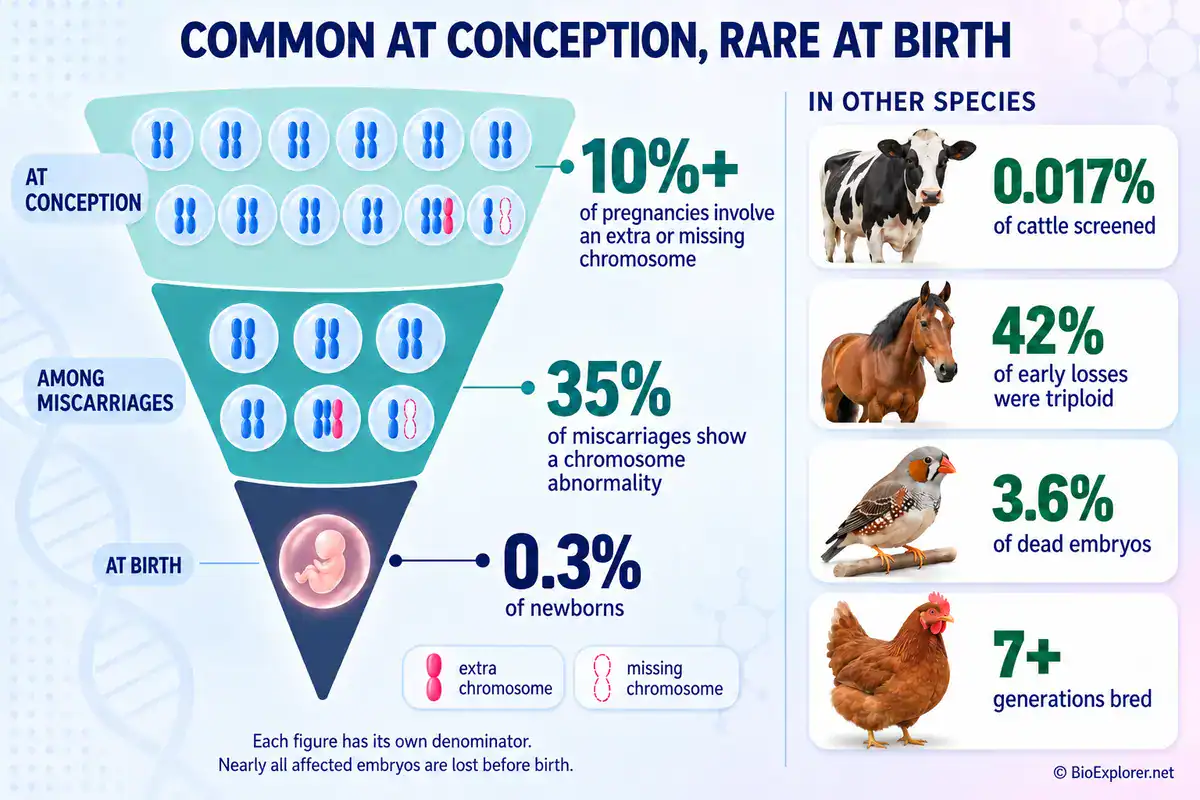
This explains why so few trisomies are ever seen in living humans. Of the autosomes, only chromosomes 13, 18, and 21 produce trisomies that are regularly compatible with live birth. Chromosome 21 is the one most often compatible with a long life.
❷ Why the answer depends on how chromosomes are numbered
Chromosome numbers are labels, not universal addresses
This is the single most misunderstood part of the topic. Genes sit on chromosomes, which is the core of the chromosome theory of inheritance. Within any species, chromosomes are numbered roughly in relation to their sizes, with chromosome 1 the largest.
The numbering is only approximate, and human chromosomes 21 and 22 are the standing exception. Chromosome 21 is in fact slightly smaller than chromosome 22, but chromosome 22 was described as the smallest first and kept the higher number.[8]
The numbering also starts over for every species. A chromosome numbered 21 in another animal is simply one of that animal's own chromosomes, ordered by size within its own karyotype. The number is a filing label, not a genetic identity, and matching numbers across two species imply nothing about matching gene content.
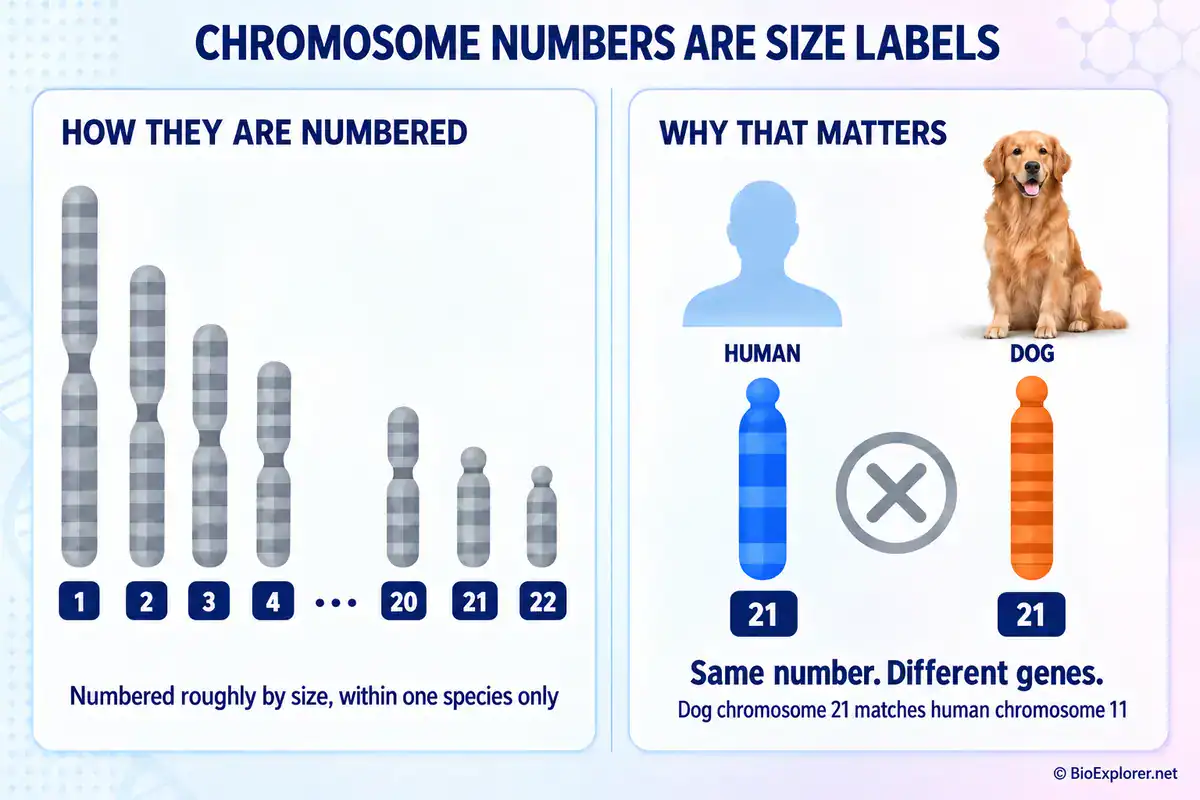
Species also differ in how many chromosomes they have. Humans have 46 chromosomes. Chimpanzees have 48. The difference traces to a single event. Human chromosome 2 formed when two ancestral chromosomes fused end to end. Chimpanzees still carry those two pieces as separate chromosomes.[9]
Even in close relatives, the chromosomes have been rearranged
The chimpanzee genome is not a reshuffled copy of the human one. Chimpanzee and gorilla chromosomes differ from human chromosomes by eleven large scale rearrangements. These include nine inversions, one translocation, and the fusion that created human chromosome 2. Chimpanzee and gorilla chromosomes also carry blocks of repetitive DNA near their ends that human chromosomes lack.[10]
The great ape chromosome that matches human chromosome 21
Great apes do carry a chromosome with essentially the same gene content as human chromosome 21. In the traditional great ape karyotype, that chromosome is numbered 22. Comparative studies of chimpanzee and human centromeric DNA have treated chimpanzee chromosome 22 and human chromosome 21 as homologous chromosomes for decades.[11]
Readers will also encounter the same chromosome written as chimpanzee chromosome 21. That is not an error. Some researchers renumber great ape chromosomes so the numbers line up with their human counterparts. The two published chimpanzee cases use the older convention and call it trisomy 22. Both numbering styles describe the same chromosome.
The genes are present in other animals, just arranged differently
Saying that no other species naturally has chromosome 21 does not mean the genes are missing. They are present across mammals, packaged into different chromosomes.
One ancient pairing shows up repeatedly. In many placental mammals the genes of human chromosome 21 sit on a single chromosome alongside the genes of human chromosome 3. This combined 3 and 21 block may be the largest widely conserved syntenic block known for mammals, and the ancestral segment order survives in some primates and some carnivores.[12]
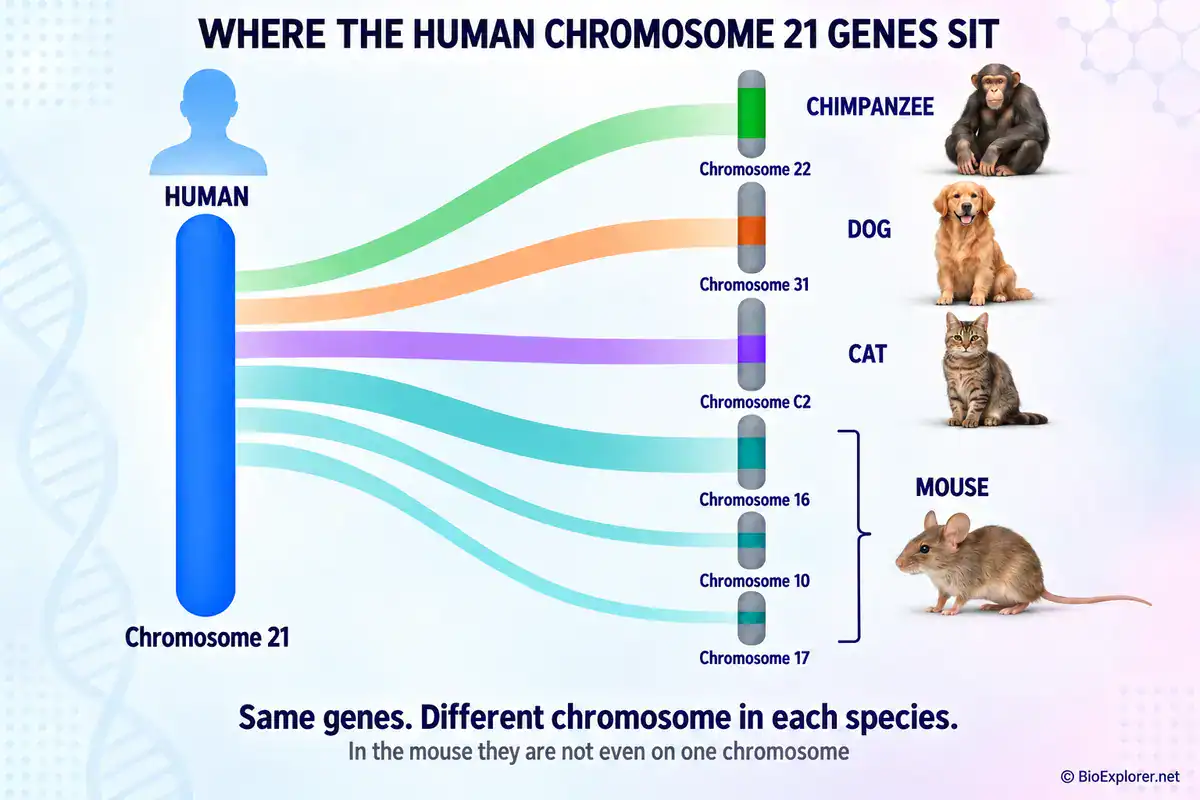
Two cautions belong with that. The association is widely conserved, not universal, and it has been broken up differently in different lineages. Dogs are a documented exception, as the section on dogs below describes. So the useful question for any given species is not whether it has a chromosome numbered 21.
It is which chromosome carries the human chromosome 21 genes, what else rides along on that chromosome, and whether an extra copy of it has ever been seen.
In mice, the human chromosome 21 genes are spread across three chromosomes
Mice show how badly the numbering can break down between species. The genes found on human chromosome 21 do not sit together on any single mouse chromosome. They are split across mouse chromosomes 10, 16, and 17. The largest block sits on mouse chromosome 16 and spans about 22.9 million base pairs containing roughly 115 human chromosome 21 gene counterparts. Around 60 more sit on mouse chromosomes 10 and 17.[13]
So a mouse cannot have trisomy 21. There is no mouse chromosome that corresponds to it. That is not a technicality. It is the reason the question has no simple yes.
🦍 The chimpanzee cases: the closest match on record
The 1969 case
The first report appeared in 1969. Researchers described an infant chimpanzee with clinical, behavioral, and cytogenetic features resembling Down syndrome. The animal showed slowed growth, congenital abnormalities, delayed neurological and postural development, an epicanthic fold at the inner eye, unusually flexible joints, and low muscle tone. Chromosome analysis found trisomy of a small acrocentric chromosome.[14]
The 2017 case
The second case was published in 2017 and involved a captive born female common chimpanzee. She carried trisomy 22, the chromosome homologous to human chromosome 21.
Her documented signs included slowed growth, infantile cataract, nystagmus, strabismus, keratoconus, a congenital atrial septal defect, and missing teeth. All of those occur commonly in human Down syndrome.
She became blind by age seven, which made social life with other chimpanzees difficult. Her caretakers arranged regular contact with other chimpanzees to compensate.[15]
How much these cases prove
Two cases across decades of primate research is a very small evidence base. Both animals were in captivity, where chromosome testing happens and where an affected infant is more likely to survive long enough to be studied.
Neither case establishes how often the condition occurs in wild chimpanzee populations. The honest summary is that trisomy of the chromosome matching human chromosome 21 has been recorded twice in chimpanzees, and that the resulting signs overlap substantially with human Down syndrome.
🐒 Trisomy in monkeys
A pigtailed macaque with trisomy 16
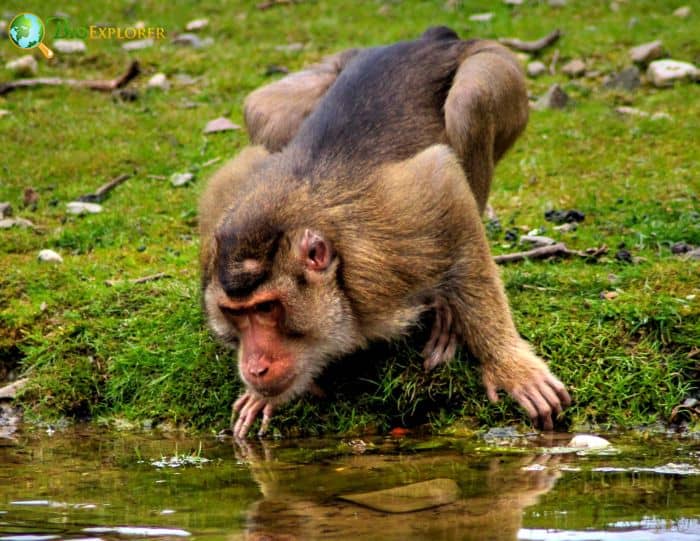
Monkeys are more distant from humans than chimpanzees are, and chromosome numbering diverges further across the types of monkeys. A female pigtailed macaque was followed from birth to age three with unusual physical features, learning deficits, abnormal social behavior, and impaired motor control.
Testing found trisomy 16. In the macaque genome, chromosome 16 corresponds to human chromosome 13, not 21. The condition was therefore the macaque counterpart of human trisomy 13, not Down syndrome. Trisomy 18 has also been reported in pigtailed macaques.[16]
A monkey with a Down syndrome face and a different trisomy
One case makes the point better than any argument. A female cynomolgus monkey at a research facility showed facial features described as characteristic of Down syndrome, including wide set eyes, upward slanting eyes, and a flattened nose. She also showed abnormal behavior and poor concentration.
Chromosome counting revealed 43 chromosomes instead of the normal 42. Multicolor FISH analysis identified the extra chromosome as a third copy of chromosome 17. Macaque chromosome 17 corresponds to human chromosome 13. The monkey looked like a Down syndrome case and genetically was not one. She reached age ten with only mild clinical signs.[17]
That is the trap in a single example. A monkey with textbook Down syndrome facial features turned out to carry trisomy 17, which corresponds to human chromosome 13. Only a chromosome test can establish which chromosome is involved, and no photograph can.
🐓 Trisomy in farm animals, pets, and other species
Cattle: the largest survey ever done
Cattle provide the best data on how often autosomal trisomy occurs in a live born mammal population. Researchers screened SNP chip genotype data from 779,138 dairy and beef cattle genotyped before 15 months of age. They found 139 animals with an autosomal trisomy, a rate of 0.017 percent.
Trisomy appeared on only ten of the cattle autosomes. The rate per chromosome was generally inversely related to chromosome length, meaning smaller chromosomes were more often involved. The extra chromosome came from the mother in 92 percent of cases. No case of autosomal monosomy was found at all, which suggests monosomy is lethal in cattle. Of 121 live born affected animals, 68 died on the farm at an average age of about seven months.[18]
Two things follow from that study. Autosomal trisomy in a mammal is real but rare. And none of the affected cattle had Down syndrome, because none of them had a chromosome 21 in the human sense.
Horses: most affected pregnancies end early
Horses show the same pattern that humans do. Researchers examined 256 equine products of conception following naturally occurring pregnancy loss. Triploidy, meaning three complete sets of chromosomes, was the most common finding at 42 percent of losses during the embryonic period.
Trisomies and monosomies together accounted for 11.6 percent. Seventeen different autosomes were involved. The authors argue that the horse is the first animal model that genuinely reproduces the main features of human miscarriage caused by chromosome errors.[19]
Horses that survive tend to have sex chromosome problems
Among living horses, chromosome abnormalities cluster in a specific way. Large surveys find abnormal karyotypes in almost 30 percent of horses with reproductive or developmental problems, compared with only 2 to 5 percent of the general horse population.
Two conditions recur. X monosomy accounts for roughly 35 percent of all chromosome abnormalities found, and SRY negative male to female sex reversal accounts for about 11 percent. Autosomal trisomies in horses are reported, but nearly all are one off cases.[20]
Dogs: no documented equivalent of Down syndrome
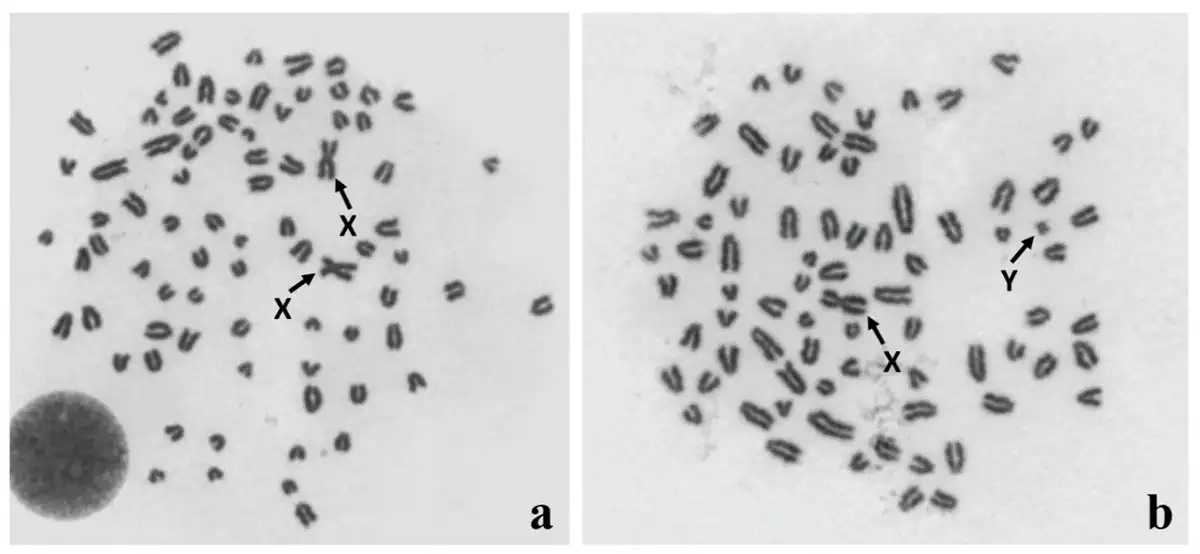
Dogs are the species most often asked about. The starting point is how many chromosomes dogs have, which is 78 in total, meaning 39 pairs. All 38 autosome pairs are acrocentric, and most are small. Their banding patterns are so similar that international committees concluded only the largest 21 autosome pairs and the sex chromosomes can be identified with certainty by conventional staining.
A published review of clinical canine cytogenetic catalogs the abnormalities documented in dogs up to that point. Those are sex chromosome aneuploidies such as X monosomy, X trisomy, and XXY, plus XX/XY leukocyte chimerism, Robertsonian translocations, and cancer related chromosome changes.[21]
The dog genome is not missing the relevant genes, and their location is known. Comparative mapping of the canine genome places the human chromosome 21 material on canine chromosome 31. Human chromosome 21 is one of only four human chromosomes whose material is confined to a single dog chromosome, alongside human chromosomes 14 and 20 and the X chromosome. Dog chromosome 21 is an unrelated chromosome that corresponds to human chromosome 11.[22]
A constitutional trisomy is a developmental chromosome abnormality, including mosaicism that arises early in embryonic development. A somatic gain is an acquired change confined to tumor cells. Extra copies of dog chromosome 31 do turn up in canine lymphoma, but those are somatic. No constitutional trisomy of dog chromosome 31 has ever been documented, which is why there is no canine Down syndrome.
The distinction matters here, because extra copies of dog chromosome 31 do turn up in dogs. A survey of 150 canine lymphomas recoded canine copy number changes into human chromosome coordinates and found that gains of dog chromosome 31 correspond to gains of human chromosome 21.
Those are somatic changes confined to tumor cells, not a developmental abnormality of the animal's own chromosome set.[23]
A dog autosomal trisomy has now been reported
The picture changed in 2021. A laboratory validating a SNP microarray covering roughly 650,000 sites across the dog genome screened 2,053 dogs of various breeds. It found three cases of aneuploidy: monosomy X, trisomy X, and an apparent mosaic trisomy of canine chromosome 38.[24]
Three points about that finding matter. The trisomy was apparent and mosaic, detected by microarray rather than confirmed by chromosome analysis. Canine chromosome 38 is the smallest dog autosome, which fits the pattern seen in cattle, where trisomy is more common on shorter chromosomes.
And canine chromosome 38 is not a counterpart of human chromosome 21, so the case is not a canine Down syndrome. What it does show is that autosomal trisomy occurs in living dogs and that wider genomic screening is starting to find it.
So a dog still cannot have human Down syndrome. The reason is not that dogs lack the genes, and not that dogs are incapable of autosomal trisomy. It is that the counterpart chromosome is dog chromosome 31, and no constitutional trisomy of it has been documented.
If such a case were ever found, it would be a canine aneuploidy involving the chromosome homologous to human chromosome 21. It would not be human trisomy 21, since that term names a specific human chromosome. It might well serve as a biological analogue, in the same way the chimpanzee cases do.
Cats and other felids: chromosomes that are not even numbered
Cats make the numbering point unusually well. The domestic cat has 38 chromosomes, meaning 19 pairs, made up of 18 autosome pairs plus X and Y. Cat chromosomes are not numbered 1 through 19 at all. They are grouped by shape and labeled A1 to A3, B1 to B4, C1 to C2, D1 to D4, E1 to E3, and F1 to F2.
Most members of the cat family share a similar karyotype, and the domestic cat karyotype is broadly representative of most carnivores. There is a documented exception. In the ocelot lineage of South American cats, a Robertsonian translocation fused chromosomes F1 and F2 into a single chromosome, giving those species 36 chromosomes rather than 38.[25]
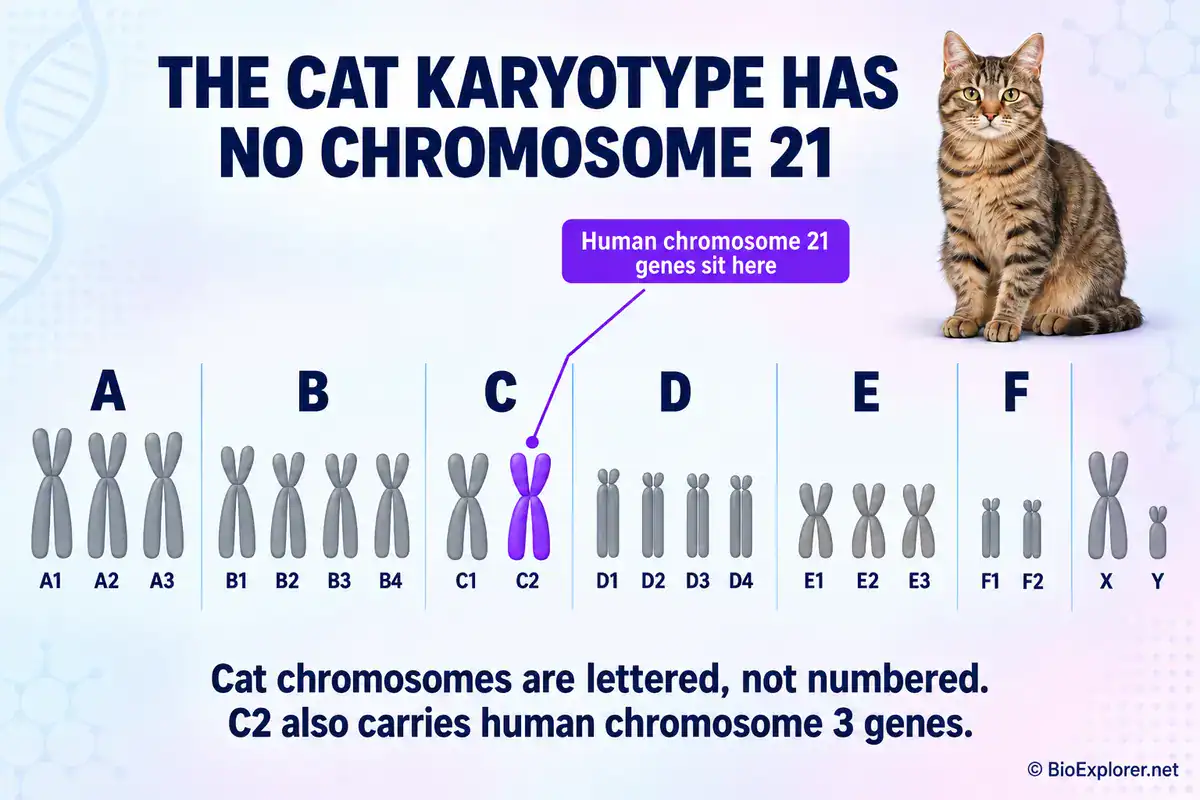
The lettering is a naming convention, not the reason a cat cannot have Down syndrome. The substantive reason is specific and documented. In the cat, the genes found on human chromosome 21 are carried on the mid-sized metacentric chromosome C2, which also holds genes from human chromosome 3.
A trisomy of C2 would therefore disrupt more genes than trisomy 21 does in humans. The likely outcome is early fetal loss that is never detected.[26]
The one cat chromosome disorder that is well documented
Cats do get chromosome abnormalities, and one is famous. Male tortoiseshell and calico cats are extremely rare, because the orange and black coat pattern normally requires two X chromosomes. A review of chromosome findings in 25 male tortoiseshell or calico cats found aneuploidy, polyploidy, mosaicism, and chimerism among them.
Sixteen of the 25 carried an XXY complement. Almost all were sterile, and their testicular tissue changes resembled human XXY Klinefelter syndrome. The coat color was only a visible clue to an underlying sex chromosome error.[27]
Zebra finches: trisomies found in dead embryos, not in sampled adults
Birds have a different chromosome system entirely, including many tiny microchromosomes and a ZW rather than XY sex determination system. A study of a captive zebra finch population screened 331 embryos that died during development and 1,210 adult birds. Twelve of the dead embryos, or 3.6 percent, carried three alleles at marker loci.
Follow up genotyping with nearly 2,000 markers confirmed cases of both trisomy and triploidy. No such cases were found among the adults. Both maternal and paternal nondisjunction were involved. The authors suggest trisomy may be a major cause of embryo mortality in this species.[28]
That result applies to the studied zebra finch population. It should not be generalized into a rule for all birds, because chickens show the opposite. Outcomes differ sharply between types of birds.
Chickens break the rule, and the reason is instructive
One chicken microchromosome carries the nucleolus organizer regions, the sites of the ribosomal RNA genes, along with the major histocompatibility complex. Chickens aneuploid for that microchromosome have been identified and bred for more than seven generations.
Crossing two trisomic parents produces viable disomic, trisomic, and tetrasomic offspring, showing two, three, and four nucleolar organizers per cell. Gene copy numbers rose accordingly, from about 290 ribosomal DNA repeats per cell in disomic birds to about 570 in tetrasomic birds. Yet mature ribosomal RNA levels in embryo fibroblasts stayed at diploid amounts across all three genotypes.[29]
Birds can therefore carry an extra chromosome, hatch, grow, and breed on for generations. Whether a trisomy is survivable depends on which chromosome is involved and whether the cell can regulate the output of the duplicated genes. None of this makes Down syndrome possible in a bird, because no bird chromosome corresponds to human chromosome 21.
Frogs, fish, and reptiles: whole extra genomes are sometimes normal
Amphibians break the pattern in an instructive way. Genuine polyploid species exist among several types of amphibians, including both frogs and salamanders, meaning entire lineages carry more than two complete sets of chromosomes and function normally.
Polyploids also arise spontaneously and can be produced experimentally in amphibians. Reviews of the subject cover the mechanisms of origin, the pairing of chromosomes during meiosis, and the way polyploid genomes gradually revert toward diploid behavior.[30]
That tolerance for extra genome copies is very different from the mammalian situation. It also has nothing to do with Down syndrome, which involves extra material from one chromosome rather than a whole extra set. The evidence above covers amphibians only.
The difference between amphibians and reptiles is large enough that these findings should not be extended to lizards or snakes. One point still settles the question for frogs, lizards, snakes, spiders, and fish alike. None of them has a chromosome corresponding to human chromosome 21. None of them can therefore have Down syndrome. How each group handles other chromosome abnormalities varies widely and has been studied unevenly.
Mice: the animal actually used to study Down syndrome
Mice cannot develop Down syndrome on their own. They are still the main research animal for it, because scientists build the condition into them deliberately. Over the past several decades many mouse strains with Down syndrome related features have been created.
These models have been used to work out which genes are dose sensitive, to map genotype to phenotype, and to test candidate treatments. Some strains carry engineered duplications of the mouse regions matching human chromosome 21. One strain, called Tc1, carries an actual copy of human chromosome 21 inside mouse cells, though the human chromosome is lost from some tissues as the animal develops.[31]
Anyone searching for the animal most associated with Down syndrome research will find the mouse. It is a constructed model, not a natural case.
⚪ Animals that go viral as Down syndrome cases but are not
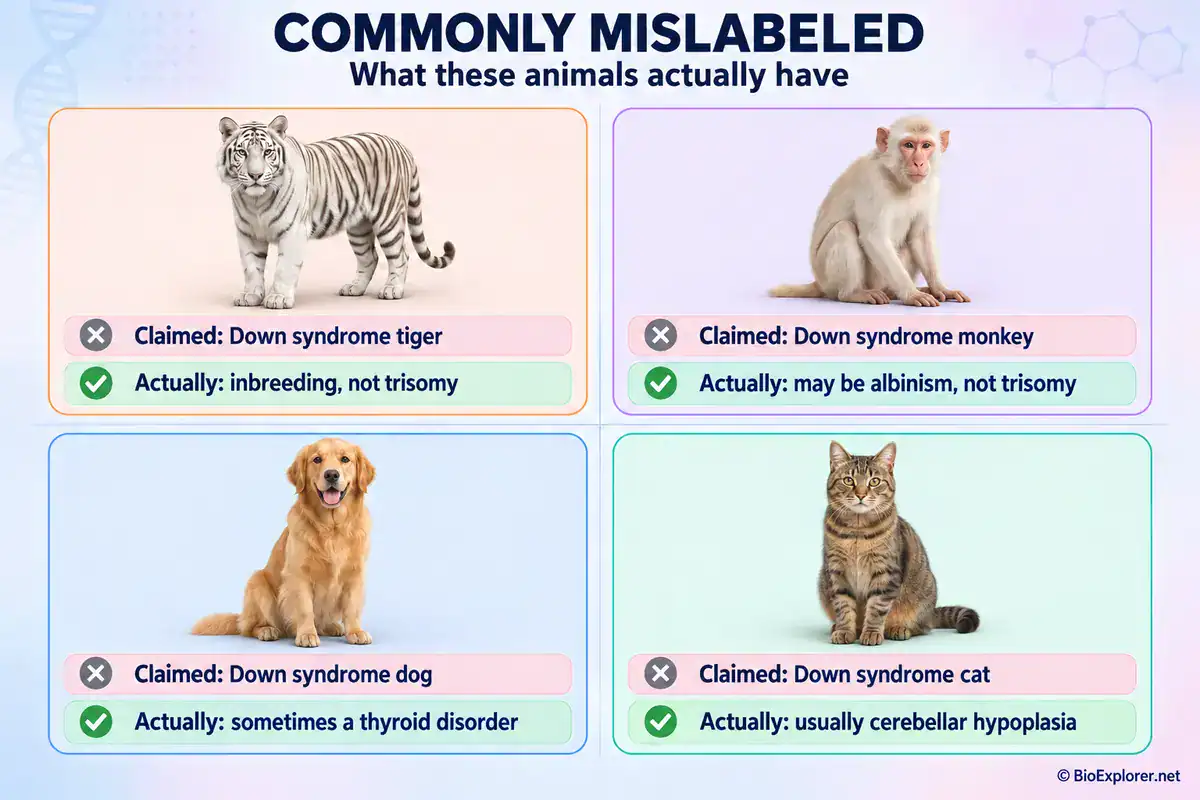
Kenny the white tiger
Kenny is the most widely shared example, and the story behind him is documented by the sanctuary that took him in. Turpentine Creek Wildlife Refuge rescued Kenny in 2000. His face was visibly deformed.
A photograph of him spread online with a false claim that he had Down syndrome, and he became what the refuge calls the poster child for the problems of inbreeding. The real cause was breeding practice. Every white tiger descends from a single captive animal named Mohan, who was bred back to his own daughter to produce white cubs. Many white tigers are visibly cross eyed as a result.[32]
Tigers share the typical felid karyotype of 19 chromosome pairs. Kenny had no chromosome 21 to triplicate. His condition was the cumulative effect of inbreeding. Inbreeding concentrates harmful recessive gene variants. It does not change the number of chromosomes.
The albino monkey
Images of pale monkeys circulate with the label "albino monkey with Down syndrome." No published report identifies or diagnoses the animals in those particular images, and a photograph on its own cannot establish any diagnosis. What can be said is that pale coloring in a primate suggests albinism, and that albino monkeys are a separate phenomenon entirely from Down syndrome.
Oculocutaneous albinism results from variants in genes including TYR, OCA2, TYRP1, and SLC45A2. Those variants disrupt the ability of cells to make melanin, which reduces pigment in skin, hair, and eyes. It follows autosomal recessive inheritance, meaning both gene copies must carry a variant. Affected individuals often have reduced visual sharpness, involuntary eye movements called nystagmus, eyes that do not point in the same direction called strabismus, and sensitivity to light.[33]
That eye list is why the confusion persists. Nystagmus and strabismus also occur in Down syndrome, and they occurred in the 2017 chimpanzee case. Two very different genetic mechanisms can produce overlapping visible signs. Albinism is a gene mutation problem. Down syndrome is a chromosome 21 dosage condition.
The "Down syndrome dog"
Puppies labeled online as having Down syndrome have not been studied as a group, so no one can say what most of them have. What can be said is that several recognized conditions produce a similar picture, and at least one of them is treatable.
Congenital hypothyroidism is a useful example of that differential. A documented case involved a seven month old French bulldog. He had a dome shaped skull and a persistent soft spot on the head. He also had an unsteady gait, weak hind legs, strabismus, and an abnormal mental state. Imaging found enlarged brain ventricles, thinned brain tissue, and a goiter.
Blood tests showed abnormally low thyroid hormone. Genetic testing confirmed a thyroid peroxidase mutation. Thyroxine supplementation rapidly improved the clinical signs. The puppy came from a litter of seven, five of which had already died.[34]
One case report does not establish how common that diagnosis is among puppies in viral photographs. It does establish that the label forecloses a question worth asking. Other conditions that can produce an overlapping picture include pituitary dwarfism, hydrocephalus, and portosystemic liver shunts, and each needs its own veterinary workup.
The "Down syndrome cat"
Cats with an unsteady, wobbling walk are frequently mislabeled the same way. The usual cause is cerebellar hypoplasia, sometimes called wobbly cat syndrome. The most common trigger is infection with feline panleukopenia virus before birth, which attacks the developing cerebellum and prevents it from forming properly.
Affected cats show exaggerated leg and head movements, wobbling when standing or walking, and jerky head motion while eating. The condition is present from birth and does not get worse over time. It is not painful. There is no cure, but affected cats often compensate as they age and can live long, healthy lives indoors.[35]
🧬 How the chromosome picture compares across species
The table below gives chromosome pairs only for the species whose counts are stated in the sources cited earlier in this article. Counts describe the typical karyotype, and the animals discussed throughout this article are the exceptions to it.
| Species | Chromosome pairs | Counterpart of human chromosome 21 | Can it have Down syndrome? |
|---|---|---|---|
| Human | 23 | Chromosome 21 itself | Yes |
| Chimpanzee | 24 | Yes, numbered 22 in the traditional ape karyotype | Not Down syndrome itself, but the closest documented equivalent |
| Cynomolgus macaque | 21 | Not identified in the sources cited here | No. Documented trisomies involve other chromosomes |
| Dog | 39 | Dog chromosome 31. Dog chromosome 21 corresponds to human chromosome 11 instead | No, though other autosomal trisomy has been reported |
| Cat and most other felids | 19, or 18 in the ocelot lineage | Chromosome C2, which also carries human chromosome 3 genes | No |
Notes on the comparison
Four cautions apply. First, a counterpart chromosome is not automatically an equivalent chromosome, and the species differ. The chimpanzee and dog counterparts correspond to human chromosome 21. The cat counterpart carries the human chromosome 3 genes as well, so an extra copy there would duplicate far more than trisomy 21 does.
Second, the chimpanzee row is the only one where the phrase "closest documented equivalent" is warranted. It rests on two published cases, not on a body of population data.
Third, three species discussed above are left out of the table because none of the sources cited here states their chromosome counts. In the mouse, the human chromosome 21 gene counterparts are split across mouse chromosomes 10, 16, and 17.
In cattle, trisomy has been documented on ten different autosomes, none of them a counterpart of human chromosome 21. In birds, the chromosome set includes many microchromosomes, and outcomes for trisomy range from embryo death in zebra finches to healthy breeding birds in chickens.
Fourth, a "No" in the last column is a statement about Down syndrome specifically. It is not a claim that the species cannot have chromosome abnormalities. Every species in this article can.
❌ Common misconceptions
- That any animal with an unusual face has Down syndrome. Facial appearance is not a diagnosis. A cynomolgus monkey with textbook Down syndrome facial features turned out to have trisomy 17, which corresponds to human chromosome 13.
- That Kenny the white tiger had Down syndrome. The claim spread with a viral photograph and is false. His deformities came from generations of deliberate inbreeding in captive white tiger lines.
- That dogs get Down syndrome and it is just rarely diagnosed. The human chromosome 21 material maps to dog chromosome 31, and no constitutional trisomy of it has been documented. Dogs can have autosomal trisomy, and an apparent mosaic trisomy of the smallest dog chromosome was reported in 2021, but that is a different chromosome and a different condition.
- That a chromosome numbered 21 means the same thing in every species. Chromosomes are numbered by size within each species separately. The number is a filing label with no cross species meaning.
- That animals never get extra chromosomes. They do. Trisomy is documented in cattle, horses, macaques, chimpanzees, zebra finches, and other species. In naturally occurring nonhuman trisomies, the extra chromosome is not human chromosome 21.
- That albinism and Down syndrome are related. Albinism comes from recessive mutations in pigment genes. Down syndrome comes from extra chromosome 21 material. They share some visible eye signs and nothing else.
- That a wobbly cat has Down syndrome. The usual cause is cerebellar hypoplasia, most often from feline panleukopenia virus infection before birth. It is not progressive and not painful.
- That the extra chromosome usually comes from the father. In humans it comes from the egg in most cases. Fewer than 5 percent of cases trace to the sperm. The same maternal bias appears in cattle, where 92 percent of trisomies were maternal in origin.
- That a puppy labeled a Down syndrome dog has nothing treatable. Congenital hypothyroidism produces a similar picture and responds rapidly to thyroid hormone supplementation. A veterinary workup is worth doing.
- That mice used in Down syndrome research have Down syndrome. They do not develop it naturally. Research strains are engineered, either by duplicating the relevant mouse regions or by inserting a human chromosome 21 copy.
⁉️ Frequently asked questions
Not in the strict sense. Down syndrome results from extra genetic material from human chromosome 21, most often a complete third copy. No other species naturally carries that chromosome. Animals do develop other trisomies, which are different conditions with different effects.
None, strictly speaking. Chimpanzees come closest. Two captive chimpanzees have been documented with a third copy of the chromosome that holds the same genes as human chromosome 21. Their signs overlapped strongly with human Down syndrome.
No. Dogs have 39 chromosome pairs. The human chromosome 21 material maps to dog chromosome 31, not to the dog chromosome numbered 21, which corresponds to human chromosome 11 instead. No constitutional trisomy of dog chromosome 31 has been documented. Dogs do get other chromosome abnormalities. A 2021 microarray screen of 2,053 dogs found monosomy X, trisomy X, and an apparent mosaic trisomy of canine chromosome 38.
No. Cats have 19 chromosome pairs. The human chromosome 21 genes sit on cat chromosome C2, which also carries human chromosome 3 genes. An extra copy of C2 would duplicate both sets, a much larger imbalance than trisomy 21. Cats do get sex chromosome abnormalities, most famously the XXY pattern seen in male tortoiseshell and calico cats.
No. Birds have a different chromosome system that includes many microchromosomes, and none of those chromosomes corresponds to human chromosome 21. Trisomy does occur in birds, with varied outcomes. A zebra finch study found it in embryos that died during development, and in none of more than 1,200 living adults. Chickens trisomic for one microchromosome, by contrast, have been bred through more than seven generations.
No. None of these groups has a chromosome corresponding to human chromosome 21, which is what settles the question. Amphibians in particular handle extra chromosomes very differently, and several frog and salamander species are naturally polyploid, carrying whole extra sets of chromosomes as a normal condition.
No. Kenny, a white tiger rescued in 2000, was widely shared online with that label. The sanctuary that cared for him states the claim was false. His facial deformities resulted from the inbreeding used to produce white tigers, all of which descend from a single animal bred to his own daughter.
Those images have not been traced to any published report, so the animals in them carry no confirmed diagnosis. Pale coloring in a primate points to albinism, which is caused by recessive mutations in pigment genes rather than by an extra chromosome. Albinism can cause nystagmus and strabismus, which also occur in Down syndrome, and that overlap is why the false label sticks.
Yes, and it has been measured. A screen of 779,138 cattle found 139 animals with an autosomal trisomy, about 0.017 percent. Trisomies appeared on ten different cattle chromosomes, more often on the shorter ones, and 92 percent came from the mother.
It depends on the species and the chromosome. In cattle, all affected animals carrying trisomy on certain chromosomes were stillborn or died within 15 days, though others lived and a few were fertile. In horses, chromosome errors account for a large share of pregnancy losses.
In zebra finches, trisomic individuals were found only among embryos that died. Chickens trisomic for one microchromosome have been bred for generations. Human trisomy 21 sits at the survivable end of that range.
The mouse. Mice cannot develop the condition naturally. Researchers engineer strains that carry extra copies of the mouse regions matching human chromosome 21. One strain carries an actual human chromosome 21. These models are used to identify dose sensitive genes and to test potential treatments.
Because the condition is defined by a specific human chromosome. Chromosome numbering restarts in every species and reflects size, not gene content. Human chromosome 21 has a counterpart chromosome in great apes, and its homologous genes are arranged on species-specific chromosomes in more distant animals. No other animal naturally carries the chromosome itself, though the Tc1 mouse strain carries an engineered copy.
Yes, and this is common. Congenital hypothyroidism in dogs, cerebellar hypoplasia in cats, albinism in primates, inbreeding damage in big cats, and unrelated trisomies in monkeys can all produce overlapping appearances. A chromosome test can confirm or rule out an abnormal chromosome number, but it cannot identify which of the other conditions is present. Each of those requires its own diagnostic workup.
📑 References
Cite this page
BioExplorer. (2026, September 11). Can Animals Have Down Syndrome?. https://www.bioexplorer.net/can-animals-have-down-syndrome.html/
About the author

MSc Genetics & Cytology
Anastasiia Nesterenko holds an MSc in Genetics and Cytology and spent sixteen years as a research assistant at the Mechnikov Institute for Microbiology and Immunology. She has written for BioExplorer since 2016, from genetics and immunology to primates, insects, plants and flowers.