
Types of Porcupines: All 32 Species With Pictures and Facts
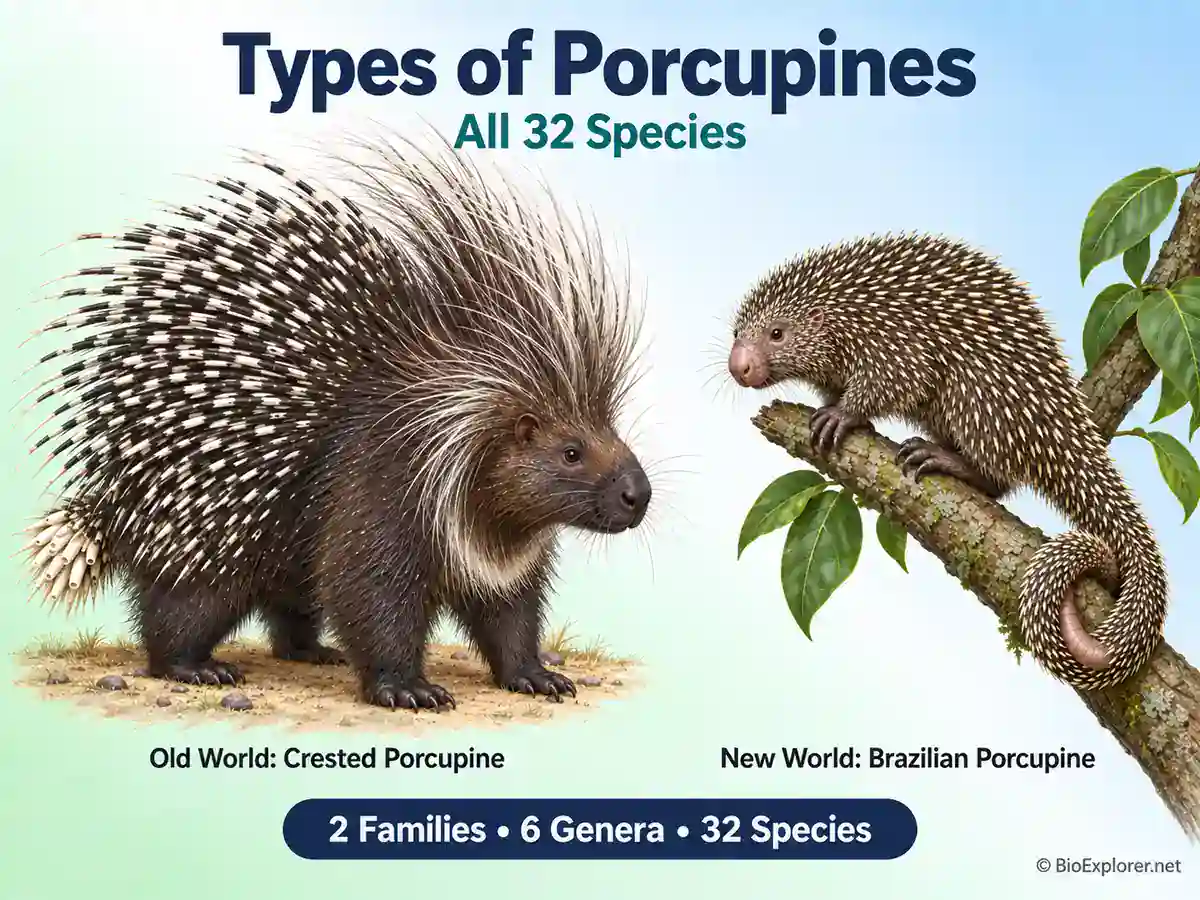
A porcupine cannot throw its quills. The North American Porcupine’s quill tip carries backward-facing barbs. Laboratory testing showed those barbs let the quill slide in easily. They also resist being pulled out. Two Old World species carry comparable microstructure. Those structures have not undergone equivalent testing.
There are 32 living porcupine species. They split between two families, on opposite sides of the world. The two families are not close relatives. Quills evolved twice, in two separate branches of the rodent tree. New World porcupines are closer to guinea pigs than to Hystricidae.
This guide covers all 32 types of porcupines. It is one part of our wider guide to the types of mammals. Each entry carries a picture, a range and a size. It also carries the one fact that sets the species apart.
Ten of the 32 lack a resolved conservation category. You will learn why. One porcupine took 15 years and 12,800 trap nights to find. Italy’s crested porcupine is probably introduced. You will see the evidence.
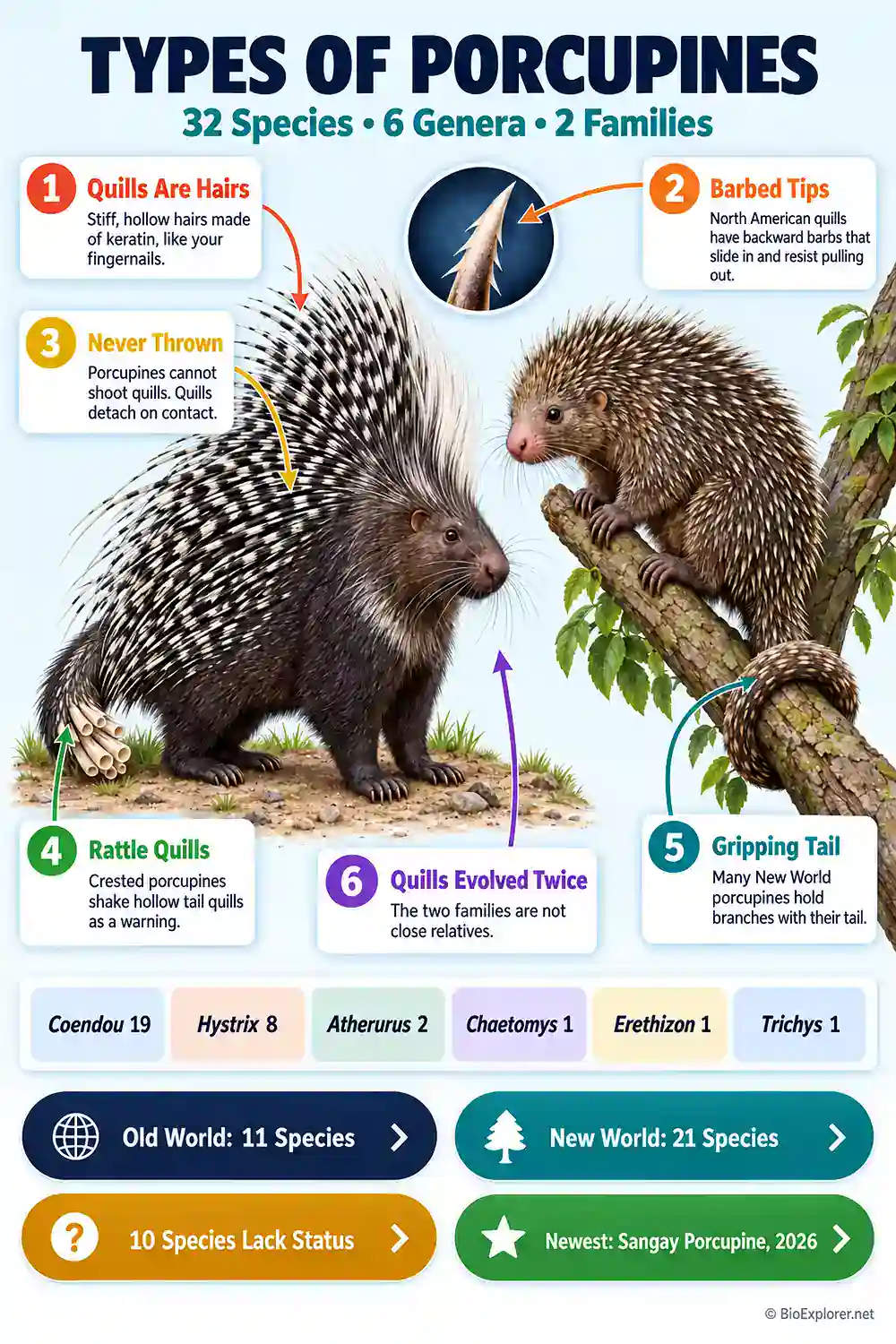
There are 32 living porcupine species, in 6 genera and 2 families. The Old World family Hystricidae holds 11. The New World family Erethizontidae holds 21. The count is contested. The Mammal Diversity Database (MDD v2.5) lists 32[1], while ITIS lists 28[2]. Two of the 32 were described in the last two years. Ten have no resolved conservation category.
Types of Porcupines Guide:
- How Many Porcupines?
- What Is a Porcupine?
- Two Families, Twice
- How Quills Work
- Large Spiny Porcupines
- Hairy Dwarf Porcupines
- The Stump-tailed Porcupine
- The Thin-spined Porcupine
- The North American Porcupine
- Crested Porcupines
- Brush-tailed Porcupines
- The Long-tailed Porcupine
- Porcupines in the US
- Rattle Quills
- The Unknown Third
- Smallest and Largest
- Porcupines in Italy
- Fossil Porcupines
- Frequently Asked Questions
How Many Porcupines?
Scientists recognize 32 living porcupine species. Two were named very recently. Coendou vossi was described in 2025[27]. Coendou sangay followed on 8 June 2026[26].
The number depends on which authority you ask. This is one of the rare cases where the major checklists disagree.
The Mammal Diversity Database is maintained by the American Society of Mammalogists. Version 2.5 lists 32 species. ITIS, the US federal taxonomic service, lists 28.
The whole disagreement sits in the New World family. Both authorities agree on all 11 Old World species. ITIS is missing Coendou longicaudatus, Coendou vossi and Coendou sangay. It also treats Coendou rothschildi as a junior synonym of Coendou quichua.
The two cannot agree on the North American species’ name either. The Mammal Diversity Database writes Erethizon dorsatum. ITIS lists Erethizon dorsatus as valid, and flags dorsatum as invalid. Mammal Species of the World used a third spelling in 2005: dorsata.
This guide follows MDD v2.5 throughout. It is the authority that tracks new descriptions as they are published.
| Genus | Family | Species | Where |
|---|---|---|---|
| Coendou | Erethizontidae | 19 | Central and South America |
| Chaetomys | Erethizontidae | 1 | Eastern Brazil |
| Erethizon | Erethizontidae | 1 | North America |
| Hystrix | Hystricidae | 8 | Africa, Asia, southern Europe |
| Atherurus | Hystricidae | 2 | Central Africa, Southeast Asia |
| Trichys | Hystricidae | 1 | Borneo |
| Total | 2 families | 32 |
What Is a Porcupine?
A porcupine is a rodent with quills. The quills are modified hairs. They are made of keratin, the same protein as your fingernails. Stiffening sharpens them into defensive spines.
All 32 species belong to the rodent suborder Hystricomorpha. They are primarily herbivorous, and our guide to what porcupines eat covers their diet in depth. Like every rodent, they have continuously growing incisors. Crested porcupines also gnaw bone, and have been recorded scavenging carrion.
Beyond that, the two families share less than their common name suggests.
Two Families, Twice
Old World and New World porcupines are not each other’s closest relatives. Their quills come from no shared spiny ancestor.
A 2013 molecular study dated the split. Hystricidae, the Old World family, branched away about 45.1 million years ago[6]. Erethizontidae, the New World family, separated from its nearest relatives later. That date falls near 33.9 million years ago[6][7].
Those nearest relatives are guinea pigs, capybaras, pacas and agoutis. For a North American porcupine, a capybara is the closer relative.
The Mammal Diversity Database records this in its classification. It places Erethizontidae in the parvorder Caviomorpha, alongside the cavies. It assigns Hystricidae no parvorder at all, listing it as incertae sedis. That is an unfilled slot at one rank. It is not doubt about the family.
So quills evolved twice. An ocean and tens of millions of years separated the two lineages. Both reached the same answer to the same problem.
The two families still differ visibly. Old World porcupines are heavy and terrestrial, and mostly cannot climb. They dig extensive burrows. Most New World porcupines are lighter and arboreal. Many carry a prehensile tail that grips branches. A gripping tail is one of the classic tropical rainforest animal adaptations.
How Quills Work
A porcupine quill is a hollow keratin cylinder with a foam-like core. The North American Porcupine carries about 30,000 of them.
The tip does the work. A 2012 study in PNAS examined North American Porcupine quills. It found the barbs at the tip point backward. Those barbs make the quill easier to push in, not harder[8]. HMW describes analogous microstructure in two Old World species. Those structures have not undergone equivalent testing.
The mechanism is straightforward. The barbs concentrate stress at the point of contact. That lets the tip part tissue with less force. The same barbs then catch on the way out.
Porcupines never throw or shoot their quills. Several wildlife agencies state this explicitly[15][18][20][22]. Quills detach easily on contact, which is what makes them seem thrown.
Porcupine quills are often called naturally antibiotic. One 1990 study underlies that claim. It does not support the popular version.
That study tested solvent extracts of quill lipids in a dish. The extracts inhibited six gram-positive bacterial strains. They had no effect on four gram-negative strains. Summer samples held 18.6 percent free fatty acids. Winter samples held 5.5 percent[9]. Whatever the effect is, it is seasonal.
The authors suggested the coating protects the porcupine from its own quills. They had a reason to think porcupines fall. Of 37 skeletons examined, 35.1 percent carried healed major fractures[9]. The study was never evidence that a quilled dog resists infection.
The clinical record does show that quill wounds are dangerous. A Canadian Veterinary Journal review covered 296 quill injuries in dogs. Complication risk rose with the delay before treatment[10]. Quills have been recovered from the heart, spinal canal and eye. Some turned up years after the encounter. None of that bears on the laboratory finding. It means a quilled animal needs a vet.
Large Spiny Porcupines
Eight Coendou species look purely spiny. No soft fur shows through the quills. Most are large. Most also have a prehensile tail as long as the body.
Taxonomy has moved fastest in this group. Three of the eight were recognized in the last five years.
Brazilian Porcupine
| Kingdom | Order | Family | Genus | Species |
|---|---|---|---|---|
| Animalia | Rodentia | Erethizontidae | Coendou | Coendou prehensilis |
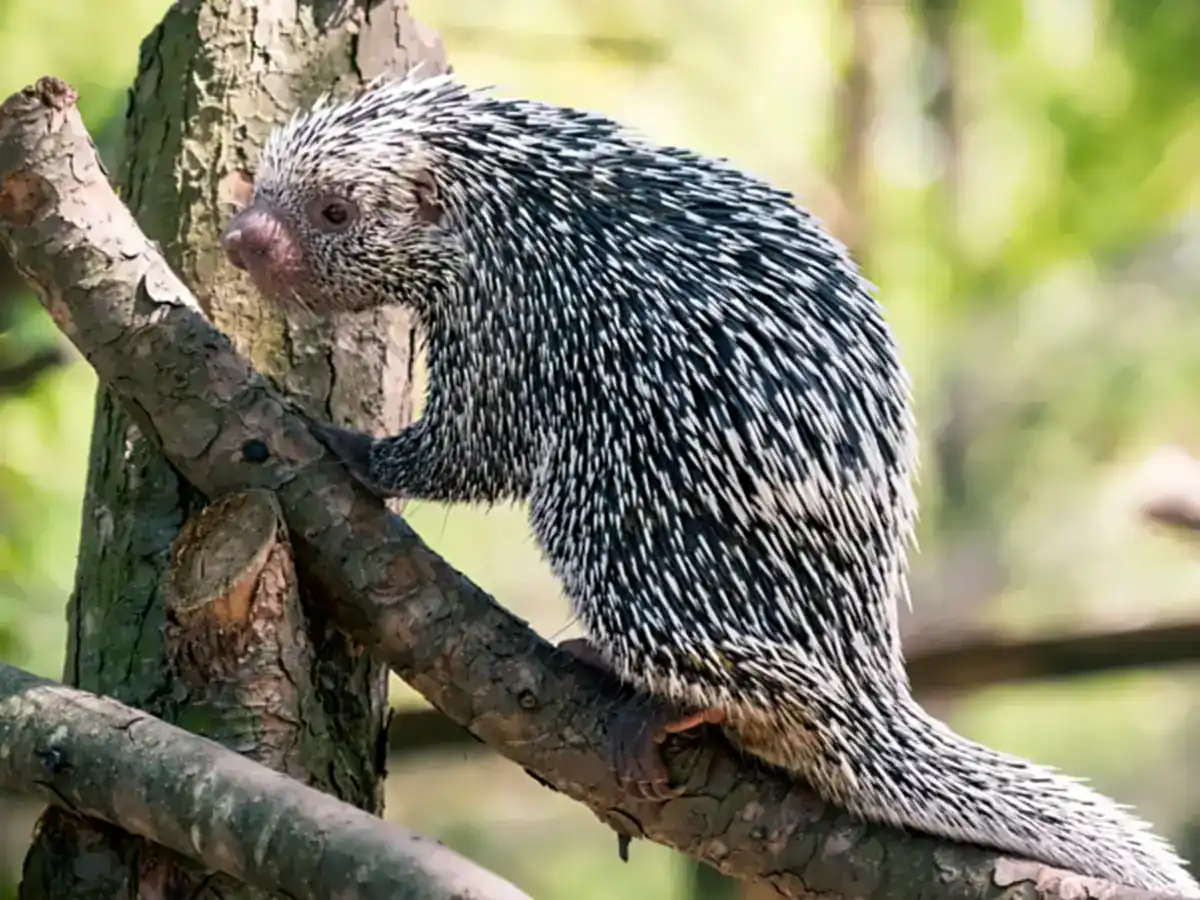
The Brazilian Porcupine is the archetypal tree porcupine. Carl Linnaeus named it in 1758. For two centuries the name covered porcupines from Colombia to Argentina.
- Head and body run 444 to 560 mm. Tails run 330 to 578 mm. Weights range from 3.2 to 5.3 kg. The tail is about as long as the animal itself. It coils upward to grip branches.
- Its quills are tricolored and reach 60 to 110 mm. Pale base, dark middle and pale tip sit in roughly equal bands. The head is round, with a large pink bulbous nose. Inflated frontal sinuses give the face a domed profile.
- The best measured samples come from northern Colombia and central Brazil. Voss recorded means of 451 mm (n=15) and 504 mm (n=7)[24]. Under the current split, both series fall mostly under the Amazonian Long-tailed.
- Its published reproductive figures are unusually specific. A captive female bears one well-developed young. Gestation runs 195 to 200 days, roughly six and a half months[4]. That is extraordinarily long for a rodent. Newborns weigh 360 to 450 g. They feed themselves by about 15 weeks.
- MDD v2.5 now restricts this species to Brazil alone.
Amazonian Long-tailed Porcupine
| Kingdom | Order | Family | Genus | Species |
|---|---|---|---|---|
| Animalia | Rodentia | Erethizontidae | Coendou | Coendou longicaudatus |
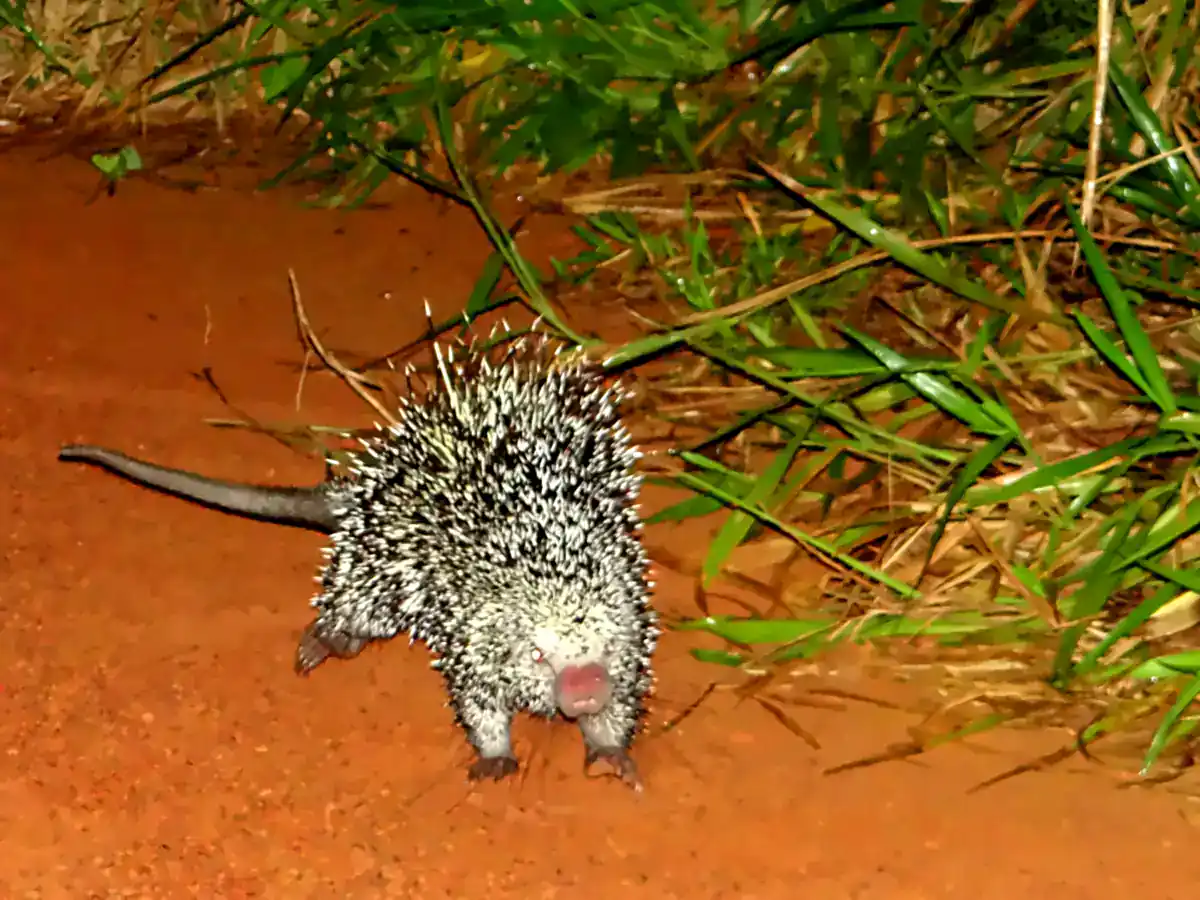
The Amazonian Long-tailed Porcupine was restored to species rank in 2021. For two centuries Coendou longicaudatus sat as a Brazilian Porcupine synonym.
- It is large and salt-and-pepper, with no emergent fur. Tricolored quills cover the rump as well as the shoulders. No measurements have been published under its own name. The Brazilian Porcupine figures above, in the old broad sense, apply here.
- It is the widest-ranging porcupine in the Americas. MDD v2.5 lists 13 countries for it. The range runs from Colombia and the Guianas south to Argentina.
- Direct observations suggest this lineage eats mainly seeds from immature fruits. Diets across the genus vary. They take in fruit, seeds, bark, roots and flowers.
- Its type specimen does not exist and never did. Francois Marie Daudin based the 1802 name on a written account. That account came from Cayenne. He had no animal in front of him. MDD v2.5 records the type material as nonexistent[1].
Bicolor-spined Porcupine
| Kingdom | Order | Family | Genus | Species |
|---|---|---|---|---|
| Animalia | Rodentia | Erethizontidae | Coendou | Coendou bicolor |
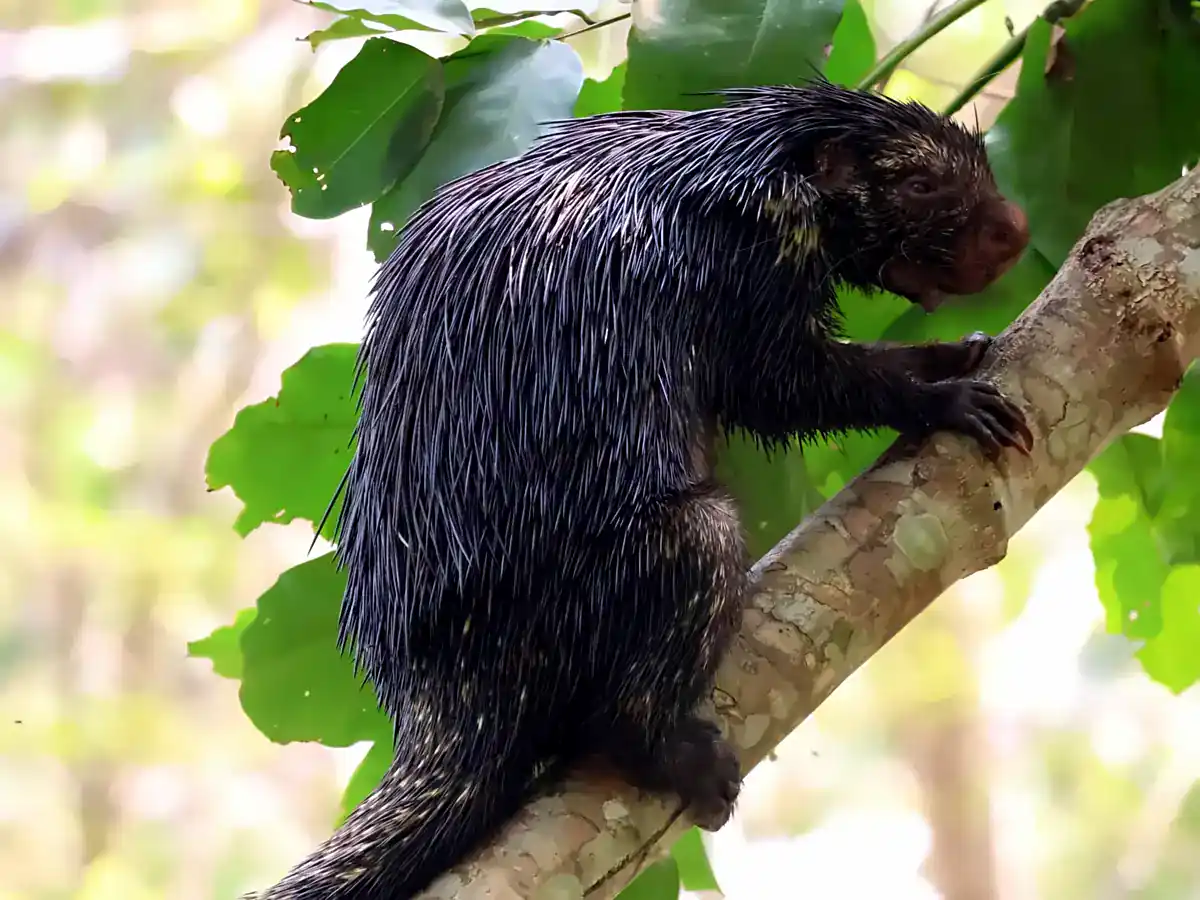
The Bicolor-spined Porcupine carries a dark mantle over a paler rump. Quills on the nape and shoulders reach 80 to 90 mm. Those on the rump are 50 mm or less. The blackish outer halves of the front quills form a mantle.
- Adults run 378 to 500 mm in head and body. Tails run 335 to 540 mm. Weights range from 3.4 to 4.7 kg. A Peruvian series of five averaged 457 mm head and body.
- It lives along the eastern Andean foothills and the adjacent Amazonian lowlands. The range runs from Peru’s San Martín south to Bolivia’s Beni. An isolated population holds relict montane forest west of the Andes.
- Almost nothing is published about how it lives. The Handbook of the Mammals of the World (HMW) gives no diet. It dens in tree holes, sometimes as an adult pair.
- For a century this porcupine was confused in both directions. Voss checked two widely used field guides. Their illustrations labeled C. bicolor show the Brazilian Porcupine. He also found the GenBank cytochrome-b sequences came from misidentified specimens[25]. Several published family trees were built on those wrong sequences.
- Johann Jakob von Tschudi described it from his Peruvian fieldwork. Sources disagree on whether the installment appeared in 1844 or 1845.
Quichua Porcupine
| Kingdom | Order | Family | Genus | Species |
|---|---|---|---|---|
| Animalia | Rodentia | Erethizontidae | Coendou | Coendou quichua |
The Quichua Porcupine is a smaller animal than it used to be. A 2025 revision took two other species out of it.
- Six animals from the Ecuadorian Andes averaged 367 mm head and body. Tails averaged 208 mm. Weight is given as 2 to 3 kg, without a sample size.
- It is now restricted to Ecuador alone.
- Be careful with older accounts. Some references still print head and body as 332 to 438 mm. Those are Panamanian animals, reassigned in 2025 to Rothschild’s Porcupine[27]. The numbers describe two species at once.
- One widely cited record needs the same caution. The first sarcoptic mange report for a Neotropical porcupine is filed here. Those animals came from the Magdalena valley. The revision places that valley in Coendou vossi.
Rothschild’s Porcupine
| Kingdom | Order | Family | Genus | Species |
|---|---|---|---|---|
| Animalia | Rodentia | Erethizontidae | Coendou | Coendou rothschildi |
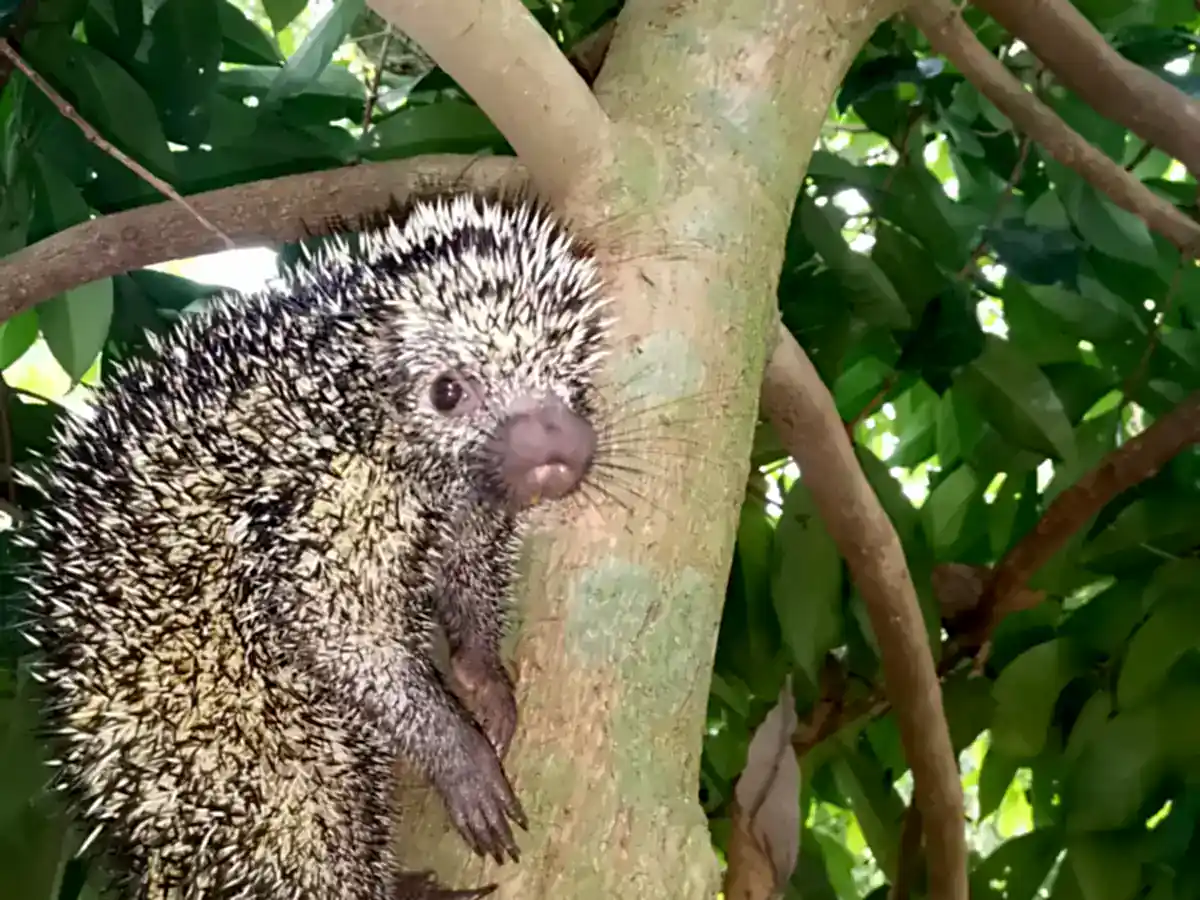
Rothschild’s Porcupine is the largest member of its complex. Fifteen animals from Colombia and Panama averaged 730 mm total length[27]. The Quichua Porcupine averaged 574 mm.
- Head and body fall between 360 and 438 mm. The tail runs 270 to 420 mm. No body mass has been published under this name.
- MDD v2.5 gives its range as Panama and Colombia only. It occupies very humid forest in several Panamanian provinces. In Colombia it holds the departments of Chocó and Córdoba.
- Its type locality is probably fabricated. Voss reports that “Sevilla Island,” the recorded place, is fraudulent[24]. The animal most likely came from mainland Boquerón.
- Oldfield Thomas named it in 1902 for Walter Rothschild. ITIS still treats it as a junior synonym of the Quichua Porcupine. That is part of why the two databases differ.
Voss’ Porcupine
| Kingdom | Order | Family | Genus | Species |
|---|---|---|---|---|
| Animalia | Rodentia | Erethizontidae | Coendou | Coendou vossi |
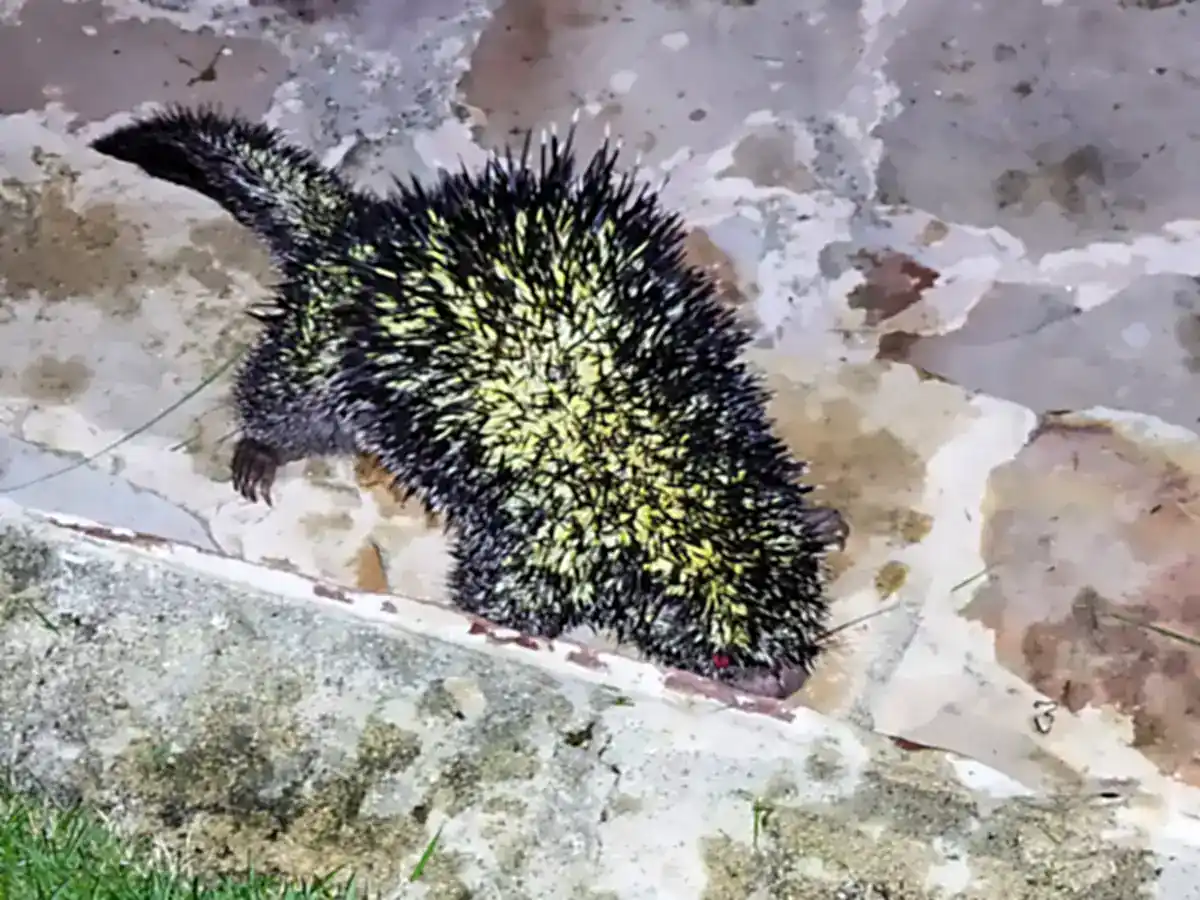
Voss’ Porcupine was described in 2025. Three of its five type specimens sat misidentified for 81 years[27].
- Head and body run 260 to 340 mm. Total length runs 468 to 620 mm. The holotype, an adult female, weighed 1,600 g. It is externally smaller than Rothschild’s Porcupine at every measure.
- Its quills run 27 to 55 mm, in two banding patterns. The combined effect is described as darkly frosted. The tail is prehensile.
- The holotype was collected in 2021 at Florencia, Caldas, Colombia. Elevation was 1,580 m. The oldest paratypes were taken at Caparrapí, Cundinamarca, on 30 June 1944.
- Genetics made the case. This is the earliest-diverging lineage of its group. It is sister to the clade holding the Quichua and Rothschild’s porcupines. All three species-delimitation methods tested supported it. That was not true of the other two.
- It has been photographed inside natural caves in Tolima and Santander. The northernmost record rests on two quills, and one DNA sequence.
- The name honors Robert S. Voss. His 2011 revision of the group made the later work possible.
Sources 1
Sangay Porcupine
| Kingdom | Order | Family | Genus | Species |
|---|---|---|---|---|
| Animalia | Rodentia | Erethizontidae | Coendou | Coendou sangay |
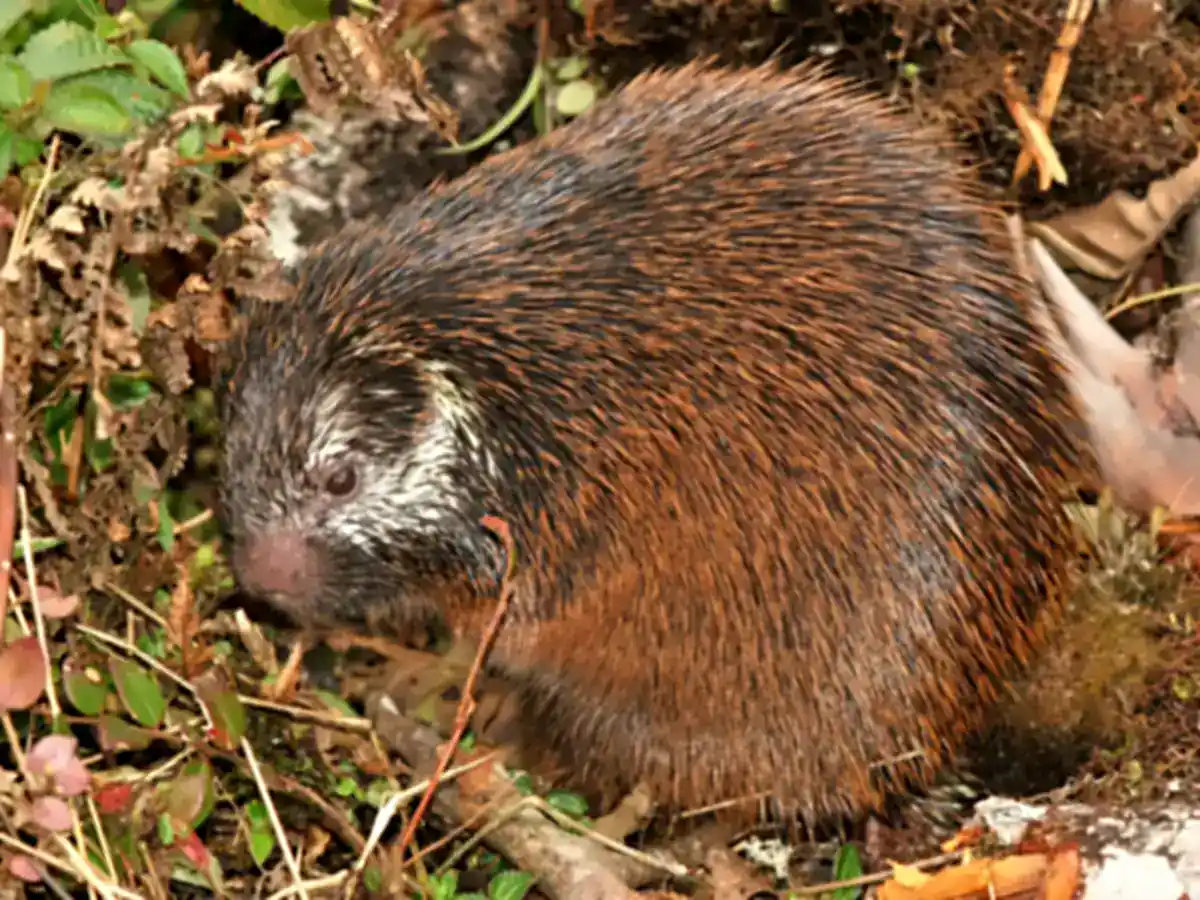
The Sangay Porcupine is this article’s most recently described species. It was described on 8 June 2026, from Ecuador’s Sangay National Park. One specimen was collected.
- The holotype, an adult female, measured 460 mm in head and body. Its tail was 120 mm and it weighed 2,000 g. Every published figure for this species has a sample size of one.
- Its tail is diagnostic. It is 26 percent of head and body length. Close relatives run 83 to 105 percent. It is also the only member of its genetic group with bristle-quills. Those are tricolored, with brownish-red tips.
- It was found at 2,400 m in primary cloud forest. It has been recorded nowhere else.
- Fifteen years of systematic survey work in the park never detected it. Researchers saw two animals and collected one, taken by hand. The sampling figures appear further down this page.
- Genetically it sits closest to the Bicolor-spined Porcupine. The cytochrome-b distance is 6.05 percent. Within-species distances run 0.81 to 2.24 percent.
Baturité Porcupine
| Kingdom | Order | Family | Genus | Species |
|---|---|---|---|---|
| Animalia | Rodentia | Erethizontidae | Coendou | Coendou baturitensis |
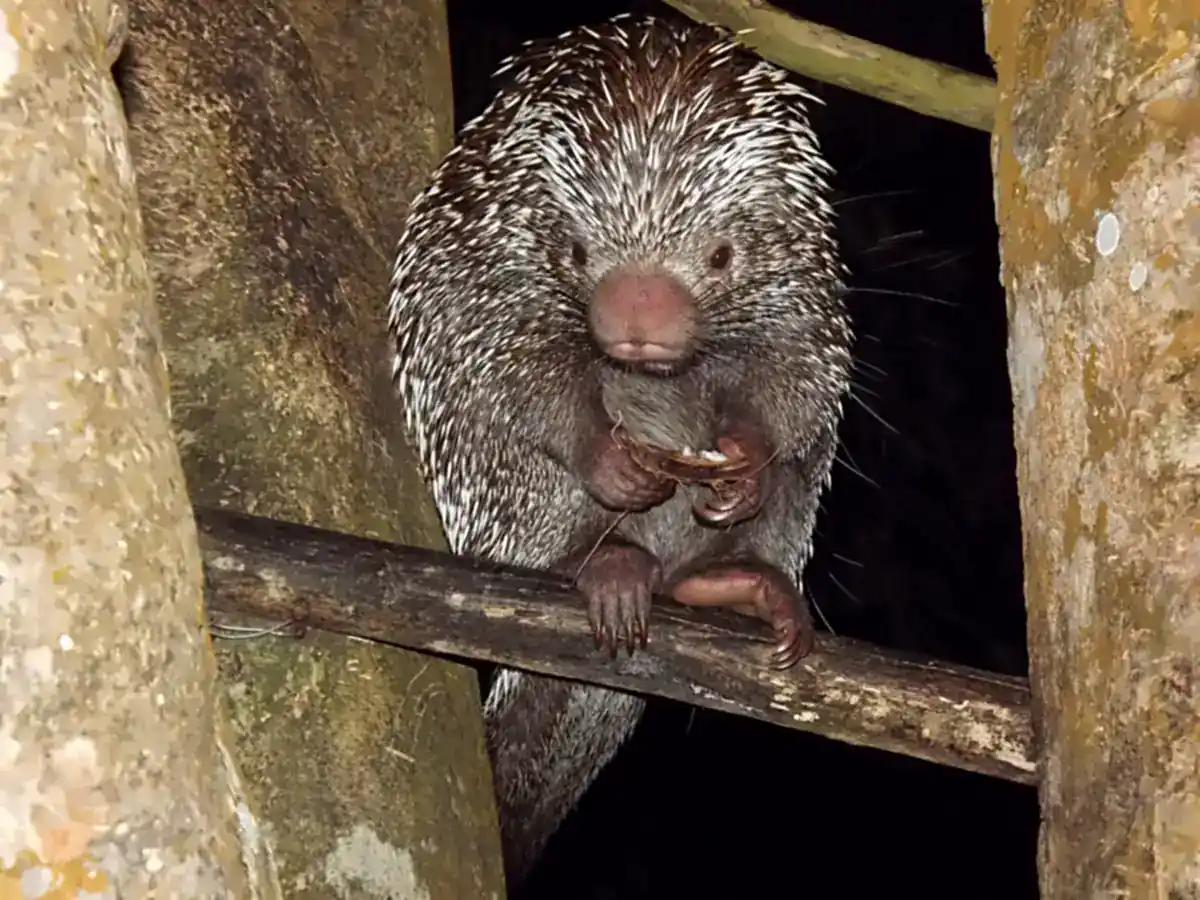
The Baturité Porcupine lives on one mountain. The Baturité massif in Ceará is a humid forest island. Dry Caatinga scrub surrounds it. This animal has been found nowhere else.
- One animal measured 500 mm head and body, tail 460 mm. The source rests its external measurements on that one animal[30]. No defensible body mass follows from a sample of one. The species was described from a holotype and a paratype.
- Its spines are tricolored: whitish base, brown midband, dirty white tip. The effect is salt-and-pepper, with no fur showing. The nose is large, bulbous and soft. Long black whiskers reach back to the shoulders.
- Nothing is known about how it lives. Diet, breeding, activity and movements all read as no information available. So do home range and social organization.
- Its small range and continuing habitat loss, one of the main threats to biodiversity, put the Baturité Porcupine at real risk. MDD v2.5 records it as Data Deficient.
- Feijó and Langguth described it in 2013. Some secondary sources cite the wrong paper. They point at a Zootaxa article on another species.
Hairy Dwarf Porcupines
Ten Coendou species are smaller and furrier than the group above. In most of them soft fur grows out past the quills. The animal looks shaggy rather than spiny. In one species the quills are hidden completely.
These were once placed in a separate genus, Sphiggurus. That genus was abandoned because no character reliably separated it.
Mexican Hairy Porcupine
| Kingdom | Order | Family | Genus | Species |
|---|---|---|---|---|
| Animalia | Rodentia | Erethizontidae | Coendou | Coendou mexicanus |
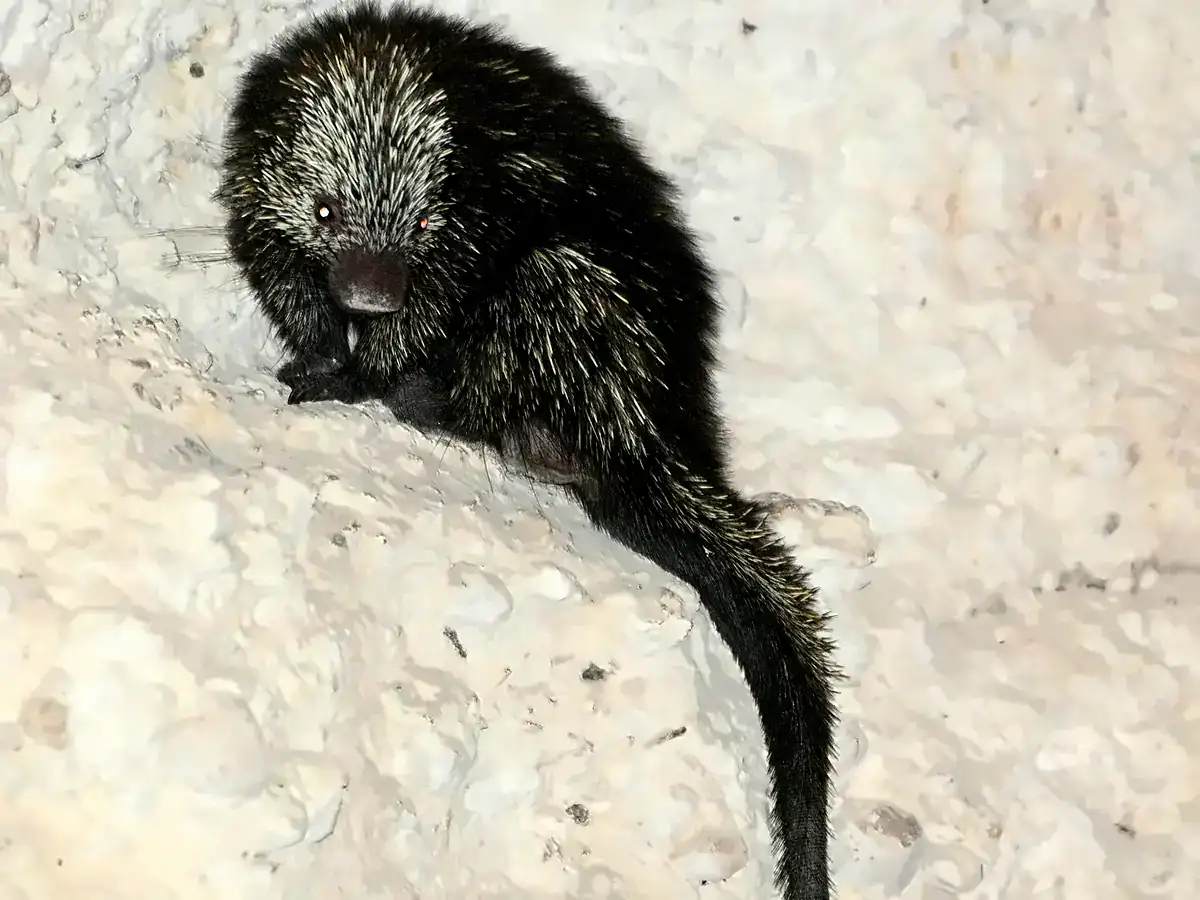
The Mexican Hairy Porcupine is the only Coendou whose range reaches Mexico. It is also the only one MDD v2.5 places in the Nearctic.
- Adults are 350 to 460 mm in head and body. Tails run 200 to 360 mm. Weights range from 1.4 to 2.6 kg. Seventeen animals from Oaxaca averaged 412 mm head and body.
- Voss gives it the cleanest diagnosis in the genus. It is the only Coendou with long, uniformly soft black fur. Its quills are short and bicolored, under 50 mm. A bony ridge usually lines the roof of its ear canal.
- Quills run 30 to 35 mm, yellow-based with black tips. The bright yellow shows through the hair on the head and neck.
- It ranges from San Luis Potosí and Michoacán south to western Panama. That covers eight countries, from sea level to at least 2,350 m.
- It dens in hollow trees. Adult pairs have been found sharing a den.
Paraguayan Hairy Dwarf Porcupine
| Kingdom | Order | Family | Genus | Species |
|---|---|---|---|---|
| Animalia | Rodentia | Erethizontidae | Coendou | Coendou spinosus |
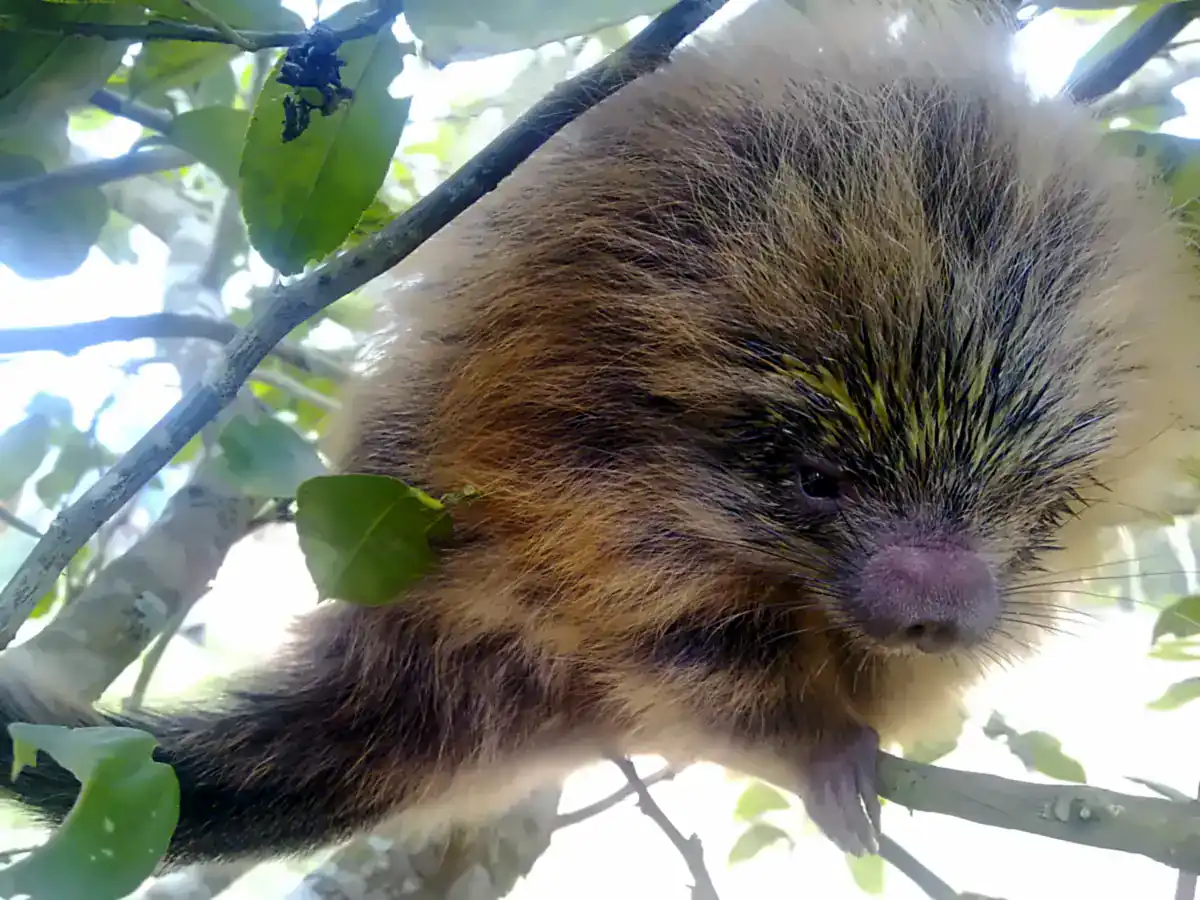
The Paraguayan Hairy Dwarf Porcupine holds the Atlantic Forest. Where it meets the Amazonian Long-tailed Porcupine, the two replace each other.
- Three regional samples put head and body at 317 to 393 mm. Tails run 255 to 282 mm. Weight is given as about 1 kg, without sample size or range.
- Voss measured Paraguayan animals as modestly smaller than Brazilian ones. He cautioned that young adults were overrepresented in the Paraguayan material.
- Its type specimen has been missing since the 1850s. Voss designated a neotype, shot at Sapucai, Paraguay, in October 1901.
- The Ache people of Paraguay eat this porcupine.
Bahian Hairy Dwarf Porcupine
| Kingdom | Order | Family | Genus | Species |
|---|---|---|---|---|
| Animalia | Rodentia | Erethizontidae | Coendou | Coendou insidiosus |
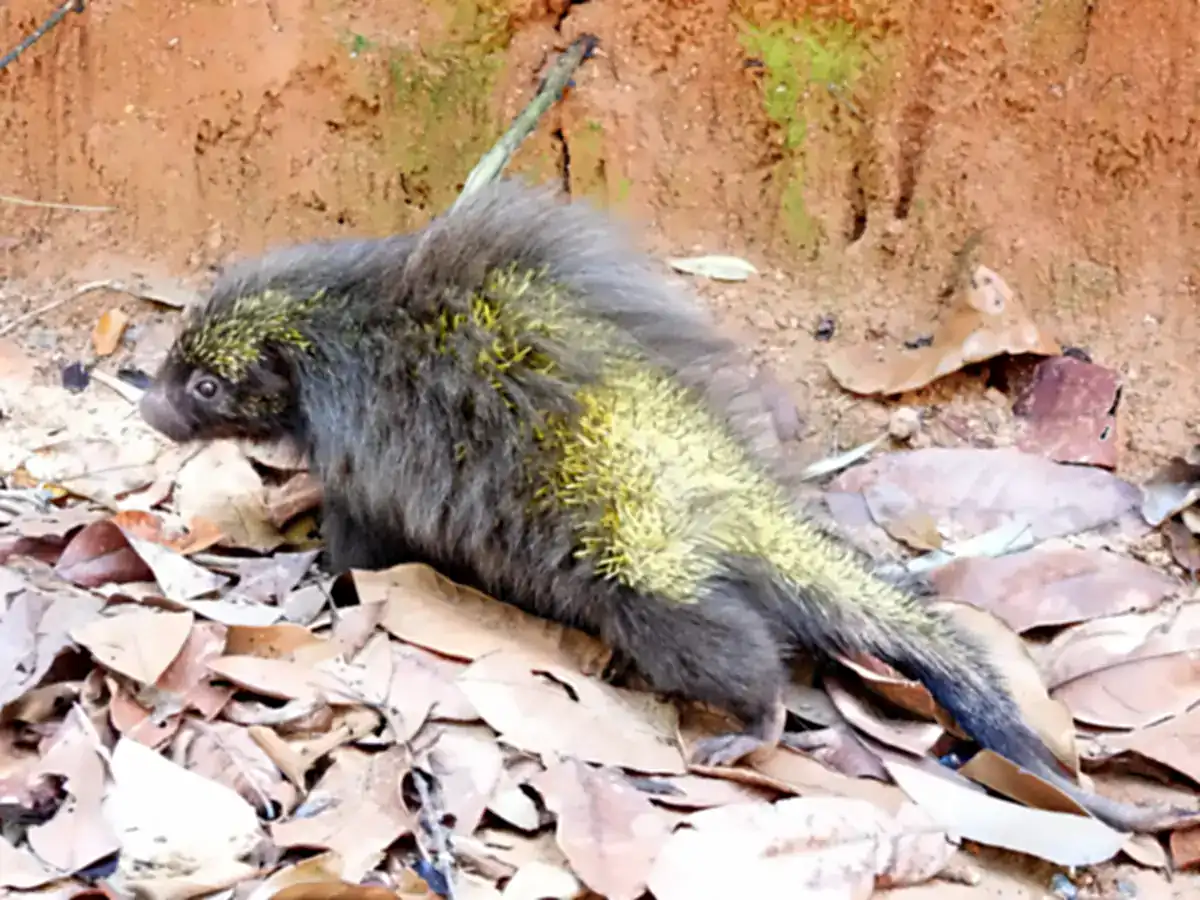
The Bahian Hairy Dwarf Porcupine appears to have no spines at all. Thick soft fur covers the body and hides the quills completely. Only the less furry head shows white at the quill bases.
- It is small: 290 to 350 mm in head and body. Tails run 180 to 222 mm. No body mass has been published for it.
- Its hidden quills are sharp, thick and bicolored. They are pale-based and dark brown over the outer half. The tail is short and prehensile, with a nearly bare tip.
- Eastern Brazil is its only home. It holds moist forest from southern Sergipe to northern Rio de Janeiro. For such a poorly known animal it uses many habitats. Those include cacao orchards grown under native canopy.
- Its diet includes fruit, cultivated roots and vegetables, and ant pupae.
- People hunt it for meat and for its quills. The quills are said to have medicinal properties.
- The name has been attached to the wrong animals repeatedly. Voss called its nomenclatural history “tediously complex.”
Black-tailed Porcupine
| Kingdom | Order | Family | Genus | Species |
|---|---|---|---|---|
| Animalia | Rodentia | Erethizontidae | Coendou | Coendou melanurus |
The Black-tailed Porcupine is named for its one conspicuous feature. The body is blackish streaked with yellow. The long prehensile tail is pitch black.
- It is small, 280 to 380 mm in head and body. Tails run 220 to 363 mm. Weights range from 1.5 to 2.4 kg.
- Long yellowish-tipped guard hairs grow out over the quills. Those quills are bicolored and under 3 cm. Thick yellow defensive quills cover the rump, sometimes hidden by fur.
- Its range covers the northeastern Amazonian lowlands, across five countries. That means north of the Amazon and east of the Rio Negro.
- It may be locally common while almost never being seen. Large numbers were rescued during construction of a hydroelectric dam. Flooding pushed animals out of a canopy nobody had managed to count.
- A multi-year survey at Paracou, French Guiana, produced one voucher specimen. None of the forestry staff interviewed recognized the animal.
Eastern Amazonian Dwarf Porcupine
| Kingdom | Order | Family | Genus | Species |
|---|---|---|---|---|
| Animalia | Rodentia | Erethizontidae | Coendou | Coendou nycthemera |
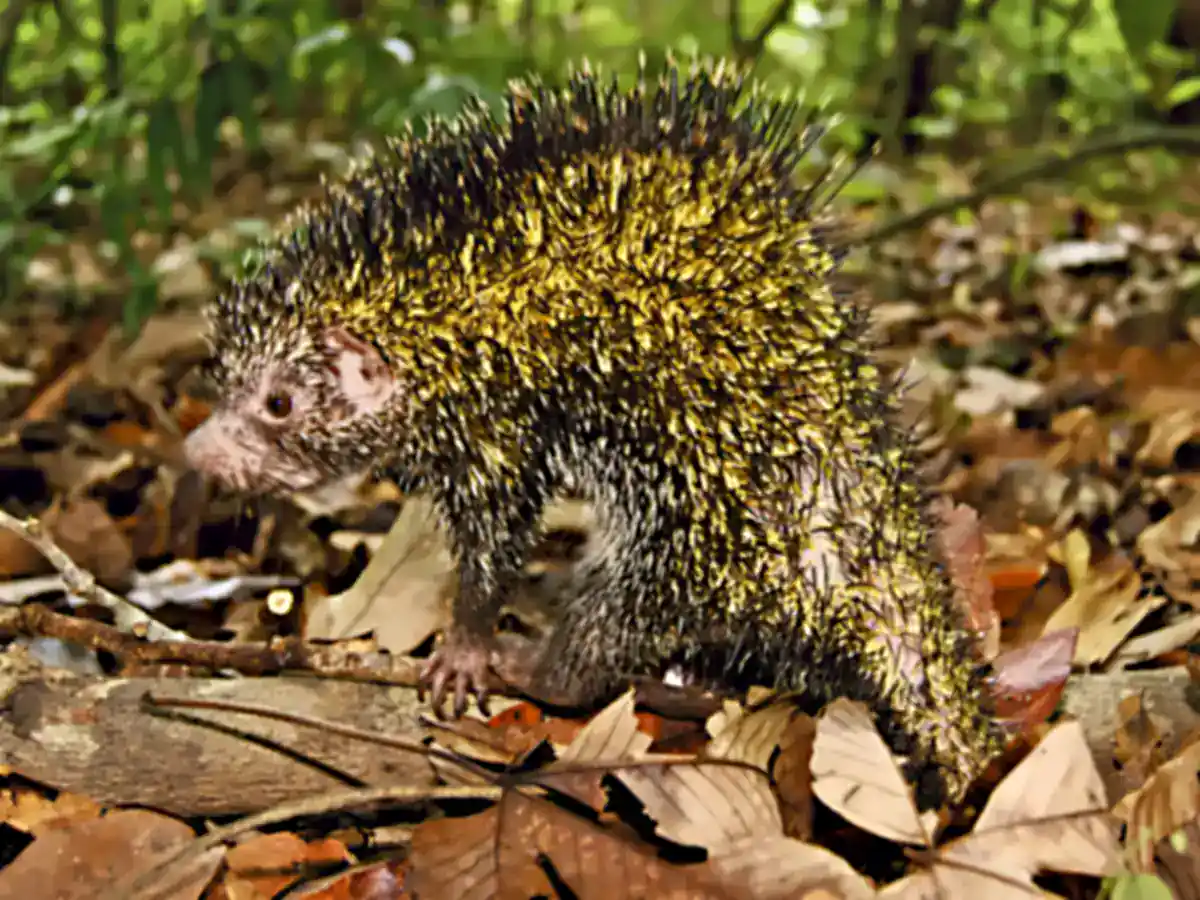
The Eastern Amazonian Dwarf Porcupine is black, spiny and almost undocumented. It lives along the south bank of the Amazon. The range runs from the Rio Madeira east to Marajó Island.
- Head and body run 290 to 380 mm. Tails run 280 to 370 mm. That is near 90 percent of head and body. The tail is fully prehensile. No trustworthy body mass turned up in the sources used here.
- Most quills are bicolored: pale basal third, black beyond. The animal looks yellow or white wherever the quill bases show. That is mainly on the head and shoulders.
- Its rump records a behavior nobody has watched. Quills just above the tail base are short, upright and worn blunt. The wear suggests the animal rests rump-first against a surface. That is deduced from abrasion on museum skins. No observation of a resting animal has been published.
- Less than 20 percent of its likely habitat is protected.
- Voss was blunt about the original description. Olfers’s 1818 Latin account, he wrote, “is virtually useless.”
Western Amazonian Dwarf Porcupine
| Kingdom | Order | Family | Genus | Species |
|---|---|---|---|---|
| Animalia | Rodentia | Erethizontidae | Coendou | Coendou ichillus |
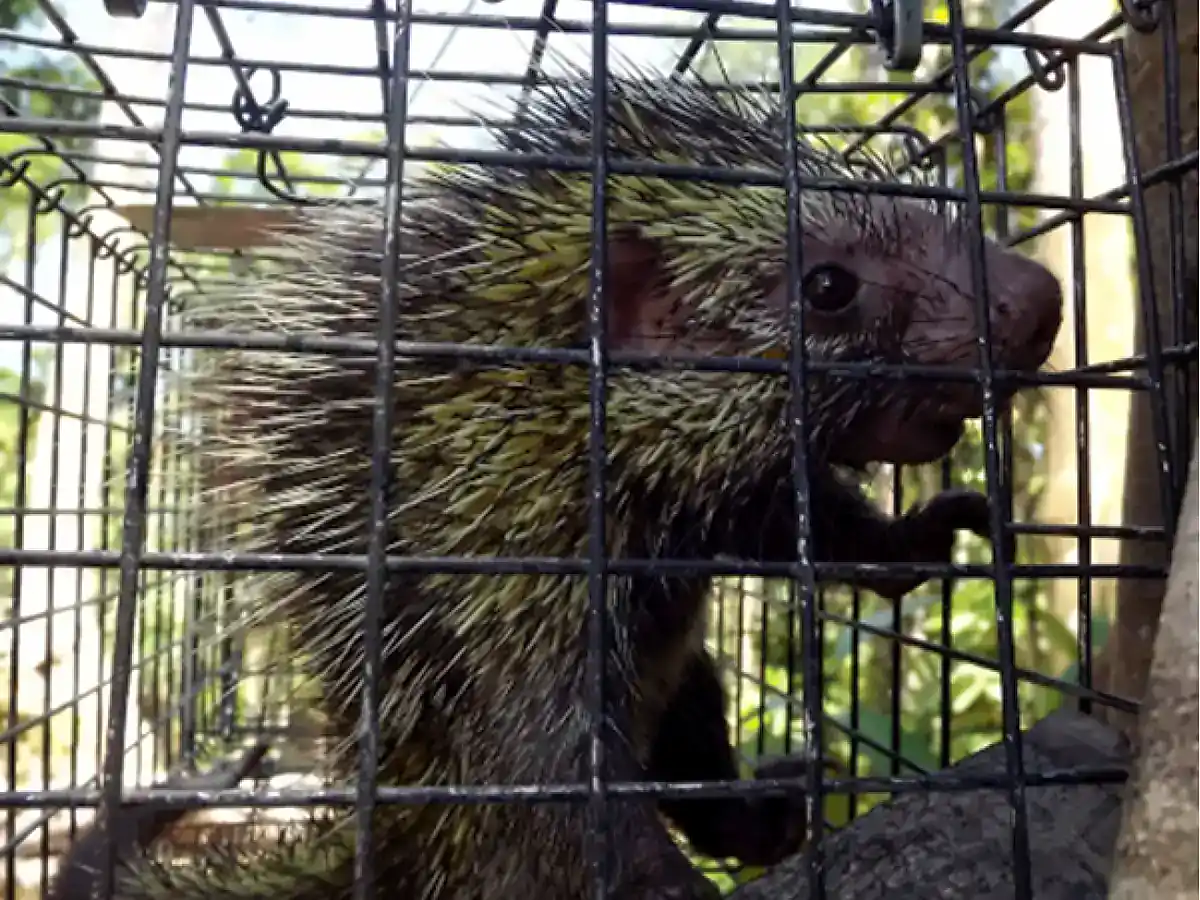
The Western Amazonian Dwarf Porcupine is small and streaked. It is known mainly from photographs taken in the treetops.
- Head and body run 260 to 307 mm. Tails run 210 to 251 mm. Exactly one body mass has been published: 770 g. That animal was an adult female, trapped in Peru in October 2013.
- Long thin bristle-quills reach 80 mm. They are pale at base and tip, with a dark midband. Scattered through the ordinary quills, they give the back its streaked look.
- Researchers watched 13 natural canopy bridges with 24 camera traps. The bridges crossed a pipeline clearing. Across 7,198 trap nights they recorded 379 photo events[33]. They counted at least 17 individuals of this species.
- The animals used nine of the 13 bridges in that study. The four they avoided were those where branches did not quite touch. The researchers read that as evidence it will not cross gaps. The animals also gnawed four cameras hard enough to pop the latches.
- Every record in that survey fell between 18:00 and 05:00. Activity peaked at 20:00, and rose significantly on darker nights.
- Its name comes from ichilla. That means small in the lowland Quichua dialect spoken where it lives.
Frosted Porcupine
| Kingdom | Order | Family | Genus | Species |
|---|---|---|---|---|
| Animalia | Rodentia | Erethizontidae | Coendou | Coendou pruinosus |
The Frosted Porcupine climbs higher than almost any porcupine in the Americas. In 2025 its known ceiling rose again.
- Colombian and Venezuelan samples give head and body near 340 mm. Tails run 175 to 199 mm. One fresh animal measured near the type locality weighed 1,010 g.
- It occupies mountains, foothills and adjacent lowlands. The range covers northeast Colombia and northwest Venezuela. Records run 54 to 2,600 m.
- A 2025 review raised that ceiling to 2,801 m[34], in Santander. The same paper added twelve Colombian localities and rejected four. It recorded the species in two departments for the first time.
- Published tail measurements for this species disagree. One Colombian male has a tail far longer than the species mean. The reviewers flagged it as an outlier rather than smoothing it over.
Roosmalens’ Porcupine
| Kingdom | Order | Family | Genus | Species |
|---|---|---|---|---|
| Animalia | Rodentia | Erethizontidae | Coendou | Coendou roosmalenorum |
Roosmalens’ Porcupine may be the smallest porcupine alive. Its describers wrote that the weight data suggest exactly that.
- Head and body come to about 290 mm, tail to 260 mm. The holotype weighed 600 g. Its describers cautioned that the animal may have been emaciated. Only three specimens existed when the species was named. No figure here rests on a meaningful sample.
- Its tail is almost 90 percent of head and body length. That held in both animals that could be measured. Its toothrows are, in the describers’ word, remarkably small.
- It was known only from the middle Rio Madeira in Brazil. A 2023 record 480 km southeast, in Mato Grosso, widened that range[28].
- Voss and da Silva named it in 2001. The name honors Marc van Roosmalen and his son. They collected the type series.
Pernambuco Dwarf Porcupine
| Kingdom | Order | Family | Genus | Species |
|---|---|---|---|---|
| Animalia | Rodentia | Erethizontidae | Coendou | Coendou speratus |
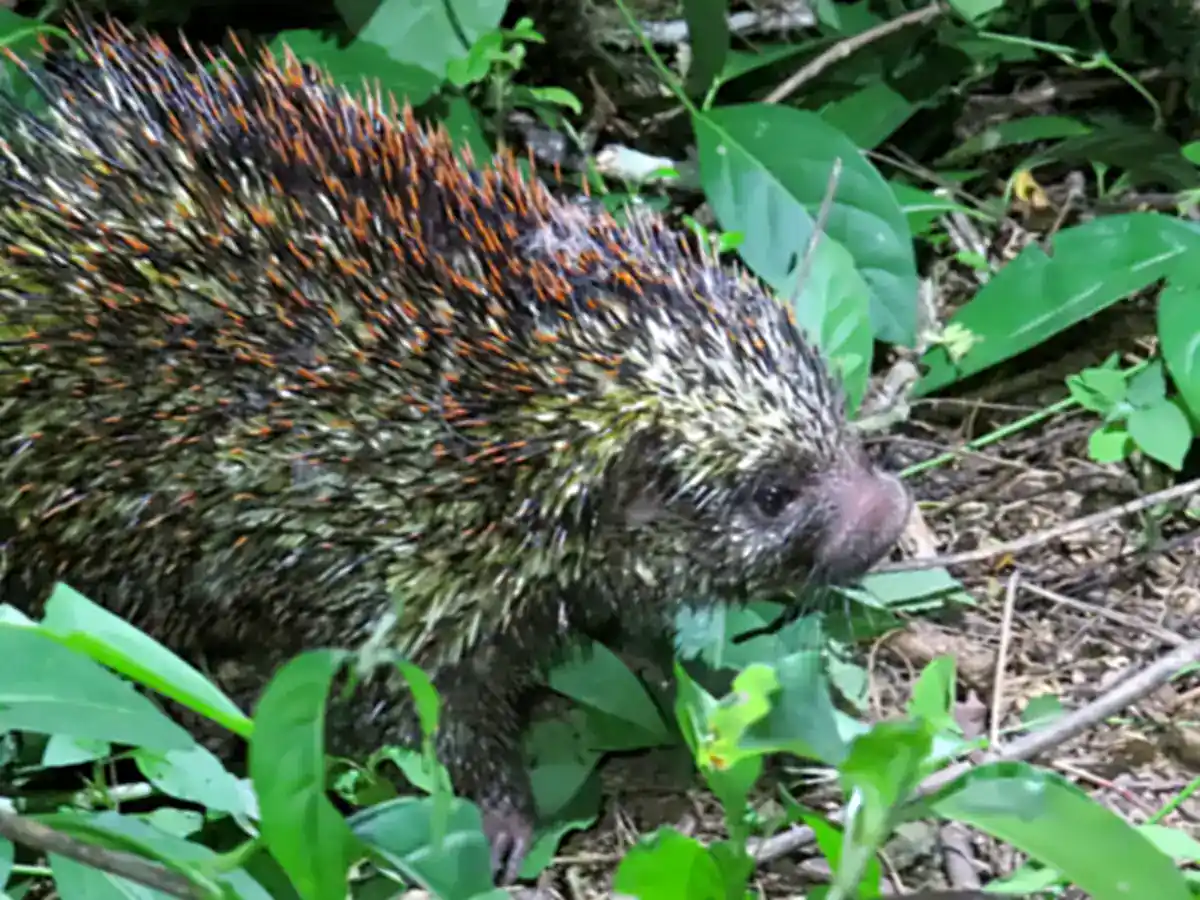
The Pernambuco Dwarf Porcupine was described in 2013 and is already Vulnerable. It lives in shrinking Atlantic forest north of the São Francisco.
- Adults run 330 to 440 mm in head and body. Tails run 286 to 320 mm. Weights range from 1.4 to 1.6 kg. The type series is five animals, so those ranges rest on five.
- Its survey history is the strongest evidence of scarcity. Its describers found it in one 470-hectare fragment. Density there ran 36.8 animals per square kilometer[31]. Five further years of work drew blanks in 23 other areas. Those included the largest and best preserved fragment in the region.
- Its species name means hope.
- Where it meets the Brazilian Porcupine, the two behave differently under threat. This species freezes. The larger animal flees.
Blackish Hairy Dwarf Porcupine
| Kingdom | Order | Family | Genus | Species |
|---|---|---|---|---|
| Animalia | Rodentia | Erethizontidae | Coendou | Coendou vestitus |
The Blackish Hairy Dwarf Porcupine is among Colombia’s rarest mammals. In 132 years only 12 museum specimens and 3 photographs have surfaced.
- Six measured animals averaged 346 mm head and body, 179 mm tail. No body mass has been published.
- It is restricted to the western foothills of Colombia’s Eastern Cordillera. Records fall between 1,300 and 2,890 m, at six localities.
- Two skull oddities set it apart. It has no coronoid process on the lower jaw. Two openings in the skull base run together. They are separate in other porcupines.
- A 2021 assessment put its extent of occurrence at 3,323 square kilometers. Its area of occupancy came to 24 square kilometers. The assessors recommended listing it as Endangered[32]. MDD v2.5 still records it as Data Deficient.
- Only two porcupine species anywhere have a full Mammalian Species account. This is one, published in 2021.
The Stump-tailed Porcupine
Stump-tailed Porcupine
| Kingdom | Order | Family | Genus | Species |
|---|---|---|---|---|
| Animalia | Rodentia | Erethizontidae | Coendou | Coendou rufescens |
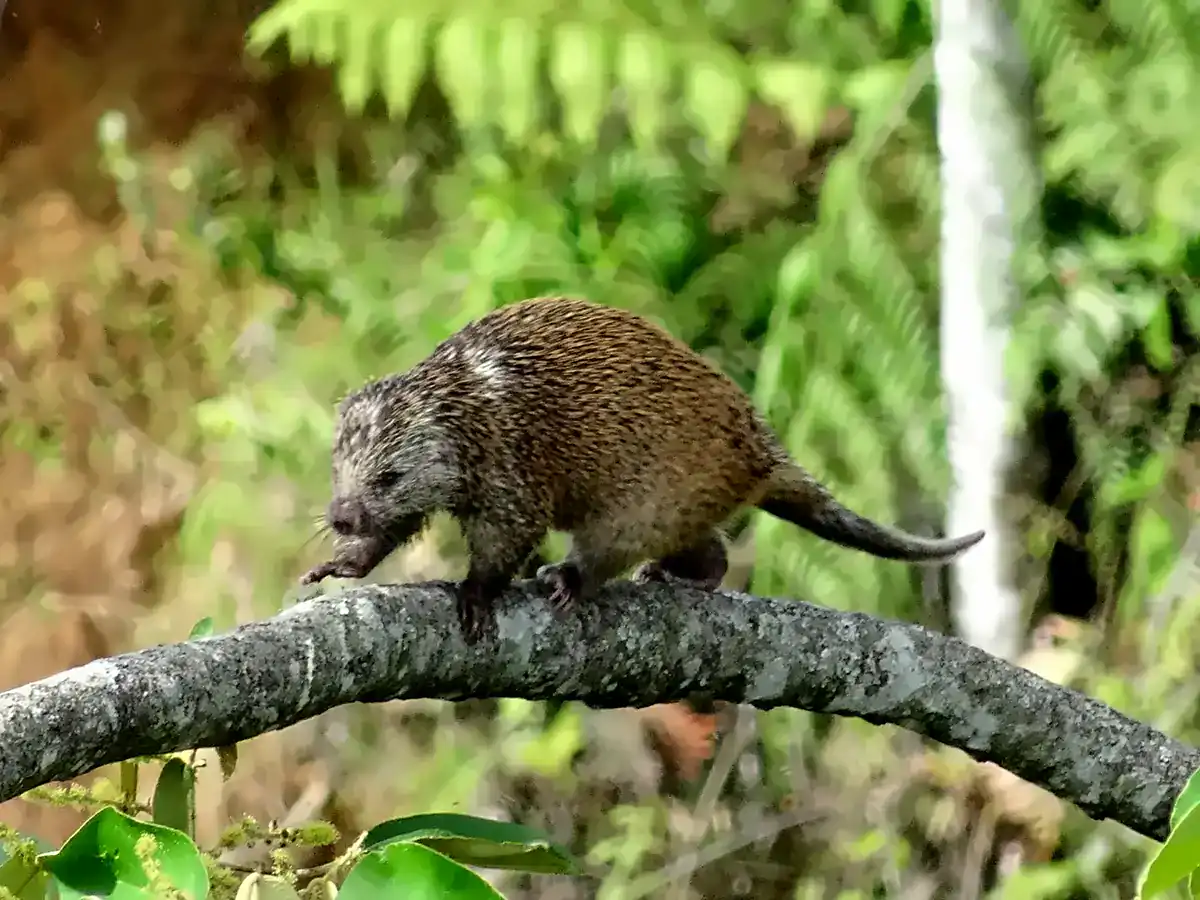
The Stump-tailed Porcupine has no prehensile tail. That is unusual in a genus built around one. It also climbs higher than any of its relatives.
- A Colombian series of ten averaged 368 mm head and body. Tails averaged just 139 mm. Sources disagree on the upper bound. No body mass has been published.
- Its tail is short, thick and not prehensile. That is why it spent decades in its own genus, Echinoprocta.
- Records come from all three Andean cordilleras of Colombia. It holds both slopes of the Ecuadorian Andes. It reaches northern Peru and Bolivia. Most records fall between 1,500 and 3,000 m.
- A 2018 Sangay National Park record raised its ceiling to 4,387 m. That is the highest elevation recorded for any New World porcupine.
- Most of its quills are not defensive. Only the shorter head and forequarter spines carry sharp points.
The Thin-spined Porcupine
Thin-spined Porcupine
| Kingdom | Order | Family | Genus | Species |
|---|---|---|---|---|
| Animalia | Rodentia | Erethizontidae | Chaetomys | Chaetomys subspinosus |
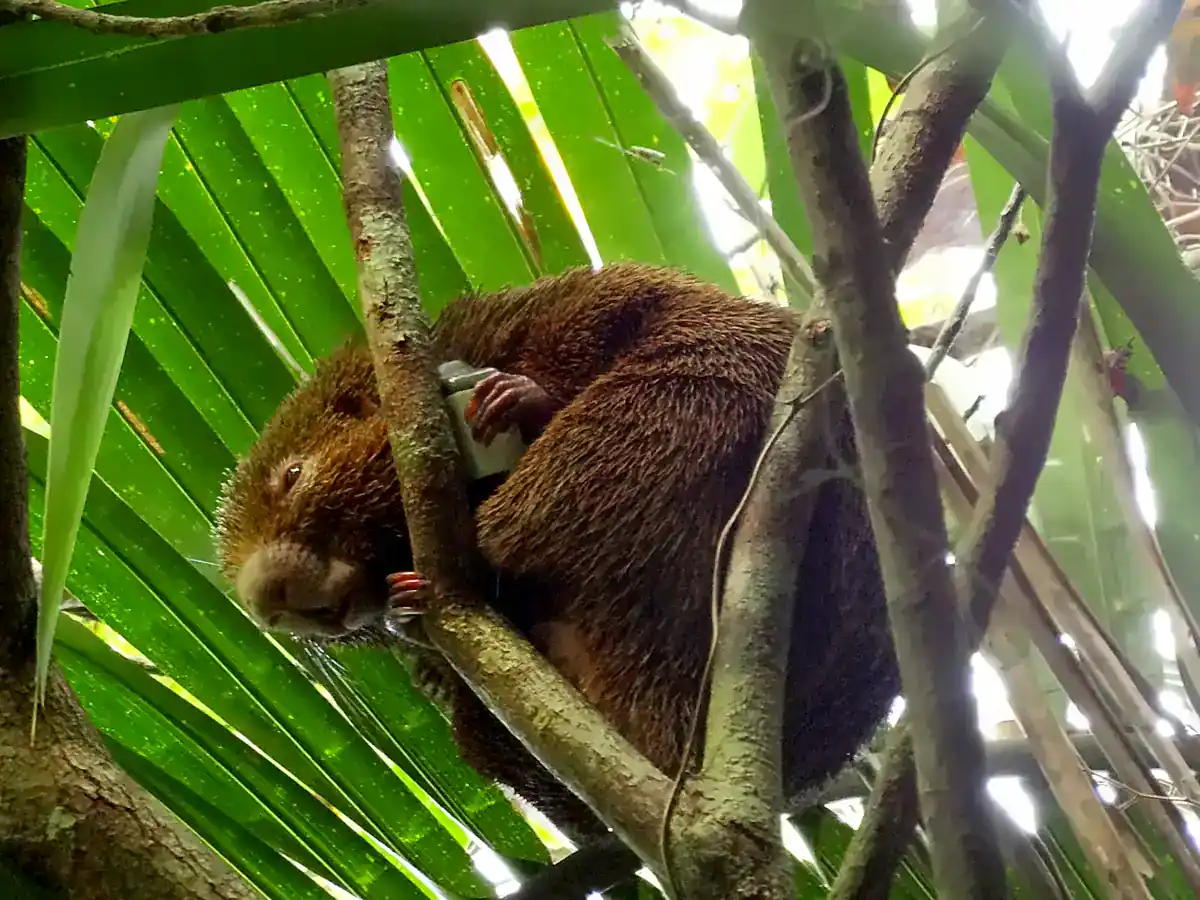
The Thin-spined Porcupine spent most of the twentieth century misfiled. It was placed with the spiny rats, on one tooth’s evidence. That tooth turned out not to mean what anyone thought.
- Head and body run 360 to 450 mm. Tails run 260 to 275 mm. Weights range from 1 to 2 kg.
- Its spines come in two kinds, and only one is a weapon. The head and shoulders carry short, kinky, sharp spines near 15 mm. Everything behind that carries longer spines near 50 mm. Those are stiff, slightly wavy and blunt, like straws on a broom.
- It is a leaf specialist. It favors protein-rich fibrous leaves from trees in the pea family. One radio-tracking study states flatly that it feeds only on leaves.
- It climbs down from the canopy to defecate. It uses concealed latrines such as bromeliads and tree hollows.
- It lives only in southeastern Brazil. Its extent of occurrence covers 104,326 square kilometers. Only 13,870 square kilometers, or 13.3 percent, remain forested[29]. The animal grows abruptly rarer below 10 percent regional forest cover.
- Molecular data returned it to the porcupines. So did a shared skull opening and a prehensile hand and foot. Voss and colleagues called it “convincingly refuted by multiple lines of evidence.”
- It is the only species in its genus. That genus sits in a subfamily of its own. Conservationists therefore describe it as carrying unusually high phylogenetic value.
The North American Porcupine
North American Porcupine
| Kingdom | Order | Family | Genus | Species |
|---|---|---|---|---|
| Animalia | Rodentia | Erethizontidae | Erethizon | Erethizon dorsatum |
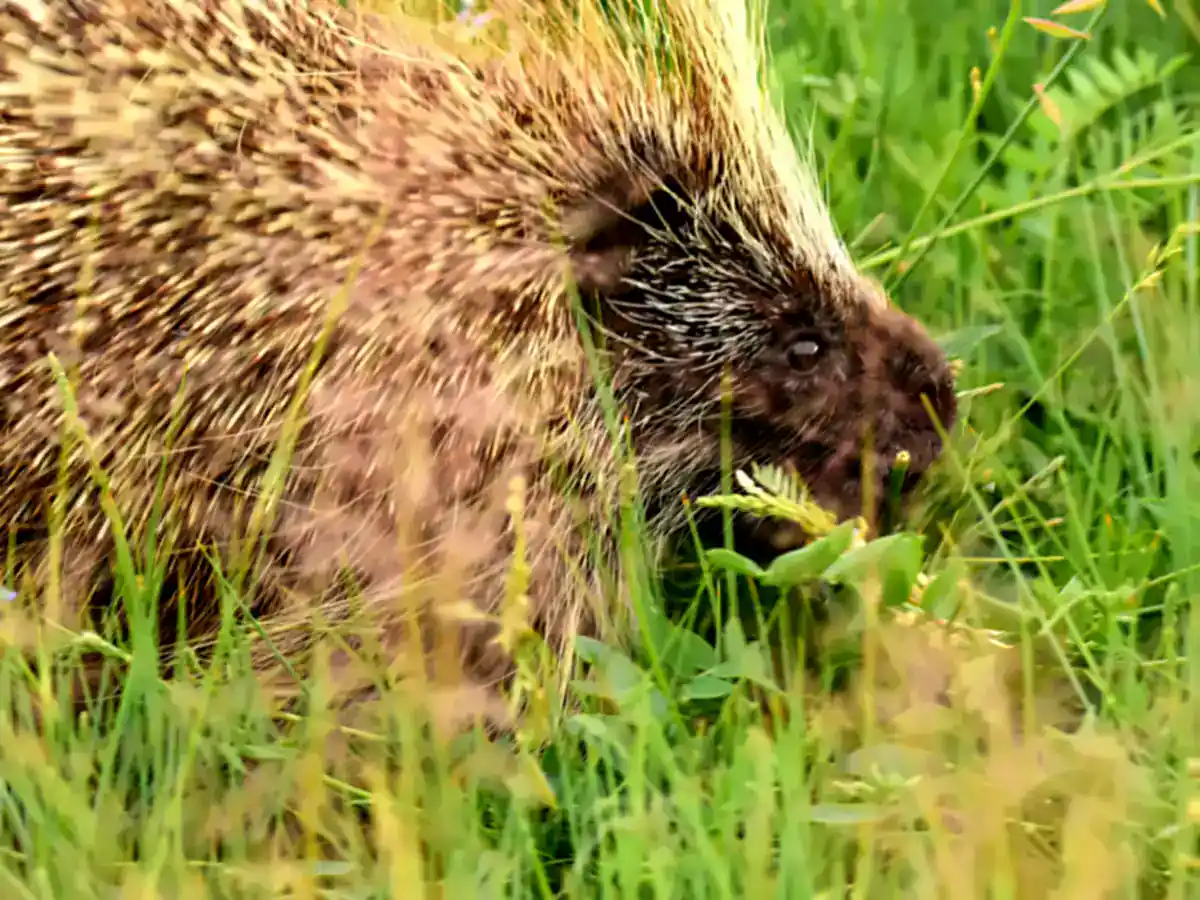
Only one porcupine is native to the United States and Canada. That is the North American Porcupine. It is the second largest rodent in North America. Its quills are the best studied in the family.
- Length runs 60 to 90 cm. Weight runs about 5 to 12 kg. Males run some 10 percent heavier than females. Published figures vary widely between agencies[15][16][19][20]. One reference gives a head and body maximum far above the rest[4].
- It carries about 30,000 quills. Three independent sources converge on that figure[4][15][16]. None explains how researchers counted them.
- The quill tip is barbed, and the barbs point backward. Laboratory testing found they ease the quill in and resist its removal. The effect was reproduced in molded polyurethane.
- A bare, greasy patch sits at the base of its tail. It is called the rosette. Its short, heavily barbed quills carry a warning odor. So the animal advertises itself by smell as well as by color.
- Winter is a bark diet. It alternates between tree species, a pattern consistent with avoiding plant toxins. Its distal colon runs about four times a similarly sized beaver’s[4]. Over a winter it loses about half its fat mass. It saves energy by spending less, not by cooling down.
- Its mouth is built for the job. The lips meet across the gap behind the incisors. So it gnaws bark without holding its mouth open in the cold.
- Sodium is the constraint on its summer diet. Summer foliage is rich in potassium and poor in sodium. An animal eating it loses more sodium than it takes in. Porcupines make up the difference by chewing. Targets include plywood glue, axe handles and canoe paddles. Road salt, vehicle undercarriages, antlers and bones also serve. Appetite peaks in May and June, then again in late summer. Offered pegs soaked in different salt solutions, Catskill porcupines chose the strongest[23]. Pregnant and lactating females chewed more than males.
- Fishers hunt it, and the effect is measurable. A 17-year capture and recapture study followed one population. Adult survival fell by up to 44 percent where fishers had returned[12]. The study credits severe winters and abundant predators acting together. Reproduction came close to total failure. The model predicted local extirpation within 50 years. A California study examined 388 fisher scats. It found little or no porcupine, so the effect is not uniform.
- Even its name is unsettled. The Mammal Diversity Database writes Erethizon dorsatum. ITIS lists dorsatus and marks dorsatum invalid. A 2005 reference used dorsata.
Crested Porcupines
Eight Hystrix species make up the heavyweight end of the family. They are terrestrial, they dig, and most cannot climb.
One warning applies to the whole genus. HMW prints identical head, tail and weight figures for three species. Several published measurements therefore cannot be separated by species. Where that happens below, this guide says so instead of repeating it.
Cape Porcupine
| Kingdom | Order | Family | Genus | Species |
|---|---|---|---|---|
| Animalia | Rodentia | Hystricidae | Hystrix | Hystrix africaeaustralis |
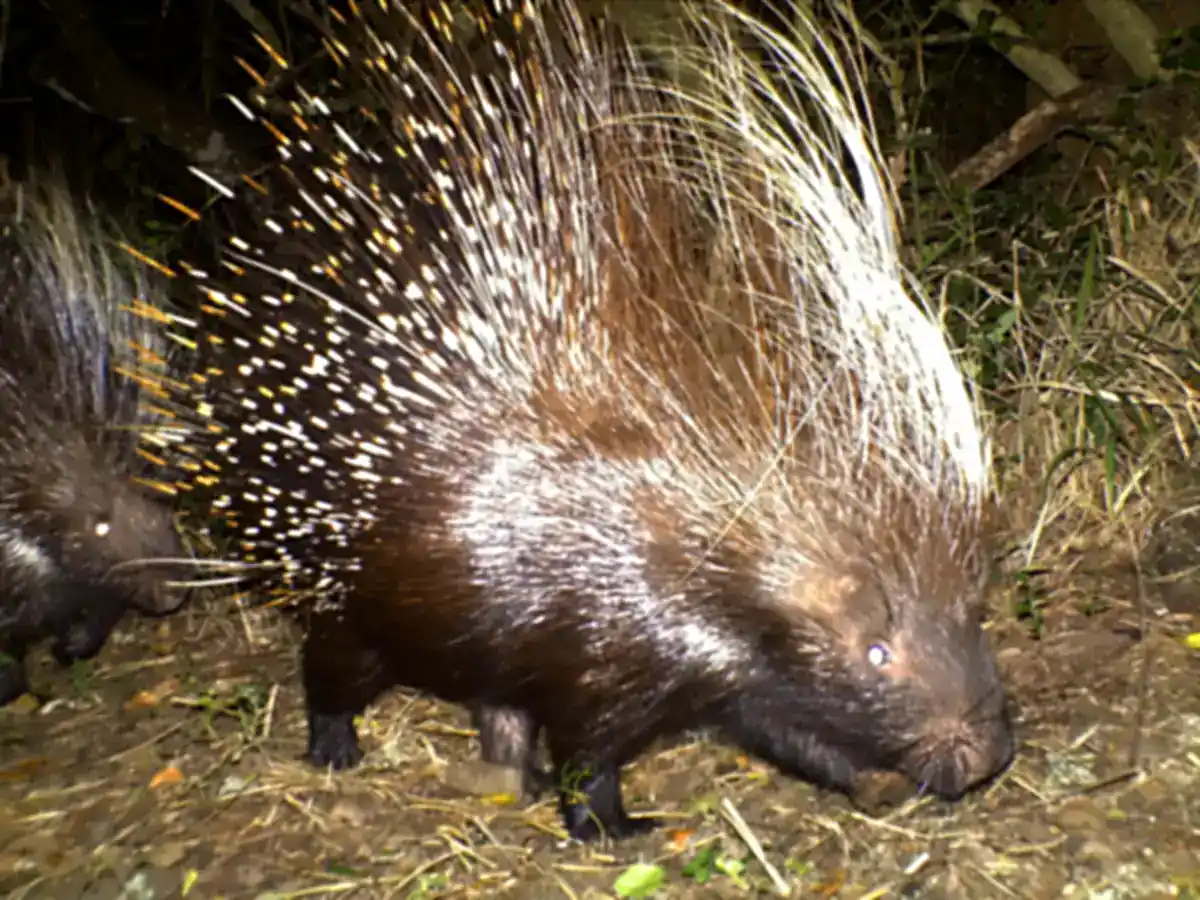
The Cape Porcupine is the largest rodent in Africa. It is the only large Hystrix with unambiguously its own measurements. That makes it the most defensible answer to which porcupine is biggest.
- Head and body run 630 to 805 mm. The tail is short, at 105 to 130 mm. Weight reaches 10 to 24.1 kg. They are the only unduplicated Hystrix figures in HMW. That makes them the most trustworthy in the genus.
- It lives across the southern half of Africa, in 17 countries. Records run from sea level to about 2,000 m.
- Cape Porcupines are monogamous. Breeding within a group is suppressed, so usually only one pair reproduces. Newborns weigh 300 to 400 g. Nursing runs 13 to 19 weeks.
- Its digging moves real quantities of earth. One study measured about 1.6 cubic meters per hectare yearly[5]. That disturbance covered 0.34 percent of the surface.
- It is also a serious force on vegetation. A 2022 South African study found almost 70 percent sapling mortality[43]. That was among trees it fed on.
- It lives about 10 years in the wild. Captive animals reach 20.
Crested Porcupine
| Kingdom | Order | Family | Genus | Species |
|---|---|---|---|---|
| Animalia | Rodentia | Hystricidae | Hystrix | Hystrix cristata |
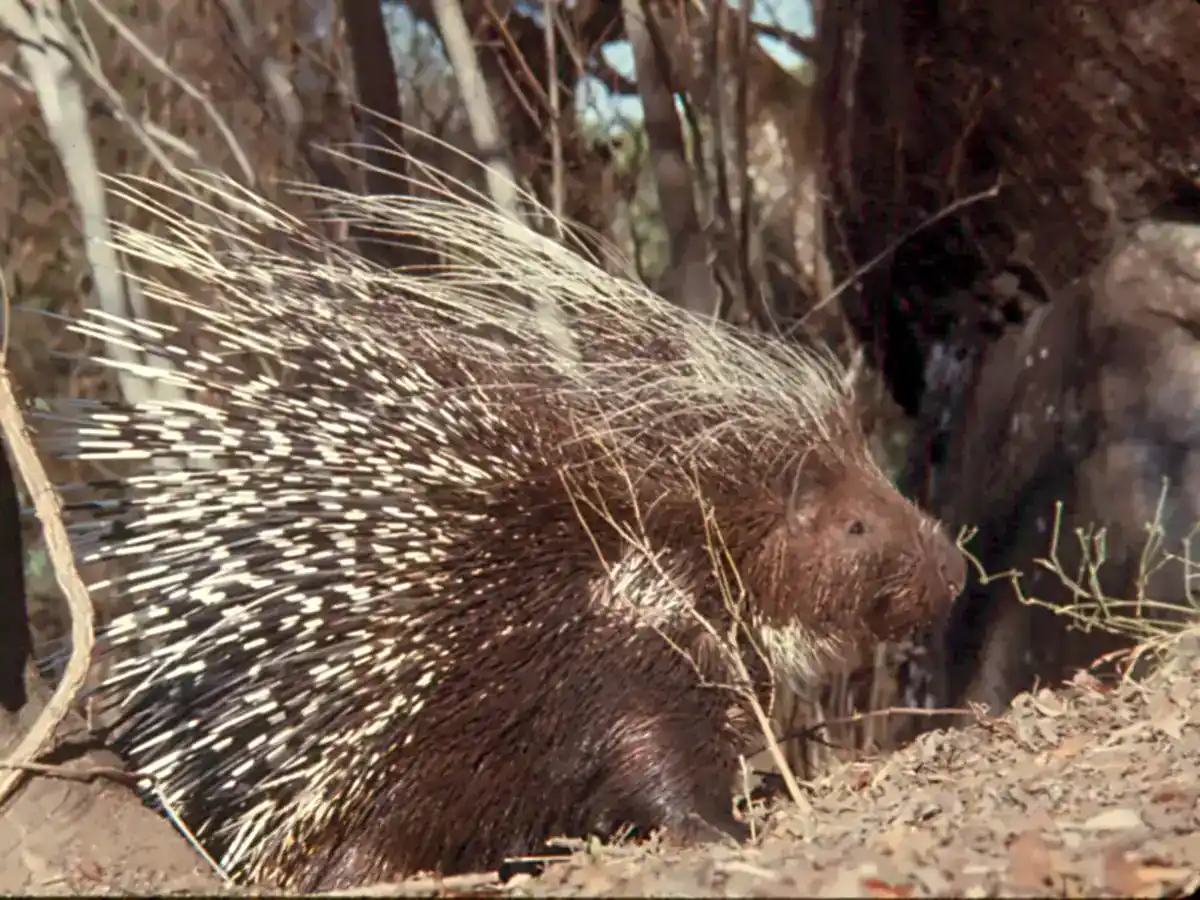
The Crested Porcupine is Europe’s second largest rodent, after the beaver. Its Italian origin was long disputed. Genetic evidence strongly supports an introduction.
- It is one of Africa’s two largest rodents, alongside the Cape Porcupine. Its published mass, 8 to 27 kg, comes from a duplicate block. HMW prints that block for three species. So the upper bound is not this animal’s record. Its head and tail figures are duplicated the same way. They are not repeated here.
- Its rattle quills have been counted properly. The sample was 130 animals collected in Tuscany between 1993 and 2021. An adult carries an average of 14.93 rattle quills. Each is about 4.07 cm long and 0.41 cm across. Cubs average 7.70, at half the length.
- It occurs across North Africa, south to the equator. It inhabits much of the Italian peninsula and Sicily[39]. A 2021 paper reported probable H. cristata quills above 46 degrees north. The authors called them Europe’s northernmost records[50].
- Genetic evidence strongly supports an introduction. Genome-wide work dates it to about 1,500 years ago, across several events. The oldest calibrated Italian subfossil is about the same age. A minority view argues the population is native. That view rests on skull measurements, not DNA or fossils.
- Linnaeus gave the type locality as “Habitat in Asia.” Oldfield Thomas restricted it in 1911 to “near Rome, Italy.” So the species’ reference population is probably an introduced one.
- Its reputation as a crop pest is contested. One Italian debarking study found damage on under 6 percent of trees[38]. It recorded no tree deaths, and concluded the impact is low.
Indian Crested Porcupine
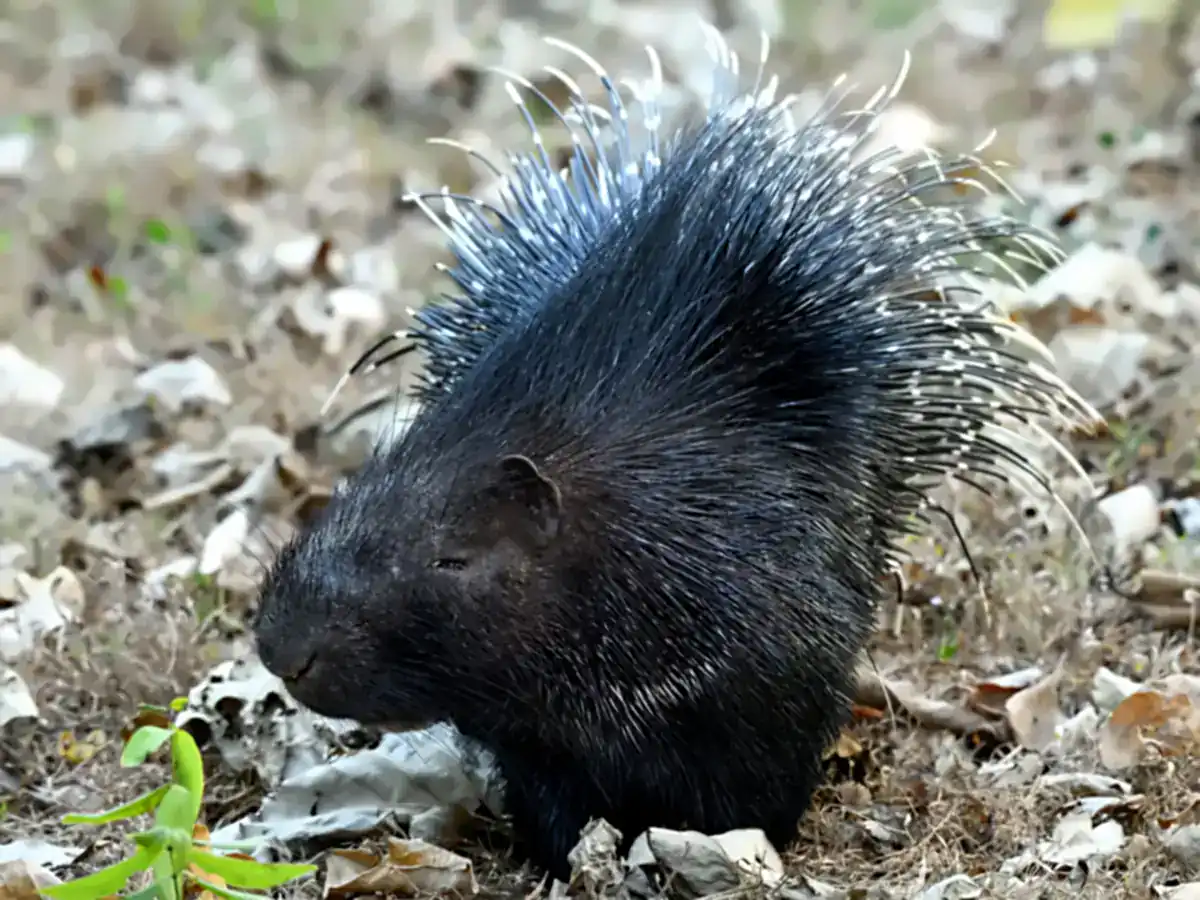
| Kingdom | Order | Family | Genus | Species |
|---|---|---|---|---|
| Animalia | Rodentia | Hystricidae | Hystrix | Hystrix indica |
The Indian Crested Porcupine ranges from the eastern Mediterranean to Sri Lanka. Its northern limit may be set by night length rather than cold.
- Ears run 40 to 47 mm, hind feet 95 to 104 mm. Two other species share its head, body and weight figures. They are not repeated here.
- It ranges from the eastern Mediterranean and Arabia northeast to Transcaucasia. The range reaches southern Kazakhstan and Dagestan. It runs south through the Indian subcontinent to Sri Lanka. That covers 26 countries.
- Night length may limit its northern distribution. The species forages in darkness. Its northernmost populations sit near 44 degrees north. There the shortest summer night runs about 7.3 hours[46]. The study calls that a postulated boundary, not a demonstrated one.
- It frequently damages crops in agricultural areas. Farmland increased occupancy in one Nepal study[44]. One Pakistan study measured 8.01 percent maize damage[45]. Another district surveyed farmers about annual losses. Of them, 51.8 percent reported US$101 to US$200[51].
- Newborns weigh about 3 percent of their mother’s weight. Their back spines are soft, and about 30 mm long at birth.
Malayan Porcupine
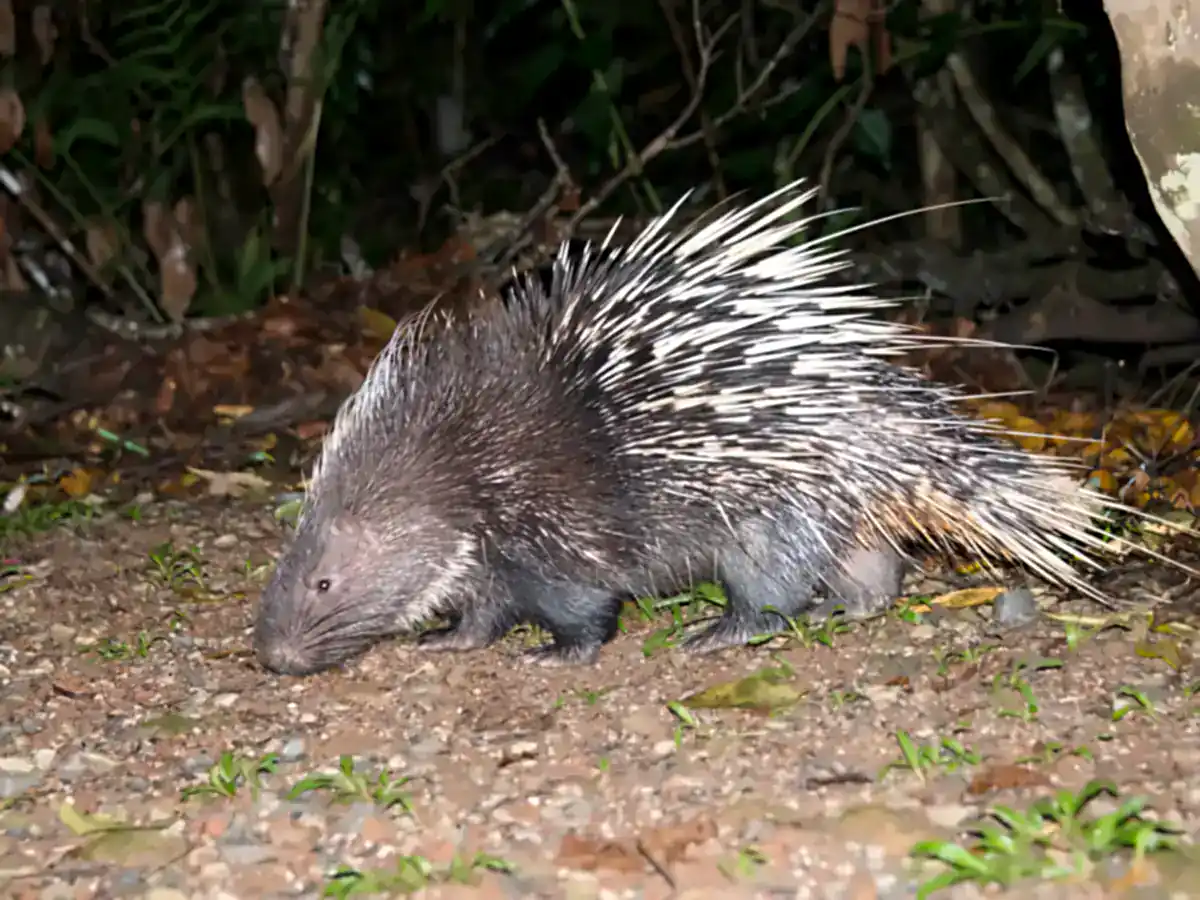
| Kingdom | Order | Family | Genus | Species |
|---|---|---|---|---|
| Animalia | Rodentia | Hystricidae | Hystrix | Hystrix brachyura |
The Malayan Porcupine is the most widespread Hystrix in Asia. It is also the one most often found living alongside people.
- Its quills reach 5 to 7 mm thick at the base. Two other species share its head, body and weight figures. They are not reliable here.
- It ranges from Nepal and northeastern India east through mainland Southeast Asia. The range takes in southern China, the Malay Peninsula, Sumatra and Borneo.
- Gestation lasts about 110 days. A female may raise two litters a year. Each holds two or three well-developed young.
- Its burrows are shared property. A 2025 Peninsular Malaysia study recorded 22 other species using them[40]. The same work recorded 80 plant species eaten by Malaysia’s two porcupines.
- It is a target of the bezoar trade. In Malaysia, stomach concretions have sold for US$193 per gram[42]. One specimen weighed 200 g.
Sunda Porcupine
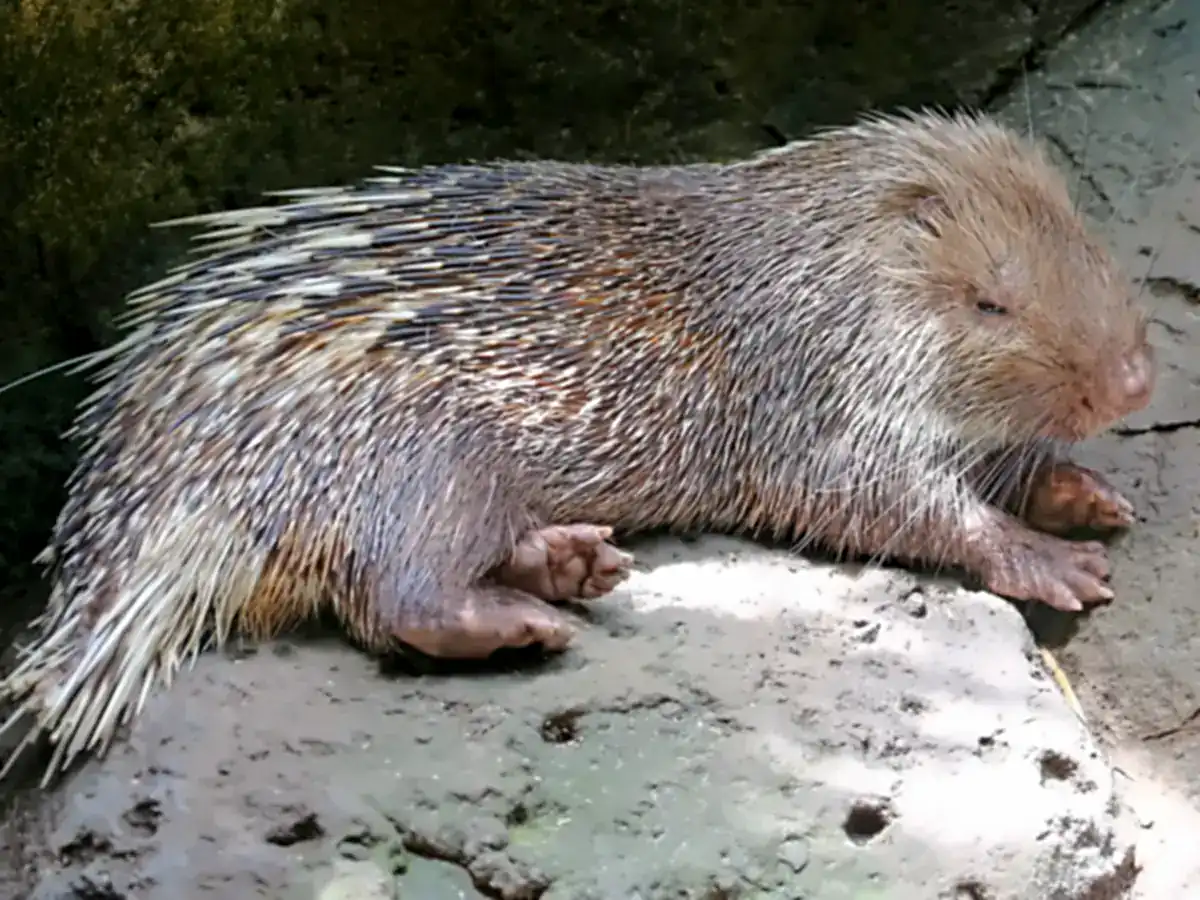
| Kingdom | Order | Family | Genus | Species |
|---|---|---|---|---|
| Animalia | Rodentia | Hystricidae | Hystrix | Hystrix javanica |
The Sunda Porcupine is the Hystrix of Java and the Lesser Sundas. Its quills are the weakest in the genus.
- At 455 to 660 mm head and body, it is substantial. Its published body mass is duplicated, and implausible at this size. No reliable mass exists in the sources used here.
- Its thickest quills run 3.5 to 6.1 mm across. Its longest reach 80 to 155 mm. Its rattle quills have hollow sections 15 to 20 mm long.
- It is endemic to Java and Madura, plus Bali, Lombok and Flores. It has also been recorded in southwestern Sulawesi, probably as an introduction.
- Lesser Sunda animals tend to be smaller than those on Java.
Sources 1
Thick-spined Porcupine
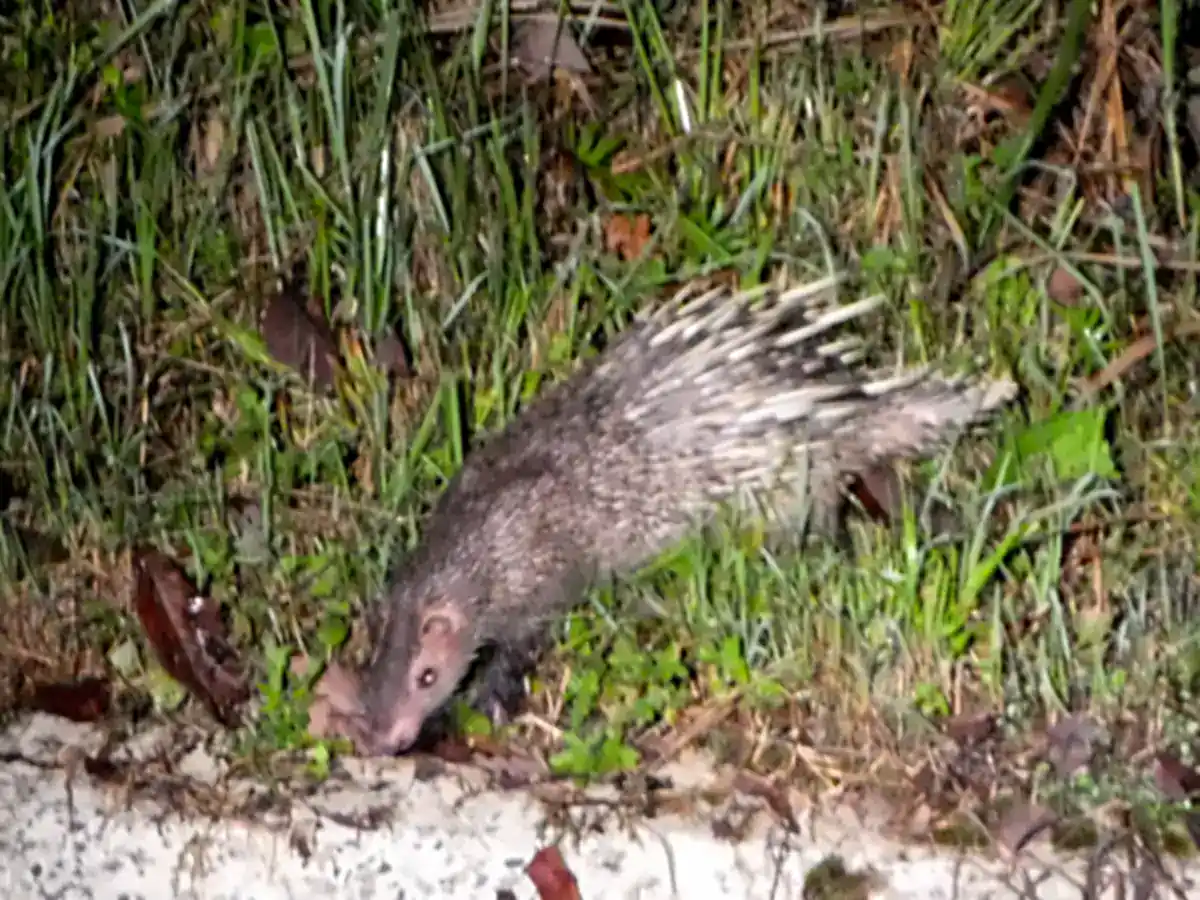
| Kingdom | Order | Family | Genus | Species |
|---|---|---|---|---|
| Animalia | Rodentia | Hystricidae | Hystrix | Hystrix crassispinis |
The Thick-spined Porcupine of Borneo has the heaviest quills in its subgenus. It also has one measurement that is unambiguously its own.
- Its thickest quills reach 8.3 mm in diameter. HMW calls that thicker than the neighboring subgenus’s largest animals. It matches the true Hystrix. That figure is the species’ signature.
- Its other published measurements are duplicated from another species. Do not use them.
- It is endemic to Borneo, in rainforest and open country. It reaches 1,200 m in East Kalimantan.
- HMW reports no diet, breeding, activity, or movement data.
- Its cheeks, neck and shoulders are speckled with white spine tips.
Sumatran Porcupine
| Kingdom | Order | Family | Genus | Species |
|---|---|---|---|---|
| Animalia | Rodentia | Hystricidae | Hystrix | Hystrix sumatrae |
The Sumatran Porcupine sits between its closest relatives in size and quills. It is endemic to one island.
- Head and body run 455 to 560 mm. Tails run 90 to 110 mm. Those figures are distinct from its relatives and appear reliable. Its published weight is shared with two other species, and needs caution.
- Its defensive back quills reach 5 to 7 mm thick. Each carries one dark band and a 70 mm white tip.
- It is endemic to Sumatra, from sea level to 300 m. That is the lowest recorded ceiling of any porcupine. It may only reflect where people have looked.
- It is common. It reaches higher densities in disturbed habitat than in primary forest.
- No information has been published on its diet, breeding or activity patterns.
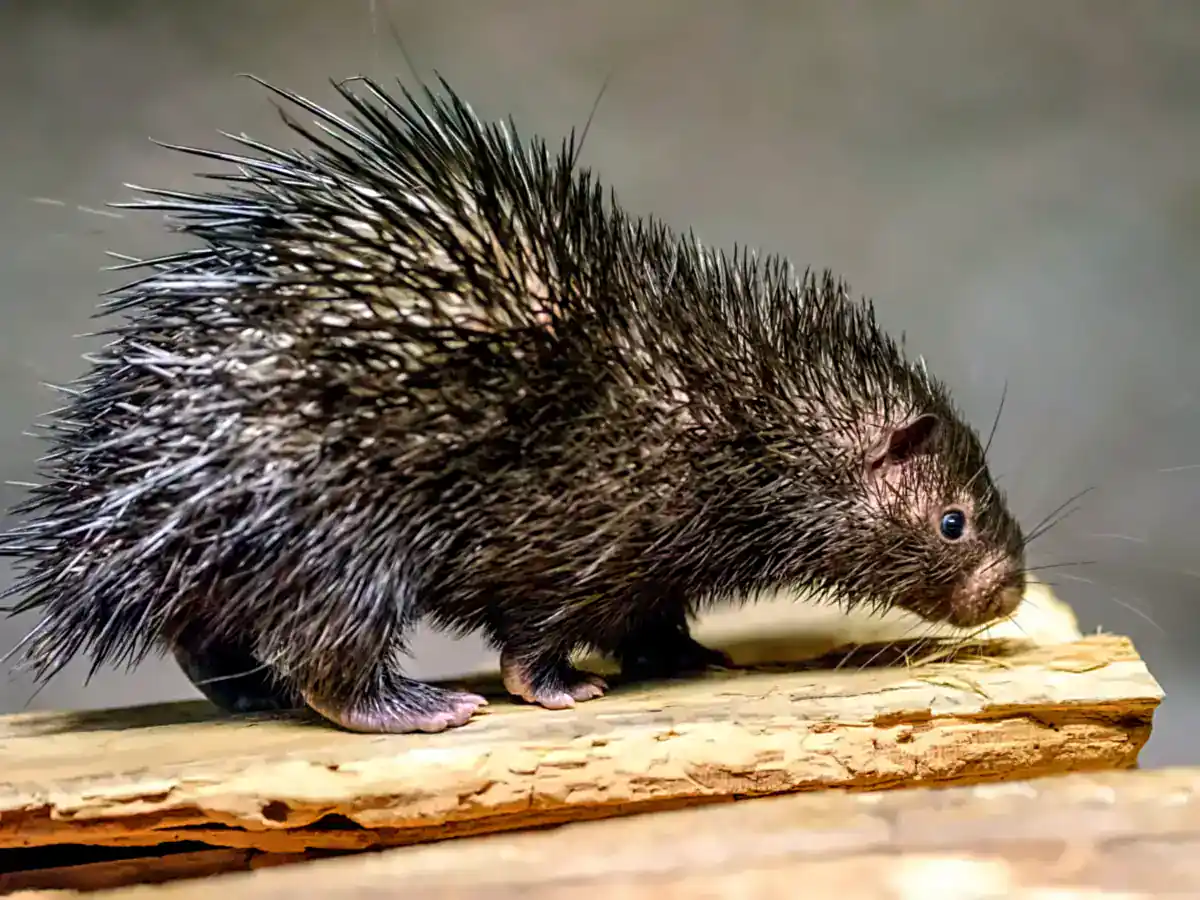
Philippine Porcupine
| Kingdom | Order | Family | Genus | Species |
|---|---|---|---|---|
| Animalia | Rodentia | Hystricidae | Hystrix | Hystrix pumila |
The Philippine Porcupine is one of three species listed as Vulnerable. Its published measurements cannot be separated from a larger relative’s.
- This guide gives it no head and body length or body mass. Its HMW figures are duplicated from a larger relative. That same reference calls this species the smallest Hystrix. It calls the other the largest of its subgenus. Identical numbers cannot support both statements. The original 1879 description has not been checked here. It may carry usable measurements.
- Its rattle quills are species-specific. Their hollow capsule sections run 10 to 11 mm, the genus’s shortest.
- It is endemic to Palawan and neighboring islands in the Philippines.
- All five ecological HMW headings read that no information is available.
- It is the family’s clearest case of an unstudied threatened animal.
Brush-tailed Porcupines
Two Atherurus species are smaller, faster and slimmer than the crested porcupines. Both carry a long tail ending in a cluster of bristles. That cluster rattles by a different mechanism.
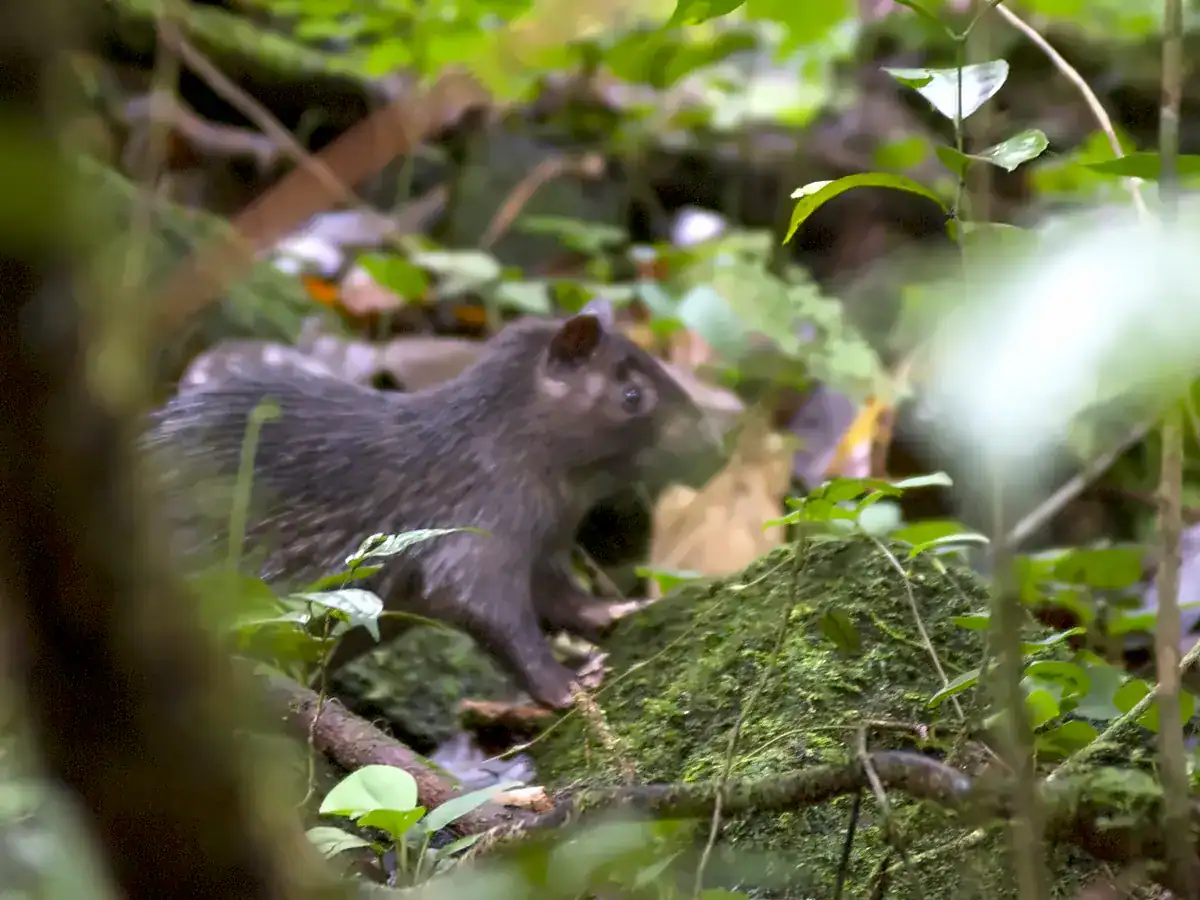
African Brush-tailed Porcupine
| Kingdom | Order | Family | Genus | Species |
|---|---|---|---|---|
| Animalia | Rodentia | Hystricidae | Atherurus | Atherurus africanus |
The African Brush-tailed Porcupine is among Central Africa’s most heavily hunted mammals.
- Head and body run 365 to 600 mm. Tails run 100 to 260 mm. Its published weight range is 1.5 to 4.3 kg. A mean carcass mass of 2.83 kg rests on the largest sample.
- That sample came from a bushmeat market. Researchers recorded 24,302 carcasses, nearly 69,000 kg[41]. All passed through the Malabo market on Bioko over 13 years.
- Its spines vary sharply by body region. Neck spines run 20 mm. Rump spines reach 90 mm.
- Its range covers the rainforest zone and forest-savanna mosaic. That runs from Guinea east to the DR Congo and Rwanda. It reaches south to Angola.
- Newborns weigh 100 to 175 g. Gestation runs 100 to 120 days. Females raise two or three litters a year.
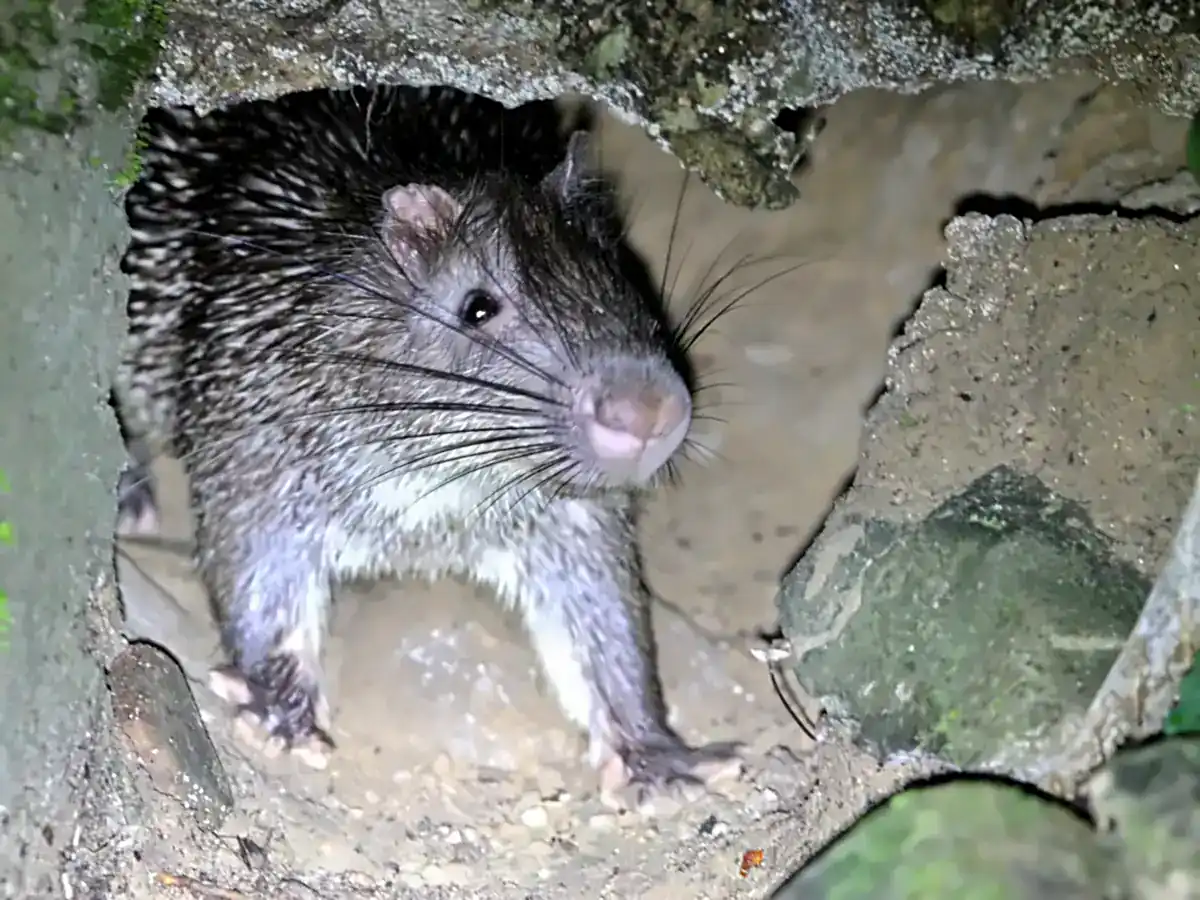
Asian Brush-tailed Porcupine
| Kingdom | Order | Family | Genus | Species |
|---|---|---|---|---|
| Animalia | Rodentia | Hystricidae | Atherurus | Atherurus macrourus |
The Asian Brush-tailed Porcupine carries the most elaborate tail in the family. Its rattle is made of beaded bristles, not hollow capsules.
- Head and body run 380 to 570 mm. Tails run 160 to 195 mm. Its published weight matches its African relative exactly. That may be real for similar-sized animals, or a repeated figure.
- The tail ends in platelet bristles, 80 to 100 mm long. Each bristle carries 2 to 6 beads. Beads run 1 to 3 mm wide, 10 to 15 mm long. The white tail brush can exceed 200 mm.
- It ranges across Southeast Asia into southern China and Hainan.
- Young leave the nest after about a week. HMW gives that as the time their quills need to harden.
The Long-tailed Porcupine
Asian Long-tailed Porcupine
| Kingdom | Order | Family | Genus | Species |
|---|---|---|---|---|
| Animalia | Rodentia | Hystricidae | Trichys | Trichys fasciculata |
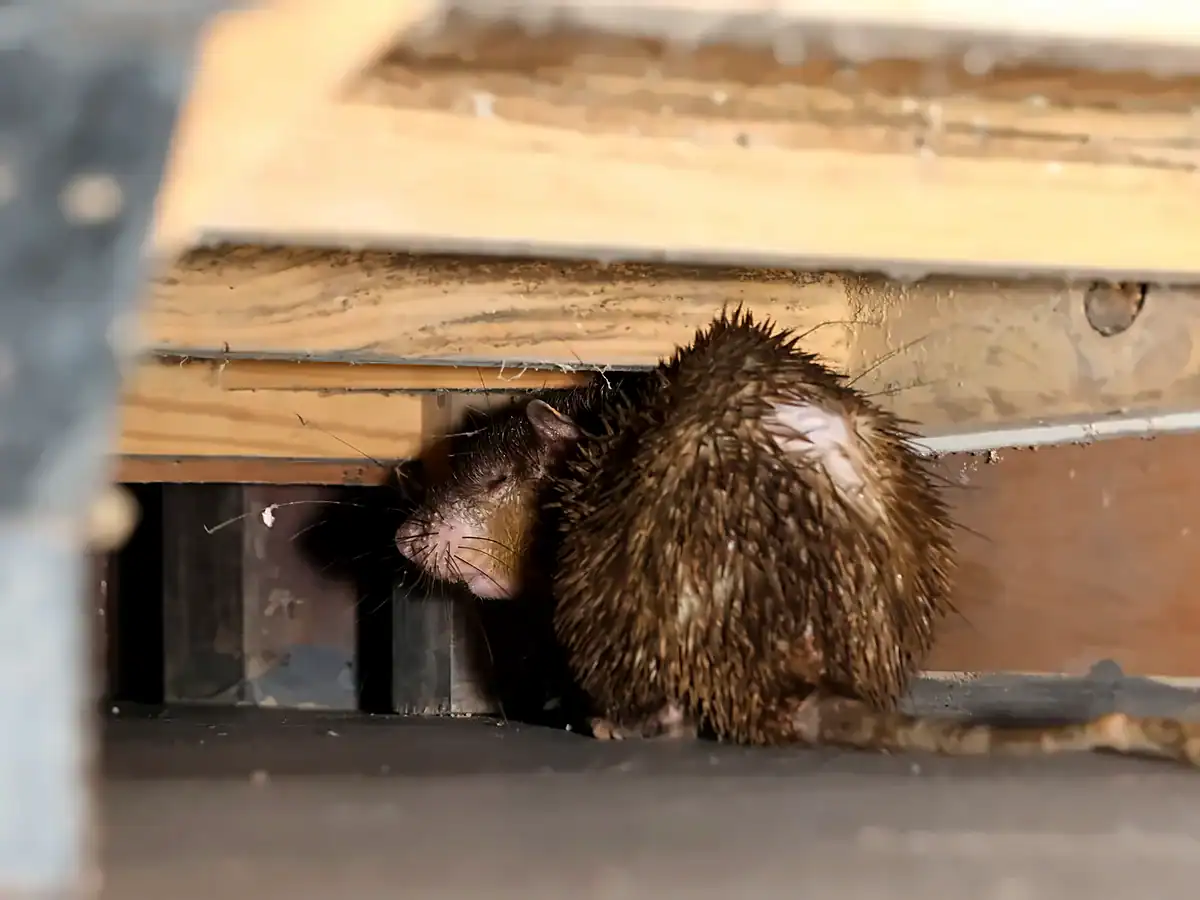
The Asian Long-tailed Porcupine looks more like a large rat. It is the earliest-diverging living lineage in the Old World family.
- Head and body run 350 to 480 mm. Tails run 175 to 235 mm. Weight runs 1.5 to 2.2 kg. It is the smallest and lightest species in its family. That mass figure is among the genus’s more trustworthy, being unduplicated.
- Its spines are short and flexible. The longest on an adult reach only 33 to 46 mm. That is why it does not look like a porcupine at all.
- Its tail bristles are flattened rather than beaded. They run 1.1 mm broad and 0.3 mm thick. It is the one Old World species that does not rattle.
- It has 46 chromosomes, the lowest count in the family.
- It lives in western Peninsular Malaysia, Sumatra and Borneo.
- HMW reports nothing on its breeding or social organization.
Sources 1
Porcupines in the US
One of the 32 species lives in the United States. That is the North American Porcupine. It is the only porcupine native to any part of the country.
MDD v2.5 lists it for 32 states. That list is a distribution record, not a current map. It mixes three different things. Some states hold established populations. Some sit at the range edge, with sparse records. In others the evidence is historical.
The core range covers the West, northern Great Plains and upper Midwest. New England holds it too. Alaska holds it through most of the forested interior. The listed southern and southeastern edges rest on far thinner evidence. Tennessee is one of those. None should be read as current breeding range.
Seven subspecies are recognized across that span. Three are almost entirely US animals. E. d. bruneri holds the Great Plains east of the Rockies. E. d. couesi runs through central Arizona, New Mexico and west Texas. E. d. epixanthum spans southern Washington, the Great Basin, and California.
The edges of that range are moving both ways at once. In Oklahoma, museum records and field observations show it pushing eastward[14]. New county records are still accumulating. In northern California, a 2017 survey found it in 19 counties. It appeared in every geomorphic province, and 36 of 59 vegetation types[13]. That is a broad footprint for a species at its southwestern limit.
The northern Midwest tells the opposite story. Fishers have been restored there. Porcupine numbers at the southern range edge are falling. The 17-year study behind that projected local disappearance within 50 years[12]. It credits severe winters and abundant predators acting together. The same model found the population viable without predators. So this is not a decline driven by habitat loss or hunting. A formerly extirpated predator has returned, and hard winters compound its effect.
Elevation is no obstacle. In the Adirondacks the species reaches 1,220 m[16]. In the West it occupies desert shrubland. Two telemetered animals there held winter home ranges averaging 0.07 ha. That is a patch of ground about 25 m across.
Rattle Quills
Most Old World porcupines carry a second set of quills. Those quills do not stab anything. They make noise.
On a crested porcupine the tail ends in a cluster of capsules. They are hollow, open-ended, and mounted on thin stalks. When the animal shakes its tail, the capsules strike each other. The result is a dry rattle. It is a warning, given before the animal turns and charges backward.
A 2025 study measured them properly for the first time. The sample was 130 animals in Tuscany[11]. Adults carry an average of 14.93 rattle quills. Each is about 4.07 cm long and 0.41 cm across. Cubs carry fewer and shorter ones, averaging 7.70 quills at 2.06 cm. So the rattle develops as the animal grows.
That study measured the quills, not the sound. No frequency or loudness figure turned up in the sources used here. No supported decibel or hertz value was found.
The other two Old World genera differ, or do not rattle. Brush-tailed porcupines rattle with beaded bristles rather than capsules. Each bristle carries two to six flattened beads. The Asian Long-tailed Porcupine has flattened bristles, no beads, and no rattle. New World porcupines have no rattle organ at all.
The Unknown Third
Ten of the 32 species lack a resolved conservation category. Every one of them is a Coendou. The ten split into two situations, worth keeping apart.
Six carry Data Deficient. That is a real category, not a blank. It means assessors looked and found the evidence too thin. Three are the Baturité, Quichua and Roosmalens’ porcupines. The remaining three are the Blackish Hairy Dwarf and both Amazonian Dwarfs.
Four carry Not Evaluated. Nobody has assessed them at all. Most are too new, or too recently resurrected. They are the Sangay Porcupine (2026) and Voss’ Porcupine (2025). The others are Rothschild’s and the Amazonian Long-tailed.
One caveat on those two tallies. Every status in this article is the value recorded in MDD v2.5. The live database has since moved some species between those two categories. The total of ten unresolved does not change.
The imbalance is stark. Ten of 21 New World species lack a resolved category. None of the 11 Old World species does. Two things drive that. Four of the ten are simply too new to have been assessed. The other six are canopy animals, which are nocturnal, quiet and hard to survey. Of all the layers of the rainforest, the canopy is among the hardest for field teams to reach. Several were described from a handful of museum skins, collected decades apart.
The clearest case is the Sangay Porcupine, described in June 2026. Researchers had inventoried that part of Sangay National Park for 15 years. Their systematic effort came to 12,800 trap nights and 2,400 camera-trap nights[26]. None of it produced a porcupine. The one specimen was caught by hand, on a 2015 expedition. The authors gave the problem a name: methodological invisibility. Ground-level cameras and traps can miss a canopy mammal, however large. They recommended canopy camera trapping and environmental DNA instead.
Several others are known from almost nothing. The Baturité Porcupine comes from one humid forest massif in dry Caatinga. It has been recorded nowhere else. For most of the ten, reference works give no home range. Litter size and lifespan are equally blank.
So porcupine conservation cannot be summarized as a family doing well. For ten species there is not enough on record to summarize.
The table below lists the status MDD v2.5 records for every species in this guide.
| Species | Scientific Name | IUCN Status |
|---|---|---|
| Brazilian Porcupine | Coendou prehensilis | Least Concern |
| Amazonian Long-tailed Porcupine | Coendou longicaudatus | Not Evaluated |
| Bicolor-spined Porcupine | Coendou bicolor | Least Concern |
| Quichua Porcupine | Coendou quichua | Data Deficient |
| Rothschild’s Porcupine | Coendou rothschildi | Not Evaluated |
| Voss’ Porcupine | Coendou vossi | Not Evaluated |
| Sangay Porcupine | Coendou sangay | Not Evaluated |
| Baturité Porcupine | Coendou baturitensis | Data Deficient |
| Mexican Hairy Porcupine | Coendou mexicanus | Least Concern |
| Paraguayan Hairy Dwarf Porcupine | Coendou spinosus | Least Concern |
| Bahian Hairy Dwarf Porcupine | Coendou insidiosus | Least Concern |
| Black-tailed Porcupine | Coendou melanurus | Least Concern |
| Eastern Amazonian Dwarf Porcupine | Coendou nycthemera | Data Deficient |
| Western Amazonian Dwarf Porcupine | Coendou ichillus | Data Deficient |
| Frosted Porcupine | Coendou pruinosus | Least Concern |
| Roosmalens’ Porcupine | Coendou roosmalenorum | Data Deficient |
| Pernambuco Dwarf Porcupine | Coendou speratus | Vulnerable |
| Blackish Hairy Dwarf Porcupine | Coendou vestitus | Data Deficient |
| Stump-tailed Porcupine | Coendou rufescens | Least Concern |
| Thin-spined Porcupine | Chaetomys subspinosus | Vulnerable |
| North American Porcupine | Erethizon dorsatum | Least Concern |
| Cape Porcupine | Hystrix africaeaustralis | Least Concern |
| Crested Porcupine | Hystrix cristata | Least Concern |
| Indian Crested Porcupine | Hystrix indica | Least Concern |
| Malayan Porcupine | Hystrix brachyura | Least Concern |
| Sunda Porcupine | Hystrix javanica | Least Concern |
| Thick-spined Porcupine | Hystrix crassispinis | Least Concern |
| Sumatran Porcupine | Hystrix sumatrae | Least Concern |
| Philippine Porcupine | Hystrix pumila | Vulnerable |
| African Brush-tailed Porcupine | Atherurus africanus | Least Concern |
| Asian Brush-tailed Porcupine | Atherurus macrourus | Least Concern |
| Asian Long-tailed Porcupine | Trichys fasciculata | Least Concern |
Smallest and Largest
Living porcupines span roughly a 40-fold range in weight. Both ends need a caveat.
At the bottom is Roosmalens’ Porcupine, at about 600 g. That figure rests on one animal. Its describers noted it may have been emaciated. So treat it as the smallest confirmed, not the smallest typical. The Asian Long-tailed Porcupine is the lightest Old World species. It runs 1.5 to 2.2 kg, measured across more animals.
At the top is the Cape Porcupine, at 10 to 24.1 kg. They are the only unduplicated Hystrix figures in HMW. That makes the Cape Porcupine the most defensible answer. The Crested Porcupine is the same size class. It is sometimes given at 27 kg. That number comes from a block printed identically for three species. The North American Porcupine leads the New World. It runs 5 to 12 kg.
The extinct species were bigger. Xenohystrix crassidens was an African hystricid. Its mean estimated body mass is 41.38 kg, across seven specimens[47]. The largest came out at 58.03 kg. Its describers put that at more than twice either living African porcupine. It approaches the average mass of a capybara.
Porcupines in Italy
The Crested Porcupine lives across much of Italy. That is odd for an African animal.
Genome-wide work published in 2016 strongly supports multiple introductions from North Africa[35][36]. The oldest calibrated Italian subfossil dates to about 1,500 years ago. That puts the arrival in the late Roman or early medieval period.
The dissenting view rests on cranial morphometrics. A 2003 study argued the Italian skulls suggest longer residence[37]. The genetic data have not supported it.
One historical detail follows from that. Linnaeus described Hystrix cristata in 1758 with a vague type locality. Oldfield Thomas restricted it in 1911 to “near Rome”. So the type locality of Africa’s crested porcupine is a European city. That population is probably introduced.
Fossil Porcupines
The fossil record places the families in different hemispheres from the start.
The oldest known erethizontid is Eopululo wigmorei, from Peru. It dates between 33.9 and 27.3 million years ago[3]. That is close to the split from the cavy lineage. So the New World porcupines diverged soon after reaching South America.
The oldest hystricid is Sivacanthion complicatus, from the Siwalik deposits of India. It dates to 15.98 to 11.63 million years ago[3]. Roughly 18 million years separate the two first appearances. No fossil links them.
Erethizon first appears in the Paleobiology Database about 4.7 million years ago. That is far later than the family containing it. The first appearance of Coendou is less settled. The same database puts it near 3.6 million years ago. Material reported online in 2025 is argued to be Late Miocene[52]. That would push the genus back several million years. This guide treats the date as open. Trichys has almost no fossil record, only Late Pleistocene material.
The extinct forms were larger. Neosteiromys pattoni comes from the late Miocene of Argentina. Its skull runs about 40 percent longer than the largest living porcupine’s[48]. No body mass has been estimated, so that stays a skull measurement. In Africa, the large Hystrix makapanensis was still present at Olduvai Gorge. That was 1.8 million years ago.
One gap should be stated. Both fossil records are far younger than the molecular dates. New World fossils reach back about 34 million years. Old World fossils reach about 16 million. The lineage split sits near 45 million. Early members of both groups are unfound, or unrecognized.
Frequently Asked Questions
There are 32, per MDD v2.5. Eleven belong to the Old World family Hystricidae. Twenty-one belong to the New World family Erethizontidae. ITIS, the US federal reference, recognizes 28. The entire disagreement sits inside the New World family.
No. A quill is anchored in the skin, and detaches only on contact. Being loosely held, a quill that brushes something often stays behind. That is where the story comes from. A porcupine that shakes itself can shed a loose quill. It cannot aim one.
The claim is weaker than it sounds. A 1990 study examined North American Porcupine quills. Fatty acids on them inhibited gram-positive bacteria in a dish. The effect varied by season. It was never shown to work inside a wound. The original hypothesis was self-protection, against its own quills after a fall. One review covered 296 dogs with quill injuries. It found no link between antimicrobial treatment and complications[10].
The North American Porcupine carries about 30,000. They run 20 to 100 mm long. Quills cover the back, sides and tail. They do not cover the belly, inner limbs, face or ears. Old World species carry fewer quills, but much longer ones. Crested porcupine quills pass 20 cm.
Yes. Both families sit in the rodent suborder Hystricomorpha. Neither family’s closest relatives are in the other family.
Not especially. Molecular dating puts the Hystricidae split near 45 million years ago. The New World family split from the cavy lineage 34 Ma. They sit closer to guinea pigs and capybaras than to Hystricidae. Quills evolved twice.
One species does. The North American Porcupine holds the West and northern Great Plains. It also holds the upper Midwest and New England. Most of forested interior Alaska carries it too. MDD v2.5 lists it for 32 states in total. That list mixes established range with marginal and historical records. It is not a map of where you would find one today.
The fisher is the best-documented specialist predator[4][17]. It circles the animal, dodges the tail, then bites the unquilled face[21]. In one Wisconsin population, adult survival fell by up to 44 percent[12]. Severe winters and abundant predators acted together. Where fishers are absent, as in Alaska, other carnivores hunt them. Those include wolves, wolverines, coyotes and lynx.
The Cape Porcupine, at a documented 10 to 24.1 kg. It is the heaviest species with figures that can be trusted. The Crested Porcupine is the same size class. Its published 27 kg maximum comes from a block repeated three times. The North American Porcupine leads the New World. It runs 5 to 12 kg. The extinct African Xenohystrix crassidens averaged just over 41 kg.
Roosmalens’ Porcupine, at about 600 g. That figure comes from one animal, possibly in poor condition. Among species measured across several animals, the Asian Long-tailed Porcupine is lightest. It runs 1.5 to 2.2 kg.
Most do. Most Coendou species have a long prehensile tail that grips branches. Several spend almost their whole lives in the canopy. The Stump-tailed and Sangay porcupines are the exceptions, with no prehensile tail. The North American Porcupine climbs well. Its short thick tail does not grip. Old World porcupines are mainly ground animals. The crested porcupines dig burrows.
Sodium. Green plants are very high in potassium and very low in sodium. A porcupine on summer foliage loses more sodium than its diet replaces. It makes that up by chewing. Targets include plywood glue, tool handles and road salt residue. Vehicle undercarriages, bones and shed antlers also serve. The craving peaks in late spring, then again in late summer.
One radio-tagged female North American porcupine lived 21 years[49]. That is remarkable for a rodent of its size. Females spend about 337 days of an average year pregnant or nursing. Gestation runs roughly 210 days, and nursing about 127. For most Coendou species, the reference works consulted here give no lifespan.
None is listed as Critically Endangered or Extinct. Three are Vulnerable. They are the Thin-spined, Pernambuco Dwarf and Philippine porcupines. Nineteen are Least Concern. The remaining ten are the problem. Six carry Data Deficient, a real category rather than a blank. It means the evidence was too thin to settle a risk class. The other four have never been assessed. So ten of the 32 have no resolved category. Every status here is the value recorded in MDD v2.5.
Cite this page
BioExplorer. (2026, September 28). Types of Porcupines: All 32 Species With Pictures and Facts. https://www.bioexplorer.net/animals/mammals/porcupines/
About the author