
Types of Sloths: Meet All 7 Living Species
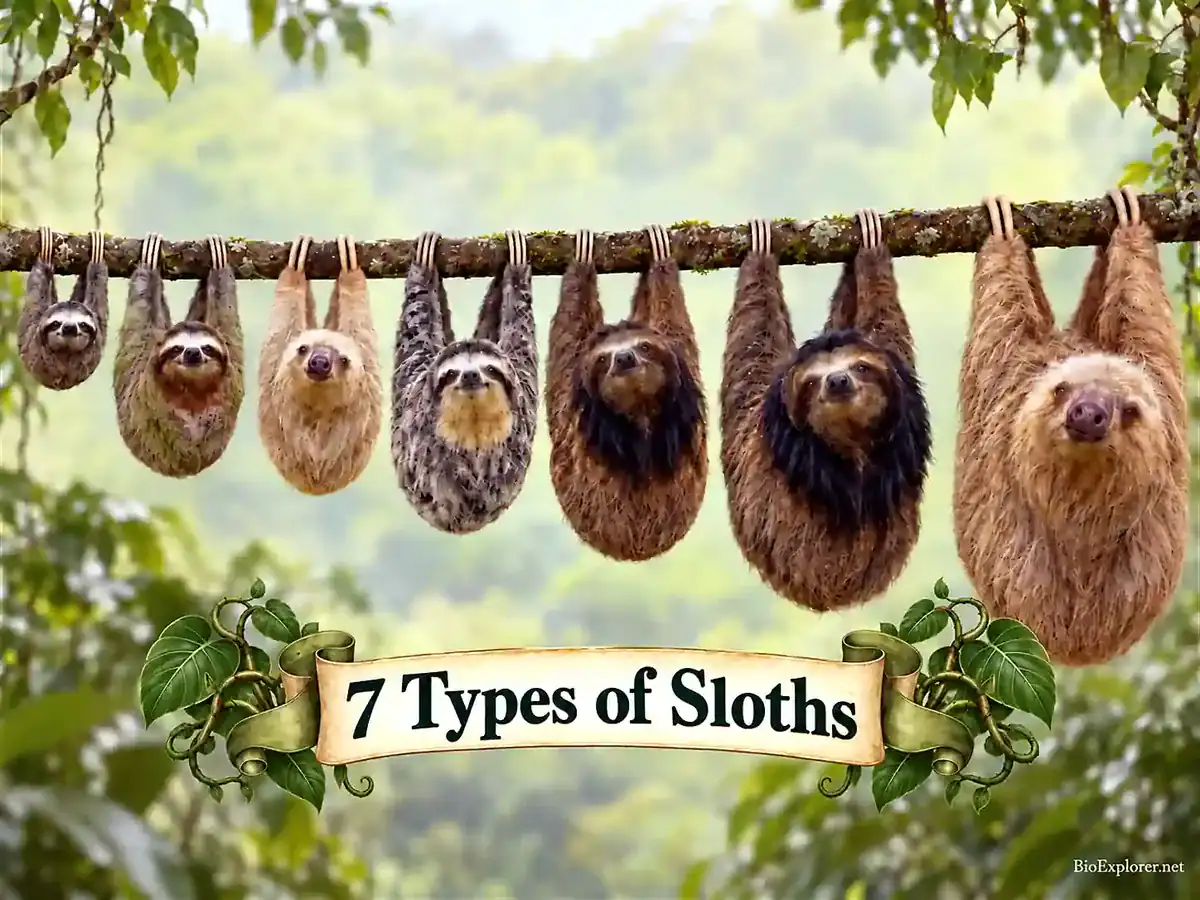
Sloths hang upside down in the rainforest canopy of Central and South America, moving so slowly that algae grows in their fur. There are 7 living species, and the number changed recently: one of them was recognized as separate only in 2022, after sitting unused as a name for 172 years.
This guide covers all 7 types of sloths. For each one you will find a picture, where it lives, how big it gets and one fact worth remembering. You will also learn why “two-toed” is the wrong name, why a genetics paper published in 2026 suggests the count may soon go to 8, and why the sloths that once lived in the United States included animals the size of a car.
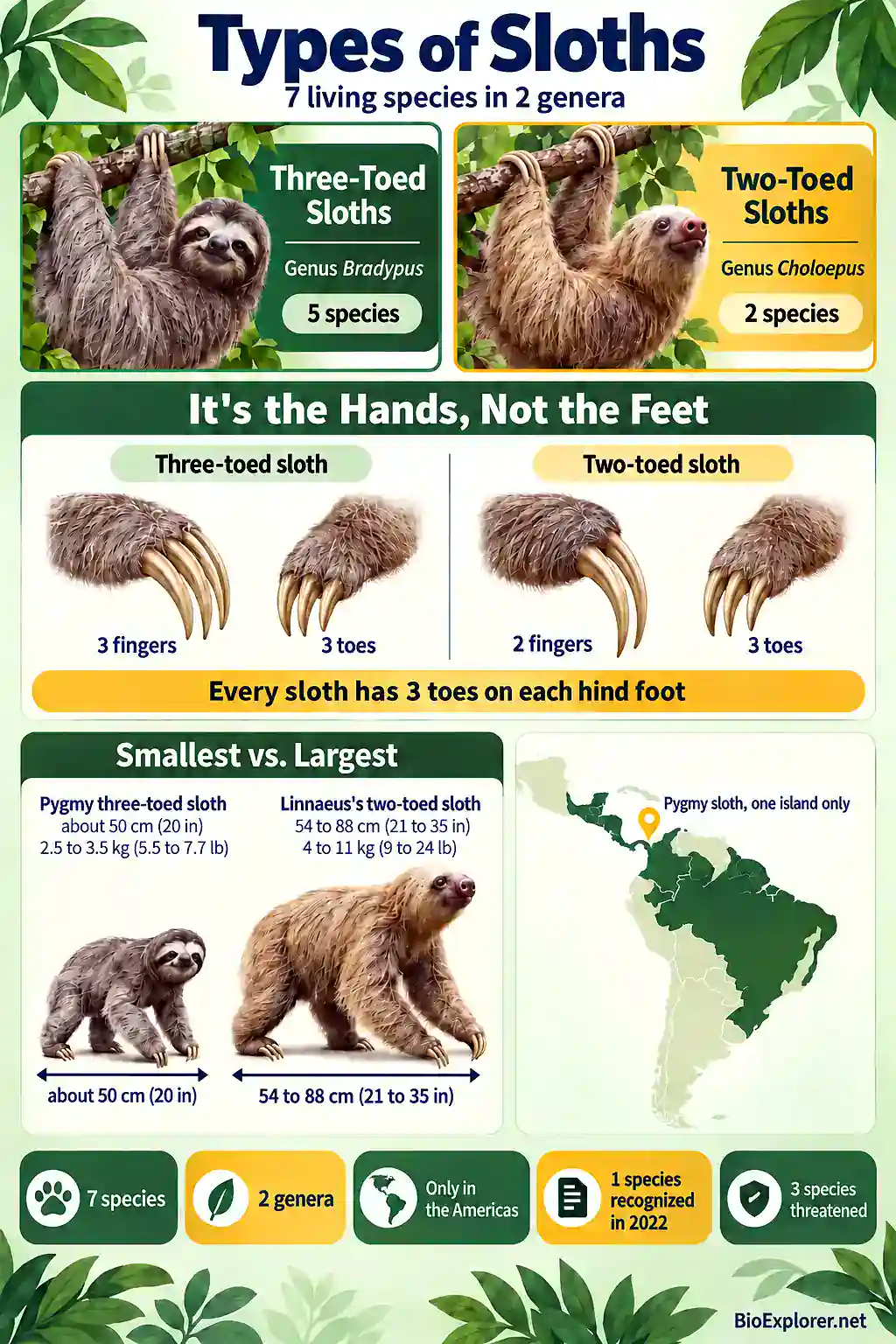
There are 7 living species of sloths, in 2 genera and 2 families. Bradypus holds 5 species with three fingers on each hand. Choloepus holds 2 species with two fingers. Many older sources still say 6, because they were written before the southern maned sloth was recognized in 2022.
Types of Sloths Guide:
- How Many Types of Sloths Are There?
- The Maned Sloth Became Two Species
- Is an Eighth Sloth Species Coming?
- What Is a Sloth?
- Three-Toed vs Two-Toed Sloths
- Three-Toed Sloths (Genus Bradypus)
- Two-Toed Sloths (Genus Choloepus)
- Sloths in the United States
- Sloths From Smallest to Largest
- Why Sloths Climb Down to Poop
- What Do Sloths Eat?
- Where Do Sloths Live?
- Sloths by Year of Classification
- Are Sloths Endangered?
- Why You Should Never Hold a Sloth
- Frequently Asked Questions
How Many Types of Sloths Are There?
Scientists recognize 7 living species of sloths. Both of the authorities that track this agree on the number: the IUCN SSC Anteater, Sloth and Armadillo Specialist Group and the Mammal Diversity Database, maintained by the American Society of Mammalogists.
You will still see 6 in a lot of places, and sometimes 5. The lower counts come from before the maned sloth was split into a northern and a southern species in 2022. Some databases have not caught up: ITIS still lists the southern maned sloth as an invalid name.
| Genus | Common name of the group | Family | Species |
|---|---|---|---|
| Bradypus | Three-toed sloths | Bradypodidae | 5 |
| Choloepus | Two-toed sloths | Choloepodidae | 2 |
| Total | 2 genera | 2 families | 7 |
The Maned Sloth Became Two Species
For most of the last two centuries, one sloth carried the name maned sloth across the whole Atlantic Forest of eastern Brazil. John Edward Gray had proposed splitting off a southern form back in 1850 and calling it Bradypus crinitus, but later researchers folded that name into the northern animal and it sat unused.
In September 2022, a team led by Flavia Miranda published a full revision of the maned sloths in the Journal of Mammalogy. Using skull shape together with mitochondrial and nuclear DNA, they showed that the northern and southern populations are separate lineages that split in the Early Pliocene, and they brought Gray’s 1850 name back. That is 172 years between the first proposal and its acceptance.
The split had a consequence nobody outside taxonomy would expect. In Red List version 2025-1, the northern maned sloth moved from Vulnerable to Endangered. The IUCN codes that change as non-genuine, meaning the animal’s situation did not suddenly worsen. What changed is that the species got smaller on paper when the southern population was carved out of it.
The Mammal Diversity Database lists 7 sloth species and places the two-toed sloths in the family Choloepodidae. ITIS, the US government taxonomic database, still lists only 4 Bradypus species, marks the southern maned sloth as an invalid name, and keeps the two-toed sloths in the old family Megalonychidae. Neither is wrong on purpose. Databases update at different speeds, and this is what the gap looks like.
Is an Eighth Sloth Species Coming?
Possibly. In April 2026, a team led by Larissa Arantes published the first genome-wide study of two-toed sloths across Amazonia, combining nuclear and mitochondrial data from multiple populations.
They found that Hoffmann’s two-toed sloth is paraphyletic: its population east of the Andes groups more closely with Linnaeus’s two-toed sloth than with its own supposed conspecifics. Their nuclear estimate puts the split between the two named species at about 3.57 million years ago, much more recent than the 8 million years earlier mitochondrial work suggested.
The authors conclude that the genus may contain at least three species and call for a full taxonomic revision with wider sampling. They did not name or describe a new species, so the official count stays at 7. A new species needs a formal description with a name, a type specimen and a diagnosis before it counts.
What Is a Sloth?
A sloth is a slow-moving, tree-dwelling mammal of Central and South American forests, built almost entirely around saving energy. Sloths belong to the order Pilosa, which they share with anteaters, and to the superorder Xenarthra, which also includes the 25 types of armadillos.
Two-Toed Sloths Are Really Two-Fingered
This is the most common mistake about sloths, and it is worth getting right. Every sloth has three toes on each hind foot. All 7 species. The difference between the groups is in the hands: Choloepus has two fingers, Bradypus has three.
So “two-toed sloth” describes something that does not exist. Costa Rican rescue centers and the IUCN specialist group now use two-fingered and three-fingered instead, which is accurate. The old names are still what people search for, which is why this page uses both.
More Neck Bones Than Almost Any Other Mammal
Nearly every mammal has exactly 7 neck vertebrae, from a mouse to a giraffe. Sloths and manatees are the only exceptions. Three-fingered sloths have 8 to 10, and two-fingered sloths have 5 to 8, so the family breaks the rule in both directions at once.
The obvious assumption is that the extra bones buy extra head rotation. A 2023 biomechanical study tested that and found the vertebra count plays only a secondary role, with overall vertebral shape mattering more. The popular claim that sloths can turn their heads 270 degrees is not supported by that work.
Built to Save Energy
A sloth’s metabolic rate runs at roughly 40 to 45 percent of what you would predict from its body weight. The often-quoted 15 hours of sleep a day comes from captive animals. When researchers put brain-activity loggers on wild sloths, brown-throated and pygmy sloths slept only about 9 to 10 hours. Linnaeus’s two-toed sloth has an unusually low and variable body temperature that shifts with the conditions around it, rather than being held near a fixed point the way most mammals hold theirs.
Digestion is just as slow. In a feeding trial with captive Linnaeus’s two-toed sloths, food particles stayed in the gut for more than 140 hours, and three of the four animals defecated only once every 5 days. The long retention had an odd side effect: the sloths produced methane accounting for about 9 percent of their energy intake, more than cattle on a forage diet.
Hanging is cheap too. Tests on sloth tendons found their tensile strength and stiffness close to the suspensory ligaments in a horse’s leg, which means a sloth can hang below a branch with very little muscle effort.
Three-Toed vs Two-Toed Sloths
The two groups are not close relatives. They sit in separate families and have looked similar for the same reason birds and bats both have wings: hanging in trees and eating leaves rewards the same body plan.
| Feature | Three-toed sloths (Bradypus) | Two-toed sloths (Choloepus) |
|---|---|---|
| Fingers on each hand | 3 | 2 |
| Toes on each hind foot | 3 | 3 |
| Species | 5 | 2 |
| Diet | Strict leaf eaters | Leaves, buds, flowers, fruit and young stems |
| Active when | Day and night in bursts | Mainly at night |
| Neck vertebrae | 8 to 10 | 5 to 8 |
| Temperament | Calmer | Will bite, with 4 canine-like teeth |
| Family | Bradypodidae | Choloepodidae |
No. Sloths are xenarthrans, a group that split from other placental mammals very early and today includes only sloths, anteaters and armadillos. Among the types of mammals, their closest living relatives are anteaters, not primates.
Three-Toed Sloths (Genus Bradypus)
The 5 Bradypus sloths are the ones with three fingers on each hand. They are specialized folivores, they are active in bursts through both day and night, and they are the calmer of the two groups to be around.
This is where the recent taxonomic action has been. One of these 5 was recognized as a separate species only in 2022.
Brown-Throated Sloth
| Kingdom | Order | Family | Genus | Species |
|---|---|---|---|---|
| Animalia | Pilosa | Bradypodidae | Bradypus | Bradypus variegatus |
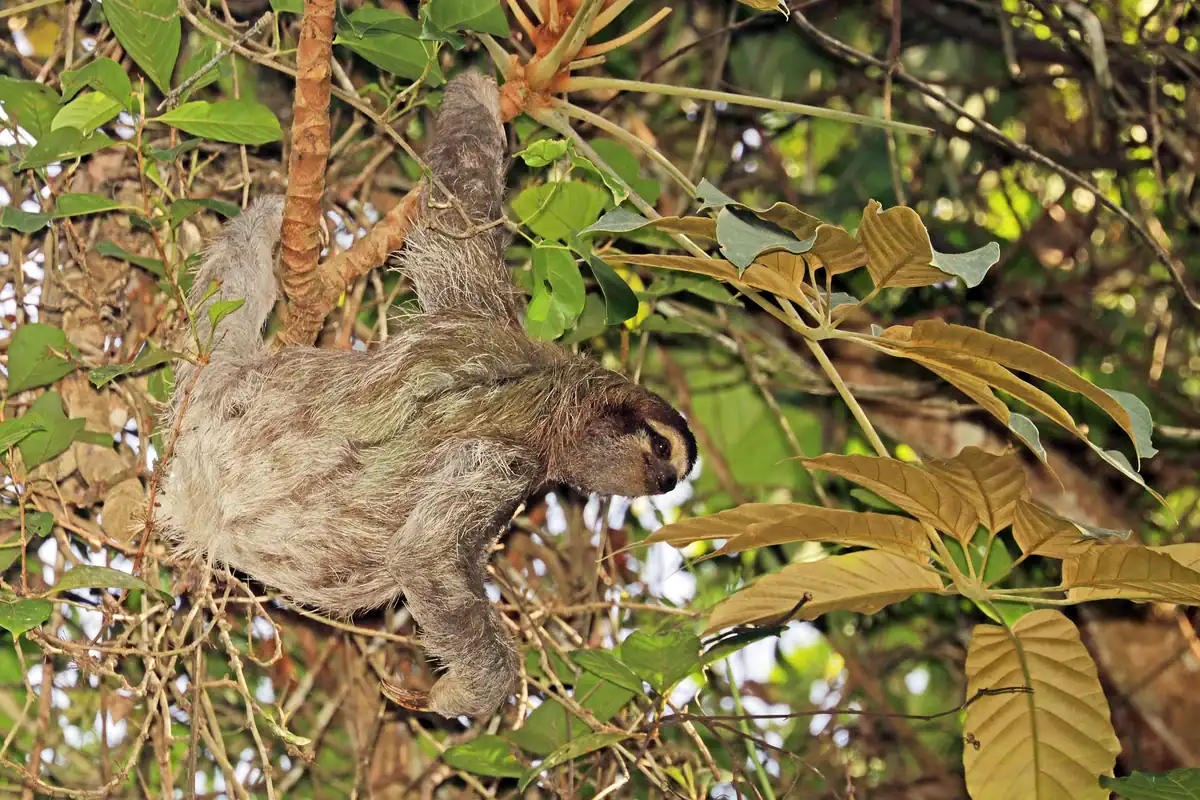
The brown-throated sloth is the one most people have seen. It ranges from eastern Honduras all the way south to northern Argentina, which makes it by far the most widespread sloth. It also copes better with disturbed land than the others, and it turns up in pasture and plantations wherever tall trees are left standing.
- Adults measure 52 to 54 cm (20 to 21 in) head to body and weigh 3.7 to 6 kg (8 to 13 lb). The coat is gray and coarse, often tinged green with algae.
- Look for the dark stripe running across a paler, browner face, which gives the animal a masked look. Males carry a patch of short cream to orange hair between the shoulders with a dark line down the middle.
- This is the sloth behind the strangest idea in sloth science. A 2014 study found that three-fingered sloths carry more moths, more nitrogen and more algae in their fur than two-fingered sloths do, and they proposed a chain to explain it: the weekly climb to the ground delivers the moths to their egg-laying site in the dung, the moths carry nutrients back up, those nutrients feed the algae, and the sloth ingests some of the algae as food.
- The team detected the alga in only 2 of the 12 three-fingered sloths it sampled, and the idea remains an unconfirmed hypothesis.
- Heinrich Rudolf Schinz, a Swiss naturalist working in Zurich, described it in 1825.
Pale-Throated Sloth
| Kingdom | Order | Family | Genus | Species |
|---|---|---|---|---|
| Animalia | Pilosa | Bradypodidae | Bradypus | Bradypus tridactylus |
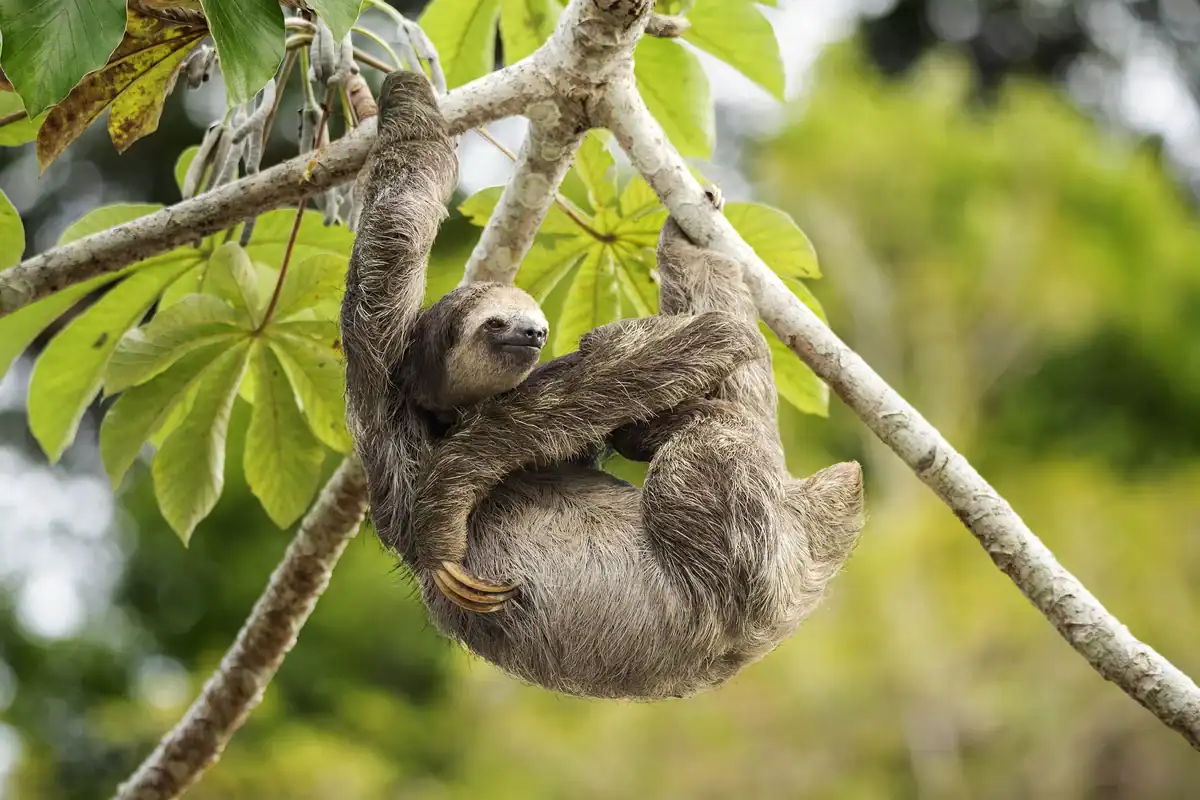
The pale-throated sloth lives north of the Amazon, in eastern Venezuela east of the Orinoco, across Guyana, Suriname and French Guiana, and into northern Brazil. The Amazon River marks its southern boundary. It is strictly arboreal and does not survive outside forest.[1]
Adults measure 45 to 75.5 cm (18 to 30 in) and weigh 3.4 to 6.5 kg (7.5 to 14.3 lb), with males smaller than females. The name is the field mark: the throat and head are pale yellow, unlike the brown throat of its southern neighbor. The back is dark gray with black speckling, heaviest around the shoulders.
It has one of the slowest digestive systems measured in any mammal. The IUCN specialist group describes it as a strict folivore feeding on canopy leaves, mainly Cecropia. One tracked individual spent 18.5 hours a day resting or motionless.
Carl Linnaeus, the Swedish naturalist who invented the two-name system biology still uses, described it in 1758.
Pygmy Three-Toed Sloth
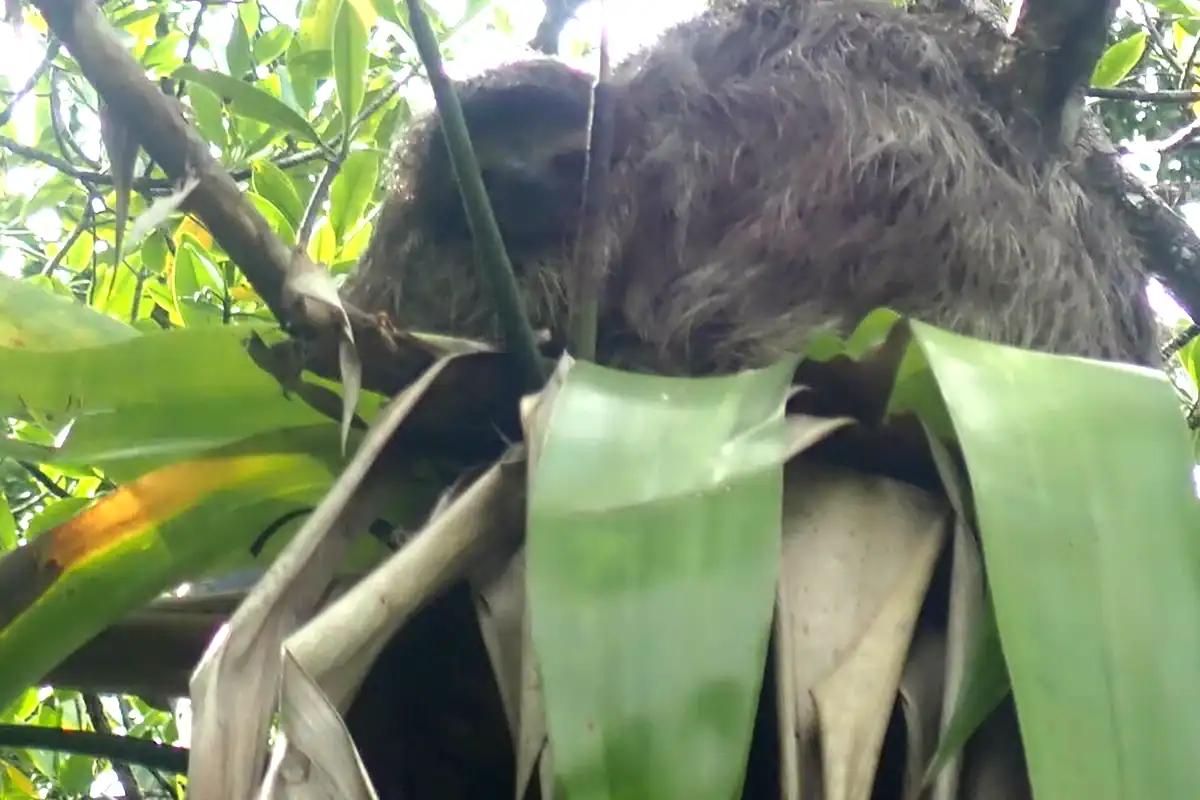
| Kingdom | Order | Family | Genus | Species |
|---|---|---|---|---|
| Animalia | Pilosa | Bradypodidae | Bradypus | Bradypus pygmaeus |
The pygmy three-toed sloth lives on one island and nowhere else. Isla Escudo de Veraguas sits about 17 km (11 mi) off the Caribbean coast of Panama and covers just 4.3 sq km (1.7 sq mi). A 2012 survey counted 79 sloths, 70 of them in mangroves, and measured the total mangrove habitat at 106,699 sq m, which is about 2.5 percent of the island.
The published paper states 0.024 percent, but the arithmetic gives 2.48, and the figure survived into the paper’s own correction notice.[9]
It is the smallest sloth, at around 50 cm (20 in) and 2.5 to 3.5 kg (5.5 to 7.7 lb), noticeably lighter than the mainland sloth it most resembles. Island dwarfism is the usual explanation. It looks like a scaled-down brown-throated sloth, with the same masked face, and the ear openings are unusually large.
The island has no native wild cats, and the sloths sleep like it. When researchers fitted wild sloths with brain-activity loggers, mainland brown-throated sloths preferred to sleep at night, most likely to stay hidden from nocturnal predators.
The pygmy sloths showed no preference at all. Feral domestic cats are a separate matter, and researchers recorded them on the island during the 2011 survey.
Robert P. Anderson and Charles O. Handley Jr. described it in 2001. Anderson is a biogeographer at the City College of New York, and Handley was the Smithsonian’s longtime curator of mammals.
Northern Maned Sloth
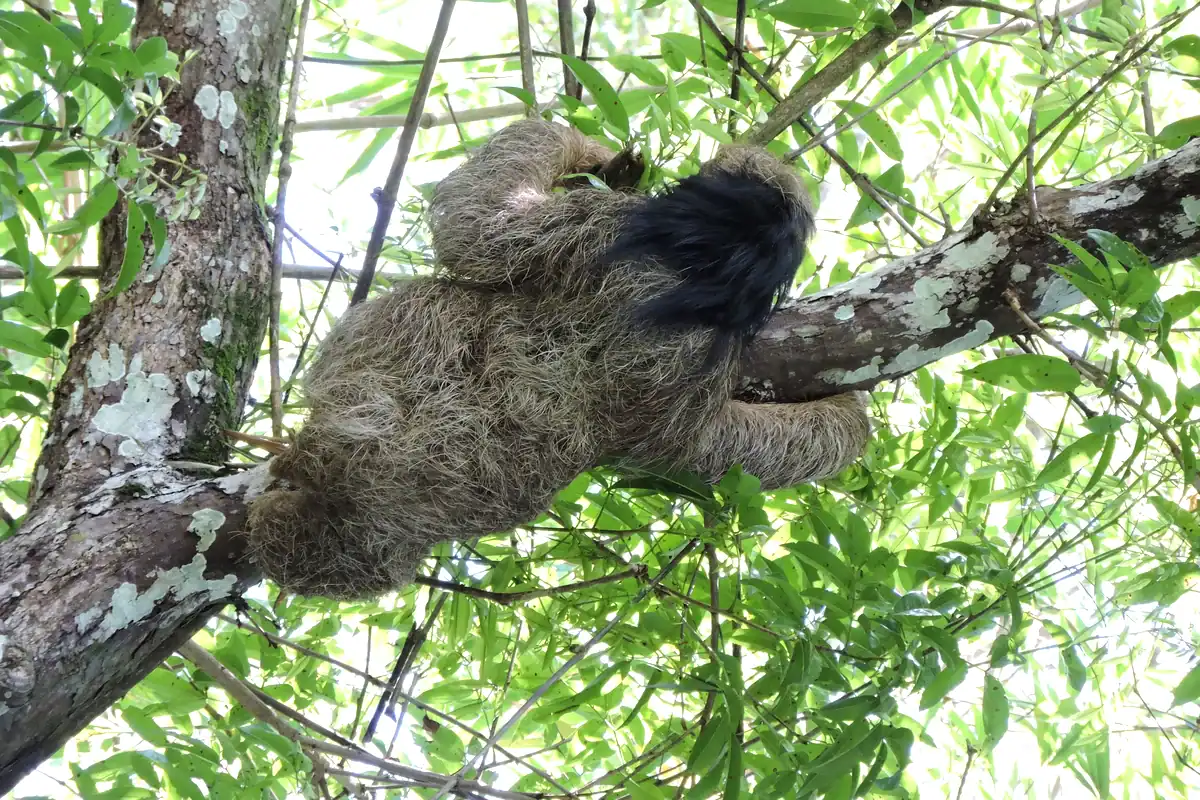
| Kingdom | Order | Family | Genus | Species |
|---|---|---|---|---|
| Animalia | Pilosa | Bradypodidae | Bradypus | Bradypus torquatus |
The northern maned sloth lives only in Brazil’s Atlantic Forest, in Bahia and Sergipe. Its stronghold is southern Bahia. It holds on in fragments as small as 20 hectares and uses cabruca, the shaded cocoa farming system that keeps native canopy trees in place, which is why cocoa growing matters to its survival.[14]
The 2022 revision that separated the two maned sloths measured Bahia animals at 51.9 to 72.2 cm (20 to 28 in) and 4.64 to 6.38 kg (10 to 14 lb). Both sexes carry a black mane of long hair around the back of the neck, longer and darker in males. Unlike other Bradypus males, maned sloth males have no orange shoulder patch.
It is fussier about food in some places than others. A study in southern Bahia found individuals feeding on anywhere from 1 to 17 plant species, so a single animal may live almost entirely off one kind of tree.
The longest single journey recorded for any maned sloth is over 300 m (984 ft) in five and a half hours, which for this family counts as a sprint.
Johann Karl Wilhelm Illiger, a German naturalist who became the first director of Berlin’s Zoological Museum, described it in 1811.
Southern Maned Sloth
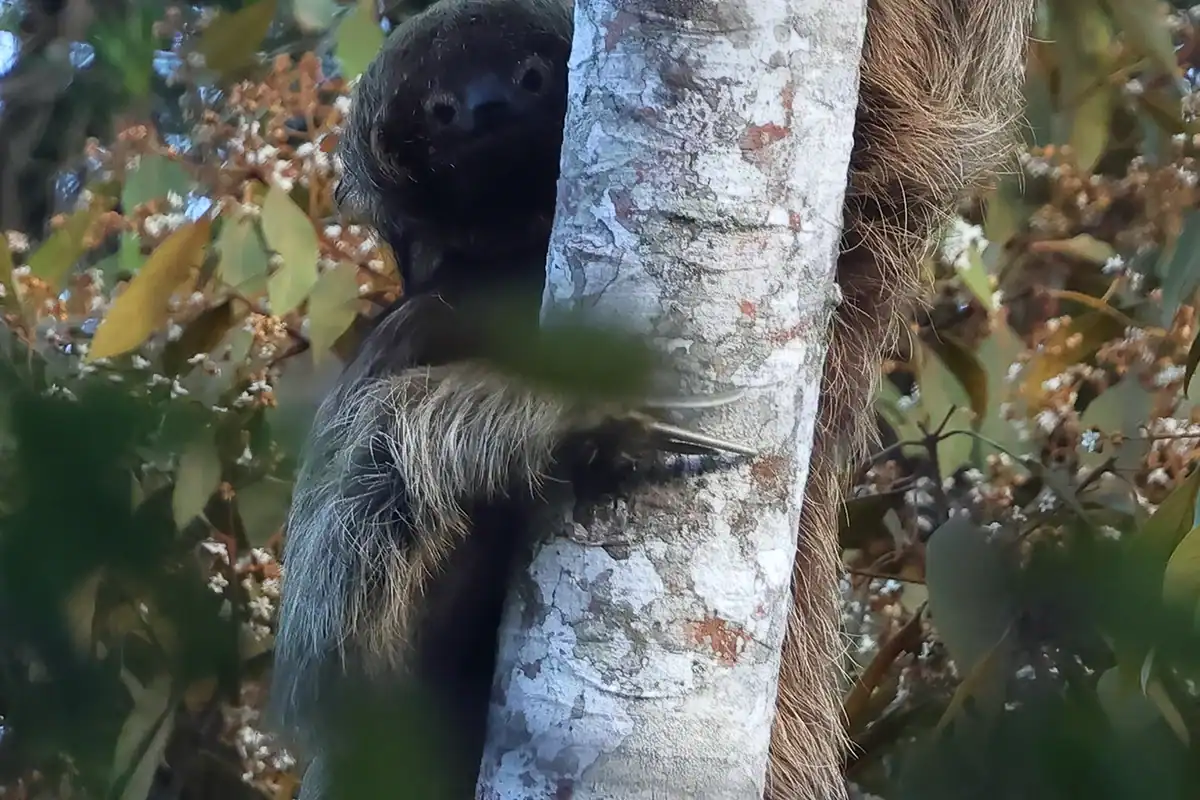
| Kingdom | Order | Family | Genus | Species |
|---|---|---|---|---|
| Animalia | Pilosa | Bradypodidae | Bradypus | Bradypus crinitus |
The southern maned sloth is the newest species on this list. It lives in the coastal forests of Espirito Santo and Rio de Janeiro in eastern Brazil, in a patchy range that runs south from the Rio Doce. Espirito Santo is the stronghold. Home ranges run from 0.8 to 10.8 hectares.[15]
You cannot tell it apart from the northern maned sloth by looking. Both carry the same black neck mane, and males of both lack the orange shoulder patch. The 2022 revision measured animals from this range at 53.5 to 76.5 cm (21 to 30 in) and 3.7 to 10.1 kg (8 to 22 lb), which makes it the largest three-fingered sloth. Geography is the practical test: north of the Rio Doce is torquatus, south of it is crinitus.
It barely moves. Animals tracked in Espirito Santo covered an average of 17 m (56 ft) during the day and 5 m (16 ft) at night, and a feeding study found that leaves from 21 plant species made up 99 percent of the diet of three animals. John Edward Gray proposed this animal as a species in 1850.
Later researchers folded the name into the northern maned sloth, and it sat unused for 172 years until a team led by Flavia Miranda revalidated it in the Journal of Mammalogy in September 2022, using skull shape together with mitochondrial and nuclear DNA. The two lineages had been separate since the Early Pliocene.
John Edward Gray, an English zoologist who ran the British Museum’s zoology department for 34 years, first proposed the name in 1850.
Two-Toed Sloths (Genus Choloepus)
The 2 Choloepus sloths have two fingers on each hand instead of three. They are larger, mainly nocturnal, and far less fussy about food: alongside leaves they take buds, flowers, fruit and young stems, and rescue centers report them eating small animals too.
They also bite. Two-fingered sloths have four sharp, canine-like front teeth that three-fingered sloths lack, and Costa Rican rescue centers describe them as the aggressive ones of the family.
Linnaeus’s Two-Toed Sloth
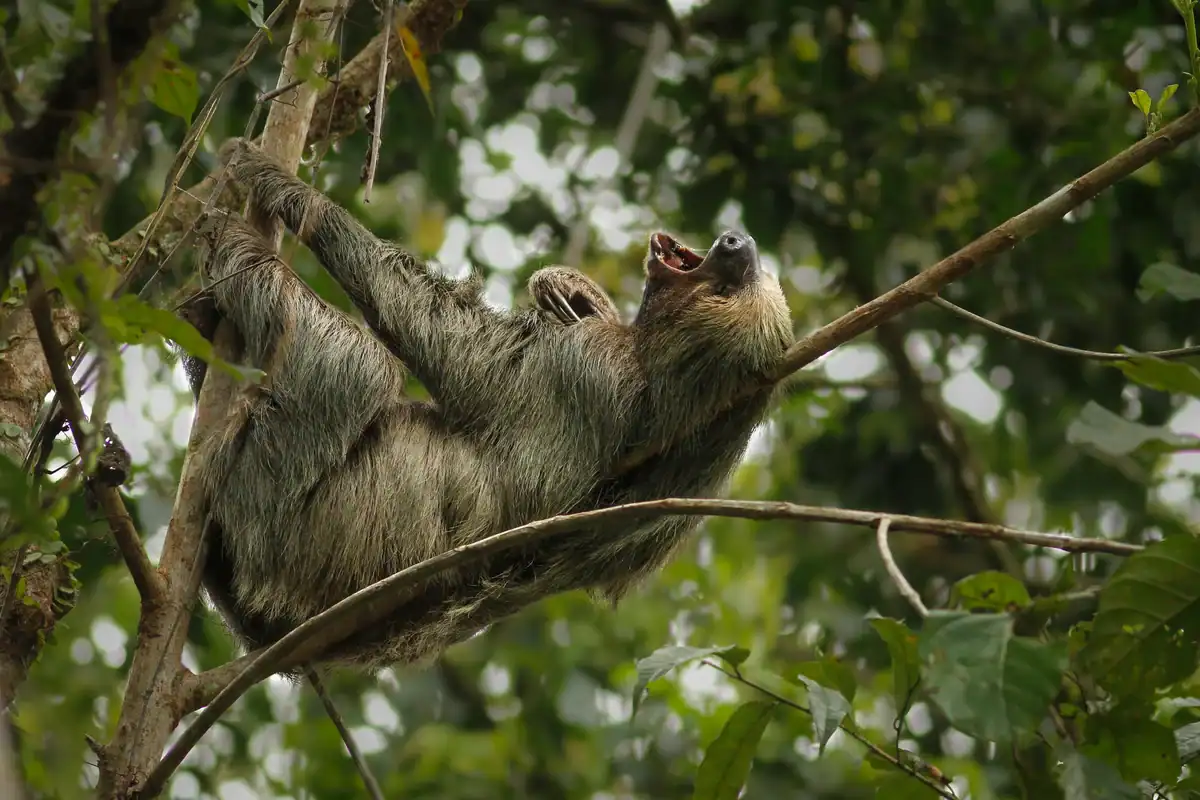
| Kingdom | Order | Family | Genus | Species |
|---|---|---|---|---|
| Animalia | Pilosa | Choloepodidae | Choloepus | Choloepus didactylus |
Linnaeus’s two-toed sloth lives across the northern Amazon, from Colombia and Venezuela through the Guianas into northern Brazil, and west into the upper Amazon basin of Ecuador and Peru. It reaches about 2,438 m (8,000 ft) in the mountains.[16]
It is the largest living sloth, at 54 to 88 cm (21 to 35 in) and 4 to 11 kg (9 to 24 lb). The fur is tan to buff, greenish in the wild from algae. The face ends in a naked, leathery, pig-like snout. There is no visible tail. Its teeth have no enamel and never stop growing, and the four front teeth are shaped like canines.
Its body temperature is unusually low and unusually changeable. Most mammals hold their core within a degree or two of a fixed point. This one lets its temperature drift with the conditions around it, which is part of how it keeps its energy costs so low. Published figures vary, so treat any single number you see for it with caution.
Carl Linnaeus described it in 1758, in the same volume that established modern scientific naming. Its common name honors him.
Hoffmann’s Two-Toed Sloth
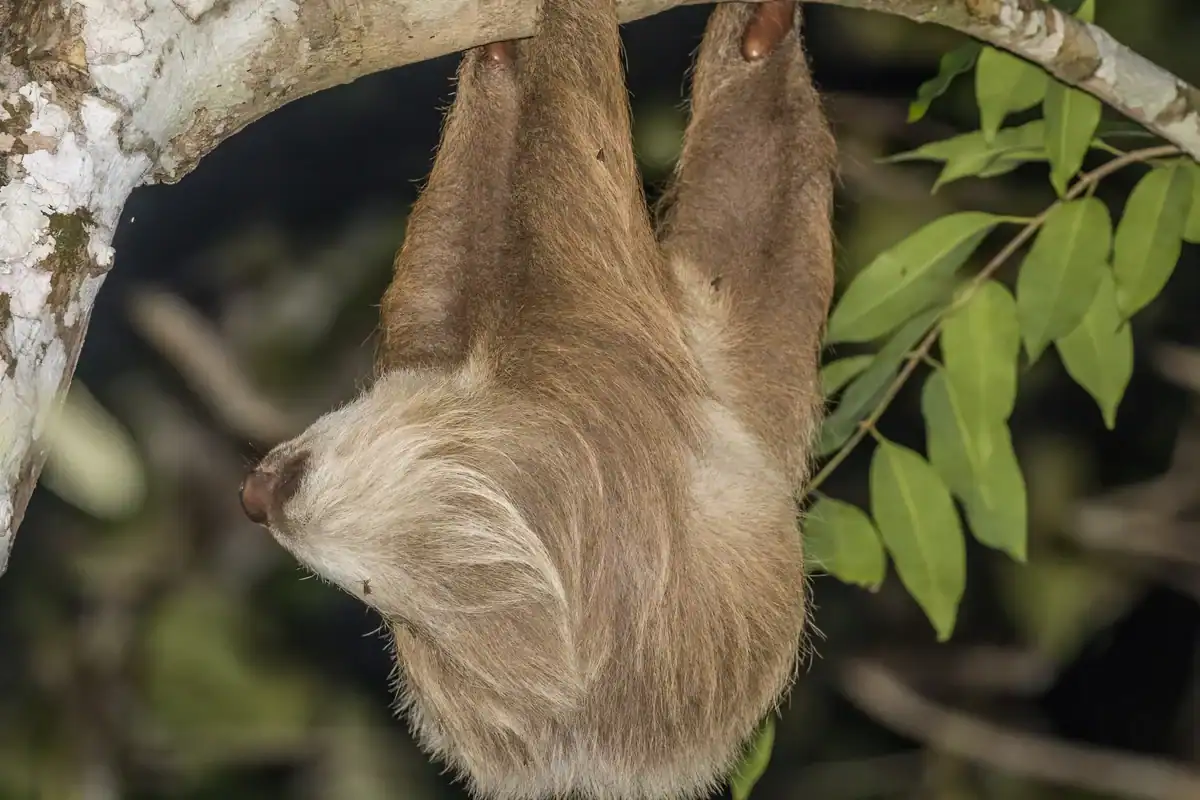
| Kingdom | Order | Family | Genus | Species |
|---|---|---|---|---|
| Animalia | Pilosa | Choloepodidae | Choloepus | Choloepus hoffmanni |
Hoffmann’s two-toed sloth lives in two populations that do not touch. The northern one runs from Honduras and Nicaragua through Costa Rica and Panama into Colombia and western Venezuela. The southern one sits far away, from north-central Peru through southwestern Brazil into central Bolivia.[17]
Adults measure 50 to 70 cm (20 to 28 in) and weigh 2.7 to 10 kg (6 to 22 lb), a wide spread even for a sloth. The fur is blond to light brown, paler than Linnaeus’s two-toed sloth, and the throat is paler too, which is the practical way to tell the two apart.
It is the highest-living sloth on record. One animal was documented at 3,328 m (10,919 ft) on Turrialba Volcano in Costa Rica, roughly 900 m above the highest record for any other sloth. A 2024 study found that highland animals face rising metabolic costs as temperatures climb, and that warming may make their survival at altitude untenable.
Wilhelm C. H. Peters, a German zoologist at the Berlin Zoological Museum, described it in 1858.
Sloths in the United States
No sloth lives in the United States today. For most of the last few million years, that was not true, and the American sloths were nothing like the ones hanging in trees now.
Thomas Jefferson Named a Giant Ground Sloth
In 1796, saltpeter miners working a limestone cave in what is now Monroe County, West Virginia, dug up a set of enormous claws. Colonel John Stuart sent them to Thomas Jefferson, who concluded he was looking at a giant clawed predator, something “of the lion kind, but of most exaggerated size“, and called it Megalonyx, meaning great claw.
Jefferson was wrong, and he found out at the worst possible moment. Arriving in Philadelphia in March 1797 to present his paper, he saw an illustration in a London magazine showing similar fossils identified as relatives of sloths. He revised the paper the same day, dropping the lion and describing the animal as “of the clawed kind“. The species was later named Megalonyx jeffersonii in his honor.
It was not small. The National Park Service puts Megalonyx at around 10 feet long and roughly 2,200 pounds, and its fossils turn up from Central America north to Alaska and the Yukon, in most states east of the Rockies and on the west coast. West Virginia made it the official state fossil in 2008. No other state has chosen a sloth.
Megalonyx was not the largest. Eremotherium eomigrans crossed into North America about 3 million years ago during the Great American Interchange, stood roughly 15 feet tall and is estimated to have weighed more than 3 tons. In South America, Megatherium americanum may have reached 4,000 kg (8,800 lb).
Why They Disappeared
Ground sloths vanished from North America around 11,000 to 13,000 years ago, at the end of the last Ice Age. Caribbean ground sloths lasted much longer. Radiocarbon dates from Cuba and Hispaniola put their disappearance at about 4,400 years ago, roughly 1,500 years after people first reached those islands. Their extinction postdated the major Ice Age climate shifts and followed human arrival, but whether hunting, habitat alteration or several pressures together caused it remains debated.
Not everyone is convinced. Researchers at the American Museum of Natural History note that on the question of what killed the large Ice Age mammals, there is still no satisfactory answer.
Sloths From Smallest to Largest
Sloths are all roughly dog-sized. Lengths below are head and body, without the tail.
| Sloth | Head-body length | Weight | Fingers |
|---|---|---|---|
| Pygmy Three-Toed Sloth | About 50 cm (20 in) | 2.5 to 3.5 kg (5.5 to 7.7 lb) | 3 |
| Brown-Throated Sloth | 52 to 54 cm (20 to 21 in) | 3.7 to 6 kg (8.2 to 13.2 lb) | 3 |
| Hoffmann’s Two-Toed Sloth | 50 to 70 cm (20 to 28 in) | 2.7 to 10 kg (6 to 22 lb) | 2 |
| Pale-Throated Sloth | 45 to 75.5 cm (18 to 30 in) | 3.4 to 6.5 kg (7.5 to 14.3 lb) | 3 |
| Northern Maned Sloth | 51.9 to 72.2 cm (20 to 28 in) | 4.64 to 6.38 kg (10.2 to 14.1 lb) | 3 |
| Southern Maned Sloth | 53.5 to 76.5 cm (21 to 30 in) | 3.7 to 10.1 kg (8.2 to 22.3 lb) | 3 |
| Linnaeus’s Two-Toed Sloth | 54 to 88 cm (21 to 35 in) | 4 to 11 kg (8.8 to 24.3 lb) | 2 |
The smallest sloth is the pygmy three-toed sloth of Panama, at around 50 cm (20 in) and 2.5 to 3.5 kg (5.5 to 7.7 lb). The largest is Linnaeus’s two-toed sloth, which the IUCN specialist group lists at 54 to 88 cm (21 to 35 in) and 4 to 11 kg (9 to 24 lb). Among the three-fingered sloths, the southern maned sloth is the biggest, reaching 10.1 kg (22 lb).
Why Sloths Climb Down to Poop
Three-fingered sloths leave the canopy about once every 8 days, climb to the base of their tree and defecate on the ground. It makes no sense on the face of it. In one Costa Rican research program, more than half of the adult sloth deaths the team documented were predation events at or near the ground, and the climb costs energy an animal this frugal can barely spare.
A 2014 study proposed an explanation, and it is worth stressing that the researchers offered it as a hypothesis rather than a settled finding. Sloth fur hosts moths that lay their eggs in sloth dung, and the larvae develop there. When a sloth descends, it may deliver the moths to their breeding site, and new adults fly up into the fur.
As moths die in the coat, fungi break them down and release nitrogen, which the authors propose feeds the algae living on the hairs. They further proposed that sloths ingest some of that algae, which the team found easy to digest and rich in fat, so it could supplement a leaf diet. The direct evidence was thin: the sloth-associated alga turned up in the stomach contents of only 2 of the 12 three-fingered sloths sampled. Deliberate algae grazing has not been demonstrated.
The same study found three-fingered sloths carry more moths, more nitrogen and more algae than two-fingered sloths, which fits: the two-fingered species are far less particular about where they go to the bathroom.
What Do Sloths Eat?
It depends on the group, and this is one of the clearest differences between them. Three-fingered sloths are folivores, and leaves make up almost all of what sloths eat. A 2014 study proposed that algae from their own fur may supplement that diet, though the evidence for it is limited. The pale-throated sloth feeds on canopy leaves, mainly Cecropia. In the southern maned sloth, leaves from 21 plant species accounted for 99 percent of what three tracked animals ate.
Two-fingered sloths are generalists. Alongside leaves they take buds, flowers, fruit, twig tips and young stems, and Costa Rican rescue centers report them eating small lizards. They have enlarged front teeth shaped like canines, which three-fingered sloths do not.
Where Do Sloths Live?
Sloths live only in the forests of Central and South America. Brazil has the most species. One species is confined to a single island. They spend nearly their whole lives in the canopy, the busiest of the layers of the rainforest.
Other than sloths, explore what animals live in rainforests here.
| Sloth | Scientific name | Where it lives | Habitat |
|---|---|---|---|
| Brown-Throated Sloth | Bradypus variegatus | Eastern Honduras south through Central America to Colombia, Venezuela, Ecuador, Peru, Brazil, Bolivia, Paraguay and northern Argentina | Tropical forest with mixed tree species, including farmland that still has canopy trees |
| Hoffmann’s Two-Toed Sloth | Choloepus hoffmanni | Two separate populations: Honduras to western Venezuela, and north-central Peru to central Bolivia | Evergreen forest canopy, from sea level to 3,328 m |
| Linnaeus’s Two-Toed Sloth | Choloepus didactylus | Colombia, Venezuela, the Guianas, northern Brazil, and the upper Amazon of Ecuador and Peru | Lowland and montane rainforest canopy, from sea level to about 2,438 m |
| Northern Maned Sloth | Bradypus torquatus | Brazil, in the states of Bahia and Sergipe | Evergreen Atlantic Forest up to 1,000 m, including shaded cocoa plantations |
| Pale-Throated Sloth | Bradypus tridactylus | Eastern Venezuela east of the Orinoco, the Guianas, and northern Brazil north of the Amazon | Lowland tropical forest with dense cover; never found outside forest |
| Pygmy Three-Toed Sloth | Bradypus pygmaeus | Panama, on Isla Escudo de Veraguas only | Red mangrove stands around the island edge, with a few animals in the interior forest |
| Southern Maned Sloth | Bradypus crinitus | Brazil, in Espirito Santo and Rio de Janeiro | Evergreen coastal forest, including regenerating secondary forest |
Sloths by Year of Classification
The table below shows when each sloth was first described and by whom. Two centuries separate the first from the last.
| Sloth | Scientific name | Year | Described by | Profession |
|---|---|---|---|---|
| Linnaeus’s Two-Toed Sloth | Choloepus didactylus | 1758 | Carl Linnaeus | Swedish naturalist |
| Pale-Throated Sloth | Bradypus tridactylus | 1758 | Carl Linnaeus | Swedish naturalist |
| Northern Maned Sloth | Bradypus torquatus | 1811 | Johann Karl Wilhelm Illiger | German naturalist |
| Brown-Throated Sloth | Bradypus variegatus | 1825 | Heinrich Rudolf Schinz | Swiss naturalist |
| Southern Maned Sloth | Bradypus crinitus | 1850 | John Edward Gray | English zoologist |
| Hoffmann’s Two-Toed Sloth | Choloepus hoffmanni | 1858 | Wilhelm C. H. Peters | German zoologist |
| Pygmy Three-Toed Sloth | Bradypus pygmaeus | 2001 | Robert P. Anderson and Charles O. Handley Jr. | American zoologists |
Are Sloths Endangered?
Four of the 7 sloths are listed as Least Concern. The other 3 are all in trouble, and all 3 have tiny ranges: the pygmy three-toed sloth on its single Panamanian island, and the two maned sloths in the fragmented Atlantic Forest of Brazil.
The pygmy three-toed sloth is Critically Endangered. A 2012 survey found 79 animals, 70 of them in the island’s mangroves, and recorded machete and saw damage across roughly 30 percent of that habitat, along with feral domestic cats.
A revised estimate published in 2015, which counted sloths living in the island’s interior forest as well, put the likely population at 500 to 1,500.
The maned sloths face habitat loss to pasture, plantations and urban sprawl, and the specialist group also lists vehicle collisions, dog attacks, electrocution on power lines, poaching and prolonged drought. Habitat loss is the common thread, and it is one of the biggest threats to biodiversity worldwide.
| IUCN status | Species | Sloths |
|---|---|---|
| Critically Endangered | 1 | Pygmy Three-Toed Sloth |
| Endangered | 2 | Northern Maned Sloth, Southern Maned Sloth |
| Least Concern | 4 | Brown-Throated Sloth, Hoffmann’s Two-Toed Sloth, Linnaeus’s Two-Toed Sloth, Pale-Throated Sloth |
Two recent studies suggest the safe-looking species may not be as safe as their labels imply. The 2026 genomics paper found that the two-toed sloths contain distinct lineages that may need their own conservation assessments. A 2024 study projected that highland Hoffmann’s two-toed sloths face metabolic costs under warming that may make survival at altitude untenable by 2100.
Why You Should Never Hold a Sloth
Sloths look like they are smiling. They are not. The expression is a product of facial structure, and it is a large part of why the sloth selfie trade exists.
A 2018 study watched 17 sloths through 70 observations on 34 tours in Brazil and Peru. On average 5 people held each sloth during a single observation, and for 48.6 percent of the time the animals were handled in ways that involved manipulating the head or limbs, or holding the animal by its claws.
The most common behaviors recorded were surveillance and limb stretching, which the authors describe as possible indicators of compromised welfare. They are careful to note that no previous study had documented sloth behavior during handling, so their data is a baseline rather than proof of harm.
World Animal Protection, which supported the work, reports that handled sloths were more vigilant and slept less than sloths at a rehabilitation center. The Sloth Conservation Foundation reports that sloths are taken from the wild for the exotic pet trade, that the United States and the European Union keep the most exotic pets overall, and that sloths held in harmful captive tourism conditions often do not survive more than a few weeks.
Frequently Asked Questions
There are 7 living species of sloths in 2 genera. Older sources say 6, because the maned sloth was counted as one species before it was split into a northern and a southern species in 2022.
The difference is in the hands, not the feet. Every sloth has three toes on each hind foot. Two-toed sloths have two fingers on each hand, three-toed sloths have three. Two-toed sloths are also larger, mainly nocturnal, and eat a wider range of food.
The pygmy three-toed sloth of Panama, at around 50 cm (20 in) and 2.5 to 3.5 kg (5.5 to 7.7 lb). It lives on one island and nowhere else.
Linnaeus’s two-toed sloth, at 54 to 88 cm (21 to 35 in) and up to 11 kg (24 lb). Among three-fingered sloths the southern maned sloth is largest, at up to 10.1 kg (22 lb). Extinct ground sloths were far bigger: Megatherium may have weighed 4,000 kg (8,800 lb).
Not today. Giant ground sloths lived across North America until about 11,000 to 13,000 years ago. Megalonyx jeffersonii, named after Thomas Jefferson, is the official state fossil of West Virginia.
Their metabolic rate runs at about 40 to 45 percent of what their body size predicts, and they live on leaves, which yield very little energy. Moving slowly is how they balance that budget. It also helps them avoid being spotted by predators that hunt by movement.
Sloth guard hairs carry unusual grooves or cracks that hold moisture and let algae take hold. The pattern differs between the two groups: two-fingered sloths have hairs with lengthwise grooves, three-fingered sloths have hairs that develop cracks across them. The algae give the coat a green tint that may provide camouflage. A 2014 study proposed that sloths also ingest some of it as food, but it detected the alga in only 2 of 12 three-fingered sloths, so that remains an unconfirmed hypothesis.
Three-fingered sloths climb down to the ground about once every 8 days. In a feeding trial, captive Linnaeus’s two-toed sloths defecated about once every 5 days, with food staying in the gut more than 140 hours.
Yes. Sloths are strong swimmers and use a stroke like a dog paddle. They move faster in water than on the ground, and some species use rivers to move between forest patches.
The pygmy three-toed sloth, which is Critically Endangered and lives only on Isla Escudo de Veraguas, a 4.3 sq km island off Panama. Estimates put the population at roughly 500 to 1,500.
Two-fingered sloths do. They have 4 sharp front teeth shaped like canines, and rescue centers describe them as the aggressive group. Three-fingered sloths are calmer, but any sloth can react badly under stress.
No. Sloths belong to Xenarthra, an early branch of placental mammals that today contains only sloths, anteaters and armadillos. Anteaters are their closest living relatives.
A sloth is not a lazy animal. It is an animal that cannot afford to waste a single calorie, and every strange thing about it follows from that.
Cite this page
BioExplorer. (2026, September 25). Types of Sloths: Meet All 7 Living Species. https://www.bioexplorer.net/animals/mammals/sloths/
About the author