
Two New Howler Monkeys Found in the Amazon, One Named With a Yanomami Word
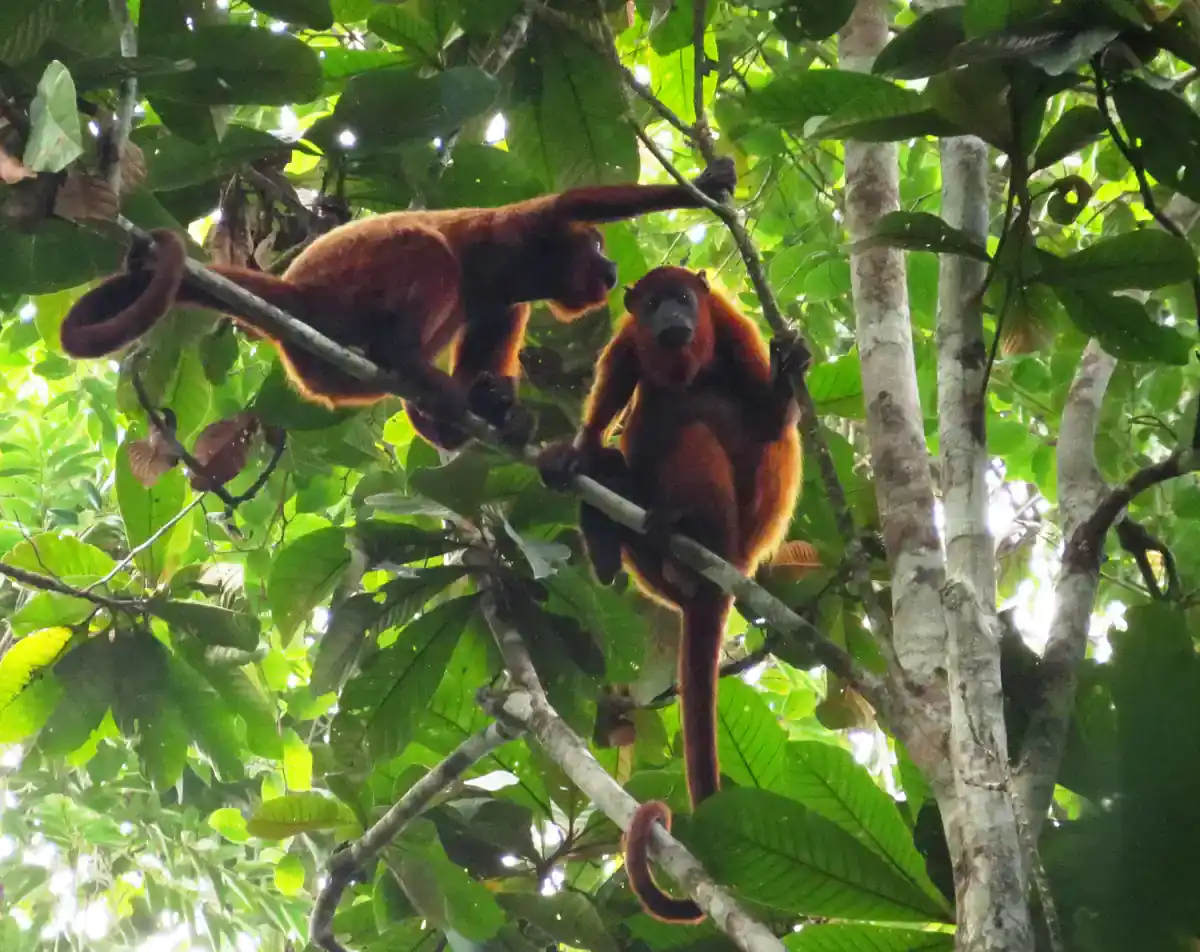
Scientists have described two new howler monkey species from the Brazilian Amazon. They are the Pantepui red howler (Alouatta iroi) and the Mato Grosso red howler (Alouatta matogrossensis). Both had been hiding in plain sight, mistaken for close relatives.
The team found them by comparing genome data from howler monkeys across the Amazon Basin. The study was published on October 30, 2026, in Communications Biology. It was led by Romina Batista of the National Institute of Amazonian Research (INPA) in Manaus, with senior author Jean P. Boubli of the University of Salford.
Batista spoke with BioExplorer about the find. The authors warn that one of the new species may already qualify as Critically Endangered.
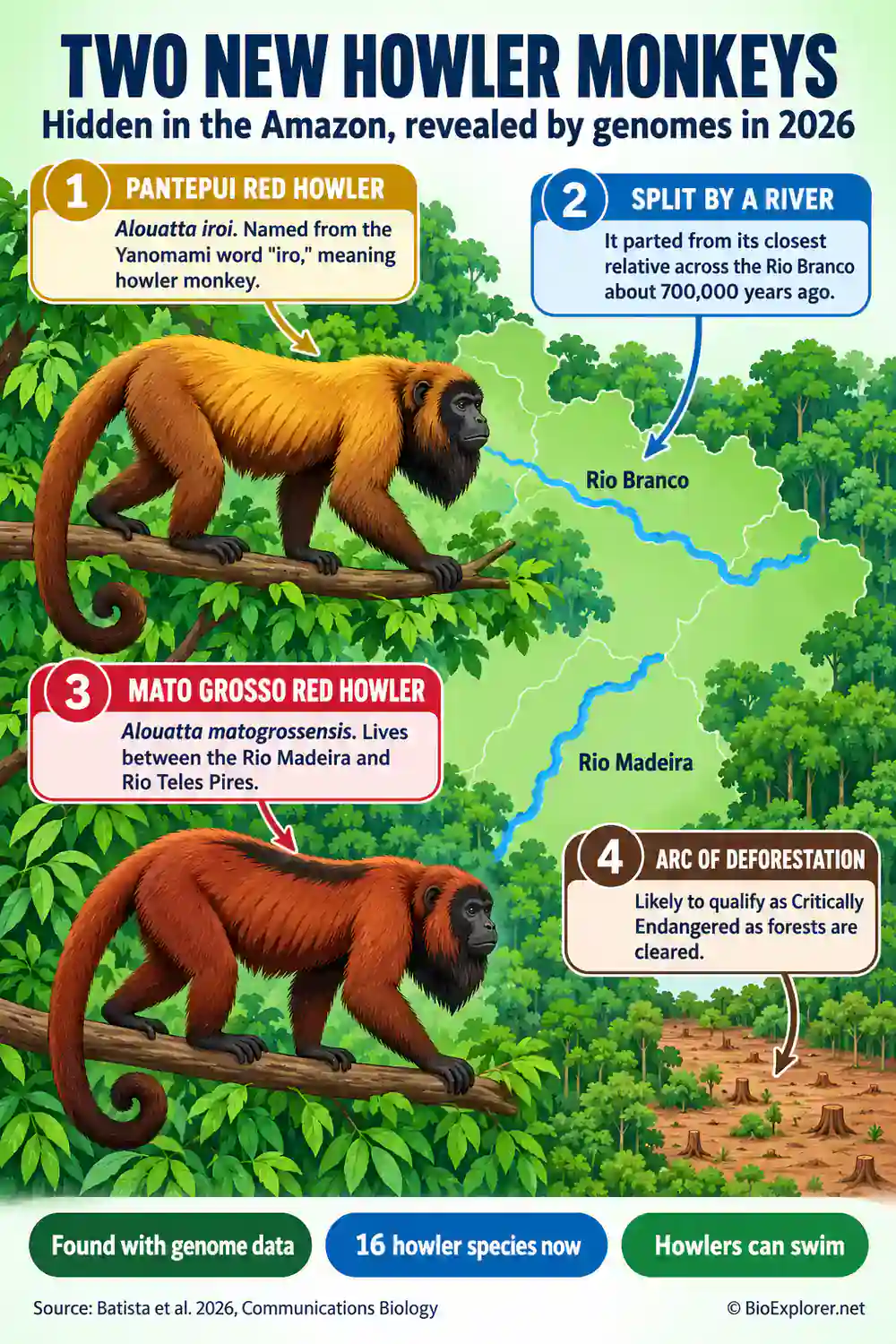
The two new species are the Pantepui red howler (Alouatta iroi) of northwestern Brazil and the Mato Grosso red howler (Alouatta matogrossensis) of southern Amazonia. Both were described in October 2026 using genome data and fur patterns. Under the revised taxonomy the authors propose, there are 16 howler monkey species.
Jump to:
Hidden in the Genomes
Howler monkeys are famous for their loud roars. They are also the most leaf-eating monkeys in the Americas. They range from Mexico to northern Argentina, and many look alike.
Batista set out to build a family tree for the genus. The team sampled 11 of the 13 howler species recognized at the time, including 83 individuals for the main analysis. They pulled nearly 2,000 genetic markers from across each genome.
The family tree showed two groups that did not match any named species. The team then checked the animals’ fur against their closest relatives.
With this genetic evidence in hand, we discussed our findings with our team of collaborators and examined the pelage (fur coloration and patterns) of several individuals.
Romina Batista, National Institute of Amazonian Research (INPA)
According to Batista, the fur showed consistent differences from each species’ closest relatives. That gave the team a second, independent line of evidence.
The Pantepui Red Howler
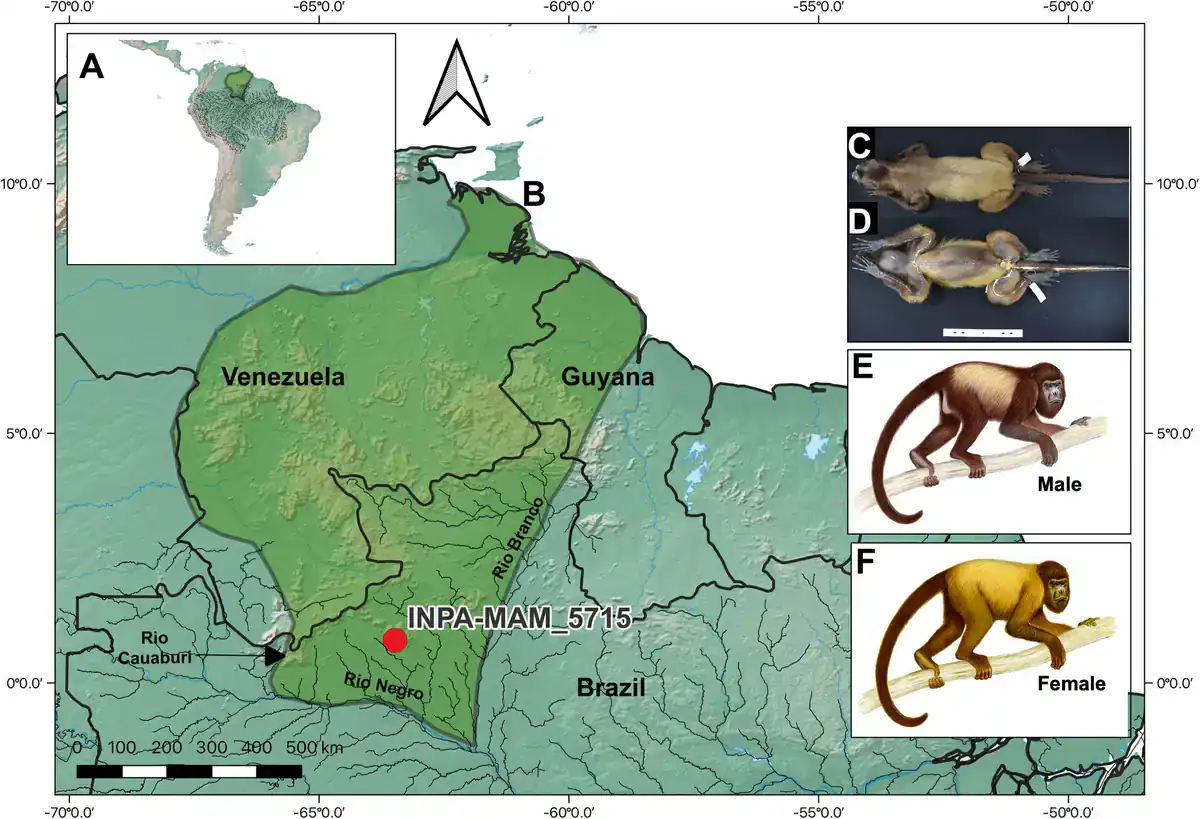
The Pantepui red howler lives in northwestern Brazil. Its range runs from the Rio Branco west to the Rio Cauaburi, north of the Rio Negro. Its northern limit likely reaches the Pantepui, a region of flat-topped mountains called tepuis.
Its back ranges from bright yellowish-brown to light golden-brown. Males have a saddle-shaped stripe down the middle of the back, which females lack. The type specimen is an adult male collected in 2005 at the foot of the Serra do Aracá, a tepui in Amazonas state.
The name iroi has a special origin.
The new monkey’s specific epithet, iroi, derives from the Yanomami word iro, meaning “howler monkey.” It acknowledges Indigenous linguistic knowledge and recognizes the importance of Indigenous peoples’ contributions to our understanding of biodiversity.
Romina Batista, National Institute of Amazonian Research (INPA)
Split by a River
The Pantepui red howler’s closest relative is the Guyanan red howler monkey, which lives east of the Rio Branco. The two split about 700,000 years ago. That is the most recent split in the whole howler family tree.
Batista said the team thinks the Rio Branco acted as a barrier, since the two species sit on opposite banks. But a river does not have to stop every monkey to keep two groups apart.
This is actually a fascinating question because howler monkeys are also capable of swimming! Nevertheless, a river does not necessarily need to be an absolute barrier to movement to restrict gene flow.
Romina Batista, National Institute of Amazonian Research (INPA)
Even if individuals occasionally cross it, the river may still limit dispersal and, over evolutionary timescales, contribute to the divergence of populations.
Romina Batista, National Institute of Amazonian Research (INPA)
The Rio Branco may also divide other primates, such as the bearded saki and its relatives, as well as some birds. Batista and colleagues explored this idea in a 2025 review of how rivers shape Amazonian wildlife.

The Mato Grosso Red Howler
The second new species lives in southern Amazonia. Its range stretches from the east bank of the Rio Madeira to the west bank of the Rio Teles Pires. The Rio Guaporé marks its southwestern edge.
Its back is bright reddish-brown, usually with a stripe down the middle. The type specimen is a female collected in 2014 on the Rio Teles Pires near Alta Floresta, Mato Grosso. Its closest relative is the Bolivian red howler, separated from it by open savanna habitats.
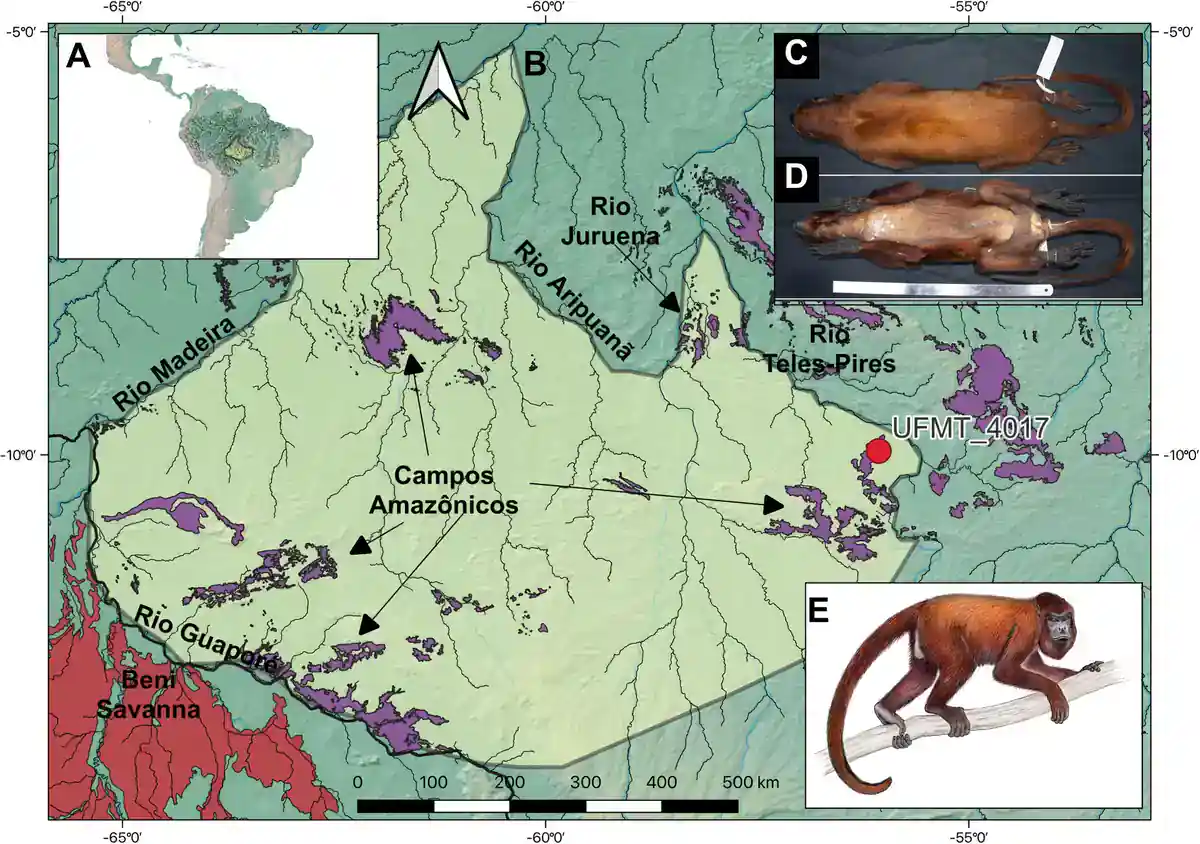
In parts of its range, the Mato Grosso red howler lives alongside the black-and-gold howler. Where they overlap, the two remain genetically distinct. The authors hypothesize that ecological or behavioral differences restrict gene flow between them.
Arc of Deforestation
The authors write that the Mato Grosso red howler “is likely to qualify as Critically Endangered.” It has not yet been formally assessed by the IUCN. It also had the lowest genome-wide heterozygosity, a measure of genetic diversity, among the howler lineages sampled in the study.
The distribution of this species falls right within the Arc of Deforestation, a region experiencing some of the highest deforestation rates in the Brazilian Amazon.
Romina Batista, National Institute of Amazonian Research (INPA)
According to Batista, the forest loss is driven mainly by farm monocultures, cattle ranching and urban growth.

We are particularly concerned that, without urgent conservation measures, even the remaining forest patches could become increasingly isolated, threatening the long-term persistence and connectivity of the populations of howlers living there.
Romina Batista, National Institute of Amazonian Research (INPA)
The paper compares its situation to the Alta Floresta titi, a monkey from the same area that was listed as Critically Endangered when it was described. Batista added that more studies of the new howler’s biology and habitat needs are essential for protecting it.
A Young Family
The study also sheds light on how howlers evolved. The first split, between the howlers of Central America and South America, happened about 3.5 million years ago. Most of the red howler species in the Amazon arose in the last million years.
Rivers, the Andes, and patches of savanna between forests split populations apart. The Pantepui red howler faces its own risks, including a planned dam on the Rio Branco and projected climate change in the region.
Under the revised taxonomy proposed by Batista and colleagues, howlers now number 16 species among the many types of monkeys in the Americas. Taxonomic databases have not yet adopted the change. The paper notes that 11 of the 16 howler taxa recognized before the study are already listed as threatened.
At a Glance
| Detail | Finding |
|---|---|
| New species 1 | Pantepui red howler (Alouatta iroi) |
| Range | Northwestern Brazil, between the Rio Branco and Rio Cauaburi |
| Name origin | Yanomami word iro, meaning “howler monkey” |
| New species 2 | Mato Grosso red howler (Alouatta matogrossensis) |
| Range | Southern Amazonia, between the Rio Madeira and Rio Teles Pires |
| Conservation | Likely to qualify as Critically Endangered, per the authors |
| Evidence | Genome data from 83 howlers plus fur patterns |
| Howler species | 16, under the authors’ revised taxonomy |
FAQs
The two new howler monkey species are the Pantepui red howler (Alouatta iroi) and the Mato Grosso red howler (Alouatta matogrossensis). Both live in the Brazilian Amazon and were described in October 2026.
Scientists compared genome data from howler monkeys across the Amazon Basin. Two groups did not match any named species, and differences in their fur confirmed they were distinct.
The name iroi comes from the Yanomami word iro, which means “howler monkey.” It honors Indigenous knowledge of the region’s wildlife.
The study’s authors say it is likely to qualify as Critically Endangered. Its range lies in Brazil’s Arc of Deforestation, where forests are being cleared for farming, ranching and towns.
Yes. According to lead researcher Romina Batista, howler monkeys can swim. Even so, large rivers such as the Rio Branco can restrict gene flow and contribute to population divergence.
Under the revised taxonomy proposed in this 2026 study, there are 16 howler monkey species, found from Mexico to northern Argentina. Taxonomic databases have not yet adopted the revision.
Cite this page
BioExplorer. (2026, November 2). Two New Howler Monkeys Found in the Amazon, One Named With a Yanomami Word. https://www.bioexplorer.net/new-howler-monkey-species.html/
About the author