
25 Types of Armadillos With Pictures and Facts
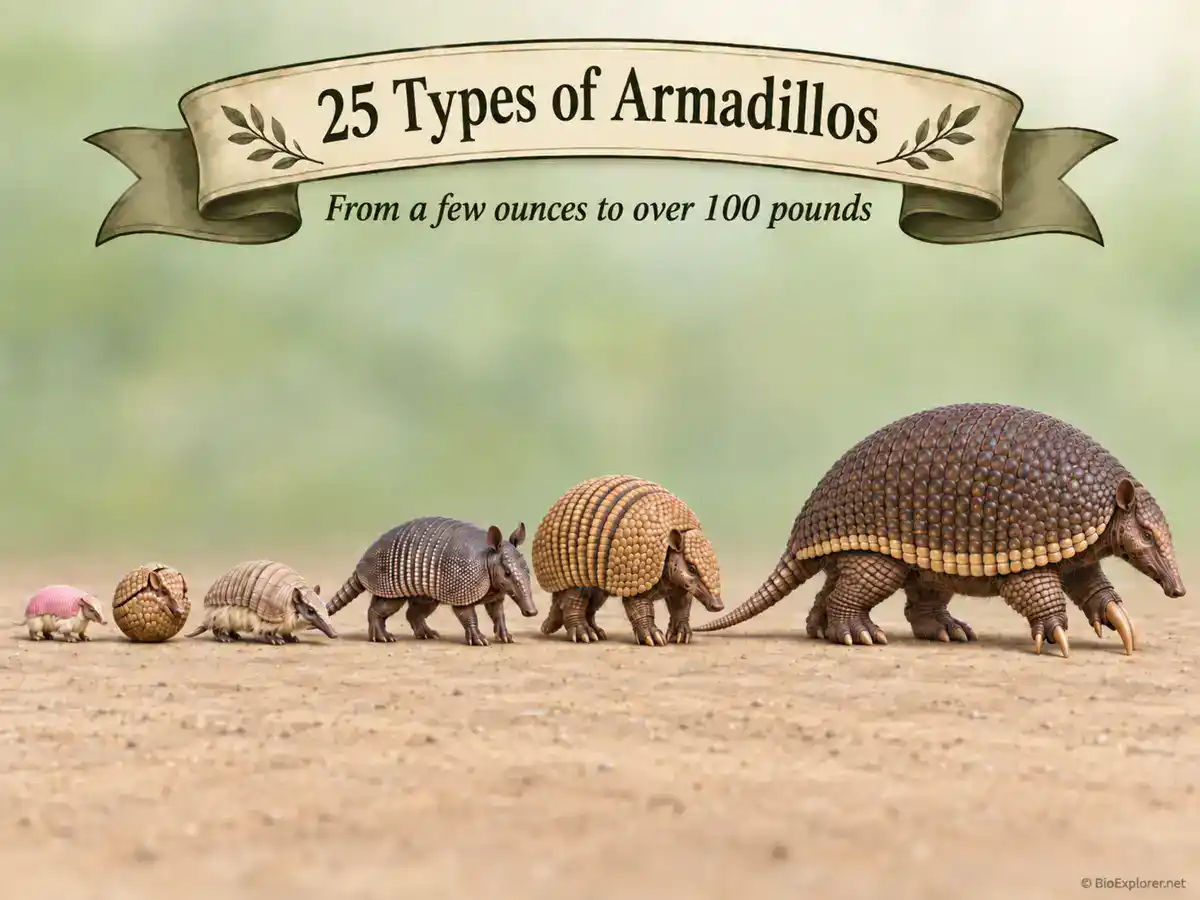
Armadillos are the only living mammals with a shell made of bone. There are 25 living species, and every one of them lives in the Americas. They range from the pink fairy armadillo, which could sit in the palm of your hand, to the giant armadillo, which can weigh as much as a large dog.
This guide covers all 25 types of armadillos. For each one, you will find a picture, where it lives, how big it gets, and one fact worth remembering. You will also learn why the armadillo in the United States got a new name in 2024.
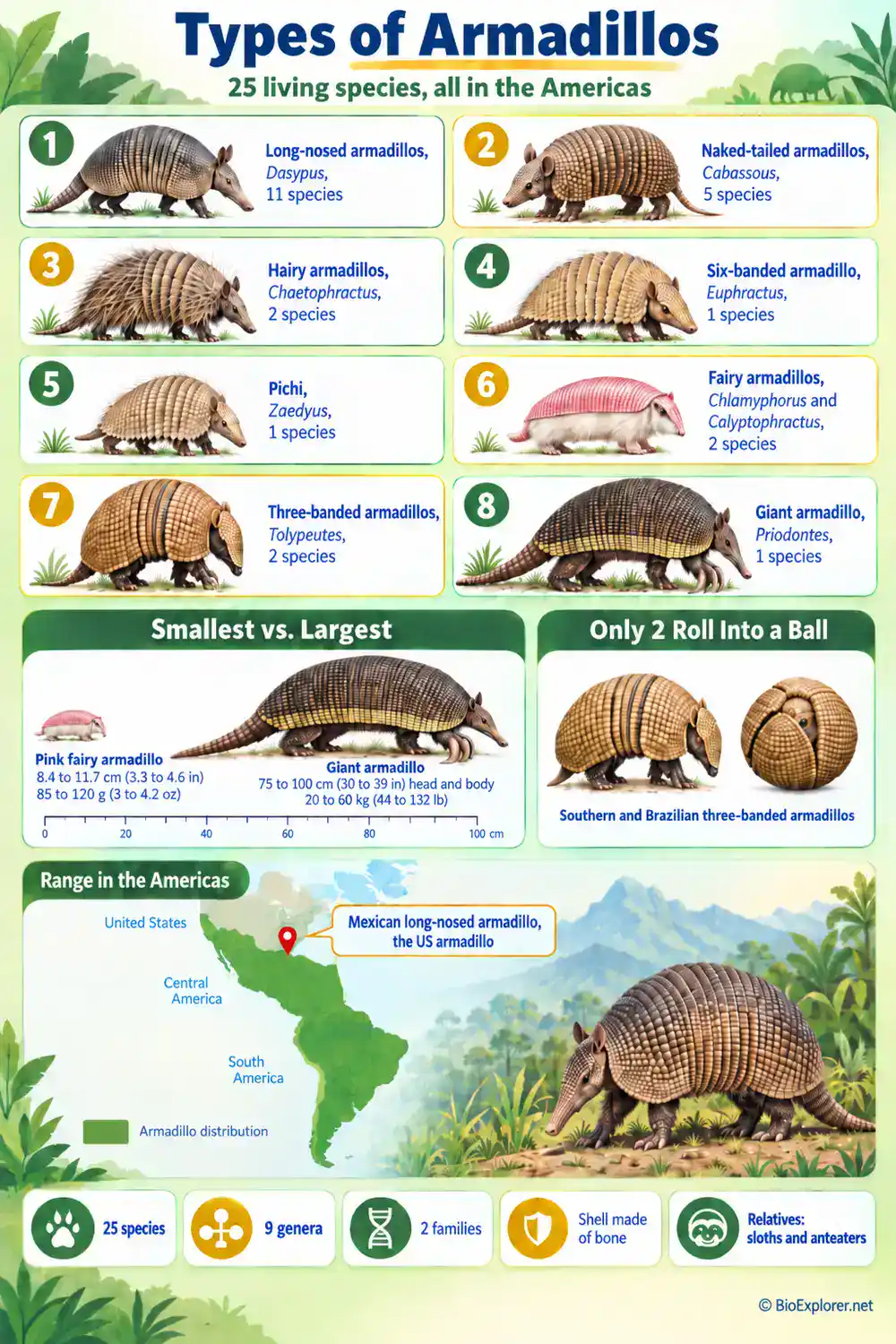
There are 25 living species of armadillos. Both the Mammal Diversity Database and the IUCN armadillo specialist group recognize 25. Under the IUCN specialist group classification used in this guide, they fall into 9 genera. The largest group is the long-nosed armadillos, with 11 species.
Armadillo Types Guide:
- How Many Types of Armadillos Are There?
- What Is an Armadillo?
- The US Armadillo Has a New Name
- Types of Long-Nosed Armadillos
- Types of Naked-Tailed Armadillos
- Hairy Armadillos and Their Relatives
- Types of Fairy Armadillos
- Types of Three-Banded Armadillos
- The Giant Armadillo
- Armadillos in the United States
- Selected Armadillos From Smallest to Largest
- Which Armadillos Can Roll Into a Ball?
- What Do Armadillos Eat?
- Where Do Armadillos Live?
- Armadillos by Year of Taxonomy Classification
- Are Armadillos Endangered?
- Frequently Asked Questions
How Many Types of Armadillos Are There?
Scientists recognize 25 living species of armadillos. Older books often list only 20 or 21. The number has grown because DNA studies keep finding hidden species. In 2016, the greater long-nosed armadillo was split into 3 species. In 2024, the nine-banded armadillo was split into 4.
Armadillos are usually sorted into 2 families. The long-nosed armadillos make up the family Dasypodidae. All the others belong to Chlamyphoridae. This is the system the IUCN armadillo specialist group uses.
This guide follows the IUCN SSC Anteater, Sloth and Armadillo Specialist Group, which recognizes 25 species in 9 genera and 2 families. The Mammal Diversity Database (v2.5, 2026) uses a newer classification with the same 25 species arranged in 10 genera and 4 families: Dasypodidae, Chlamyphoridae, Euphractidae, and Tolypeutidae.
| Group | Genus | Species | Family |
|---|---|---|---|
| Long-nosed armadillos | Dasypus | 11 | Dasypodidae |
| Naked-tailed armadillos | Cabassous | 5 | Chlamyphoridae |
| Hairy armadillos | Chaetophractus | 2 | Chlamyphoridae |
| Six-banded armadillo | Euphractus | 1 | Chlamyphoridae |
| Pichi | Zaedyus | 1 | Chlamyphoridae |
| Fairy armadillos | Chlamyphorus, Calyptophractus | 2 | Chlamyphoridae |
| Three-banded armadillos | Tolypeutes | 2 | Chlamyphoridae |
| Giant armadillo | Priodontes | 1 | Chlamyphoridae |
| Total | 9 genera | 25 |
What Is an Armadillo?
An armadillo is a mammal with a hard, flexible shell. The San Diego Zoo notes that the word armadillo is Spanish for “little armored thing“.
A Shell Made of Bone
An armadillo’s shell is made of many small bony plates called osteoderms. A thin layer of keratin, the same material as your fingernails, covers the plates. Bands of softer skin across the middle let the shell bend. A 2021 study in PubMed Central calls armadillos “the only known mammals” with a shell of this kind covering the head, body, and tail.
Built for Digging
Most armadillos have strong claws and dig burrows for shelter. Their teeth are simple pegs, good for crunching insects. The giant armadillo has the most teeth of any armadillo, up to 100, according to the San Diego Zoo.
Armadillos run cool for mammals. University of Georgia Extension gives a normal body temperature of 92 to 95 °F (33 to 35 °C) for the US armadillo, and notes that it does not store much body fat. That is why most armadillos live in warm places.
Armadillo Relatives
Armadillos belong to a group of mammals called xenarthrans. Their closest living relatives are sloths and anteaters.
Their extinct cousins were even stranger. Glyptodonts were huge, armored mammals that died out at the end of the last ice age. The American Museum of Natural History reports that some weighed 2 tons or more. It also says glyptodonts should be seen as just another subfamily of armadillos.
The US Armadillo Has a New Name
For more than 250 years, the armadillo in the United States was called the nine-banded armadillo, Dasypus novemcinctus. In 2024, that changed.
A team of scientists sequenced 80 complete mitochondrial genomes and captured nuclear DNA from 71 long-nosed armadillos, including 48 museum specimens. They found that the nine-banded armadillo is really 4 different species.
The study was published in the journal Systematic Biology. The Field Museum summed it up this way: “The armadillo that’s found in the United States should now be called the Mexican long-nosed armadillo“.
| New species | Where it lives |
|---|---|
| Mexican long-nosed armadillo (Dasypus mexicanus) | United States, Mexico, and Central America |
| Western Andean long-nosed armadillo (Dasypus fenestratus) | Western Andes to Costa Rica |
| Nine-banded armadillo (Dasypus novemcinctus) | South America |
| Guianan long-nosed armadillo (Dasypus guianensis) | Guiana Shield, northeastern South America |
Texas’s state symbol has not changed. The 1995 resolution simply names “the armadillo” as the official Small State Mammal. Scientifically, the animal Texans see on the roadside is now Dasypus mexicanus, the Mexican long-nosed armadillo.
Types of Long-Nosed Armadillos
Long-nosed armadillos belong to the genus Dasypus. With 11 species, this is the largest group of armadillos. They have long snouts, long ears, and long tails.
Several of these species look almost the same. Scientists often need DNA to tell them apart. The Mammal Diversity Database notes that two of them, the Yungas and Llanos long-nosed armadillos, may one day be merged back into the nine-banded armadillo.
Mexican Long-Nosed Armadillo
| Kingdom | Order | Family | Genus | Species |
|---|---|---|---|---|
| Animalia | Cingulata | Dasypodidae | Dasypus | Dasypus mexicanus |
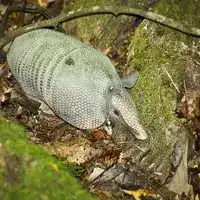
This is the armadillo you can see in the United States. It lives from Costa Rica north through Central America and Mexico to the central and eastern United States. It is very adaptable, and its range in the US is still growing.[23]
Texas Tech University reports an average total length of about 76 cm (30 in), and almost half of that is tail. Males weigh 5 to 8 kg (11 to 18 lb), and females weigh 4 to 6 kg (9 to 13 lb). Most have 9 movable bands.
Tidbit: Until 2024, this armadillo was called the nine-banded armadillo. A DNA study found that the nine-banded armadillo is really 4 species. The Field Museum announced that the one in the US should now be called the Mexican long-nosed armadillo. Texas named “the armadillo” its official Small State Mammal in 1995, so that title still stands.
Wilhelm Peters, a German naturalist, first named this form in 1865. It was treated as a subspecies until the 2024 study raised it to a full species.
Sources 1
- Photo: National Park Service, Congaree National Park (public domain)
Nine-Banded Armadillo
| Kingdom | Order | Family | Genus | Species |
|---|---|---|---|---|
| Animalia | Cingulata | Dasypodidae | Dasypus | Dasypus novemcinctus |
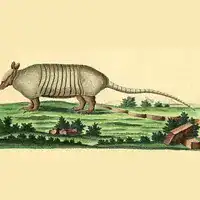
Since 2024, the scientific name Dasypus novemcinctus applies only to armadillos in South America. It is the smallest of the 4 species that were split from the old nine-banded armadillo.[24]
It lives on the eastern side of the Andes, from Ecuador, Colombia, and Venezuela to Brazil, Peru, Bolivia, Paraguay, Uruguay, and northern Argentina. It also lives in Trinidad and Tobago. It uses many kinds of habitat, including forests, farm fields, pastures, and plantations.
Tidbit: Despite its name, this armadillo can have anywhere from 7 to 11 movable bands. Nine is just the most common number. Litters are usually 4 genetically identical young.
Carl Linnaeus, the Swedish naturalist who created the modern system for naming species, named it in 1758.
Image: Schreber, Die Säugthiere, Plate LXXIV (public domain)
Western Andean Long-Nosed Armadillo
| Kingdom | Order | Family | Genus | Species |
|---|---|---|---|---|
| Animalia | Cingulata | Dasypodidae | Dasypus | Dasypus fenestratus |
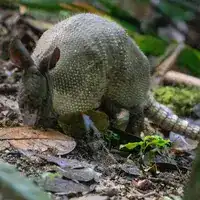
This armadillo lives on the western slopes of the Andes in northern Peru, Ecuador, Colombia, and Venezuela, and north into Central America as far as Costa Rica. The Mammal Diversity Database does not yet list Peru. In northern Costa Rica, it shares its range with the Mexican long-nosed armadillo.[4]
It has the smallest shell of the 4 species split from the old nine-banded armadillo. Adults average about 78 cm (31 in) long from nose to tail tip.
Tidbit: Its name, fenestratus, is Latin for “with windows.” Wilhelm Peters named it from a specimen collected in Costa Rica, which is still kept at the natural history museum in Berlin.
Wilhelm Peters named this form in 1865. The 2024 DNA study raised it from a subspecies to a full species.
Guianan Long-Nosed Armadillo
| Kingdom | Order | Family | Genus | Species |
|---|---|---|---|---|
| Animalia | Cingulata | Dasypodidae | Dasypus | Dasypus guianensis |
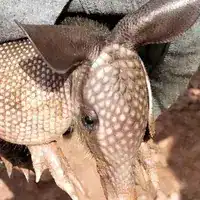
This armadillo lives in the Guiana Shield of northeastern South America. Its range covers French Guiana, Suriname, Guyana, eastern Venezuela east of the Orinoco River, and northern Brazil north of the lower Amazon.
It is the largest of the 4 species split from the old nine-banded armadillo. Adults average about 86 cm (34 in) from nose to tail tip and weigh about 5.5 to 6.5 kg (12 to 14 lb). It usually has 8 or 9 movable bands.
Tidbit: The Field Museum calls it the first armadillo described in the last 30 years. Scientists told it apart from its relatives using DNA and skull features. One of the lead researchers said these armadillos are “almost impossible to differentiate in the field.”
A team led by Mathilde Barthe and Frédéric Delsuc, two French scientists, described it in 2024.
Photo: Gerry van Tonder via iNaturalist, CC BY 4.0, cropped
Seven-Banded Armadillo
| Kingdom | Order | Family | Genus | Species |
|---|---|---|---|---|
| Animalia | Cingulata | Dasypodidae | Dasypus | Dasypus septemcinctus |
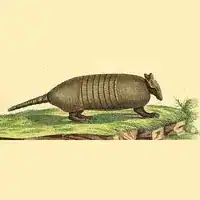
This long-nosed armadillo lives in Brazil, Paraguay, Bolivia, Argentina, and Uruguay. Its range reaches south to Buenos Aires province in Argentina. It prefers open country such as grasslands and savannas, although it also lives in forests and shrublands.
Adults measure about 24 to 47 cm (9 to 19 in) from head to rump and weigh around 2 kg (4.4 lb), although size varies a lot between populations. It usually has 6 or 7 movable bands, sometimes 8.
Tidbit: Its litters are large for an armadillo. ICMBio reports litters of 7 to 9 young. The young are probably monozygotic, meaning genetically identical, a trait linked to the genus Dasypus.
Carl Linnaeus named it in 1758.
Image: Schreber, Die Säugthiere, Plate LXXII (public domain)
Hairy Long-Nosed Armadillo
| Kingdom | Order | Family | Genus | Species |
|---|---|---|---|---|
| Animalia | Cingulata | Dasypodidae | Dasypus | Dasypus pilosus |
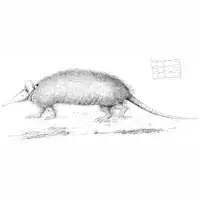
This armadillo lives only in Peru. Peru’s national Red Book lists it from the mountain forests of Amazonas, San Martín, Huánuco, Pasco, and Junín.[26]
It is a small long-nosed armadillo with a very long, narrow snout. Peru lists it as a threatened species, but it is so rarely seen that the IUCN rates it as Data Deficient.
Tidbit: It is the only armadillo whose shell is completely covered in dense hair. Its skull is so unusual that some scientists have proposed moving it into a genus of its own, Cryptophractus.
Leopold Fitzinger, an Austrian zoologist, described it in 1856.
Image: Hermann Burmeister, 1862 (public domain)
Yungas Long-Nosed Armadillo
| Kingdom | Order | Family | Genus | Species |
|---|---|---|---|---|
| Animalia | Cingulata | Dasypodidae | Dasypus | Dasypus mazzai |
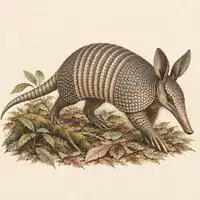
This armadillo may live only in Argentina. It was first known from Salta and Jujuy provinces in the northwest, and it has since been found in Santa Fe. It may also live in Bolivia and Paraguay. It lives in Yungas forests and in the drier Chaco.[28]
It is a medium-small long-nosed armadillo with long ears. Very few specimens exist, so its size is not well known.
Tidbit: Its name honors Dr. Salvador Mazza, a physician who spent his life fighting Chagas disease and supplied the first specimens. For years the name was thought to be invalid, and the animal was renamed Dasypus yepesi. Later studies showed that D. mazzai was the correct name after all. Scientists still debate whether it is a separate species.
José Yepes, an Argentine mammalogist, described it in 1933.
Illustration © BioExplorer.net
Llanos Long-Nosed Armadillo
| Kingdom | Order | Family | Genus | Species |
|---|---|---|---|---|
| Animalia | Cingulata | Dasypodidae | Dasypus | Dasypus sabanicola |
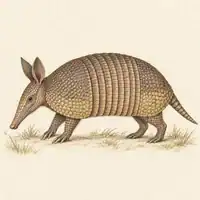
This armadillo lives only on the Llanos, the flat grassland plains of Venezuela and Colombia. It is a savanna specialist.[30]
It is small, with an average total length of about 50 cm (20 in) including the tail. Its shell is brownish, sometimes with yellowish sides.
Tidbit: Its name, sabanicola, means “savanna dweller.” It is one of the few long-nosed armadillos that lives mainly in open grassland instead of forest.
Edgardo Mondolfi, a Venezuelan zoologist, described it in 1968. The 2024 DNA study could not confirm it as a separate species, so its status is still under review.
Illustration © BioExplorer.net
Guianan Greater Long-Nosed Armadillo
| Kingdom | Order | Family | Genus | Species |
|---|---|---|---|---|
| Animalia | Cingulata | Dasypodidae | Dasypus | Dasypus kappleri |
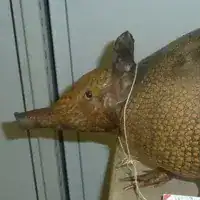
This is the largest long-nosed armadillo. It lives in French Guiana, Suriname, Guyana, eastern Venezuela, and northern Brazil north of the Amazon. It lives in tropical rainforest and is rare in savannas.
Adults measure 51 to 58 cm (20 to 23 in) from head to rump and weigh about 8.5 to 10.5 kg (19 to 23 lb). It has large, spiky scales on the backs of its hind legs and 7 or 8 movable bands.
Tidbit: The specimen used to name this species was collected by August Kappler in Suriname in 1846. It is still kept at the natural history museum in Stuttgart, Germany. The photo above shows that very specimen.
Ferdinand Krauss, a German naturalist, described it in 1862. In 2016, scientists split this species into 3. The other two are listed next.
Eastern Greater Long-Nosed Armadillo
| Kingdom | Order | Family | Genus | Species |
|---|---|---|---|---|
| Animalia | Cingulata | Dasypodidae | Dasypus | Dasypus beniensis |
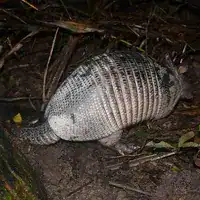
This large armadillo lives south of the Amazon River in Brazil and in northern Bolivia, and the Mammal Diversity Database also lists Peru. It uses lowland rainforest and the edges of savannas.
Like its two close relatives, it has large, spiky scales at its knees. Adults weigh about 8.5 to 10.5 kg (19 to 23 lb).
Tidbit: Its name comes from the Beni River in Bolivia. The first specimen was collected near the spot where the Madre de Dios River flows into the Beni.
Einar Lönnberg, a Swedish zoologist, described it in 1942.
Photo: Vincent A. Vos via iNaturalist, CC BY 4.0, cropped
Western Greater Long-Nosed Armadillo
| Kingdom | Order | Family | Genus | Species |
|---|---|---|---|---|
| Animalia | Cingulata | Dasypodidae | Dasypus | Dasypus pastasae |
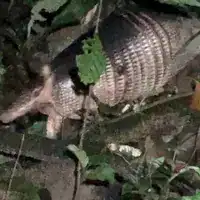
This armadillo lives in the foothills of the eastern Andes in Peru, Ecuador, Colombia, and Venezuela, and east into the western Brazilian Amazon. It probably also lives in northern Bolivia. It is a lowland rainforest species.[2]
It shares the spiky knee scales of the other greater long-nosed armadillos. Adults weigh about 8.5 to 10.5 kg (19 to 23 lb).
Tidbit: Oldfield Thomas first named it in 1901. For more than a century, scientists treated it as part of the greater long-nosed armadillo. A 2016 study showed it was a separate species after all.
Oldfield Thomas, a British zoologist, described it in 1901.
Photo: Jared Shorma via iNaturalist, CC BY 4.0, cropped
Types of Naked-Tailed Armadillos
Naked-tailed armadillos belong to the genus Cabassous. There are 5 species. Their tails have only a few thin, widely spaced plates, so the tail looks bare. They dig a lot and eat mostly ants and termites.
Northern Naked-Tailed Armadillo
| Kingdom | Order | Family | Genus | Species |
|---|---|---|---|---|
| Animalia | Cingulata | Chlamyphoridae | Cabassous | Cabassous centralis |
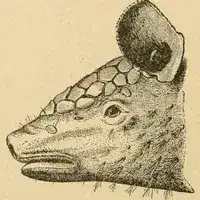
This armadillo lives from southern Mexico through Central America to western Colombia, northwestern Ecuador, and northwestern Venezuela. It lives in dry to moist forests.[31]
Adults measure 30 to 38 cm (12 to 15 in) from head to rump, plus a 13 to 18 cm (5 to 7 in) tail. They weigh 2 to 3.5 kg (4.4 to 7.7 lb). Like all naked-tailed armadillos, its tail has only a few thin, widely spaced plates. It eats mainly ants and termites.
Tidbit: It often digs its burrows into banks. The entrances are oval or round.
Gerrit S. Miller Jr., an American mammalogist at the Smithsonian, described it in 1899.
Image: early 1900s drawing (public domain)
Chacoan Naked-Tailed Armadillo
| Kingdom | Order | Family | Genus | Species |
|---|---|---|---|---|
| Animalia | Cingulata | Chlamyphoridae | Cabassous | Cabassous chacoensis |
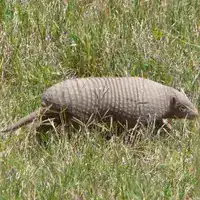
This is the smallest naked-tailed armadillo. It lives in the Gran Chaco of western Paraguay and north-central Argentina, where it lives in dry thorn forest and thorn scrub.[32]
Adults average about 30 cm (12 in) from head to rump. It has tiny ears and eats mainly ants and termites.
Tidbit: It is so rarely studied that much of what we know comes from a handful of specimens. People who have handled it have heard it give a grunting call.
Ralph Wetzel, an American mammalogist, described it in 1980.
Photo: Pablo H Capovilla via iNaturalist, CC BY 4.0, cropped
Cerrado Naked-Tailed Armadillo
| Kingdom | Order | Family | Genus | Species |
|---|---|---|---|---|
| Animalia | Cingulata | Chlamyphoridae | Cabassous | Cabassous squamicaudis |
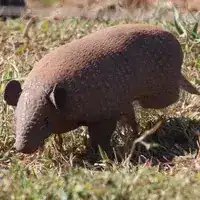
This armadillo lives in central Brazil, southeastern Bolivia, and northeastern Paraguay. It is a species of open habitats, especially the Cerrado savanna.[33]
Adults measure 29 to 34 cm (11 to 13 in) from head to rump and weigh 1.5 to 2 kg (3.3 to 4.4 lb). It feeds mainly on termites.
Tidbit: Unlike most armadillos, it is active in the middle of the day. In one study in the Cerrado of São Paulo, 97 percent of captures came between 10 a.m. and 2 p.m.
Peter Wilhelm Lund, a Danish naturalist, described it in 1845. For many years, it was grouped with the Amazon naked-tailed armadillo.
Photo: Jan Ebr and Ivana Ebrová via iNaturalist, CC BY 4.0, cropped
Greater Naked-Tailed Armadillo
| Kingdom | Order | Family | Genus | Species |
|---|---|---|---|---|
| Animalia | Cingulata | Chlamyphoridae | Cabassous | Cabassous tatouay |
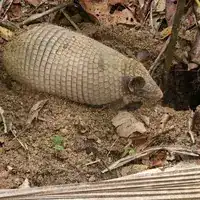
This is the largest naked-tailed armadillo. It lives in eastern and southern Brazil, southeastern Paraguay, northeastern Argentina, and northeastern Uruguay. It uses forests, the Cerrado savanna, and open grasslands.[35]
Adults average about 46 cm (18 in) from head to rump, plus a tail of about 18 cm (7 in). They weigh about 4.8 to 6.2 kg (10.6 to 13.7 lb). It has 10 to 13 movable bands and large, funnel-shaped ears about 4 cm (1.6 in) long.
Tidbit: Even though it is the largest naked-tailed armadillo, it is so poorly studied that Brazil lists it as Data Deficient.
Anselme Gaëtan Desmarest, a French zoologist, described it in 1804.
Photo: Marcelino Dias via iNaturalist, CC BY 4.0, cropped
Amazon Naked-Tailed Armadillo
| Kingdom | Order | Family | Genus | Species |
|---|---|---|---|---|
| Animalia | Cingulata | Chlamyphoridae | Cabassous | Cabassous unicinctus |
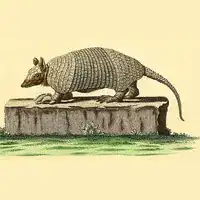
This armadillo is also called the southern naked-tailed armadillo. It lives east of the Andes in Colombia, Venezuela, the Guianas, northern Brazil, Ecuador, and northeastern Peru, south to Bolivia and Mato Grosso do Sul in Brazil. It lives mainly in rainforest.[37]
Adults measure 35 to 44 cm (14 to 17 in) from head to rump, plus a 16 to 20 cm (6 to 8 in) tail. They weigh 2.5 to 3.6 kg (5.5 to 8 lb). In northern animals, a pale band runs around the lower edge of the shell.
Tidbit: It loves termites. In one study, 90 percent of its burrows were dug into termite mounds.
Carl Linnaeus named it in 1758.
Image: Schreber, Die Säugthiere, Plate LXXV (public domain)
Hairy Armadillos and Their Relatives
This group includes the 2 hairy armadillos (genus Chaetophractus) and their close relatives, the six-banded armadillo and the pichi. Scientists place all 4 in the same branch of the armadillo family tree. Most of them eat both plants and animals.
Large Hairy Armadillo
| Kingdom | Order | Family | Genus | Species |
|---|---|---|---|---|
| Animalia | Cingulata | Chlamyphoridae | Chaetophractus | Chaetophractus villosus |
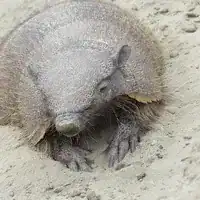
This armadillo lives in southeastern Bolivia, Paraguay, most of Argentina, and southern Chile. It uses open, dry areas such as the Pampas, the Chaco, and the Patagonian steppe, and it also does well on farmland.[38]
Adults weigh 2 to 5 kg (4.4 to 11 lb). Its shell is flat, with long, sparse hair and 6 to 8 movable bands, most often 8. It eats both plants and animals, including insects and dead animals.
Tidbit: It often visits garbage dumps to find food. Anselme Gaëtan Desmarest described it in 1804.
Photo: Diego Carús, Wikimedia Commons (CC0)
Screaming Hairy Armadillo
| Kingdom | Order | Family | Genus | Species |
|---|---|---|---|---|
| Animalia | Cingulata | Chlamyphoridae | Chaetophractus | Chaetophractus vellerosus |
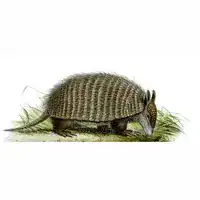
This armadillo lives in Bolivia, northeastern Chile, and Paraguay, south to Buenos Aires province in Argentina. In Chile it lives as high as 4,600 m (15,100 ft). It prefers dry areas with loose, sandy soil.[40]
Adults measure 20 to 30 cm (8 to 12 in) from head to rump and weigh 0.6 to 1.2 kg (1.3 to 2.6 lb). It has large ears and 6 to 8 movable bands. It eats beetles and other insects, plants, and small vertebrates.
Tidbit: It lets out a loud cry when it feels threatened. That is how it got its name. There is also a separate population in Buenos Aires province, far from the rest of its range.
John Edward Gray, a British zoologist, described it in 1865. The IUCN armadillo specialist group places it in Chaetophractus. The Mammal Diversity Database (v2.5) moves it to its own genus, Dasyphractus.
Image: Joseph Wolf, 1865 (public domain)
Six-Banded Armadillo
| Kingdom | Order | Family | Genus | Species |
|---|---|---|---|---|
| Animalia | Cingulata | Chlamyphoridae | Euphractus | Euphractus sexcinctus |
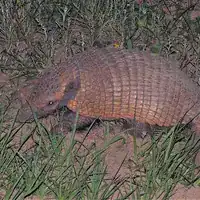
This armadillo is also called the yellow armadillo. It lives from southern Suriname and nearby Brazil south to Bolivia, Paraguay, Uruguay, and north-central Argentina. It prefers open areas, savanna, and forest edges.[41]
Adults measure 40 to 50 cm (16 to 20 in) from head to rump and weigh 3 to 7 kg (6.6 to 15.4 lb). It has 6 to 8 movable bands. It is active mainly during the day. It eats plants, fruit, insects, dead animals, and small vertebrates.
Tidbit: It has 2 to 4 small holes near the back of its shell. Scent glands release a smell through them, which it uses to mark its burrows. Carl Linnaeus named it in 1758.
Photo: Hugo Hulsberg, Wikimedia Commons (CC0)
Pichi
| Kingdom | Order | Family | Genus | Species |
|---|---|---|---|---|
| Animalia | Cingulata | Chlamyphoridae | Zaedyus | Zaedyus pichiy |
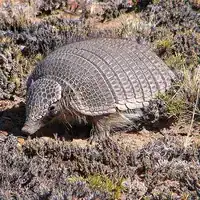
The pichi is also called the dwarf armadillo. It lives in Argentina and Chile, all the way south to the Strait of Magellan. It lives in dry areas with firm, sandy soil, such as the Patagonian steppe.[43]
Adults weigh 0.7 to 1.5 kg (1.5 to 3.3 lb), and Chile reports a total length of about 40 cm (16 in) including a 12 cm (5 in) tail. It eats mostly insects, but it will eat many other foods.
Tidbit: The pichi is the only xenarthran known to enter torpor and hibernate. From May to August, its body temperature can drop to about 14.5 °C (58 °F). Anselme Gaëtan Desmarest described it in 1804.
Photo: Hugo Hulsberg, Wikimedia Commons (CC0)
Types of Fairy Armadillos
Fairy armadillos are the smallest armadillos. There are 2 species, and each has a genus of its own. Both spend nearly all their time underground. They are seen so rarely that the IUCN lists both as Data Deficient.
Pink Fairy Armadillo
| Kingdom | Order | Family | Genus | Species |
|---|---|---|---|---|
| Animalia | Cingulata | Chlamyphoridae | Chlamyphorus | Chlamyphorus truncatus |
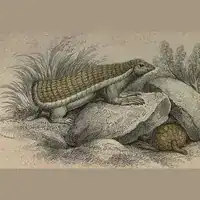
This is the smallest armadillo in the world. It lives only in central Argentina, in dry and semi-desert areas with loose, sandy soil.[46]
Argentina’s national parks agency gives a head and body length of 8.4 to 11.7 cm (3.3 to 4.6 in) and a weight of 85 to 120 grams (3 to 4.2 oz). Its pinkish shell is attached to its body only along the middle of its back. It eats ants, beetles, worms, snails, and larvae, plus some seeds and roots.
Tidbit: It has a flat plate on its rear end. It uses this plate to pack loose soil behind it as it tunnels, and to seal the entrance of its burrow.
Richard Harlan, an American naturalist, described it in 1825.
Image: The Naturalist’s Library, 1833 (public domain)
Greater Fairy Armadillo
| Kingdom | Order | Family | Genus | Species |
|---|---|---|---|---|
| Animalia | Cingulata | Chlamyphoridae | Calyptophractus | Calyptophractus retusus |
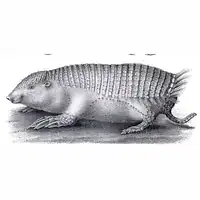
This armadillo is also called Burmeister’s armadillo. It lives in the Gran Chaco of central and southeastern Bolivia, western Paraguay, and far northern Argentina, but only where the soil is loose and sandy.
Adults measure 11.6 to 17.5 cm (4.6 to 6.9 in) from head to rump and weigh 86 to 130 grams (3 to 4.6 oz). It has short, strong forelimbs with big digging claws. A plate set straight up and down at the back of its body gives it a cut-off look.
Tidbit: It spends so much time underground that people rarely see it. Argentina’s national parks agency says almost nothing is known about its biology.
Hermann Burmeister, a German naturalist who ran the natural history museum in Buenos Aires, described it in 1863.
Image: Hermann Burmeister, 1863 (public domain)
Types of Three-Banded Armadillos
Three-banded armadillos belong to the genus Tolypeutes. There are 2 species. The IUCN armadillo specialist group notes that they are the only armadillos that can curl into a perfect ball.
Southern Three-Banded Armadillo
| Kingdom | Order | Family | Genus | Species |
|---|---|---|---|---|
| Animalia | Cingulata | Chlamyphoridae | Tolypeutes | Tolypeutes matacus |

This armadillo is also called the La Plata three-banded armadillo. It lives in eastern Bolivia, southwestern Brazil, the Gran Chaco of Paraguay, and northern and central Argentina.[15]
Adults weigh about 1 to 1.6 kg (2.2 to 3.5 lb). Its shell is stiff and dome-shaped, with usually 3 movable bands. It eats mostly ants and termites.
Tidbit: It can roll into a tight, armored ball. Its shell is not attached to the skin along its sides, which leaves room to tuck in its head, legs, and tail.
Anselme Gaëtan Desmarest described it in 1804.
Photo: Allan Harris, Wikimedia Commons (CC0)
Brazilian Three-Banded Armadillo
| Kingdom | Order | Family | Genus | Species |
|---|---|---|---|---|
| Animalia | Cingulata | Chlamyphoridae | Tolypeutes | Tolypeutes tricinctus |
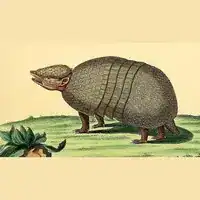
This armadillo is the only armadillo found only in Brazil. It lives in the northeast, mainly in the Caatinga, a dry thorn scrub, and in the Cerrado.[48]
Adults measure 23 to 25 cm (9 to 10 in) from head to rump and weigh 1 to 1.8 kg (2.2 to 4 lb). It eats mainly termites and other small invertebrates.
Tidbit: It inspired Fuleco, the official mascot of the 2014 FIFA World Cup in Brazil. Like its southern cousin, it can roll into a hard ball, though some wild dogs can still break through.
Carl Linnaeus named it in 1758.
Image: Schreber, Die Säugthiere, Plate LXXI (public domain)
The Giant Armadillo
The giant armadillo is the only species in the genus Priodontes. It is the largest living armadillo by far.
Giant Armadillo
| Kingdom | Order | Family | Genus | Species |
|---|---|---|---|---|
| Animalia | Cingulata | Chlamyphoridae | Priodontes | Priodontes maximus |
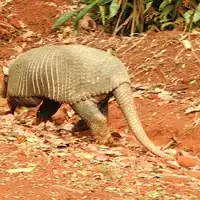
This is the largest armadillo alive today. It lives east of the Andes in Colombia, Venezuela, the Guianas, Brazil, Ecuador, Peru, Bolivia, Paraguay, and northern Argentina. It uses the Amazon rainforest, the Pantanal, and the Cerrado savanna.[50]
Adults measure 75 to 100 cm (30 to 39 in) from head to rump, plus a tail of about 50 cm (20 in). They weigh 20 to 60 kg (44 to 132 lb). It eats mainly ants and termites. A female usually has 1 young at a time.
Tidbit: The claw on its third front finger measures about 20 cm (8 in) along the curve. Its huge burrows also help other wildlife. A city government in Brazil that tracks these armadillos says their burrows shelter more than 100 kinds of vertebrates.
Robert Kerr, a Scottish surgeon and writer, described it in 1792.
Photo: Naturalist Tours, Wikimedia Commons (CC0)
Armadillos in the United States
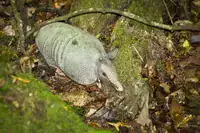
Only one armadillo lives in the United States: the Mexican long-nosed armadillo. The US Geological Survey says it was first recorded in Texas in 1849. It has been moving north and east ever since.
How Far North Have Armadillos Spread?
A 2025 USGS study mapped where armadillos live today. Since 2014, they have spread across all of Missouri and into southern Iowa. They have also moved farther into Kansas, Illinois, Indiana, Kentucky, and Tennessee. They now cover all of South Carolina and Georgia, and they have settled in the western third of North Carolina.
Cold winters are the main limit. University of Illinois Extension notes that armadillos have a very hard time surviving winters much farther north than Champaign County, Illinois. Even so, the USGS study found plenty of room for them to keep spreading, especially in the eastern US.
Always Quadruplets
US armadillos have a strange way of having babies. Texas Parks and Wildlife notes that all 4 young in a litter are identical quadruplets that develop from the same egg, so they are always the same sex.
Mating happens in July, but the embryo stays dormant until November. This pause is called delayed implantation.
Jumpers and Swimmers
The Florida Museum of Natural History says a startled armadillo can jump four to five feet high. This jump can protect it from predators. The National Institute of Environmental Health Sciences points out that it can be deadly when an armadillo jumps up under a moving car.
Armadillos are also good in water. The Florida Museum notes they can hold their breath for up to six minutes and walk along the bottom of a stream. The National Park Service adds that they can gulp air into their stomachs so they float when they swim across.
Some armadillos in the southern US carry the bacteria that cause leprosy, also called Hansen’s disease. The CDC says it may be possible for armadillos to spread it to people, but “the risk is very low.”
The CDC also notes that around 95 percent of people cannot get leprosy, because their immune system can fight off the bacteria. Leprosy is curable. Armadillos are also the main animal used in leprosy research, because the bacteria cannot grow in a lab dish.
Selected Armadillos From Smallest to Largest
Armadillos come in a huge range of sizes. The giant armadillo can weigh more than 500 times as much as the pink fairy armadillo. Lengths below are head and body only, without the tail.
| Armadillo | Head and body length | Weight |
|---|---|---|
| Pink Fairy Armadillo | 8.4 to 11.7 cm (3.3 to 4.6 in) | 85 to 120 g (3 to 4.2 oz) |
| Greater Fairy Armadillo | 11.6 to 17.5 cm (4.6 to 6.9 in) | 86 to 130 g (3 to 4.6 oz) |
| Southern Three-Banded Armadillo | 20 to 25 cm (8 to 10 in) | 1 to 1.6 kg (2.2 to 3.5 lb) |
| Screaming Hairy Armadillo | 20 to 30 cm (8 to 12 in) | 0.6 to 1.2 kg (1.3 to 2.6 lb) |
| Pichi | 22 to 31 cm (9 to 12 in) | 0.7 to 1.5 kg (1.5 to 3.3 lb) |
| Seven-Banded Armadillo | 24 to 47 cm (9 to 19 in) | About 2 kg (4.4 lb) |
| Llanos Long-Nosed Armadillo | 25 to 31 cm (10 to 12 in) | 1 to 2 kg (2.2 to 4.4 lb) |
| Mexican Long-Nosed Armadillo | 38 to 45 cm (15 to 18 in) | 3 to 6 kg (6.6 to 13.2 lb) |
| Six-Banded Armadillo | 40 to 50 cm (16 to 20 in) | 3 to 7 kg (6.6 to 15.4 lb) |
| Guianan Greater Long-Nosed Armadillo | 51 to 58 cm (20 to 23 in) | 8.5 to 10.5 kg (18.7 to 23.1 lb) |
| Giant Armadillo | 75 to 100 cm (30 to 39 in) | 20 to 60 kg (44.1 to 132.3 lb) |
Which Armadillos Can Roll Into a Ball?
Only 2 armadillos can roll into a complete ball: the southern three-banded armadillo and the Brazilian three-banded armadillo. When one rolls up, its head shield and tail shield fit into the gap in the shell. This leaves a hard armored ball that is difficult for many predators to open.
Many people think all armadillos do this, but they do not. The National Institute of Environmental Health Sciences notes that the nine-banded armadillo does not roll into a ball. The Missouri Department of Conservation agrees: it cannot curl into a ball.
What Do Armadillos Eat?
Most armadillos eat insects and other small invertebrates. The San Diego Zoo notes that they also eat fruit, eggs, and small animals. Many species, such as the naked-tailed armadillos and the giant armadillo, feed mainly on ants and termites.
The hairy armadillos, the six-banded armadillo, and the pichi eat a wider mix of plants and animals. For a full breakdown, see our guide to what armadillos eat.
Where Do Armadillos Live?
All armadillos live in the Americas. Their range stretches from the central and eastern United States south to the Strait of Magellan in Chile and Argentina. Most species live in South America.
| Armadillo | Scientific name | Where it lives | Habitat |
|---|---|---|---|
| Amazon Naked-Tailed Armadillo | Cabassous unicinctus | Amazon and Orinoco basins | Rainforest |
| Brazilian Three-Banded Armadillo | Tolypeutes tricinctus | Northeastern Brazil only | Caatinga dry scrub and Cerrado |
| Cerrado Naked-Tailed Armadillo | Cabassous squamicaudis | Central Brazil, southeastern Bolivia, and northeastern Paraguay | Cerrado savanna and other open habitats |
| Chacoan Naked-Tailed Armadillo | Cabassous chacoensis | Gran Chaco of Paraguay and Argentina | Dry thorn forest |
| Eastern Greater Long-Nosed Armadillo | Dasypus beniensis | Southern Amazon of Brazil, northern Bolivia, and Peru | Lowland rainforest and savanna edges |
| Giant Armadillo | Priodontes maximus | South America, from Colombia to northern Argentina | Rainforest, wetlands, and savanna |
| Greater Fairy Armadillo | Calyptophractus retusus | Gran Chaco of Bolivia, Paraguay, and Argentina | Soft, sandy soils |
| Greater Naked-Tailed Armadillo | Cabassous tatouay | Southern and eastern Brazil, Paraguay, Argentina, and Uruguay | Forests, Cerrado, and grasslands |
| Guianan Greater Long-Nosed Armadillo | Dasypus kappleri | The Guianas, eastern Venezuela, and northern Brazil | Lowland rainforest |
| Guianan Long-Nosed Armadillo | Dasypus guianensis | French Guiana, Suriname, Guyana, eastern Venezuela, and northern Brazil | Lowland rainforest and savanna |
| Hairy Long-Nosed Armadillo | Dasypus pilosus | Peru only | Mountain forests (yungas) |
| Large Hairy Armadillo | Chaetophractus villosus | Bolivia, Paraguay, Argentina, and southern Chile | Grasslands, steppe, and farmland |
| Llanos Long-Nosed Armadillo | Dasypus sabanicola | Llanos of Venezuela and Colombia | Open grasslands (Llanos) |
| Mexican Long-Nosed Armadillo | Dasypus mexicanus | Central and eastern United States to Costa Rica | Forests along rivers and creeks, but adapts to many habitats |
| Nine-Banded Armadillo | Dasypus novemcinctus | South America east of the Andes, plus Trinidad and Tobago | Forests, farmland, and pastures |
| Northern Naked-Tailed Armadillo | Cabassous centralis | Southern Mexico to northwestern South America | Dry and moist forests |
| Pichi | Zaedyus pichiy | Argentina and Chile, south to the Strait of Magellan | Patagonian steppe and other dry areas |
| Pink Fairy Armadillo | Chlamyphorus truncatus | Central Argentina | Dry, sandy plains and semi-desert |
| Screaming Hairy Armadillo | Chaetophractus vellerosus | Bolivia, Chile, Paraguay, and Argentina | Dry scrub with sandy soil |
| Seven-Banded Armadillo | Dasypus septemcinctus | Brazil, Paraguay, Bolivia, Argentina, and Uruguay | Grasslands, savannas, forests, and shrublands |
| Six-Banded Armadillo | Euphractus sexcinctus | Suriname and Brazil to Argentina | Savanna, open areas, and forest edges |
| Southern Three-Banded Armadillo | Tolypeutes matacus | Bolivia, Brazil, Paraguay, and Argentina | Dry scrub, grasslands, and open forest |
| Western Andean Long-Nosed Armadillo | Dasypus fenestratus | Western Andes of northern Peru, Ecuador, Colombia, and Venezuela to Costa Rica | Western Andean slopes and Central American forests |
| Western Greater Long-Nosed Armadillo | Dasypus pastasae | Eastern Andes foothills to the western Brazilian Amazon | Lowland rainforest |
| Yungas Long-Nosed Armadillo | Dasypus mazzai | Northern Argentina, possibly Bolivia and Paraguay | Yungas forests and dry Chaco |
Armadillos by Year of Taxonomy Classification
The table below shows when each armadillo was first described and by whom. Some species were named long ago but only recently recognized as separate species.
Carl Linnaeus named 5 of these armadillos in 1758, in the 10th edition of Systema Naturae. That book is the official starting point for modern animal names. The newest species, the Guianan long-nosed armadillo, was described in 2024, 266 years later.
| Armadillo | Scientific name | Year | Described by | Profession |
|---|---|---|---|---|
| Amazon Naked-Tailed Armadillo | Cabassous unicinctus | 1758 | Carl Linnaeus | Swedish naturalist |
| Brazilian Three-Banded Armadillo | Tolypeutes tricinctus | 1758 | Carl Linnaeus | Swedish naturalist |
| Nine-Banded Armadillo | Dasypus novemcinctus | 1758 | Carl Linnaeus | Swedish naturalist |
| Seven-Banded Armadillo | Dasypus septemcinctus | 1758 | Carl Linnaeus | Swedish naturalist |
| Six-Banded Armadillo | Euphractus sexcinctus | 1758 | Carl Linnaeus | Swedish naturalist |
| Giant Armadillo | Priodontes maximus | 1792 | Robert Kerr | Scottish surgeon and writer |
| Greater Naked-Tailed Armadillo | Cabassous tatouay | 1804 | Anselme Gaëtan Desmarest | French zoologist |
| Large Hairy Armadillo | Chaetophractus villosus | 1804 | Anselme Gaëtan Desmarest | French zoologist |
| Pichi | Zaedyus pichiy | 1804 | Anselme Gaëtan Desmarest | French zoologist |
| Southern Three-Banded Armadillo | Tolypeutes matacus | 1804 | Anselme Gaëtan Desmarest | French zoologist |
| Pink Fairy Armadillo | Chlamyphorus truncatus | 1825 | Richard Harlan | American naturalist |
| Cerrado Naked-Tailed Armadillo | Cabassous squamicaudis | 1845 | Peter Wilhelm Lund | Danish naturalist |
| Hairy Long-Nosed Armadillo | Dasypus pilosus | 1856 | Leopold Fitzinger | Austrian zoologist |
| Guianan Greater Long-Nosed Armadillo | Dasypus kappleri | 1862 | Ferdinand Krauss | German naturalist |
| Greater Fairy Armadillo | Calyptophractus retusus | 1863 | Hermann Burmeister | German naturalist |
| Mexican Long-Nosed Armadillo | Dasypus mexicanus | 1865 | Wilhelm Peters | German naturalist |
| Screaming Hairy Armadillo | Chaetophractus vellerosus | 1865 | John Edward Gray | British zoologist |
| Western Andean Long-Nosed Armadillo | Dasypus fenestratus | 1865 | Wilhelm Peters | German naturalist |
| Northern Naked-Tailed Armadillo | Cabassous centralis | 1899 | Gerrit S. Miller Jr. | American mammalogist |
| Western Greater Long-Nosed Armadillo | Dasypus pastasae | 1901 | Oldfield Thomas | British zoologist |
| Yungas Long-Nosed Armadillo | Dasypus mazzai | 1933 | José Yepes | Argentine mammalogist |
| Eastern Greater Long-Nosed Armadillo | Dasypus beniensis | 1942 | Einar Lönnberg | Swedish zoologist |
| Llanos Long-Nosed Armadillo | Dasypus sabanicola | 1968 | Edgardo Mondolfi | Venezuelan zoologist |
| Chacoan Naked-Tailed Armadillo | Cabassous chacoensis | 1980 | Ralph Wetzel | American mammalogist |
| Guianan Long-Nosed Armadillo | Dasypus guianensis | 2024 | Mathilde Barthe, Frédéric Delsuc, and colleagues | French research team |
Are Armadillos Endangered?
Most armadillos are not endangered, but several are in trouble. According to the IUCN armadillo specialist group, the giant armadillo and the Brazilian three-banded armadillo are Vulnerable. Four more species are Near Threatened. The main threats are habitat loss and hunting.
Four species are Data Deficient, which means scientists do not know enough to judge their risk. Five long-nosed armadillos were split or described so recently that they have no formal IUCN Red List assessment yet, so they are listed as Not Evaluated.
The specialist group’s own species pages describe them as Least Concern, but formal Red List pages are not yet available.
| IUCN status | Species | Armadillos |
|---|---|---|
| Vulnerable | 2 | Brazilian Three-Banded Armadillo, Giant Armadillo |
| Near Threatened | 4 | Chacoan Naked-Tailed Armadillo, Llanos Long-Nosed Armadillo, Pichi, Southern Three-Banded Armadillo |
| Data Deficient | 4 | Greater Fairy Armadillo, Hairy Long-Nosed Armadillo, Pink Fairy Armadillo, Yungas Long-Nosed Armadillo |
| Least Concern | 10 | Amazon Naked-Tailed Armadillo, Cerrado Naked-Tailed Armadillo, Greater Naked-Tailed Armadillo, Guianan Greater Long-Nosed Armadillo, Large Hairy Armadillo, Nine-Banded Armadillo, Northern Naked-Tailed Armadillo, Screaming Hairy Armadillo, Seven-Banded Armadillo, Six-Banded Armadillo |
| Not Evaluated | 5 | Eastern Greater Long-Nosed Armadillo, Guianan Long-Nosed Armadillo, Mexican Long-Nosed Armadillo, Western Andean Long-Nosed Armadillo, Western Greater Long-Nosed Armadillo |
Frequently Asked Questions
There are 25 living species of armadillos. The long-nosed armadillos are the largest group, with 11 species.
The armadillo in the United States is the Mexican long-nosed armadillo, Dasypus mexicanus. It was called the nine-banded armadillo until a 2024 study split that species into 4.
No. Only the 2 three-banded armadillos can roll into a complete ball. The armadillo in the United States cannot.
The pink fairy armadillo is the smallest. Its head and body measure 8.4 to 11.7 cm (3.3 to 4.6 in), and it weighs 85 to 120 grams (3 to 4.2 oz).
The giant armadillo is the largest. It can weigh 20 to 60 kg (44 to 132 lb) and measure up to 100 cm (39 in) from head to rump.
Armadillos live only in the Americas, from the central and eastern United States to the southern tip of South America. Most species live in South America.
No. They can have 7 to 11 movable bands. Nine is just the most common number.
In the armadillo found in the US, a single fertilized egg splits into 4 embryos. The 4 young are genetically identical and always the same sex.
It is possible but rare. The CDC says the risk is very low, and around 95 percent of people cannot get leprosy at all.
Most are not. The giant armadillo and the Brazilian three-banded armadillo are Vulnerable, and 4 more species are Near Threatened.
The pichi of Argentina and Chile is the only xenarthran known to hibernate. Its body temperature can drop to about 14.5 °C (58 °F) in winter.
Sloths and anteaters are the closest living relatives of armadillos. The extinct glyptodonts were giant armadillo relatives.
An armadillo’s shell can stop a thorn or a hungry fox. It cannot stop a bulldozer.
Cite this page
BioExplorer. (2026, September 21). 25 Types of Armadillos With Pictures and Facts. https://www.bioexplorer.net/animals/mammals/armadillos/
About the author