All 29 Ibis Species, From the Bare-Faced Ibis to the Giant Ibis
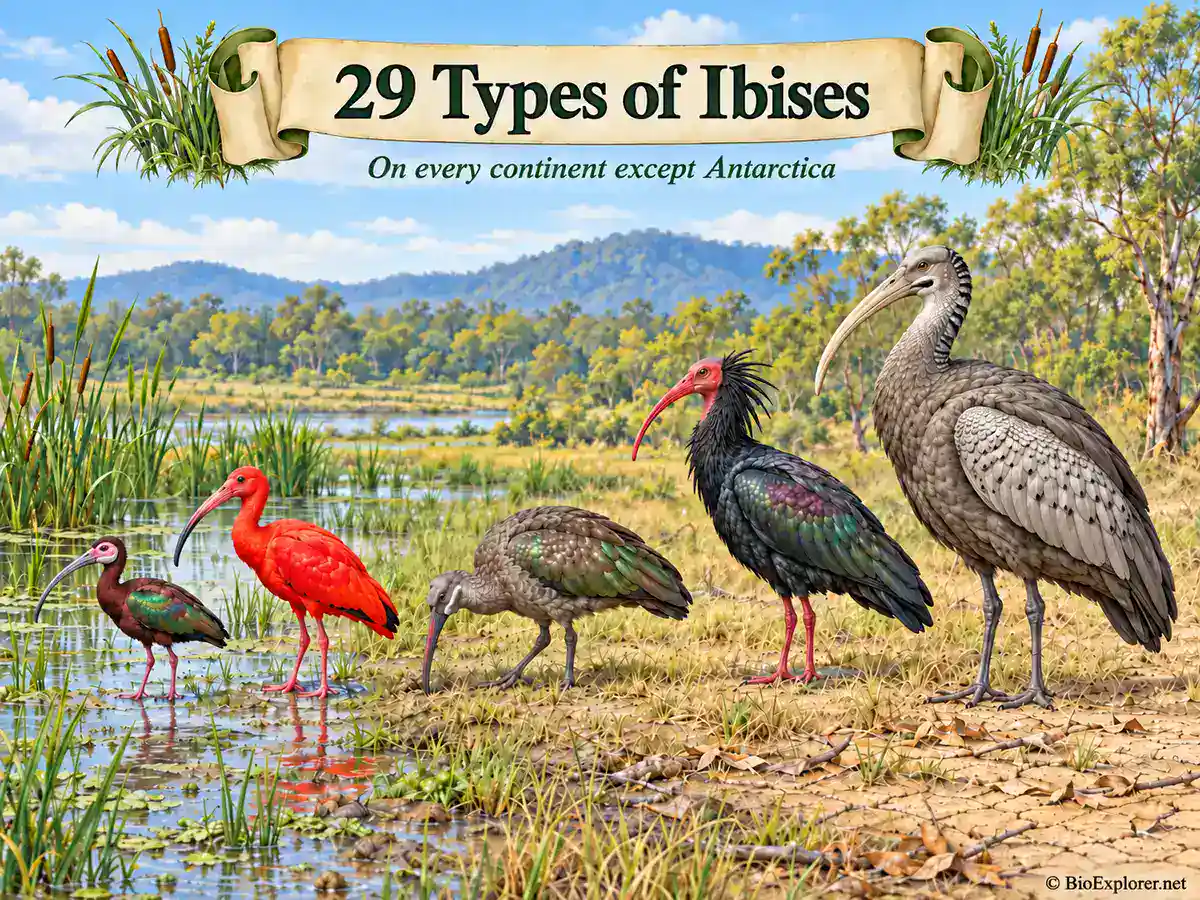
An ibis often finds its food by touch. Sensory pits near the tip of the long curved bill detect vibrations and pressure changes in wet soil. That lets the bird locate a worm before the bill ever reaches it.
There are 29 living ibis species, spread across every continent except Antarctica. One is the national bird of Cambodia, and the latest formal count put it below 300 birds. Another is so at home in Australian cities that people call it the bin chicken.
This guide covers all 29 types of ibises, one branch of the many types of birds on this site. For each species you will find a picture, its range and size, and one fact worth remembering.
You will also learn why the Giant Ibis just changed its scientific name. You will see how seven birds found in a Chinese village in 1981 saved a species. And you will find out why a mummified ibis was the first specimen ever used to test evolution.
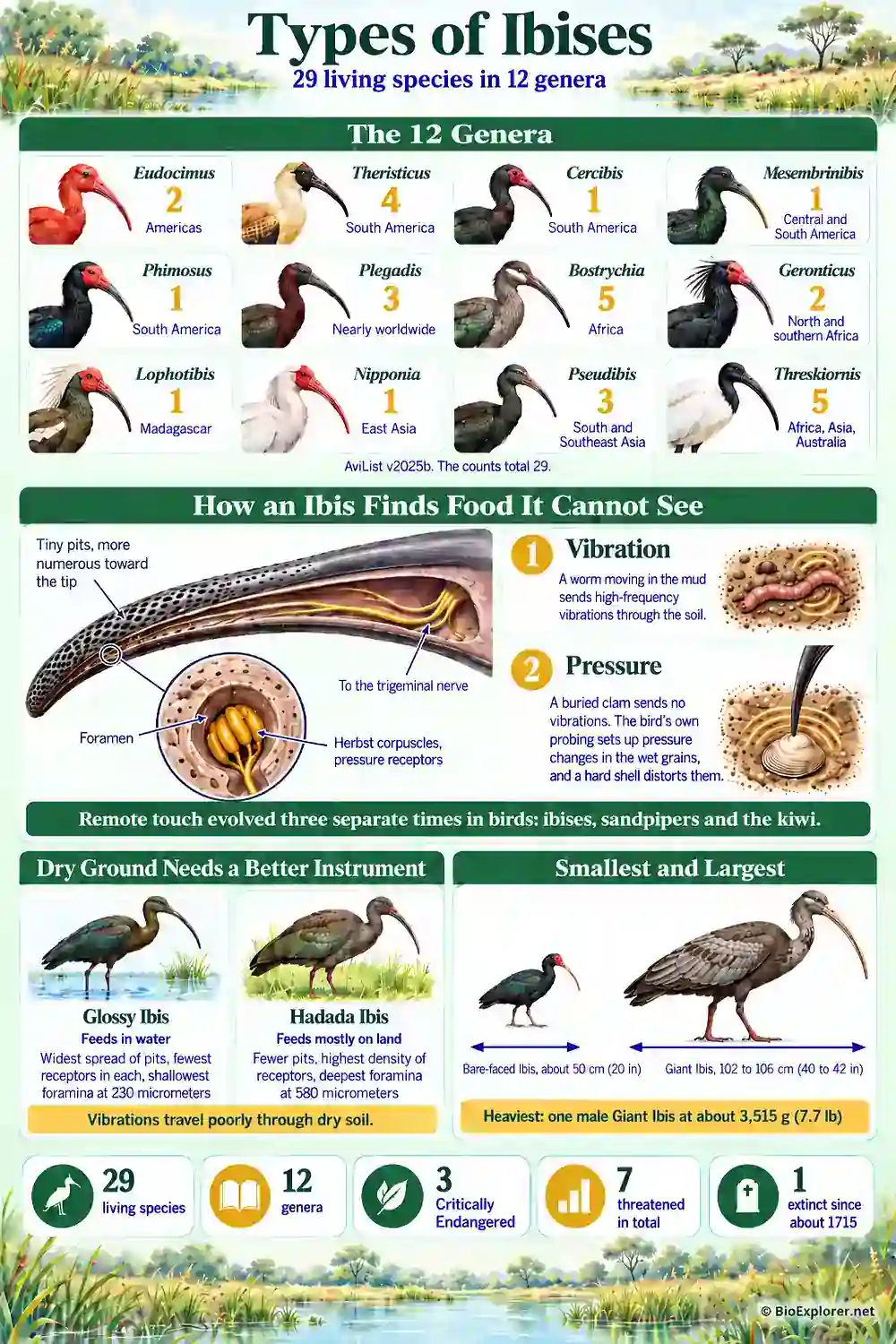
There are 29 living ibis species, plus one that is extinct. They sit in the family Threskiornithidae alongside the 6 spoonbills, for a family total of 35 living birds and one extinct one. Five separate authorities agree on that count, which is unusual. Of the 29, seven are threatened and two more are Near Threatened.
Ibises Types Guide:
How Many Ibises?
Scientists recognize 29 living ibis species. A 30th, the Reunion Ibis, died out around 1715.
The count is solid. AviList v2025b, the IOC World Bird List v15.2, the Clements checklist, BirdLife International and ITIS all list the same 36 birds in the family Threskiornithidae, counting the extinct Reunion Ibis. That is 30 ibises and 6 spoonbills, and bird taxonomy rarely lines up this cleanly on a species count.
The genus assignments are a different matter. AviList places the Giant Ibis in Pseudibis, while BirdLife still uses Thaumatibis, and that disagreement is covered later in this guide.
The IOC World Bird List stopped being updated in April 2026. Version 15.2 was the final release, and its editors folded their work into AviList. Any page that still calls the IOC list the living standard is out of date.
The ibises split across 12 genera. Bostrychia and Threskiornis hold five living species each, Theristicus holds four, and five genera hold only one species apiece.
| Genus | Living species | Where |
|---|---|---|
| Eudocimus | 2 | Americas |
| Theristicus | 4 | South America |
| Cercibis | 1 | South America |
| Mesembrinibis | 1 | Central and South America |
| Phimosus | 1 | South America |
| Plegadis | 3 | Nearly worldwide |
| Bostrychia | 5 | Africa |
| Geronticus | 2 | North Africa and southern Africa |
| Lophotibis | 1 | Madagascar |
| Nipponia | 1 | East Asia |
| Pseudibis | 3 | South and Southeast Asia |
| Threskiornis | 5 | Africa, Asia, Australia |
What Is an Ibis?
An ibis is a medium to large wading bird with a long, thin, downcurved bill. It probes that bill into water, mud or soil to pull out prey it cannot see.
Most ibises have bare skin on the face. Two species take it further. The Northern Bald Ibis and the Southern Bald Ibis have bare heads, which is where both common names come from.
Ibises fly with the neck stretched straight out and the feet trailing behind. They alternate quick wingbeats with glides, and flocks often travel in long lines or a V.
Herons do the opposite. A heron folds its neck into a tight S and tucks its head into its shoulders.
That flight difference is a useful field mark. It is not a family tree. Ibises and herons both sit in the order Pelecaniformes, along with pelicans, the hamerkop and the shoebill.
Storks are the outsiders here, alone in their own order Ciconiiformes. The American Ornithologists’ Union made that move in 2010, based on DNA work that showed the old arrangement did not hold up. All 20 types of storks sit there together, and no ibis does.
Ibises are also confused with cranes and rails, which sit in the order Gruiformes. That is another family tree question rather than a field one.
Nearly all ibises nest in colonies. Glossy Ibis nests can sit two feet apart. Colonies are often mixed, with egrets, herons and spoonbills in the same trees.
Ibis or Spoonbill?
Ibises and spoonbills share one family, Threskiornithidae. The difference between them is the tool on the front of the bird, and how the bird uses it.
An ibis probes, pushing the bill down into mud or shallow water and feeling for prey one spot at a time.
A spoonbill sweeps. It holds the flattened, spoon-shaped tip slightly open and swings it side to side through the water, snapping shut the moment it feels something.
The family tree is less tidy than the names suggest. Spoonbills are a natural group. All six belong to one genus, Platalea, and DNA confirms they are each other’s closest relatives.
But that group sits inside the ibis part of the family tree.
Two studies show it. Chesser and colleagues sequenced all six spoonbills in 2010 and concluded that splitting the family into two subfamilies “may not be warranted.” Ramirez, Miyaki and Del Lama put it plainly in 2013: the spoonbills form a monophyletic group, but one nested within the ibises, which are therefore paraphyletic.
So “ibis” is a useful word, not a natural group. Some ibises are more closely related to spoonbills than they are to other ibises.
The same 2013 study found two major branches in the family. One is restricted to the Americas. The other is widespread.
They split about 39 to 42 million years ago.
Remote Touch
Remote touch is the family’s signature.
The tip of an ibis bill is drilled with tiny openings called foramina. Each one holds a cluster of pressure receptors called Herbst corpuscles. One opening plus its corpuscles makes a sensory pit.
The pits crowd together near the bill tip, wired back to the trigeminal nerve.
The bird can then detect prey it has not touched. Researchers call this remote touch.
Two different signals count.
A worm moving in the mud sends high-frequency vibrations through the substrate. A buried clam sends no vibrations at all. But the bird’s own repeated probing sets up pressure changes in wet grains, and a hard shell distorts them.
Remote touch evolved three separate times in birds.
Ibises have it. So do sandpipers and their relatives among the Charadriiformes shorebirds. So does the kiwi.
The proof in an ibis came from the Madagascar Crested Ibis. Susan Cunningham, Isabel Castro and colleagues showed it could find moving prey with every other sensory cue removed.[6]
A 2022 study by du Toit, Chinsamy and Cunningham compared three African ibises. The results run against intuition.
The Glossy Ibis feeds almost entirely in water. It had the widest spread of pits, the fewest receptors in each one, and the shallowest foramina at 230 micrometers. The Hadada Ibis, which feeds mostly on land, had fewer pits but the highest density of receptors and the deepest foramina at 580 micrometers.
Vibrations travel poorly through dry soil. A bird working dry ground needs a more sensitive instrument than one working mud.
The same team tested it directly in 2024. Hadada Ibises found live worms faster than dead ones, which showed they were using vibration.[7]
But the advantage grew as soil water content rose, and it vanished in dry soil. Soil moisture had no effect at all on plain direct-contact probing.
The practical consequence is that drying can reduce prey availability and make vibratory cues harder to detect. Both effects work against a bird that hunts by feel.
American Ibises
Twelve ibis species breed in the Americas, and three of them breed in the United States. The other nine run from Mexico to Tierra del Fuego, and two of those are Andean birds that live higher than most people ever hike. One of the twelve, the Glossy Ibis, is not American in origin at all, and it also occurs across Africa, Asia and Australia.
American White Ibis
| Kingdom | Order | Family | Genus | Species |
|---|---|---|---|---|
| Animalia | Pelecaniformes | Threskiornithidae | Eudocimus | Eudocimus albus |
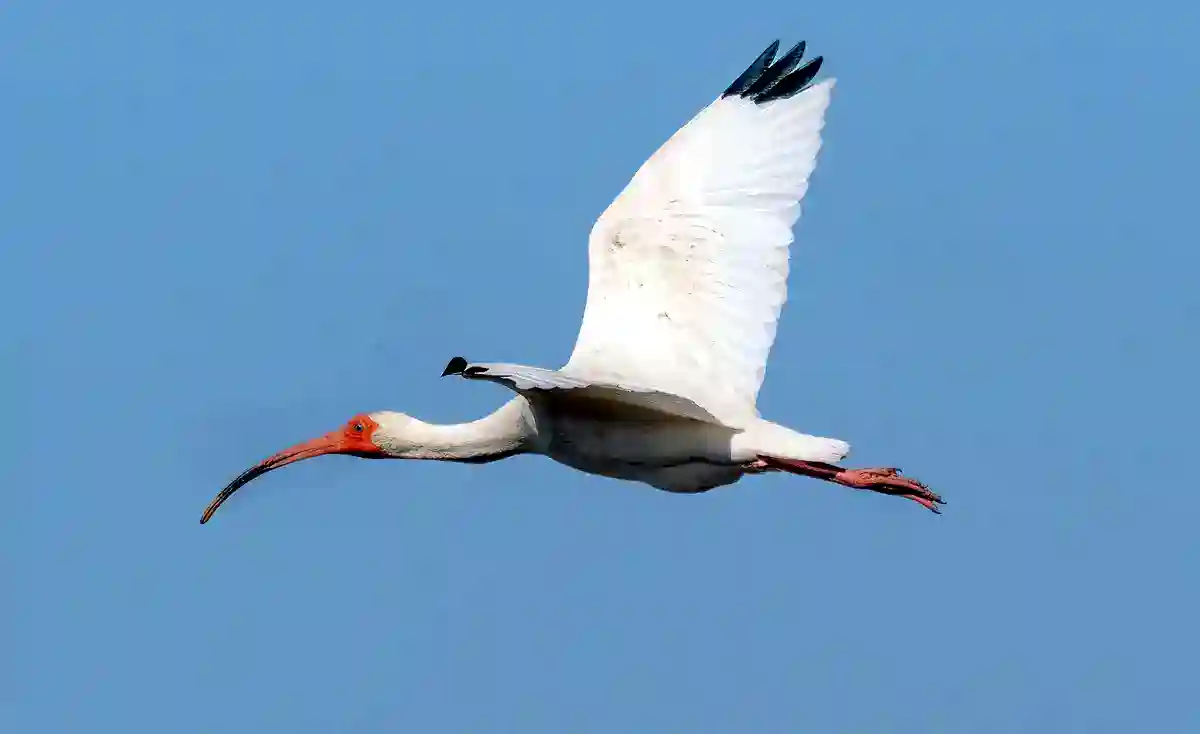
The American White Ibis is the one most people in the United States have seen. It ranges from the Carolinas through Florida and west along the Gulf Coast, then south through Mexico and Central America to coastal South America. It is one of the most familiar Florida birds.
- An adult American White Ibis measures 56 to 68 cm (22 to 27 in) and weighs 750 to 1,050 g (1.7 to 2.3 lb). The body is white. The bill, legs and bare facial skin are reddish pink, turning brilliant red at the peak of breeding. Only the tips of the outer four primaries are black, and you usually see them only in flight.
- Juveniles confuse people constantly. A young White Ibis is brown above and white below, with a streaky brown neck. First-summer birds look blotchy, half brown and half white.
- The White Ibis feeds in water less than 8 inches deep, probing mud by touch. A Florida study by Kushlan and Kushlan, based on 199 samples, found crayfish made up 51 percent of the diet by weight and turned up in 80 percent of samples.[33] Fish came second. At least 69 prey types were recorded.
- Since 2009, Sonia Hernandez at the University of Georgia has tracked White Ibises that left the Everglades for city parks in South Florida. The urban birds eat handouts instead of invertebrates. They shed Salmonella at significantly higher rates, and some genotypes match strains found in human patients. Their gut microbiomes are less diverse.
- The rest of the results run the other way. Urban White Ibises have lower stress hormone levels, fight off E. coli better, and carry fewer external parasites. Hernandez calls it a honeymoon period and warns it may end as urban flocks grow and start breeding in the city.
- Carl Linnaeus described the American White Ibis in 1758.
Scarlet Ibis
| Kingdom | Order | Family | Genus | Species |
|---|---|---|---|---|
| Animalia | Pelecaniformes | Threskiornithidae | Eudocimus | Eudocimus ruber |
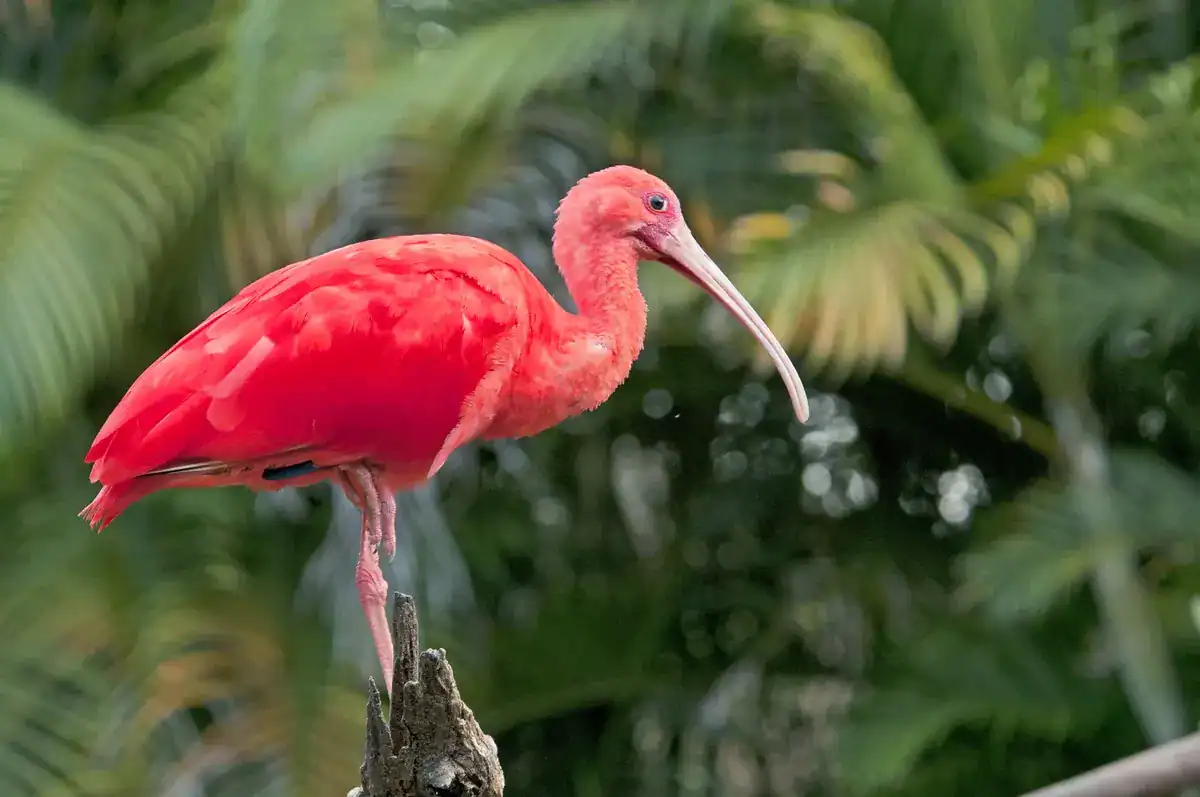
The Scarlet Ibis is the most spectacular bird in this article, and it belongs on any list of the most colorful birds in the world. Adults are uniformly brilliant red, with only the tips of the outer flight feathers black. The eyes and bill are black, and the legs are a lighter, scaly red.
- The Scarlet Ibis measures 55 to 76 cm (22 to 30 in) from bill tip to tail tip. Published weights disagree, running from about 0.9 to 1.4 kg (2 to 3 lb). It lives along the coast of northern South America, from Colombia and Venezuela east to Trinidad, the Guianas and northeastern Brazil, in mangrove swamps, tidal mudflats and lagoons.
- The red comes from its food. Carotenoid pigments in crabs and small crustaceans accumulate in the feathers, and the more carotenoid-rich the diet, the deeper the color. Zoos have to engineer it back in. San Diego Zoo feeds its scarlet ibises a dry diet made for flamingos, formulated to supply the pigments the birds need. Several of the best zoos in the USA keep this species, and every one of them faces the same problem.
- Young Scarlet Ibises do not start red. They begin blackish gray above and white below, and take roughly 18 months to two years to reach full adult scarlet.
- You may see one in Florida. It is not a wild American bird. In 1961, 22 Scarlet Ibis eggs from Trinidad were placed in American White Ibis nests at Greynolds Park in North Miami Beach. The chicks grew up and bred with White Ibises, and the red faded through the hybrid generations. By the early 1980s five hybrids in various shades of pink remained. A light-pink bird recorded at Paynes Prairie in June 1981 was the northernmost hybrid on record for North America.[34]
- The Scarlet Ibis is the national bird of Trinidad and Tobago. Carl Linnaeus described the species in 1758.
Glossy Ibis
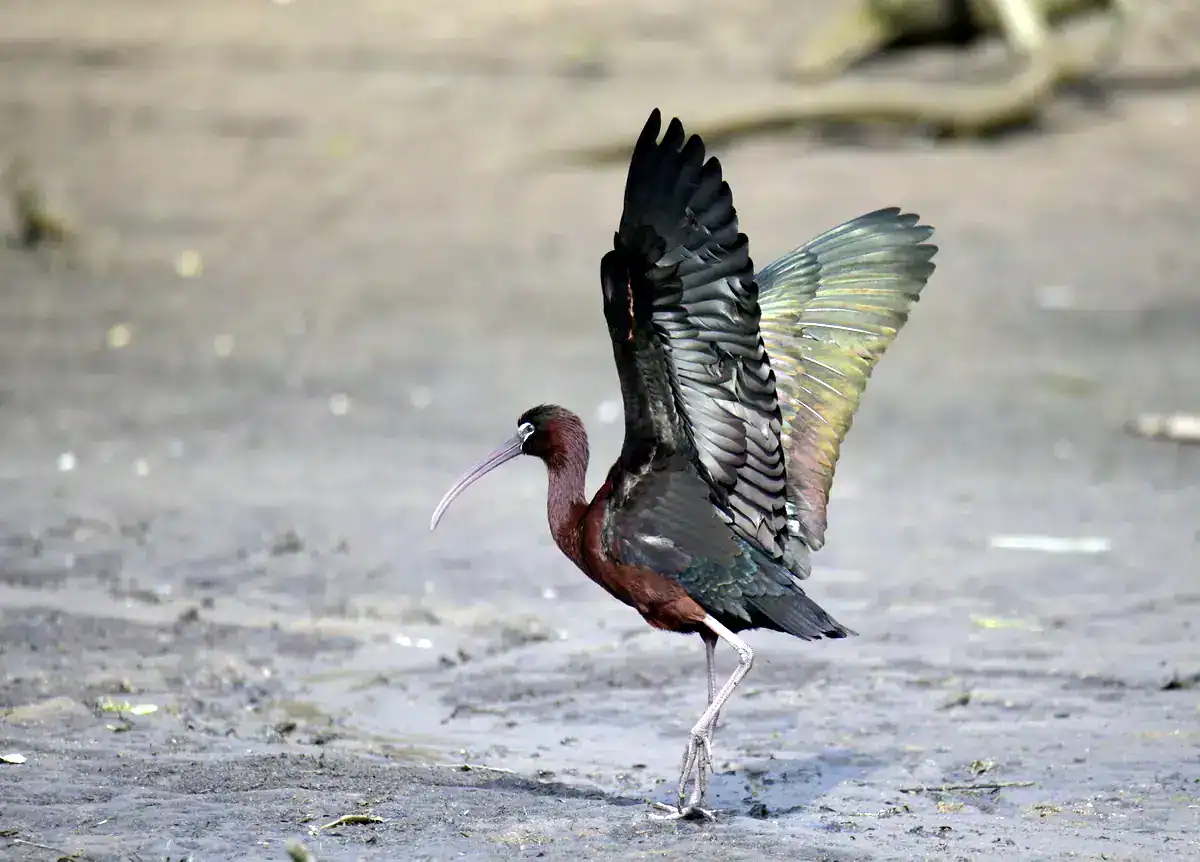
| Kingdom | Order | Family | Genus | Species |
|---|---|---|---|---|
| Animalia | Pelecaniformes | Threskiornithidae | Plegadis | Plegadis falcinellus |
The Glossy Ibis is the most widely distributed ibis on Earth. It breeds in Africa, southern Europe, Asia east to Australasia, and across the Americas.
- At a distance the Glossy Ibis looks plain dark. Up close, a breeding adult is deep maroon with emerald, bronze and violet fire across the wings. The bare facial skin is dark gray, edged by thin pale blue lines that run from the bill toward the eye and stop short. The eye is dark brown. Adults measure 48 to 66 cm (19 to 26 in) and weigh 530 to 768 g (1.2 to 1.7 lb).
- It did not start out American. Genomic work published in 2019 states that the Glossy Ibis colonized eastern North America in the early 19th century. Audubon’s account suggests the mechanism: the birds likely rode the trade winds from West Africa to the Caribbean. From there the species spread north through the 20th century, from a rare Florida bird to a regular breeder as far north as Maine.
- North American Glossy Ibis numbers grew about 4.2 percent per year between 1966 and 2015, close to an eightfold increase.
- What happened next is the interesting part. The same 2019 study sequenced 4,616 ultraconserved elements from 66 birds across three Plegadis species.[9] Ultraconserved elements are stretches of DNA that barely change between species, which makes them useful markers. Since arriving, Glossy Ibises have exchanged genes with native White-faced Ibises, and the gene flow runs more strongly into the Glossy Ibis than out of it. There was little sign of selection against the hybrids.
- Carl Linnaeus described the Glossy Ibis in 1766.
White-faced Ibis
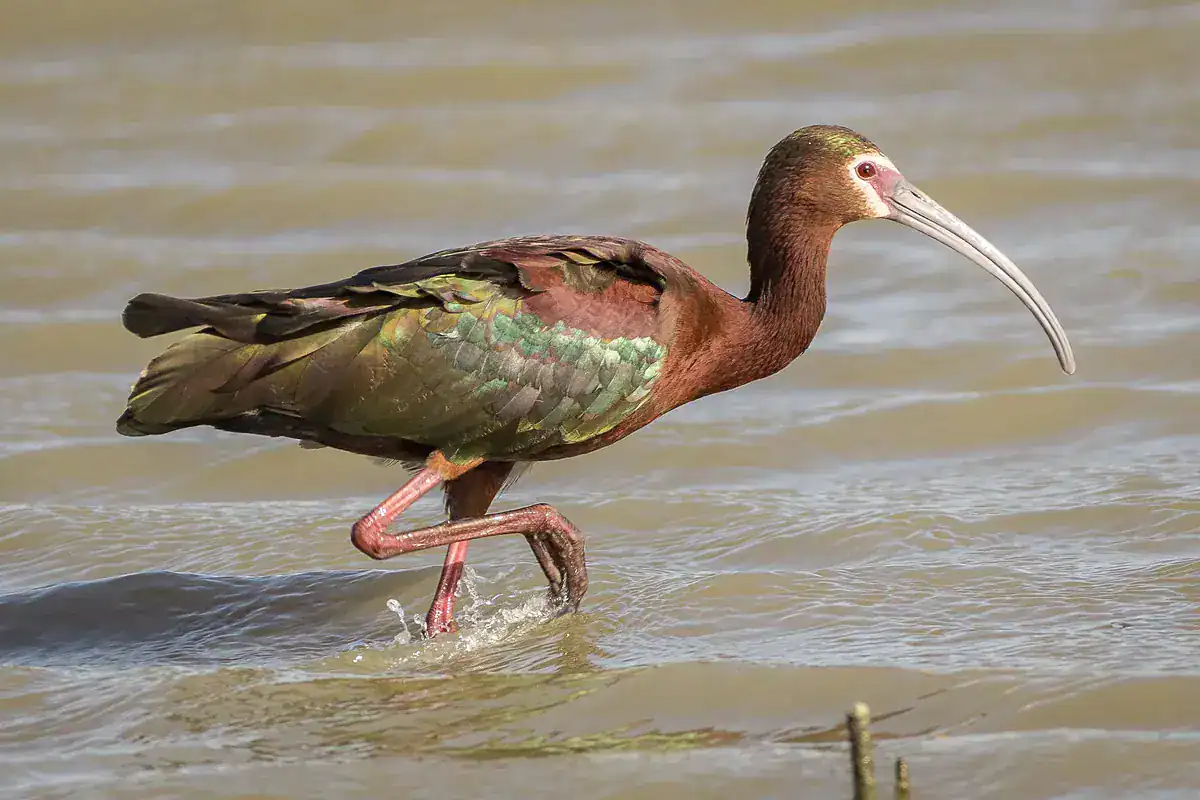
| Kingdom | Order | Family | Genus | Species |
|---|---|---|---|---|
| Animalia | Pelecaniformes | Threskiornithidae | Plegadis | Plegadis chihi |
The White-faced Ibis is the Glossy Ibis of the American West. It breeds across the Great Basin, east over the Great Plains, and along the Gulf Coast, where it is one of the more striking Texas birds. A second population lives in southern South America.
- An adult White-faced Ibis measures 46 to 56 cm (18 to 22 in) and weighs 450 to 525 g (1 to 1.2 lb). The wingspan runs 90 to 93 cm (35 to 37 in). A breeding bird is glossy maroon with green and bronze on the wings. The eye is ruby red. The pink bare facial skin is ringed all the way around by a band of white feathers, and the legs are pink.
- Telling the White-faced Ibis from the Glossy Ibis is the usual difficulty, and three marks do it. The white feather border goes completely around the face, including behind and below the eye, and the Glossy Ibis has no white feathering at all. The eye is red year-round, whereas the Glossy Ibis’s eye is dark brown. Breeding legs are pink rather than dark gray.
- Nonbreeding and first-winter White-faced and Glossy Ibises often cannot be separated at all. Audubon recommends recording first-winter birds of either species simply as “ibis sp.”
- Glossy and White-faced hybrids make it harder. Nebraska Game and Parks has logged at least 55 presumed hybrids since 2004, most in April and May. Genetic work shows many mixed birds are later-generation hybrids, which means the hybrids themselves breed successfully.
- The White-faced Ibis is doing well. Numbers rose about 2.8 percent per year from 1968 to 2017. Great Basin breeding pairs nearly tripled between 1985 and 1997.[30] The reason is nomadism. This bird abandons a colony when conditions sour and colonizes new wetlands fast, which is why regional wetland management matters more than protecting any single site.
- Great Salt Lake is the White-faced Ibis stronghold, with about 27,000 breeding adults and peak counts above 50,000.
- The scientific name is literal. Chihi is a French rendering of the sound the White-faced Ibis makes, so the bird is named for its own voice. Louis Jean Pierre Vieillot described the White-faced Ibis in 1817.
Puna Ibis
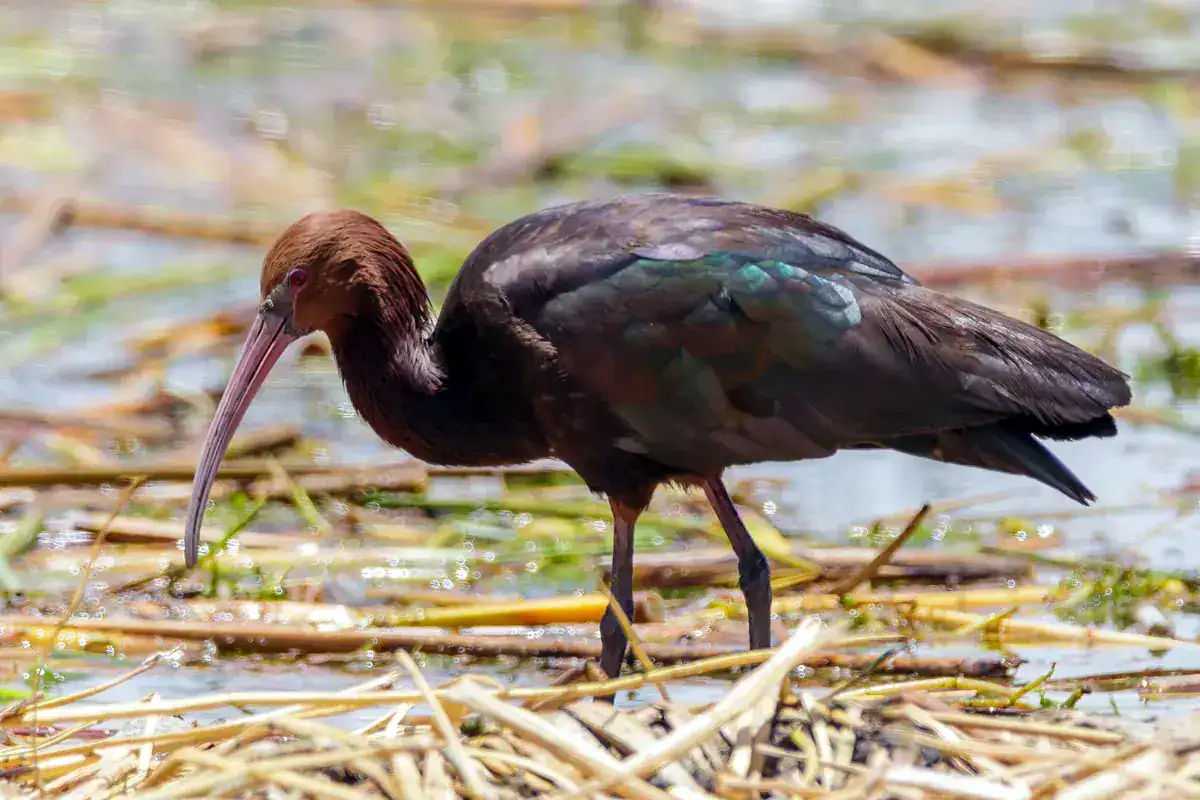
| Kingdom | Order | Family | Genus | Species |
|---|---|---|---|---|
| Animalia | Pelecaniformes | Threskiornithidae | Plegadis | Plegadis ridgwayi |
The Puna Ibis is one of the highest-living members of the family. It is common in the Andes at 3,200 to 4,500 m (10,500 to 14,800 ft), from central Peru south through western Bolivia to northern Chile and northwestern Argentina.
- The Puna Ibis measures about 60 cm (24 in). The CRC Handbook of Avian Body Masses reports a mean of 657 g for three males and 511 g for three females. The head, neck and upper breast are reddish brown. The rest of the body is black with a blue-green gloss. A pink bill and gray legs finish it.
- Where it overlaps with the White-faced Ibis, three marks separate them. The Puna Ibis is stockier and shorter-legged. Its bill is pink or red, never pale gray. Its belly is black, not brown.
- The Puna Ibis feeds in bofedales, the high-altitude peat bogs of the puna grassland it is named for, and at muddy lake margins. Several hundred birds may gather at one feeding area at 4,000 m.
- Altitude is no barrier to gene flow. The 2019 Plegadis study found signals of admixture between the Puna Ibis and South American White-faced Ibises.
- Joel Asaph Allen described the Puna Ibis in 1876. Allen was the first president of the American Ornithologists’ Union and edited The Auk for 27 years. The name honors Robert Ridgway, the Smithsonian’s curator of birds.
Black-faced Ibis
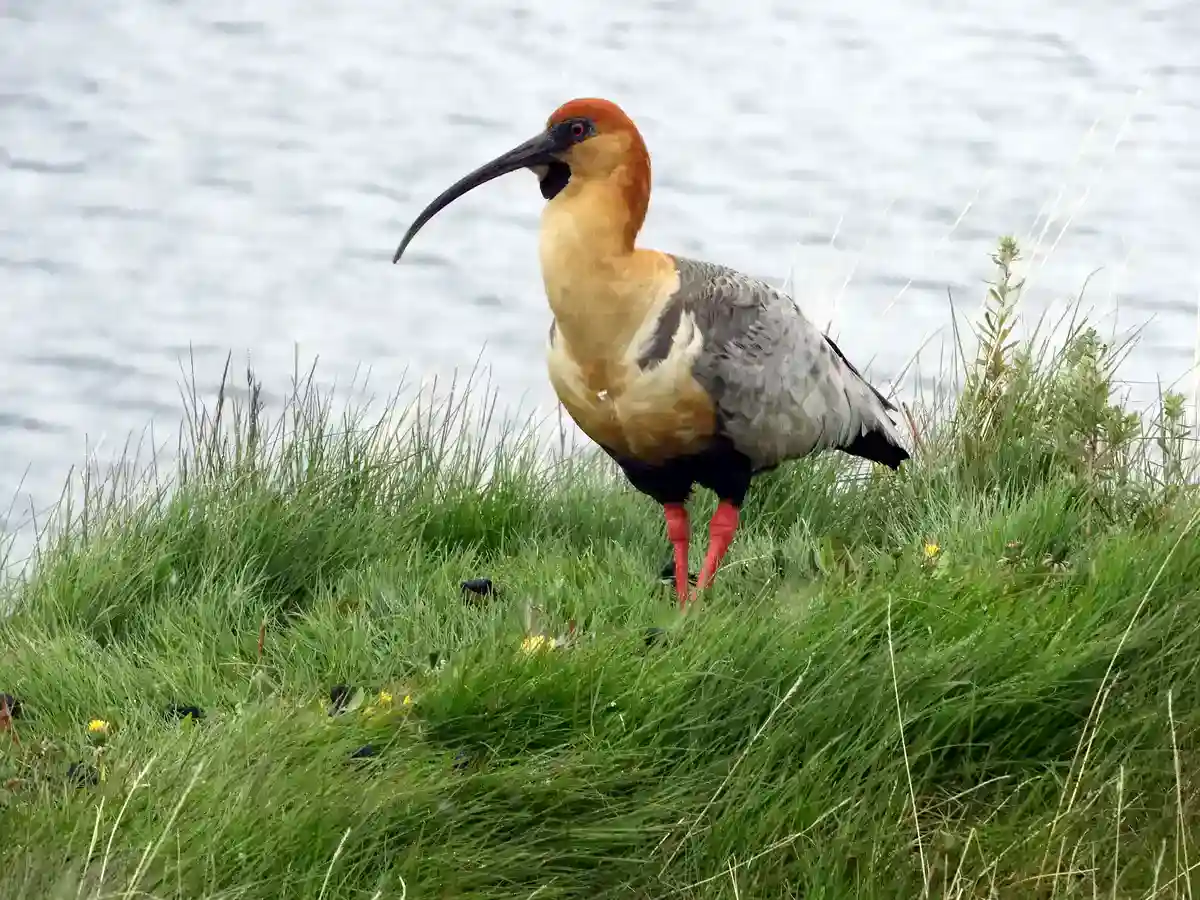
| Kingdom | Order | Family | Genus | Species |
|---|---|---|---|---|
| Animalia | Pelecaniformes | Threskiornithidae | Theristicus | Theristicus melanopis |
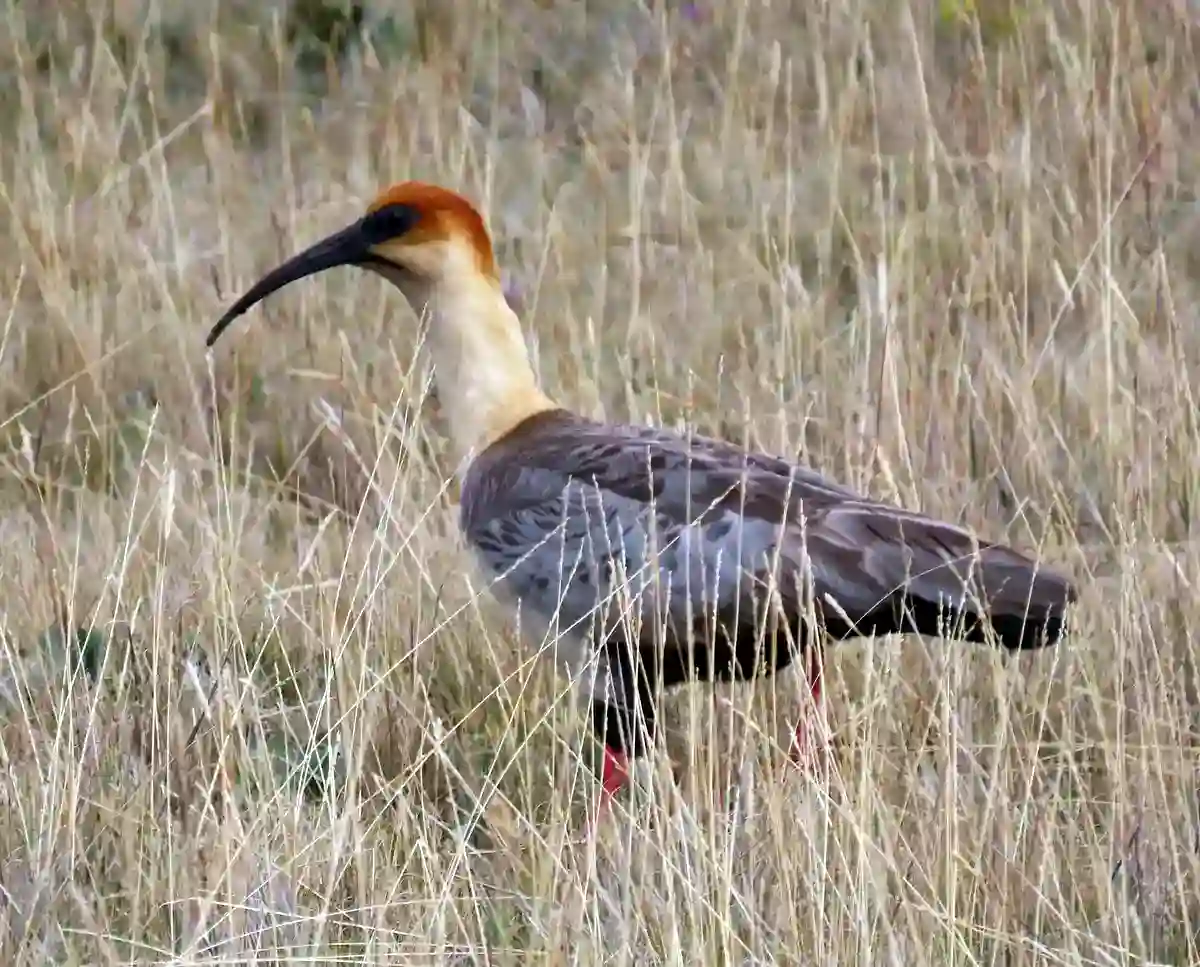
The Black-faced Ibis occupies two separate blocks of South America. One runs along coastal Peru and far northern Chile. The other covers central Chile and central Argentina south to Tierra del Fuego.
- The Black-faced Ibis measures about 74 cm (29 in). No weight figure for it turned up in the sources used here. The cap is rufous, fading to buff down the neck. The upperparts are gray, with a broad pale wing patch along the sides. Below that the breast is pale and the belly black. The legs are short and red, and the bare face is black. Adults carry a dark throat wattle that is more prominent in males.
- Those two features, the wing patch and the wattle, are what separate the Black-faced Ibis from the Andean Ibis. The Andean Ibis has neither.
- The Black-faced Ibis feeds on damp or dry ground rather than wading, and it tolerates towns. It nests colonially in trees and on cliffs, sometimes inside cities, and it soars on broad wings, occasionally riding thermals alongside vultures. Its trumpeting calls carry a long way.
- The coastal Peruvian population of Black-faced Ibis is now rare, and the decline is attributed to the destruction of coastal wetlands there.
- Johann Friedrich Gmelin described the Black-faced Ibis in 1789. Gmelin was a professor at Gottingen who edited the 13th edition of Linnaeus’s Systema Naturae.
Andean Ibis
| Kingdom | Order | Family | Genus | Species |
|---|---|---|---|---|
| Animalia | Pelecaniformes | Threskiornithidae | Theristicus | Theristicus branickii |
The Andean Ibis is the newest species in this section, and the reason it is now a species of its own is worth telling.
- For most of the last century the Andean Ibis was treated as a form of the Black-faced Ibis. In May 2019 Alvaro Jaramillo submitted Proposal 822 to the South American Classification Committee, arguing for a split.[5] The committee passed it unanimously and adopted it on October 2, 2019.
- The evidence had two parts. Collar and Bird had shown in 2011 that branickii, the Andean form, has a substantially shorter bill, with essentially no overlap, plus a longer tail, shorter legs and longer wings. It also lacks the facial wattle. Then Vizcarra documented the two forms living side by side in southern Peru and northern Chile with no hybridization. They behaved aggressively toward each other and sorted into single-species flocks even while foraging in the same place.
- The Andean Ibis split is about as clean a test of the biological species concept as field ornithology offers.
- The Andean Ibis measures about 74 cm (29 in), and one male weighed for the CRC Handbook of Avian Body Masses came in at 1,492 g. The cap is rufous, fading to buff, and the upperparts are a uniform bluish gray with no wing patch. It lives at 3,700 to 4,600 m in Peru, in bofedales and puna grassland, and roosts and nests on cliffs. It is wary and flushes easily. IUCN lists it as Near Threatened, and its population may be declining.
- Hans von Berlepsch and Jan Sztolcman described the Andean Ibis in 1894. The name honors Konstanty von Branicki, the Polish zoologist who founded the Branicki Zoological Museum in Warsaw.
Buff-necked Ibis
| Kingdom | Order | Family | Genus | Species |
|---|---|---|---|---|
| Animalia | Pelecaniformes | Threskiornithidae | Theristicus | Theristicus caudatus |
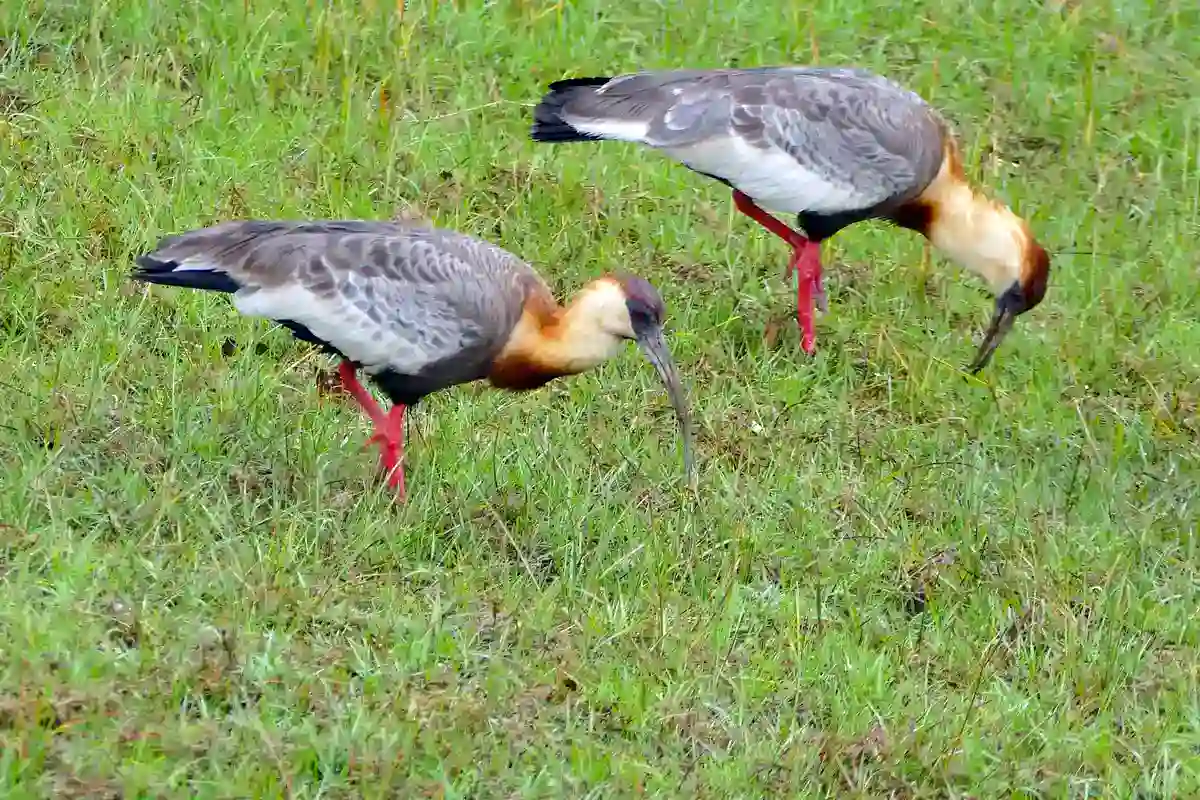
The Buff-necked Ibis is a bird of open lowland country east of the Andes. It ranges from eastern Colombia and Venezuela through the Guianas and Brazil south to Bolivia, Paraguay and northern Argentina.
- The Buff-necked Ibis measures about 74 cm (29 in). Five birds weighed for the CRC Handbook of Avian Body Masses averaged 1,726 g, with a range of 1,550 to 1,950 g. The cap is rufous and the neck buff, set against gray upperparts, with a broad near-white wing patch, a rusty breast, a black belly and short red legs.
- The Buff-necked Ibis is one of the few ibises that routinely feeds far from water, out on dry savanna and pasture. It rests in trees and bushes and on fence posts.
- The Buff-necked Ibis range is expanding as forest is cleared, so deforestation has been good for this particular bird.
- Pieter Boddaert described the Buff-necked Ibis in 1783.
Plumbeous Ibis
| Kingdom | Order | Family | Genus | Species |
|---|---|---|---|---|
| Animalia | Pelecaniformes | Threskiornithidae | Theristicus | Theristicus caerulescens |
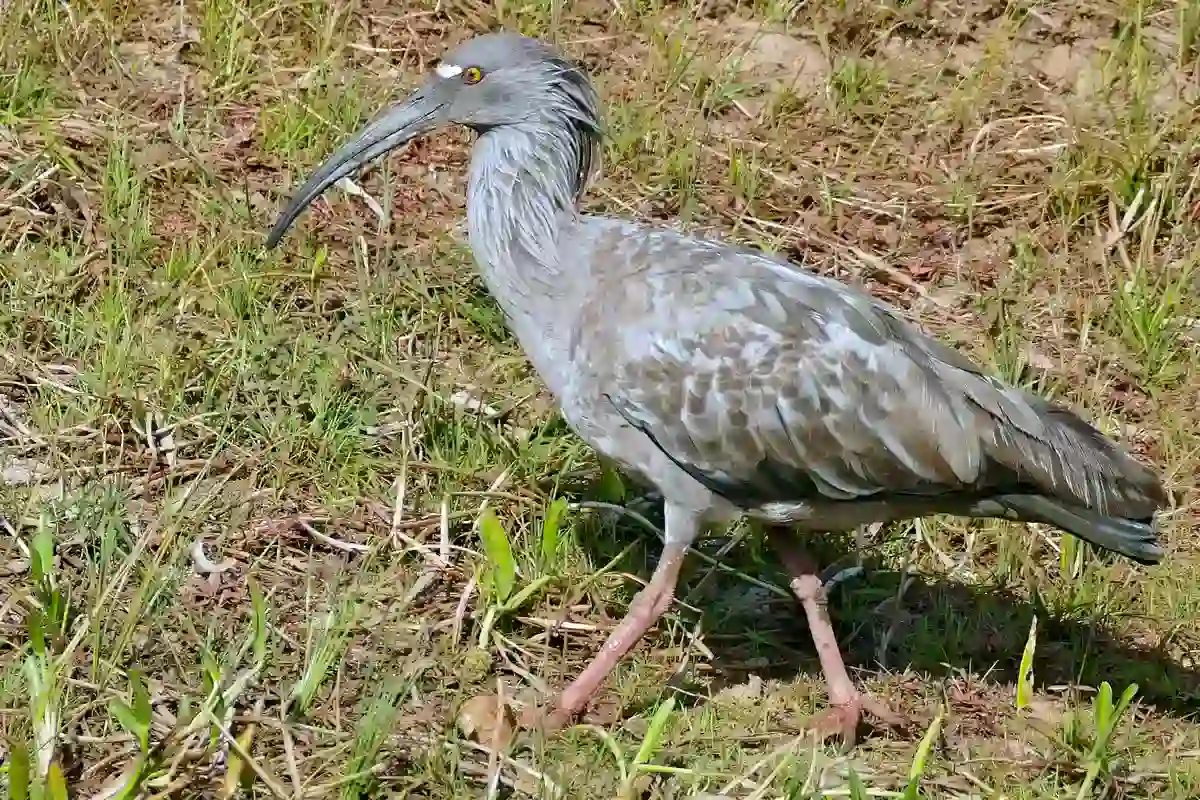
The Plumbeous Ibis is a Pantanal and Chaco bird, found in the lowlands of southern Brazil west to Bolivia and south through Paraguay to northeastern Argentina.
- Plumbeous means lead-colored, and that is the Plumbeous Ibis exactly. It is uniformly gray, stocky, with a white forehead and a shaggy bushy crest on the nape. eBird’s account calls it unmistakable. Published lengths for this species do not follow a consistent convention, so none is given here. One male weighed for the CRC Handbook of Avian Body Masses came in at 1,500 g.
- The Plumbeous Ibis feeds on mudflats, at wetland margins and often well away from water, usually alone or in pairs.
- The memorable part is the performance. At dawn and dusk the Plumbeous Ibis climbs to the crown of a tree, preferring one with few or no leaves, and sings a rapid cackle while standing in silhouette.
- Louis Jean Pierre Vieillot described the Plumbeous Ibis in 1817. Vieillot was a businessman in Saint-Domingue who took up natural history. He collected birds in the United States around 1800, then returned to France and supported himself as a clerk at the Bulletin des Lois. He was the first to describe 26 genera and 32 species of North American birds under modern naming rules.
Green Ibis
| Kingdom | Order | Family | Genus | Species |
|---|---|---|---|---|
| Animalia | Pelecaniformes | Threskiornithidae | Mesembrinibis | Mesembrinibis cayennensis |
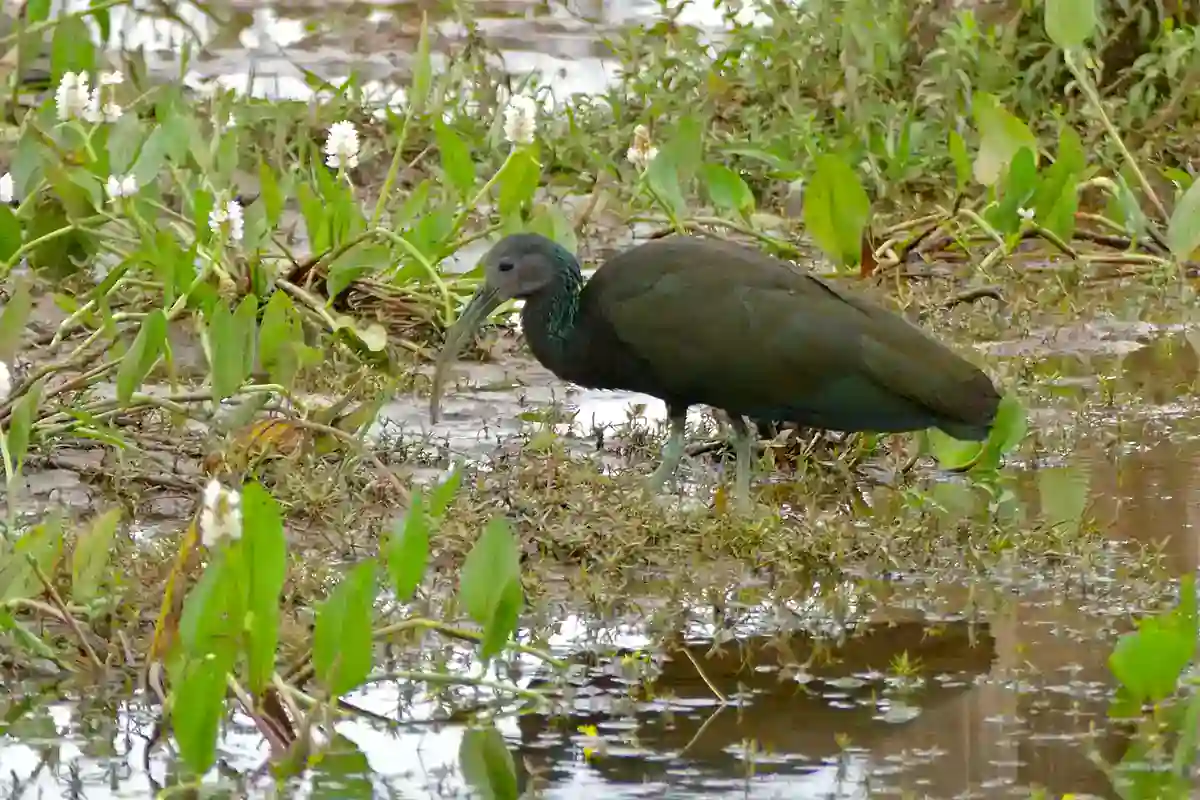
The Green Ibis is the forest ibis of the Neotropics. It lives in the lowlands from Costa Rica south through Colombia, Ecuador, Peru, Bolivia and Brazil to northeastern Argentina.
- The Green Ibis measures about 57 cm (23 in). Seven birds weighed for the CRC Handbook of Avian Body Masses averaged 756 g, with a range of 670 to 865 g. The plumage is blackish with heavy iridescent green, including glossy green streaking on the neck. The bill and legs are greenish, and the legs are notably short. There is no brightly colored bare facial skin. That last point separates it from the Bare-faced Ibis wherever the two overlap.
- The Green Ibis works muddy edges close to continuous forest, along rivers, streams, oxbow lakes and Mauritia palm swamps, usually alone or in pairs. It roosts in trees at the forest border.
- Two habits stand out. The Green Ibis forages by day and by night, which very few ibises do. And when flushed it flies up into the trees rather than away across open water.
- Johann Friedrich Gmelin described the Green Ibis in 1789.
Bare-faced Ibis
| Kingdom | Order | Family | Genus | Species |
|---|---|---|---|---|
| Animalia | Pelecaniformes | Threskiornithidae | Phimosus | Phimosus infuscatus |
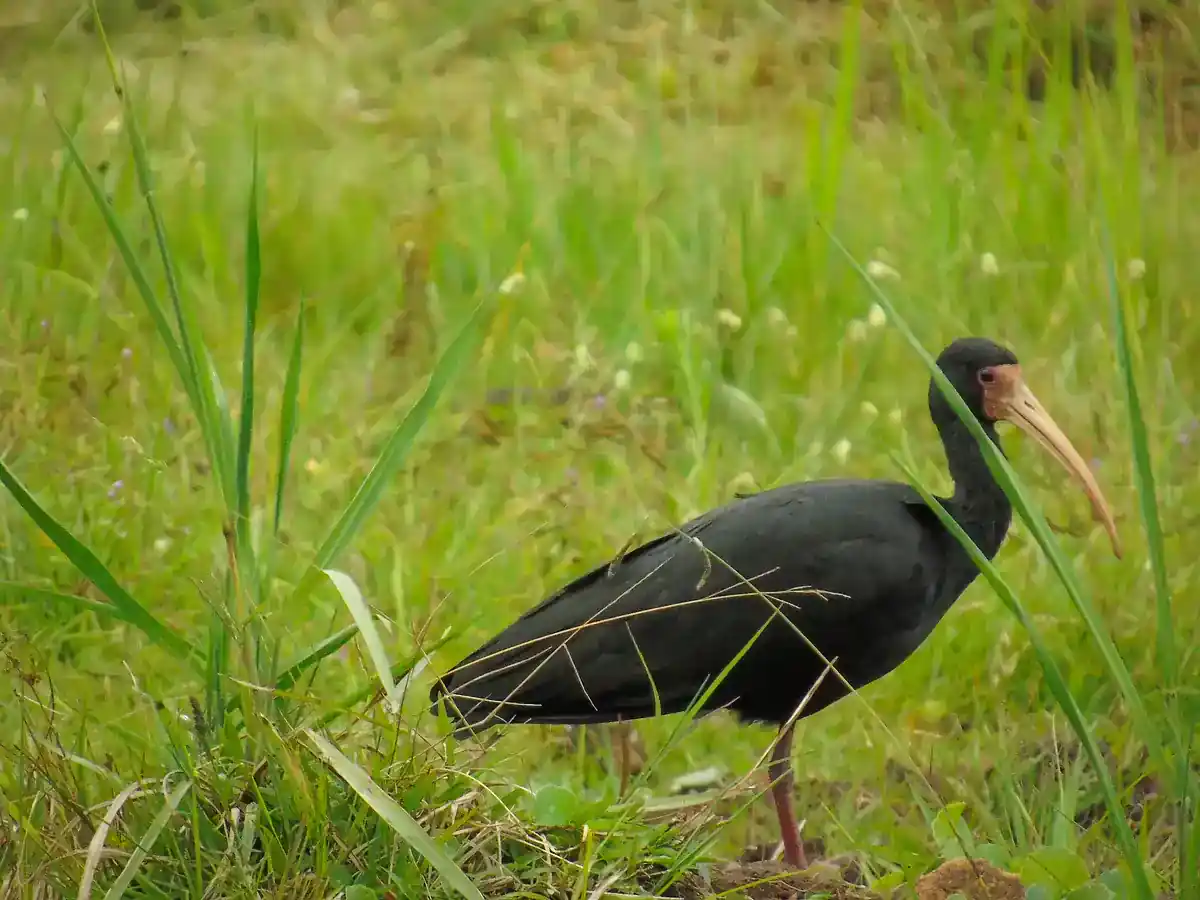
The Bare-faced Ibis is small, dark and extremely sociable. It measures about 50 cm (20 in), and four birds weighed for the CRC Handbook of Avian Body Masses averaged 559 g.
- The plumage of the Bare-faced Ibis is dull blackish, with green and blue iridescence on the wings. The name comes from the bare, unfeathered front of the face. That skin ranges from dull red to bright orange-pink. A dull reddish to pale yellowish bill sits above short pinkish legs. Bare-part colors shift through the breeding cycle.
- The Bare-faced Ibis range is oddly split, with populations on either side of the Amazon basin. It lives north in Colombia, Venezuela and the Guianas, and south in Bolivia, Brazil, Paraguay, Uruguay and Argentina. It is currently expanding along the Napo and Amazon rivers in Peru.
- The Bare-faced Ibis is the most gregarious ibis in Bolivia, gathering in flocks that run into the hundreds.
- Martin Hinrich Carl Lichtenstein described the Bare-faced Ibis in 1823.
Sharp-tailed Ibis
| Kingdom | Order | Family | Genus | Species |
|---|---|---|---|---|
| Animalia | Pelecaniformes | Threskiornithidae | Cercibis | Cercibis oxycerca |
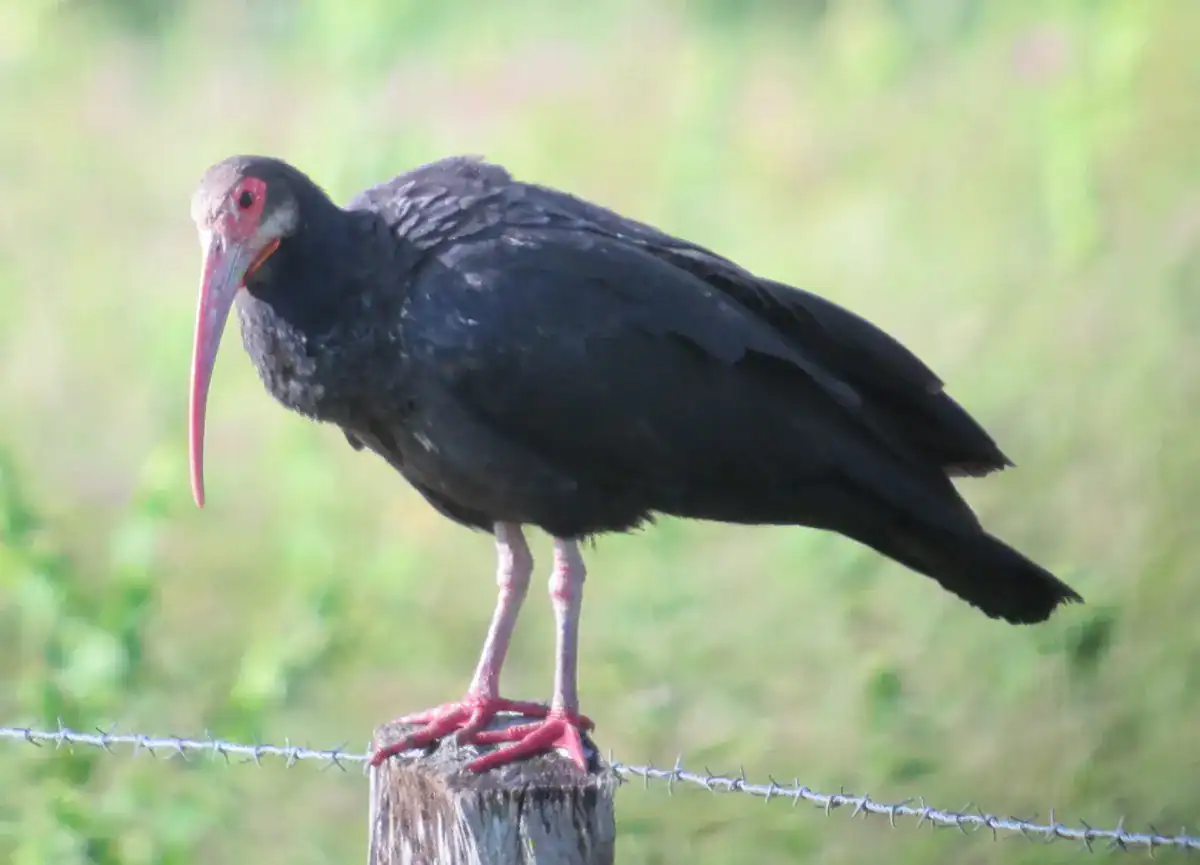
The Sharp-tailed Ibis lives in the llanos of eastern Colombia and Venezuela, east to the Guianas and west into Amazonian Brazil. No reliable measurements have been published for it, which tells you something about how little studied it is. The one comparison available is that it is larger and longer-tailed than the Bare-faced Ibis.
- The Sharp-tailed Ibis is mostly black, with a red bill, red legs and bare red skin on the throat and around the eye. The signature is structural: a long, pointed tail against short legs, giving a low-slung, stretched-out profile unlike any other New World ibis.
- The Sharp-tailed Ibis works flooded savanna in pairs or small groups, probing mud and soft ground. It does not form the big flocks the Bare-faced Ibis does.
- The voice is the Sharp-tailed Ibis’s most distinctive feature. It gives a single far-carrying horn-like note, and pairs duet with one bird pitched higher than the other, so together they sound like a braying donkey.
- Johann Baptist von Spix described the Sharp-tailed Ibis in 1825. Spix was sent from Munich to Brazil in 1817 by the King of Bavaria, traveled with the botanist Carl von Martius, then went up the Amazon alone. He came home in 1820 with thousands of specimens and died in 1826 of diseases he picked up on the journey.
African Ibises
Eight ibises are primarily African, living on the mainland and the islands off its west coast. The Glossy Ibis occurs across Africa too, but it is covered with the American species above.
Expect surprises in this group. Three are forest birds and two live on cliffs, so only a few behave the way the phrase “wading bird” suggests.
Northern Bald Ibis
| Kingdom | Order | Family | Genus | Species |
|---|---|---|---|---|
| Animalia | Pelecaniformes | Threskiornithidae | Geronticus | Geronticus eremita |
The Northern Bald Ibis came closer to extinction than any other member of the family, and it has recovered further than any of them.
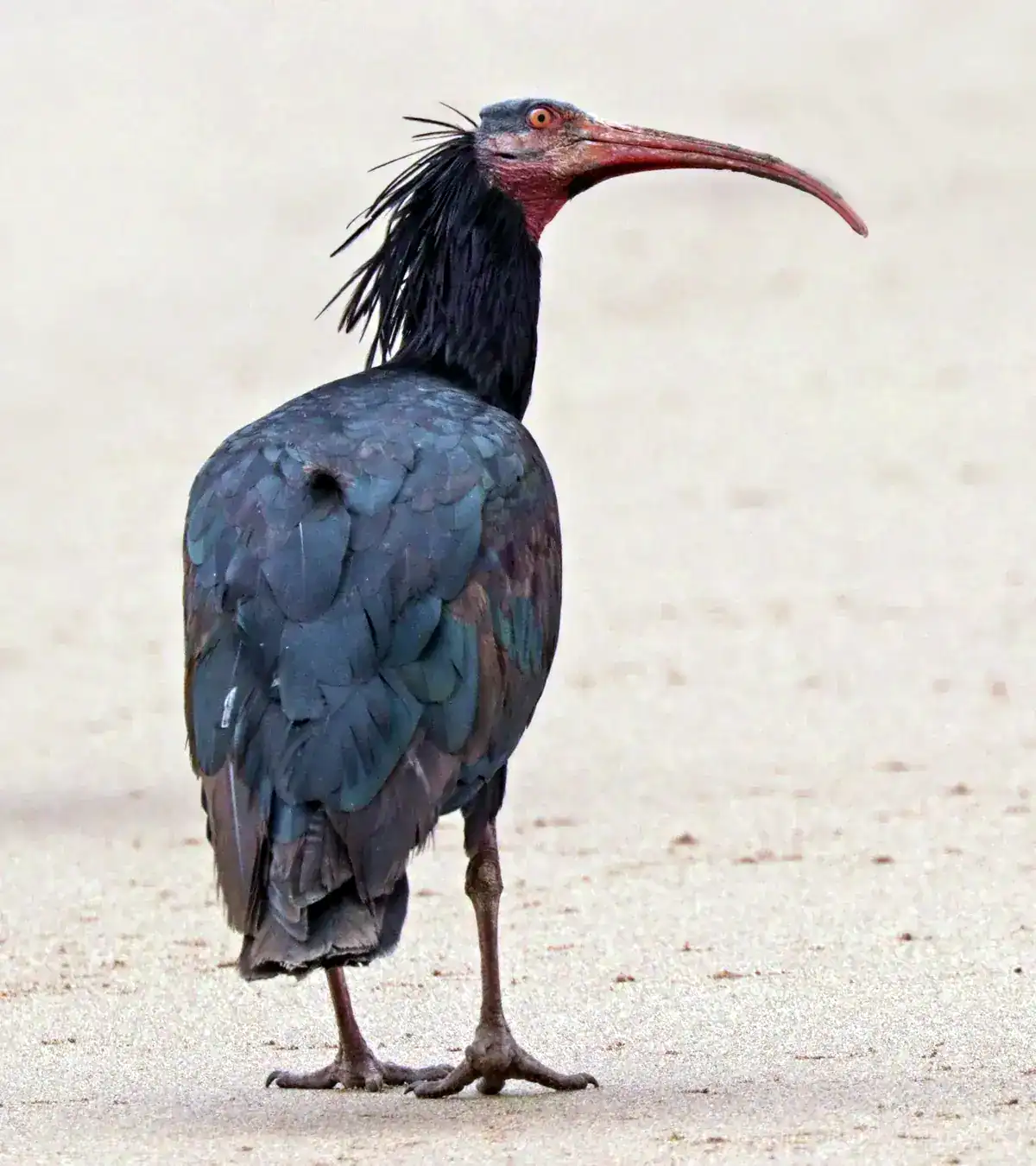
- The Northern Bald Ibis is black overall, with blue, green and copper iridescence in sunlight. The face and crown are naked and red, and a ruff of long narrow feathers hangs from the nape. Adults measure 70 to 80 cm (28 to 31 in). This is not a wetland bird at all. It lives on arid plains and plateaus with rocky escarpments, nests on cliffs, castles and walls, and eats beetles, snails, scorpions, lizards, snakes and the occasional small rodent.
- The decline was catastrophic. Morocco held about 1,500 Northern Bald Ibises in roughly 70 colonies around 1940. By 1975 that was 600 birds in 13 colonies. By the end of the century four colonies remained.
- Turkey’s collapse was worse. Its Northern Bald Ibis colony at Birecik held 3,000 birds in 1930. DDT spraying against malaria and locusts in 1959 and 1960 killed more than 600 adults, around 70 percent of the colony as it then stood. By 1982 there were 400 birds. In 1989 the Turkish population was declared extinct, and only one of the three returning adults survived that breeding season.
- A die-off in May 1996 then cut Morocco’s Northern Bald Ibises to 59 breeding pairs.
- That was the floor for the Northern Bald Ibis. Souss-Massa National Park had been established in 1991 and focused conservation work began in 1993. By 2018 Morocco held 147 breeding pairs and 708 individuals. Two contributors to a March 2025 specialist-group symposium gave different figures for Morocco.[18] One reported roughly 750 birds and about 120 breeding pairs. The other estimated more than 800 birds and more than 180 pairs, covering a different area. IUCN downlisted the species from Critically Endangered to Endangered in November 2018, coded as a genuine improvement rather than a correction.
- The Syrian chapter did not end well. Seven Northern Bald Ibises were discovered near Palmyra in 2002. They migrated over 3,000 km to a wintering site near Addis Ababa. The last of them disappeared in 2013, and with it the species’ last surviving wild migration tradition.
- Europe had the same problem, and worse. Its own Northern Bald Ibises had been gone for roughly 400 years, so the reintroduction team had to teach the birds the route by hand. The Waldrappteam project has run since 2002, with human-led migration flights since 2004. Two designated human foster parents keep permanent contact with each cohort of chicks. The young birds are then trained to follow a microlight aircraft flying at 40 to 45 km/h.
- The method works. Released Northern Bald Ibises have migrated independently since 2011, and young have hatched in the wild since 2012. By the end of 2024 the migratory population stood at 280 individuals across four breeding colonies, in Bavaria, Salzburg, Baden-Wurttemberg and Carinthia, wintering mainly in Tuscany. Viability modeling puts the self-sustaining threshold at about 320 birds. A separate sedentary population of about 300 lives in Cadiz, Spain.
- The Northern Bald Ibis name is good too. Geronticus eremita means elderly hermit, for the bare head and the solitary manner. The German name Waldrapp means forest raven.
- Conrad Gessner figured a live Northern Bald Ibis in 1557, and his drawing shows a juvenile with a feathered head, which indicates he saw one himself. Europe’s population then died out, and the last European record is from Graz in 1621. After that, the old pictures were taken for portraits of a mythical creature, and science did not realize they showed a real, still-living species until 1897.
- Carl Linnaeus described the Northern Bald Ibis in 1758.
Hadada Ibis
| Kingdom | Order | Family | Genus | Species |
|---|---|---|---|---|
| Animalia | Pelecaniformes | Threskiornithidae | Bostrychia | Bostrychia hagedash |
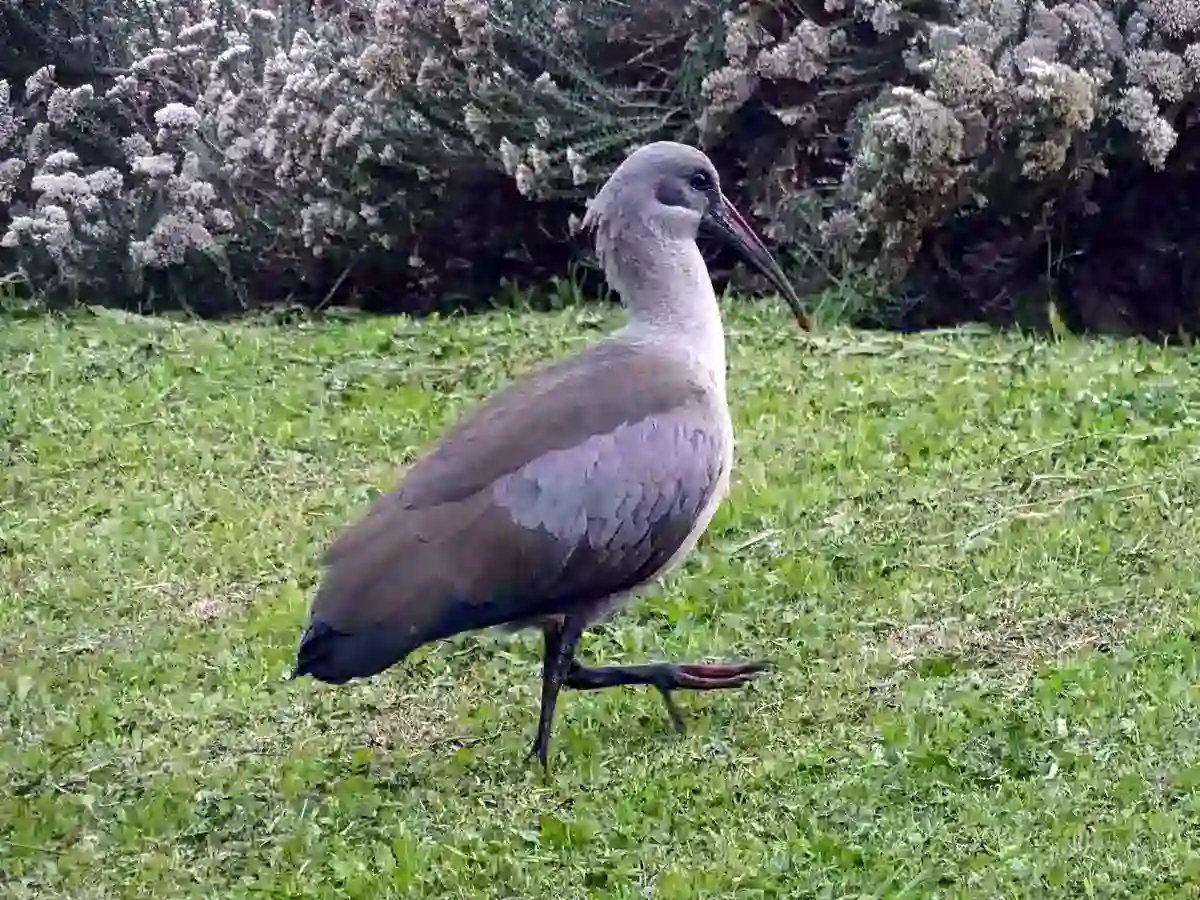
The Hadada Ibis has expanded without any deliberate help. It is gray-brown with a metallic green rump and a bronzy-green wing that sometimes flashes purple. It measures roughly 76 cm long and weighs about 1.25 kg.
- An analysis of South African bird-atlas data found that the Hadada’s range had expanded by 40 percent between 1910 and 1985, and it is still growing, particularly in cities. The same atlas work called the Hadada one of the region’s most dynamic and successful species, spreading into some of the country’s driest areas.
- The reason is lawns. A thesis at the University of KwaZulu-Natal found Hadadas nesting and roosting in more exotic trees than indigenous ones, and feeding on short, well-watered grass.[8] Irrigated turf recreates the soft moist ground the bill evolved to probe. Suburbia manufactures wetland foraging conditions every morning with a sprinkler.
- The mechanism behind that was nailed down experimentally in 2024. Hadadas locate prey by vibration, and their success rises with soil moisture. In dry soil, the advantage disappears. The same researchers warn that warming and drying, producing hard sun-baked ground the bill cannot enter, will slow or reverse the expansion.
- The Hadada’s name is onomatopoeic. The call gets written as “ha-da-da, ha-da-da, ha-da-dee.” It is loud, it carries, and it is usually given on takeoff from a roost. The University of Cape Town’s FitzPatrick Institute headlined its own research on the species “African alarm clocks.”
- John Latham described the Hadada Ibis in 1790. That year matters: 1790 is when Latham adopted Linnaean binomial naming, which is why so many of his names carry that date.
African Sacred Ibis
| Kingdom | Order | Family | Genus | Species |
|---|---|---|---|---|
| Animalia | Pelecaniformes | Threskiornithidae | Threskiornis | Threskiornis aethiopicus |
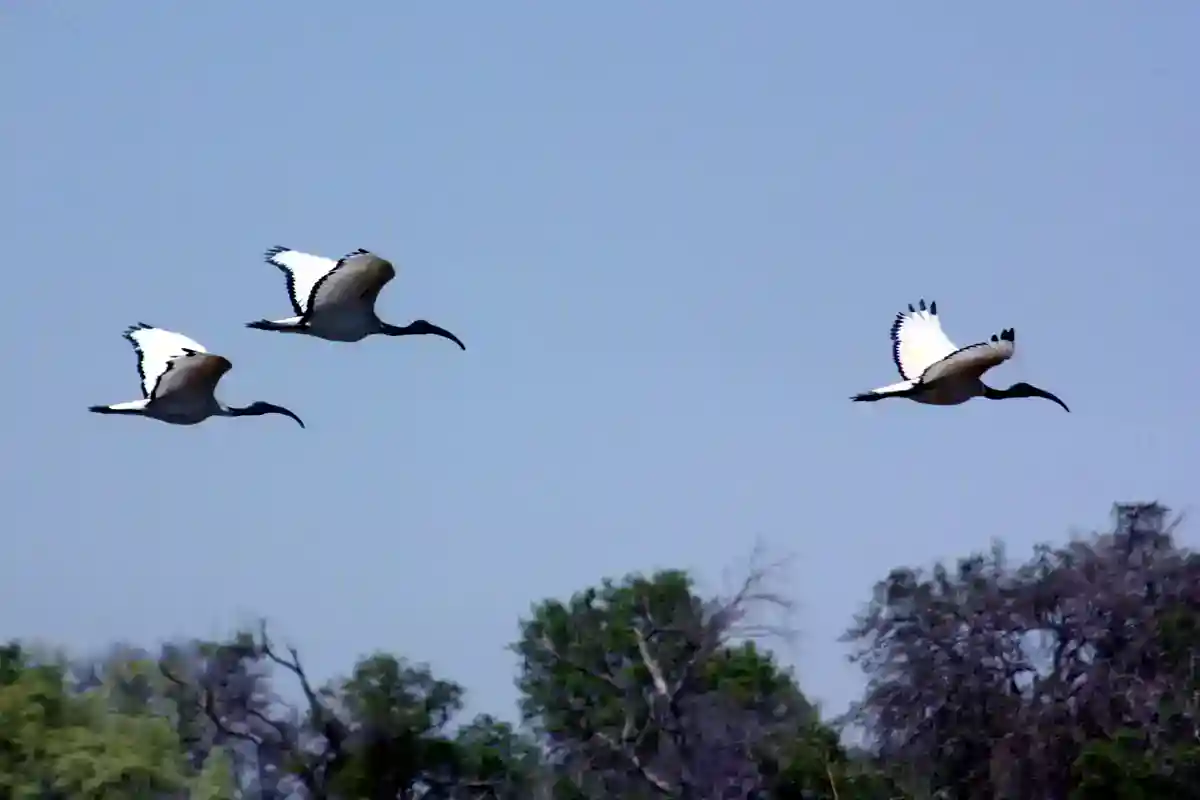
The African Sacred Ibis is the bird Egypt mummified by the million, and the bird now shot in France.
- The African Sacred Ibis is white, with black-tipped flight feathers, a bare black head and neck, and black ornamental plumes over the rump. Adults measure 65 to 89 cm (26 to 35 in) and weigh about 1,500 g (3.3 lb). The wingspan runs 112 to 124 cm. This bird forages in wet and dry habitats, and is notably comfortable in man-made ones, including dams, sewage works, dung heaps, refuse dumps and cultivated land.
- The African Sacred Ibis lives across sub-Saharan Africa and in southeastern Iraq. It no longer lives in Egypt. The ibis of ancient Egypt disappeared from the country around 1850, centuries after the mummification stopped, as the marshes were drained for farmland.
- The second story is more recent. During the 1970s and 1980s several European zoos tried to establish free-flying Sacred Ibis colonies. Twenty birds were imported from Kenya to French wildlife parks in four deliveries between 1975 and 1980, and a breeding colony settled at Branfere Zoological Garden in Brittany. Wild birds were first noticed in 1993.
- The growth was steep. France had 450 breeding pairs of Sacred Ibis in 2001, 1,100 in 2005 and 1,700 in 2006, with over 5,000 birds counted in winter. Italy recorded its first nest in 1989, but its population remained low until 2006. By 2019 it held 1,249 nests in 31 colonies, with 10,880 birds at winter roosts in the northwest. Spain’s birds escaped from Barcelona Zoo starting in 1974.
- The problem is what they eat. In July 2004, two sacred ibises stripped every egg from a 30-nest sandwich tern colony in four hours. Documented prey includes the eggs and chicks of black terns, whiskered terns, common terns, mallards and lapwings. In their native South Africa, sacred ibises were responsible for 65 percent of cape cormorant chick predation deaths on one island.
- France responded with culling. Around 3,000 Sacred Ibises were shot in 2008, leaving about 2,500 by February 2009, and by spring 2009 only 13 remained on the Mediterranean coast.
- Not everyone agrees the Sacred Ibis impact is simple. One study at Grand-Lieu Lake asked whether the alien ibises might actually stabilize native spoonbill colonies. A long-term diet comparison questioned how much of a threat the birds really pose.
- John Latham described the African Sacred Ibis in 1790. It is the type species of the genus Threskiornis, so it defines the group four other living ibises in this guide belong to, plus the extinct Reunion Ibis.
Southern Bald Ibis
| Kingdom | Order | Family | Genus | Species |
|---|---|---|---|---|
| Animalia | Pelecaniformes | Threskiornithidae | Geronticus | Geronticus calvus |
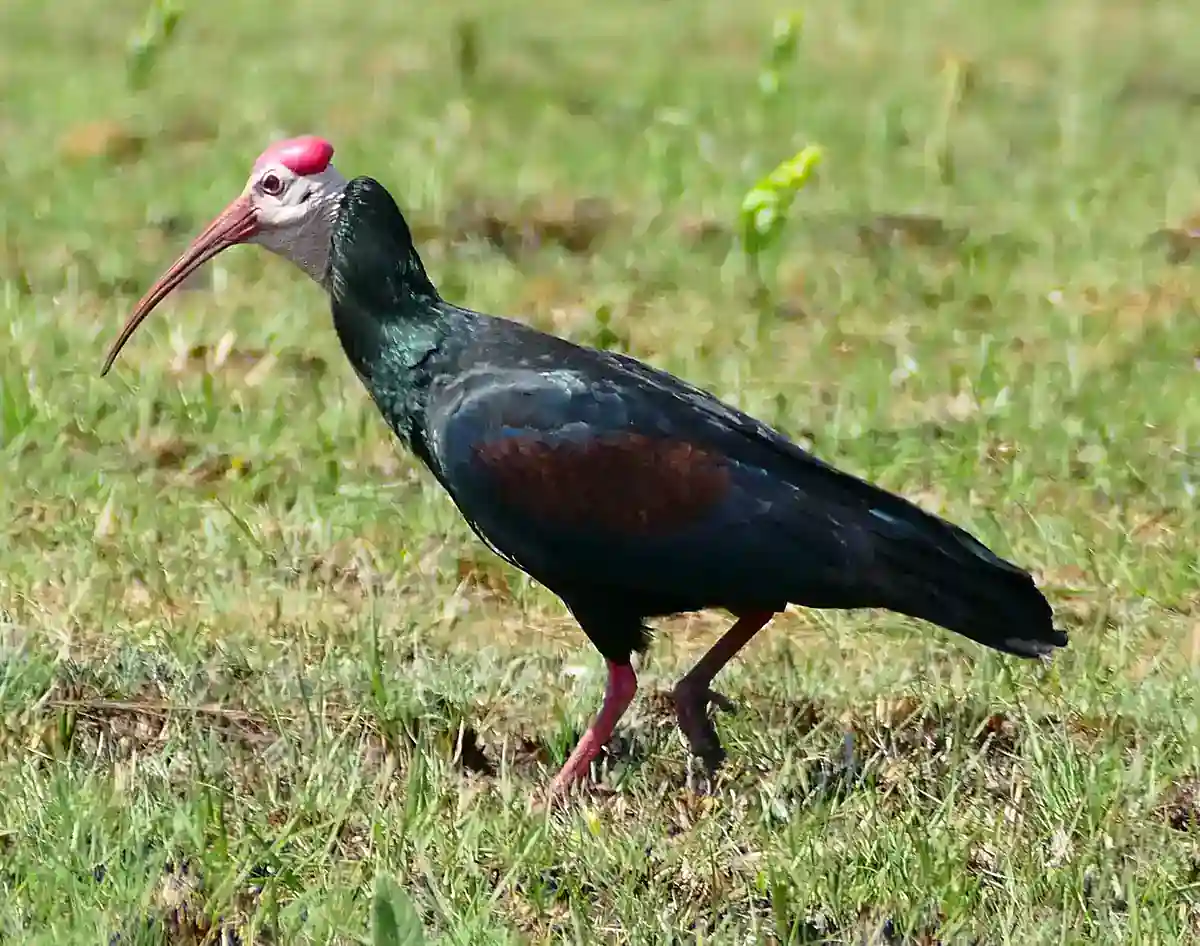
The Southern Bald Ibis is endemic to the highlands of northeastern South Africa, Lesotho and Eswatini. It has a bare head with wrinkled skin on the face and neck, and dark plumage streaked with green, violet and bronze. Juveniles are dull gray.
- The Southern Bald Ibis lives in mesic grassland above 1,200 m in high-rainfall country, and it roosts and breeds communally on steep cliff lines. It also uses electricity pylons as roosts.
- The habit that makes the Southern Bald Ibis interesting involves fire. Its favored foraging ground is short, dense grass, including recently burned grassland. The species action plan for South Africa goes further. The timing of breeding often correlates with how much burned grassland is available.[22] The bird schedules its breeding season around the burn.
- In a Free State breeding-season study, maize stalk borer larvae and adult beetles were staple foods. The maize stalk borer is a serious crop pest, so in that region the Southern Bald Ibis provides free pest control to farmers, some of whom poison it.
- BirdLife South Africa’s current listing puts the Southern Bald Ibis population at around 10,000 individuals, of which roughly 7,000 to 8,000 are breeding birds. Earlier surveys of 166 breeding sites between 2007 and 2011 had produced a lower figure and a declining trend, and that older number is still widely quoted. IUCN downlisted the species from Vulnerable to Near Threatened in February 2024, treating the improvement as genuine rather than a correction.[14] Predicted habitat loss is still the main concern for its future.
- Pieter Boddaert described the Southern Bald Ibis in 1783.
Wattled Ibis
| Kingdom | Order | Family | Genus | Species |
|---|---|---|---|---|
| Animalia | Pelecaniformes | Threskiornithidae | Bostrychia | Bostrychia carunculata |
The Wattled Ibis belongs to the Ethiopian highlands, and it lives higher than almost any bird in this guide. It ranges from 1,500 m up to the moorlands at 4,100 m, and typically nests between 1,800 and 3,000 m. It is found in Ethiopia and Eritrea.
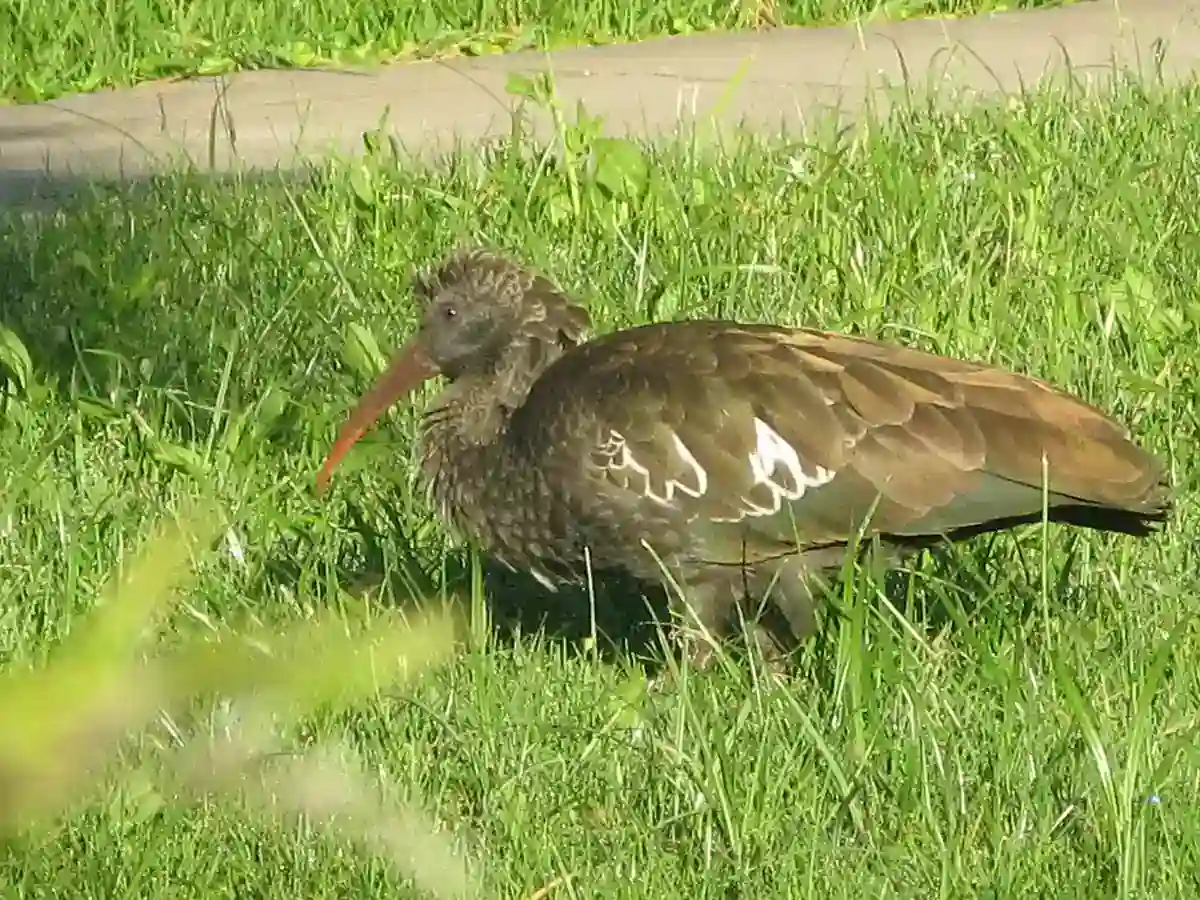
- The Wattled Ibis averages 60 cm (24 in), and the AVONET database gives its mass as about 1.28 kg (2.8 lb). It is a large, dark ibis with a dull green gloss. A small thin red wattle hangs from the throat at the base of the bill, and a crest sits on the nape.
- The Wattled Ibis field mark is the wing. The IUCN specialist group puts it in one line: no other dark African ibis has a white wing patch.
- The Wattled Ibis uses meadows, highland river courses with rocky cliffs, alpine moorland, swamps, cultivated land and open woodland, and it has adapted well to farmed and settled country. One survey in Bale Mountains National Park recorded at least 246 birds along 27 km.
- The Wattled Ibis forages at the altitude of the Ethiopian wolf. It is not a wading bird in any useful sense.
- Eduard Ruppell described the Wattled Ibis in 1837. Ruppell collected across Egypt, Sinai and Abyssinia for the Senckenberg Nature Research Society.
Sao Tome Ibis
| Kingdom | Order | Family | Genus | Species |
|---|---|---|---|---|
| Animalia | Pelecaniformes | Threskiornithidae | Bostrychia | Bostrychia bocagei |
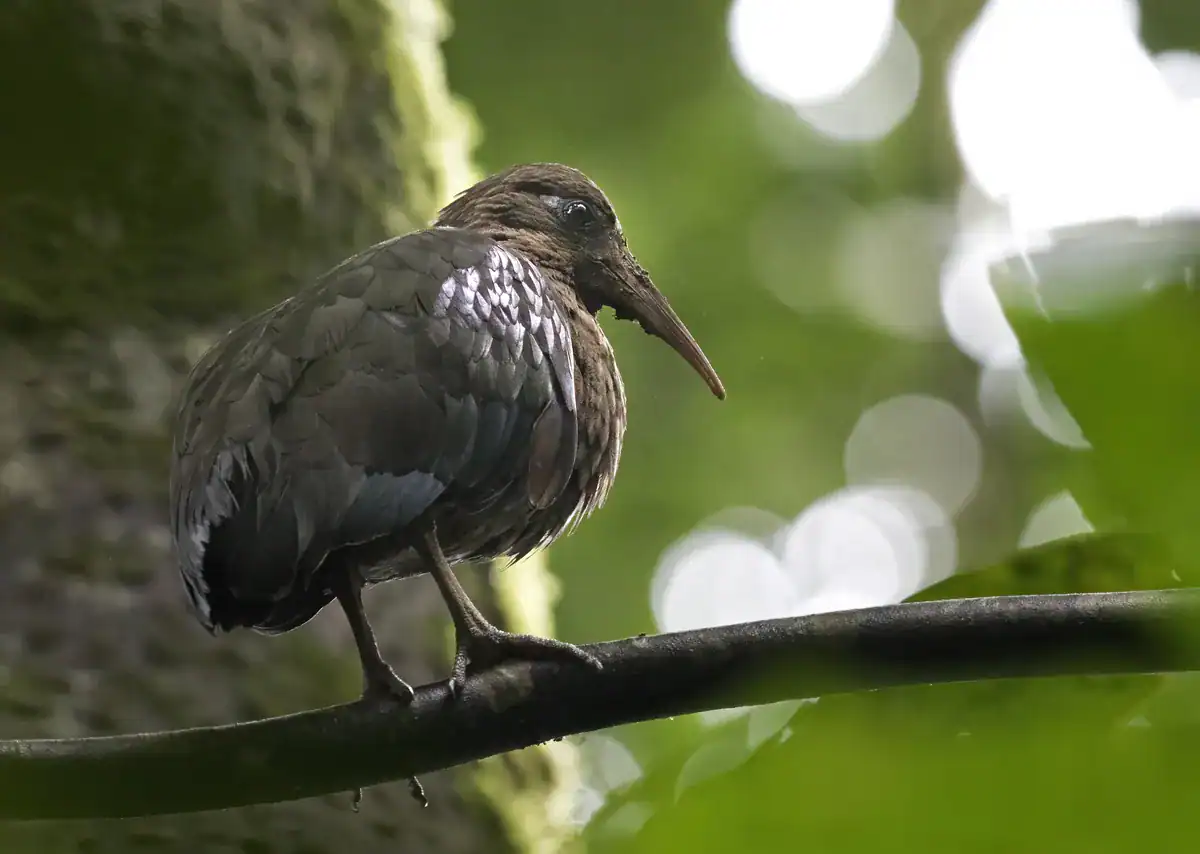
The Sao Tome Ibis, also called the Dwarf Ibis, lives on one island in the Gulf of Guinea and nowhere else. It is Critically Endangered.
- Published accounts give the Sao Tome Ibis 60 to 65 cm (24 to 26 in). It is usually described as the smallest Bostrychia, which is where the alternative name comes from. BirdLife describes it as a shy forest dweller with a haunting call.
- The Sao Tome Ibis lives in lowland old-growth and mature secondary rainforest, favoring flat ground, high tree density and large trees, and it feeds on the forest floor. Its potential annual range is 127 sq km. In the breeding season that shrinks to 65 sq km.
- Sao Tome Ibis population figures do not agree. The estimate in the peer-reviewed literature is 70 to 400 individuals, an IUCN baseline quoted in a 2017 survey paper. BirdLife’s own recent communications use a looser figure of fewer than 2,000 birds. Both are in print.
- Either way, the hunting arithmetic is alarming. The same survey team estimated that subsistence hunters might be killing hundreds of Sao Tome Ibises a year.
- That makes the Sao Tome Ibis conservation response unusually clever. Between 2022 and 2024, BirdLife and local partners recruited 75 local hunters as “Agents of Change,” paying them to find the island’s rarest birds and report illegal hunting.[17] The people who were the main threat became the survey team.
- James Paul Chapin described the Sao Tome Ibis in 1923.
Olive Ibis
| Kingdom | Order | Family | Genus | Species |
|---|---|---|---|---|
| Animalia | Pelecaniformes | Threskiornithidae | Bostrychia | Bostrychia olivacea |
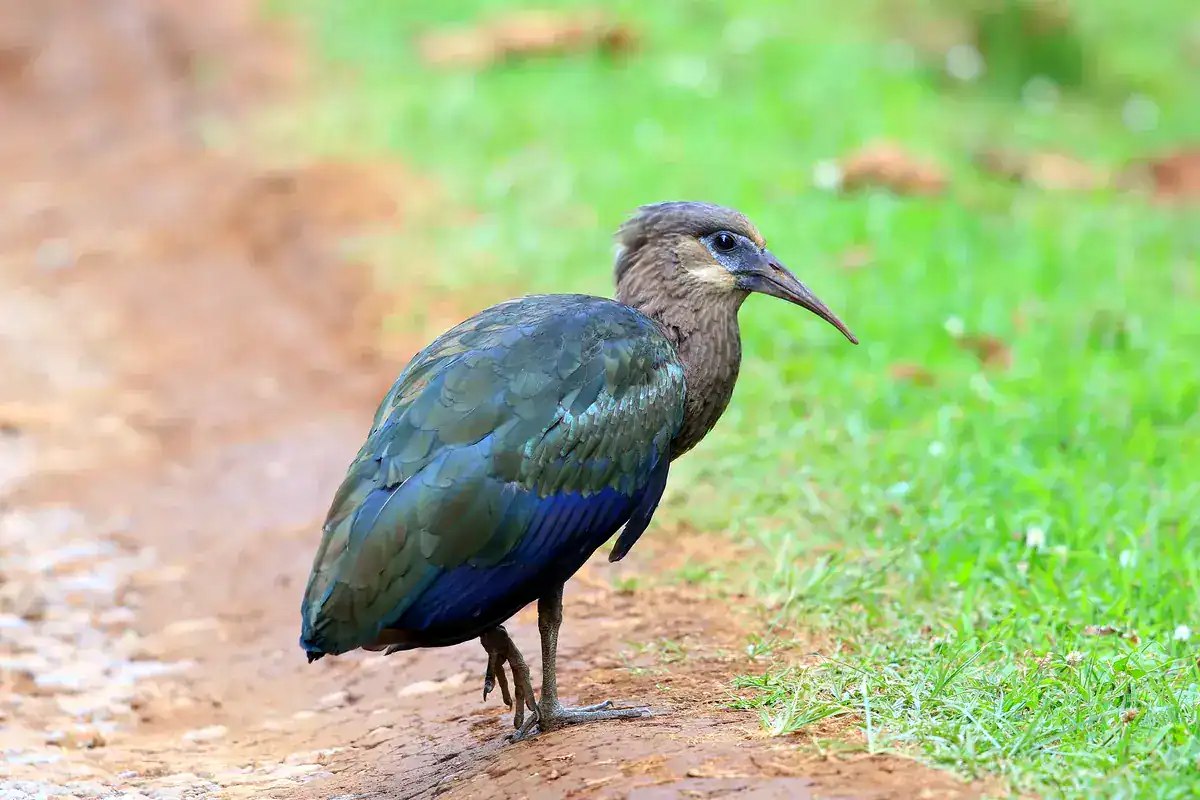
The Olive Ibis is one of the least known birds in Africa, and the article will not pretend otherwise.
- No length or weight for the Olive Ibis turned up in the sources used here. What is described is dark brown plumage, a loose head crest, a bare blackish-blue face, a coral-red bill and metallic copper and purple-blue wing coverts. The call is a loud resonant “HAH-hah,” stressed on the first syllable.
- The Olive Ibis is a forest bird, living in lowland rainforest and mangroves along streams. Its home is what is left of the West African rainforest, one of the great rainforests of the world. It is active at dawn and dusk and moves in pairs or small groups of four to six.
- The Olive Ibis record is remarkably thin. A 2015 survey report for the African Bird Club stated that no nest of this species had been documented for over 100 years before that survey. And the IUCN specialist group’s own species page for it is an empty stub carrying nothing but the name, the authority and a Least Concern badge.
- The disagreement is real too. Two papers published in 2015 flatly contradict each other about whether the Olive Ibis occurs in Nigeria. One recommends deleting it from the national list for lack of documentation. The other reports seven nests in Cross River State and estimates a Nigerian population of 1,500 to 3,000 birds.
- Bernard Du Bus de Gisignies described the Olive Ibis in 1838.
Spot-breasted Ibis
| Kingdom | Order | Family | Genus | Species |
|---|---|---|---|---|
| Animalia | Pelecaniformes | Threskiornithidae | Bostrychia | Bostrychia rara |
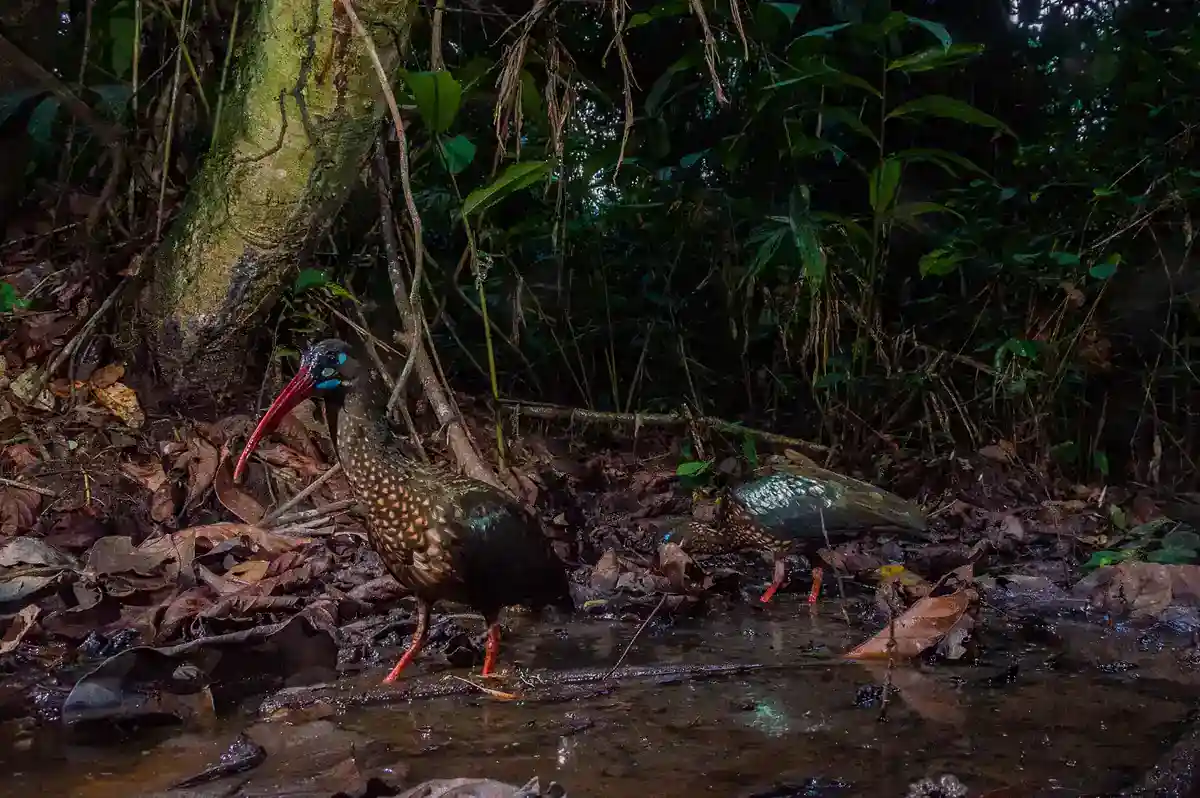
The Spot-breasted Ibis is the least documented of all 29. No published length, no published weight, no population estimate, no trend.
- The Spot-breasted Ibis lives in swamp and riverine forest across the West and Central African lowland rainforest belt. The range runs from Liberia to Cameroon, Gabon, the Democratic Republic of the Congo and far northeastern Angola. One regional review describes it as widespread and more common than the Olive Ibis.
- The Spot-breasted Ibis page at the IUCN specialist group is, like the Olive Ibis page, a stub with no content. The species was not among those reassessed in the 2025 Red List cycle.
- Of the 29 living ibises, the Spot-breasted is the one the world knows least about, and the gap is worth stating rather than filling with guesses.
- Lionel Walter Rothschild, Ernst Hartert and Otto Kleinschmidt described the Spot-breasted Ibis in 1897. Rothschild was a banker who became a zoologist and built his own museum at Tring. It held 2 million butterflies and 300,000 bird skins, and it is now part of the Natural History Museum in London.
Madagascar Ibises
Two ibises live on Madagascar and almost nowhere else. One works the forest floor and the other works the coast, and both are in trouble.
Madagascar Ibis
| Kingdom | Order | Family | Genus | Species |
|---|---|---|---|---|
| Animalia | Pelecaniformes | Threskiornithidae | Lophotibis | Lophotibis cristata |
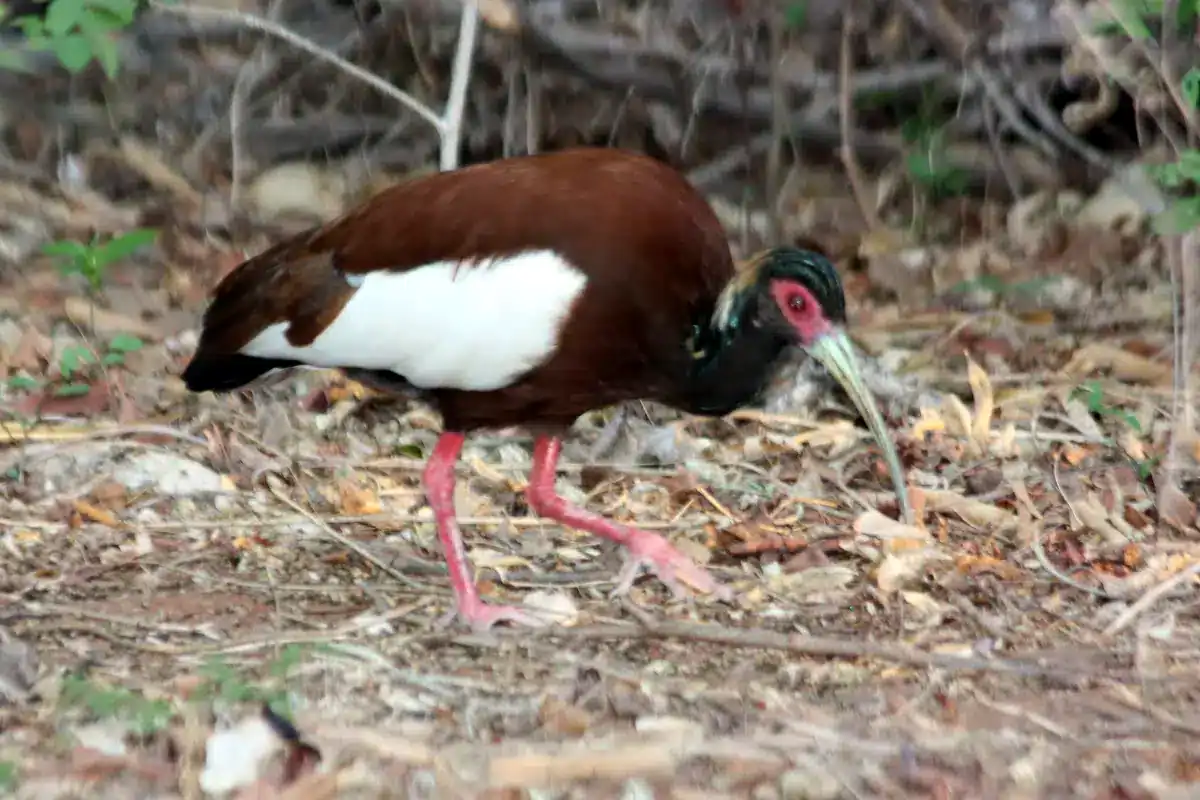
The Madagascar Ibis, also called the Madagascar Crested Ibis or the White-winged Ibis, is a forest bird. It uses every kind of woodland on the island, including rainforest in the north and east, dry forest in the south and west, and sometimes mangroves. It forages on the ground, probing leaf litter rather than water.
- It measures about 50 cm (20 in). It has a long decurved bill, creamy crown plumes forming a long crest, glossy iridescent green feathers down the nape, and sturdy legs with spreading, slightly webbed toes. The name White-winged Ibis comes from the white wing patches, which are conspicuous in flight. When alarmed it raises the crest and puffs out its feathers.
- This is the species that proved remote touch works. Susan Cunningham, Isabel Castro and colleagues showed a Madagascar Crested Ibis could find moving prey with every other sensory cue removed. The sensitive spots at the bill tip do the work.
- IUCN uplisted the Madagascar Ibis to Vulnerable in 2024. The population numbers fewer than 10,000 birds, and the assessors noted that 10,000 now stands as an absolute maximum. Hunting is the headline threat, combined with heavy forest degradation over the past 20 years.
- The most damning Madagascar Ibis number comes from inside a protected area. One researcher recorded 4 to 5 birds over a five-day survey in 2012.[15] Repeating identical methods at the same sites in 2022 turned up fewer than 2 birds.
- Be careful with older pages. The IUCN specialist group’s own page and several zoo sites still list the Madagascar Ibis as Near Threatened.
- Pieter Boddaert described the Madagascar Ibis in 1783, the same year he described the Southern Bald Ibis.
Malagasy Sacred Ibis
| Kingdom | Order | Family | Genus | Species |
|---|---|---|---|---|
| Animalia | Pelecaniformes | Threskiornithidae | Threskiornis | Threskiornis bernieri |
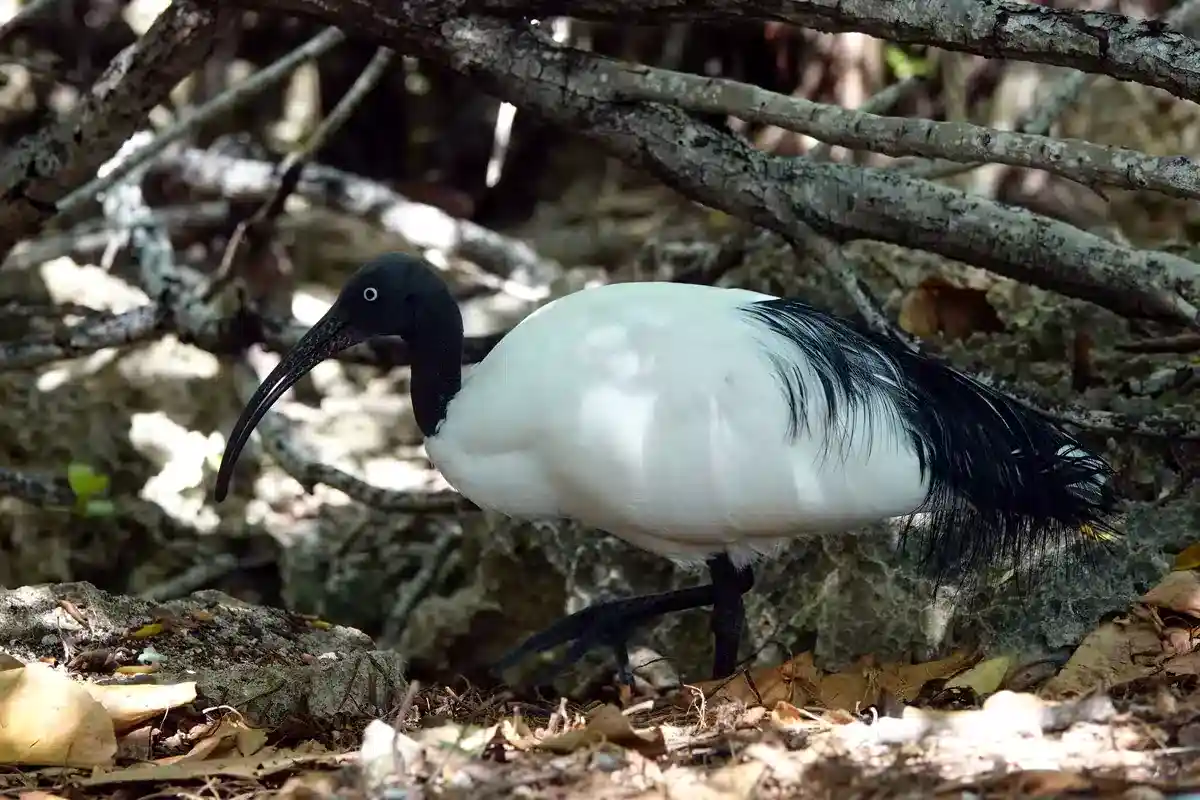
The Malagasy Sacred Ibis is the ibis nobody argues about and almost nobody counts. It was long lumped with the African Sacred Ibis and only recently separated as a full species.
- The Malagasy Sacred Ibis is white with black plumes across the rump and a black head. Four marks separate it from its African relative. It has pale blue eyes, a smaller build, and a shorter, thinner bill. Its wing tips are white, whereas the African bird’s are black, though that mark shows only in flight or on a bird with the wing spread, so a perched Malagasy Sacred Ibis is usually told by the eye. Juveniles are lighter, with dark eyes that pale with age. No verified length or weight has been published.
- In western Madagascar and the Seychelles, the Malagasy Sacred Ibis occupies mangrove bays, river deltas and brackish riverbanks along the saline coastal zone. It is not an inland marsh bird.
- IUCN has listed the Malagasy Sacred Ibis as Endangered since 2004. The population is estimated at 1,700 to 2,200 mature individuals.[21]
- Those numbers are abstract until you see the fieldwork. A dedicated Malagasy Sacred Ibis survey of the Mahavavy-Kinkony Complex from June through November 2019 covered three bays and found 46 birds in total.
- Charles Lucien Bonaparte described the Malagasy Sacred Ibis in 1855.
Asian Ibises
Five ibises are primarily Asian, and the spread between them is extraordinary. Two are Critically Endangered and counted in the hundreds.
One was reduced to seven birds and now numbers over eleven thousand. Another has spread along irrigation canals to more than 400,000 birds.
Giant Ibis
| Kingdom | Order | Family | Genus | Species |
|---|---|---|---|---|
| Animalia | Pelecaniformes | Threskiornithidae | Pseudibis | Pseudibis gigantea |
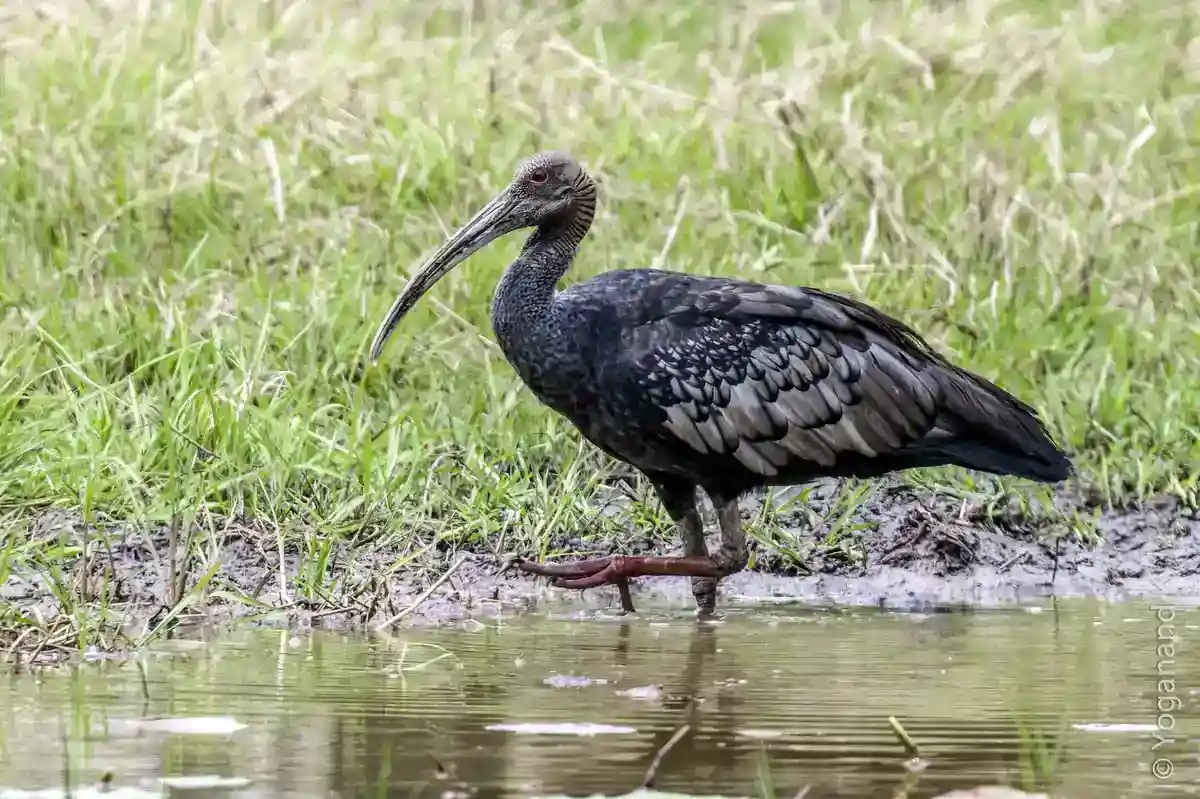
The Giant Ibis is the largest ibis alive, and one of the rarest.
- The Giant Ibis measures 102 to 106 cm (40 to 42 in). One male specimen weighed about 3,515 g (7.7 lb). Adults are mostly dark, with a naked grayish head and upper neck, dark bands on the hindcrown and nape, and pale grayish wing coverts crossed by dark bars. The eye is dark red. The voice is a repeated, loud, ringing a-leurk a-leurk at dawn and dusk.
- It is not a marsh bird. It lives in open deciduous dipterocarp forest, dominated by the tall hardwoods of that family, and depends on soft mud around seasonal pools, which Cambodians call trapeangs. A field study in Preah Vihear found that pools used by Giant Ibises averaged more than 1,000 square meters and had twice the mud area of unused pools. In the dry season the birds caught 26 prey items an hour, and frogs made up almost half the take. Earthworm mounds turned out to be a good predictor of breeding birds.
- BirdLife’s Red List assessment gives the Giant Ibis a minimum of 194 mature individuals, equivalent to about 290 birds.[12] The estimate was calculated in 2014 and published in 2018, and it remains the latest formal one. It has been Critically Endangered since 1994. Its range once covered much of mainland Southeast Asia and is now effectively northern and eastern Cambodia, with a few birds in southern Laos. It is regionally extinct in Thailand.
- The greatest threat named by IUCN is habitat conversion by large-scale economic land concessions, clearing lowland dry forest for rubber, cassava, wood pulp and teak. Poisoning matters too. On April 9, 2020, three Giant Ibises were killed with carbofuran placed in waterholes, and those three birds represented 1 to 2 percent of the entire global population.[20]
- The Giant Ibis is Cambodia’s national bird. It went unrecorded for decades. On February 3, 1993, a single bird was found wading in a small pool on a stagnant river in southern Laos.[40]
- Now for the taxonomic news, and this is where most websites are out of date. AviList places the Giant Ibis in the genus Pseudibis, alongside the Red-naped Ibis and the White-shouldered Ibis. Nearly every page online still calls it Thaumatibis gigantea.
- The reasoning behind the Giant Ibis move matters. The decision summary says the change was made because “justification for its treatment as a monotypic genus is lacking.” It then adds, in the committee’s own words, that “genetic data would be informative.” In other words there is no published genetic study behind the move. It is a consistency decision, and the committee flagged the missing evidence itself.
- The combination is also not new. Serious sources used Pseudibis gigantea for the Giant Ibis a generation ago, including the 1996 paper that announced the bird’s rediscovery. The name most websites use is the one being set aside.
- Jean-Frederic Emile Oustalet described the Giant Ibis in 1877, from a specimen collected on the banks of the Mekong.
Crested Ibis
| Kingdom | Order | Family | Genus | Species |
|---|---|---|---|---|
| Animalia | Pelecaniformes | Threskiornithidae | Nipponia | Nipponia nippon |
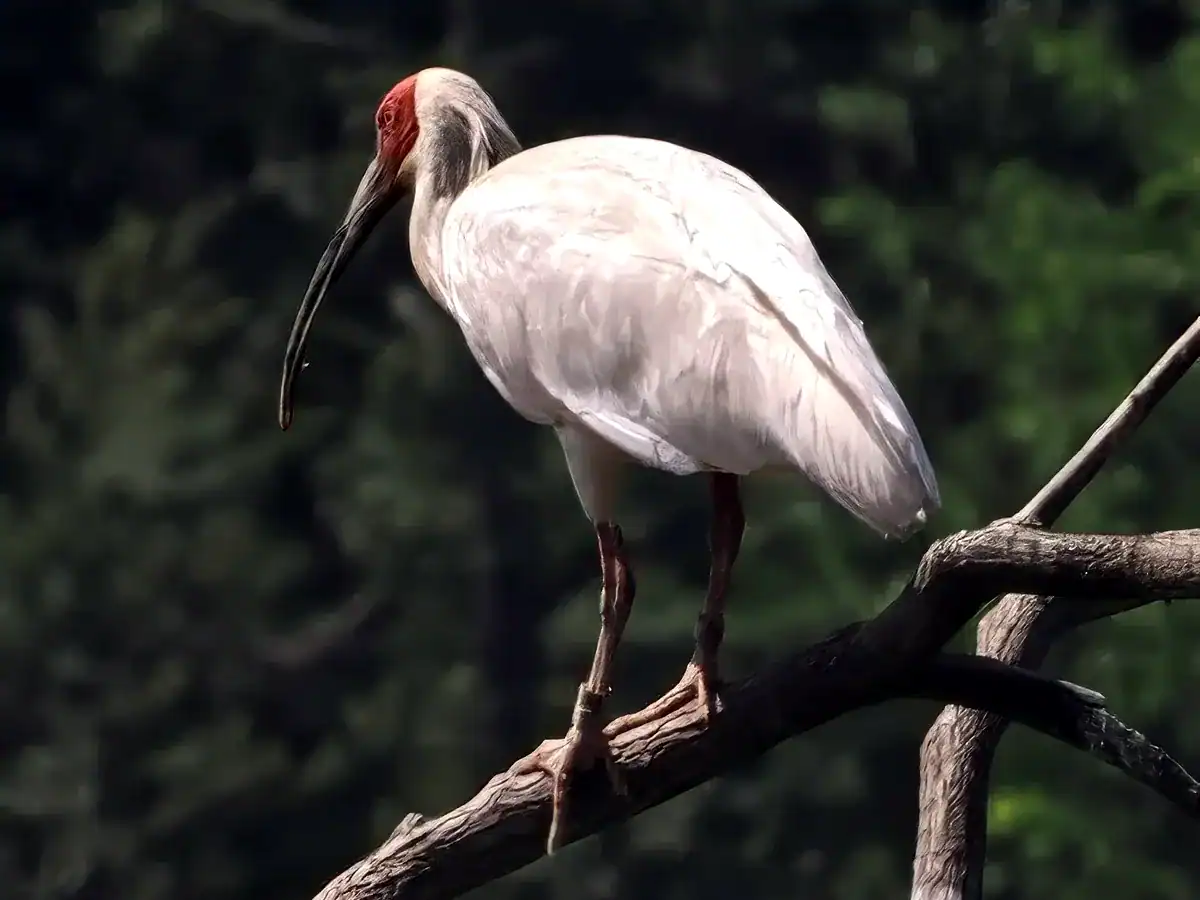
The Crested Ibis is named twice over for Japan. The genus means Japan. The species epithet means Japan. Japan is exactly where it died out.
- IUCN lists the Crested Ibis as Endangered. It measures about 76 cm (30 in) and weighs around 1,900 g (4.2 lb). The plumage is white to pale gray washed with salmon pink, and the face is bare and red, under a red crown and a shaggy crest. The long black bill is tipped red. The bird feeds in paddy fields, streams and marshes, and nests in tall trees on wooded hillsides above them. Its recovery is inseparable from how those paddies are managed.
- Japan’s Crested Ibis timeline is stark. The bird was protected in 1908 and declared extinct in 1926 after uncontrolled hunting. It was rediscovered on the Noto Peninsula in 1929 and on Sado Island in 1931. Japan’s Ministry of the Environment records that in January 1981 the last five wild birds were captured, ending the wild population.[36] The last Japanese-born bird, a female named Kin, died in 2003, ending the native genetic line.
- China’s timeline starts in the same year. In 1981, surveyors found seven crested ibises at Yaojiagou village in Yangxian county, Shaanxi, on the edge of the Qinling Mountains.[37] Those seven are the ancestors of every crested ibis alive today.
- The Crested Ibis recovery since then is one of the largest in bird conservation. China banned blasting, excavation, and the use of pesticides and chemical fertilizer around the birds, and put breeding sites under 24-hour monitoring. China’s government reported a 2023 survey putting the global population above 11,000 birds, with more than 7,700 in Shaanxi.
- Japan started over with Crested Ibises from China. Two birds, You-you and Yang-yang, arrived as a gift in 1999. The first release of 10 birds took place on Sado Island on September 25, 2008. Sado passed 60 settled birds in 2012 and 220 in 2018. By 2021 the wild population stood at 325, made up of 277 released birds and 48 hatched in the wild. From 2008 through 2021, 429 birds were released in 25 groups.
- South Korea began Crested Ibis releases at the Upo Wetlands in May 2019 with 40 birds. By the seventh release, on May 4, 2023, a total of 270 had been set free.
- One more oddity is worth noting: the crested ibis does not molt into breeding plumage. It manufactures the color, smearing itself gray with a secretion during the breeding season.
- Coenraad Jacob Temminck described the Crested Ibis in 1835.
White-shouldered Ibis
| Kingdom | Order | Family | Genus | Species |
|---|---|---|---|---|
| Animalia | Pelecaniformes | Threskiornithidae | Pseudibis | Pseudibis davisoni |
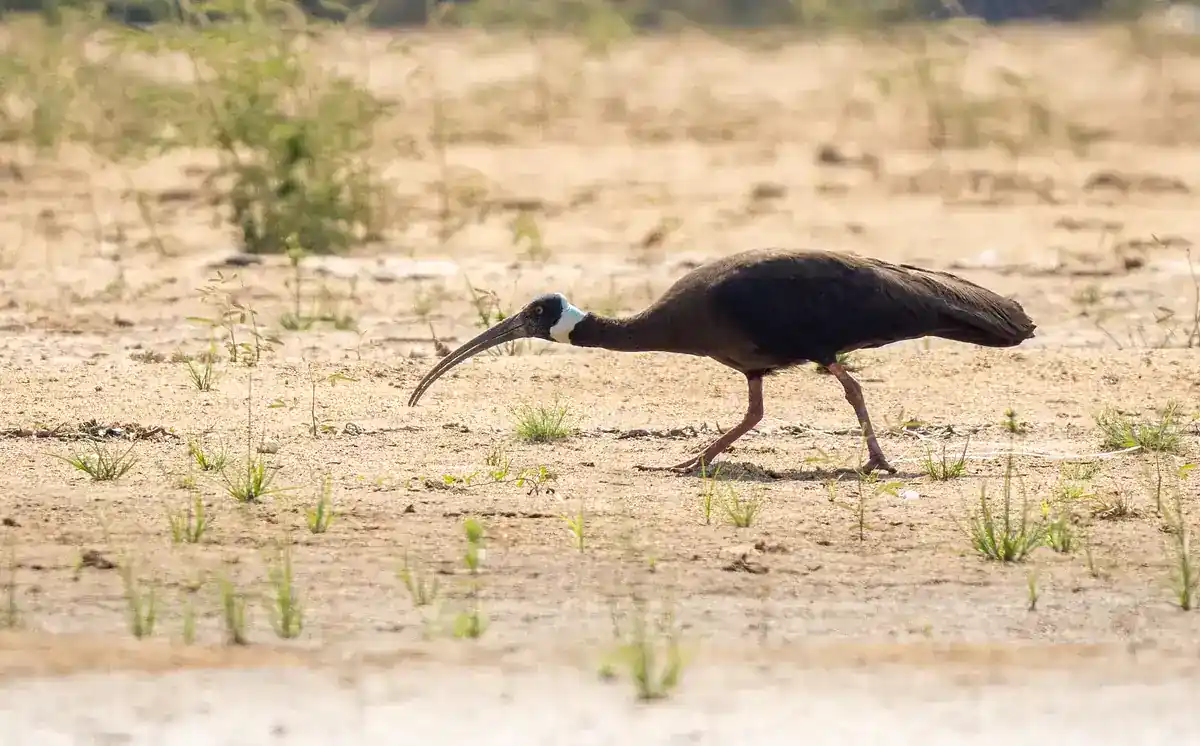
The White-shouldered Ibis is the Giant Ibis’s neighbor and shares its problems, including a Critically Endangered listing. WWF gives its length as 75 to 85 cm (30 to 33 in) and its weight as 0.95 to 1.6 kg (2.1 to 3.5 lb). It is uniformly dark. Bare blue skin covers the mid hindcrown and nape. Below it sits a bold white collar that reaches around beneath the ear coverts. A white patch on the inner wing coverts gives the bird its name.
- The White-shouldered Ibis historical range ran from southwestern China through Myanmar and peninsular Thailand into Indochina. Cambodia now holds most of the global population, with small numbers surviving in southern Laos and on Kalimantan in Indonesia. In Cambodia it lives in dry dipterocarp forest, the same seasonal-pool system the Giant Ibis uses. It breeds solitarily between December and April, nesting in the dipterocarp canopy during the dry season.
- White-shouldered Ibis numbers are better than they were. BirdLife put the world population at 650 mature individuals in 2010. Cambodia’s Ministry of Environment ran a census in 2021 with WCS and WWF, counting four times a month from July to October. It produced a global estimate of about 1,000 birds, of which 670 are mature. The highest single count was 754 in August 2021, with 373 at Siem Pang Wildlife Sanctuary and 252 at Sambo.[19] Counts had been under 500 in 2015 and 2016, so the trend is up.
- The White-shouldered Ibis census took six organizations working simultaneously: Cambodia’s Ministry of Environment, NatureLife Cambodia, the Wildlife Conservation Society, WWF, the Angkor Centre for Conservation of Biodiversity and Rising Phoenix.
- The most interesting piece of the White-shouldered Ibis conservation work is economic. IBIS Rice pays farmers a premium for organically grown rice in exchange for a commitment not to hunt, log or clear forest. Farmers also report sightings of priority species in their fields. The model started at Western Siem Pang and was extended to Lomphat Wildlife Sanctuary.
- Allan Octavian Hume described the White-shouldered Ibis in 1875, in his own journal Stray Feathers, under a section headed “Novelties.”
Red-naped Ibis
| Kingdom | Order | Family | Genus | Species |
|---|---|---|---|---|
| Animalia | Pelecaniformes | Threskiornithidae | Pseudibis | Pseudibis papillosa |
The Red-naped Ibis is the counterweight to everything above. Same genus as the Giant Ibis. Roughly ten thousand times as many birds.
- The first field-based Red-naped Ibis population estimate, published in the IUCN specialist group’s bulletin in 2022, put it at 1.75 to 2.5 million birds. Set that beside the Giant Ibis’s 194 mature individuals and you have two species in one genus separated by four orders of magnitude.
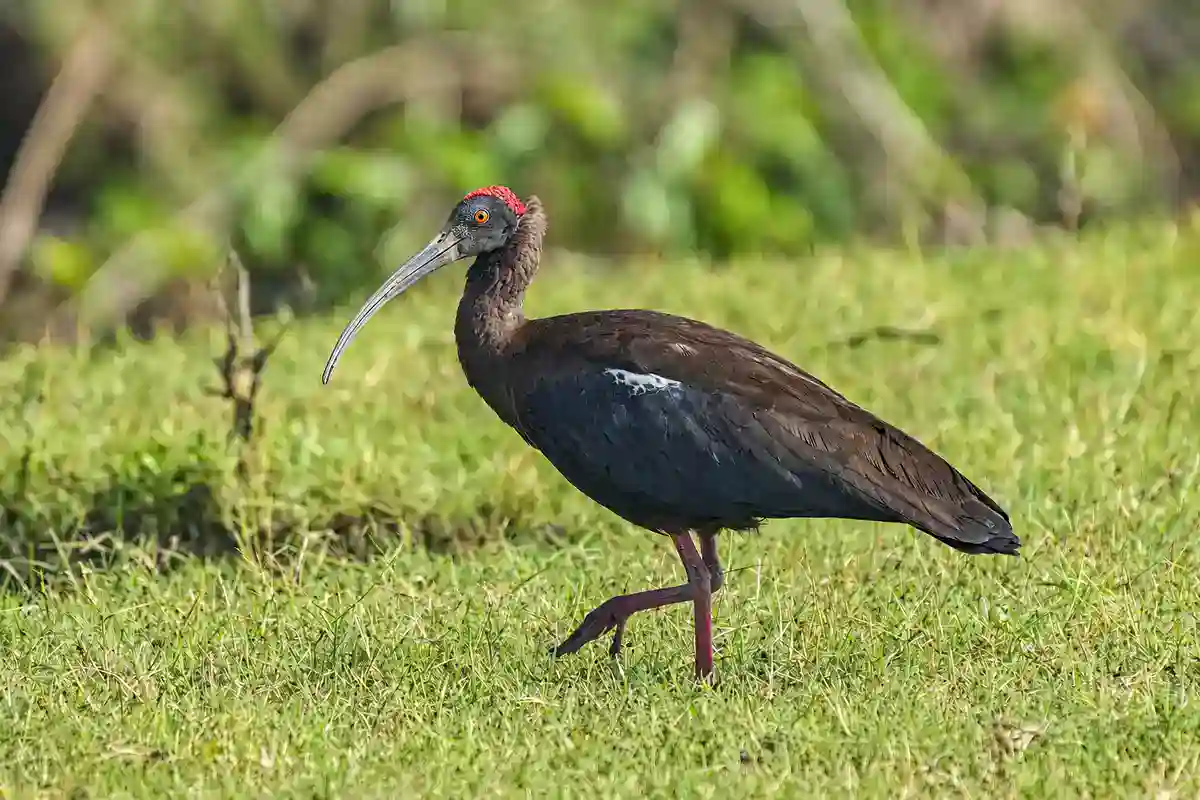
- The Red-naped Ibis is a large dark bird, named for the bare red patch on its nape and hindcrown. It lives in the semiarid lowlands of India and Pakistan, and it is emphatically not a marsh bird. Researchers have recorded it in stubble fields, freshly plowed ground, flooded grassland, sand dunes, wastewater sites and garbage dumps. It nests singly, on eucalyptus in farmland, on neem and peepal trees in and around small cities, and beside village ponds. Nesting on power lines is a recent development.
- The 2022 Red-naped Ibis review also recorded a string of firsts. Its authors call the species one of the least studied birds in the world. The list includes the first record of nectar feeding in any ibis, along with regular colonial nesting in a village. It also covers preying on pigeons and their eggs, feeding on food waste in small towns, and fishing.
- The Red-naped Ibis names are worth keeping. British hunters in India called it the king ibis, the black curlew and the king curlew. Because it ate large numbers of crickets and grasshoppers in indigo fields, planters called it the planter’s friend. It also carries a long list of South Asian names, including Anril in Tamil, Kala Buza in Hindi and Kalakantak in Sanskrit.
- The Red-naped Ibis was once thought to be the same species as the White-shouldered Ibis, on the strength of how similar they look.
- Coenraad Jacob Temminck described the Red-naped Ibis in 1824. It is the type species of Pseudibis, so it is the anchor of the genus the Giant Ibis has now joined.
Black-headed Ibis
| Kingdom | Order | Family | Genus | Species |
|---|---|---|---|---|
| Animalia | Pelecaniformes | Threskiornithidae | Threskiornis | Threskiornis melanocephalus |
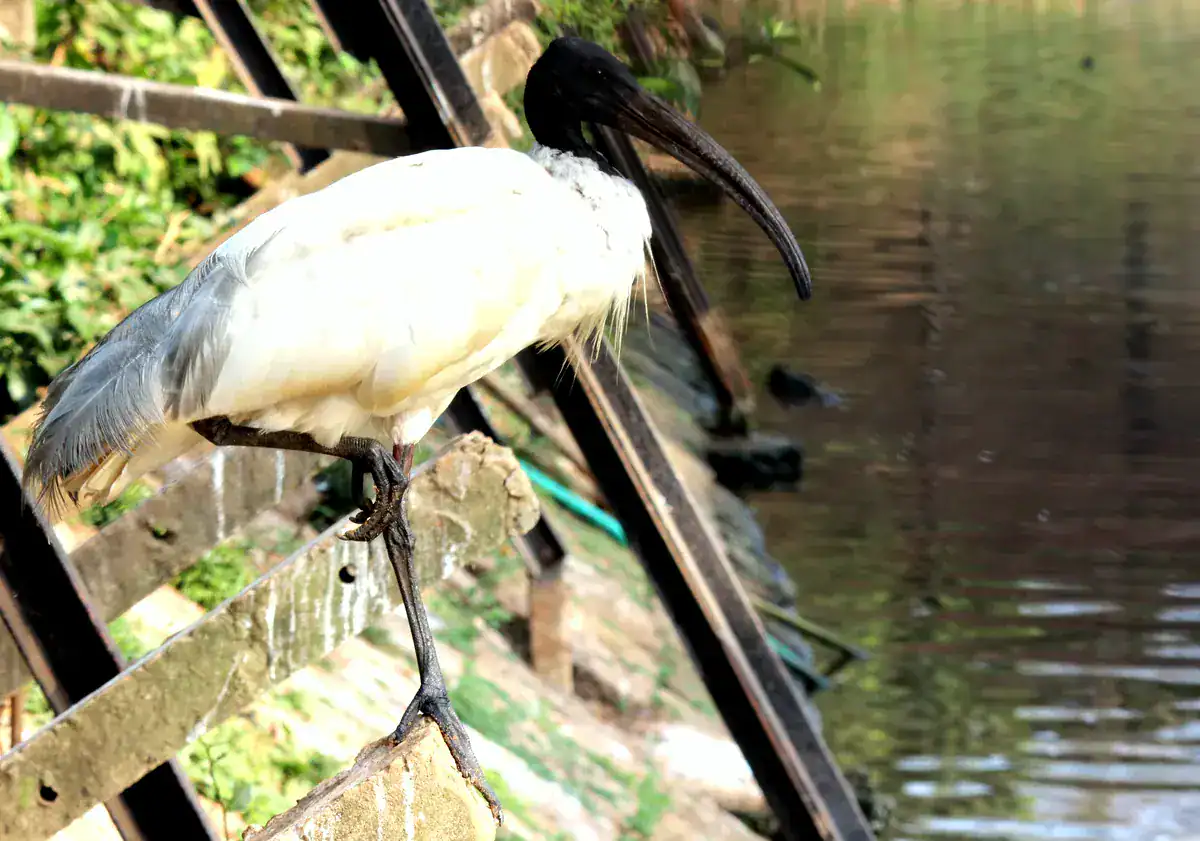
The Black-headed Ibis may be the only bird in this guide whose recovery is owed to irrigation engineering.
- The Black-headed Ibis is white-bodied, with a bare black head and neck and a long black downcurved bill. It ranges from India across southeastern Asia and winters in eastern China, Sumatra and the Philippines, using wetlands and irrigated farmland.
- BirdLife’s reviewers downlisted the Black-headed Ibis to Least Concern on May 20, 2024, on an estimate of more than 400,000 birds in South Asia supplied by the ornithologist K. S. Gopi Sundar.[16] The reviewers credited the expanding irrigation canal network across the region. In Kerala the species went from nearly absent in 1993 to hundreds and sometimes thousands by 2014. It now occupies a larger area than previously recorded, including urban wetlands in Pune, Bhopal and Bangalore. The reassessment also corrected data that had been used incorrectly before.
- Local Black-headed Ibis declines still happen where wetlands dry out. They affect breeding success in particular places rather than the range as a whole.
- John Latham described the Black-headed Ibis in 1790, in the same work and the same year in which he described the African Sacred Ibis.
Australian Ibises
Three ibis species occur in Australia. Two of them are covered here, and they have gone in opposite directions: one moved to town and the other stayed on the farm. The third, the globally distributed Glossy Ibis, appears with the American species above.
Australian White Ibis
| Kingdom | Order | Family | Genus | Species |
|---|---|---|---|---|
| Animalia | Pelecaniformes | Threskiornithidae | Threskiornis | Threskiornis molucca |
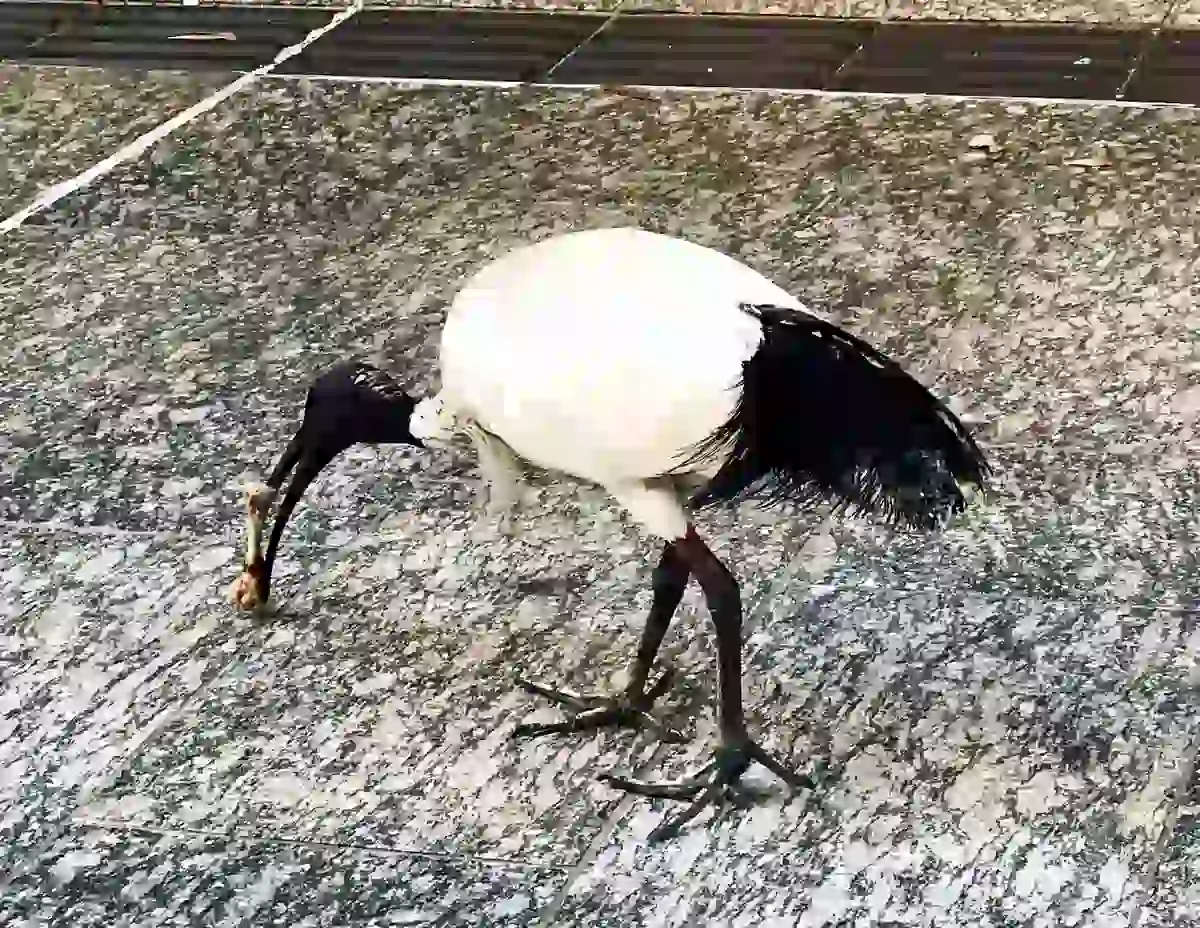
The Australian White Ibis is the bird Australians call the bin chicken, and the relationship is more complicated than the nickname suggests.
- New South Wales wildlife guidance gives the Australian White Ibis 65 to 75 cm (26 to 30 in) and a wingspan up to 1.25 m. Males weigh 1.7 to 2.5 kg and females 1.4 to 1.9 kg. The body is white and the head and neck are bare and black, with a long black downcurved bill. In the breeding season the bare skin under the wing turns from dull pink to dark scarlet. Young birds have black feathers on the neck instead of bare skin. Flocks fly in V formation.
- The Australian White Ibis is naturally an inland waterbird, feeding on wetland invertebrates and fish. Drought through the 2000s and habitat loss then pushed inland populations down and coastal city populations up, as the birds moved toward reliable water and food. Western Australia’s wildlife department notes that year-round water and food in cities let ibises breed continuously instead of seasonally. Urban colonies now sometimes run to hundreds of nests and thousands of birds.
- Australian White Ibis nicknames followed. Tip turkey. Dumpster chook. Most commonly, bin chicken.
- Public feeling has since shifted. The Australian White Ibis was runner-up in the 2017 Bird of the Year vote. It was among the top ten most commonly seen backyard birds in 2019. A 2024 study analyzed 68 Australian newspaper items published between 2013 and 2024. Pest and victim framings had dropped sharply. Two new narratives, survivor and hero, made up 44 percent of the coverage.
- BirdLife Australia notes that Australian White Ibis populations in the natural range are declining even as urban numbers grow, so the urban boom is not the whole picture.
- Georges Cuvier described the Australian White Ibis in 1829, from a specimen from the Moluccas, which is why an Australian bird carries an Indonesian island name. Cuvier turns up again later in this article, for a very different reason.
Straw-necked Ibis
| Kingdom | Order | Family | Genus | Species |
|---|---|---|---|---|
| Animalia | Pelecaniformes | Threskiornithidae | Threskiornis | Threskiornis spinicollis |
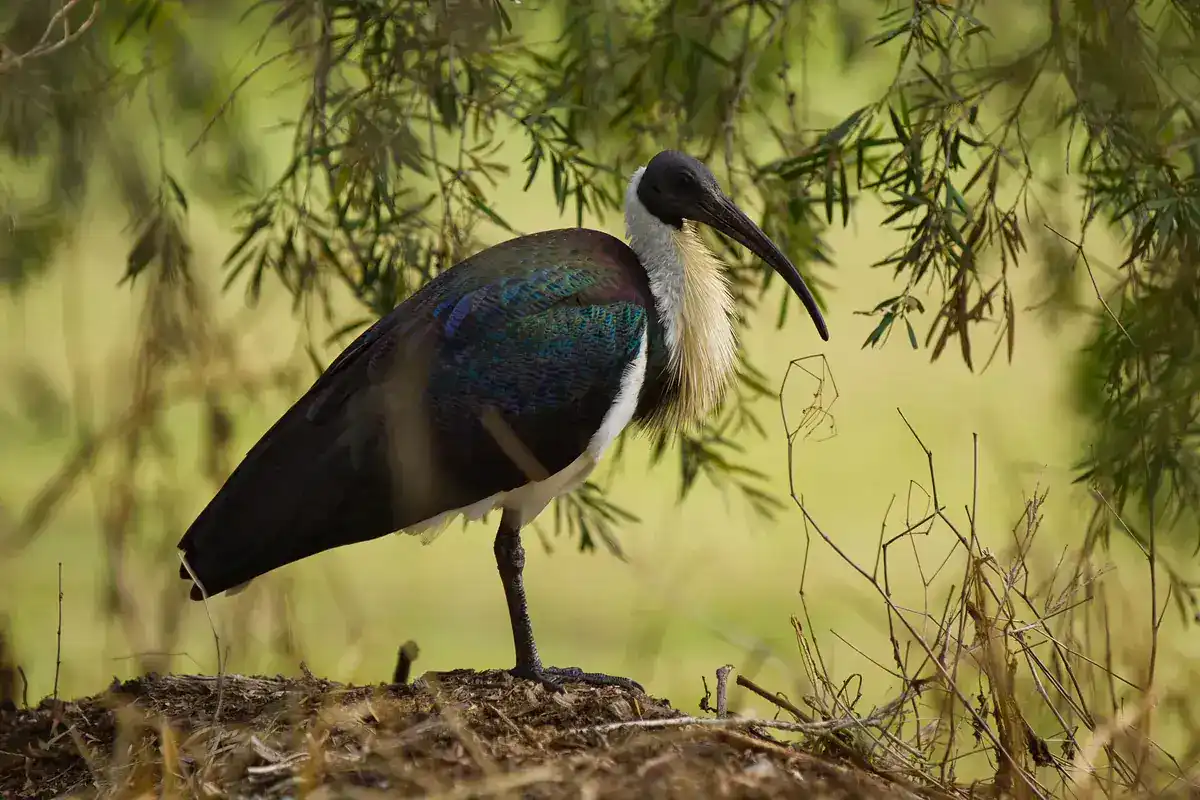
The Straw-necked Ibis is the one Australian farmers actually want. Its nickname is the Farmer’s Friend, and it earned that name by eating grasshoppers and locusts.
- The Straw-necked Ibis measures 60 to 70 cm (24 to 28 in) and weighs 1.1 to 1.5 kg (2.4 to 3.3 lb). The back and wings are glossy blue-black with a purple, green and bronze sheen. Underneath it is white, with a bare black head and red legs. The field mark is the set of stiff, straw-like plumes on the foreneck, which is where both the common name and the scientific name come from.
- Separating it from the Australian White Ibis is easy. The white ibis has a white body and a black bare head. The straw-necked ibis has a dark iridescent back, white underparts and those neck plumes.
- The Straw-necked Ibis uses wet and dry grassland, pasture, cropland and swamp margins, and it is rarely seen on the coast or in mangroves. But it needs flooded wetland to breed. Australia’s environment department is explicit that flooding provides optimal breeding conditions and that keeping water levels up through the breeding cycle is essential for chick survival.
- Two numbers show what kind of bird the Straw-necked Ibis is. A breeding group can hold more than 100,000 nests, and one tracked individual traveled over 3,500 km. It crosses a continent to find a flood, then breeds in very large colonies once it gets there.
- The Macquarie Marshes in New South Wales are one of the few remaining Australian sites supporting large straw-necked ibis breeding colonies. They routinely hold more than 20,000 waterbirds, and more than 500,000 in large floods.
- Robert Jameson described the Straw-necked Ibis in 1835, from the Murray River in New South Wales.
The Extinct Ibis
Reunion Ibis
| Kingdom | Order | Family | Genus | Species |
|---|---|---|---|---|
| Animalia | Pelecaniformes | Threskiornithidae | Threskiornis | Threskiornis solitarius |
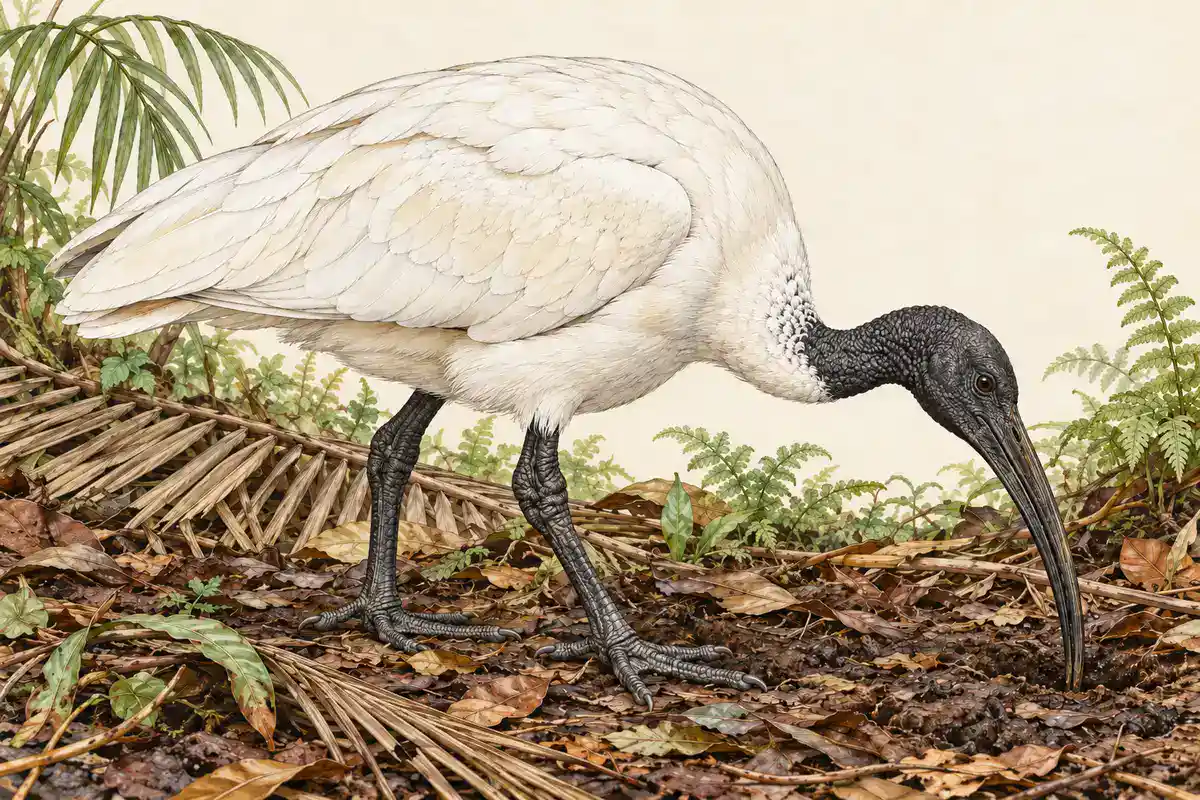
The Reunion Ibis was last reported around 1715, which puts it on the long list of extinct birds. For roughly 150 years, science filed it as a dodo.
No photograph of this bird exists and none ever will. The picture above is an illustration, reconstructed from subfossil bones and one seventeenth-century eyewitness account.
The confusion is baked into the name. Michel Edmond de Selys Longchamps formally described the bird in 1848, inside a paper about Strickland’s dodo monograph. He put it in a genus called Apterornis, meaning wingless bird.
He had no bones. He was working from travelers’ accounts.
The error had a specific source. A genre of seventeenth-century Dutch paintings showed a white dodo. Travelers to Reunion had reported a large, pale, approachable ground bird they called the solitaire.
In 1869 Alfred Newton matched the two and produced the white dodo of Reunion. The evidential problem is blunt: none of the paintings attributed to Reunion birds has any supporting documentation.
Bones settled it. Subfossil material was recovered from five sites on the island, mostly around Saint-Paul in the northwest. It includes coracoids, humeri, ulnae, tibiotarsi, tarsometatarsi, mandibles and foot bones, from adults and juveniles.
The deposits produced abundant remains of an ibis and not one bone of any dodo-like bird.[23] That absence is the decisive evidence. The 1995 note that announced the result asked the question in its title: was the solitaire of Reunion an ibis?
The bones say more.[24] This was a heavily built bird for an ibis, but its wing elements indicate near-normal flying ability.
So the old accounts of a bird that stood about and was easy to catch describe behavior rather than anatomy. It was not one of the truly flightless birds, and it was probably still capable of flight.
The most useful eyewitness is Dubois, who spent 16 months on Reunion in 1671 and 1672. He described a beak like a woodcock’s but larger, and a bird that fed on worms and filth taken on or in the soil. That is probing, which is what an ibis does and what a dodo does not.
One more wrinkle followed. When the bone material was first described in 1987 it was given a new name, Borbonibis latipes. Once researchers recognized it as the same animal as the solitaire, the 1848 epithet took priority, and the bird became Threskiornis solitarius.
Ibises in the US
Three ibis species breed in the United States. The Roseate Spoonbill breeds here too, but it is a spoonbill, not an ibis. The Scarlet Ibis is South American, and the birds you may see in Florida are escapees, descendants of an old introduction, or hybrids.
American White Ibis breeds across the Southeast, with Florida and the Gulf Coast at the center. Glossy Ibis breeds along the Atlantic and Gulf coasts. White-faced Ibis breeds in the interior West and across the Great Plains.
The American White Ibis is the one scientists monitor most closely, because it works as a gauge for the Everglades.
A century of drainage changed which birds could make a living. Egrets hunt by sight in deeper water, so they did relatively well. Ibises and wood storks feed by touch and need prey concentrated into shallow drying pools, so they became proportionately much less common.
That makes ibis nesting a direct readout of whether water management has restored the natural wet and dry rhythm.
The numbers are dramatic. Coastal colonies in the southern Everglades held over 100,000 nests in the 1930s. Recent decades have typically produced fewer than 5 percent of that.
In 2018, extensive flooding of seasonal wetlands produced a crayfish boom, and the birds responded. Coastal colonies in Everglades National Park went from 1,075 nests in 2017 to 30,420 nests in 2018, the highest in 87 years. The South Florida Water Management District recorded 138,834 wading bird nests across the region that season, of which 100,784 were White Ibis, about 73 percent of every nest counted.[28]
It did not last. The 2022 season produced 52,532 nests in total, including 31,848 White Ibis nests.[29] The 2023 season produced 46,174 nests in total, including 22,003 White Ibis nests.
The honest reading is mixed. White Ibis, Great Egret and Wood Stork have met their Comprehensive Everglades Restoration Plan nest-count targets on a three-year running average. But the spatial target is being missed badly.
The plan calls for 50 percent of nests to be in the coastal Everglades, matching the historic pattern. The actual figures were 32.8 percent in 2018, 14 percent in 2022 and 23 percent in 2023.
Still, the direction is right. Before restoration work began in the 1980s and 1990s, the Everglades routinely saw only about 5,000 nests regardless of the weather.
Out west, the White-faced Ibis story runs through Great Salt Lake. The Western Hemisphere Shorebird Reserve Network puts its breeding population at roughly 27,000 adults, one of the largest anywhere.[31]
Great Salt Lake is shrinking, and the remote-touch research above suggests why that matters twice over. Drier ground holds less prey, and it transmits the vibrations detected by a probing bill less effectively.
Sacred Ibis Mummies
Ancient Egypt mummified ibises on an industrial scale. The numbers are hard to take in.
A 2019 study led by Griffith University researchers puts roughly 1.75 million ibis mummies at Saqqara, deposited at about ten thousand a year.[10] Tuna el-Gebel holds approximately four million, the largest known assemblage of birds anywhere.
Abydos and Thebes hold further burials. The votive mummies are stacked floor to ceiling along kilometers of catacombs.
The birds were offerings to Thoth, the god of writing, scribes, wisdom, time and justice. A prayer was made, a bird was mummified, and the mummy was deposited. A rarer second kind came from ibises that lived in temples as incarnations of the god and were mummified after dying naturally.
The practice ran from the Twenty-Sixth Dynasty through to the early Roman period, and radiocarbon dating shows it peaked between 450 and 250 BC.
That raises an obvious question. Where did millions of birds come from?
The textual evidence pointed to farming. The archive of the priest Hor of Sebennytos, from the second century BC, describes the regular feeding of about 60,000 sacred ibises on clover and bread.
A 2019 study tested it genetically. Researchers sequenced 14 complete mitochondrial genomes from mummies roughly 2,500 years old, taken from Saqqara, Tuna el-Gebel and Sohag. They compared them with 26 modern sacred ibises from ten locations across Africa.
The logic of the test is clean. Long-term captive breeding from a small founder stock leaves fingerprints.
Diversity drops. Birds from different catacombs start to look genetically distinct from one another, because each site is breeding its own closed flock. And mildly harmful mutations build up, because captive birds are shielded from the pressures that would weed them out.
None of that showed up. Diversity in the ancient birds was not significantly different from diversity in modern African populations. The measure of harmful mutation buildup was not significantly different either.
Birds from different catacombs were not genetically distinct.
The conclusion was that the Egyptians were not running a centralized breeding industry. The authors describe it as a sustained short-term taming of wild migratory sacred ibises, to meet the annual ritual demand. Birds were tended in natural habitats or in small local facilities, possibly for a single season.
The study rules out large-scale long-term farming, but it does not say the Egyptians never kept ibises at all.
The mummies had one more use. Ibis mummies were carried back to Paris and presented to the French Academy around 1802. Georges Cuvier measured the 3,000-year-old birds against modern ones, found no measurable difference, and used the result as evidence that species do not change.[11]
Jean-Baptiste Lamarck replied that 3,000 years was far too short a span, especially in a stable environment. That dispute began in 1802 and was separate from the better known 1830 debate between Cuvier and Geoffroy Saint-Hilaire, which was about animal structure rather than ibises.
A mummified ibis was the first specimen ever used to test whether species evolve. And the man who did the measuring, Cuvier, is the same man who described the Australian White Ibis in 1829.
The bird Cuvier measured no longer lives in Egypt at all.
Rarest Ibises
Of the 29 living ibis species, seven are threatened: three Critically Endangered, three Endangered and one Vulnerable. Two more are Near Threatened. Roughly one ibis in three is in some degree of trouble, and one more, the Reunion Ibis, is already gone.
| IUCN Status | IBIS Species |
|---|---|
| Critically Enangered | Giant Ibis, White-shouldered Ibis, Sao Tome Ibis |
| Enangered | Crested Ibis, Northern Bald Ibis, Malagasy Sacred Ibis |
| Vulnerable | Madagascar Ibis |
| Near Threatened | Southern Bald Ibis, Andean Ibis |
| Least Concern | American White Ibis, Scarlet Ibis, Glossy Ibis, White-faced Ibis, Puna Ibis, Black-faced Ibis, Buff-necked Ibis, Plumbeous Ibis, Green Ibis, Bare-faced Ibis, Sharp-tailed Ibis, Hadada Ibis, African Sacred Ibis, Wattled Ibis, Olive Ibis, Spot-breasted Ibis, Red-naped Ibis, Black-headed Ibis, Australian White Ibis, Straw-necked Ibis |
| Extinct | Reunion Ibis |
The Giant Ibis in particular belongs among the rare birds of all time. But the trouble is not spread evenly. It concentrates in Southeast Asia, Madagascar, the Gulf of Guinea islands and North Africa.
Meanwhile the widespread generalists are doing fine or expanding: Glossy, White-faced, American White, African Sacred, Hadada, Australian White, Straw-necked and Black-headed.
Four threats come up again and again, and each is a standard problem in conservation biology.
Wetland drainage is the most general. The Convention on Wetlands reports that more than 400 million hectares have disappeared since 1970, at an average of about 0.52 percent a year. It hits touch-feeders hardest, because drying reduces both the prey and the vibratory cues they give off.
Hunting and egg collection threaten the Cambodian species and the Sao Tome Ibis, and they contributed heavily to the Northern Bald Ibis collapse.
Pesticides and contaminants crashed the Turkish bald ibises in 1959 and 1960 and helped crash the Crested Ibis. There is also a well-controlled US result worth knowing. American White Ibises were dosed for three years with methylmercury at concentrations wild birds routinely encounter.[26] Male-male pairing rose with the dose, reaching 55 percent of males at the high end. Courtship declined. Fledgling production fell by 35 percent. The authors called contaminant effects on sexual preference a probably under-reported mechanism.
Forest loss is the threat readers will not expect from a family they think of as wetland birds. It is what endangers the Sao Tome Ibis, the Madagascar Ibis, the Giant Ibis and the White-shouldered Ibis.
Agriculture cuts both ways. The Crested Ibis depends on rice fields kept flooded through the winter, a traditional practice now being abandoned. Irrigation and lawns, meanwhile, have helped both the Hadada Ibis and the Black-headed Ibis expand.
Morocco’s wild Northern Bald Ibis population went from 59 breeding pairs in 1996 to at least 750 birds by 2025, with one 2025 estimate exceeding 800, and the species moved from Critically Endangered to Endangered in 2018. The Crested Ibis went from seven birds in a Chinese village in 1981 to more than 11,000. Neither was luck. Both took decades of specific, unglamorous work.
Smallest and Largest
The Giant Ibis is the largest, at 102 to 106 cm (40 to 42 in). One male specimen weighed about 3,515 g (7.7 lb), which is heavier than any other ibis on record.
At the small end, several species cluster around 50 cm (20 in), including the Bare-faced Ibis and the Madagascar Ibis. Which one is genuinely smallest is unresolved, because the published measurements are not comparable.
One caveat matters here. No single source measures all 29 species the same way, and published lengths for several South American ibises follow different conventions. The table below uses only figures from authorities that state a conventional total length.
| Species | Length | Weight |
|---|---|---|
| Giant Ibis | 102 to 106 cm (40 to 42 in) | about 3,515 g (7.7 lb), one male |
| African Sacred Ibis | 65 to 89 cm (26 to 35 in) | about 1,500 g (3.3 lb) |
| Northern Bald Ibis | 70 to 80 cm (28 to 31 in) | 1.0 to 1.3 kg (2.2 to 2.9 lb) |
| Hadada Ibis | about 76 cm (30 in) | about 1.25 kg (2.8 lb) |
| Buff-necked Ibis | about 74 cm (29 in) | 1,726 g mean (1,550 to 1,950 g, n=5) |
| Crested Ibis | about 76 cm (30 in) | about 1,900 g (4.2 lb) |
| Scarlet Ibis | 55 to 76 cm (22 to 30 in) | 0.9 to 1.4 kg (2 to 3 lb) |
| White-shouldered Ibis | 75 to 85 cm (30 to 33 in) | 0.95 to 1.6 kg (2.1 to 3.5 lb) |
| Australian White Ibis | 65 to 75 cm (26 to 30 in) | males 1.7 to 2.5 kg, females 1.4 to 1.9 kg |
| Straw-necked Ibis | 60 to 70 cm (24 to 28 in) | 1.1 to 1.5 kg (2.4 to 3.3 lb) |
| American White Ibis | 56 to 68 cm (22 to 27 in) | 750 to 1,050 g (1.7 to 2.3 lb) |
| Glossy Ibis | 48 to 66 cm (19 to 26 in) | 530 to 768 g (1.2 to 1.7 lb) |
| Wattled Ibis | about 60 cm (24 in) | about 1.28 kg (2.8 lb) |
| Green Ibis | about 57 cm (23 in) | 756 g mean (670 to 865 g, n=7) |
| Puna Ibis | about 60 cm (24 in) | males 657 g mean, females 511 g mean (n=3 each) |
| White-faced Ibis | 46 to 56 cm (18 to 22 in) | 450 to 525 g (1 to 1.2 lb) |
| Bare-faced Ibis | about 50 cm (20 in) | 559 g mean (512 to 600 g, n=4) |
| Madagascar Ibis | about 50 cm (20 in) | no robust wild mass found |
The weights above come from the specialist sources named through this guide and from the AVONET trait database. Several also come from the CRC Handbook of Avian Body Masses, which compiles museum and field measurements. Published lengths for several South American species follow inconsistent conventions and are left out of this table rather than mixed in.
Ibises in Formation
One last piece of research is worth adding.
Northern Bald Ibises flying in a V do not just sit in the right place.[25] A 2014 study found they position themselves in aerodynamically optimal spots.
They then flap spatially in phase with the bird ahead. Each wingtip traces a path that captures the upwash through the entire flap cycle.
And when a bird flies directly behind another instead of off to the side, the pattern reverses. The wingbeats shift into anti-phase, which reduces the effect of the downwash coming off the bird in front.
The researchers said plainly that this was not thought possible for birds. It implies the ibis is aware of, or can predict, the shape of the air coming off its flockmates.
The measurements were possible because the birds were part of the European reintroduction program. The species had been gone from Europe for roughly 400 years, so there were no adults left to teach the migration route. Hand-raised chicks learn it by following a microlight flown by their human foster parent.
That is also how researchers came to fly alongside a formation with instruments on every bird.
Frequently Asked Questions
There are 29 living ibis species, in 12 genera. A 30th, the Reunion Ibis, went extinct around 1715. Five separate authorities agree on the count: AviList, the IOC World Bird List, Clements, BirdLife International and ITIS.
The Giant Ibis of Cambodia, at 102 to 106 cm (40 to 42 in). The latest formal estimate, built in 2014 and published in 2018, put it at fewer than 300 birds.
Several species cluster around 50 cm (20 in), among them the Bare-faced Ibis of South America and the Madagascar Ibis. No single study has measured all 29 the same way, so the ranking at the small end is unresolved.
Yes, three. The American White Ibis breeds across the Southeast, the Glossy Ibis along the Atlantic and Gulf coasts, and the White-faced Ibis across the interior West and Great Plains. The Roseate Spoonbill also breeds here, but it is a spoonbill.
Look at the face. A breeding White-faced Ibis has a band of white feathers that goes completely around the bare face, including behind and below the eye, and its eye is red. The Glossy Ibis has no white feathering, only a thin pale blue line of bare skin that runs toward the eye and stops. Its eye is dark brown. In nonbreeding and first-winter plumage the two often cannot be separated at all.
No. Ibises are in the family Threskiornithidae, in the order Pelecaniformes, along with pelicans, herons, the hamerkop and the shoebill. Storks sit in a separate order, Ciconiiformes.
Not in common usage, but the family tree is messier than the names suggest. All six spoonbills belong to one genus, Platalea, and they are each other’s closest relatives. That group sits inside the ibis part of the tree, which means some ibises are more closely related to spoonbills than to other ibises.
Mostly invertebrates they locate by touch. American White Ibises in Florida eat crayfish above everything else, at 51 percent of the diet by weight. Giant Ibises take frogs, eels and earthworms. Southern Bald Ibises in one Free State study fed mainly on maize stalk borer larvae and adult beetles. Straw-necked Ibises eat grasshoppers and locusts. African Sacred Ibises will eat almost anything, including the eggs and chicks of other birds.
Through sensory pits at the tip of the bill. Each pit holds a cluster of pressure receptors called Herbst corpuscles, wired to the trigeminal nerve. The bird detects vibrations from moving prey, and pressure changes around stationary hard-shelled prey. Researchers call it remote touch, and it works far better in wet soil than dry.
Seven of the 29 living species are threatened, and two more are Near Threatened. The Giant Ibis, White-shouldered Ibis and Sao Tome Ibis are Critically Endangered. At the same time, several widespread species are expanding.
The African Sacred Ibis was linked to Thoth, the god of writing, wisdom, time and justice. Birds were mummified as votive offerings. Researchers estimate that Saqqara holds roughly 1.75 million mummies and Tuna el-Gebel about 4 million. DNA work published in 2019 indicates the birds were wild-caught and briefly tamed rather than bred in a large captive operation.
The Australian White Ibis, an inland waterbird that moved into Australian cities as the interior dried out. The nickname refers to its scavenging. Public feeling has shifted, and it was runner-up in the 2017 Australian Bird of the Year vote.
AviList moved it from Thaumatibis to Pseudibis, on the grounds that keeping it in a genus of its own was not justified. The committee’s own decision summary adds that genetic data would be informative, which is to say no genetic study underpins the change. The combination Pseudibis gigantea is also not new, and was used by serious sources a generation ago.
An ibis hunts what it cannot see. Drain the wet ground and you take away the prey and the signal that betrays it, both at once.
Cite this page
BioExplorer. (2026, September 26). All 29 Ibis Species, From the Bare-Faced Ibis to the Giant Ibis. https://www.bioexplorer.net/animals/birds/ibises/
About the author